

“Baseball’s Union Association: The Short,
Strange Life of a 19th-Century Major League”
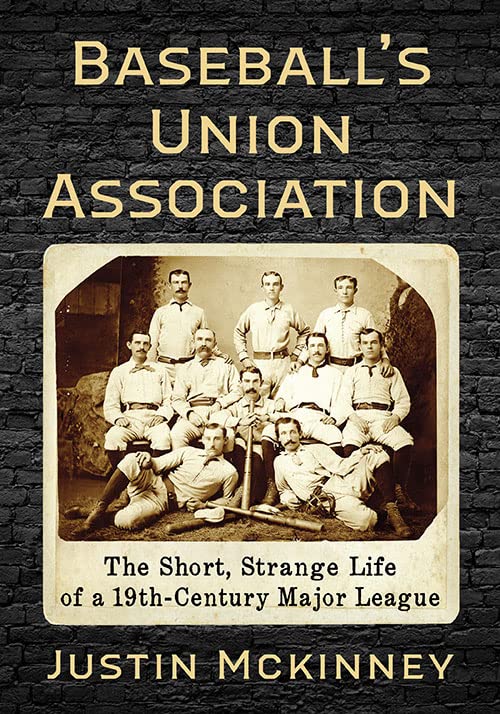
The author:
Justin McKinney
The publishing info:
McFarland
277 pages, $49.95
Released Nov. 11, 2022
The links:
The publishers website
At Bookshop.org
At Vromans.com
At TheLastBookStoreLA
At Skylight Books
At Target
At BarnesAndNoble.com
At Amazon.com
“Baseball’s Wildest Season:
Three Leagues, Thirty-Four Teams
and the Chaos of 1884″

The author:
William J. Ryczek
The publishing info:
McFarland
273 pages, $45
Released March 10, 2023
The links:
The publishers website
At Bookshop.org
At Powells.com
At TheLastBookstoreLA.com
At Vromans.com
At SkylightBooks.com
At Barnes & Noble.com
At Amazon.com
The reviews in 90 feet or less
More to establish some justice than to insure any sort of domestic tranquility, the imperfect Union Association was formed — or throw together — as Option C for anyone aspiring to play what was considered major-league baseball in 1884, the 14th such season on record for such an enterprise.
It lasted all of one season. These things happen.
For context: Eighteen-hundred and eighty-four was less than 20 years removed from the official end of the Civil War. Chester A. Arthur was sheepishly trying to navigate his way around the White House in the wake of James Garfield’s assassination (and his assassin’s eventual hanging before a live audience as his punishment). The Depression/Recession of 1882-1885 was derailing some of the heralded progress going on during the Gilded Age.
It was a country 140 years ago that was still very short of developing its prefrontal cortex. something still somewhat evident in today’s world.

At baseball-refernece.com, the official existence of all 12 teams (in 13 cities) that came and went in the Union Association, along with details about its 94-19 champion St. Louis Maroons, is rightly placed amidst the data produced by the National League (started in 1876) and the American Association (started in 1882 but exhausting itself in 1891, a decade before the official American League came into being in 1901). This is where you’ll first see the existence of the Milwaukee Brewers, the Boston Reds (sans the Sox) and the Washington Nationals amidst the Wilmington Quicksteps, the Baltimore Monuments and the Cincinnati Outlaw Reds.
It’s where the Legend of Fred Dunlap exists.

St. Louis’ 25-year-old 5-foot-8 second baseman posted his Union-best .412 batting average, 13 homers, 185 hits, 160 runs, .621 slugging percentage and 1.069 OPS in 101 games, which looks practically Hall of Fame worthy. Dunlap, who defected to the Maroons for that 1884 season after playing four seasons for the National Association’s Cleveland Blues, would fade away with the 44-91-4 Washington Statesmen of the American Association in 1891 before dying at age 43, penniless, disabled from an ankle injury. Dunlap was better remembered for being on the 1887 Detroit Wolverines team that won the World Series against St. Louis’ Brown Stockings.
We’ve caught wind of the Players League of 1890. The Federal League of 1914-15. The National Association had also come and gone in the early 1870s. The Continental League, created by Branch Rickey in the late 1950s as a way to force MLB to expand. But anything short of what Bill James had covered in his Historical Baseball Abstract (and making a case the Union League not be recognized as a major league) is the reason why Justin McKinney, inspired by his Society of American Baseball Research brethren, decided to research and document even more about this one-and-done enterprise through newspaper clippings and the Baseball Hall of Fame excavation.
McKinney says his goal from the start is “to convince you that the Union Association is more than just Fred Dunlap, Henry Lucas (the Maroons’ diminutive, free-spending owner and league president), and a debate about league quality. It is about the spiteful magnates, disgruntled superstars, hungry youngsters, drunks, screw-ups, castoffs, anonymities, future stars, never-weres, hangers-on, and fanatics who did battle with the baseball establishment.”
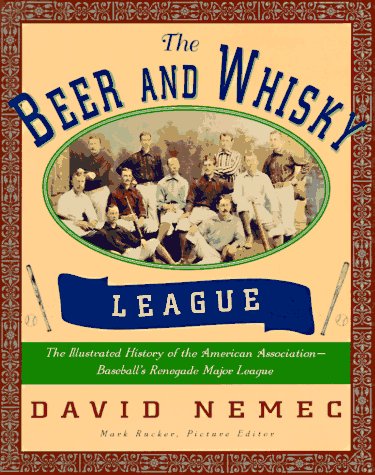
Kind of what David Nemec shows us in 1994 with his “The Beer and Whisky League: The Illustrated History of the American Association, Baseball’s Renegade Major League,” or Edward Achorn did with his 2013 book, “The Summer of Beer and Whiskey: How Brewers, Barkeeps, Rowdies, Immigrants and a Wild Pennant Fight Made Baseball America’s Game,” and even and Robert Ross’ 2016 “The Great Baseball Revolt: The Rise and Fall of the 1890 Players League.”
There is also cause to re-examine the Union League in the wake of seven 20th Century Negro Leagues added to the official MLB database.
“It is worth discussing why the Union Association was granted major league status in 1969,” writes McKinney, noting the push by Al Spink, founder of The Sporting News, and Ernest Lanigan, Spink’s nephew who published the first Baseball Cyclopedia in 1922, including stats he developed called RBIs and caught stealing.
The Union Association came about, as McKinney shows, because of the financial successes of the National League and the American Association in 1883, and some opportunists seeking ways to expand beyond the rule of law in the two co-existing leagues as well as conquering new markets.
As always, follow the money.
The Union Association started with eight teams, ended with 12, and was ready to fall apart after 1884 when Baltimore franchise owner Albert Henderson gave up and stopped paying players. Amidst a bunch of owner squabbles, black-listed players, and the angling for some teams to join other leagues (like Lucas pushing his team into the National League) all amidst the gentleman’s pledge to what was called the National Agreement, the Union Association was not in union with each other. Only four of the 12 teams turned profits, two broke even and the other six struggled as some still couldn’t play on Sundays because of local city rules. “Western cities” such as Columbus, Indianapolis, St. Paul, Detroit, Dayton and Cleveland had been trying to join the Union Association, but it wasn’t going to happen.
McKinney concludes that the Union Association “came a long a year or two too late.” The American Association was two years in, and the National Agreement ensured roster stability and no overlapping with AA and National League markets.
“Eighteen eight-four was also a year with too much baseball, to be frank,” McKinney writes. Consider there were 33 teams considered major players, plus 14 more minor leagues in existence, plus semi-pro, independent and amateur clubs.
“There was simply not enough good baseball players in the country to sustain that many teams,” McKinney writes. Even if many of the headliners continued playing in the other two leagues from 1885 beyond.
“Without photos or accurate records, the Union Association story became codified into a brief narrative. The record books tell one story: cartoonish batting lines, absurd mismatches and remarkable success and futility. The history books have told another, one of a reckless, naïve and generous millionaire (Lucas), loyal to his players to a fault, who bought a winning team but bankrupted himself in the process. The real story is much richer and a whole lot more fun.”

Following up to add even more texture and context on this 1884 chaos, for the same publisher, is William J. Ryczek, a finance professional from Wallingford, Conn., who has previously done “When Johnny Came Sliding Home: The Post-Civil War Baseball Boom, 1865-1870” in 2006, “Baseball’s First Inning: A History of the National Pastime Through the Civil War” in 2009, and “Blackguards and Red Stockings: A History of Baseball’s National Association, 1871-1875” in 2016. He also has a hefty resume on SABR.org worth exploring.
Ryczek acknowledges research for this began in the mid-1990s in libraries but, as often the case now, it can be carried out at home through the access of hundreds of local newspaper archives.
“Those who help with the process have become increasingly anonymous, and I would lake to thank all those who made the digital age possible,” he adds. “For those of us who’ve been researching baseball history for more than four decades, the transformation is miraculous.”
Ryczek notes in Chapter 19 that when the 1884 season ended, “Sporting Life wrote: ‘The past year in base ball has been the most successful period of modern revival. The season opened earlier and lasted longer … It has been a prosperous year for players. Base ball can now be ranked as an established occupation’.”
He also notes that the Baltimore Sun had a story reading: “It is very clear that the base-ball business has been overdone this season.”
Nemec offers this book blurb on Ryczek’s behalf: “The 1884 campaign had it all―three major leagues, the first momentous challenge to the recently created Reserve Clause, the first Black players to openly play big time ball, the first influx of talent all the way from the West Coast, to cite only a few of the things that make 1884 unique. In Baseball’s Wildest Season it’s all there. All the scandals, stars, scoundrels, minor league mountebanks, and hustlers galore. You name your 1884 favorite figure; chances are excellent Ryczek has something new to say about him.”
How it goes in the scorebook
Historical histrionics always work in a baseball book.

Especially when one considers that the Union Association had for more than 100 years kept the MLB record for most strike outs by a pitcher in a nine-inning game – 19, by muttonchopped Hugh “One Arm” Daily of the St. Louis Maroons over the Boston Reds (he had the nickname because he lost his left hand in a gun accident, leaving him with a stumb). It stayed around until Boston’s Roger Clemens had his 20-strike out game in 1986.
And then there was the brief success of Jack Glasscock, an infielder with the NL’s Cleveland Blues who gravitated to the Cincinnati Outlaw Reds of the Union League for 38 games. He hit .419 that season and his 70 hits were enough to push him past 2,000 in his 17-year career that saw him win the 1890 NL batting title (.336 mark) for the New York Giants.
Last April, McKinney was justifiably rewarded with a 2023 SABR Baseball Research Award.
You can look it up: More to ponder
== Podcast: The Good Seats Still Available show with Tim Hanlon.
== MLB historian John Thorn has more research on the Union Association.
== Here are the Wikipedia fall-off-the-cliff notes if it helps as an entry point.
== McKinney does a Zoom interviews for SABR:

 Tom Hoffarth's The Drill: More Farther Off the Wall
1 thought on “Day 17 of 2023 baseball books: Look for the Union label, talking a walk on the wild side of 1884”