
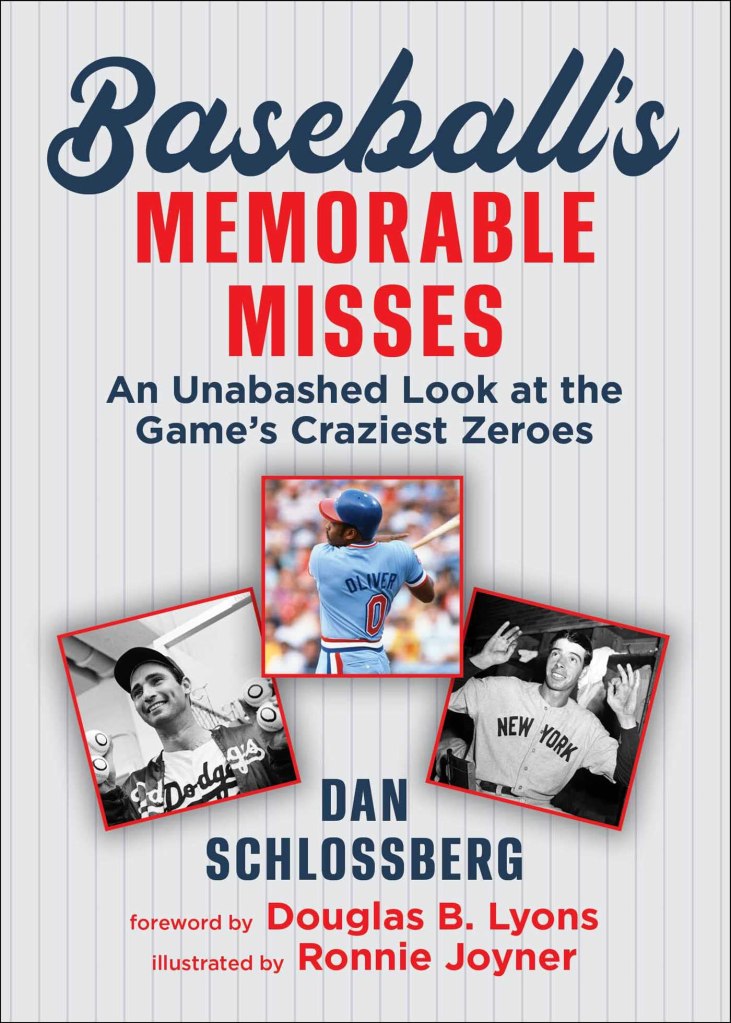
“Baseball’s Memorable Misses:
An Unabashed Look at the Game’s Craziest Zeroes”
The author:
Dan Schlossberg
The publishing info:
Sports Publishing/Skyhorse
208 pages; $15
Released February, 2023
The links:
The publishers website
The authors website
At Bookshop.org
At Target
At BarnesAndNoble.com
At Amazon.com
“The Baseball Maniac’s Almanac:
The Absolutely, Positively and Without Question
Greatest Book of Facts, Figures and
Astonishing Lists Ever Compiled”

The editor:
Bert Randolph Sugar
With Ken Samelson
The publishing info:
Sports Publishing/Skyhorse
480 pages, $19.99
Released April 18, 2023
The links:
The publishers website
At Bookshop.org
At Powells.com
At Vromans.com
At TheLastBookStoreLA
At Skylight Books
At Diesel Books
At Target
At Barnes and Noble.com
At Amazon.com
The review in 90 feet or less
This may be our first baseball book intervention.
When we saw prolific author Dan Schlossberg (with a forward from Doug Lyons) was fleshing out a project of “Famous Zeros” of baseball lore, our attention immediately zeroed into all the opportunities.
The premise is along these lines:

- Nolan Ryan has an MLB record seven no-hitters – in addition to a career-best strikeout total and a Hall of Fame induction. How many Cy Youngs did he win? Zero.
- Roger Clemens has an MLB record seven Cy Young Awards. How many no-hitters did he throw? Zero.
- Kirk Gibson, the 1984 AL MVP and 1988 NL MVP, made how many MLB All-Star teams? Zero.
- How many times did Willie Mays lead the league in RBIs, or Stan Musial lead the league in home runs, despite their prolific career stats in each category? Zero.
- Total World Series appearances for Hall of Famers Ernie Banks, Billy Williams, Ron Santo, Rod Carew, Andrew Dawson, Phil Niekro, Gaylord Perry, Frank Thomas, Ryne Sandberg, Ralph Kiner, Ken Griffey Jr., Roy Halladay, Ferguson Jenkins, Lee Smith … Nap Lajoie … do we go on? Zero.
It’s all marketed as the “Almost But Not Quite” account of intrigue.
As we plowed through it, we found ourselves jotting notes:
Amount of fun and enjoyment gained past the first few pages: Let’s go with almost zero.
Whatever value and worth this pitch had from author to publisher, it was lacking context. It needed more stories. It needed less a string of zeros that, at some point, zeroed themselves out and were becoming a rounding error.
We came to that conclusion after we hit these shortly into the book:
- 0: Number of Cy Youngs won by Cleveland Indians star pitcher Bob Feller (1936-’41 and ’45-‘56). Because the award wasn’t created until 1957. And then it was just for one pitcher in all of baseball.
- 0: Appearances by Carl Erskine in the Bobby Thomson game. The explanation: “Normally a starter, Erskine was a prospective ninth-inning reliever before he bounced a curve while warming up in the bullpen – convincing Dodgers manager Charlie Dressen to summon Ralph Branca instead. Thomson’s three-run homer gave the Giants a 5-4 victory and the NL pennant.” Over the Brooklyn Dodgers, we might add. Just for fact’s sake.
- 0: Houston major-league teams before 1962. Because the Houston Colt .45s, a National League expansion team, began play in 1962.
Then this one put us over the edge, at page 11:
- 0: “Runs allowed by Orel Hershiser during record scoreless inning streak. The star right-hander of the Los Angeles Dodgers worked a record 59 consecutive scoreless innings in 1988. Later that year, he was selected Most Valuable Player of both the NL Championship Series and World Series and winner of a World Series ring and both the NL’s Cy Young and Gold Glove awards. Hershiser was a later MVP in an American League Championship Series.” He won that award, for what it’s worth, while with the Cleveland Indians in 1995, just again for fact’s sake, which really isn’t that important to this entry. If you need a real zero for Hershiser, try this one: With a career .201 batting average included a .356 average in 73 at bats (34 games) during the 1993 season (winning a Silver Slugger Award), how many home runs did he hit in 949 plate appearances over 18 years? Zero. But who really cares?
This was the one that had us throw the book across the room, on page 27:
- 0: “Openers for Lou Gehrig after 1939. He started for the Yankees, had no hits and made an error. On July 4 of that year, he told Yankee Stadium fans he was ‘the luckiest man on the face of the earth.’ He died two years later of ALS.’
That’s how you want to remember Lou Gehrig. Attached to a zero?
If this is “unabashed,” you might try bashing it up.
Still, we saw potential in this. Not to do the proverbial reinvention of the wheel, but what might we have done to make this more enjoyable learning and less a list of “Famous Zeroes” that fizzled out?

Especially when it seemed that, after a certain point, it was just twisting semantics to make it fit something that kind of quickly exhausted itself.

One of our favorite ways to kill time and scatter our brains over the years has been “Baseball Maniac’s Almanac,” which, according to the information stored on the inside pages, started in 2005, reloaded in 2010, 2012, 2016, 2019 and now is back – and by Skyhorse Publishing, which owns Sports Publishing. The price has also jumped $3 since it’s last two issues, so there’s value in that.
Why is “Baseball Maniac’s Almanac,” launched by Bert Randolph Sugar, such a non-trivial pursuit and worthy of a sixth edition (with presumably more to come)? As Bob Costas writes in one of his many book blurb activities: “Being a baseball maniac is a condition which cannot be cured – it can only be treated. So take two chapters of Bert Sugar’s book and then call him in the morning.”
That’s a pretty sick review. Considering Sugar died more than a decade ago.
We took more than two chapters – we re-devoured the whole thing. The lists that started it all are still there, but are always in need of updating. More seem to be inspired. It can spiral into some really hard-core triviality, but you get the spirit behind it.
Add to that, we collected material we’ve read over the years from the annual baseball quizzes that George Will posted each season in the Washington Post. We scanned some of our own resource material. We pondered what could generate some curiosity worthy in a pursuit of happiness.
Now, some of these may already be in the Book of Schlossberg. We tried to plow through it couple more times to avoid duplication of ideas and material. But we can’t be sure. There are too many moments when trying to digest Schlossberg’s book when our eyes just started glazing over and we couldn’t concentrate.
Sugar’s book, again, sweetened the deal when it came to devoting time, and eye care, to something that was more an enjoyable journey.
With that, we present our new suggestion list of our own Zero Dark Ten (while we won’t always flesh out the story behind it, we are more intrigued to find out more “why is this?” than “oh, that’s a zero, eh?)
0 Seven relief pitchers are in the Baseball Hall of Fame. Bruce Sutter was the first. How many games did he start in his career? Zero.
In 661 appearances, recording 300 saves. He also has a losing record: 68-71. Trevor Hoffman also falls into this trivial category: 1,035 appearances in 18 years, 601 saves, no starts. He also has a losing record: 61-75.
More background to this: Of the other five, Hoyt Wilhelm retired at age 49 as a Dodger after the 1972 season having appeared in a then-record 1,070 games. But 52 were starts. His first six seasons (N.Y. Giants, St. Louis and Cleveland, from 1952-57) were all as a pure reliever. As a 29-year-old rookie, he led the NL with 71 games, an 2.43 ERA and an .833 winning percentage (15-3). Baltimore made him a starter in 1958 and ’59 (winning an AL ERA title at 2.91 in ’59). But then he was back as a swingman and, after three starts with the Chicago White Sox in 1960, he was a non-starter for the rest of his career. He never won more than 15 games, or saved more than 27 in a season.
The other relievers with starts etched on their permanent record:
Rollie Fingers (994 games, 37 starts, with a high of 19 in 1970 at age 23, and four complete games)
Lee Smith (1,022 games, six starts, with five of them coming for the Chicago Cubs in 1982 before he became strictly a reliever, and amassing a losing 71-92 record)
Goose Gossage (1,002 appearances in 22 seasons, 310 saves, 37 starts, including 29 for the Chicago White Sox in 1976 when he finished 9-17 but made the AL All-Star team)
Mariano Riviera (1,115 appearances in 19 seasons, all-time MLB record 652 saves, all-time MLB record 952 games finished — and 10 starts, all in his 1995 rookie season.
Meanwhile, Dennis Eckersley and John Smoltz, who built careers as a starter but then made All-Star teams as reliever, are also in this bunch. Sorta.
Once more on Wilhelm: He hit a home run in his first major-league at bat – April 23, 1952. How many more over his 21-year career? Zero.

0 Eddie Murray was inducted into the Baseball Hall of Fame in 2003, one of the game’s great switch hitters. He finished with 504 home runs, which was second only to Mickey Mantle among all-time switch hitters. How many seasons did Murray hit more than 40 homers? Zilch. He led the league only once, with 22, in the strike-interrupted 1981 season.
Murray also had 3,255 hits in his career. How many times did he have 200 in a season? Zero. The most was 186 in 1980. Also zero 200-hit seasons for Rickey Henderson (3,005 career hits), Dave Winfield (3,110 career hits), Barry Bonds (2,935 career hits) or Carl Yastrzemski (3,419 career hits).
0 Dale Murphy, Roger Maris and Juan Gonzalez each are two-time MVPs in their career. How many Hall of Fame plaques represent them in Cooperstown? Zero.
0 Runs scored by the Los Angeles Dodgers during the last 33 innings of the 1966 World Series against the Baltimore Orioles? Zero.
0 Victories compiled in his career by the Dodgers’ Sandy Koufax after he won 27 in 1966? Zero. And zero games pitched.
0 Home runs given up by Walter Johnson during the 1916 season when he threw 369 innings and was 25-20 with a 1.90 ERA? Zero. He also gave up no homers in 1908 (256 innings) and 1919 (290 innings with a 1.45 ERA). He also went into the Hall of Fame with the first class of five in 1939. Cy Young went in after him.
0 In 1911, Joe Jackson hit .408 for Cleveland In 1912, he hit .395. In 1920, he hit .382, a year after he was caught up in the fabled “Black Sox Scandal.” How many AL batting titles did Jackson win those three seasons: Zero. Ty Cobb beat him out in ’11 (.420), ’12 (.409) and George Sisler did it to him in ’20 (.407). Shoeless Joe was battling-title-less in his whole career. The .408 mark is an MLB rookie record.
0 Derek Jeter went into the Hall with 3,464 hits and a .310 career average. Paul Molitor went into the Baseball Hall of Fame with 3,319 hits and a career mark of .306. How many batting titles combined did they win? Zero.
0 In 1990, Fernando Valenzuela threw a no-hitter for the Dodgers against St. Louis. How many victories did Valenzuela post the next season? Zero. He spent 1991 alone, pitching in the Mexican League, trying to figure things out. He came back to win eight with Baltimore in 1993, and an impressive 13 with the San Diego Padres in 1996. His final year in St. Louis — Appearances: Five. Losses: Four. Wins: Zero.
0 How many Silver Slugger awards has been won by Angels’ two-time All-Star pitcher Shohei Ohtaini (34-17 in his career, 3.00 ERA, 558 strike outs in 438 innings), despite having a .271 career batting average with 153 home runs and 404 RBIs through June 27, 2023, spanning more than six seasons? Zero. It’s the least they can do if they keep giving the AL MVP Award to Aaron Judge.
0 MLB players who were active in the 20th Century that are still playing in the 21st Century: Zero. The last was Bartolo Colon and Adrian Beltre in 2018. Colon, the Angels’ 2005 AL Cy Young Award winner, who finished his 21-year career in Texas at age 45 in 2018. He started with Cleveland in 1997. Beltre, who started as a 19-year-old with the Dodgers in 1998, lasted 21 years, finishing with Texas at age 39 in 2018.

0 Our favorite players to zero out on the back of the jersey:
Who wore 00:
Brian Wilson (Dodgers, 2013-14)
Omar Olivares (St. Louis, Philadelphia, 1993-95)
Jeffrey Leonard (San Francisco, Milwaukee, Seattle, 1987-90)
Don Baylor (Oakland, 1988)
Brennen Boesch (Angels, 2014)
Bobby Bonds (St. Louis, 1980)

Who wore 0:
Domingo German (N.Y. Yankees, 2023)
Al Oliver (Texas, Montreal, Philadelphia, San Francisco, Toronto and Dodgers, 1978-85)
Oddibe McDowell (Texas, 1985-88)
Rey Ordonez (N.Y. Mets, 1996-97)
Adam Ottavino (Colorado, N.Y. Yankees, Boston, N.Y. Mets, 2013-23)
George Scott (Kansas City, 1979)
And …
Players who wore both 0 and 00 in their careers? Zip, zilch, zot.
How it goes down in the scorebook
Are we grading on a curve?
We expect zero support in this exercise. But it was something we feel better about.
And for what it’s worth:
0 How many mistakes might one find in the “Baseball Maniac’s Almanac” sixth edition.
Not zero.
It’s marketing blurb reads: “Part reference, part trivia, part brain teaser, and absolutely the most unusual and thorough compendium of baseball stats and facts ever assembled—all verified for accuracy by the Baseball Hall of Fame.”
The Hall may want to check these:
Page 182: In the list of “Most Career Hits by Players Not in the Hall of Fame,” we’ve got:
4,256: Pete Rose (1963-1986).
3,166: Adrian Beltre (1998-2018). Will be eligible in 2023.
3,384: Albert Pujols (1998-2022). Will be eligible in 2028.
3,166: Adrian Beltre (1998-2018). Will be eligible in 2024.
3,155: Alex Rodriguez (1994-2013, 2015-16)
3,089: Ichiro Suzuki (2001-19). Will be eligible in 2025.
3,088: Miguel Cabrerra (2003- ). Active player.
3,020: Rafael Palmeiro (1986-2005)
2,935: Barry Bonds (1986-2012)
2,877: Omar Vizquel (1989-2012)
2,866: Harold Baines (1989-2001).
To explain: There is no further information as to why Rose isn’t in (a lifetime ban that hasn’t been lifted).
Yes, it mentions Beltre twice, with the same numbers, but conflicting eligibility dates (he’ll be eligible in ’24).
There’s no real explanation given for why Rodriguez, Palmeiro or Bonds haven’t been inducted, and that’s probably OK.
Meawwhile, against all odds, Baines actually is in the Hall, since 2019 (although he never received greater than 6.1 percent of the writers’ vote, three years after he was first eligible, but his veterans pals made sure he got a pass).
Also on page 183: “Most Career Wins by Pitchers Not in the Hall of Fame.” It goes:
354: Roger Clemens (1984-2007)
297: Bobby Matthews (1871-1887)
288: Tommy John (1963-89)
284: Tony Mullane (1881-94)
283: Jim Kaat (1959-83)
270: Mike Mussina (1991-2008)
Again, we don’t have to explain Clemens.

Mussina was actually inducted in 2019. Kaat is also in now, as of 2022.
There are always cases to be found to push Tommy John into Cooperstown, especially since he has a unique impact on the game’s history going forward. He’s already in the Smithsonian, for crying out loud.
Without him, maybe there aren’t a lot of pitchers still pitching. Even Jim Kaat said so.
So what’s the story of Matthews and Mullane? Matthews, a 5-feet-5½ and 140 pounds, got most of his wins in the National Association and the American Association, leagues often brushed aside. Mullane, known as the Count and the Apollo of the Box, was the first ambidextrous pitcher in major-league history in 1882. We need to know more.
Also of note, page 253:
Olympians in other sports than baseball who played major league baseball:
= Ed Minahan: A Cincinnati Reds pitcher in 1907 who competed in the Paris 1900 Summer Games in track and field.
= Al Spalding: A Chicago Cubs pitcher from 1876-78, who competed in the Paris 1900 Summer Games in shooting.
= Jim Thorpe: An outfielder for the New York Giants (1913-15, ’17-18), Cincinnati Reds (1917) and Boston Braves (1919), who, of course, won the decathlon in the 1912 Stockholm Summer Games.
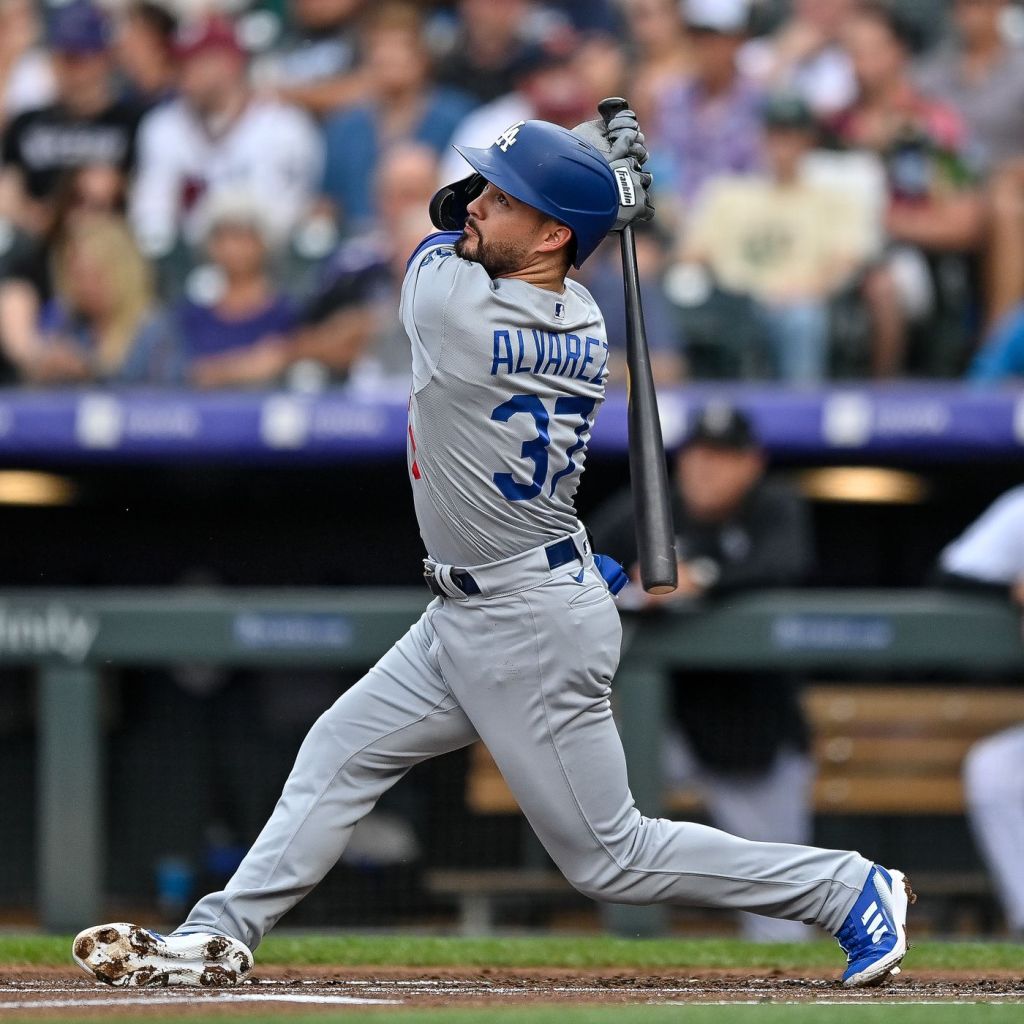
Who’s missing?
= Eddy Alvarez: An infielder/outfielder for the Dodgers (2022) and Miami (2020-21) who won a silver medal in the men’s 5,000 meter speed skating relay at the 2014 Sochi Winter Games. He also was on the U.S. men’s baseball team that lost the gold medal game to Japan in the 2020 (played in 2021) Summer Olympics.
Listen, if you need some freelance editing on these things, let us know. We’re available.
You can look it up: More to ponder
We got nothing here to add.

 Tom Hoffarth's The Drill: More Farther Off the Wall
1 thought on “Day 19 of 2023 baseball books: Trying to win a zero-sum game”