

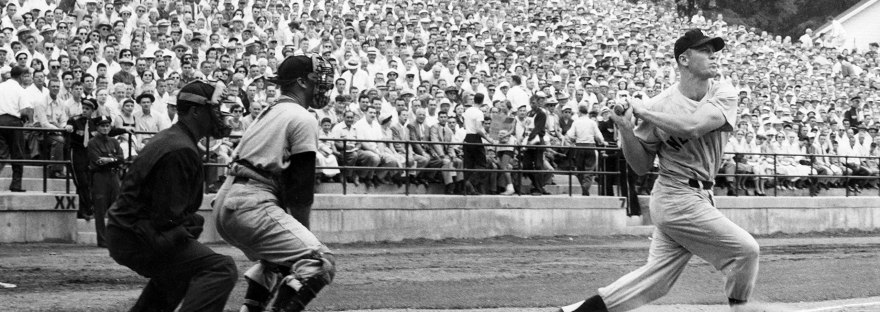
“Baseball: The Turbulent Midcentury Years”

The author:
Steven P. Gietschier
The publishing info:
University of Nebraska Press
624 pages; $44.95
Released July 1, 2023
The links:
The publishers website
At Bookshop.org
At Powells.com
At Vromans.com
At TheLastBookStoreLA
At Skylight Books
At Diesel Books
At {Pages: A Book Store}
At BarnesAndNoble.com
At Amazon.com
The review in 90 feet or less
We offer a brief (as brief as we can muster) apology. We acknowledge most of our reviews in this series – not only this year, but in years past – have unraveled.
They can go long. Turbulently long, perhaps.
In our defense, we simply enjoy the reviewing and writing process. As well as the research, memory retrieval, and dot-connecting. But when you see the reviews linked in a social media post, and it says something like “estimated read time: 18 minutes,” who are we fooling?

Perhaps. But here’s our argument: If we feel it’s compelling, interesting and entertaining, the reader, as a partner in this journey, can decide whether to quit or go forward. We have read plenty of long pieces in newspapers, magazines and — yes — baseball books that we stick with because we didn’t expect it to be something we couldn’t put down, or we find it runs out of steam and we’d wish an editor could have worked with the writer to shape it better.
We can’t Bill Simmons ourselves into self-importance. We used him as a reference of someone in the sports journalism world who seemed to make it OK to go beyond the traditional 800-word essay and insert himself far too much into the pounding-out-paragraphs process.
That said, consider this:
For what may end up as the largest book we review this year – in excess of 600 total pages, with about 600 reference books listed in nearly 30 pages of bibliography, along with 40-plus pages of notes – save whatever time you’d spend on our otherwise excessive glowing review and invest it into this epic undertaking.
It ain’t heavy lifting. It’s high heat. It’s history come alive and brilliant. You’ll end up far more educated than you anticipated.

Steve Gietschier, an Ohio State grad with a Masters and Ph.D. in history and once an archival consultant for The Sporting News, comes from a place where he taught American history, sport history and the history and culture of baseball at the liberal arts Lindenwood University in St. Charles, Missouri. He retired, as many did, in 2020. He edited the 2017 book “Replays, Rivalries and Rumbles: The Most Iconic Moments in American Sports,” which, if you ever saw the cover, you’d not forget it.
Here is your chance to audit Gietschier’s master class in what happened to baseball between the Great Depression and its expansion West.
Imagine sitting there among the students, with Gietschier at the lectern, reading aloud the very first line in the introduction: “This book is a scholarly work exploring the history of organized baseball during the middle of the twentieth century.”
Go on …
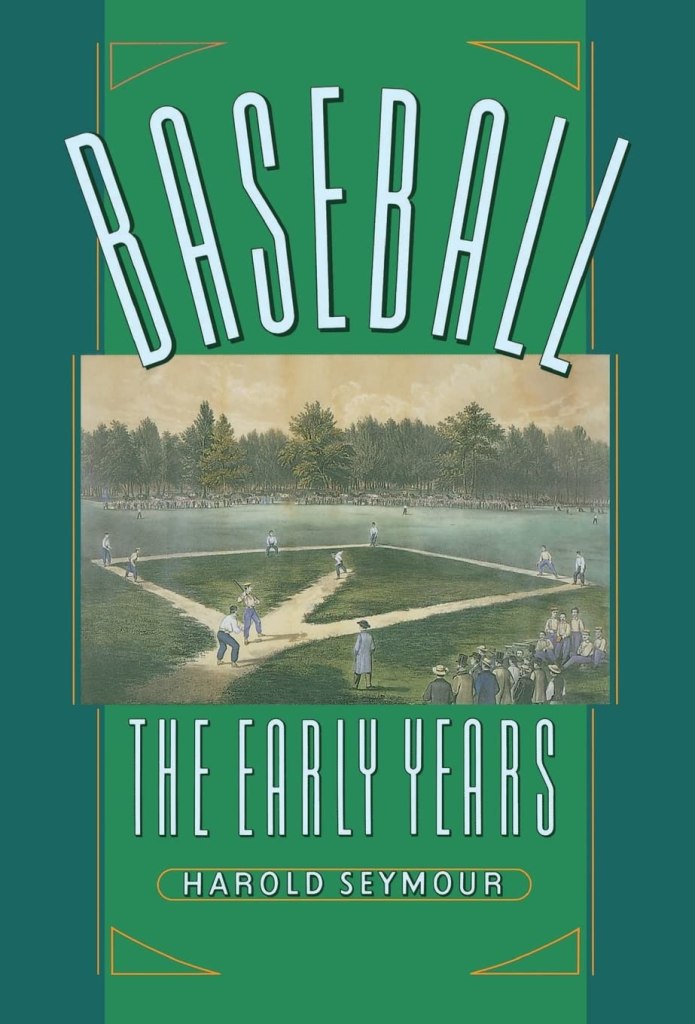
He credits the past work of Harold and Dorothy Seymour with “Baseball: The Early Years” in 1960 followed by “Baseball: The Golden Age” in 1971 and “Baseball: The People’s Game” in 1990. He acknowledges the massive work also done by his cohorts at the Society of American Baseball Research. He admits he is inspired that “the time has come for a new summing up,” examining the game from the depths of the Great Depression in the 1930s to the migration West at the end of the 1950s and early 1960s.
There are 14 chapters built around a particular figure in baseball that segues into the game’s history at that point. They go as follows:

Chapter 1: Connie Mack / Baseball deals with the Great Depression.
Chapter 2: Branch Rickey / The farm system
Chapter 3: Kenesaw Mountain Landis / Survival of the minor leagues
Chapter 4: Ed Barrow / Building the New York Yankees
Chapter 5: Larry MacPhail / Night baseball arrives
Chapter 6: Hank Greenberg / Ethnicity in baseball, and its thriving on the radio
Chapter 7: Don Barnes / World War II launches
Chapter 8: Yogi Berra / Players in the armed forces return
Chapter 9: Tom Yawkey / Disruptions in the game
Chapter 10: Bill Veeck / The Pacific Coast League rises

Chapter 11: Red Barber / Desegregation
Chapter 12: Ford Frick / Lawsuits and the rise of TV
Chapter 13: Henry Aaron / West Coast relocation
Chapter 14: Bill Shea / The Continental League idea
The 10th and 13th chapters may be most interesting to West Coast folk who’ve read various accounts on why baseball moved this direction, and what impact the PCL had on its decision. The title quote for Chapter 13 — “I have long desired to see California” — comes from Abraham Lincoln five weeks before his assassination. The nuggets of info from Chapter 14, meanwhile, include how Jack Kent Cooke, who’d eventually bring professional hockey to Los Angeles (and buy up the Los Angeles Lakers, the Forum, and the L.A. Daily News), was involved with trying to get Toronto a franchise in the upstart Continental Baseball League that never happened, but forced MLB expansion instead after the Dodgers and Giants fled New York for California.
Here’s the plan: Take each of the 14 chapters as a week’s worth of a semester-long course. There’ll be no quiz at the end. No thesis paper due. The only guarantee is you’ll be smarter.
There is also this disclaimer by Gietschier himself: “To be a baseball fan is, in a certain case, to be a student of baseball history. … But a historian striving to write with some degree of objectivity must attempt to keep the passion of the fan in check or even dismiss it. My first history professor, Carroll Quigley, told his Georgetown University freshmen that the historian’s job is twofold: To see things as they really were and to see that they could have been different. If this work approaches these two targets, it will have accomplished much.”
It does, and it did.
Just the gratification that you’ve completed one of the most industrious, entertaining and informative pieces of baseball history you’d ever want to ease back into an easy chair and enjoy.
Author Q&A

We were fortunate to connect via email with Steve Gietschier to see if we could extract more context on his project:
Q You write in the introduction that “the time has come for a new summing up” of the Midcentury years of baseball in the 1900s. What inspired you to take on this task?
A I first began thinking about a book like this when I met Dorothy Seymour Mills many years ago. She was the widow of Dr. Harold Seymour, and together they had written a trilogy of works that were general histories of baseball from its origins up until about 1930. I asked Dorothy what she would think if someone picked up the ball where she and her late husband had put it down, and she said that would be a wonderful idea. At the time, I was not thinking that I would write this book, but when I asked many friends in the baseball history community if they wanted to take on this task, they all said no and that I should do it. After talking to the late Dan Ross, then the director of the University of Nebraska Press, I decided to say yes. It was daunting, to say the least.
Q Was this book an extension of a curriculum you taught in college?
A No, not really. I was very lucky as a college faculty member. Our department created a number of thematic American history courses that were approved as general education courses, and among these was one called “America Through Sport.” I taught three sections of this gen ed course each academic year. Then, every other year, I taught an upper-division seminar-type course called “Baseball History and American Culture.” It encompassed the entirety of baseball history, not just the period about which I wrote in this book.
Q Did you struggle with thinking readers may resist the length of the book – more than 600 pages – or maybe finally decide that’s really what it needed to tell this story correctly?
A The book is long, no question about that, but 150 of those 600 pages are end notes and bibliography that many readers can skip. In truth, I did not plan a book of this length. My goal in writing the text was to be thorough and to keep it lively. I wanted to appeal to both an academic audience and a popular audience. That’s one reason why I focused on one figure in baseball history in each chapter. We’ll see if I succeeded. One early reader told me that he found an “I didn’t know that” moment on nearly every page. That’s high praise, indeed.
Q What’s your short list of the greatest baseball history books ever done?

A Nearly everyone who is asked this question puts Lawrence Ritter’s oral history, “The Glory of Their Times” (1966) on his short list. I do, too. I met Larry Ritter once, and he was a decent man. His crowning achievement in that book was to eliminate himself from the text. There are no questions, just answers. He gives the players all the best lines, and what they told him was memorable. My list would also include Jules Tygiel’s “Baseball’s Great Experiment” (1983) an academic study of Jackie Robinson and the end of the color line, and the first edition of the Macmillan baseball encyclopedia, published in 1969, because it gave us an inkling of what baseball could do with computers. Beyond that, I have a lot of personal favorites, mainly books written by friends whom I love and admire.
Q What’s your connection to baseball growing up? A Cardinals fan in the Midwest — as we see you wearing a St. Louis baseball shirt in one of your Twitter posts?
A I did not grow up in St. Louis. I was born in Brooklyn and grew up on Long Island. My family were Dodgers fans, and that mark was imprinted on my soul from an early age. In fact, my first distant baseball memory is the Dodgers winning the World Series in 1955, and I distinctly remember seeing a couple of games in Ebbets Field. Once the Dodgers moved to Los Angeles, of course, we were bereft until the birth of the Mets.
Q When you write that your history professor in college instilled in you “to see things as they really were and to see that they could have been different.” Do you think you accomplished that here? What’s the best way to measure if that’s happened?
A I think this is a question for my readers to answer, but my overarching goal, as I pursued the research, was to persuade readers that these three decades, roughly 1930 through 1960, were indeed a time of turbulence. Baseball faced many challenges or problems during the Depression, World War II, and the postwar years and met them with not the greatest of ease and success. In that way, things certainly could have been different.
Q Does having an endorsement from John Thorn go a long way in justifying you accomplished what you set out to do?
A I asked several respected friends if they would be willing to read the manuscript and blurb it for the dust jacket. Most of them, including John, said yes. We are friends, and I respect the breadth and depth of his knowledge, both in baseball and beyond. To have him say good things about the book for publication is quite humbling and quite nice.
Q The Graig Kreindler cover is pretty impressive. Is there a history between you two at The Sporting News? How did you connect on getting this particular cover illustration? Does it illustrate your book accurately?
A Many years old, I helped Graig do some research so that he could begin painting images of ballplayers based on the photographs of Charles Martin Conlon. Truthfully, we’d lost touch until it came time for me to consider what the dust jacket might look like. I wanted a work of art, not a documentary photograph, and when I saw this painting of Graig’s, I knew it was evocative of the era about which I write and the style of the game as it was then played. Graig gave his permission, and the design staff at the press added the bright red pennant. I agree with you that their work is pretty impressive.
Q What’s the ultimate takeaway you’d like readers to have from your extensive work?
A I would like readers to appreciate the work that goes into writing a book like this, or any book, really. Authors work really hard at their craft, and editorial staffers make their work even better. In addition, I hope readers see the book for what I hope it is: a solid contribution to the field of baseball history combining original research with a bringing together, a “summing up,” of all so much good work done by so many others.
How it goes in the scorebook
Purposefully posting this on July 4, we expect the reader will see that it promotes the general welfare of baseball and will down in history, from cover to cover, as an era beautifully covered.
As MLB historian John Thorn notes in his blurb: “Steve Gietschier knows that history is not merely a record of what happened long ago, but also what it may portend for today’s game, fans and nation. The Seymour’s scholarly history of baseball ended in 1930; this ambitions, sprawling volume tells us what has happened since and why – it is a splendid successor. If you take a serious interest in baseball, ‘Baseball: The Turbulent Midcentry Years’ must find a place on your shelf.”
How do you say it any better?
If you are one to have enjoyed Thorn’s “Baseball in the Garden of Eden: The Secret History of the Early Game” in 2011, or John Helyar’s “Lords of the Realm: The Real History of Baseball” from 1994, or James Michener’s “Sports in America” 1976 classic, or even David McCullough’s “1776,” this is in your wheelhouse of pristine patience and practical know-how.
You can look it up: More to ponder

== On the subject of the cover: Artist Graig Kreindler is the focus of this new book: “Black Baseball in Living Color: The Artwork of Graig Kreindler” (Baseball Art LLC, with contributing writers Ike Brooks, Jay Caldwell, Bill Johnson, Gary Gillette, Tim Odzer and Dave Wilike, edited by Bill Nowlin and Carl Reichers, designed by Justin Oefelein and Todd Radom. $49.95 hard cover, $35 soft cover, $25 hard cover with uncoated paper, released March 11, 2023.)
The Amazon blurb: “This book explores the events and eras that shaped Black Baseball from the nineteenth century through the twenty-first century illustrated with nearly 240 color portraits painted by renowned sports artist Graig Kreindler. The importance of five players – James “Cool Papa” Bell, Andrew “Rube” Foster, Josh Gibson, Leroy “Satchel” Paige, and Jackie Robinson – is highlighted by focusing on their contributions to the sport and American society in five chapters written by different SABR authors. The portraits of the remaining players are grouped by the seven eras in which they played along with biographical data and a brief story about their career and contribution. Each of these seven chapters is highlighted by two colorized photos of teams from the era provide by MancavePictures.com. The SABR authors explore the intersection of these seven eras with the profound impact world events had on baseball including the Transatlantic slave trade, the legal basis for segregation after the Civil War, the Spanish-American War, the Great Depression and Dust Bowl, and World War II. And how, in spite of a world seemingly set against them, the Black ball players persevered and stood out as rays of hope and triumph as early civil rights leaders from Octavius Catto to Doc Sykes to Jackie Robinson.”
More background:
== While “The Turbulent Years” covered here are identified as 1930 to 1960, but does not include dates included in the title, we have seen more books out currently that got us to give it a glance-through, not really compelled to buy the concept that the year itself on the cover was anything extra ordinary, but we’ll include them here nonetheless:

== “The Greatest Summer in Baseball History: How the ’73 Season Changed Us Forever,” by John Rosengren (Sourcebooks, 448 pages, $16.99, released April 1, 2023)
In our memory book, ’73 didn’t change us “forever” as much as it prepared us for a much more eventful 1974 season — The Dodgers returned to the World Series for the first time in eight years, with Steve Garvey as a write-in starting first baseman for the All-Star Game, Henry Aaron actually breaking Babe Ruth’s home run record and taking a victory lap, 35-year-old Lou Brock setting the MLB record with 118 stolen bases (eclipsing Maury Wills’ 104 in ’62), Mike Marshall appearing in a record 104 games as a relief pitcher and winning the Cy Young Award, Dick Allen leading the AL with 32 home runs as a White Sox star, Nolan Ryan throwing another no-hitter and striking out 367 batters (a year after setting the mark of 383 in ’73), Bob Gibson is only the second pitcher in MLB history with 3,000 career strike outs, Al Kaline retiring after 22 seasons with his 3,000th hit, and the Oakland A’s establishing a three-peat. Plus, St. Louis outlasting the New York Mets in a 25-inning game in Sept., ’74, that ended at 3:12 a.m.
Then again, in 2013, we had Matthew Silverman’s “Swinging ’73: Baseball’s Wildest Season: The Incredible Year that Baseball got the Designated Hitter, Wife-Swapping Pitchers, World Champion A’s and Willie Mays said Goodbye to America,” with a blurb cover endorsement by MLB historian Thorn. What’s more to offer?

On top of that, we find in this review (as well as Rosengren’s website) that this was actually published already in 2008 under the title “Hammerin’ Hank, George Almighty and the Say Hey Kid: The Year that Baseball Changed Forever,” but it is now trying to take advantage of the 50th anniversary of that season.
== “Do You Believe in Magic? Baseball and America in the Groundbreaking Year of 1966,” by David Krell (Rowman & Littlefield, 262 pages, $34, released March 8, 2023). We do, just not in this case.
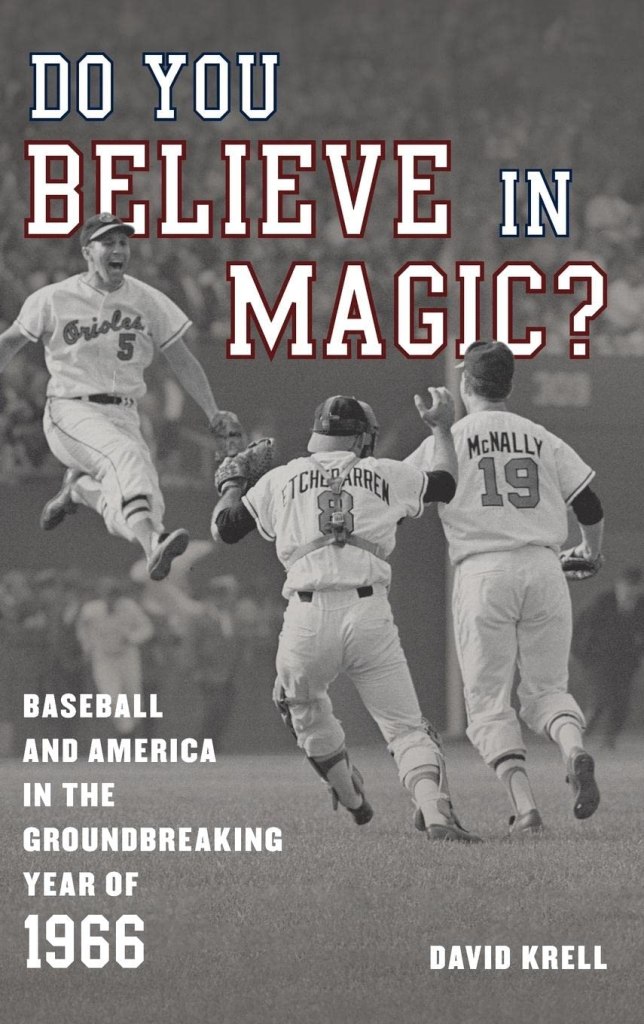
When we last reviewed a Krell book related to a particular season of baseball, it was in 2021 when he was trying to make us believe 1962 had a lot of relevance. This is formatted in the same January-to-December template, which turns out to be a quite a dreadful way of trying to filing away information in this sort of historical context.
(We also took the opportunity to write about all the other books over the decades that focused on just one particular year).
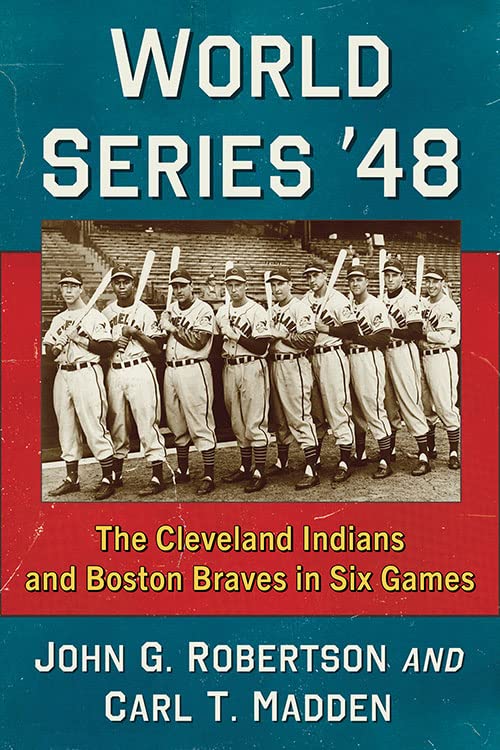
== “World Series ’48: The Cleveland Indians and Boston Graves in Six Games,” by John G. Robertson and Carl. T. Madden (McFarland, 258 pages, $35, released November 7, 2022). Here’s a link to that series from Baseball-Reference.com if you want to wade through it.
== “Major League Players of the 1970s: A Biographical Dictionary from Aase to Zisk,” by Bill Ballew (McFarland, 595 pages, $95, released December 5, 2022).
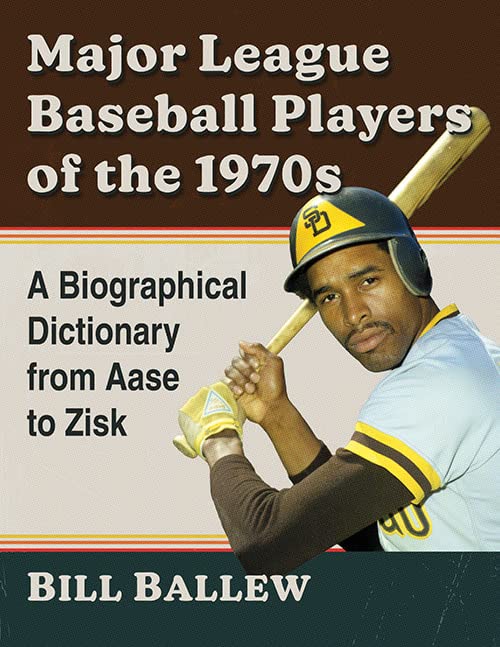
There’s 1,300-plus players for something just short of a full Benjamin. If that isn’t pricey enough, we’ve found some used copies in the $135 range.

 Tom Hoffarth's The Drill: More Farther Off the Wall
3 thoughts on “Day 21 of 2023 baseball books: History, coming in hot & heavy, with a Midcentury modern approach”