

“The Black and White of Baseball:
Overcoming Bias in Baseball and Life”
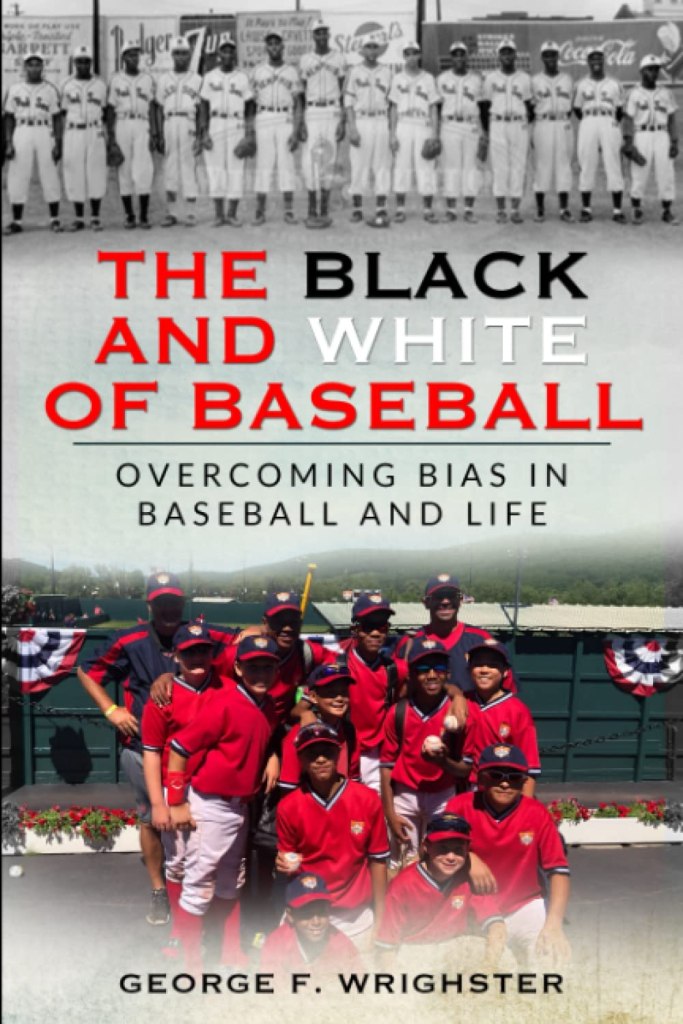
The author:
George F. Wrighster
The publishing info:
Elite Publications
Gifts of Legacy
105 pages
$15.95
May 11, 2023
The links:
The book’s website
The author’s website
At Amazon.com
The review in 90 feet or less
We happened to be re-reading the other day a synopsis of the 1992 paperback reissue of Robert W. Peterson’s classic, “Only The Ball Was White: A History of Legendary black Players and All-Black Professional Teams” (Oxford University Press, 416 pages).
The blurb read: “When ‘Only the Ball Was White’ was first published in 1970, Satchel Paige had not yet been inducted into the Hall of Fame and there was a general ignorance even among sports enthusiasts of the rich tradition of the Negro Leagues. Few knew that during the 1930s and ’40s outstanding black teams were playing regularly in Yankee Stadium and Brooklyn’s Ebbets Field. And names like Cool Papa Bell, Rube Foster, Judy Johnson, Biz Mackey, and Buck Leonard would bring no flash of smiling recognition to the fan’s face, even though many of these men could easily have played alongside Ty Cobb, Walter Johnson, Hack Wilson, Lou Gehrig — and shattered their records in the process.
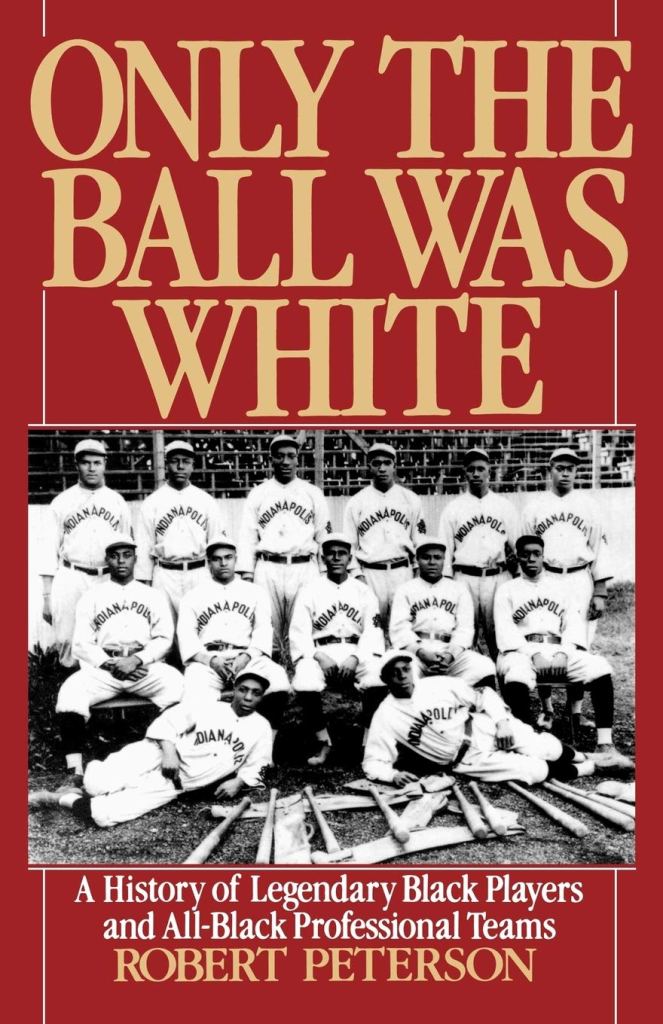
“Many baseball pundits now believe, for example, that had Josh Gibson played in the major leagues, he would have surpassed Babe Ruth’s 714 home runs before Hank Aaron had even hit his first. And the great Dizzy Dean acknowledged that the best pitcher he had ever seen was not Lefty Grove or Carl Hubbell, but rather ‘old Satchel Paige, that big lanky colored boy’.”
Between the time of the Civil War’s ending and the signing of Jackie Robinson by the Dodgers in 1947, there was stops and starts in baseball’s struggle, which mirrored the country’s struggle, in how to level the playing field, discard the Jim Crow blanket of laws stubbornly covering much of the country, acknowledge our imperfections, and be better people.
More than 50 years after that book’s release – which occurred less than 25 years after Robinson’s debut – we are still, in many disturbing and distressing ways, trying to teach those in our community to learn from history rather than repeat it.
In the brief but powerful 11th chapter of George F. Wrighster’s new self-published book — the chapter is titled “Nigga” — he explains what he saw while watching his grandson one game playing shortstop, a runner on the other team pulled up at second base, and “everything went sideways.”
The white player on second base had called Wrighster’s grandson a “nigga.” The umpire started yelling at his grandson. The grandson tried to explain to him what happened. His teammate at third base heard it as well and said so, and then questioned the umpire’s reaction to be upset at the wrong player. The coaches and umpire huddled.
“Unfortunately, after the conversation concluded, the umpire did nothing to address the issue,” Wrighster continues. “Instead, they allowed the player making the derogatory statement to remain in the game. Of course, that didn’t sit well with my grandson or his teammates.”
What made it seem worse, Wrighster adds, was his grandson’s coach was only upset that he missed a sign earlier in that inning.
“I was bewildered,” Wrighster concedes. “The only thing I could focus on was how the head coach had a player called a nigga, showed no empathy for how disturbing that is for a black player, and was more concerned about a missed sign on a play? What kind of person are we dealing with; where is his moral compass and humanity displayed for this kid, my kid?”
It got more sideways.
Wrighster’s grandson was switched to pitch the next inning. He eventually faced the kid who called him the name, struck him out, told him to “go sit down,” and was ejected by the umpire.
“He was devastated by the turn of events,” Wrighster goes on. “Immediately, he saw me, walked over, then fell into my arms. Then sobbing with a tremble, he said, ‘I can’t take it anymore. I have a racist coach; players on the other teams don’t like black people in this sport and can saw whatever they want with nothing happening.’
“It almost broke me as a grandparent.”
It got even more sideways.
“The head coach told him the next day, ‘I would have felt better if you had reacted and punched the player rather than be thrown out of the game’,” Wrighster writes.
He then concludes: “We all have biases that affect our decisions; the goal is to recognize and address the negative biases so they won’t hinder our growth.”
That becomes the final sentence in each of the 16 chapters. Point well taken in all of them.

Wrighster comes from a background of motivational speaking and life coaching. His website focuses on “Mindset Mastery” with his ultimate goal to “help my clients achieve meaningful and lasting transformation, so they can lead fulfilling and purpose-driven lives.” Also one that is “good and fearless.” His YouTube channel professes ways to “harness the omnipotent fire within and rewrite your destiny.”
From his LinkedIn biography, he has arrived at this point after a career in Southern California in customer service for health care, banking, aerospace and consumer products. He has run a cupcake store in Pasadena. He served as a project coordinator at a non-profit in Chatsworth.
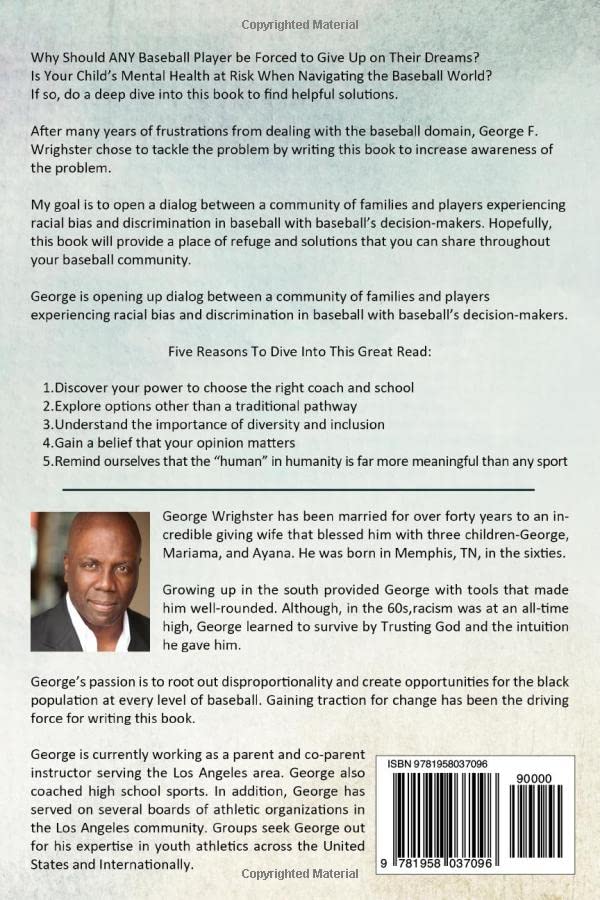
Wrighster’s background starts with his birth in Memphis, Tenn., in the early 1960s, growing up in Georgia, facing his own racism while dreaming to be a pro baseball player, and trying to be a positive force of nature as he watches the struggle continue.
It’s again a teachable moment, as he wants this book to accomplish five things – spelled out on the back cover:
- Discover your power to choose the right coach and school
- Explore options other than a traditional pathway
- Understand the importance of diversity and inclusion
- Gain a belief that your opinion matters
- Remind ourselves that the “human” in humanity is far more meaningful than any sport
He then encourages the reader to help him build a “prosocial movement to change the current narrative,” which includes filling out a “stakeholder survey” by scanning a QR code to arrive at TheBlackAndWhiteofBaseball.com/survey.
Again, baseball is the purposeful platform and a common ground to start with in this discussion that has many levels and approaches.
How it goes in the scorebook
A loud amen, with a lot of peace, love and mercy.
And hope.
This book, he says, is part of that “passion to root out disproportionality and create opportunities for the black population at every level of baseball.”
We circle back to “Only the Ball Was White” as a way to continue, what Wrighster promotes, a way to find appropriate role models, discuss reasons why people default to as for the longevity of Blacks in baseball, having tough conversations and making promises to move forward with intent.
He is hopeful this can be achieved. As are we, if only for devoting space here for that purpose.
You can look it up: More to ponder
== As the MLB All Star Game converges on Seattle, former Mariners star and Hall of Famer Ken Griffey Jr., has been involved in “addressing baseball’s cultural blind spot,” as the story says in Adweek.com.
Case in point: When Griffey Jr. was in the early days of his career in 1991, Black players made up 18 percent baseball’s rosters. Today, the Institute for Diversity and Ethics in Sports (TIDES) noted that Black players make up just 6.2 percent of baseball rosters.
“Over the years, we have seen the decline of African-American players not because they don’t want to play, but rather because they haven’t been seen,” said Griffey, an ambassador for MLB and MLBPA’s Youth Development Foundation.
== More background on the MLB’s RBI program.
== George Wrighster III, the oldest son of George F. Wrighster, may be more well known as the former NFL tight end out of Sylmar High/The Buckley School in Sherman Oaks who went onto star at Oregon and was a fourth-round pick by Jacksonville in 2003. He moved onto become a sports-talk host when KFWB-AM (980) had a run as “The Beast” in 2014, then moved onto Fox Sports and SiriusXM. He and his wife live in the San Fernando Valley and have four children and have the Wrighster Family Foundation since 2017. He is also part of The Football Players Health Study at Harvard University, a comprehensive research program that examines the multi-factorial causes that impact the health and well being of former NFL players. One of his recent posts:

 Tom Hoffarth's The Drill: More Farther Off the Wall
1 thought on “Day 22 of 2023 baseball books: The Wrighster way and its sense of purpose”