
“No Crying in Baseball:
The Inside Story of ‘A League Of Their Own’:
Big Stars, Dugout Drama and
a Home Run for Hollywood”
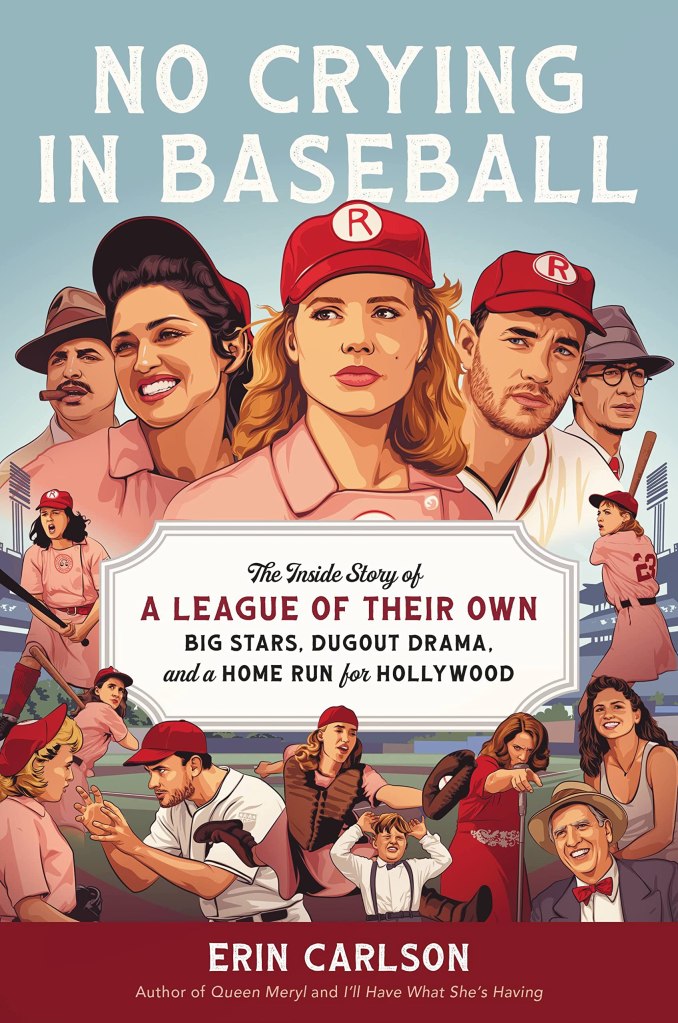
The author:
Erin Carlson
The publishing info:
Hachette Books
320 pages; $29
Scheduled for release: Sept. 5, 2023
The links:
The publishers website
The authors website
At Bookshop.org
At Powells.com
At Vromans.com
At TheLastBookStoreLA
At Skylight Books
At Diesel Books
At PagesABookstore.com
At BarnesAndNoble.com
At Amazon.com
The review in 90 feet or less
For cryin’ out loud, there’s plenty of crying in baseball.
And in Hollywood.
From who’s in and who didn’t make the cut in a blockbuster casting call. From studio bickering about who’ll head up the project and why it’s worth nearly killing it. To what it might even take to remove a scene in the editing department because it isn’t resonating with the test audiences.
In 1992, the same year when the British-made “The Crying Game” with its shocking plot twist was one of the Academy Award nominees for Best Picture, the Penny Marshall-made “A League of Their Own” may really be best remembered for, well, crying.
Because of this:
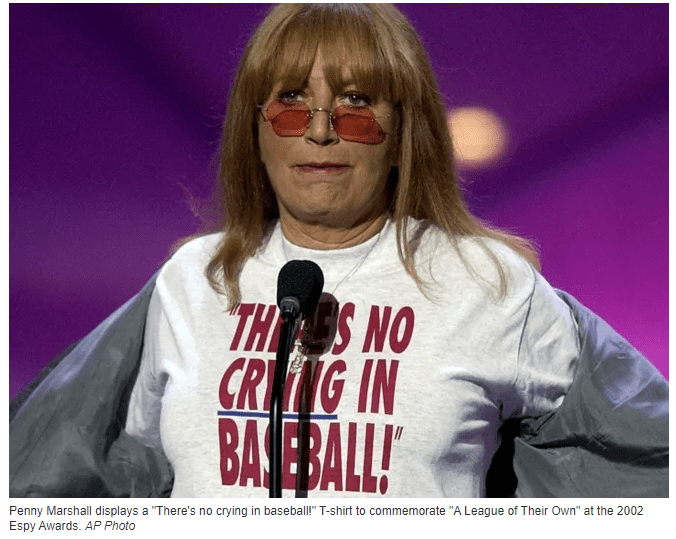
The dialogue Tom Hanks spit out during “A League of their Own” – he’s all puffed up as Rockford Peaches manager Jimmy Dugan, beyond frustrated with his right fielder, Evelyn Gardner (played by Bitty Schram) – has become so identified with the film as its pop and sports culture reference point that, in 2005, when the American Film Institute’s 100 Movie Quotes in cinema came out, “There’s no crying in baseball” is locked in via the popular vote at No. 54.
Also no surprise it’s the eye-dabbing, heart-pulling title that the publishers attached to Erin Carlson’s new book about how this whole movie came about, why its worthy of being included in the Library of Congress’ National Film Registry, and how it’s been revived as an Amazon streaming series with a modern update/enlightenment character development that its original screenplay didn’t have the gumption to dive into nearly 30 years ago.
Different times, different audiences. Different threshold for what was considered tear-jerking.
On page 70, getting into the fourth chapter of Carlson’s well-crafted research on the film, we see how screenwriters Lowell Ganz and Babaloo Mandell pulled out that line, again maybe not surprising, based on a true Hollywood story.

Carlson, a culture and entertainment journalist who has previously done two Hollywood-based film books on Nora Ephron and Meryl Streep, first explains how Ganz and Mandell established their chemistry by collaborating on scripts for TV that included Marshall the actress (“The Odd Couple” and “Laverne and Shirley”) and then went into movies with familiar cohorts (the Ron Howard-directed “Night Shift” in 1982, followed by the Tom Hanks-Daryl Hannah “Splash” in 1984, Steve Martin in “Parenthood” in 1989 and Billy Crystal in “City Slickers” in 1991).
So, that rant they pulled together for Dugan came from a moment when Ganz and Mandel were included in a studio’s story development meeting. A woman director (whose identity isn’t revealed) shed tears at some point during the discussion. The writers remembered hearing a producer in the room mutter under his breath: ‘What is this crying? Did Howard Hawks ever cry at a meeting?’”
In her notes, Carlson sites a 1992 Los Angeles Times story that reveals how Ganz and Mandel “concocted dialogue on the fly and acted the scene out loud. They scratched out words and revised in tandem.” From an ESPN.com story on the oral history of the film published in 2017 (which SABR.org created a post for, but the original story doesn’t seem easily accessed now), the typewritten script looked like this:
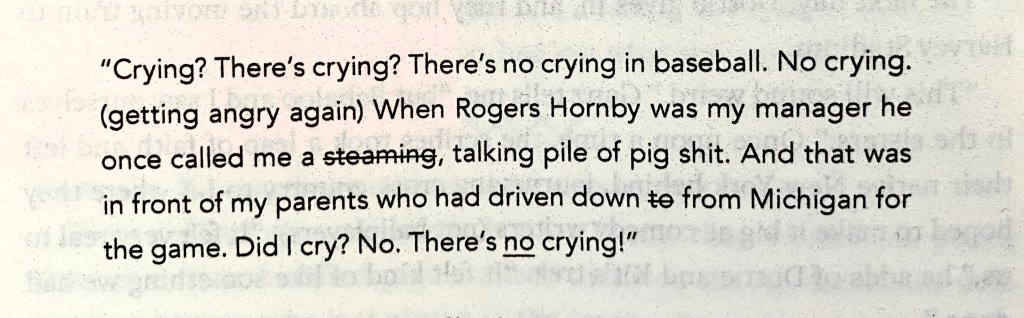
Carlson takes the opportunity to explain how that piece of dialogue is meant to show how Dugan “hates that he’s managing a bunch of chicks. They offend his fragile, toxic masculinity. Who do these gender-bending lightweights think they are? What the hell had he become? … As Jimmy rips Evelyn apart, it is possible that he would subject a male crybaby to the same needless verbal abuse. Do men cry in baseball? Oh yes, all the time. And despite his titanic show of anger, Jimmy Dugan is definitely weeping on the inside … (the anger) is a projection of the loathing he feels toward himself.”
Carlson concludes: “As crafted by Ganz and Mandel, his tirade was hilarious because of its exaggerated specificity and the truths it contained about men and baseball. Jimmy was like those pissed-off, helicoptering Little League dads who live vicariously through their sons and are always yelling over the slightest mistake.
“The right actor could take the bit and run with it.”
Frankly, my dear, if Hanks hadn’t been the one delivering it, it’s doubtful for inclusion on that AFI list (where Hanks is also represented for lines he delivered in “Forrest Gump” and “Apollo 13” — look ’em up if they’re not on the top of your tongue).
In Carlson’s estimation, Ganz and Mandel deserve credit for creating “the most-quoted line in sports movie history. Scratch that: In sports history, period. For a couple of baseball junkies, that was like winning the World Series.”

In general, we’d agree. Even if we most often find ourselves gnashing our teeth when spitting out “You’re killing me, Smalls,” from “The Sandlot” at least three times a week to no one in particular.
The story behind the quote is one of dozens of golden nuggets excavated from an array of diamond gems Carlson finds from stories done about the film as well as dozens of new interviews she does with many of the major players (minus Penny Marshall, Tom Hanks and Madonna) to reconstruct Marshall’s rise as a director in her post-“Laverne” film and TV existence, why this film almost didn’t get made when the original studio gave up on it, and why we still crave to know more about its creative spirit all this time after its release and a new media attempt to build on its legacy.
With that, we have our own list, the Top Five things we learned about “A League of Their Own” we thought we knew, we really didn’t, and now we better remember:
1. Marshall had done plenty of AAGPBL research, going back to the original Southern California PBS documentary in 1987 (first aired on KCET, then picked up nationally, produced by Kim Wilson and Kelly Candaele, who got story credit for “ALOTO”) and then being present at the original “Women In Baseball” gathering in Cooperstown in November of 1988. She was said to be “lurking in the background,” unaware there was another group trying to research their own film on the subject matter. Marshall still felt she had the best handle on the story telling.
She was all was lined up to do the movie for Fox. But by the time the studio wanted to do it, she was starting to direct the film “Awakenings” with Robin Williams and Robert Di Nero. The studio then pushed for David Anspaugh, fresh off “Hoosiers,” to take charge of it. Fox was also trying to angle for the somewhat toxic Sean Young in the lead role of catcher Dottie Hinson. Anspaugh wanted Daryl Hannah as Dottie Hinson and Laura Dern as little sister Kit. Marshall always had eyes on Debra Winger or Demi Moore for the Dottie role.
Geena Davis? Coming off “Themla and Louise,” she had credibility, but …
One argument led to another, and Fox gave up on it, selling it off to Sony/Columbia pictures for $7 million. Marshall re-joined the team (with a $3.75 million salary to direct and be the executive producer), and the pieces were all in place.
Sort of.
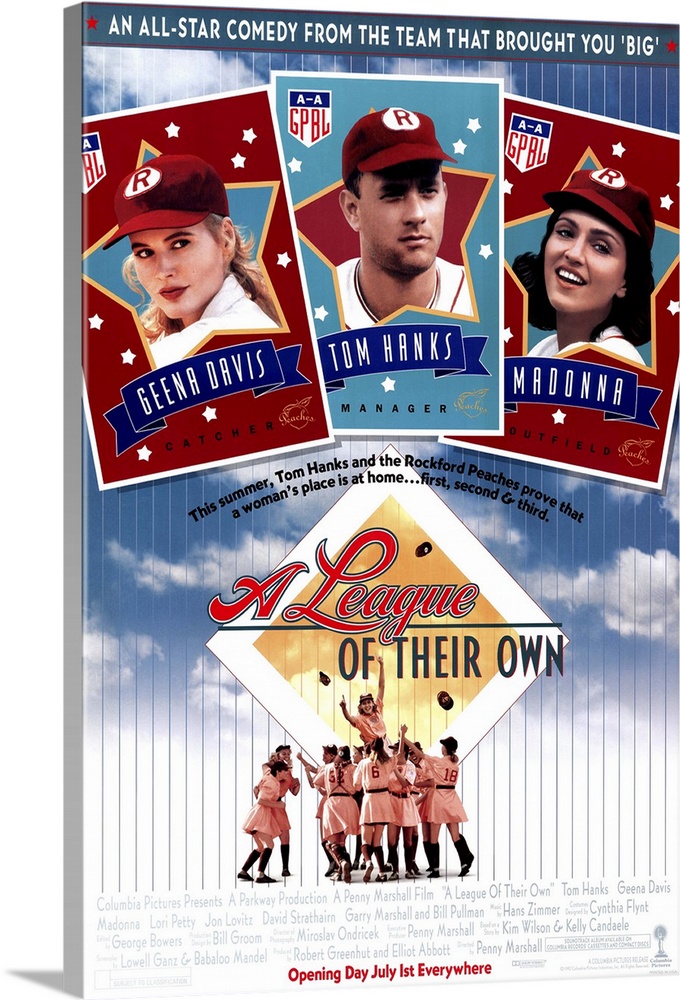
2. Demi Moore could still be Dottie, but … she got pregnant. Her and husband Bruce Willis were expecting their first, daughter Rumer.
“She literally got fucked out of the part,” Marshall once explained.
Winger was Marshall’s second pick, a good friend. Winger almost made it to the first day of shooting. But when she caught wind that Madonna, the pop star who shared the same agent and had once said snarky things about her, was now added to the cast (not even one of the top two players, but outfielder “All The Way” Mae Mordabito). Winger wanted out. Columbia paid her $3 million to just go away.
Marshall considered a few others, recruited Davis, and got to work.
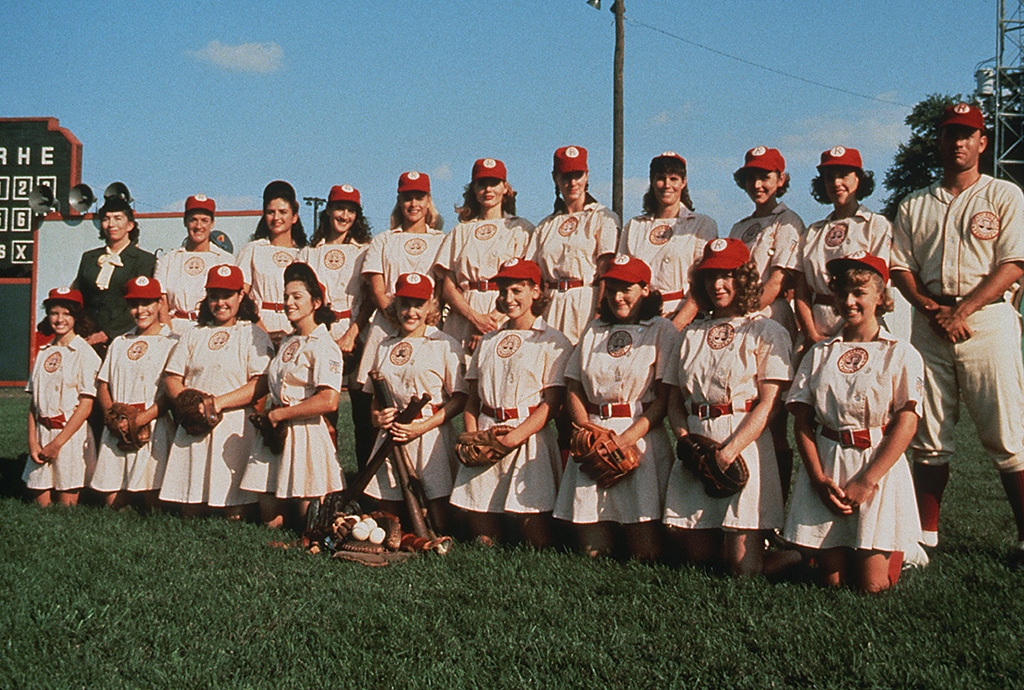
3. Before all these musical chairs, a robust casting call for actresses who might be baseball-worthy happened in February of 1990 at USC’s Dedeaux Field – and Rod Dedeaux, the retired USC coach, was there himself to help assess the talent. Carlson explains in the fifth chapter called “The Tryout,” about how the actresses (and a few stunt women) were divided into “athletes,” “trainable” and “hopeless.”
Those who showed up to be judged but didn’t pass the audition: Tatum O’Neal (not all that removed from “Bad News Bears” fame), Helen Hunt, Marla Maples, Courteney Cox, Cindy Crawford, Sarah Jessica Parker, Kelly Preston, Brooke Shields and Elizabeth Perkins. Those who wanted a private tryout: Daryl Hannah, Mariel Hemingway, Laura Dern and Jennifer Gray.
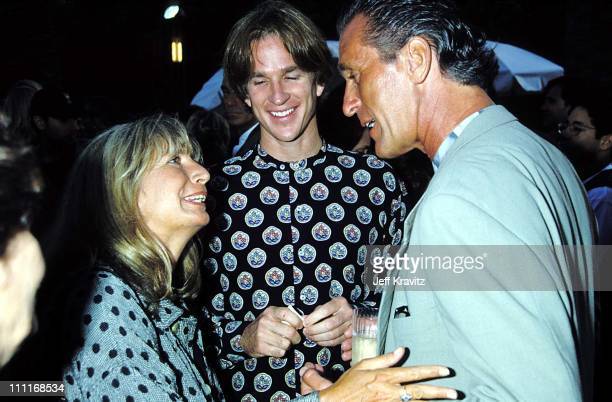
4. Pat Riley was considered for the Jimmy Dugan role. The dashing 40-something Lakers coach was only in the mix because of Marshall’s affection for the Lakers as a season-seat holder. She brought Riley in for a long video audition, “which was perfectly fine but didn’t have any real comedy,” said one of the film’s producers, Bob Greenhut.
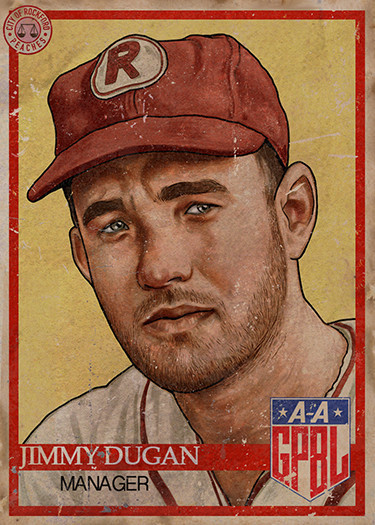
Than again, Jim Belushi was also a leading choice for Dugan, going back to the original Fox production. When Columbia came on, it decided it could find someone “bigger” than Belishi and talked about Michael Douglas or Paul Newman.
Finally, Tom Hanks, whose career was going a bit sideways after “The ‘Burbs,” “Joe Versus the Volcano” and “The Bonfire of the Vanities,” asked to be considered, hardly from a place of star power. Marshall, who worked with him in “Big,” didn’t think he was the perfect choice, but added him because he worked well with others, and was willing to add a few pounds.
Back to Belushi: How would that whole “no crying in baseball” scene have played out with him acting it out versus Hanks? We’d have loved to seen a screen test.
Our instincts lead us to believe Belushi was better suited for this role of the sloppy, self-loathing, boozed-up ex-major-league heavyweight (like Jimmy Foxx or Hack Wilson), physically looking more the part and able to show the wear and tear of guy hating himself. Imagine all the facial expressions he could have used to pull that off as well with a simple raising of an eyebrow. Like his brother, John.
5. DeLisa Chinn-Tyler deserves the five pages Carlson devotes to her in this book.
Chinn-Tyler isn’t credited for her part in the film, and as Carlson writes, “more than three decades later, many involved with ‘A League of Their Own’ don’t know DeLisa’s name.”
She has a 15-second scene.
A ball is overthrown and rolls to her. Chinn-Tyler’s character (unnamed) is sitting in the segregated seats down the first base line. She picks up the ball and fires it back. The two Peaches players are stunned. The girl then nods and walks away. No words are spoken.
It’s a not-s0-subtle reminder that Blacks were not only excluded from Major League Baseball at this point in World War II games, but also from the AAGPBL.
Chinn-Tyler showed up for an open audition, but knew she wouldn’t be included. Marshall saw her and had an idea. The script was rewritten to include her for that scene.
Carlson also writes later that at the movie’s screening, “Chinn-Tyler lingered in her theater seat, her eyes combing the credits for her name. She didn’t find it anywhere and her disappointment lasted years.” She made $750 for that scene.
No surprise the Amazon “A League of their Own” has already explored more storylines about the Black player experiences in Jim Crow times.
How it goes in the scorebook
After further review, it is confirmed: The girls just wanted to have fun. And they did, making history along the way.
For Carlson’s efforts, dirt is dug up and and dished out in a fun way that explains as much about Penny Marshall’s post-“Laverne” existence as the movie’s way to honor the women who played the game and keep it on the radar with baseball historians. Carlson gave us a joyous run-up on how she’d approach this with her two previous books: The 2017 “I’ll Have What She’s Having: How Nora Ephron’s Three Iconic Films Saved the Romantic Comedy,” and the 2019 “Queen Meryl: The Iconic Roles, Heroic Deeds and Legendary Life of Meryl Streep.” This follows up very well with the same attitude and entertaining writing style.
It also reconfirms how the movie-making dance is often about who’s in the right spot at the right time, whose personality conflicts affects hiring, and how major studio like Fox can whiff on a project that ended up so important –even if it was compensated by selling it to Sony/Columbia.
All in all, that’s the real extend of a project like this, which has been somewhat covered in all sorts of oral history projects at various points in “ALOTO” anniversaries, mostly serving as checks to see how things have held up.
In this case, with the Amazon series in play (and now stalled with the writers’ strike), we need to remember the struggle to get it made in the first place and how that can provide the foundation for more storytelling — even after CBS tried to cash in on its own “ALOTO” sit-com a year later with Marshall as the executive producer but only have it last six episodes with a couple of actresses reprising their roles. (Ganz and Mandel wrote the first two scripts, Marshall and Hanks even directed an episode).

While Carlson was able to track down and seek more information from many involved in the film — Ganz and Mandel, plus Geena Davis, Lori Petty and Rosie O’Donnell) she was still missing Marshall, Hanks and Madonna. As for Marshall, who died in 2018 at age 75, Carlson could really lean into Marshall’s 2012 memoir, “My Mother Was Nuts” (New Harvest Publishing, 352 pages).
All and all, the reader here can’t expect anything close to what Ron Shelton did in 2022 with “The Church of Baseball: The Making of Bull Durham – Home Runs, Bad Calls, Crazy Fights, Big Swings and A Hit” (Knopf/Penguin/Random House), and that’s not really what happens here. We eventually figure out the key to Shelton’s success explaining what went into his movie is all about how he was there far before the start of “Bull Durham” to years after it, and his account of all that happens and decisions made is something that should be part of the curriculum in a college film course.
This is just, after all, a cool thing to piece together through research and new interviews. Consider it more what Chris Nashawaty, a former film critic for Entertainment Weekly, did with mining information to put together his 2018 book, “Caddyshack: The Making of a Hollywood Cinderella Story” (Flatiron Books).
You can look it up: More to ponder

== In “The New York Times Book Of Movies: The Essential 1,000 Films To See,” updated in 2019, it is encouraging to see “A League of their Own” is included on page 611. The entry, based on a review that Vincent Canby in July of ’92, calls the film “one of the year’s most cheerful, most relaxed, most easily enjoyable comedies. It’s a serious film that’s lighter than air, a very funny movie that manages to score a few points for feminism in passing. …Though (it) is an ensemble piece, Mr. Hanks is first among the equals. His Jimmy Dugan is a priceless, very graceful eccentric. With his work here, there can be no doubt that Mr. Hanks is now one of Hollywood’s most accomplished and self-assured actors. Having put on weight for the role, he even looks jowly and over-the-hill. … Not since “Desperately Seeking Susan” has Madonna had a role that fits her public personality as well as Mae, an opinionated, operational fighter who’s not about to pay too much attention to training rules when it comes to men. It’s not a big role, but it is choice. … “A League of Their Own” has its share of obligatory lines. At a sentimental moment, Jimmy Dugan must say, “There’s no crying in baseball.” He must also define the game for the women: “Baseball is what gets inside you. It’s what lights you up.” (The film) is so good that it can accommodate such stuff and still leave one admiring its skill, humor and all-American enthusiasm.”
This entry gives the film noteworthy street cred. Also included among baseball-themed films: “Bull Durham” (page 178), “Pride of the Yankees” (page 870), “Eight Men Out” (page 327) and “Damn Yankees” (page 246). What is left out: “Field of Dreams,” “42,” “The Natural,” “Bang the Drum Slowly” and “Moneyball.” And, of course, “Ed.” The one with Matt LeBlanc and the chimp and the Santa Rosa Rockets minor-league team. Look it up.
== A 2022 list by Will Leitch for MLB.com of the “Best Baseball Movies of All Times” has “A League of their Own” at No. 2, behind “Bull Durham.” Leitch wrote: “A movie that has baseball in its bones as few other movies do, and one that tells a terrific story that few people even knew about. The cast is terrific top to bottom — even Madonna is good in it! — and the movie has the good fortune of having Tom Hanks as the crusty manager just before he became the biggest movie star in the world.”
== The RottenTomatoes.com list of the “66 Best Baseball Movies of All Time” – ranked, predictably, by the percentage of good reviews – has “A League of their Own” at No. 14 with 81 percent. “The critics say: Sentimental and light, but still thoroughly charming … buoyed by solid performances and a wonderful cast.”
== The IMBD.com list from 2017 of the “Top 25 Baseball Movies” has it No. 2 behind “Field of Dreams” with a 69 Metascore and a 7.3 star out of 10.
== And why not include: The 2023 AARP list of “12 Great Baseball Movies to Stream” from the aforementioned Chris Nashawaty, who has “A League of Their Own” included with the writeup: “Tom Hanks like a human whoopie cushion as the hard-drinking, tobacco-chewing manager of the Rockford Peaches, an all-female baseball team whose roster includes Madonna, Rosie O’Donnell and Geena Davis. …. Director Penny Marshall’s A League of Their Own may be light and breezy, but it also manages to be about something much bigger than baseball. It’s about women finding their voices and independence and sisterhood through sports. Just don’t tell that to Hanks’ crusty Jimmy “There’s no crying in baseball!” Dugan.”
It always comes back to that line about crying.
== More passing thoughts about “A League of Their Own” as a consumer/viewer/observer:
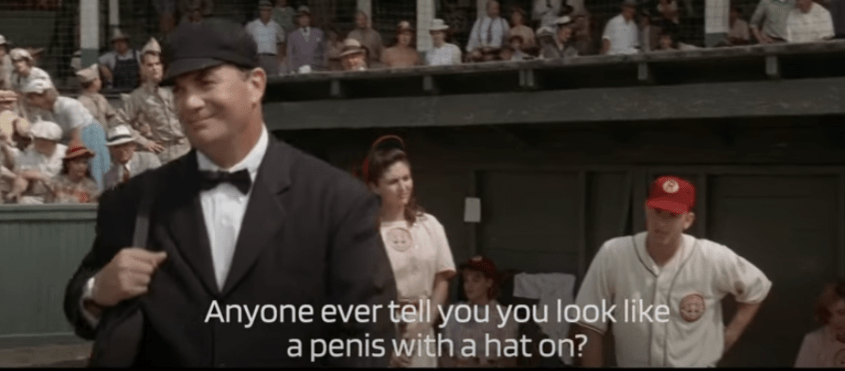
For our money, the line Hanks delivers right after that “no crying” rant, after the umpire scolds him, was far more quote worthy: “Did I ever tell you, you look like a penis with a little hat on?”
What also might be overlooked is that “no crying” scene is revisited. Dugan and Evelyn get into another “discussion” in front of the dugout later in the film about her error-prone ways. Dugan seems to have figured out a way to explain to her what happened without making her cry. But he’s ready to explode himself:
Again, as much as we love Hanks, we can envision Jim Belushi doing this with far more credibility and humor.
== From the Aug. 15, 2023 edition of the New York Times: “Take a bow, Madonna,” acknowledging her 65th birthday.
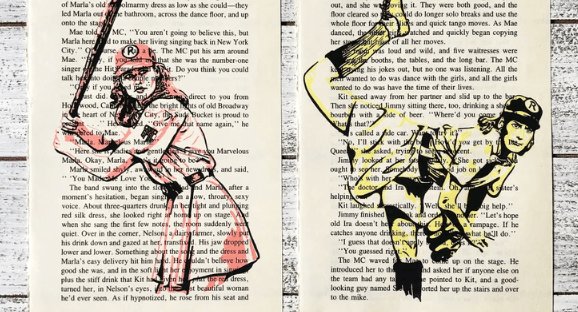
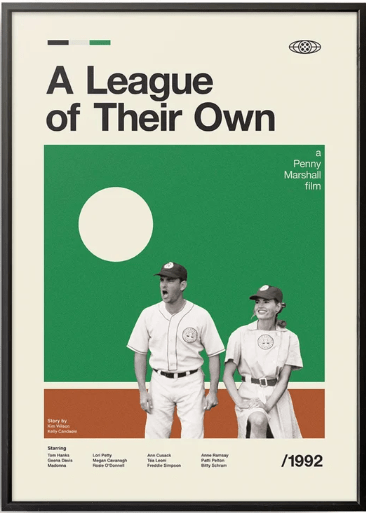
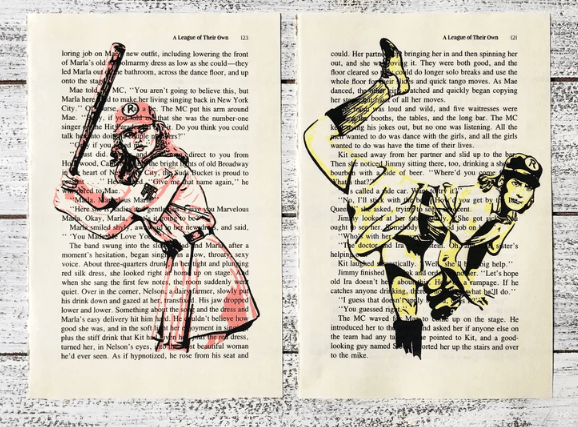
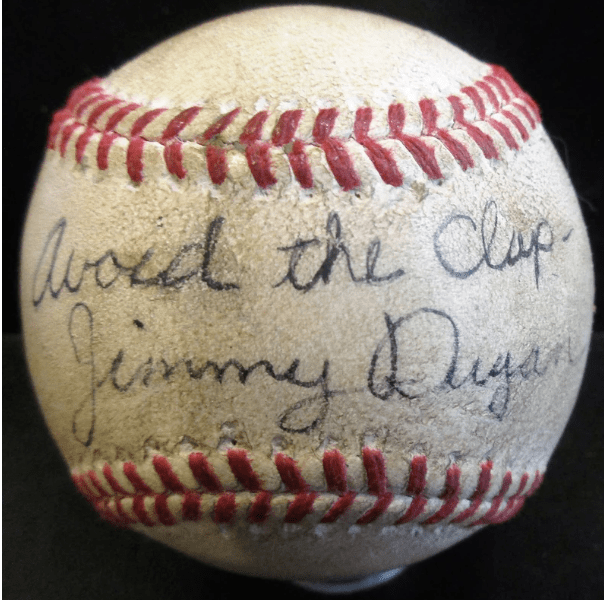
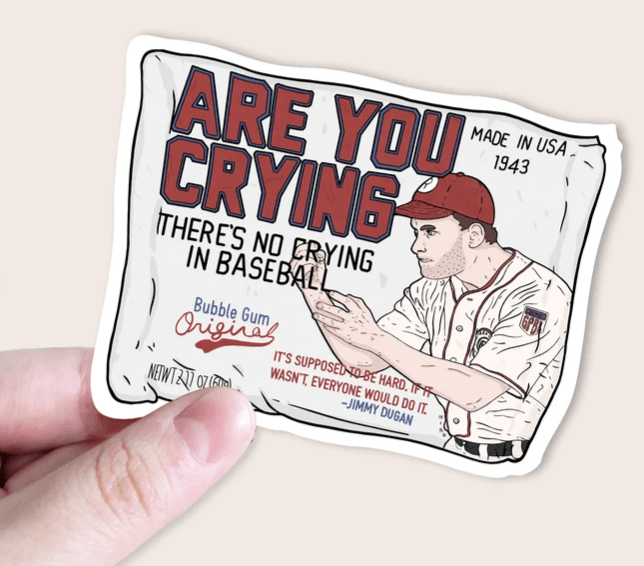
== Among the things fans have created on Etsy that memorialize the movie:

 Tom Hoffarth's The Drill: More Farther Off the Wall
2 thoughts on “Day 29 of 2023 baseball books: Penny for your thoughts about ‘League’s’ lasting power, and our two-cents worth”