


This post is part of a media project called SoCal Sports History 101: The Prime Numbers from 00 to 99 that Uniformly, Uniquely and Unapologetically Reveal The Narrative of Our Region’s Athletic Heritage. Pick a number, and consider the list of athletes attached to it. Who wore it best? Or, what’s the most compelling story linked to it? Any person, place or thing is in play with Southern California connections. Star power, transformational achievement, longevity, notoriety and quirkiness all factor in. Whatever leads to a lively discussion and interpretation.
The most obvious choices for No. 47:

LeRoy Irvin: Los Angeles Rams
Joey Browner: USC football
Clay Matthews III: USC football
Andy Messersmith: California Angels and Los Angeles Dodgers
The not-so-obvious choices for No. 47:
Ryan Nece: UCLA football
Trevor Bauer, UCLA baseball
The most interesting story for No. 47:
Trevor Bauer: UCLA baseball pitcher (2009 to 2011), Los Angeles Dodgers (2021)
Southern California map pinpoints:
North Hollywood; Newhall; Westwood (UCLA); Los Angeles (Dodger Stadium)
Assume there’s 47 shades of gray through which Trevor Bauer navigates life. For someone who often sees the world more as black and white/wrong or right, Bauer tends to be the one ahead of the curve, and the rest of us just don’t understand why that is so.
A pseudo psychologist trying to get inside the head of this uniquely driven Southern California product – born in North Hollywood, an early graduate of Hart High of Newhall, finding stardom at UCLA, and then, coming off a Cy Young Award, bedazzling the Los Angeles Dodgers into taking a measured risk on his employment — has plenty of material to work with. Bauer provides it often.
His accomplishments on the field stand out. His off-the-field adventures sit him down in the ever changing court of public opinion, as well as through the legal system. As Bauer has tried to rehabilitate what is left of his professional resume by taking up work in Japan, or Mexico, or South Korea, and then shoveling fastballs past prospects and future-has-beens in the independent minor leagues, Bauer has always been fit to be tied up, gagged and subdued. He has not left quietly.
A story of local, national and global interest is soon to reach a resolution, but until then, it’s just chasing headlines and podcast fodder for anyone still interested.
The background
Trevor Bauer was said to be so bored of high school– or tired of getting bullied for playing baseball – that he got enough credits to graduate after his junior year and enroll early at UCLA in January of 2009.
At Hart High, wearing No. 5, Bauer admitted to having teammate issues on a 2008 squad that would finish 23-7 and include senior Mike Montgomery, whom Bauer would later face in the 2016 World Series where the Chicago Cubs broke their curse over Bauer’s then-Cleveland Indians.
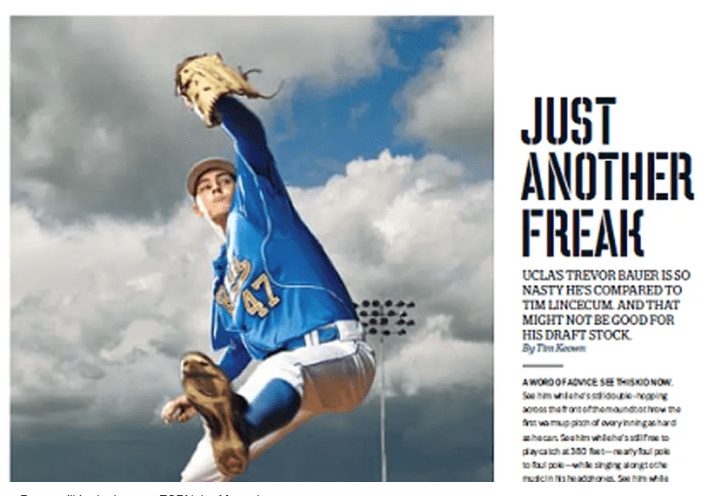
A story posted during that time in USA Today assessed why Bauer skipped his senior year — “a hostile environment fostered by older players on the team who did not take to Bauer’s brash attitude or his unusual training techniques.” File that away for future reference at the next steps along his progression.
In three seasons at UCLA, wearing No. 47 and majoring in mechanical engineering, Bauer was a sophomore when he teamed up with Gerrit Cole to provide the needed push to get the Bruins into the 2010 College World Series. At a junior, Bauer won USA Baseball’s Golden Spikes Award and the College Baseball Foundation’s National Pitcher of the Year.
The Arizona Diamondbacks took him in the ’11 MLB draft at No. 3 overall, two spots after Pittsburgh made Cole the No. 1 choice.
Voted into the UCLA Athletic Hall of Fame His 2021 selection into the UCLA Athletic Hall of Fame, at a point where he was still the school’s all-time leader in wins with 34 during his 44 starts, came the year after he won the NL Cy Young as a member of the Cincinnati Reds.
Wait, so what happened in Arizona?
Seems Bauer couldn’t get along with his Diamondbacks teammates. He also established a quirky pregame ritual of playing long toss between the two foul poles — which meant trying to throw the ball nearly 500 feet each time. It still raised eyebrows among those worried about its physical affect on his arm, but … what did he have to lose?
Arizona dealt him to Cleveland in 2012. Back to wearing his UCLA No. 47, Bauer refined his mechanics and became an AL All Star. Still, many in the organization wasn’t all that enamored with him. Especially after he threw a ball from the pitcher’s mound over the center-field fence when manager Terry Francona came out to remove him from a game in 2019. Bauer would apologize. Just a rough day, man. And right on brand.
There was even a story that his social media account was “gloriously hacked” in 2016 to revealed a bloody right pinkie finger injury that Bauer endured during the American League Championship Series. How did it happen. He was accused of slicing the finger open while working on his drone, and the stitches came loose.
Sent to Cincinnati for the truncated COVID season of 2020, Bauer managed to turn a 1.73 ERA in 11 starts, which included two complete-game shutouts amidst his five total wins (against four losses) into a Cy Young-worthy event. And he was a free agent.
That compelled the Dodgers to bring him back to Southern California in an oddly structured three-year deal – $40 million for ’21, $45 million for ’22, then just $22.5 million for the ‘23 season. Maybe they could foresee this wasn’t going to end well.
If there’s a will, there’s a Bauer.
“This season is about adding to our legacy, and I can’t wait Dodger fans,” Bauer said in the YouTube video, ending on a shot of him wearing a white Dodgers uniform with a new No. 27.
The pivot
For the first few months of his Dodger Stadium residency, the 30-year-old unflinchingly gave public dissertations, including one on the Dodgers’ TV pregame show, about how he was able to get a super tacky grip on the baseball to help his pitching abilities. Bauer actually showed how he could create a mix of rosin and sweat and, holding his right hand out flat, could attach a ball to his palm and keep there. It looked like a magic trick. That, he admitted, improved his spin rate. And it was perfectly legal. Even for someone who contended he was the only one capable of throwing what he called a reverse slider. Which was, what, a ball the went to the plate standing up?
When today you see an umpire stop a pitcher coming off the mound after an inning, or entering a game from the bullpen, to check a pitcher’s glove, hand and other parts of his body for anything that appears to be sticky sweat, thank Bauer for this. Even though the 2021 season was already underway, the MLB Protectors of Game Integrity created and enforced a new rule that allowed umps to dismiss a pitcher if they believe he had concocted a way to make his hand get a better grip on the ball through all the stuff Bauer showed off.
At the time in early July, Bauer was leading the NL in innings pitched and strike outs. It wasn’t reflected by his 8-5 record and 2.59 ERA after 17 starts during his Dodgers’ debut season.
That’s when things got really sticky.
Bauer had some scandalous personal accusations to deal with — enough to where he had to serve an extended MLB investigation/suspension of 324 games. It was reduced to 194 games after an appeal. The Dodgers kept paying him per his contract. Then they then cut ties in January of 2023 because it was reported that Bauer didn’t show remorse for his actions.

A relationship Bauer had with (at least) one woman involving an assortment of unseemly activity in the privacy of their bedrooms became public knowledge when lawyers got involved, documents were filed and dirty laundry was aired. Bauer did his own layers of lawyering on social media, which somewhat backfired on him.
While the Dodgers were on the hook for the remainder of his $22.5 million salary for the 2023 — a season where he never pitched, but was all fair based on the contract he signed — no other MLB team wanted any part of his contract bargain availability.
Bauer flew away and joined the Yokomama DeNA BayStars of the Nippon Professional Baseball League, donning a ying/yang No. 96 when he received a one-year, $4 million contract.
Bauer’s Twitter/X account posts allowed him to expand his audience and deliver his free-thinking thoughts on his desire to be defined as a free-market capitalist and social liberal, denying climate change, defending the use of Chief Wahoo as the Cleveland mascot and enjoying all sorts of barb exchanges with social media users.
As more court records produced more women accusing Bauer of inappropriate assaults – consensual or not – more defamation lawsuits were filed by him and his legal against those who reported on it.
It was a lot of more gray area producing plenty of shade thrown around. It made as much sense as Citizen Trevor posting things on things like his experimentation with vending machine quail eggs:
All the while, Bauer has lobbied to return stateside, with regular missives coming from the Los Angeles Times.
In 2024, he was the Mexican League’s Pitcher of the Year with a 10-0 mark and 2.48 ERA, striking out 120 in 83 1/3 innings for the champion Diablos Rojos. Red Devil Bauer also set a Mexican League record with a 19 strikeout-game against Oaxaca. He also had a game where he fanned nine in a row against Leon. In the postseason, Bauer, now 33, struck out 32 batters in 27 innings and had a 1.67 ERA.
In 2025, he went back to the Yokohama DeNA BayStars, but the organization didn’t flinch in sending him to its minor leagues when, in late June, Bauer had a 4-7 record, a 4.13 ERA and league-worst marks in walks and homers allowed.
“I have elite swing-and-miss stuff, but every time I throw it in the zone, it gets hit,” Bauer explained. “I try to throw more on the edges, I don’t get swings out of the zone, and I walk a lot of people. So then, as the game goes along, I try to throw more pitches in the zone, so I don’t walk people, and then everything is a hit.
“I don’t know what else to … I’m completely lost, to be honest. It’s a mixture of frustration and depression. Everything I’ve tried has been unsuccessful. I have five elite pitches. When I throw them in the zone, they hit like .400 on balls in play. I lead the Central League in strikeouts, but I’ve given up the most hits and the most runs. I don’t know how to rationalize those two things.”
The demotion also came after he yelled at his pitching coach, who came to remove him during a start. Bauer left the dugout instead of staying to watch the inning finish.
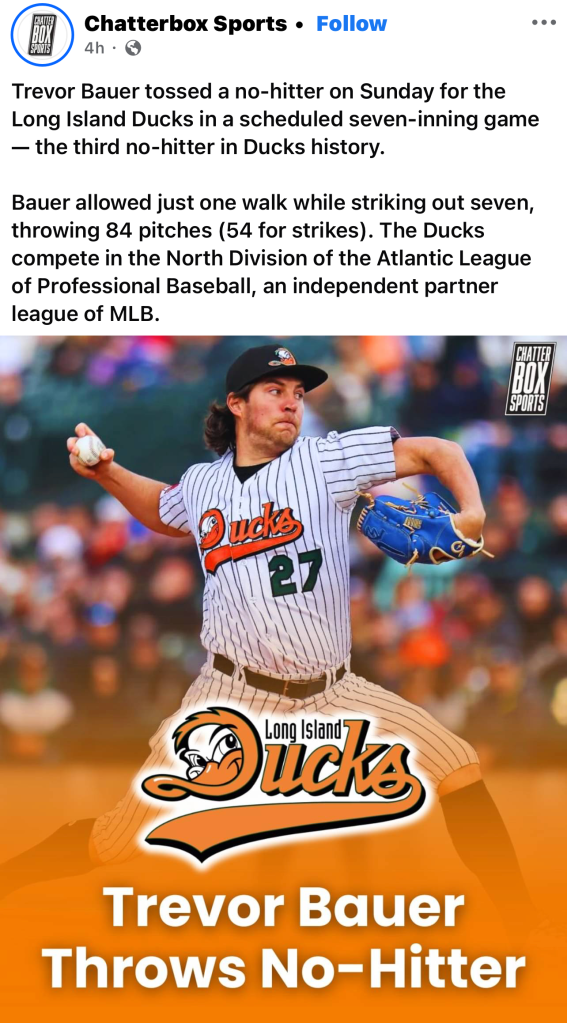
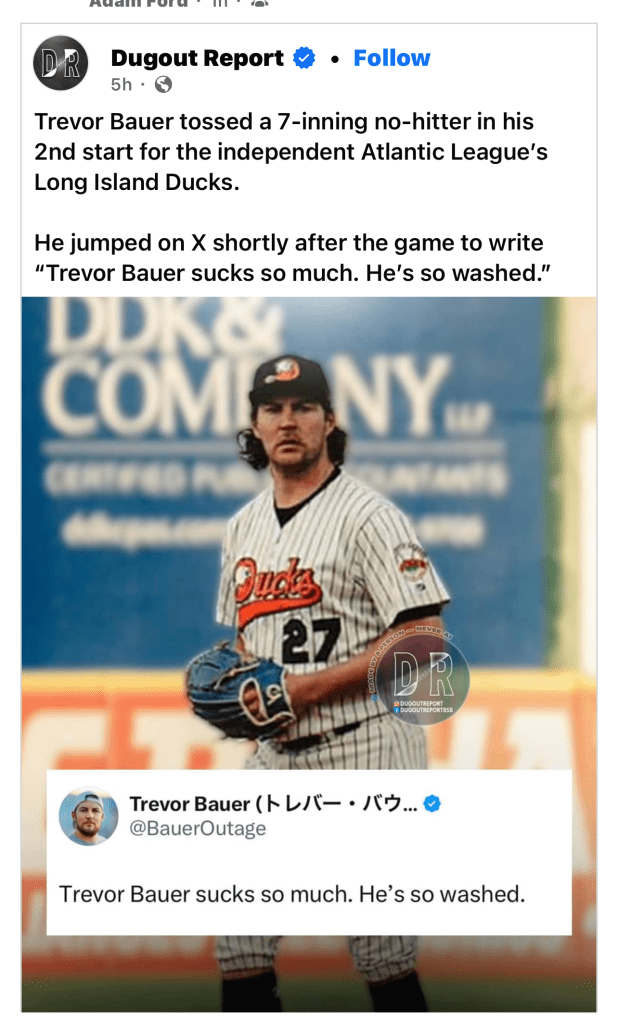
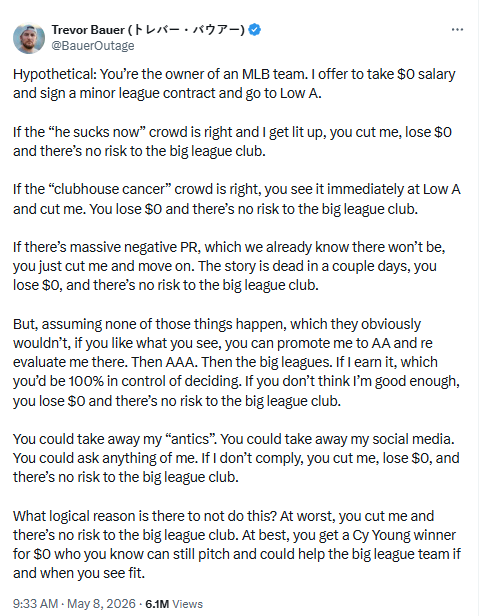
In 2026, the still lame-duck Bauer somehow landed with the independent Long Island Ducks. He made news when he threw a n0-hitter (a seven-inning version), which immediately gave Bauer more fodder to show how that was a pretty big indicator of how good he still was. He posted on social media he’d be willing to take an MLB job for a “$0 salary.”
Informed that the MLB Players Association might have an issue with him playing for free, Bauer replied, “Who gives a crap about what mlbpa does or doesn’t want?”
How did that pan out?
Later that summer, Bauer was back pitching in Mexico, giving media outlets like OutkickTheCoverage more material to back the narrative that he has unjustly been sent into a professional exile.
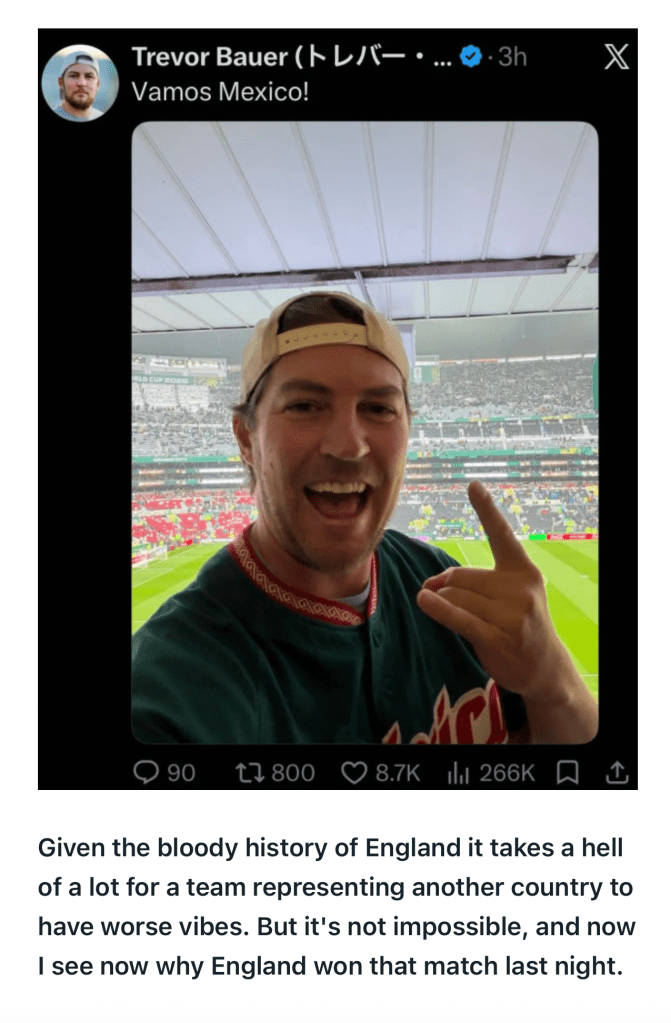
During the 2026 World Cup, Bauer showed up in another social media post — attending an England-Mexico game in Mexico City. Thanks to Craig Calcaterra for providing the caption of the latest “Where’s Waldo” version of the Bauer journey:
Who else wore No. 47 in SoCal sports history?
Make a case for:
LeRoy Irvin, Los Angeles Rams defensive back/cornerback (1980 to 1989):
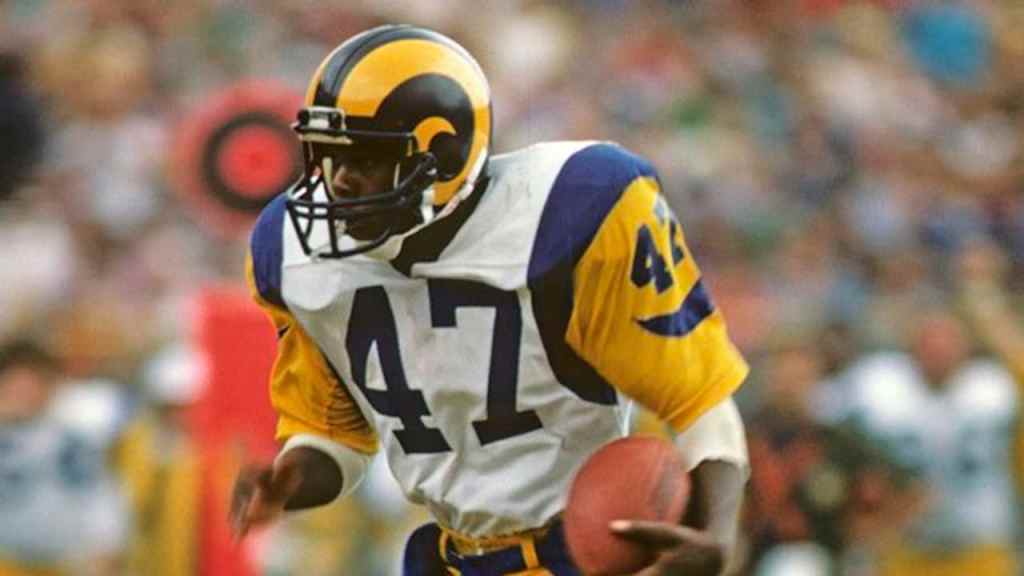
Best known: Irvin holds the franchise record for most touchdowns that came as a result of not being on the offensive side the ball. Of his 11 in this category, five were interception returns, four were four punt returns, and one each as a fumble recovery return and blocked field goal return.
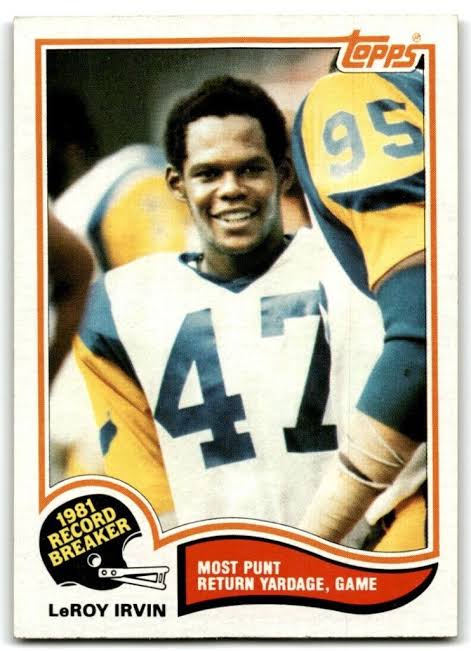
Selected by the Rams in the third round of the 1980 draft out of Kansas, Irvin’s 10 seasons in L.A. saw him shine in a 1981 game where he set an NFL record that still stands — 207 punt return yards during a 37-35 win over Atlanta. Two of his six punt returns that day went for touchdowns, of 75 and 84 yards. Irvin finished his career with 35 interceptions for 676 yards, and 147 punt returns for 1,457 yards. After retirement, Irvin became a mortgage banker, a gas station owner and a boxing promoter and then returned to SoCal as a volunteer assistant at Cal State Northridge in 1992. He died at age 68 after a long battle with throat cancer.
Clay Matthews III: USC football linebacker/defensive end (2004 to 2008):

Best known: The son of former USC and NFL standout Clay Matthews Jr., nephew of Pro Football Hall of Famer and USC star offensive lineman Bruce Matthews, grandson of former NFL player Clay Matthews Sr., and younger brother of USC 2003 national title team member Kyle Matthews, Clay Tre was hardly a blip on the college recruiters’ iPad when he came out of Agoura High. “I was undersized as a junior and I didn’t even start, and my dad was the D-coordinator, so that alone should speak volumes about where I’ve come from,” he once told the Milwaukee Journal Sentinel after the Green Bay Packers used a first-round pick on him in 2009.

Clay III walked on at USC, redshirt a season despite head coach Pete Carroll tempting him to go into games on special teams or as a backup linebacker. His first time on the field was 2005 as a sophomore, finally getting a scholarship.
By the time he was finished, he was USC’s Special Teams Player of the Year in in 2006, ’07 and ’08 and, getting up to 6-foot-3 and 245 pounds, broke into the starting lineup as a senior at what was called the hybrid “elephant” position — standing at defensive end, but dropping back as a linebacker depending on the play in front of him. He wound up starting 10 games, and finished fourth on the team with 56 tackles (nine for loss) to go with 4½ sacks. USC teammates Brian Cushing (drafted No. 15 overall by Houston) and Rey Maualuga (drafted No. 38 overall to Cincinnati) got most of the attention on USC’s defense, but Green Bay had plans for him with its 26th overall choice, seeing him as a type of player such as former Los Angeles Rams great Kevin Greene. Matthews III played in six Pro Bowls for Green Bay and was the Packers’ all-time sack leader (83.5).
Not well remembered: Clay III finished his career with the Los Angeles Rams, starting 13 games and wearing No. 52 in 2019.
Joey Browner, USC football defensive back (1979 to 1982):
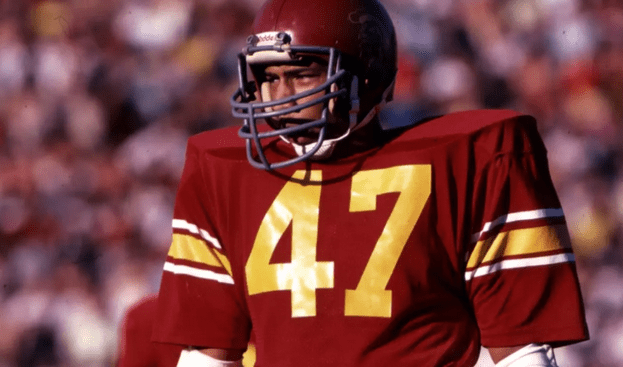
Best known: Browner was earned the Mike McKeever Award as team MVP follow his senior season, having picked off six passes and returning three for touchdowns. He was also given the Marv Goux Award, presented to player who contributed the most during the USC-UCLA game that same season. He was the Trojans’ punt return leader in 1981 (17 for 136 yards, an 18.0 average) and ’82 (29 for 273 yards with a TD. In 1981, he also led the team in pass deflections (16) and fumble recoveries (2). In 1982, Browner was USC’s kick return leader (6 for 134, a 22.3 average) and fumble recovery leader (3). A first-round NFL draft pick by Minnesota, No. 19 overall in 1983, Browner played in 145 games with 37 interceptions, making three Pro Bowls and four times on the “All-Madden Team.” He was one of four brothers to make it to the NFL, including younger Keith Browner (at USC, Class of ’84), after older brothers Ross and Jim went to Notre Dame. Joey Browner died at 65 in March of 2026.
Not well remembered: Joey Browner was named to the Pac-12 All-Century Team in 2015 but was never a consensus All-American pick during his career.
Andy Messersmith, California Angels pitcher (1968 to 1972), Los Angeles Dodgers pitcher (1973 to 1975, and 1979):
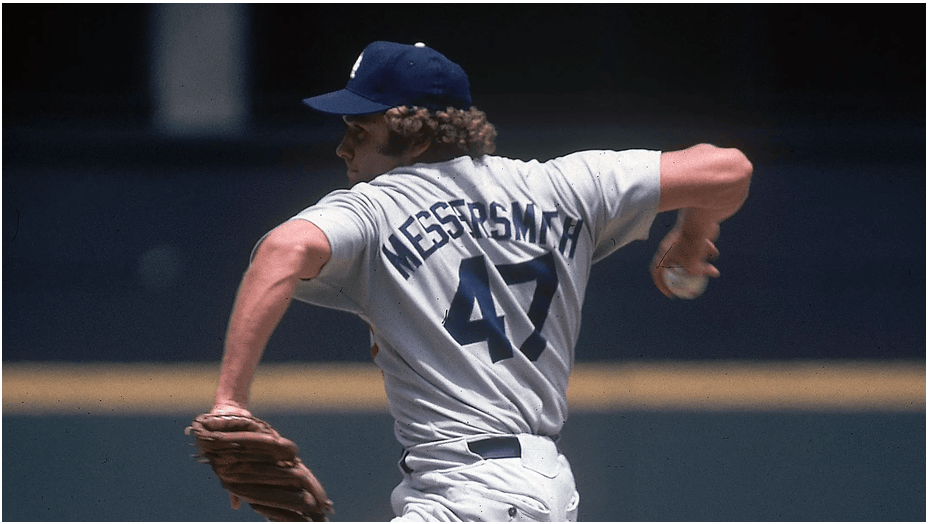
Best known: The first major benefactor of the MLB players’ challenge of the reserve clause, Messersmith made news signing a $1 million, three-year deal with Atlanta, choosing to leave the Dodgers (and his $90,000 salary) after after two All-Star seasons — leading the league with 20 wins on the ’74 World Series team to go with 40 starts, 19 complete games and seven shutouts in 321 innings in ’75 with a 2.29 ERA and 19 wins when he pitched without a contract.
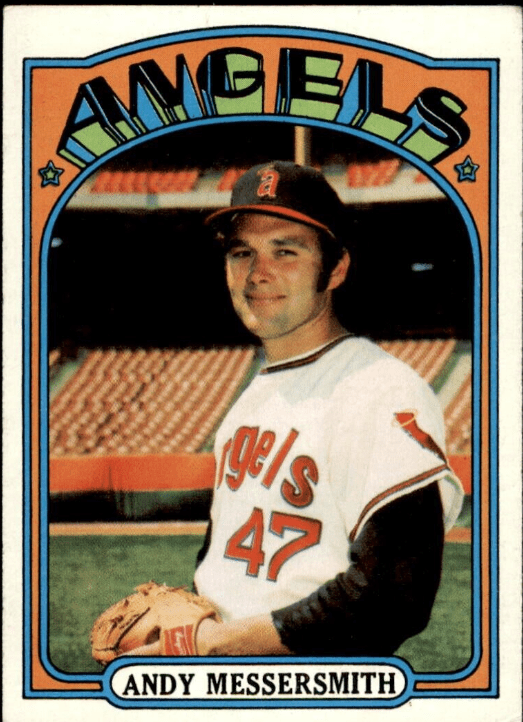
Messersmith moved to Orange County with his family and first played high school baseball at Long Beach Wilson before transferring to Western High in Anaheim. Messersmith had a 14–1 record, a 0.75 ERA and a .344 batting average as a senior as Western was runner-up in the CIF 3A finals. Messersmith was the Sunset League Player of the Year, All-CIF and the Orange County Player of the Year voted by Orange County sportswriters. It was fitting he was a first-round pick (12th overall) in the 1966 MLB Draft by the Angels out of Cal. Messersmith won 59 games for the Angels at the start of his career and was a 1971 All Star. He was dealt to the Dodgers with third baseman Ken McMullen in exchange for DH Frank Robinson, Bobby Valentine, Bill Singer, Bill Grabarkewitz and Mike Strahler in one of the biggest trades between the two Southern California clubs. Messersmith won 55 games for L.A. — that included his final two after he circled back in 1979. That closed out a run when he was just 16-15 in three seasons for the Braves and Yankees.
Not well remembered: Messersmith’s best story related to wearing a number came when Braves team owner Ted Turner issued him No. 17 and then had the word “Channel” stitched across his back where his last name would have been. “Channel” was supposed to be Messersmith’s new nickname? It was done advertise Turner’s local TV station, Channel 17. That didn’t fly with MLB rule makers.

Ryan Nece, UCLA football linebacker (1999 to 2001): The son of former USC All-American and Pro Football Hall of Famer Ronnie Lott purposely took the surname of his mother so that it might take some of the pressure off him in his football pursuits as he started at Pacific High in San Bernardino. He began as a his safety but converted to linebacker as a four-year starter and was an All-Pac-10 honorable mention.
Lee Smith, California Angels pitcher (1995 to 1996): There are 13 players in the Baseball Hall of Fame who spent at least one season in an Angels uniform: Bert Blyleven (1989), Rod Carew (1979 to 1985), Vlad Guerrero (2004 to 2009, the only one actually wearing an Angels cap), Rickey Henderson (1997), Reggie Jackson (1982 to 1986), Frank Robinson (1973 to 1974), Nolan Ryan (1972 to 1979), Don Sutton (1985 to 1987), Hoyt Wilhelm (1969), Dave Winfield (1990 to 1991) and Dave Parker (1991). Add Smith to that list. He had 37 saves in 1995 (among his 487 career mark) and made the AL All-Star team despite an 0-5 record, adding to a W-L career mark of 71-92. These are the things you learn from the Immaculate Grid game. Smith was inducted into the Hall with a Chicago Cubs hat.
Have you heard this story?
Bear Bachmeier, Murietta Valley High School football quarterback (2022-to-’24):
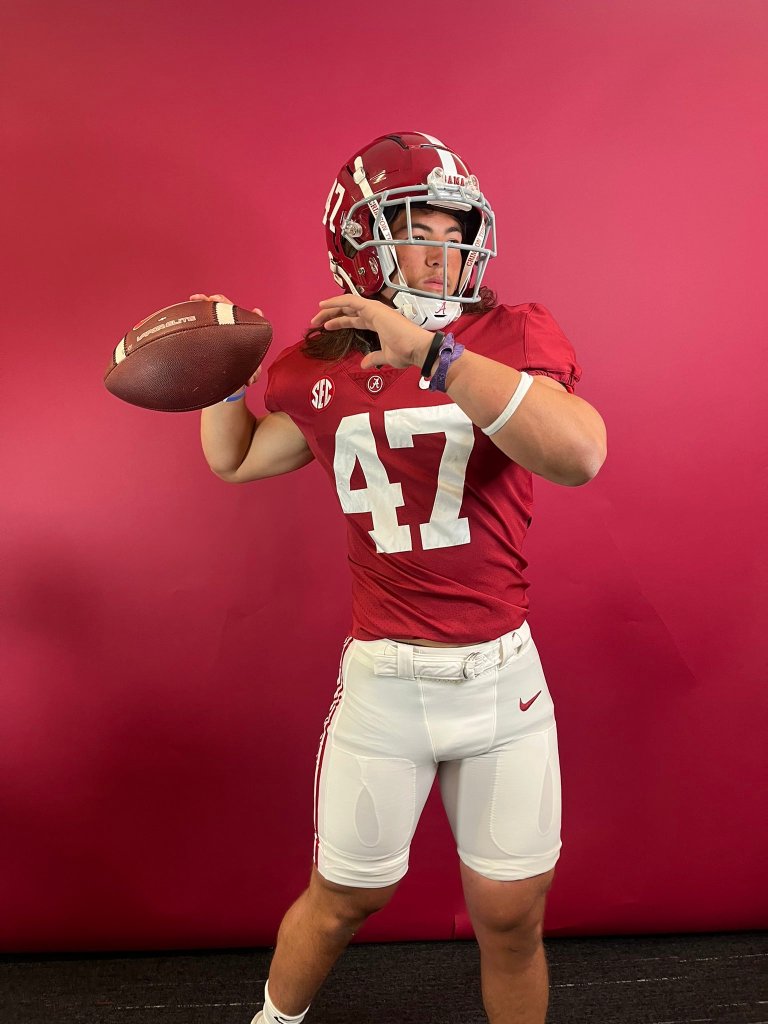
The L.A. Times story begans: “Bear Bachmeier of Murrieta Valley might be the only quarterback in America wearing No. 47. … ‘My dad (Michael) always jokes around with me: “Once you cross that line of scrimmage, you’re a fullback.” I think it’s testament to how hard I run the ball. It’s cool to wear No. 47.” The 6-foot-2, 225-pound Bachmeier took Murietta Valley High to the Southern Section Division 2 championship game and finished with 92 yards passing and 66 yards rushing in a 31-28 loss to Newbury Park. He signed to play at Stanford in December, 2024, enrolled a month later, but transferred to BYU in May of 2025 and continued to wear No. 47. It caught the attention of the New York Times in a story headlined: “Can a jersey number give a player a psychological edge? Just ask the QB who wears 47.” It noted that in 2025, of the 163 FBS quarterbacks who have played 150 snaps this season, Bachmeier is the only one to wear a number above 19. “As humans, we really like having control of our lives, control of our surroundings, and part of that control is controlling your own identity,” said Dr. Chris Stankovich, a sports psychologist who has worked with youth, collegiate and pro athletes. “As an athlete, you think, ‘That is who I am. I am that number.’ And the number for many athletes provides comfort and confidence. Every little edge helps. It might not be a big deal to 6 or 7 year olds, but in high school, college, the pros, if you can get a jump about feeling good with your own identity with this number on your back, why wouldn’t you do it?” Growing up, Bachmeier also wore No. 47 playing baseball and basketball. Hank, the oldest of the five Bachmeier children, wore the No. 19 most of his life. Tiger Bachmeier, Bear’s older brother and a junior wide receiver for BYU, wears 19.
Luis Cruz, Los Angeles Dodgers infielder (2012 to 2013): For some reason, Dodgers fans loved chanting his name “Cruuuuuuuuz” as he took over playing third base and shortstop as a fill-in between Dee Gordon and Hanley Ramirez in 2012. Cruz drove in a run in each of his first four games, the first in franchise history to do that since Jimmy Wynn (who drove in a run in each of his first six games as a Dodger in 1974.) Cruz hit .297 in 78 games. But the 28-year-old from Mexico, who had played in more than 1,200 minor-league games, didn’t last past the next mid-season. Still, he was a feel-good story. And a cult hero. Cruz was named the Dodgers’ Spanish-language TV analyst for the 2025 season after the passing of Fernando Valenzuela.
Howie Kendrick, California Angels infielder (2006 to 2014), Los Angeles Dodgers infielder (2015 to 2016): An AL All-Star pick in 2011 for the Angels, the Dodgers had him as a utility player for two seasons before he came back to haunt them in the 2019 playoffs. Kendrick hit a 10th-inning grand slam off Joe Kelly to boost fourth-seeded wildcard Washington to a 7-3 win in Game 5 of the NL Division Series over the favored Dodgers.
Moose Stubbing, California Angels manager (1998): As a player, Stubbing got into five MLB games all as a pinch hitter in 1967 and struck out four times. He played in more than 1,400 min0r league games from 1956 to 1969 before joining the Angels’ coaching staff and minor-league affiliates. In 1988, when the Angels fired Cookie Rojas as their manager, Stubbing took over to end the season — losing the final eight games.
Anyone else worth nominating?
It’s been noted that the number 47 is recurring in episodes of “Star Trek” franchise, going back to 1966 as the TV show that spawned 10 spin-offs and 13 movies. It seems to be connected to writer Joe Menosky, who incorporated 47 as a reference to his time at Pomona College. The story goes that two students did a research project to determine whether No. 47 occurred more often in nature than other numbers. It was never proven. But it was established as Pomona folklore.


1 thought on “No. 47: Trevor Bauer”