


“The Bill James Handbook 1990-2023: Walk-Off Edition”

The authors:
Bill James
& Sports Info Solutions
The publishing info:
ACTA Sports; 252 pages; $24.95; released Oct. 30, 2023
The links:
The publishers website; the authors website; at Bookshop.org; at Powells.com; at BarnesAndNoble.com; at Amazon.com
The review in 90 feet or less
Win shares. Runs created. Range factor. Similarity scores. Power/Speed.
And nut cases.
Go to war with all that if need be. Or accept it as collateral damage to your value system of HR, RBIs, W-L and ERA.
Bill James created Sabermetrics, and Sabermetrics changed Baseball. And Baseball Today is what it is because of, in a lot of ways, George William James, aka The Professor of Baseball. It can be a rough road to traverse, navigating a baseball world of new and improved weights and measures, if you don’t really look back at who tipped the scales into a modern-day mishmash of numerical mayhem.
James not only did that, but he provided context. And that’s why it has worked out, kicking and screaming. Don’t be a baby about it as you soak in your bathwater.
With this particular book project, a 34-year run ends. All good things do.
The way James changed the entire dynamics on how baseball is sized up, dissected and reconstructed is coming to a natural conclusion. And he’s now allowed to take his name out of the lineup.
The trick isn’t that the 75-year-old historian/writer/statman created the name “sabermetrics” after the Society of American Baseball Research. It was that, for someone who started pounding out essays while working as a night-shift security guard at the Stokley-Van Camp’s pork and beans cannery after leaving the U.S. Army ended up included in Time magazine’s 2006 edition of one of the 100 most influential people in the world.

New Yorker magazine once said James’ writing was a critical influence for Nate Silver, among many others—it’s possible that data-journalism outlets such as Silver’s FiveThirtyEight and the Times’ The Upshot would not exist without the groundwork James laid.
This “walk off” edition bookends a run that began with his Baseball Abstract launch in 1977, which introduced more than a dozen new statistical measurements of players’ performance and abilities. Sports Illustrated caught onto it, promoted its genius in the early ‘80s, imitators emerged, but none could catch up. James had built too great a lead into this thick forest. He stopped writing the Abstract, became a favorite resource of Fantasy Baseball players with his ratings systems, and segued into the Handbook in 2003, featuring Barry Zito on the cover.
That’s also the year Michael Lewis dedicated a chapter of his best-selling book, “Moneyball,” to James’ career and sabermetrics affect on Oakland Athletics GM Billy Beane. James also was referenced several times in the film version of “Moneyball,” mostly because of how the Boston Red Sox eventually hired him to help assess their roster.
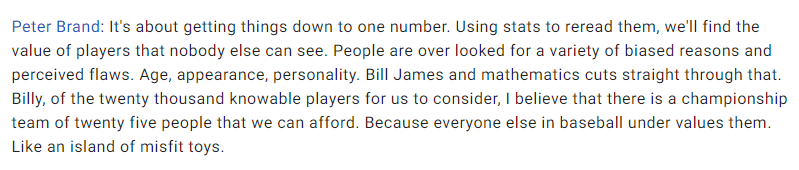
(By the way: There’s a movement among some seamheads that the 1994 kids’ movie, “Little Big League,” where a 12-year-old inherits the managers role with the Minnesota Twins based on his knowledge of stats, really was more a positive push for sabermetrics than “Moneyball.” You can look it up).
For this final edition, some may find it thin as it’s not graphics heavy. Instead, it’s more reflective, with enough fresh and original material that holds weight.
James explains how this all started – he was frustrated with The Sporting News’ Baseball Register and thought he could do better.
“There we some choices we made years ago that weren’t good ones,” he admits on page 11. “And there were some that were good ones that didn’t age well.” He admits that since it was “my book,” there were some problematic issues with the fact “I did about 1 percent of the book,” and much was done by his staff of researchers and writers. He thanks them all.
James gets one last crack at explaining Win Shares, “born in a burst of overconfidence, which I suppose is a fault to which I am prone.” He also rhapsodizes on Career Targets, Baserunning, Pitcher Value Retention and the Reliability of Park Effects.
Also appropriate is a 15-page transcript of a Q&A with James, conducted by Mark Simon, where at one point James explains his process: “I create an approach toward a problem, and I work on it until somebody with more technical skills picks it up, and then I go do something else.”
Here’s someone who still can give a credible explanation as to why he thinks Mike Trout was the World’s No. 1 Hitter on each of the 1,752 days between 2014 and 2021, taking the title from Miguel Cabrera before giving it up to Mookie Betts, we’re in. Especially if 50 years from now, the same basic dynamic can put the career of Shoehi Ohtani into some kind of perspective with Babe Ruth.
And if we can still look back on the 2011 National League MVP voting – 12 years after Milwaukee’s Ryan Braun was given the title, tainted, over the Dodgers’ Matt Kemp – let’s do it. And the conclusion by writer Bobby Scales (a former Chicago Cubs relief pitcher, by the way, with a career WAR of 0.1, and is now the Baseball Info Solutions’ VP of Baseball after working several years in the front offices of the Angels and Pirates): Kemp deserved it more. Scales tips the scales to Kemp because he led the league with 39 homers, 115 runs scored and 126 RBIs with more than 13 different players hitting behind him. Braun had Prince Fielder hitting behind him in that Brewers’ lineup every day, and Fielder ended up third in that MVP voting for the NL Central-winning (with 96 victories) Milwaukee franchise (vs. the 82-79 third place NL West finish for those Dodgers). And it has nothing to do, really, with the post-award revelation of Braun’s PED use, and Kemp’s non-PED use.
Well of course Kemp deserved it. Even without official replay. But now we have a platform.
How it goes in the scorebook
Grab it before it goes extinct, absorb it while the reflection process is still there, and shelf it among the prominent baseball books on the shelf, if only to show future generations you lived in a time when the game did a dramatic pivot in how it was enjoyed and consumed.
As it is written in the dedication: “This book is dedicated to the next person that tells you they want to learn more about baseball. Educate them well. You never know what may come of it. That person might be the next great baseball researcher.”
Now, could Cooperstown just create a plaque of this cover, include that inscription, and place it somewhere in a wing of contributors that allows James proper recognition? Wonder what James would think of that.
You can look it up: More to ponder
== Hey, has Bill James ever really broken down the career of the somewhat sketchy “Big Bill” James, an MLB pitcher from 1911 to 1919 who was one of the “clean” members of the Chicago White Sox roster (even though he gave up eight hits, walked three and surrendered three runs to post a 5.79 ERA just short of five innings pitched in that ’19 World Series).
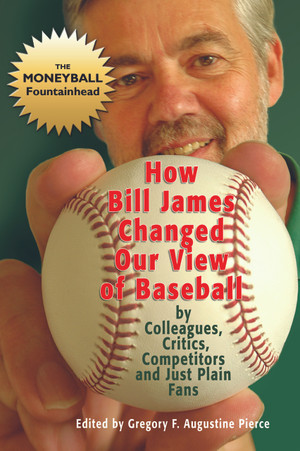
== Tracking down James’ “Walk Off” Handbook also compelled me to find (and re-read) two others:
“How Bill James Changed Our View of Baseball,” edited by Gregory F. Augustine Pierce (2007, ACTA Sports), with contributions by Rob Neyer, Steve Moyer, Hal Richman, John Thorn, Alan Schwarz and James himself with a piece called “The Last Word.” It helps put this final “Handbook” into more perspective.
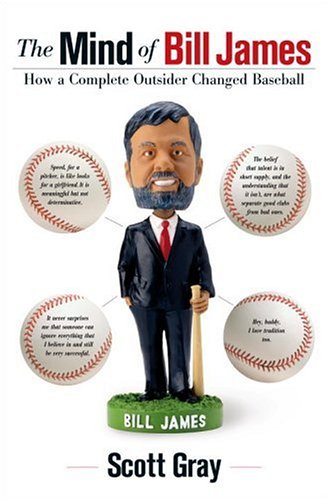
Also: “The Mind of Bill James: How a Complete Outsider Changed Baseball,” by Scott Gray from 2006 (Doubleday Publishing, 256 pages). Here’s an excerpt of that from the New York Times.
== Some of those who’ve written things substantially about James’ “Walk Off” publications includes IBWAA member Bill Johnson, a contributor to SABR’s Biography Project, who posted this in the IBWAA Substack account in late December:
“As with Tom Wolfe’s work researching and crafting his book The Right Stuff, the seminal examination of the inner sanctum of military aviation culture in the late 1950s and the subsequent transition to NASA and the space program in the ‘60s, (all from his perch as a non-invested observer), James’ role as baseball outsider allowed him to question some of the sacred cows of the game, the knowledge and knowing, the ontology and epistemology of the national pastime, without violating any unwritten professional codes.
“His perspective as an outsider has always allowed him to be direct — blunt even — in his analytical process, and his conclusions have both entertained his audiences and stimulated incalculable thought about something so specific and arbitrary as the game of baseball.
“With the closing of his website, Bill James Online.com, and the end of the Annuals, it is time to consider the future of baseball analysis for those of us who remain.
“James’ ability to explain his inquiries, his methods, his conclusions, and then his extrapolations, remains unequaled. His gift with words was terrific from the start and only grew over time, and will be an inextricable part of his legacy for as long as there is a reading audience for baseball. That communication is what must be replaced or replicated as the field of analytics matures.
“There are some supremely talented writers in the James’ genre working today. Joe Sheehan jumps immediately to mind, but any list of such writers offered here would necessarily be incomplete due to space limitations. Still, the advances of social media and the attendant compression of expression are unintentionally narrowing the qualitative scope of questions, and are, more and more, demanding reliance on simple regurgitation of numbers for the technical audience. Solve for X, that thinking goes, and voila, the mysterious fog of the game should clear.
“If it were only that simple.
“The next generation of popular baseball analysts will probably need to study their messaging as much as their message.”
= Al Yellon from BleedCubbieBlue.com posted in late December:
I’ll miss the annual Bill James Handbook, though as is pointed out, most of the numbers they put in print form are available online via Baseball-Reference and Fangraphs, among other sites. Bill’s website Bill James Online was also retired last September, though the archive remains live.

== And there’s always this if you need to track it down: “Covering the Bases: Making Sense of Bill James’ Statistical Nonsense,” by Travis Walsh and Thomas McFall (2006, self published, 244 pages, $18.95).

 Tom Hoffarth's The Drill: More Farther Off the Wall
1 thought on “Day 1 of 2024 baseball book reviews: Bill James values his intentional walk”