
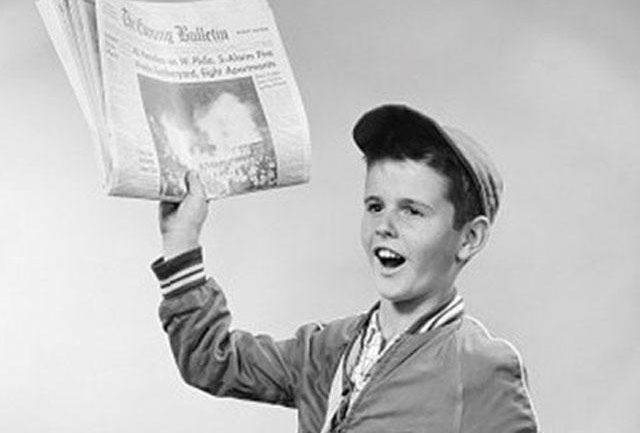

“The Dodger Collection: Richard Kee Photographs”
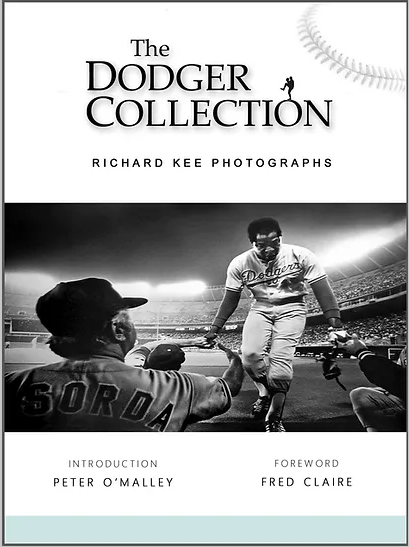
The author: Richard Kee
The publishing info: Taylor Publishing; 188 pages; $39; released Sept. 27, 2023
The links: The publishers website; the authors website; at Amazon.com
The review in 90 feet or less
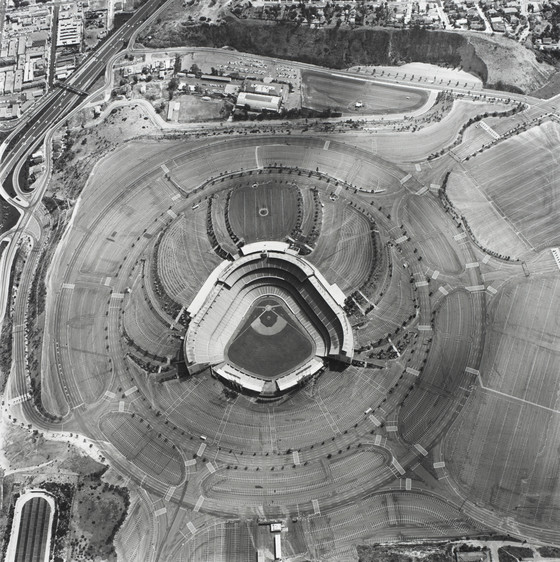
Above, check out Dodger Stadium from above.
The photo is included in rare and classic 1967 collection curated by artist Ed Ruscha called “Thirtyfour Parking Lots in Los Angeles.” Limited-edition copies of the self-published 10-by-8 inch book, part of a series of 16, sell in the thousands of dollars.
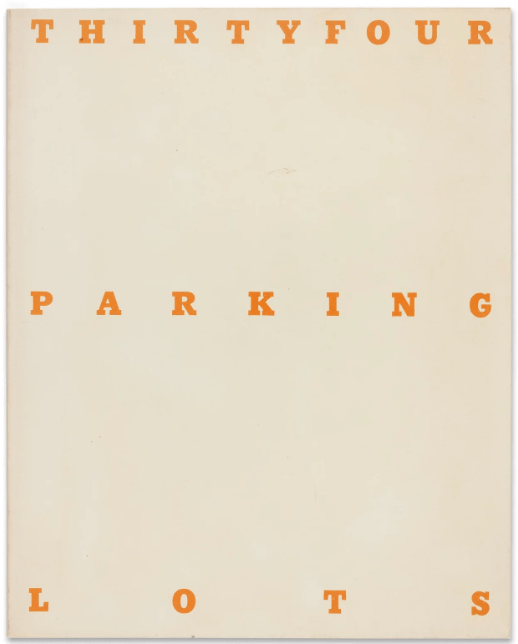
In this book, Ruscha uses aerial viewpoints over many places in L.A. to capture its dramatic display of abstract geometry and composition — including the football field and campus over Pierce College in Woodland Hills, the Gilmore Drive-In, a Sears & Roebuck store, churches, shopping centers and spots in Century City and Universal Studios.
The images were actually taken by Art Alanis, with the direction of Ruscha, hovering in a helicopter Ruscha hired for this shoot on an early Sunday morning. In 1999, Ruscha produced limited edition portfolio prints from the same negatives as from the 1967 book, but some were cropped differently, which displayed more of the original image. They are in a book that describes them as a way to “bespeak and punctuate a rapidly developing cityscape.” That ’67 book also came a year after Ruscha famously published “Every Building on the Sunset Strip.“
The Los Angeles County Museum of Art has an exhibit called “Ed Ruscha / Now Then” starting April 7 and running through October 6. It also has an online digital display of 30 of Ruscha’s “Parking Lots” — here is the Dodger Stadium shot as it was printed on gelatin silver paper for display.
One of the most important artists still working today, Ruscha moved to L.A. from the Midwest in 1956 to attend Chouinard Art Institute, now known as Cal Arts. Ruscha’s “diverse oeuvre” (as one gallery puts it) includes painting, drawing, prints, photography, film and artists books. His work is known to be inquisitive and philosophical, mirroring pop culture, language, commercial advertising and contemporary life. A Warhol for today’s world.
Reflecting on the 2024 Dodger Stadium home opener — more than 50 years now since it opened, after updating, reshaping and still preserving its original 1960s art form — I’m thinking that if Ruscha’s work in this instance is focused from high above the ballpark, Richard Kee has a collection of work that captures the place from its primary foundation.
So much so, photographer Kee can even step back to admire and acknowledge just that aspect, as, in this book, his portfolio concludes with the shot below and Kee captions it: ” … and finally, the heart and soul of Los Angeles Dodgers baseball.”

That’s actually quite heavenly.
And that’s how this becomes an important entry point.
Kee explains that his time with the Dodgers started in 1976 as a 23-year-old. It spanned all the Dodgers-type Showtime of the 1980s – Fernandomania, World Series runs, Tommy Lasorda’s takeover, crushed playoff endings, and all the joy in between.
Much of his work was for Dodger team publications, marketing, and framed to be displayed in the stadium offices and halls. But he also owned his photos and has a lifetime licensing to use them — with the knowledge the team will often pull them out to show important moments in its existence.
Key’s time documented an historical period of the Garvey-Lopes-Russell-Cey infield. Photos that Kee took over the 30-home run group of 1977 became iconic enough to create a four-person bobblehead. As well as some city folk art.
Expanding on that, the validation of people around the team that also had an impact: Bud Furillo, Francis Friedman, Nobe Kawano, Roger Owens, Bob Hunter, Al Campanis ….
There’s even a precious story conveyed about a baseball that Vin Scully signed to “pretty Laura,” Kee’s daughter, who then took the ball to her “show and tell” at pre-school and explained to the class: “Mr. Scully is the gas station man. He puts gas in our cars.” Because that’s how she knew him as the nice man who did the commercials for Union 76.
Priceless.
As Kee has been doing talks about his book around Southern California, he explains more about how he misses that time when he was using film, with 36 shots to a roll, and having to make sure he had enough loaded in the camera to get the work done needed. It was then the process of having the film developed in the dark room and anticipating if the shot he thought he got actually happened, or what surprise he found by a fortunate click of the shutter.
The cover photo also has a story: Kee got permission from the Philadelphia Phillies to be in the Dodgers dugout during a came at Veterans Stadium, and he captured a shot he wanted — a wide-angle of a player coming back to the dugout after a home run, showing celebration. But right after that, umpire Ed Vargo ordered him out of the dugout. Tommy Lasorda came to his defense. Kee ran toward the clubhouse tunnel. He found out he had been ejected.
Some of Kee’s favorite photos in the book: Burt Hooton and his son Eugene in the lockerroom tunnel, a close up of umpire Joe West wearing his mask, the right angle of capturing Ron Cey on the ground in pain after he was hit in the head by a Goose Gossage pitch in the World Series — and his helmet, which saved his life, sitting their on the ground.
It’s somewhat insufficient to put more words up net to all these images. Preview for yourself.
How it goes in the scorebook
The trivial assessment is that this book is “picture perfect” but …
These pictures perfectly convey the history of that time, the cool, the fun, the energy, the Hollywood, the intensity, the entertainment value. The black-and-white presentation gives it context because, in our digital color world, these camera-and-film moments feel as much as if they were captured such a long time ago as well as if it was just yesterday. It’s also one thing to swipe through photos on a phone, or scroll through on a screen, but to have then bound in a tangible book gives them weight and honor.
This time-capsule presence brings moments and memories back, reinvigorates conversation and likely curates a thirst for more.
Imagine that.
We can be thankful for the time and effort put into this project and proudly add this to our collection. The endorsements provided by Ross Porter, Steve Garvey, Dennis Gilbert, Ted Giannoulas and Ann Meyers Drysdale, plus Fred Claire (who hired Key in 1976 with little credentials), validate the project’s importance. Claire continues to be impressed with the way Kee was able to capture moments in the game that weren’t just slides into second or a hitter connecting on a fastba..
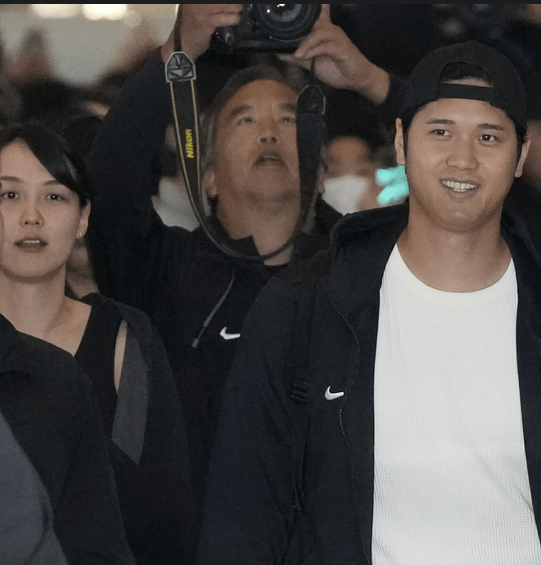
An added bonus: Photos from the book are available for purchase at the official website. That Scully-Lasorda pix, with the black frame, matted, is simply a steal at $79.
With this book, we are also reminded that someday, the work of Jon Soohoo, the Dodgers’ official team photographer since 1995, shall someday be as much a blockbuster collection. A story we did on Soohoo in 2017 may explain better.
He’s been on the field recording Dodgers’ history since he and I left USC in the mid 1980s. The moments Soohoo has alone with Scully — including Scully taking him with him to receive the the Presidential Medal of Freedom in 2016, and the stories that must be with it — are worthy of a published collection, should the Dodgers grant that accessibility to his work. There’s also this shot from Scully’s Ring of Honor induction in May, 2017.
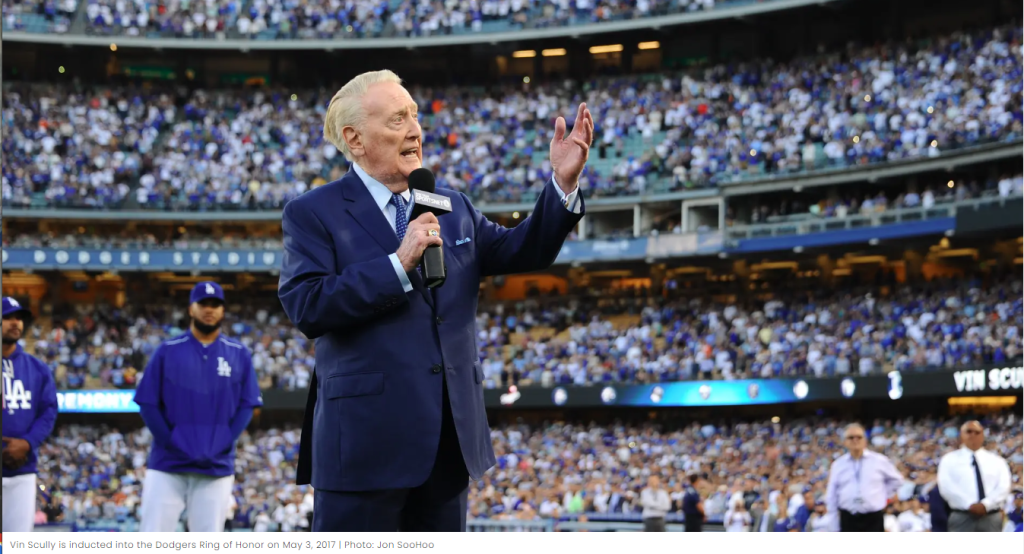
Until that happens, we endorse enjoyment of this collection from Richard Kee — to not just pacify those thoughts, but also reinforce that idea that these things need to be saved and shared as fruitful as possible.
You can look it up: More to ponder
== As you take in that aerial shot of Dodger Stadium, and consider all that it took to get that land for the ballpark, and the history that we have lived with for decades now, be aware there is a new piece of state legislation seeking reparations for those people who were displaced from the property coming up on 70 years ago.
== Kee is included in a recent “Just A Good Conversation” podcast and the “K.P. Wee Podcast.”
== I asked David Davis, a well-versed author and a board member of Photo Friends, a non profit all volunteer group that organizes public programs to support the L.A. Public Library’s Photo Collection, for his thoughts on this project. He said:
Rich Kee’s photographs of the Dodgers reveal a sublime moment in L.A. baseball: the glory years of the late ‘70s and early ‘80s, before Fox and McCourt took over & mucked things up and before the outrageous $18 beers and $50 parking fees.
This isn’t to say that that era was a more innocent time – there was never anything innocent about the ruthless business dealings of the Dodgers – but professional sports in general was a less frenzied affair. The breathless, 365-24-7 heartbeat of today’s sports world, with ESPN’s incessant talking heads and the Internet and social media, was on the horizon.
Kee’s intimate. behind-the-scenes, black-and-white photos portray the personalities behind the players, long before everyone was equipped with cameras on their phones. It’s obvious that Kee had a true-blue connection with the players, Tommy Lasorda and the coaching staff, and Vin Scully.
The prestigious post of Dodgers team photographer has included Barney Stein (from the Brooklyn days) and Jon Soohoo (the longtime and current lens-man). Rich Kee’s body of work rates among the best, as he captured an integral part of the team’s rich visual narrative.
On that note, the Central Library will have Kee come by on April 17 at 12:15 p.m. — yes, it goes head to head with the Dodgers’ afternoon game hosting the Washington Nationals, but we can always record that and watch later.


 Tom Hoffarth's The Drill: More Farther Off the Wall
2 thoughts on “Day 6 of 2024 baseball book reviews: Take my picture, Rich”