


“Let There Be Baseball: The 60-Year Battle
To Legitimize Sunday Play”

The author:
Arthur G. Sharp
The publishing info:
McFarland; 292 pages; $49.95
Released Nov. 8, 2023
The links:
The publishers website; at Bookshop.org; at Powells.com; at Vromans.com; at TheLastBookStoreLA; at BarnesAndNoble.com; at Amazon.com
The review in 90 feet or less
Imagine the blasphemous idea of actually playing baseball on an Easter Sunday.
Good grief. Especially for those trying to observe a Good Friday of penance.
Rotten eggs everywhere.
Why would actual the Catholic Padres and actual Catholic Cardinals approve of it – especially as the Dodgers, who started their season with two games against San Diego’s Padres in Seoul and now have their U.S.-based opening day series against St. Louis’ Cardinals?
Because, they’re baseball fans, too. They respect the religious importance of the moment, and they enjoy the community that the game brings.
Let’s not even get into as to how the Angels – the heralded Halos of Los Angeles – have been dispatched on these holiest of days to Baltimore? Maybe the tragedy of the bridge collapse there necessitates the city needing something of a communal place of healing. Like the cathedral of baseball.
As Arthur Sharp writes in his introduction to “Let There Be Baseball”:
“Today people attend or play in baseball games on Sundays without giving a thought to who made it possible, how they did it, or how long it took to secure the right. The story of the pro-Sunday baseball advocates’ struggle to overcome the determined opposition’s push to enforce the draconian blue laws, aka Sunday laws, in the United States that prevented Sunday baseball in most states is one worth reading.”
As we believe we have before.
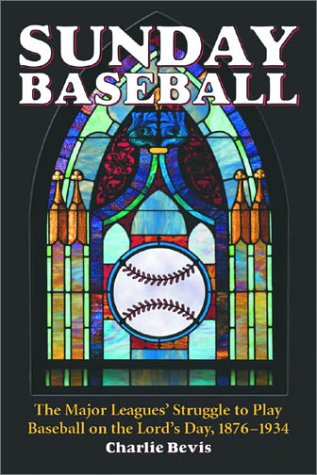
In 2003, Charlie Bevis authored “Sunday Baseball: The Major Leagues’ Struggle to Play Baseball on the Lord’s Day, 1876-1934,” also for McFarland.
He now endorses Sharp’s efforts here:
“Sharp vividly depicts the profound struggle between ordinary citizens desiring to watch or play a Sunday ball game on their only day off in the once-standard six-day workweek and religious dogmatists seeking to control people’s lives under the fig leaf of a state-mandated compulsory day of rest. Through extensive use of contemporaneous newspaper accounts, Sharp richly details the tensions of a civil-rights quarrel for individual choice to pursue secular activities on Sunday without governmental interference in numerous small cities with baseball teams at the amateur, semi-pro, and minor-league levels. This book is a fascinating exploration of the on-the-ground activities conducted over several decades with regard to restrictive laws prohibiting Sunday baseball, which adds significant color to the existing legislative and judicial accounts by historians that have focused largely on cities with major-league teams.”
Bevis’ previous writing on the subject at his BevisBaseballResearch.com site even recounts how Cy Young came into this Sunday baseball discussion.

Cy Young, a pitcher for Cleveland, abstained from pitching on Sunday for three seasons, 1892 to 1894, before retreating from that Sabbatarian stance in 1895 for the remainder of his baseball career. His initial Sunday game in 1895, a late-season relief appearance, became one of Young’s favorite anecdotes later in life, when he conflated a draft animal with the Cleveland manager. “The Bible stated that rescuing your neighbor’s ass from the pit on the Sabbath was not a sin,” Young would begin his retelling. “Well, I’ll be darned if I know any bigger ass than [Patsy] Tebeau anywhere, and he certainly was in an awful hole. So I helped him out.” The namesake of today’s Cy Young Award had 511 career victories, many of which occurred in Sunday games.
It’s a very nuanced subject, really, but one that, upon reflection, gives us a greater depth of knowledge, and appreciation, for those who saw the bigger picture. They pushed back from religious leaders who feared any sort of non-church activities on Sundays was drawing people away from “their” day. We smile these days when we see the Rose Bowl game will never be played on a Sunday if that’s where January 1 falls. Instead it’s moved to the next day. Or how sporting events scheduled at Brigham Young University have always revolved around not happening on a Sunday because of their strong belief that it is a day of rest and spiritual gathering, a family day of celebration.
Both are reminders about how the “Sunday” rules are still somewhat lingering in our cultural psyche. And that’s OK.

As far as baseball goes, clerics and legislators once formed a tag team trying to impose “their combined personal morals and beliefs on society in general,” writes Sharp. “Diversity was not part of their worldview.”
There’s the bullet point.
As Sharp also explains in Chapter 14, there is a “law of intended consequences” when it comes to battling Sabbatarians who try to manipulate the law to their advantage.
He points out a lawsuit in Liberal, Kansas (of all places) in 1917, when “men’s attendance at games on the Sabbath caused their wives great despair. Allegedly, the men were spending money for tickets that could have been used for better purposes.”
In a political climate today where we can’t always be certain how being affiliated with a religious community will be appallingly appropriated it for political purposes — the $60 bible … really? — and an internal confusion happens among those whose houses of worship may not even be recognizable to some extent, the story of how Sunday baseball came about needs to be better understood and appreciated it.
And for those wondering: At least the Dodgers and Cardinals shouldn’t interfere with any Easter Sunday plans. Their game at Dodger Stadium starts at 4:10 p.m. It’s part of ESPN’s “Sunday Night Baseball.”
Wonder if the folks at the TV company now take Sunday baseball for granted, and if they’re the ones granting us the privilege of better enjoying it?
How it goes in the scorebook

No more egg on our face when a discussion comes up about the history of Sunday baseball. We see the convergence of commercial, social, political and religious change made it happen.
We wonder how if baseball still had a decades-long history of no games on Sunday, would be much more difficult to discuss these days.
As one author once said about this: Proponents of change cannot—and should not—rely solely on courts to bring about advances in liberty.
So for those who converge on the cathedrals of baseball on Easter Sunday, why not dress up the day. Wear your Sunday best. Even if it rains.
More to consider

== Another quick piece on the subject from the Library of Congress, featuring a photo of Sandy Koufax. It outlines: As late as 1961, the Supreme Court decided four cases on these laws, in each instance upholding the concept of the legality of state laws banning certain types of commerce on Sundays. The four cases decided that year were:
McGowan v. Maryland, 366 US 420 (1961)
Gallagher v. Crown Kosher Super Market of Mass., Inc., 366 U.S. 617 (1961)
Braunfeld v. Brown, 366 U.S. 599 (1961)
Two Guys from Harrison v. McGinley, 366 U.S. 582 (1961)
Fortunately, the laws for Sunday baseball had changed almost 30 years before these decisions were rendered.
== Read the SABR story about how a 1962 Dodgers’ doubleheader in the heat of a Houston summer resulted in the then-Colt .45s moving games from Sunday afternoon to Sunday nights. It involves Don Drysdale losing 12 pounds while pitching in a 9-3 win in Game 1.
== More on Billy Sunday, the outfielder for the National League clubs Chicago, Pittsburgh and Philadelphia between 1883 and 1890 who became an influential and controversial Presbyterian evangelist in the early 1900s, declaring himself “as God’s unconventional messenger to a sinful world.”

 Tom Hoffarth's The Drill: More Farther Off the Wall
1 thought on “Day 8 of 2024 baseball book reviews: Six ways (and more) to why Sunday baseball became legit”