


“Frank Chance’s Diamond:
The Baseball Journalism of Ring Lardner”

The author/editor:
Ron Rapoport
The publishing info:
Globe Pequot/Lyons Press; Rowman & Littlefield; 264 pages; $24.95; released Feb. 6, 2024
The links:
The publishers website; the author’s website; at Bookshop.org; at {pages}; at Powells.com; at BarnesAndNoble.com; at Amazon.com
The review in 90 feet or less
The name Ringgold Wilmer Lardner still rings a bell.
For us, it started with a USC journalism class syllabus in the early 1980s that required reading “Sports and the Spirit of Play in American Fiction: Hawthorne to Faulkner,” by Christian Messenger.
Chapter Five — “Lardner: The Popular Sports Hero” – started this way:
“The most talented sportswriter was Ring Lardner, the innovative chronicler of American games, comic players and their foibles. He allied himself to popular sport and the realist tradition while irrevocably fixing the stereotype of the professional athlete for modern fiction. Lardner stands at the center of any discussion of popular sport in modern American literature.”
Our education continued with Ron Rapoport, our former colleague at the Los Angeles Daily News who we are grateful in that he created the forward to our new Vin Scully appreciation book.
Rapoport, a recipient of the Ring Lardner Award for Excellence in Sports Journalism, has a deep appreciation for the man who, in 1963, was the Baseball Writers Association of America career excellence recipient as acknowledged by the Baseball Hall of Fame. The honor came 30 years after his death.

Rapoport, a one-time Chicago Sun Times columnist competing with the likes of Lardner’s former employer, the Chicago Tribune, has a connection to Lardner’s work that goes deepest in his cultivation of a nearly 600-page book, “The Lost Journalism of Ring Lardner,” in 2017 for University of Nebraska Press. Rapoport mined the archives to find his earliest work in the South Bend Times and Chicago Tribune, where it was just sports but also politics, war, Prohibition and other essays about life in America. Rapoport had the support of Lardner’s grandson and New York Times writer James, plus his cousin Susan.
This “Frank Chance’s Diamond” is a condensed version of that, based only on baseball shaped his vernacular.
When Rapoport appeared recently at the NINE convention of baseball writers and enthusiasts in Tempe, Ariz., he did about a 15- minute presentation about how and why he came to do this manuscript.
Somewhere, Lardner’s ears must be ringing. Rapoport talked about:
== Why he focused this time on Lardner’s baseball journalism: “Much of it has never been seen since it was first published. This is to show the range of his work. Early in his career, he wrote straight game stories. He could write about hits, runs and errors with the best of them. But they would give him a column, ‘In the Wake of the News,’ which is still part of the Tribune’s sports section, and Lardner started experimenting. … He was wildly original. .. I think I’m right in saying that no one approached sports at its wildest like Lardner.” Rapoport also writes in the introduction that baseball is where Lardner adopted “a jockular tone he would seldom abandoned when writing about baseball.”
== His favorite pieces in the book are the 1912 “The Tears of Christy Mathewson,” calling them “just gorgeous. He even wrote many things on Babe Ruth and admired him even if he thought he destroyed the game he loved.”

== Lardner’s baseball “masterpiece” were the six columns he wrote for the Bell Syndicate on the 1922 World Series. Three years after the Black Sox Scandal, Lardner flat-out said he was betting on this New York Giants vs. New York Yankees matchup in his first post titled “The Most Important World Series in History.” Lardner then explained how he was betting on the Yankees so he could win enough money to buy his wife a fur coat. As Lardner was losing the bet, he wondered if selling his children’s kitten might solve the problem. The headline over the final column read: “Yanks Lose,But Lardner Kittens Spared.”
== One of his favorite Lardner lines was about the unassisted triple play that Cleveland Indians second baseman Bill Wambsganss pulled in Game 5 of the 1926 World Series. Lardner wrote: “It was the first time in World Series’ history that a man named Wambsganss had ever made a triple play assisted by consonants only.”
== Another aspect of Lardner’s journalism that is “less amusing … he never wrote about a Black player, or the Negro Leagues, or the color line. Sometimes in his baseball writing, he used awfully racists lines, which are a blot on his reputation. I repeat a lot in the book, where I talk about the conundrum about how this great observer of American life could have such racist tendencies. Why did Ring stoop to this kind of language and these kind of attitudes?”
Rapoport then pulls up a piece in 1914, while the Cubs were meandering through another awful season. Over on the South Side was a great Negro League shortstop named Pop Lloyd, playing brilliantly for the Chicago American Giants. So Ring writes a poem where he addresses Cubs manager Hank O’Day.
“I will leave it to you to decide if this is a sly dig at baseball’s color line,” says Rapoport, “or whether it’s more racist crap from Ring:
If I were Hank, I b’lieve that I
Would go out south some night,
And there corral a certain guy.
Named Lloyd, and paint him white.
“Racist? I can’t make up my mind.”
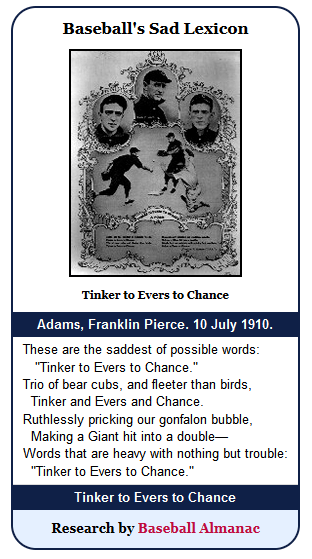
Here’s a side question: How was it that, with all the lyrical things Lardner loved to compose, at a time he was covering the Cubs, he didn’t create that famous eight-line stanza “Baseball’s Sad Lexicon” about Tinker To Evers To Chance often cited as one of the reasons those three ended up in the Baseball Hall of Fame? The poem was first published in the New York Evening Mail in July 1910 under the title “That Double Play Again” by Franklin Pierce Adams. A writer in New York, Adams was said to have compiled that poem as a way to fill that space while on his way to cover a game at the Polo Grounds.That poem came out at a time Lardner left Chicago to work in St. Louis, coming back to the Windy City in 1913.
Rapoport’s answer to this via email: Remember now that “Tinker to Evers to Chance” was a lament, written by a fan of the Giants in New York. The closest Ring ever came to something similar was his classic lead in “The Tears of Christy Mathewson” on Page 155. I don’t think I ever saw Ring make a reference to Tinker or Evers although he adored Chance, the player.
There is also a poem Lardner wrote about Mathewson — many have mistaken this to have come about at Mathewson’s death in 1925 at age 45 of tuberculosis, but as Rapoport includes on page 79, it was actually when Mathewson was traded from the Giants to the Reds in July 1916 at the end of his career (also noting Mathewson was originally drafted by the Reds in 1900 but then traded to the Giants to launch his Hall of Fame career):
My eyes are very misty
As I pen these lines to Christy;
O, my heart is full of heaviness today.
May the flowers ne’er wither, Matty,
On your grave at Cincinnati,
Which you’ve chosen for your final fade-away.
Baseball historian John Thorn reprinted Lardner’s ode to Mathewson on his own Medium page in 2013.
== The title of Rapoport’s book came from a piece F. Scott Fitzgerald wrote about Lardner upon his death at age 48 in 1933. In Great Neck, New York, Fitzgerald had one of Lardner’s drinking buddies. Fitzgerald had also based characters in his books, ‘The Great Gatsby’ and ‘Tender Is the Night’ on Lardner.
“So when Ring died, Fitzgerald wrote a very affectionate tribute about how much he was such a great contributor to the American language. But he quite surprisingly turned it to be a little nasty at the end.”
Rapoport recited some of what Fitzgerald wrote for the New Republic in October of 1933, after explaining how in 1922, he didn’t think Lardner “really gave a damn about anything except his personal relationships with a few people … This this period of huge earnings and an increasingly solid reputation on top and beneath … he was too far gone in illness to get a proper satisfaction from it. …”
Fitzgerald went on:
“During those years, when most men of promise achieve an adult education, if only in the school of war, Ring moved in the company of a few dozen illiterates playing a boy’s game. A boy’s game, with no more possibilities in it than a boy could master, a game bounded by walls which kept out novelty or danger, change or adventure. This material, the observation of it under such circumstances, was the text of Ring’s schooling during the most formative period of the mind. A writer can spin on about his adventures after thirty, after forty, after fifty, but the criteria by which these adventures are weighed and valued are irrevocably settled at the age of twenty-five. However deeply Ring might cut into it, his cake had exactly the diameter of Frank Chance’s diamond.”
“It’s nasty,” Rapoport said of the last line, a dig at Lardner’s comfort in writing about the Chicago Cubs then managed by Frank Chance, “but it’s kind of true.”
Fitzgerald wrote later in the piece: “Here was his artistic problem, and it promised future trouble. So long as he wrote within that enclosure the result was magnificent: within it he heard and recorded the voice of a continent. But when, inevitably, he outgrew his interest in it, what was Ring left with?”
Rapoport concluded in the NINE presentation, as he does in this book’s introduction, that as people begged Lardner to write the Great American Novel, and do for the “New West” what Mark Twain did for the “Old West,” Lardner resisted.
“He was content spending his life … proving just how deeply a writer who loved baseball beyond measure could cut into the delicious cake that was Frank Chance’s diamond.”
How it goes in the scorebook
Ring it up for us, chapter and verse. We never tire of learning more about Lardner, the work and the genius. Especially if Rapoport is our Sherpa on this latest diamond mining of information.
This also gives a moment to wonder: Did T.J. Simers, the former Los Angeles Times and Orange County Register sports columnist, ever channel Ring Lardner into his own columns for a couple decades starting in 1990? It can come off that way in some sense of the way Simers often deviated from the norm, had many references to his editors in his writing rants and almost seemed so bored in a way about the sporting event he was watching that he couldn’t help but try to just entertain the readers with his unique (and often caustic) perspectives.
You can look it up: More to ponder
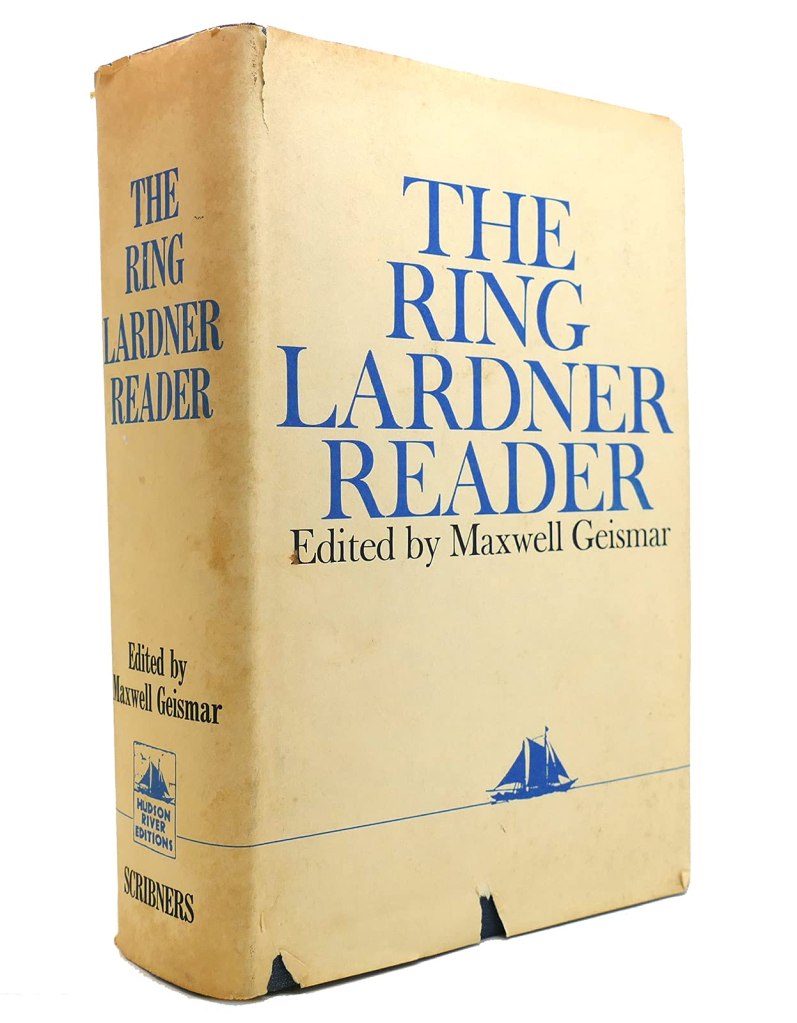
== For the Ring Lardner Marching and Chowder Society, there’s been a quite a few Ring Lardner readers and bios over the years. It starts perhaps, some 60 years ago with “The Ring Lardner Reader,” edited by Maxwell Geismar for Scribners in 1963 at about 660 pages.

Jonathan Yardley created the classic, robust bio for Random House in 1977 called “Ring: A Biography of Ring Lardner,” exceeding 400 pages. Yardly writes that the quality of Lardner’s writing was so high, it’s one of the triumphs of American journalism. Yardley later did “Ring Lardner: Selected Stories,” for Penguin Classics in 1997.

We are also quite fond of the cover of the paperback version that came out in 2001 by Rowman & Littlefield that makes it look like Buster Keaton.
Rapoport recommends finding Donald Elder’s “Ring Lardner: A Biography” from 1956, currently out of print.
Add to that “Ring Lardner: Stories & Other Writings,” edited by Ian Frazier for Library of America in 2013.
If you want to be baseball specific, there’s also:
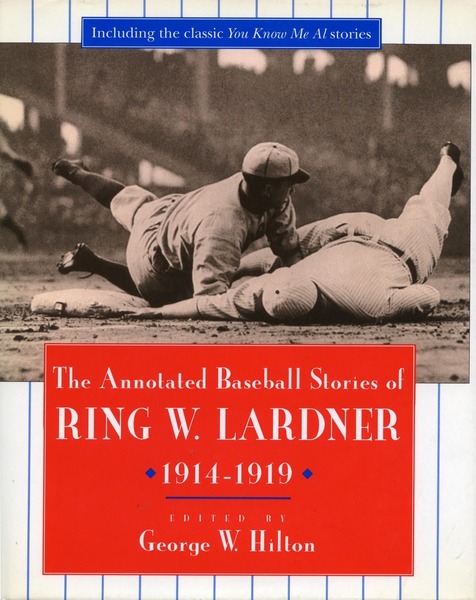
“The Annotated Baseball Stories of Ring W. Lardner, 1914-1919,” edited by George W. Hilton for Stanford University Press in 1995; “Ring Around the Bases: The Complete Baseball Stories of Ring Lardner,” edited by Matthew Joseph Bruccoli for Scribner in 1992 (at more than 700 pages). And “Lardner on Baseball,” edited by Jeff Silvermann for Lyons Press in 2003.
Rapoport has an appreciation as well for “The Lardners: My Family Remembered,” by Ring Lardner Jr., an Oscar-writing screenwriter who died in 2000.
As for the books done by Lardner himself:

His most famous, “You Know Me Al: A Busher’s Letters,” with the first six stories from a series published in 1916, has its own Wikipedia entry and its page on the Society for American Baseball Research. The Project Gutenberg offers it for free at this link.
One can find “How To Write Shorts Stories – With Samples” on the art of creative writing he did for Scribner’s in 1925. A paperback revivial of it came from Watson Press in 2013.
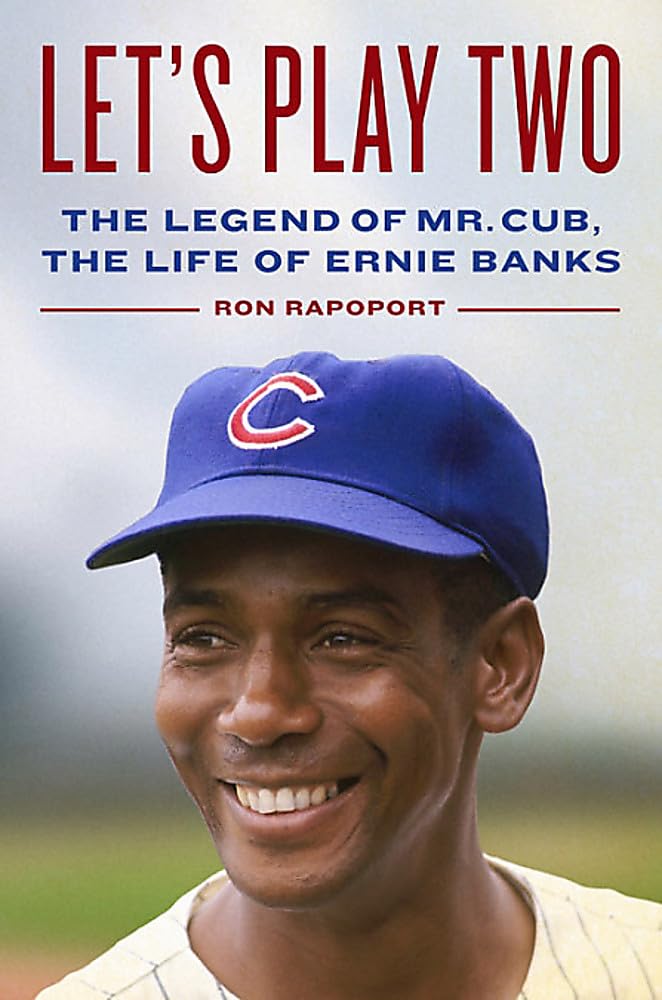
== More from Rapoport: From 2019, his bio “Let’s Play Two: The Legend of Mr. Cub, The Life of Ernie Banks,” for Hachette Books. Our review is here.
== John Schulian edited “The John Lardner Reader: A Press Box Legend’s Classic Sportswriting,” released in 2010 for Bison Books/University of Nebraska Press. Highlighting the work of Ring Lardner’s son, we wrote about it when it came out this way: “There’s no doubt a better-crafted, lightly sanded, deftly buffed paragraph somewhere in John Lardner’s body of work that better describes how he stacked up back in the day of Red Smith, W.C. Heinz, Jimmy Cannon and those members of the golden age of sports writing. For our purposes, we’ll savor what Schulian writes (in this book’s introduction): ‘Since TV and talk radio started throwing crazy money at them, more and more otherwise admirable sportswriters have been only too happy to install whoopee cushions where their regard for the language used to be. Sly humor and high style have taken a drubbing everywhere sports are written. Worst yet, John Lardner has been forgotten. That’s as wrong as wearing white socks at a funeral.”

== Also from 2019: “The Great American Sports Page: A Century of Classic Columns from Ring Lardner to Sally Jenkins,” for Library of America, edited by Schulian. We reviewed that for the Los Angeles Times and Schulian told us that having worked for six newspapers in a 16-year career before working in Hollywood writing scripts, he had faith that sports newspapering will stay relevant if it’s “bright, lively, culturally attuned and unafraid of prickly issues … I still read the sports section first every morning mainly because the front page is too damn painful. … But it must be disheartening for someone to get into sportswriting as I once did. Sports has changed so much, having gone corporate, and athletes becoming more remote. It’s harder for writers to do the kind of pieces that used to make sports sections special. There was a time when a columnist could do a real character sketch of someone. “Sports afforded me the opportunity to write, a stylistic freedom that many in this book were also seeking. There are plenty of good writers today, God knows, who get past this wall and do great work.”

 Tom Hoffarth's The Drill: More Farther Off the Wall
2 thoughts on “Day 10 of 2024 baseball book reviews: Updating the spin rate on Ring Lardner’s slider”