
“715 at 50: The Night Henry Aaron
Changed Baseball and the World Forever”

The author:
Randy Louis Cox
The publishing info:
Summer Game Books
162 pages; $24.99
Released March 4, 2024
The links:
The publishers website; the National Baseball Hall of Fame store; at Bookshop.org; at Powells.com;
at {pages a bookstore}; at BarnesAndNoble.com; at Amazon.com
“Home Run King: The Remarkable Record of Hank Aaron”

The author:
Dan Schlossberg
The publishing info:
Sports Publishing
288 pages; $32
To be released May 14, 2024
The links:
The publishers website; at the authors website; at Bookshop.org; at Powells.com; at {pages a bookstore}; at BarnesAndNoble.com; at Amazon.com
“Baseball’s Ultimate Power:
Ranking The All-Time Greatest Distance
Home Run Hitters”

The author: Bill Jenkinson
The publishing info: Lyons Press; 352 pages; $24.99; released April 2, 2024
The links: The publishers website; at Bookshop.org; at Powells.com; at {pages a bookstore}; at BarnesAndNoble.com; at Amazon.com
The prelude
Before going forward, play this in the background and enjoy the tribute:
Now, we look back at history.
The reviews in 90 feet or less
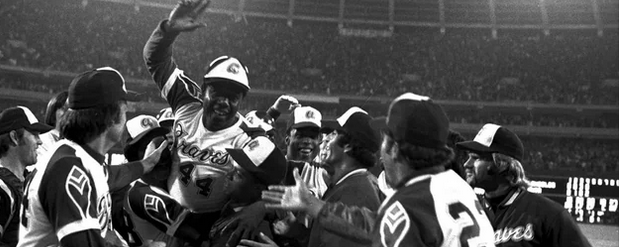
So where were you when Henry Aaron broke Babe Ruth’s all-time home-run record on April 8, 1974?
I was sitting in the third-base dugout of my Hawthorne American Pony League Dodgers’ team (and we wore green and white for some reason). It’s about 6 o’clock and the sun is in our eyes as usual. Lots of squinting to see what was going on in front of us. Amidst the glare, everyone on my team — and around the park — knew the Dodgers were in Atlanta playing the Braves. A few of our parents brought their transistor radios with them, listing to Vin Scully’s call. It was also a nationally televised game on NBC, with Curt Gowdy doing it. But we had Vin.
There was a buzz was in the stands as Aaron hit his 715th homer in the fourth inning off the Dodgers’ Al Downing.

I knew I was going to the Dodgers-Braves game at Dodger Stadium a few weeks later. The Dodgers gave away a special poster commemorating the feat. On May 17, 1974, it was “Hank Aaron Poster Day” at Dodger Stadium — a Friday night, the first trip the Atlanta Braves came to L.A. that season. Downing actually started this game and went the first eight innings in a 5-4 loss to the Braves that went into the 11th inning (as Aaron went 0-for-3 against Downing this time.)
The beauty of this poster is that it was a chart so kids could document Aaron’s home runs in 1974 — and we dutifully logged in the information. We participated. We were invested in recording history.

To commemorate the 50th anniversary of Aaron’s accomplishment, so many things were going on April 8, 2024.
The Baseball Hall of Fame announced it was erecting a new statue in Aaron’s honor. An MLB Network remembrance narrated by Bob Costas. A new set of U.S. postage stamps for those who still use letters. At a ceremony before the Braves’ game, baseball commissioner Rob Manfred announced a $100,000 endowment of a scholarship at Tuskegee University, a historically Black university in Aaron’s home state of Alabama.
There’s even a fan who revealed he had footage of the event that night and just now let everyone know about it:
A few new books as well to stamp home this occasion.

Randy Cox, an Atlanta native who has been in the journalism field for more than 50 years, got a photo credential for the Braves’ home opener in 1974. As the 24-year-old sports editor of The Valley Times-News of Lanett, Ala., Cox planted himself in the photographer well near the Braves dugout at Atlanta Fulton County Stadium.

Cox noted that “only a handful of us daily newspaper sports editors in Aaron’s home state of Alabama covered this momentous event in person … nearly all the major papers filed their stories using wire service copy and photos. … For those of us who were there, it was unforgettable.”
Cox said he was even able to approach Aaron after the celebration at home plate died down, shake his hand and congratulate him. He nodded and with a smile said “Thank you.”
Cox writes that as a second grader in Decatur, Georgia, he started watching Aaron with the Milwaukee Braves in 1957 as they upset the New York Yankees in the World Series. When the Braves moved to Atlanta in 1966, Cox was thrilled — but the the drawback was they were supplanting the Atlanta Crackers, the “Yankees of the South,” a team that started as a Single-A in the early 1900s, moved up to Double-A (for the Dodgers in the early ’60s) and by the mid-’60s was a Triple-A team for the Milwaukee Braves, laying the groundwork for the move.
Cox had covered his first Braves game in ’71 as a Georgia State journalism class assignment — on the night Aaron his hit 600th homer.
For this book, Cox has 44 of his own photos to honor No. 44 — few that have been published before this. Cox’s photos are accompanied by interviews he did with Braves public relations man Bob Hope, as well as Braves pitcher Ron Reed and Buzz Capra, who recorded the win and the save in that ’74 contest against the Dodgers.
With Dan Schlossberg’s latest, “Home Run King: The Remarkable Record of Hank Aaron,” it’s also noted the author has been a lifelong Braves fan-turned-journalist. He touches on all parts of Aaron’s career, including his desire to become a manager, general manager and the commissioner of baseball. And how was it that nine voters for the Baseball Hall of Fame actually left him off their ballot in his first year of eligibility?
Jenkinson’s ode to the longest homers in baseball history is a refresh of his 2010 version. Aaron remains in the photo montage of the book’s new cover as he did in the one 14 years ago.

Of the top 100 longest homers in MLB history, starting with Ruth’s 575-foot shot in Detroit in 1921, Aaron doesn’t make the list (all of which are at least 500 footers).
Jenkinson’s pursuit of trying to document the longest of the long balls doesn’t often include Aaron as much as it does Babe Ruth, Mickey Mantle, Jimmy Foxx, Dick Allen, Dave Kingman, Mark McGwire or Willie Stargell. Even names like Ron Kittle, Mule Suttles, Wally Post and Andres Galaragas have generated more lore in this department than Aaron, according to Jenkinson’s data.
All the same, a book about home runs can’t be done without some sort of ode to Aaron. This at least tries to do that.
How it goes in the scorebook
Hammer time.
You can look it up: More to ponder
== Schlossberg talks more about his book with his SABR pals:
== Of all the other Aaron related book we’ve poured through in the recent past, many actually more of a deeper dive.

In 2022 came Terrence Moore’s “The Real Hank Aaron: An Intimate Look at the Life
and Legacy of the Home Run King.” Moore wrote in his intro: “No sports journalist understood the essence of Hank Aaron better than I, and as our years of conversations turned into one, two and before long, four decades of riveting dialogue for the ages, we grew close enough as friends … Hank contacted me (over the years) to deliver his inner thoughts regarding just about everything, especially when he wished to communicate to the rest of the world … Despite a slew of Hank Aaron books written in history and documentaries produced, none had what I had. None had anything close.” Our post also includes information on the 2004 book “Hank Aaron and the Home Run that Changed America,” where Tom Stanton did an exquisite job bringing context to what happened as Aaron was on this chase; the 1991 book “I Had a Hammer: The Hank Aaron Story,” where Aaron worked with the late Lonnie Wheeler; and in 2010, “The Last Hero: A Life of Henry Aaron,” was a 640-page, very thorough (perhaps to a fault) and editor-lacking work by Howard Bryant for Pantheon, called “beautifully written and culturally important” in The Washington Post.

 Tom Hoffarth's The Drill: More Farther Off the Wall
1 thought on “Day 15 of 2024 baseball book reviews: #OTD – Babe moved over, and here came Henry”