
“The Fenway Effect: A Cultural History of the Boston Red Sox”

The author:
David Krell
The publishing info:
University of Nebraska Press; 264 pages; $34.95; released April 1, 2024
The links:
The publishers website; the authors website; at Bookshop.org; at BarnesAndNoble.com; at Amazon.com … and the Harvard Book store.
The review in 90 feet or less
Hark, the unheralded Angels make their only 2024 visit to Fenway Park this weekend – games against the Red Sox on Friday, Saturday and Sunday come very early this time around for some reason we don’t quite understand. It’s such a great summer road trip to take otherwise.
This is also a missed opportunity.
Had the Angels been allowed to stay just one more day, they’d have landed a rare trifecta — an April 15 appearance that would a) celebrate Jackie Robinson Day, b) celebrate Patriots’ Day (as the city shuts down for the Boston Marathon) and c) celebrated the dreaded 2024 Tax Day, with perhaps some planned tea party re-enactments in Boston Harbor.
The Angels struggled against the Red Sox at Angel Stadium last weekend, losing two of three to mark their home-opening series. Their return to Boston this time will be without their not-so-secret weapon, Shohei Ohtani.
Remember the effect Fenway Park had on Ohtani during his career?
The game on May 14, 2021 — he flicked his bat out at a pitch down and away, and it cleared the Green Monster. It was his AL lead-tying 11th homer. He went 2-for-4 with a double. And the Angels, of course, lost.
A season later on May 5, 2022 — on the mound, he struck out 11 in seven scoreless innings, throwing 81 of 99 pitches for strikes. At the plate, he was credited with a fourth-inning single off Rich Hill that landed in the deepest part of the park, near the 420 mark in right-center, as a fly ball was lost in the sun. Taylor Ward, running ahead of Ohtani, had to wait to see what would happen before he could take off and end up at third. Ohtani was stuck at first with a 389-foot single that would have been a homer in 11 other MLB parks.
Then with the bases loaded in the eighth inning, he lined a single off the Green Monster that actually hit above the “LAA” sign on the innings total, and it knocked the “17” number in the manually operated scoreboard off its moorings.
That’s the kind of stuff that makes Fenway Park a part of baseball and cultural history.
He again went 2-for-4 that game. On the mound, he got the win to improve to 3-2.
There wasn’t mention of this in David Krell’s latest book that celebrates the Red Sox’s cultural history, nor should we have expected it. Ohtani’s presence really doesn’t add to the Red Sox’s overall mystique in any way. It just give it come added historical value.

The focus is more on how a TV series like “Cheers” put the spotlight on the Boston charm, thanks to bartender Sam “Mayday” Malone. Krell said he watched all 230-plus episodes from ’82 to ’93 so he could pick up on the nuances.
Just like another heralded TV series, “St. Elsewhere,” the Boston-based medical teaching center. The show lasted from ’82 to ’88 with Howie Mandel, Ed Begley Jr., and Denzel Washington … and Mark Harmon.

(FWIW: “St. Elsewhere” actually ended its third season with two characters meeting at the Cheers bar, and Cliff Clavin trying to get free medical advice).
Of course, the 2005 Farrelly brother’s sweet flick “Fever Pitch,” where Jimmy Fallon plays a Red Sox fanatic and season-ticket holder named Ben, trying to court Drew Barrymore (Lindsey). The film ends with them dancing on the field in St. Louis celebrating the team’s 2004 World Series win – which was totally not planned as the film was being made.
(There’s also the scene at the end, after they marry, and discuss the name of their pending child – if it’s a boy, it’s Ted Williams Wrightman, and if it’s a girl … Carla Yastrzemski Wrightman).
The movie seems to play off a character Fallon played on “Saturday Night Live” in the late 1990s, “The Boston Teens” sketch with Rachel Dratch, as a loud obnoxiou couple who could always resolve an argument with a mention of the Red Sox and a “Nooo-MAAAR” chant.
Our reference points to the Red Sox and pop culture may be limited on the West side of the coast — we’re far more in tune with the Dodgers and Angels players popping up on TV and movie screens. Maybe we aren’t “Red Sox” savvy enough to pick up on the nuances beyond knowing about the Hollywood stories behind “Fear Strikes Out” or “The Town.”

Our fear is that we’ve struck out too many times with Krell’s previous books, and we’re often still climbing the walls.
When Krell did “1962: Baseball and America in the Time of JFK,” in 2021, we summed it up as a “meandering disjointed journey of research. Baseball’s lack of fitting into this premise seems to materialize in how there are 12 chapters – one for each month – and the game can’t be expected to fill it out to the edges amidst everything else. … Does it all mesh during this unmethodical mix-and-match? The reader can decide if it brings back memories, or just muddles what you already may recall.”
When Krell did “Do You Believe in Magic? Baseball and America in the Groundbreaking Year of 1966,” in 2023, we buried it in a roundup of books that were pertaining to certain years and added: This is formatted in the same January-to-December template, which turns out to be a quite a dreadful way of trying to filing away information in this sort of historical context.
We did not read, or review, his 2015 “Our Bums: The Brooklyn Dodgers in History, Memory, and Popular Culture.” We have it on the shelf.
In “Fenway Effect,” we still feel as if nostalgia and history are trying to be wedged into historical references and things that perhaps give context to the time period but more or less becomes like distracting gnats flying through focus-lacking sentences. It’s a great idea. Maybe it still needs to be workshopped.

Krell writes in the introduction that while there have been many books about the Red Sox’s narratives and documentaries about their history, he wanted to do something different. Tell us why Narragansett Beer means so much so many fans in the region. What’s the story behind the Citgo sign. Explain “Sweet Caroline.”
Bah, bah, bah.
Good for all of us. Especially those once gainfully employed in Southern California as grips and lighting techs for the “Cheers” series, filmed at the local Paramount lot. Those who once caught the Mannywood Virus and purchased a now-tainted Ramirez 99 jersey in 2008. There’s no overlooking the time when “Ballpark” Frank McCourt, the Boston parking lot baron, was allowed to temporarily seize (and sleaze) ownership of the team (with his wife, Jamie), and nearly squeeze the life out of it.
His name is still taken in vain as it’s apparent that he’s still drawing disposable income from those who trust their cars to come onto the property around Dodger Stadium. Those too shortsighted to take the Union Station bus into the facility to avoid having him get their money (and don’t even start with this gondola thing).
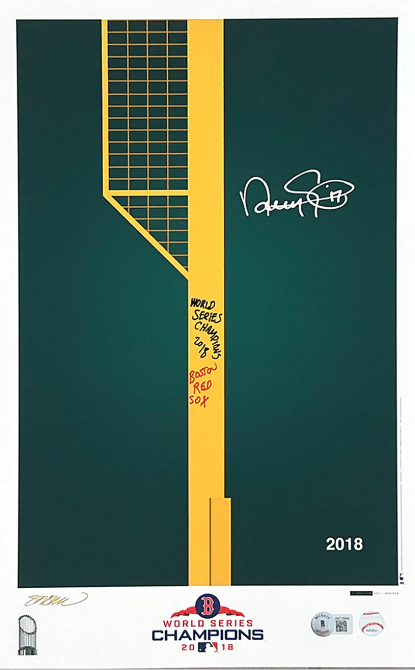
There was also, of course, the 2018 World Series, when the Red Sox celebrated at Dodger Stadium after their Game 5 win, facilitated by Clayton Kershaw’s 0-2 record and 7.35 ERA.
You’re welcome. Culturally speaking. We SoCal natives — who don’t really call ourselves that — have lukewarm Bosox feelings. We know we once took in Tony Conigliaro and Jimmy Piersall. We also saw Dave Henderson end that ’86 ALCS and send Donnie Moore into a spiral that the Angels will forever have a scar to show for it.
Maybe this weekend, we’ll pick it up, read it again, enjoy the sights and sounds from Fenway — done that before, took the ballpark tour, had a blast — and see again how and why this matters.
How it goes in the scorebook
For those who will trip delightfully over the connecting of these dots, groovy. For those who aren’t inclined, enjoy your Nor’eastern as we wash down a Fenway Frank with a Dunkin Donuts luke-warm coffee while humming a tune from the Dropkick Murphys and slipping around in our bloody socks.
All in all, we do like the cover.
You can look it up: More to ponder
== A March 30, ’24 Zoom chat with the SABR Babe Ruth Chapter:
== Netflix announced recently it will follow an MLB team over the course of the 2024 season, documenting the Boston Red Sox. From the creators of Cheer, Last Chance U, and Wrestlers, the docuseries will debut in 2025.
== In 2022, we covered a new Triumph Books series called “The Franchise,” with the Boston Red Sox as one of the first two covered. Eh …

 Tom Hoffarth's The Drill: More Farther Off the Wall
1 thought on “Day 17 of 2024 baseball book reviews: The Bosox injection”