

“The Wizard of College Baseball:
How Ron Fraser Elevated Miami and
an Entire Sport to National Prominence”
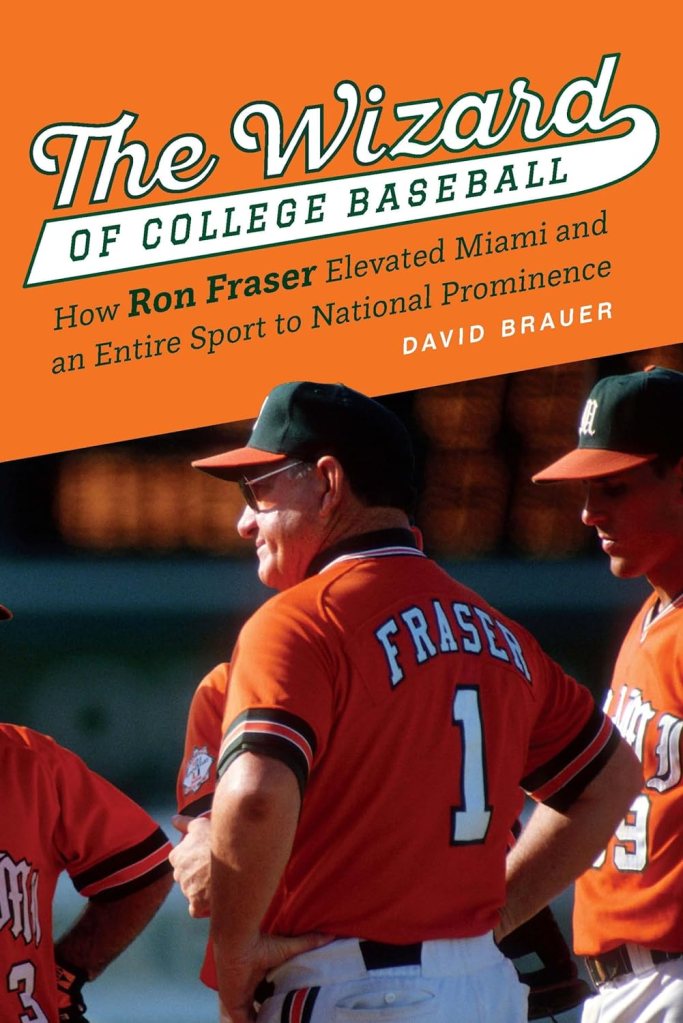
The author:
David Brauer
The publishing info:
University of Nebraska Press;
224 pages, $29.95
To be released June 1
The links:
The publishers website
The authors website
At Bookshop.org; at Powells.com; at Vromans.com; at TheLastBookStoreLA; at Skylight Books; at {pages: a bookstore}; at BarnesAndNoble.com; att Amazon.com
The review in 90 feet or less

College baseball’s two late, great forces of nature — USC’s Rod Dedeaux and Miami’s Ron Fraser — couldn’t do much behind the scenes this year to will either the Trojans or the Gators into the 2024 NCAA baseball playoffs.
The brackets announced today will be minus two of the most dominant programs in the sport’s history, and are the ones who united the two coasts of the United States to join in the middle.
Or as close to Omaha, Nebraska, as possible.
ESPN and its family of channels will host the selection show of the 64 teams for the NCAA Regionals, which feed into the June 14-24 College World Series in Omaha. It’s important to remember that in 1981, ESPN, which had been in TV cable business just a couple years and still wasn’t confident in what it was programming as live events were making a difference in the viewership world, were the first to jump into carrying its first college baseball games.
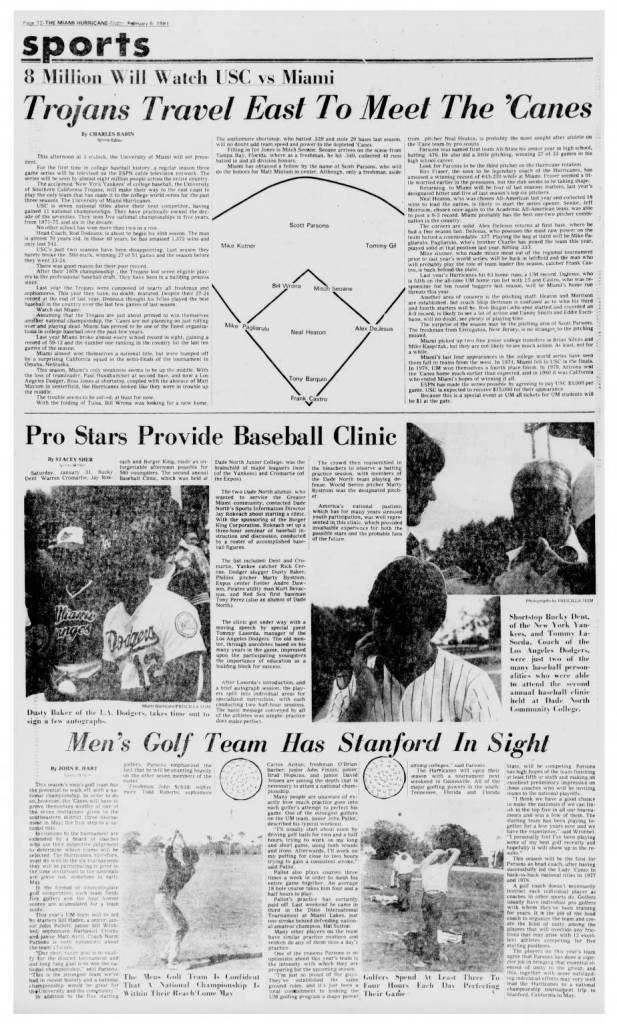
On February 6, 7 and 8 of ’81 — at a time we were at USC and enjoyed watching the baseball team play at Dedeaux Field — the thought that the Trojans would go all the way to Miami for a season-opening series, and have them televised live, was very eye-raising.
They’re doing what? And why?
Why not.

Dedeaux had been USC’s coach for almost 40 years at that point, and had a few more to go before he retired in 1986. Fraser was starting his 19th season at Miami then, and would have 10 more to go.
“I remember my dad wanting to be part of it and talking about how big this thing could be for college baseball,” Justin Dedeaux, an assistant coach on his dad’s team who then worked as a color commentator for ESPN’s College World Series telecasts, tells Brauer on page 122.
Until that trip, USC had never played east of the Mississippi River. Why would it have had to? It won six national titles in the 1970s. ESPN, Brauer adds, covered most of USC’s travel expenses for the televised series.
(To note: The ’24 USC team, playing two seasons in a row of practically all road games as its Dedeaux Field is under renovation, made one noteworthy trip to Arlington, Tex., for a series against Top 10-ranked TCU and Texas A&M. The Trojans lost all three. They then lost in the Pac-12 title game, blowing a 3-1 ninth-inning lead to Arizona State. Season over. Conference done).
In ’81, Fraser went to ESPN’s offices in Bristol, Conn., to convince the network to cover this Miami-USC event.
“Fraser called ESPN the biggest factor in the development of college baseball’s popularity and the sport’s turning point,” Brauer writes.
Miami won the opener, 7-6, before 12,550 at Mark Light Stadium (now known as Alex Rodriguez Park at Mark Light Field, even though Rodriguez never played at the university). The Hurricanes won 6-3 the next night and 10-9 in 13 innings in the finale to sweep the series, en route to a 20-0 start that went to 39-1 and finishing 56-8 with a No. 1 national ranking. USC, three seasons removed from their last NCAA title, finished ’81 with a 38-25 mark, 15-15 in conference, and missed the tournament, despite having eventual first-round draft pick and All-American outfielder Dave Leeper, plus standout outfielder and future Dodger draft pick Stu Pederson (the father of Joc Pederson), on the team.

From that series, ESPN did a weekly college baseball game live, many times including Miami. National college baseball attendance was 5.3 million in 1979, when ESPN launched. In 1983, it was 12.8 million.
“People forget that Ron had college baseball as the Sunday Night Game of the Week (on ESPN) long before Major League Baseball,” Mike Fiore, a standout outfielder and first baseman at Miami from 1985 to 1988 and inducted into the school’s Hall of Fame in 2000, tells Brauer. “Those are the things people do not really understand about his greatness. He understood how to take it to the next level. He was in a class by himself.”
(People may also forget: Fraser once had a tryout with the Brooklyn Dodgers in 1952 that could have postponed his time as the Miami mayhem):
By 1982, Miami had won the College World Series, the first time any Florida team won any kind of national title. The Hurricanes won again in 1985. Fraser was a giant in the game by then — and he wasn’t going to be around forever.
Fraser retired in 1992 as the Hurricanes finished one win away from the CWS title game. In 2006, he was inducted into the first class of the College Baseball Hall of Fame. A 7-foot, 500-pound bronze statue of him stands outside of Alex Rodriguez Park, since 2015, two years after Fraser’s death. The place is still called Mark Light Stadium — in honor of the biggest donor to the program, thanks to Fraser’s canoodling.
(Rodriguez had actually committed to playing in his hometown Miami in 1993 but, age 17, he couldn’t resist signing as the No. 1 overall pick of Seattle).
Fraser, as Brauer writes on page 104, was “a mix of Casey Stengel and Bill Veeck … no college baseball coach ever wore so many hats. Fraser could have earned Hall of Fame recognition strictly as coach or promoter and businessman.”
Dedeaux knew the business before Fraser, and one can’t help think he passed that onto him.
How it goes in the scorebook
When you call someone the “The Wizard of” in a sports context, that usually defaults to John Wooden. If only for the alliteration of the “Westwood” tag.
In this case, Fraser may be the Phenom of Florida. The Magician of Miami.
Since they’ve already stamped “Wizard” firmly onto his resume, we’ll go with that.
And Fraser, like Dedeaux, deserved to wear No. 1 on the back of their jersey.
When the history of college baseball is collected to discern, Fraser’s contributions are duly noted — as well as his contributions to the Olympic baseball movement, assisted by Tommy Lasorda and Dedeaux’s love of that aspect of the international game.
You can look it up: More to ponder

== Our profile on Dedeaux for our Prime Numbers 101 project.

== More books in this college baseball genre:
= “Never Make the Same Mistake Once: A tribute to the wisdom and teachings of the legendary USC Baseball Coach, Rod Dedeaux,” by Bob Leach (2011) and “Rod Dedeaux: Master of the Diamond” by David Rankin (2013)

= “Everything Matters in Baseball: The Skip Bertman Story” by Glenn Guilbeau (2022). Bertman, like Dedeaux and Fraser, was an inaugural selection into the College Baseball Hall of Fame in 2006.

 Tom Hoffarth's The Drill: More Farther Off the Wall
1 thought on “Day 29 of 2024 baseball book reviews: Who upped the stakes for TV and the College World Series? Dedeaux and …. ?”