
“Perfect Eloquence: An Appreciation of Vin Scully”

The author/editor: Tom Hoffarth
The forward: Ron Rapoport
The contributors:
Broadcasters — Bob Costas, Al Michaels, Jaime Jarrin, Joe Davis, Joe Buck, Jessica Mendoza, Ross Porter, Bob Miller, Ken Levine, Matt Vasgersian, Tom Leykis, Jim Hill, John Ireland, Ken Korach, Brian Wheeler, Mike Parker, Josh Suchon
Baseball execs — Bud Selig, Peter O’Malley, Derrick Hall, Josh Rawitch, Tim Mead, Ned Colletti, Fred Claire
Players in the media — Orel Hershiser, Steve Garvey, Eric Karros
TV executives/media cohorts — Andy Rosenberg, Jeff Proctor, Tom Villante, Boyd Robertson, Doug Mann, Ben Platt, John Olguin, Brent Shyer, Jon Weisman
Historians — David J. Halberstam, Paul Haddad
Journalists — Will Leitch, Patt Morrison, Chris Erskine, Dennis McCarthy, Steve Dilbeck, Jill Painter Lopez, Sammy Roth, Brian Golden, Lisa Nehus Saxon, Bill Dwyre, T.J. Simers, JP Hoornstra, Paul Vercammen, Pablo Kay
Academics — Joe Saltzman, Dan Durbin, Dale Marini, Michael Green
Religious — Fr. Willy Raymond, Tim Klosterman, Kevin O’Malley
Actors — Bryan Cranston and Harry Shearer
More admirers — Gil Hodges Jr., Ann Meyers Drysdale, umpire Bruce Froemming, agent Dennis Gilbert, cartoonist Kevin Fagan, longtime fan Emma Amaya
The publishing info: University of Nebraska Press; 288 pages; $34.95 (Canada: $47; U.K: £29.99); Released May 1, 2024
The links: The publishers website; at the Google book preview; at the authors website; at Bookshop.org; at Powells.com; at Vromans.com; at {pages: a bookstore};
At TheLastBookStoreLA; at Skylight Books; at Diesel: A Bookstore;
At BarnesAndNoble.com; at Amazon.com
The review in 90 feet or less
A friend asks: So you’re going to review your book, right? Along with all the other new baseball books for 2024?
This had to be a setup. What kind of a perverse, self-indulgent, ego-stoking exercise would that turn out to be?
Or …
What an opportunity to interview myself, ask some complex questions, get to the heart of everything. Let’s take this to another level of enlightenment, entertainment and information.
Or, chalk it up to over eagerness. No review as such. We’ve got plenty of them already to note below. Instead here’s my exclusive interview (and because I’m a Gemini, I’m confident this can work):
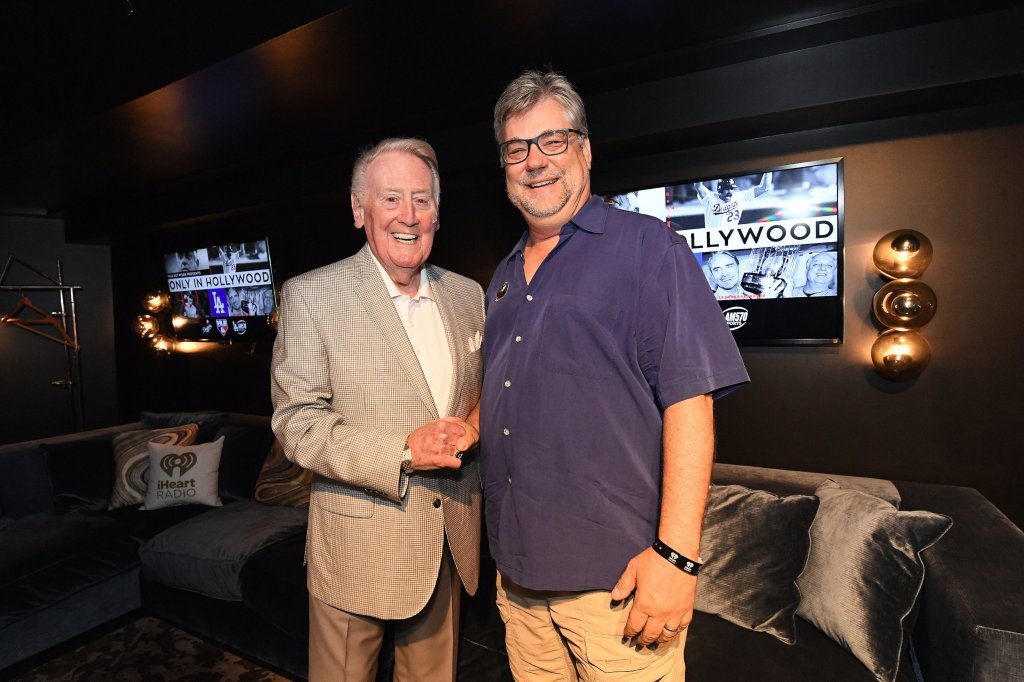
Author Q&A
Q: What’s the deal with being called the book’s “editor?” Does that mean you didn’t write anything?
A: You’re coming in hot. No need to start getting cranky from the start.
Maybe let’s explain it this way: In the academic publishing field, an editor is someone who has pulled the project together with the help of other writers. That’s what this evolved into. It didn’t start that way. I’ve written perhaps a good third of the book, from the preface, to historical timeline, the epilogue, and a hefty part the start each of the nine chapters. All from my own notes and interviews and observations. But in the process of adding other essayists, I was expanding my role into a point person. I’ve come to learn “editor” is a fairly high title. So I’ll wear it. For what it’s worth.
Also: Did you notice on the cover: A reproduction of Vin’s signature is in the microphone, but the black art on the mic, and the dark blue of the signature blended together. Just look harder.
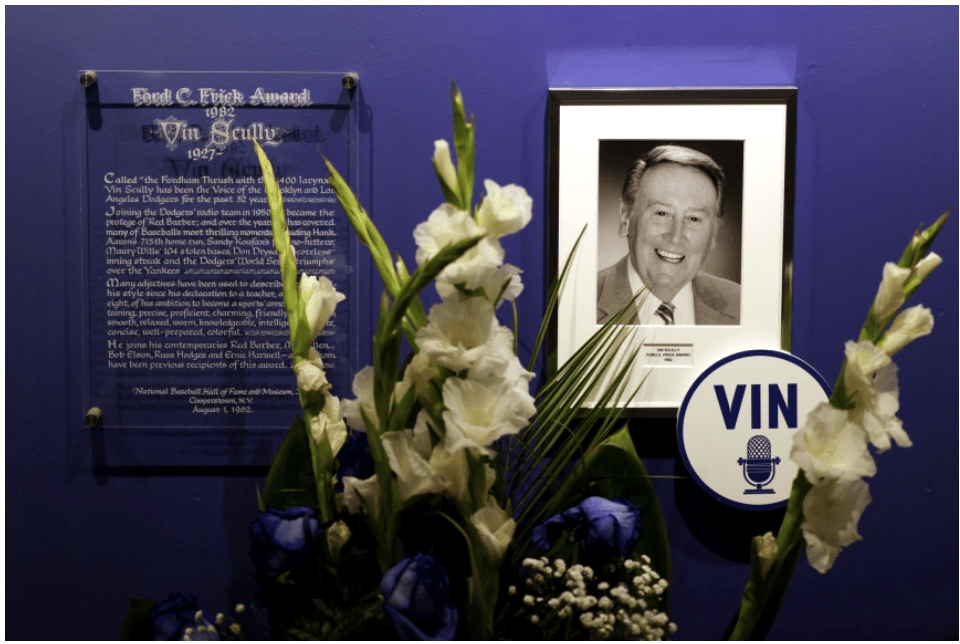
Q: Why are you answering questions before I have a chance to ask them. My next question was: Is that Vin’s signature on the cover? Jeepers. So we’ll follow it up with this: How many times have you read the manuscript since sending it to the publisher in June, 2023? Did you find any mistakes?
A: Many, many, many. Reads, not mistakes.
The reviewing of it all comes in waves. There was one set of edits from the publisher’s staff I had to review, go back and forth over suggested changes, and then let it go in early February ’24. There was a gestation period to where I finally saw a softbound review copy in March ’24 at the NINE Convention in Scottsdale, Ariz., where the University of Nebraska Press had its presence. But then I re-read it again after I got my first author shipment in early April.
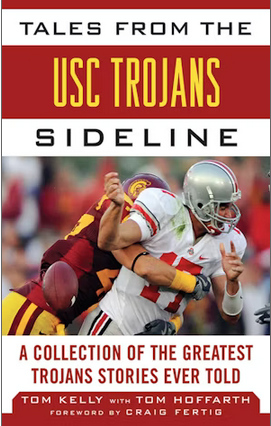
I did a book back in 2007 on former USC broadcaster Tom Kelly with then-Sports Publishing LLC, which went out of business and was purchased by Skyhorse Publishing. That was a “Tales from the USC Sideline” with the late broadcaster Tom Kelly, updated three times since its initial run. But with the Scully book, there was something surreal, magical and appreciative in reading it from cover to cover, separated from it for months, and giving it a look with a fresh set of eyes. I went over the preface, each chapter, the essays, the postscript, the author bios … reading it as a reader. I was just so grateful in how it came together. There are no mistakes. It came out as it’s supposed to come out, when it came out.
Q: Sure, but there’s plenty to second guess? Don’t you wonder: If I only got this done, or if only this person was available, or … if only Vin could see this response?
A: Sure, if you want to create another definition of insanity, you go over and over all the possibilities. Of course, there are people I had hoped to track down for an essay but weren’t able to for various reasons. Mostly — they didn’t want to write. It’s a painful experience. So some of them talked it out and I helped shape it for them. I wish some of the photos originally submitted were high enough quality to be included, but it didn’t happen. But it happened. It’s here. It’s sweet.
Q: How would you describe the relationship you had with Vin over the years — and don’t make it more than it really was, OK? It’s not like you were best pals.
A: Didn’t everyone feel as if they were Vin’s friend? As an L.A. native, a fan, someone who felt connected from the start. As a journalist, a professional respect for his time, to go to him for an answer to a pressing question. Then as a journalist who got to know him better, see him, have more confidential exchanges. A better understanding of what made him the best in so many areas. No trips to his house. No special privileges — except I did sneak into the press box before games just to chat him up on current events. It was good enough to place a phone call or two to him after he retired to see how he was doing and hear what he’d been watching and enjoying. The relationship wasn’t any greater than some — many who are in the book — nor was it distant enough to feel I couldn’t get a read on him.
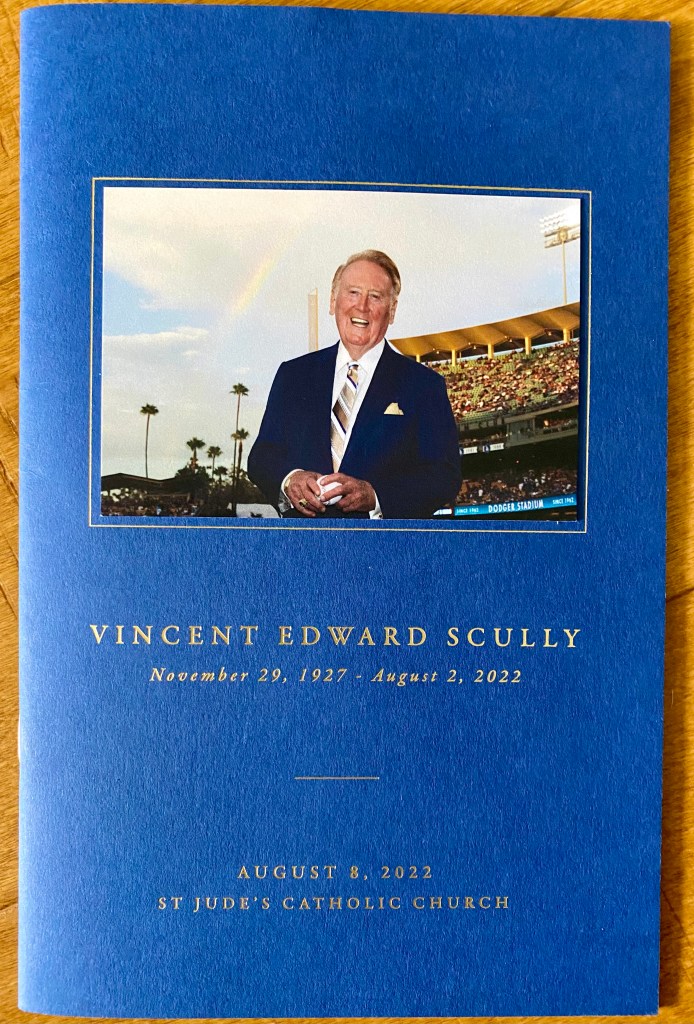
Q: How did you figure out the way to format the book with the chapters, and the essay contributors, and who the publisher would be?
A: Short story long, because we can: Ever since Vin’s passing I have been trying to get Jon SooHoo, the Dodgers team photographer, to coordinate a coffee table size book with his photographs and offer up my essays for it. There is not a lot of clarity about who owns the photos he took — likely, the Dodgers would have to sign off on it, and that wasn’t happening.
I had collected so many interview transcripts and notes and recordings of him over the years, and knew many weren’t aware of some important and interesting things that only got into my regular columns at the Daily Breeze and Daily News and OC Register. I took photos as well of him in the press box and around the stadium, just for fun, sometimes to accompany my stories. In 2016, I did a series of columns on him as his career was winding down, talking to others about him. I followed up with more stories after he left.
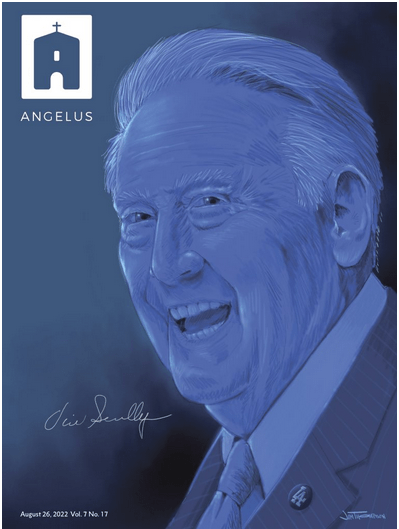
The impetus for this book was an appreciation piece I did about him for the Angelus News, the Catholic news organization of Los Angeles, to cover his Catholic life. It took me three days to even get the courage up to ask to write it, let alone do it. Then magical things started to happen. I reached out to a priest I knew, Fr. Steve Davoren, to see what he might remember doing the Mass for him and others at Dodger Stadium in the past. He confided: He was the celebrant for Vin’s funeral Mass in a couple of days. I found more and more material on him talking about his faith, how it helped pull him through some personal trials. To me, so many consider him already the best broadcaster of all time. The master storyteller. The person who connected generations. But that was only three chapters. I knew his kindness, empathy, sincerity, friendships, how he dealt with celebrity, how he influenced other kids into wanting to be a professional communicator. I thought back on it: Vin’s love of the language and storytelling likely shaped my desire to get into journalism — he was never a homer, but told the most accurate stories that he could gather from newspapers. Dots were connected, and I had a layout for the book.

The two books I felt helped me most in shaping this:
Steve Kettman’s 2021 book, “Remember Who You Are: What Pedro Gomez Showed Us About Baseball and Life,” which was a collection of essays rounded up and explained the true takeaway from the life of journalist Pedro Gomez, beloved in the industry. Here’s an excerpt. Steve wrote this beautiful intro.
It showed me how there can be a premise about someone’s life, and having dozens of people not only verify that, but amplify it with more context made it an organic tribute to someone we could learn from. Essays included Peter Gammons, Bob Ley, Max Scherzer, Dusty Baker, Tracy Ringolsby, Jack Curry, Billy Beane, A.J. Hinch, Ken Rosenthal …
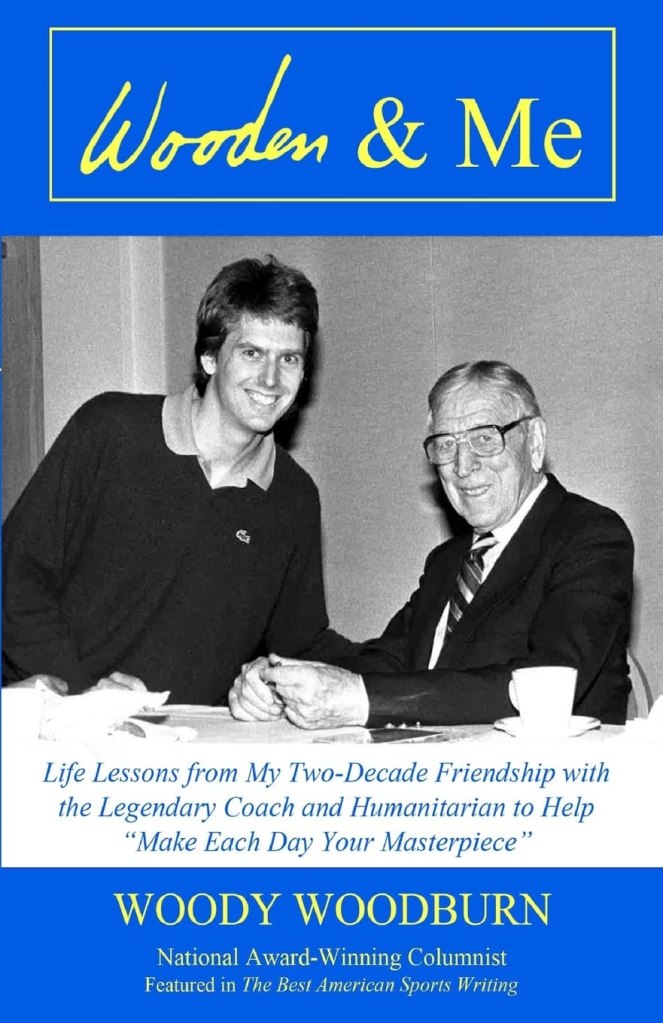
Woody Woodburn’s 2003 book “Wooden & Me: Life Lessons from My Two-Decade Friendship with the Legendary Coach and Humanitarian to Help ‘Make Each Day Your Masterpiece’” resonated for me as well. There are volumes of books written by those who were in the orbit of John Wooden, but Woody’s struck me as the best relationship model — a journalist who listened and observed and learned. That’s how I felt being around Scully.
As I put chapter ideas together, I started seeking others to see if they could corroborate my themes, or had some of their own, and which lane they might want to pick if they did an essay. Bob Costas was the first to return my email with a phone call, and recommended a few others. More and more said they would do it — Peter O’Malley (despite the fact he was dealing with the last days of his wife’s life), Kevin Fagan, who created the comic stripe Drabble and I arranged once to meet Vin after he drew a Vin-specific cartoon; so many people connected with Catholic Athletes for Christ; former Dodgers GM Ned Colletti, writer/author Will Leitch … they set the groundwork.
Q: How did the Dodgers help in any of this? The book is going to be all over their team stores and radio shows and …
A: Are you trying to answer your own question? It’s not that simple, Simon. The only real help I got from team historian and longtime friend Mark Langill, but even he couldn’t do as much as he might have done — considering all the help he does with other writers tapping into Dodgers history. Since this really wasn’t an historical pursuit, Mark could more or less suggest names of people to seek out. I knew few if any of the top names currently working for the Dodgers were apt to contribute, because of some hesitancy to possibly do something that could upset the Scully family and then have them cut off by any misunderstanding. For example, when Vin died, a couple of quick-published books came out, almost too soon, and seemed to be taking advantage of the emotional situation. Anyone who then tried to something after that — like me — was going to face more resistance. None of that is a surprise, nor did I want to dwell on it too much. Vin was a public figure, I never pursued a book with him when he was alive for various reasons, and the Dodgers’ current policy with current ownership is also not to carry books in their team stores, or endorse any books that aren’t MLB Properties approved. Which is just too bad because there are so many great books about the team out right now. Surely they could get a concession on it. This book, however, will be in the Baseball Hall of Fame store soon. As well as Joanna and Chip Gaines’ “16” store in Waco, Tex. So that’s something.
Q: How did the Scully family contribute? Were they supportive and open up all their archives to help make this process more wide spread?
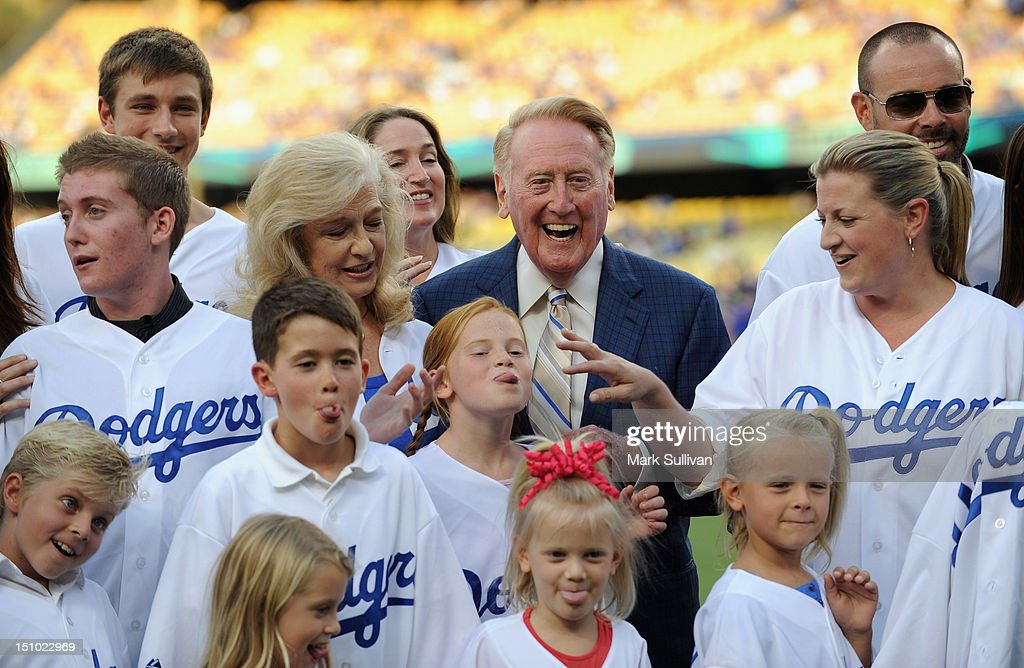
A: They didn’t have to be, because that’s not what this book was about. I was told through the Dodgers they are working on their own media project and they have a point person for it. I was able to connect through various friends to several of Vin’s daughters, and I was told all was OK to proceed, that whatever project they might do, this wouldn’t conflict, but would compliment it.
Here’s a sidestory to that: I was speaking to a USC Annenberg School of Communication and Journalism class by professor Dan Durbin, who is one of the book’s essayists. The class is called COMM 383m: Sports, Communication and Culture. It was a Zoom gathering. I could see the names of the students as they popped up on the screen. About 20 minutes into the class, Dan asked me about the Scully family dynamics. I had to pause. There was a student in the class identified as Will Scully. Turns out, it was Vin’s grandson, the son of Vin’s second oldest son, Kevin.
What we learned about Vin Scully from his grandson Will:
“In all his free time, he never watched baseball. He adored football. He had a quick, active mind. My dad told me that when I was a teenager — grandpa’s like you. That love of football was passed down to my dad, who is also a fanatic. I’m kind of an antsy person myself and trying to watch baseball is hard. We have so many grandkids around that when we’re at a gather, there’s so much energy around. But the love of football and basketball — he kind of kept that private.
“How would I want him to be remembered? I’ve never known anyone, and don’t know if I ever will know anyone, who was so in love with his craft. He did it until he couldn’t do it well any more. Sixty-seven years is something I can’t comprehend. He felt he won the lottery. He was so lucky to fall into that position and he also worked harder than anyone else. If you can find something you deeply love it will take you far.”
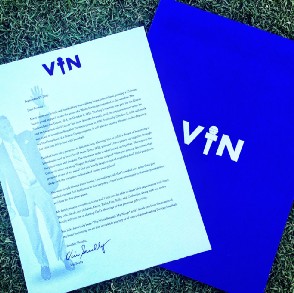
Q: So, about connecting with this particular publisher … will you go back and finish the answer?
A: Sorry, it was such a long-winded question you lost me. Maybe break it up better next time.
And why wasn’t that question italicized? You’re switching fonts on me and it’s confusing.
Plus I’m still misty eyed from that response from his grandson above.
I had the general concept done, and a handful of essayists committed, I reached out to come contacts first at University of Nebraska Press. This was within a month or so Vin’s passing in August, 2022. I didn’t know if my deal was too late, or wasn’t fleshed out enough. While I waited for some Nebraska responses, I kept working on it, lining up other potential (and more local) publishers. Nebraska is a company I’ve worked with for years in doing baseball book reviews, and their quality of work has been outstanding. I got a call finally in early March, ’23, from acquisitions czar Rob Taylor. He liked the idea that Nebraska had just purchased the publishing rights to Curt Smith’s bio on Scully, “Pull Up A Chair: The Vin Scully Story.” The company also recently published a heavy duty biography on Scully’s mentor, Red Barber. My idea fit into their portfolio. Rob talked me through some things and basically said: If you can have it all done by June 2023, we can get it out probably by the start of the ’24 baseball season. If you need more time, we’ll aim for the World Series of ’24. I wanted it ASAP, and the 10-month start-to-finish process — longer if there’s an index to compile — would be worth the extra hustle at the start. I worked daily and long hours from March, April and June to do it.
Q: The number of essays … how do you explain it landing on 67? A favorite number on the roulette wheel?
A: Does a roulette wheel even go that high?
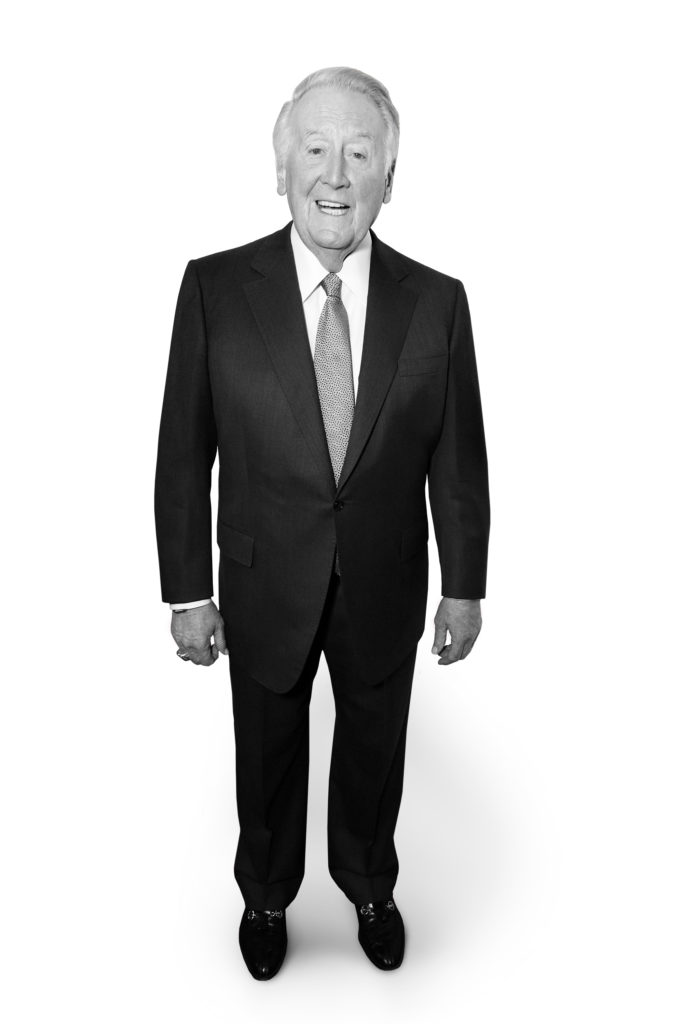
I honestly had no idea how many essays I would get in that short of time — and didn’t realize how many people I’d have to connect with via phone or zoom, interview them, shape a possible essay draft, have them approve it, and then figure out where it was going to go. With a couple days left before the manuscript was due, I was connected with former MLB commissioner Bud Selig, on the advice of Dennis Gilbert, who not only did an essay but was Vin’s last business manager. As I sorted where to put Selig’s essay, and was trying to divide up the 85,000 words I was told I could use, and cutting my own chapter intros down while bolstering others, I counted up the essays.
Wait, it can’t be 67. I counted again. I had a couple that hadn’t come through, but the deadline was here. I had to stop. And I landed on 67. The exact number of years Vin was the Dodgers’ broadcaster. I couldn’t believe it. There was some kind of guardian watching over this whole thing.
Q: Yeah, yeah … karma … great … but there had to be people who you really wanted to be part of this but didn’t get it done. Spill on that. There could have been 100 or so, right?
A: You know the definition between skeptical and cynical? Maybe don’t go so far the other way on how this panned out.
At some point in the process, some of my author friends who I’d been hashing this out with reminded me: Get as wide a mix of people and professions as you can. I realized at one point all I had were a) male, b) white, c) older contributors. I rewrote the list. I went more purposefully on diversity. The rainbow effect worked.
People who I reached out to but weren’t able to make it work into their schedule can be listed here, but I won’t go into it. The main misses may have been Sandy Koufax, Kevin Costner, Keith Olbermann, Ron Howard, journalist Claire Smith, MLB historian John Thorn, and Jackie Robinson’s son, David, who runs a Tanazian coffee co-op (and you can order Sweet Unity Farms Coffee online, friends, as I had done that initially and then began exchanging emails with his daughter in this process). We can always circle back.
Q: Favorite stories about Vin you wanted to consider for the book but couldn’t make happen?
A: That’s when I learned all about copyright licensing, publications permission, author OKs … Sometimes it worked, other times it didn’t. Three essays that made it are versions of ones previously published — by Bob Costas, Sammy Roth and Dale Marini. They modified them for the occasion and just used the previous ones as a starting point.
Keith Olbermann wrote a spectacular piece for Esquire in 2016 — “Vin Scully Is A Legend, But Not A Saint” — I wish I could just cut and paste. I couldn’t get permission. George Will did a spectacular 2016 story upon Vin’s retirement in 2016 I asked to use — “Baseball’s storyteller, our friend.” for The Washington Post. The newspaper said, sure, you can have it for a fee. Kind of steep. Will’s people said I could use it, but, really, I couldn’t. Will’s secretary later told me if they knew, George would have paid the copyright fee. Oh well. Michael Kay did a piece for the New York Post in ’22. Kay said it was OK to use it. The paper asked for a fee. I passed.
And things like this:
Q: Let’s take a break from the giant letters –– Here’s a bunch of quick questions: Favorite person you tracked down that you never thought you would get? A: Harry Scherer and Brian Cranston. Both were swell to work with. And had a unique connection with their Hollywood flavor for this.
Q: Favorite essay that best sizes up Vin‘s compassion? A: The one by Lisa Nehus Saxon.
Q: Favorite essay that explains Vin’s impact on those who aspired to have a career like his? A: The one by Jon Weisman, which is why I made it the last one in the book. Weisman was the closer.
Q: Favorite photo? A: The one that launched Dale Marini’s essay about his son captured in an AP shot during Vin’s last game in San Francisco. Amazing backstory.
Q: The most bittersweet essay? A: The one by Doug Mann, Vin’s longtime stat person who passed away in February, ’24. At least Doug got to see his finished essay in the context of the book as I was able to have him read a review copy. Not knowing at all, this would be the only time he would received the finished book. His sister and I have been conversing, and she is interested in doing a book about him for young adults, to inspire their interest in that field of work. She already has a working title: “Stat Mann.”
Q: Favorite nugget of information found in an essay you’d never heard about? A: Ned Colletti telling Vin he bought two sets of Scully’s golf clubs put up in a family auction.
Q: Coolest book blurb? Gotta be Koufax, right? A: When essayists Patt Morrison was able to get one from her friend, actress Annette Bening. By the way, did you see her performance in “Nyad”? Better than anything Warren Beatty ever tried to do. Koufax was the toughest to get anything. Via his handlers. That’s just how it is.
Q: What about Curt Smith? Did you enjoy his bio on Scully? A: No, and neither did Scully, which I once wrote about. It was felt that it wasn’t worth asking Smith about helping with this. It wasn’t a good fit.
Q: Anything else inspire this book? Some wanderlust deep-seeded memory you had with the transistor under the bed at night listening to him rock you gently to sleep?
A: Me, and a whole city in the ’60s, ’70s, ’80s …
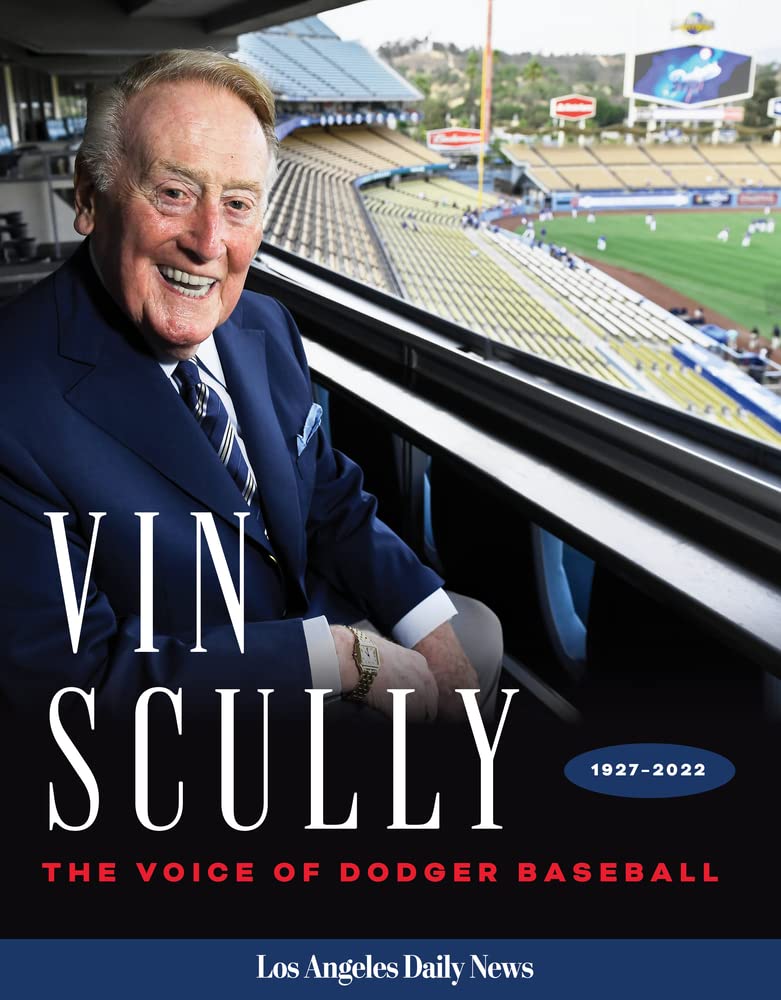
When Scully died, my former employer, the Southern California News Group, partnered with Triumph Books to produce “Vin Scully: The Voice of Dodger Baseball: 1927-2022.” There are 27 stories reproduced from the company’s database, plus a new introduction by writer J.P. Hoornstra. Of those selected, I wrote eight of them, and there were at least a dozen more to consider. I didn’t get to pick or choose. No residuals from any of that. So be it. I didn’t own it. But I knew I owned a lot of more that they never saw, and I never printed. Including photos. So I was compelled to find more.
Q: Will there be an audio version of the book and, if so, who is The Voice? It would seem cool if all the essayists could read their own pieces.
A: I was told there was to be one, but now that’s in limbo. My suggestion would be to have Ross Porter do it. All of it. I’d love to hear him in particular do his own essay.
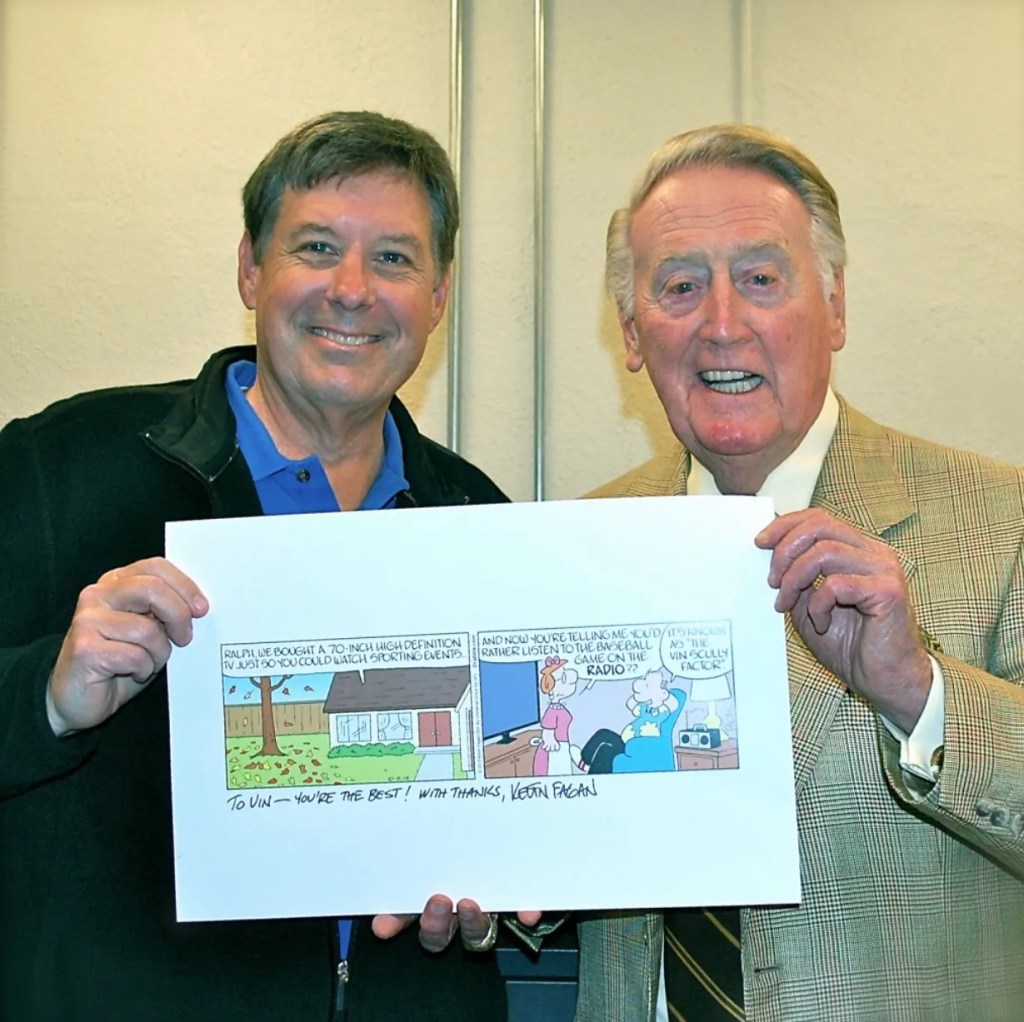
Q: Hey is there a better photo of the cartoon that Kevin Fagan did about Vin?
A: Sure. Here it is above. And the story I wrote about it at the time in 2013.
Q: Last question ….
A: How can you be sure?
Q: Mostly by fatigue. What do you want readers to take away from the book?
A: That Vin Scully’s actions spoke louder than his words. Which is a pretty profound way of thinking of his existence on the planet for 92 years. A life well lived. Maybe this is a playbook someone can use. A self-help book. However it works.
Q: Any outtakes worth bringing up?
A: What happened to the other question being the last one?
Plenty of material was left out for space, and maybe it didn’t quite fit. It will be incorporated into the book’s website.
Such as:
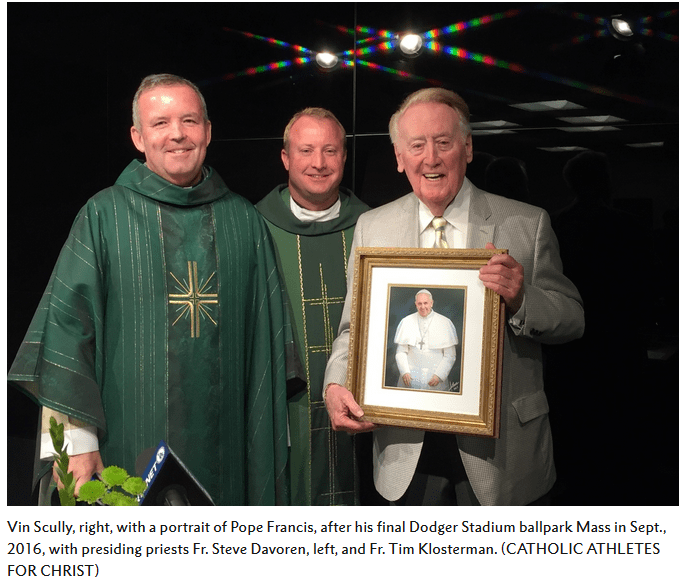
== Should Vin Scully be up for canonization in the Catholic church? On the road to sainthood?
== This Feb., 2023 story about his granddaughter playing softball at Seattle University, dedicating her season to him.
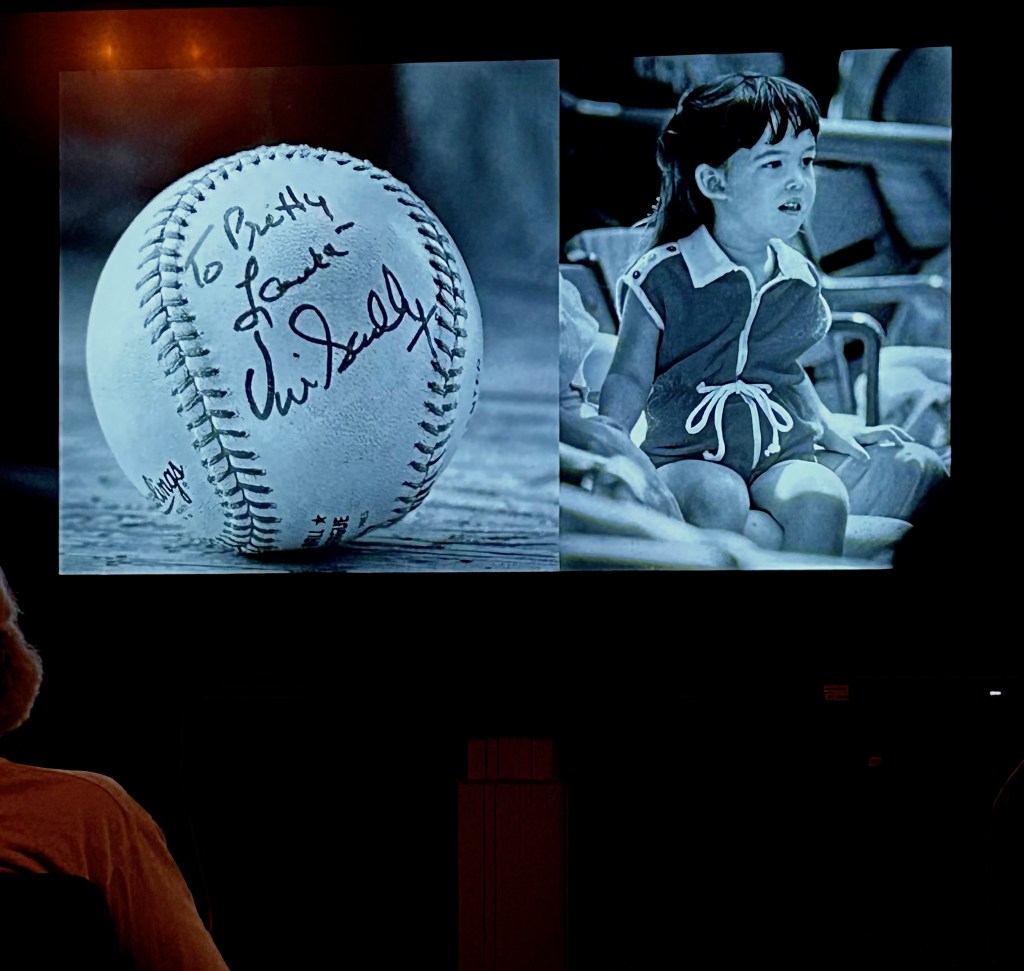
== In photographer Rich Key’s new book, “The Dodger Collection,” which we reviewed, he explains how his daughter, Laura, once received an autographed ball from Vin and … he tells the story better.
== Kevin O’Malley from Catholic Athletes for Christ has his story retold in the Arlington (Va.) Catholic Herald.
We’re not giving it all away here. Well, we are giving it away. Because it’s the nice thing to do. Check the website for updates.
How it goes in the scorebook
A true appreciation.
Not a tribute. Or biography.
An elegant landing.
You can look it up: More to ponder
= An interview on Ross Porter’s YouTube channel
== A review from Library Journal.com
= An excerpt from “Off Base with Howard Cole” with essays from Bob Costas, Joe Davis and Ross Porter.
= From GoodReads.com, a five-star review: “It’s difficult to add any more praise and adulation for Vin Scully that hasn’t already been said, but this book by Tom Hoffarth does just that. … That is why this book is not only such a joy to read but is also one that must be given credit for accomplishing a difficult task – namely to share insights into the man that were not already shared either during his last year of broadcasting in 2016 or after his death in 2022. By interviewing various people – from fans to baseball personnel to other celebrities – Hoffath was able to compile a great selection of stories on many different aspects of Scully’s life. To a person, everyone that Hoffath gathered information from said the same thing about Scully – that he treated them with kindness, listened to them and expressed sincere pleasure in meeting them.”
= An excerpt from JohnMillen.com, who we interviewed for the chapter on the art of storytelling, explaining how Scully is a storytelling role model.
== More audio excerpts:
== One last link, to LinkedIn

 Tom Hoffarth's The Drill: More Farther Off the Wall
Great interview. I really enjoyed reading about the backstory of the book.
On Thu, May 30, 2024 at 9:06 AM Tom Hoffarth’s The Drill: More Farther Off
LikeLike