


This is the latest post for an ongoing media project — SoCal Sports History 101: The Prime Numbers from 00 to 99 that Uniformly, Uniquely and Unapologetically Reveal The Narrative of Our Region’s Athletic Heritage. Pick a number and highlight an athlete — person, place or thing — most obviously connected to it by fame and fortune, someone who isn’t so obvious, and then take a deeper dive into the most interesting story tied to it. It’s a combination of star power, achievement, longevity, notoriety, and, above all, what makes that athlete so Southern California. Quirkiness and notoriety factor in. And it should open itself to more discussion and debate — which is what sports is best at doing.
The obvious choices for No. 73:
= Dennis Rodman: Los Angeles Lakers
= Ron Yary: Los Angeles Rams
The not-so obvious choices for No. 73:
= Charlie Cowan: Los Angeles Rams
= Tyler Toffoli: Los Angeles Kings
= George Stanich: UCLA basketball
The most interesting story for No. 73:
Dennis Rodman: Los Angeles Lakers forward (1999)
Southern California map pinpoints:
Newport Beach; Long Beach; Inglewood (Forum)
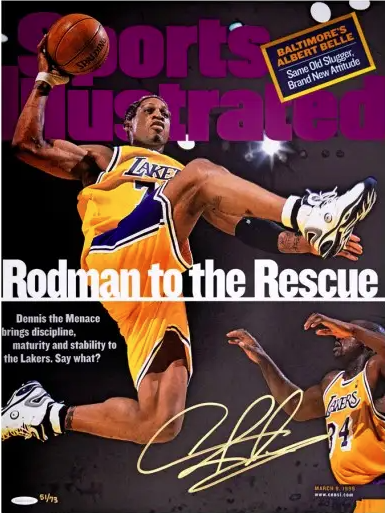
For 50 days spanning 23 games between February 23 and April 15, 1999, Dennis “The Menace” Rodman was a Laker. The time felt much longer and more painful.
A month after the Chicago Bulls released him, and showing up the day after the Lakers fired Del Harris as their coach and handed the job to Bill Bertka, there was a perfect amount of turmoil for Rodman to come on board.
Aside from tardiness and unpredictability, Rodman’s hair was a daily guessing game as well — dyed all shades of yellow sprinkled with black dots in it, accentuating his tattoos and piercings. Straight from the heart through his head.
Fast forward to Tax Day ’99, after he had taxed everyone’s patience. He was finally audited a month after Los Angeles Times columnist Bill Plaschke jerked his knee and told the Lakers they had to cut him loose “before he returns from spring break.”
The whole experience was long enough to get him a cover story in Sports Illustrated. Someone even had enough material to put together his “10 best plays” highlight reel.
It ended up as the latest chapter in the decades-long drama, “As The Worm Turns” starring Rodzilla, aka Demolition Man, aka El Loco.
Aka Psycho.

The frantic end of an NBA season already shortened to 50 games because of a league lockout saw the Lakers also finishing out their final games at the Forum in Inglewood. They were trying to handle their business with second-year player Kobe Bryant and Shaquille O’Neal in his third Lakers season and making all sorts of roster moves on the fly.
The decision was to add Rodman, soon-to-be 38 and living in Newport Beach, because … he was available? Team owner Jerry Buss apparently offered a personal invitation to him. He knew showmanship when he saw it.
“I think a lot of people would forgive him as long as he tried to act somewhat orderly,” said Buss. “Dennis is Dennis. We’re not about to tell Dennis how to be someone else. We’d take him the way he is.”
Somewhere in all that was the fact Rodman’s agent, Steve Chasman, was trying to work a movie deal with Fox, a studio that had an option to buy into the Lakers as a 10-percent partner, upon Buss’ approval. Deals with the devil can sprout horns quickly.
Rodman was trying to make a career rebound after the Bulls’ post-Michael Jordan house cleaning. This was three years after being named one of the NBA’s 50 greatest players of all time on the league’s half-century anniversary, recognizing he played on five championship teams (three in Chicago, two in Detroit), winning seven rebound titles in a row before coming to the Lakers, and having been a two-time All-Star.
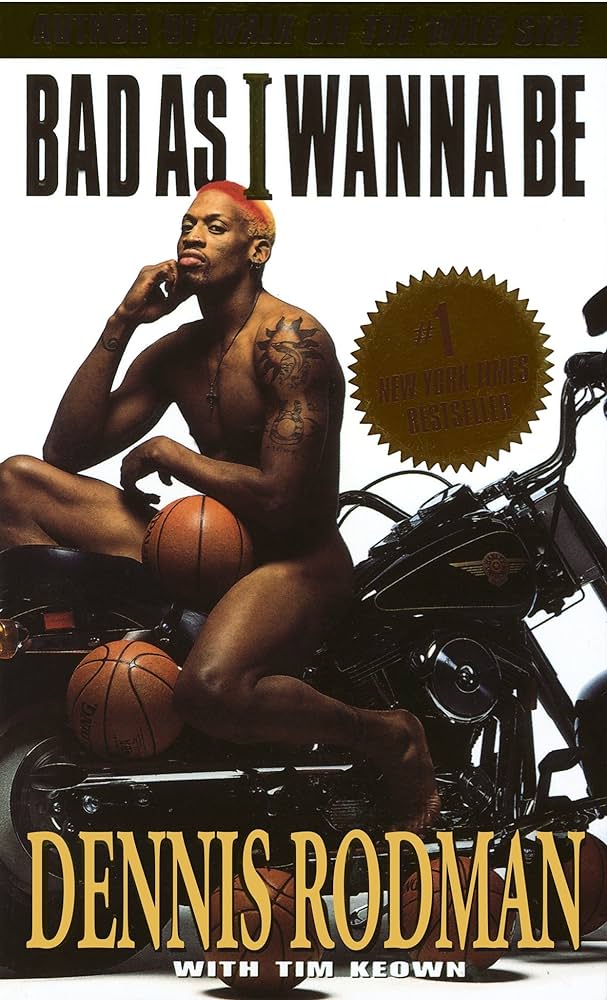
The same year he was dressed in a white wedding dress at an appearance for a New York book store to promote his autobiography, “Bad As I Wanna Be.” (It would be followed up by “Walk on the Wild Side” in 1997 and “I Should Be Dead By Now” in 2007.
“He doesn’t merely come with baggage,” wrote the Los Angeles Times’ Mark Heisler, “but an entire train of it.”
He cited a three-game NBA suspension for once head-butting a referee. He blew off a practice during the NBA Finals without permission to wrestle in a WWE event. He had been suspended six times in the previous seven seasons, either by the league or his team.

Al Seib, AP
When the team signed Rodman, the L.A. Times story was headlined “Lakers Going Hollyweird” also reported that he called his own press conference at Planet Hollywood to let everyone know, then began sobbing behind a pair of sun glasses while badgered with questions about whether he thought he was being too selfish for drawing out negotiations about his return.
It was revealed he wanted to wear No. 69, but the team rejected it. (True fact: No NBA player has ever worn No. 69. The closest Rodman has come to that number, in a business sense, is having card No. 69 in the 1998-’99 Bowman basketball card set.
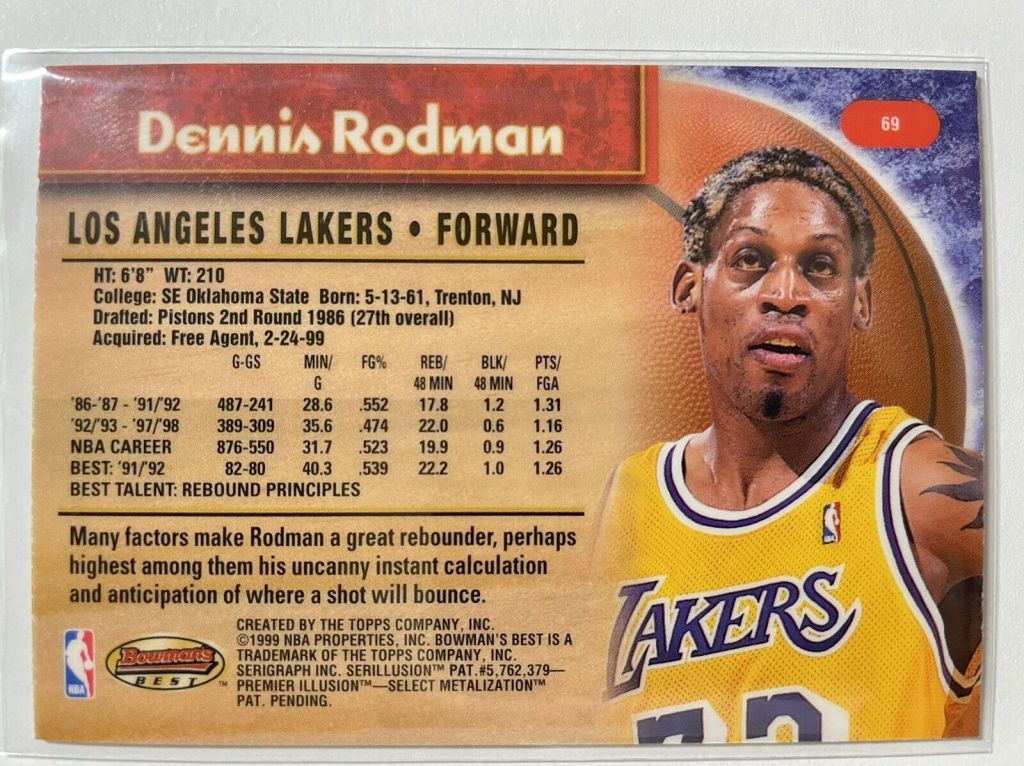
He said he settled on No. 73 because seven represented the number of rebound titles he had won, and three was for the number of NBA title teams he played on.
The Lakers did win 11 in a row between February and March with Rodman – and after naming Kurt Rambis as the head babysitter. Then they went 6-6.
Rodman was averaging 11.2 rebounds, 28.6 minutes and at least a half-dozen headaches a game for all around him. On a night he would grab 17 rebounds in a Laker victory over Denver, he would turn around and be ejected from a game after picking up two technical fouls.
Carl’s Jr. began airing commercials starring Rodman that week, but Converse canceled a multi-million-dollar endorsement contract.
He took a “leave of absence for personal reasons” amidst all this and missed eight days, having split with his wife of six months, actress Carmen Electra, for the second time. Hence, the Plaschke plea to let him go and take care of his stuff.
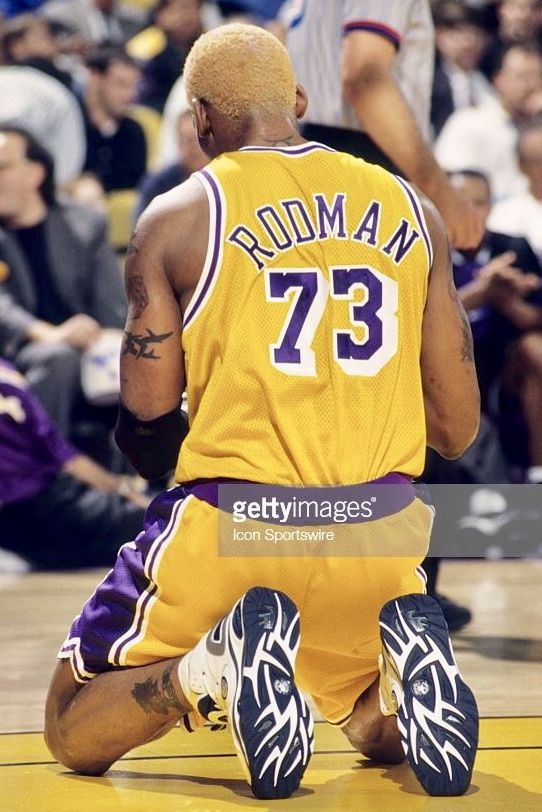
During a 37-point loss at Portland, Rodman wouldn’t go back into a game, sitting out the second half with what he said was a sore elbow. The next day, he shown up late for practice, couldn’t find his shoes or socks, and Rambis just told him to go home. That was it.
”At this time we feel it’s in the best interests of the Lakers to end the relationship,” the Lakers vice president Jerry West said in a statement. ”This obviously didn’t work out like we had hoped, but we would like to thank Dennis for the contributions he did make to the team and wish him the best of luck in the future.”
The team limped all the way to the Western Conference finals, swept by San Antonio, moved to Staples Center and turned the page on all of it.
And Rodman connected with collectors who got themselves a jersey suitable for framing. Even if Rodmen felt he was the one being framed.

The aftermath
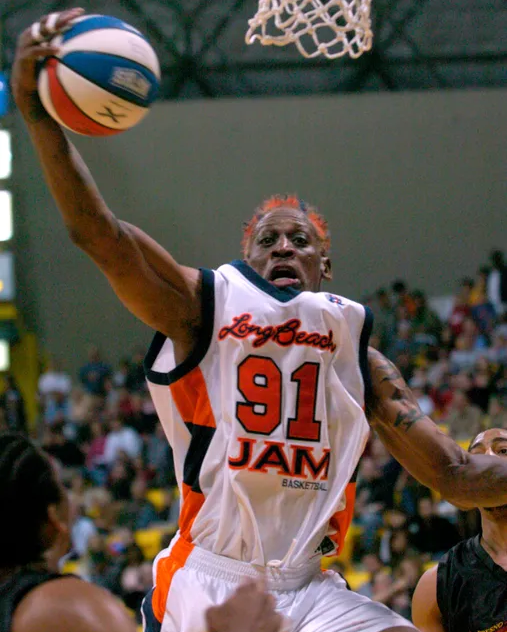
In January of 2004, I was sent to the Long Beach City College gym to find Rodman, then age 43, as he making (another) comeback with the Long Beach Jam of the re-constituted American Basketball Association.
Stephen Carr, AP
They said he would be wearing No. 91, as he once did with the Bulls (1995-96 to 1997-98; after wearing No. 10 for Detroit from 1986-87 through 1992-93, and then at San Antonio from ’93-’94 to ’94-95, then going to No. 70 for Dallas in 1999-2000 — and his when his 29-day stay with the Mavericks ended when he was waived a day after he criticized owner-in-waiting Mark Cuban).
He couldn’t participate in drills that day, the team said, because he had a large silver ring stuck through the middle of his lower lip and “he didn’t have the instrument that he needed to get it off,” according to Jam president Steve Chase, watching Rodman jog through some set offensive plays with teammates, minus any defenders. “So he didn’t want to chance an injury.”’
Not when you’re promised $850 a week.
He had said he was sober since October after he crashed a motorcycle doing stunts outside a Las Vegas strip club and tore up a knee. He said he was now a devoted husband and a loving father as he was appearing in an ABC reality show called “Celebrity Mole: Yucatan” – which he eventually was declared the winner.
“My record speaks for itself,”’ Rodman said when a crush of media types practically pinned him to a wall and asked why anyone shouldn’t be skeptical about this latest cry for attention.
“There’s nothing to be skeptical about because it’s not like we’re throwing $20 million at him to play for us,” said Jam coach Earl Cureton.
The grand plan was to get Rodman back in the NBA, playing with the Jam, whose schedule included two games in Las Vegas.
“That’ll be a test for his sobriety,”’ Chase admitted.
Michelle Rodman, officially married to him since May, remained optimistic.
“He’s made a complete turnaround,”’ she said. “You don’t know the hell I used to go through with him. Now, I wouldn’t give this guy up for anything.”
Rodman actually gave the Jam a title in the seven-team ABA.
A couple months later, Rodman sold his two-story house on the Balboa Peninsula for $3.7 million, in part so he could separate himself from the crazy O.C. beach party scene. He still thought he could play in the NBA and three teams were still interested. He went to the ABA’s Tijuana Dragons and Orange County Crush/Buzz (2004-05). He also participated in games for Finland’s professional league and three games for the Brighton Bears of the British Basketball League.
He faded to black. Or yellowish. Or something less colorful.
The legacy
For the body of work in his 14-year NBA career, he was somehow inducted into the Basketball Hall of Fame in 2011, the second-best thing that happened to him that year as he also made it to his 50th birthday.
In 2014, he was seen with North Korean leader Kim Jong-Un at a basketball game in Pyongyang and that became … nuclear.
In February 2017, Rodman was sentenced to three years of probation for misdemeanor charges stemming from going the wrong way onto the I-5 freeway in Santa Ana and, authorities said, prompting a crash.
In January of 2022, Rodman said Bryant and O’Neal were “envious” of him during their time together since he got so much attention and the team allowed him to do his own thing.
“They couldn’t stand me on that damn team, to be honest with you,” he said.

He also said he was dating future the owner’s daughter and future team president Jeannie Buss for six months. Maybe that was an issue?
In September of 2022, Shaquille O’Neal called Rodman his worst teammate ever.
“He was a great player, but he made it hard. Like when you try to corral the guys together and the people above you [are] letting this one guy do whatever he wants. So we had to be there an hour before the game. He’d come in fifteen minutes before the game eating chicken and rice. While the coaches are talking, he would jump in the shower. Cold shower. Come and give you 15-20 rebounds.”
Rodman’s name hasn’t disappeared in the sports world.

His son, D.J., is a 6-foot-6 forward in his final year at USC, transferring after his first four years at from Washington State, wearing No. 10.
His daughter, Trinity, played for the U.S. Women’s National Team that competed in the 2023 World Cup.
“People do know Trinity Rodman sometimes before Dennis Rodman now,” Trinity told ESPN in June 2022.
“That’s a cool thing for me. I’m not trying to overcome what he accomplished, I just want to build my own story, and I think I’m doing a really good job.”
Who else wore No. 73 in SoCal sports history?
Make a case for:
Charlie Cowan, Los Angels Rams offensive lineman (1961 to 1975):

Started his career at left guard but made the Pro Bowl as a right tackle and left tackle from 1967 to ’70, starting 186 of 206 NFL games in L.A. alongside Tom Mack and Ken Iman. Cowan took the Rams’ offer (as a fifth-round pick) instead of being the 36th overall selection by the Denver Broncos in the 1961 AFL draft. In 1998 he died at age 59 from kidney failure complications.
Ron Yary, Los Angeles Rams offensive tackle (1982): At the end of a 15-year NFL career that led him to the Pro Football Hall of Fame based on his success with the Minnesota Vikings, the former USC Outland Trophy winner out of Bellflower High and Cerritos College game back to L.A. at age 36, wearing the same number he had in Minnesota (after wearing No. 77 at USC).

Tyler Toffoli, Los Angeles Kings center (2012-13 to 2019-20): Picked 47th overall in the 2010 NHL draft, Toffoli was a fan favorite during the team’s 2014 Stanley Cup run on “That 70s Line” with Jeff Carter and Tanner Pearson. Scored 23 goals in ’14-’15 and 31 goals in ’15-’16, where he had a league-best plus-35 ranking. Traded to Vancouver for a couple draft choices at the 2020 deadline. His eight seasons in L.A. from age 20 to 27: 515 games, 139 goals, 151 assists, and a hat trick during the chrome-helmeted Kings’ 3-1 win over Colorado on Feb. 15, 2020 at the Air Force Academy’s Falcon Field — a Stadium Series outdoor event at 6,600-feet above sea level where temperatures dipping into the 20s. Two of his goals were scored in the final minute, one to break a 1-1 tie, the other on an empty netter to seal it. He didn’t even keep his stick. He gave it to one of the cadets cheering him on. “The things that they do for the United States, all over the world, is pretty impressive. So, it wasn’t a very hard decision.”
Bob Winslow, USC football end (1937 to 1939): Part of the Trojans’ 1939 national title team that defeated Tennessee, 14-0, in the Rose Bowl to finish 8-0-2. Winslow came out of Inglewood High and in 1940, was drafted by the NFL’s Detroit Lions, also playing for the Brooklyn Dodgers. In 1944 he played quarterback for the Hollywood Rangers in its last years of the American Football League. Winslow was the backfield coach at USC from 1943 to ’46 and again in ’48. He was the head coach at the University of Arizona from 1949 to ’51. His son, Troy, was the USC quarterback in 1964 to ’66.
Have you heard this story:

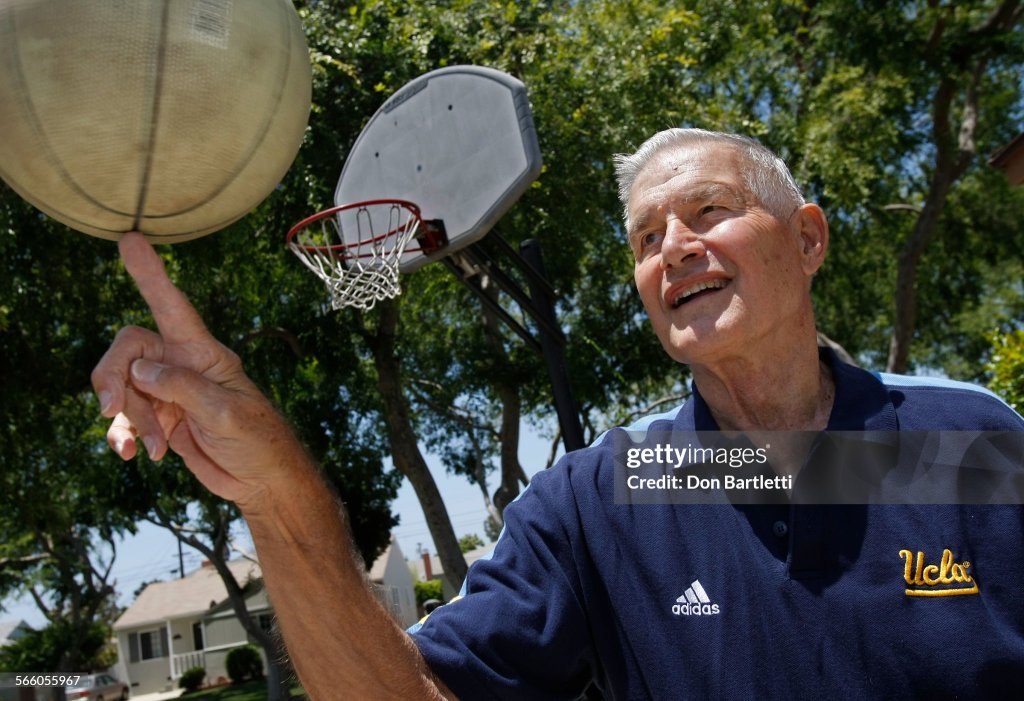
George Stanich, UCLA basketball guard (1947-48 to 1949-1950):
A two-time all-Pacific Coast Conference performer, Stanich was coach John Wooden’s first All-American player in Westwood. Under coach Wilbur Johns in the 1947-48 season, the 6-foot-3 Stanich started at center and his 5-7 older brother John led Bruins in scoring. For the ’48-’49 season, Wooden came in and moved Stanich to guard. He also pitched for the baseball team three seasons, including throwing a 5-hit shutout as a sophomore as UCLA beat USC for the first time in five years. Some of that also happened as he was taking the bronze medal at the 1948 Summer Olympics in London in the high jump (where he initially thought he had the silver). Drafted by the NBA’s Rochester Royals No. 22 overall in 1950 (in the same draft where the Washington Royals drafted USC’s Bill Sharman), Stanich never entered the league deciding the money was in baseball. He pitched the Oakland Oaks of the Pacific Coast League, as well as Idaho Falls Russets and Stockton. Inducted into the UCLA Hall of Fame in 1985, Stanich became the Torrance High School baseball and football coach for one year (1955) before a 37-year run at El Camino Junior College (1956-1992), coaching basketball for the first 20 years and helping to get Keith Erickson on the UCLA roster. “Of all the men that I’ve met,” Erickson says, “George Stanich is as close to John Wooden as I’ve ever known.” The Gardena resident living near the ECC campus born in 1928 “touched the lives of so many young men,” said Ron Wey, a center on the 1960-61 ECC team, in The Union ECC newspaper. “He was a disciple of John Wooden, he did not cuss, drink or smoke. Very passionate about coaching his team. [Stanich] had a wonderful wife and family that made lots of sacrifices so he could spend time with us.”
Anyone else worth nominating?

 Tom Hoffarth's The Drill: More Farther Off the Wall
1 thought on “No. 73: Dennis Rodman”