

This is the latest post for an ongoing media project — SoCal Sports History 101: The Prime Numbers from 00 to 99 that Uniformly, Uniquely and Unapologetically Reveal The Narrative of Our Region’s Athletic Heritage. Pick a number and highlight an athlete — person, place or thing — most obviously connected to it by fame and fortune, someone who isn’t so obvious, and then take a deeper dive into the most interesting story tied to it. It’s a combination of star power, achievement, longevity, notoriety, and, above all, what makes that athlete so Southern California. Quirkiness and notoriety factor in. And it should open itself to more discussion and debate — which is what sports is best at doing.

The most obvious choices for No. 48:
= Les Richter, Los Angeles Rams
= Ramon Martinez, Los Angeles Dodgers pitcher
= Dave Stewart, Los Angeles Dodgers pitcher
= Torii Hunter, Anaheim Angels outfielder
The not-so-obvious choices for No. 48:
= Lionel Washington, Los Angeles Raiders
The most interesting story for No. 48:
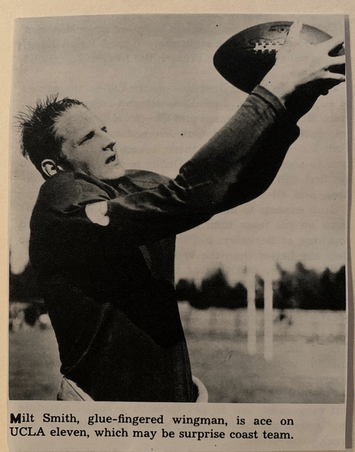
Milt Smith, UCLA football left end (1939 to 1943)
Southern California map pinpoints:
Redlands, Santa Ana, Westwood
Watch what happens here, and tell us if we’re taking up too much time.
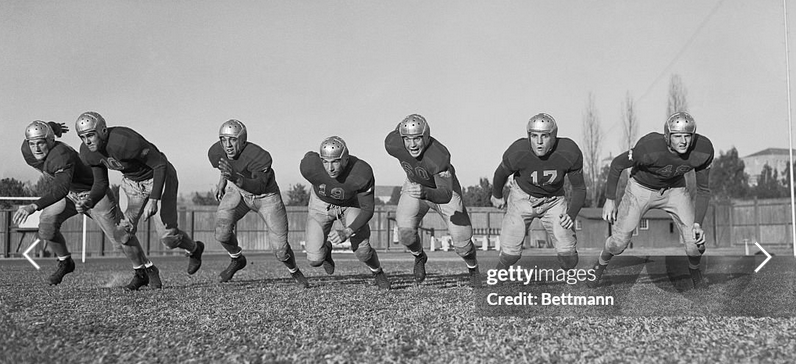
You’ve heard of the 1939 UCLA undefeated football team full of soon-to-be legendary figures?

Milton Bradley “Snuffy” Smith wasn’t one of them.
His name, after all, was Smith.
When the Redlands-born kid from Santa Ana High joined the Bruins roster as a freshman, the offense was already generated by the talents of Jackie Robinson, Kenny Washington and Woody Strode. The Gold Dust Trio.
As Strode moved on after the season to start a film career and try some local semi-pro football, the sophomore Smith was named as his replacement at left end by coach Babe Horrell. But Smith’s season ended with a broken leg in the third quarter of a game in the next-to-last game against Washington — the team’ s only win that season. Smith was still selected second team on the Associated Press and All-Pacific Coast Conference teams.
In 1941, with Bob Waterfield coming in as the new UCLA quarterback, Smith was one of his favorite receivers. He ended up as an honorable mention for the All-PCC team.

By the time Smith reached his senior year, he became part of the Bruins’ first Rose Bowl appearance in Pasadena, after UCLA outlasted USC at the Coliseum in the final regular season game.
Smith’s daughter, Barbara White, told the Los Angeles Times in 2012 that before the 1942 USC-UCLA game, a group of Bruins went to Newport Beach for a party that year and ran into some USC players. Smith and a USC player got into a fight, and both were arrested.
“My mom went down to bail them out and he refused to let her unless she bailed out the USC player too,” says White. “There was respect.”

After UCLA’s 9-0 loss to Georgia in the Rose Bowl, Smith enlisted in the U.S. Army and was shipped out to armored commander officer candidates’ school in Fort Knox, Kentucky.
They had no military football team there — Waterfield had one when he was drafted into the Army at Fort Benning — so Smith didn’t play, yet the Philadelphia Eagles made him a 23rd round pick (No. 234 overall) in 1944, tabbing him as a defensive back and quarterback.
Smith was in a Washington, D.C., hospital when he finally received a letter telling him the Eagles wanted his services.
“Dad needed a job, so he signed it while still in the hospital,” said White. “ He hadn’t been out of bed in a year.”
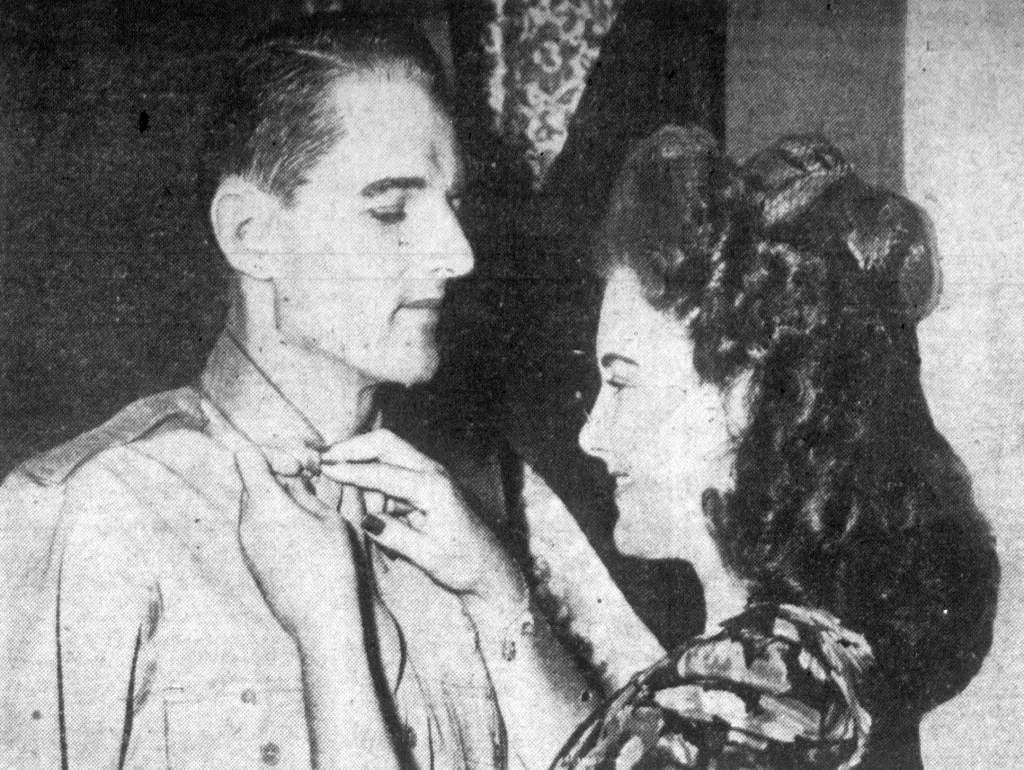
It wasn’t until 1945 when Milt Smith, at age 26, suited up for the Eagles, and played just five games, wearing No. 30)
He was then called into battle in Europe as a World War II lieutenant.

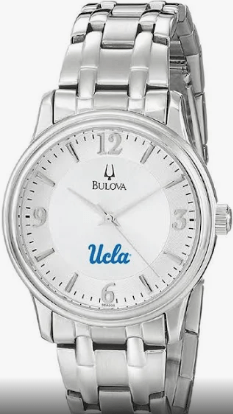
During the historic Battle of the Bulge, fought for one month in miserable weather between December ’44 to January ’45 in Luxembourg and Belgium, Smith was so badly wounded that he could have been left for dead. But one of the medics spotted Smith’s engraved 1943 Rose Bowl gift watch on his wrist and reported shouted: “This is one got we’ve got to save!”
Eventually, the Americans suffered 81,000 causalities in that conflict.
Extraordinary measures were then given to Smith, who eventually recovered from his wounds 18 months later.
(And please, don’t bring up the Christopher Walken scene from “Pulp Fiction.”)
The Rose Bowl watch was lost when Smith’s family home burned down in the 1960s.
Down the road, he would start Smith’s Sporting Goods in Westwood, and then enjoy a life involved in equestrian, chess and yachting.
He still was able to remember the time when a UCLA-USC rivalry game was on.
“In his later years, Dad would watch the game alone,” White said of her father who died at 91 in 2010. “He would shut himself in the den. He didn’t want anybody yelling. He didn’t want any distractions. He wanted to focus on the game.”
Who else wore No. 48 in SoCal sports history? Make a case for:
Ramon Martinez: Los Angeles Dodgers pitcher (1988 to 1998):

If ultimately he’s known as the older brother of Hall of Fame pitcher Pedro Martinez, it’s a disservice. As a 22-year-old in 1990, Martinez was a 20-game winner, led the NL with 12 complete games, tied Sandy Koufax’s team record with 18 strikeouts in a game against Atlanta, and finished second in the Cy Young Award voting (somehow outvoted by Pittsburgh’s Doug Drabek). He was also fifth in the Cy voting in 1995 (17-7, 3.66 ERA) and won 123 games in his 11 seasons with the Dodgers, making five Opening Day starts for the team. That season included a July 14 no-hitter at Dodger Stadium against the Florida Marlins.
Dave Stewart, Los Angeles Dodgers pitcher (1978 to 1983):
A decade before he rattled off four-straight 20-win seasons for the Oakland Athletics, becoming a member of the “Black Aces,” and was a perennial Cy Young candidate, Stewart came to the Dodgers as a 16th round pick from Oakland in 1975. After a brief callup in ’78, he spent all of ’79 and ’80 at Triple-A Albuquerque. Out of options, the Dodgers couldn’t send him back again and brought him up. Perhaps the most noteworthy thing Stewart did as a Dodger was in 1983. Stewart relieved Fernando Valenzuela with the bases loaded and two out in the sixth inning against St. Louis. As Stewart walked Tommy Herr to force in the run, the pitch was also wild, and Glenn Brummer, running from second on the 3-2 count, scored as well. As first-base runner Ken Forsch was trying to go to third, catcher Steve Yeager, throwing the ball to Stewart as he covered the plate, tossed it wild, and Forsch came around to score the third run on the play. The Dodgers would eventually trade Stewart to Texas for Rick Honeycutt, which helped them
Les Richter, Los Angeles Rams linebacker, kicker (1956 to 1962):

The Cal grad from Fresno started his pro career as a linebacker wearing No. 67 for the Rams in 1954 and ’55 before switching to No. 48 — a reflection of him moving to a middle guard, then making the Pro Bowl in eight of his nine NFL seasons. How he even landed with the Rams is a historic story unto itself.
The All-American guard and linebacker in Berkeley was the second player selected overall in the 1952 NFL Draft by the New York Yanks (after the Rams picked Vanderbilt quarterback Billy Wade at No. 1). Just a couple months later, the Rams shipped 11 players to Dallas for the rights to Richter — the biggest trade in league history to that point. As it turned out, the Rams came out very much on the right end of the deal. Even then, Richter wasn’t coming to L.A. right away — he spent two years in the U.S. Army during the Korean War before playing as a rookie in 1954. He led the Rams in scoring in 1955 and 1956. In all, he totaled 193 points off of 29 field goals and 106 extra points during his career. Richter, who went into the College Football Hall of Fame in 1982, eventually got into the Pro Football Hall of Fame in 2011 — a year after he died at age 79. But he was alive to experience going into the Motor Sports Hall of Fame in 2009. Richter got into motorsports in 1959 as part of a group that bought Riverside Raceway. While president of Riverside Raceway Richter helped form the International Race Of Champions (IROC) Series in 1972. When the Riverside track closed in 1989, he joined NASCAR as a vice president, working out of the Daytona Beach headquarters. Upon retiring from NASCAR, Richter became a vice president of the California Speedway at Fontana.
Torii Hunter: Los Angeles Angels of Anaheim outfielder (2008 to 2012): He made the AL All Star team twice, won two Gold Gloves and one Silver Slugger in his six seasons with the team.
Have you heard this story:
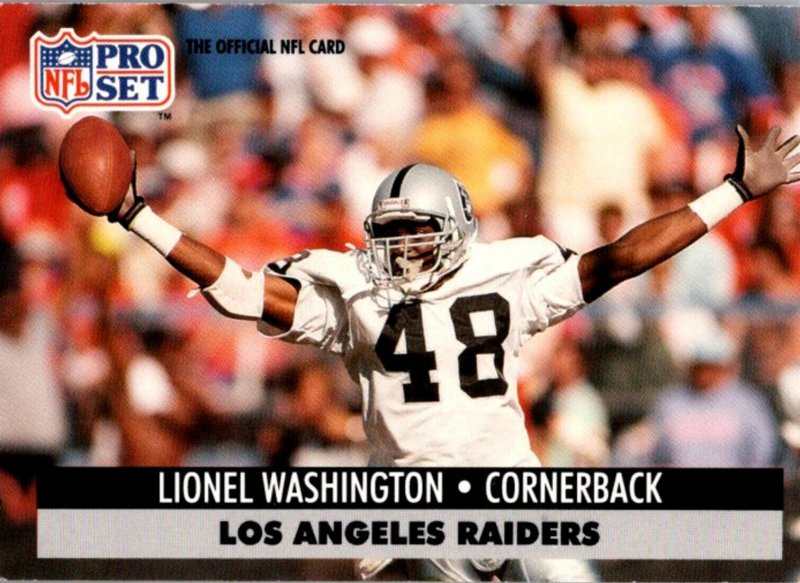
Lionel Washington, Los Angeles Raiders defensive back (1987 to 1994):
My mom’s favorite Los Angeles Raiders player was Lionel Washington. Maybe because she met him at the South Bay Galleria one afternoon. That was probably also a day when she was his favorite person.
He had with his wife and kids at the mall in Redondo Beach that day and lost his wallet. My mom found it. She’s always been good about finding things. There it was on a bench in the middle of the flow of pedestrian traffic as she sat down.
She saw the ID card was a man from Louisiana. Then she saw a gold card that identified him as a member of the local NFL team. She held onto the wallet as she saw a group of young men come nearby.
She knew what to do next. She want to the information booth, pulled the employee off to the side, and explained the situation.
As they were talking, Washington and his family came from the other side to the booth.
“I think I have what you’re looking for,” my mom said.
She said Washington looked to the heavens and said a blessing. Everything was still there in the wallet, of course.
Washington wanted to reward her. My mom didn’t want anything in return. He invited her to come to the team’s training facility in El Segundo and get an autographed photo.
She did that, and still has that signed picture.
She asked me the other day how her friend Lionel was doing – because I was sure to know. I looked him up and found he’s the defensive coordinator at Southern University in his home state. The Tulane grad, a fourth-round pick in 1983 by the St. Louis Cardinals, played 15 seasons in the NFL, the longest time with the Raiders of Los Angeles from 1987 to 1994, and circled back to the Raiders when they moved to Oakland in 1997.
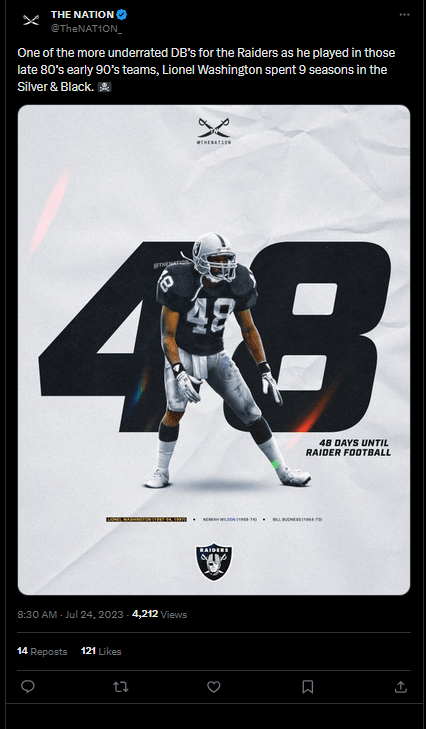
He coached DBs for the Raiders from 2009-10 in Oakland, then started a run in college, with his alma mater as the co-defensive coordinator from 2012-17. He’s been with Southern since 2018.
One of the kids he was with in the mall that day, his son Deron, became a second-round pick in the 2008 NBA Draft by Detroit after his career at Virginia Tech. The 6-foot-8 small forward last played in Germany after tours in Israel and Italy. Deron’s mom, Denise, played college basketball at Xavier.
In a May 2023 feature for Sports Illustrated, Tom LaMarre did a piece on how Washigton was “another overlooked Raider” cornerback in a franchise that included Hall of Famers Willie Brown and Mike Haynes.
“He’s been a consummate pro,” then-Coach Art Shell said.
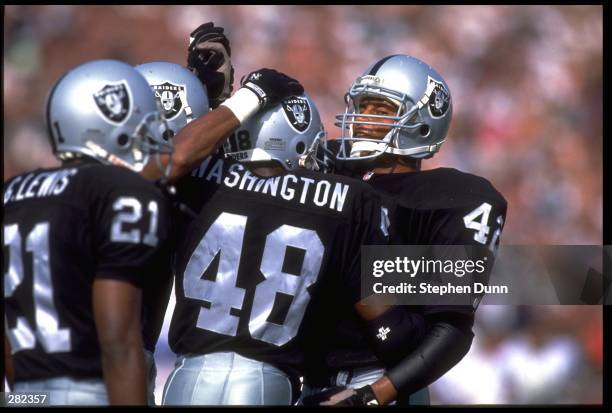
In 122 games with the Raiders, including 99 starts, Washington intercepted 19 passes that he returned for 200 yards and three touchdowns. His best season came in 1991 when he made five interceptions and had a career-high 72 tackles.
Washington also made 454 tackles, turning four into safeties.
“When I was a veteran player, it was hard for a coach to say something to me,” said Washington, admitting he did things his way on the field. “I never tried to change the way they played the game because there is a reason why they reached the highest level. I just tried to tweak it and ask them what they thought. But, basically I just went out onto the field and played the game the way I knew how to do it. That usually worked out pretty good.”
Washington’s 15-year career is one of the longest by a defensive back in NFL history. He played in 205 NFL games during his career, with 165 starts, and recorded 37 interceptions, returning four for touchdowns.
Pro Bowl and All-Pro recognition never came Washington’s way. But on that one day in the South Bay Galleria, he was my mom’s superstar friend.
We also have:
Bill Singer, California Angels pitcher (1973 to 1975). No. 48 is also what he wore as the Toronto Blue Jays starting pitcher in their first American League game in 1977.
Russ Ortiz, Los Angeles Dodgers pitcher (2010)
Reid Detmers, Los Angeles Angels pitcher (2021 to present)
Ralph Garr, California Angels outfielder (1979 to 1980)
Anyone else worth nominating?

 Tom Hoffarth's The Drill: More Farther Off the Wall
2 thoughts on “No. 48: Milt Smith”