

“L.A. Story:
Shohei Ohtani, The Los Angeles Dodgers,
And A Season for the Ages“
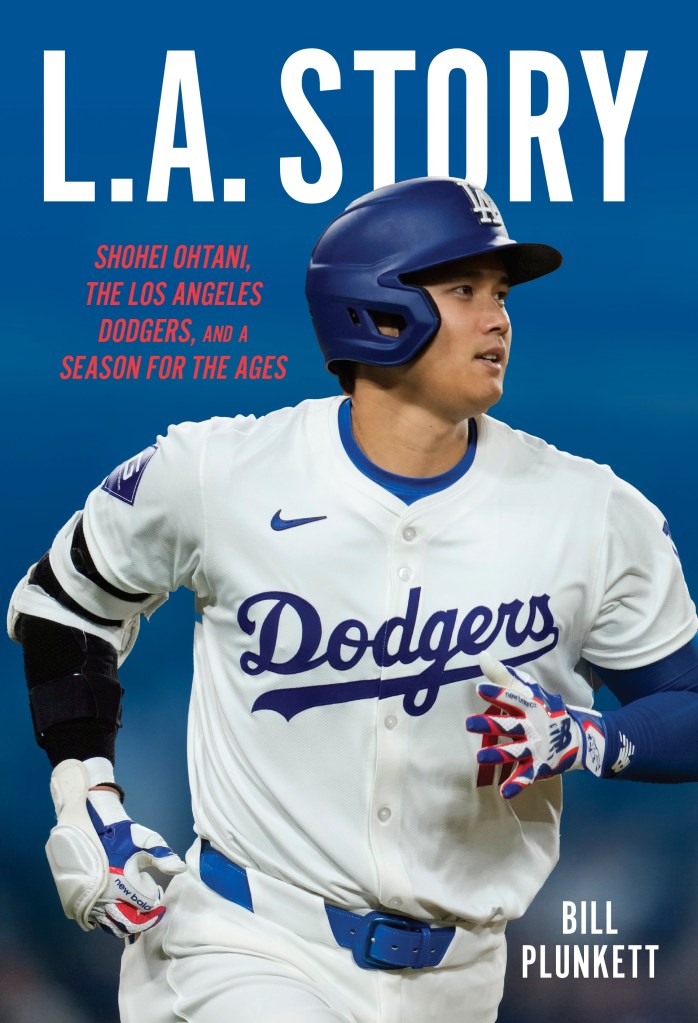
The author: Bill Plunkett
The details: Triumph Books, 256 pages, $30, to be released April 1, 2025; best available at the publishers website and Bookshop.org
A review in 90 feet or less

Early in the top of the third inning of a Dodgers-White Sox exhibition game in Glendale, Ariz., last March, there was a buzz in the crowd.
From what we could tell from our seats along the first-base line at Camelback Ranch Stadium, Shohei Ohtani was coming to the plate, about to get in a few more spring-training cuts before calling it a day.
We could not actually confirm it was taking place. Our view had been eclipsed by a large gentleman wearing an equally robust-sized Ohtani jersey. He stopped walking down the aisle to our left, then stood and waited. And waited. A few folks in that row figured out he was asking if he could by and slide into his seat down the row — no small feat.
As four men stood up, all wore some version of Dodgers’ Ohtani jersey. Now they formed a convoy, and more sight line was affected.
A couple pitches went by. The group still failed to execute the simple dance required– the suck-in-the-stomach maneuver, with the down-the-aisle shimmy.
“Hey, guys, park it!” my brother sitting next to me eventually barked. “If you’re all such big Ohtani fans, why aren’t you paying attention when he’s up to bat?”
A couple pitches later, Ohtani struck out. The Ohtani fan contingency didn’t stir, obsessed with their concession-stand ultra-edibles and gallon-sized diet sodas. They went back to their general lack of awareness.
But, certainly, buy the jerseys and show your allegiance.
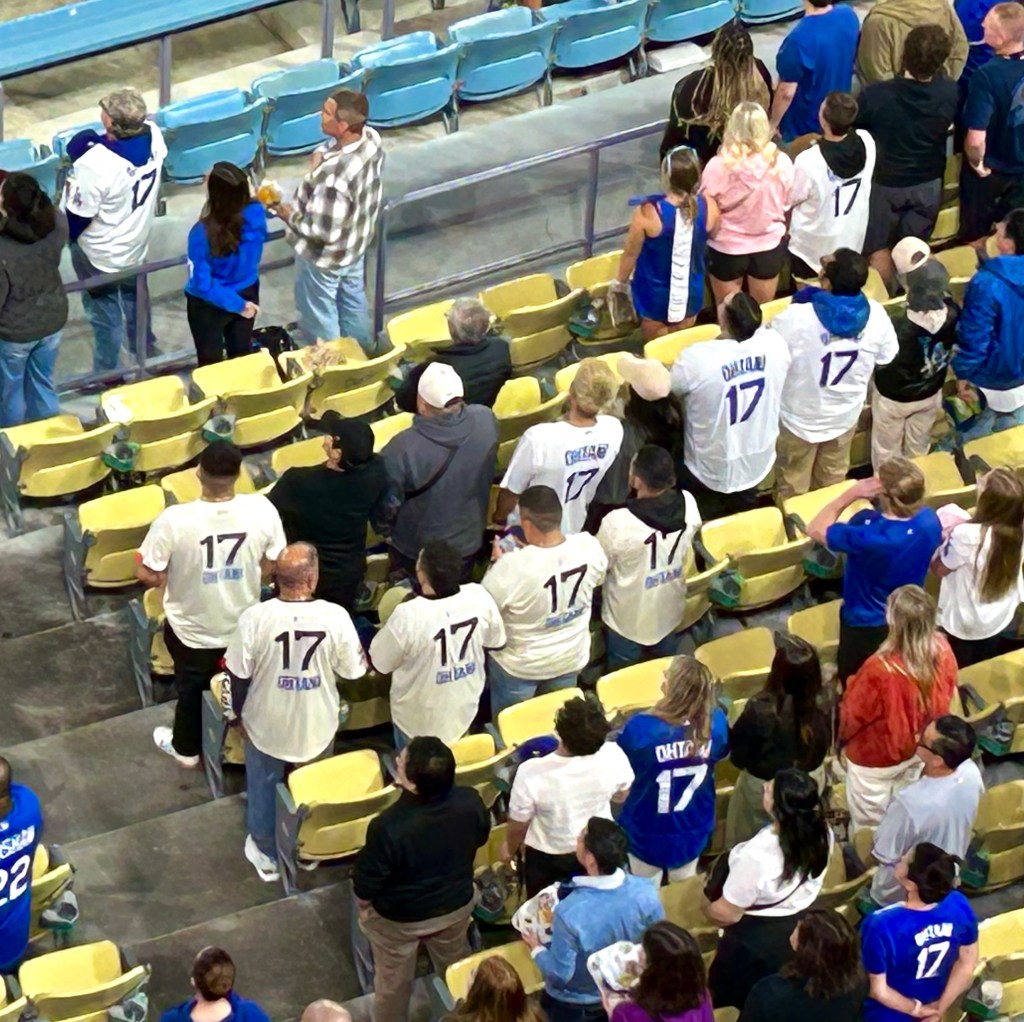
Back at Dodger Stadium for the final home game of the ’24 regular season, as the Dodgers clinched the NL West title, the Ohtani Obsession was more evident from our place in the Reserve Level looking down to the Field Level, third base side. The gaggle of Ohtani jerseys were impressive to behold.
It has been recorded that Ohtani Effect took over Los Angeles in earnest soon on a day in mid-December, 2023. The Dodgers announced they had convinced the All-Star pitcher/DH to move from Orange County red to blue L.A. County blue for his seventh season since leaving Japan to seek fame, fortune and titles.
Fortunately for the Dodgers, the titles never came in Anaheim.
Going back to Tokyo to open the 2025 season, the Dodgers saw how the Oh-Oh-Oh-Ohtani Noise Meter could go up past 11. The Tokyo Series against the Cubs took it to new planetary levels.
Any opportunity there is these days to assess our century’s version of Babe Ruth Deluxe — or even better, as historians now try to convince us — means being part of shock-and-awe experience, no matter whose jersey one may be wearing. This is someone who stands to make $100 million this season on endorsements alone, with a modest $2 million players salary, freeing up some 97 percent of a 10-year, $700 million contract so the team won’t be hogtied by financial straights.
Ohtani and his afterglow must be recorded on as many media platforms as possible today, for the sake of future generations, as we witness baseball’s first superstar of the digital era.

Bill Plunkett, the Southern California Newspaper Group’s longtime Dodgers beat writer, had his lottery number pulled to be the next to document Ohtani’s journey, specifically his first year with the Dodgers’ organization. Another publisher in Japan requested this assignment, it found its way to Plunkett, and he got Triumph Books on board for the English/U.S. version of what he could gather.
It happened that Plunkett’s cohort at his newspaper org, Angels beat writer Jeff Fletcher, did a quite compelling account of Ohtani’s arrival in the U.S. and subsequent success with a book that landed in July 2022, “Sho-Time: The Inside Story of Shohei Ohtani and the Greatest Baseball Season Ever Played.”
The focus there was recapping Ohtani’s ’21 season — his first full-time commitment to a hitter/pitcher, resulting in his first unanimous AL MVP Award. Also his first All-Star team, a Silver Slugger Award for hitting 46 homers with 100 RBIs, 26 stolen bases and a league-high eight triples, and then going 9-2 on the mound with a 3.18 ERA and striking out 156 in 130 innings.
As the book came out during the ’22 season, it almost became a bit obsolete. In ’22 again, Ohtani upped his performance with:
A 6.2 WAR on the mound — 15-9, 2.33 ERA in 28 starts, 210 strike outs in 166 innings, a league-best 11.9 strike outs-per-nine innings.
A 3.4 WAR at the plate — 34 homers, 95 RBIs, 11 steals, .273 average in 157 games and 666 plate appearances.
It should have resulted in another AL MVP, but since the anal New York media pushed for the Yankees’ Aaron Judge to win it after barely breaking Babe Ruth’s AL single-season league home run record, Ohtani’s greatest performance of a two-way player got him second place in the AL MVP and fourth in the AL Cy Young Award tabulation. Several pitchers have won a Cy Young and MVP in the same season, but only based on their value as a pitcher. Ohtani’s ballots in each category reflected what he did in each department.
An updated version of Fletcher’s book on Ohtani came out for 2023. And even that was somewhat behind the times again.
Ohtani’s next unanimous AL MVP Award came in ’23 as a result of a league-best 44 homers, 95 RBIs, 20 stolen bases, a .304 average, a 1.066 OPS and 325 total bases. On the mound: A personal-best 10 win season (against five losses) in 23 starts through August before hurting ruining his elbow again, with a 3.14 ERA and 167 strike outs in 132 innings (11.4 per nine innings).
And with it came free agency. Would the Angels, who declined to trade him at the ’23 deadline, go all out to re-sign him? It seemed like a nifty fit.
The Dodgers trumped them. The Angels rolled over.
Ohtani’s ’23 exit velocity propelled him in Plunketts direction for the next documentary of this Identified Flying Object.
In the Dodgers’ current group of mainstream media beat writers group, Plunkett is the far most experienced with seeing and hearing what’s occurring on a daily basis along with Jack Harris of the Los Angeles Times, Juan Toribio of MLB.com and Fabian Ardaya of The Athletic. Many blog owners of Dodgers fandom and following regularly attend home games. Others try to watch on TV, read those four writers’ dispatches, and put their own spins on it.
Plunkett also has the resume of having reported on other high-profile Japanese players coming to Southern California — Hideo Nomo and Kenta Maeda with the Dodgers as well as Hideki Matsui with the Angels. Those signings were considered to be the noteworthy from the Orient before Ohtani’s courtship.
The power points for Ohtani 2024 started with knowing he wasn’t going to pitch because he was recovering from his second Tommy John elbow surgery (this one more extensive than the first because an additional procedure was included to help stabilize the joint), but it escalated to new scrutiny when his long-time interpreter was arrested to stealing money from him to pay off lost gambling debt. Ohtani then announced his marriage, had a bobblehead night for him and his dog, and somehow did things even more unimaginable from a statistical standpoint, starting with a 50-plus homer/50-plus stolen base season. It ended with another unanimous MVP trophy, the first in history to have that distinction. And he’s just 30.
Plunkett has explained the focus of this book was, for him, to try to explain as many of Ohtani’s superpowers for those awestruck by what they were trying to process.
Such as:
= The strength by which Ohtani hits the baseball is unprecedented. There were 288 balls he hit in 2024 that exceeded 95 miles-per-hour off the bat, the most in the MLB. The first base hit he had when the Dodgers were in South Korea was a single that registered 112.3 mph. A 113.9 mph single he hit in the Dodgers’ home opener was the hardest hit ball by anyone in the franchise since 2021. For the season, his average exit velocity off the bat was 95.8, second in the game behind Aaron Judge’s 96.2.
This is all a result, as assistant hitting coach Aaron Bates explains, because he is “super efficient” with his core, shoulders and legs. Bates also believes since Ohtani worked all year on his pitching comeback without actually pitching, it improved his hitting. One activity helped the other, especially mentally as provided “a natural break.” And as he worked on developing stronger legs to pitch with, it provided a hitting bonus. Bates believes if Ohtani stopped pitching at this point, his hitting might taper off.
= At the ’24 All Star break, Ohtani was just the second player in NL history to have at least 50 extra base hits (29 homers, 23 doubles, four triples) as well as 20-plus stolen bases (23). The last was Bobby Bonds in 1973. Ohtani also became the first person in MLB history to homer in an All Star game (the 2024 event in Texas, now as an NL player) after previously been the winning pitcher on the mound (the 2021 event in Colorado where he was also leading off as the DH as an AL player).
= The September 19, 2024 game in Miami when he went 6-for-6 with three homers, 10 RBIs and stole two bases to reach the 50-50 mark, and the Dodgers clinched a playoff berth, came on the one-year anniversary of his second elbow surgery as he was with the Angels. Of those six hits, five were at least 105 mph off his bat. The softest was a 97.1 mph single. Also recall, after having a homer, single and double, he was thrown out at third base trying to get a triple and hit for the cycle in his first four at bats. His third homer of that game, 113.6 mph off the bat, went 440 feet and was generated from a 68.3 mph pitch (from a Marlins’ position player in the ninth inning). No other player in MLB history had 10 RBIs from the leadoff spot.
= In August of ’24, he became the first player to hit 12 home runs in a month and go 15-for-15 (or better) in stolen bases in a month during his career. Except, he did it in that same single month. No other player had done those two things any month prior in their career.
= Since he went 29-for-53 to end the season, he raised his average from .288 to .310, which nearly got him the NL Triple Crown (after leading the NL with 54 homers and 130 RBIs). He also had a league-best 134 runs, a .390 on-base percentage, a .646 slugging percentage and 411 total bases, the fifth-most in MLB history since 1940.
= He played through the last few games of the World Series after dislocating his left shoulder sliding into second. He actually saw that as a good thing. In English, he sent a group text to his teammates after their Game 2 win where he left early with the injury and stayed back a day for an exam: “Nice game, guys. Last time (Cody) Bellinger’s shoulder was dislocated (during the 2020 playoffs). This time, my shoulder was dislocated. This is a good sign for a world championship.” It was, actually.
= Also take in the fact Ohtani says he gets at least 10 hours of sleep a day. Some of that as a result of a Japanese mattress company doing a 3D scan of his body to create the ultimate customized sleeping surface along with extra stuffed pillows.
Just don’t sleep on Ohtani when he’s between the lines. Anything can happen.
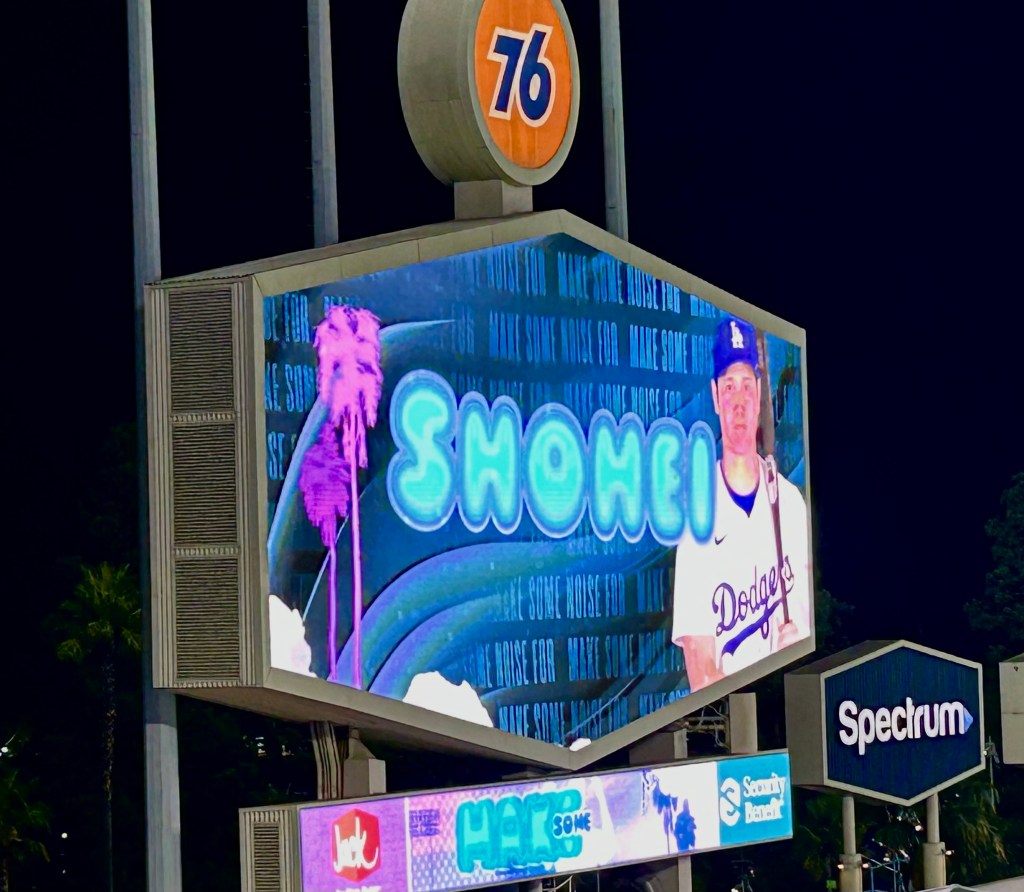
How it goes in the scorebook
Record this as a two-way achievement. To be enjoyed with both sushi and pizza (see Chapter 5).
Any scribe-turned-author hopes to both inform and entertain, and Plunkett gets both done, again recapping the “what” but also explaining “why” things occurred. The reader can trust the source — it’s not someone who parachuted in and might have some uncheck fandom clouding their prose.
If the 1991 Steve Martin film “L.A. Story” got a 75 percent rating from the audience-generated “Popcorn Meter” on RottenTomatoes.com, this “L.A. Story” will measure far better from the Southern California peanut gallery.
You can look it up: More to ponder
== Our July, 2024 post in the SoCal Sports History 101 project assigned No. 17 to Ohtani, with our perspective focused on the Dodgers’ signing him in December of ’23 and a feeling that Southern California took it up a notch from a sports-and-entertainment business to full-on, no shame, global Sho-business.
There had been welcome galas in the past to introduce icons like Wayne Gretzky, LeBron James, Shaquille O’Neal, David Beckham and Albert Pujols into the Southern California sports galaxy, those with established credentials in other parts of the globe could now add Hollywood-adjacent to their resume. Along with the inflated salary that came with it. Shohei Ohtani’s way of re-entering the SoCal stage as a re-imagined global icon raised the bar spectacularly.
== Who’s up next: They tell us it’s Shotaro Morii, a new addition to the nomadic Sacramento Athletics. The 18-year-old power-hitting shortstop and pitcher who has a 95 mph fastball and was the ninth-ranked Japanese high school prospect — was signed by the A’s this past January for $1.5 million, the largest bonus ever given to a Japanese amateur who skipped the Nippon Professional Baseball. It’s a big deal apparently.
== More to consume as context:

= “Baseball’s Two-Way Greats: Pitching/Batting Stars from Ruth to Rogan to Ohtani,” by Chris Jensen, McFarland Books, 279 pages, $39.95, released Jan. 7, 2025; find it best at the publisher’s website
Shohei Ohtani has his own chapter in this book — No. 12. So does Hall of Famers like Babe Ruth, John Montgomery Ward, Bullet Rogan, Martin Dihigo, Leon Day and Ted “Double Duty” Radcliffe. Those are the seven who rise above the novelty. From there, when you look at those who did this double-duty feat in the 19th Century (the likes of Kid Gleason, Bob Caruthers and George Bradley), those during the Deadball era through 1919 (Ray Caldwall, Smoky Joe Wood), those in the Negro Leagues (Cool Papa Bell, Oscar Charleston, “Steel Arm” Davis, Rube Foster, “Three Finger” Gisanter) and finally to the Live Ball era beyond 1920 (George Sisler, Lefty O’Doul, Mel Queen, Brooks Kieschnick, Rick Ankiel and Michael Lorenzen), the “unicorn” designation seems a bit less impressive. It shouldn’t be. There are some 130 players covered here, including more than 60 from the Negro Leagues alone, which may be a residual effect of what was done more out of necessity. Hail, hail to those who’ve tried it, done it with some success, or switched from one aspect and then tried another part. That’s what sets someone like Ohtani apart as we draw comparisons to those from the past. The baseline are players who pitched in at least 10 games and had at least 200 plate appearances in the same season. They may be problematic to rate on a list of the best, because of different eras, conditions, talent and degree of difficulty. But it provides plenty of context for those just getting into the Ohtani Zone.

 Tom Hoffarth's The Drill: More Farther Off the Wall
1 thought on “Day 4 of 2025 baseball book reviews: Ohtani from the L.A. Observation Deck, post-OC”