

“Dangerous Danny Gardella:
Baseball’s Neglected Trailblazer
for Today’s Millionaire Athletes”
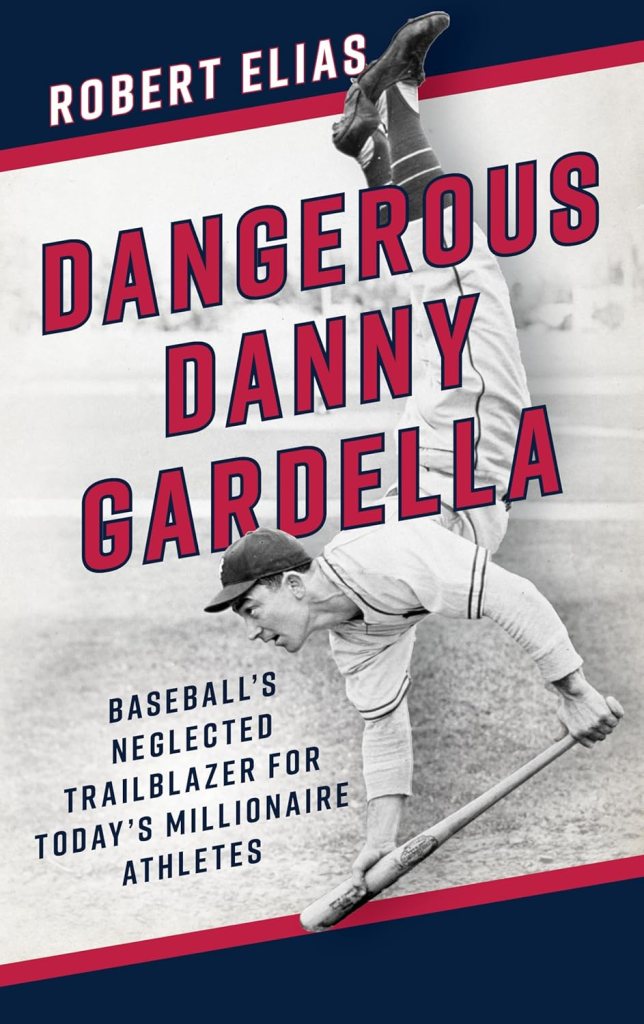
The author: Robert Elias
The details: Rowman & Littlefield, 325 pages, $39, released April 15, 2025; best found at the publisher’s website or BookShop.org
A review in 90 feet or less
Get to know Daniel Lewis Gardella. No real danger in that.
Unless you’re concerned about getting lumped in with Communists and other people up to no good for baseball’s financial success.
Robert Elias isn’t deterred.

The New York native whose journey as a university teacher went through Montreal (McGill), Boston and France (Tufts), College Park and Europe (Maryland), Geneva (Graduate Institute of International Studies) and the Bay Area (UC Berkeley and now at University of San Francisco), Elias dug in as abaseball/politics/legal studies historical researcher authoring works such as “Baseball and the American Dream: Race, Class, Gender, and the National Pastime” in 2001 and “The Empire Strikes Out: How Baseball Sold U.S. Foreign Policy and Promoted the American Way Abroad” in 2010.
Then came the two he collaborated with Pete Dreier that focused on the game’s anarchistic best in “Baseball Rebels: The Players, People, and Social Movements That Shook Up the Game and Changed America” (a finalist for the 2023 Seymour Medal) and “Major League Rebels: Baseball Battles over Workers’ Rights and American Empire,” both in 2022 and curiously by two different publishers as we noted back then.
All trails seem to lead back to this Gardella character.
Not by accident.
“In those books one person kept popping up: Danny Gardella,” Elias writes in the preface of this bio. “Apparently an obscure figure, he nevertheless appeared over and over.”
Time to flesh it out.
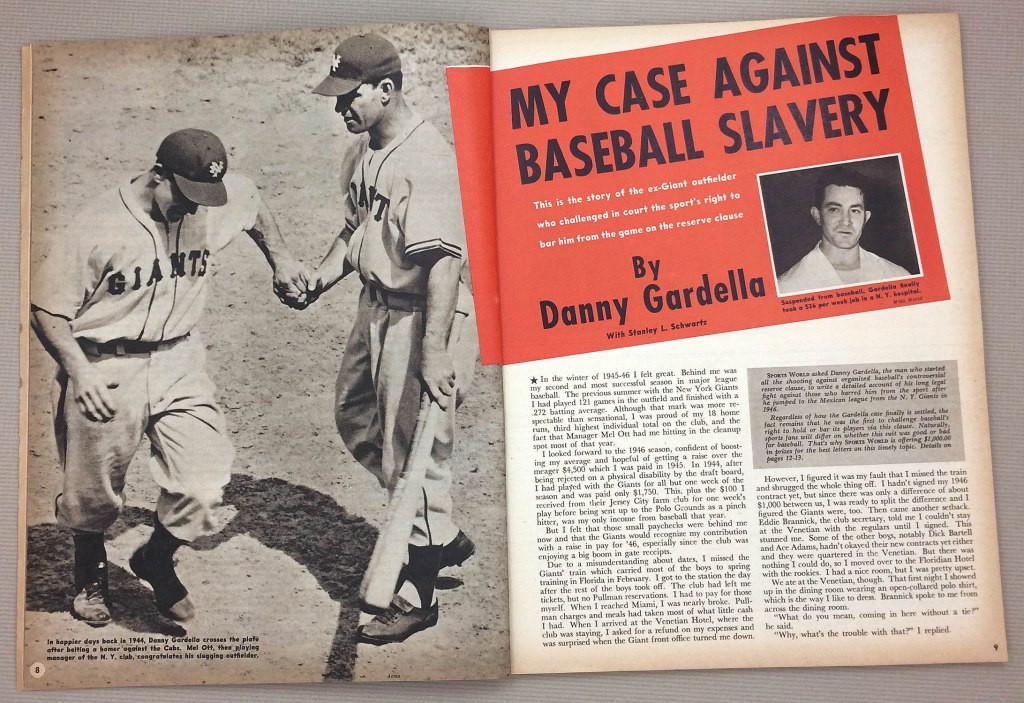
If only for the fact Gardella was the first major baseball figure, in 1946, to challenge and almost overturn the game’s reserve clause, that’s a nifty legacy.
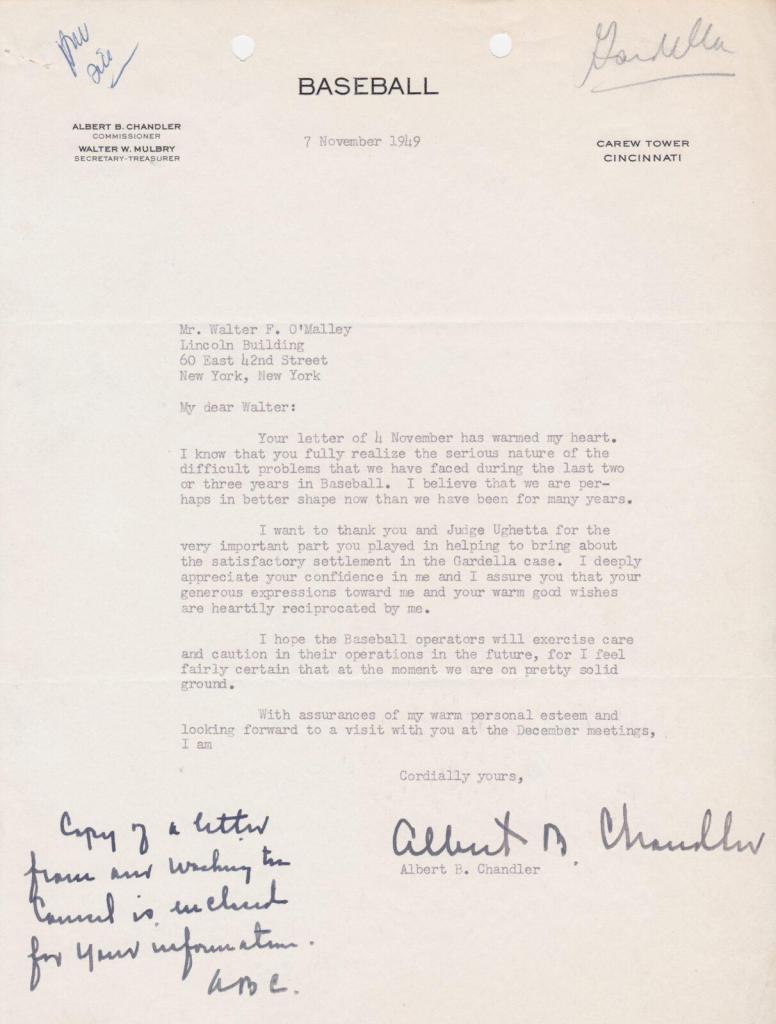
It must have taken a lot to anger Baseball commissioner Happy Chandler. This did it, as Gardella lawyered up, found himself and others blacklisted, settled out of court, was allowed to come back, but really made some Congress folks uneasy that the national pastime’s antitrust laws protection.
That’s the danger Gardella dealt with.
When the Curt Flood case came up not only in the court of public opinion but made it to the Supreme Court in 1972 two years after it was filed, only to be squashed, Gardella was among those noteworthy observers who newspaper people tracked down for some more context.
A SABR piece by David Mandell on that moment now as part of the archives, posted in 2006, a year after Gardella’s death.
But wait, there’s much more.
Here, with a huge debt of gratitude to Elias, we hit upon the major teachable moments:
D: Dream, American: A tough-minded son of Italian-American immigrants living in the Bronx, Gardella dropped out of high school, found work, worked on making a name for himself, sacrificed his livelihood on that pursuit and lived to see the residual effects of it.
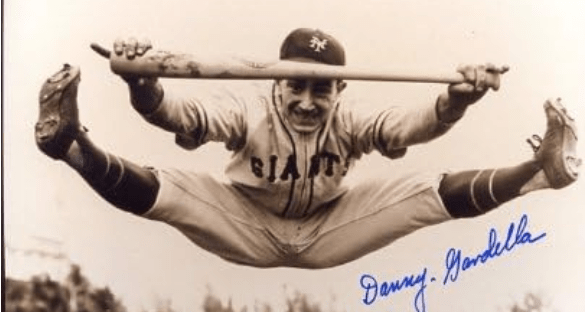
A: Acrobatic: Just look at the cover. An accomplished gymnast who sang opera, played on Broadway, performed vaudeville, was a Golden Gloves boxer, got into fitness nutrition ahead of its time, a self-taught poet and philosopher … someone who could tie himself, and his career, in knots and somehow escape.
N: Nicknames: “Dangerous” was just one of them, but the one Elias seized onto as the most appropriate — his home-run strength from someone measuring up at 5-foot-7, 160-pounds his fielding lapses that caused consternation with his manager, and his ability to be a threat to the game because of his common sense and sensibilities. Other nicknames that stuck: “Desperate,” “Dauntless,” “Dynamite,” “The Mighty Midget,” “The Magnificent Busher,” “The Little Philosopher,” “The Mighty Mite of Swat, “Little Atlas, “Desperate Desmond,” “The Ignited Italian,” and “The Voice of the Bronx.”
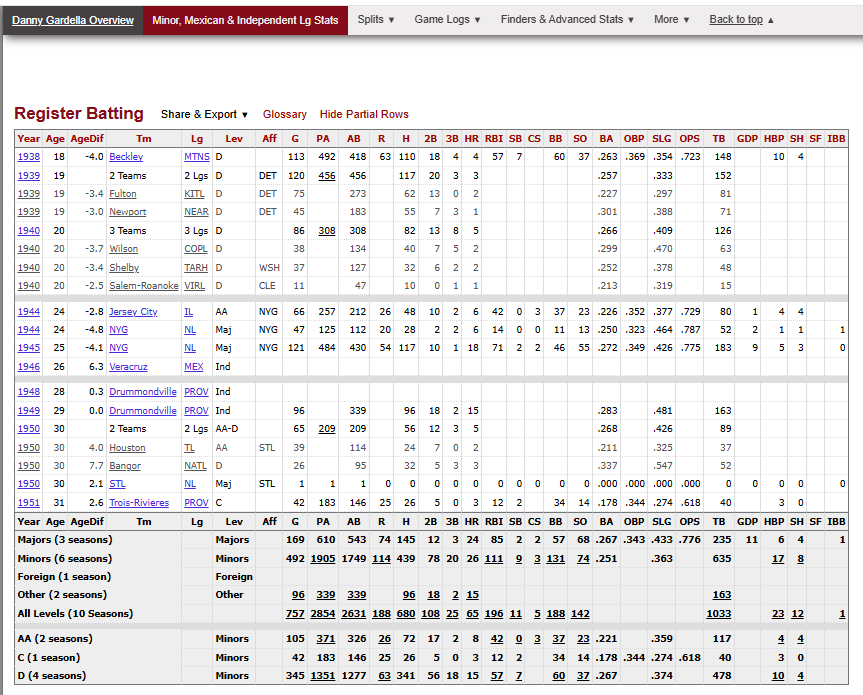
G: Game-winning homers: His 1945 season with the New York Giants — 121 games, posting a .272 average with 18 homers (eighth in the NL) to go with 71 RBIs — included hitting three game-winning HRs for the team in the last two months of the season. It didn’t seem to be enough.
E: Eccentric, Extrovert Entertainer: As his baseball career seemed to be something he couldn’t return to, the acting idea occurred to be a new way to pick himself up. “I don’t want you to think I’m stage struck,” he is quoted on page 185 from a theater reviewer. “But going on stage is a terror to me. but I attack what I fear and do what the coward in me will not do. I sing for my spiritual development. Show business is helping me. It’s making me an extrovert. I want to reach the point where nothing will break my heart again.”
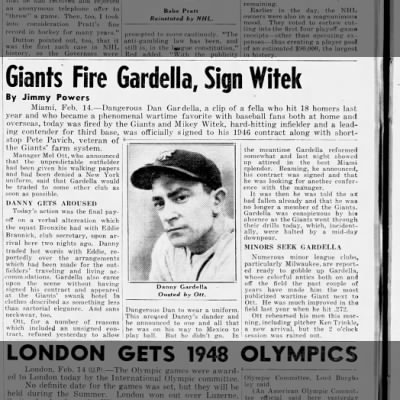
R: Rebel With A Reserve Clause: The Giants offered him $5,000 to come back in 1946 (a boost from $1,900 in ’44 and $2,200 in ’45, elevated to $5,000 by midseason). Player/Manager Mel Ott, his teammate essentially as well as his boss, was on board with it. Gardella wasn’t, and finding a wealth Mexican customers broker he met at a gym, it was arranged for him to play in Veracruz, Mexico for a $5,000 bonus on top of an $8,000 salary. Almost two dozen MLB players saw Gardella’s lead and followed, including Sal Maglie. Gardella went on the Giants’ “ineligible list.” So be it. Gardella hit a two-run homer in Veracruz’ season opening win over Mexico City. Then he played in Cuba. He would end up playing in Canada as well. Baseball commissioner Chandler banned him and others from the major leagues for five years, citing the reserve clause that bound a player to a team for life unless he was traded or released. Gardella rebelled, rightfully so in his mind. Aside from a one-game comeback with St. Louis in 1950, Gardella’s major-league career might look minor. When St. Louis tried to trade Curt Flood in 1969, look what happened.
O: Occupations: Aside from all those listed, in 1990, at age 70, he became an Apicella Ranger — a Yonkers street sweeper. Even thought his 10 kids had grown up, he felt he needed a job to supplement his Social Security. “Dad worked at just about every blue-collar company in Westchester,” said his son Artie.
U: Understudy: Al Gardella, Danny’s older brother, also made it to the big leagues at age 27, when Danny was 25, and they overlapped for more than a dozen games in 1945 for the Giants. It was one of four different pro teams they played together on. Al’s managerial career in the minors allowed Danny some landing spots as he worked though his legal issues. “Al had a moderating effect on Danny’s eccentricities,” Elias writes on page 207. “It was said that if Al had Danny’s talents or Danny had Al’s drive, one of them would have made the Baseball Hall of Fame.”
S: Shakespearian: Danny’s hobby of writing poems included this one:
Baby Ruth is not a candy
But a sweet ballplayer
The best batter we knew.
He was our hearl
And we loved him dearly.
I saw him once in the Polo Grounds
Twirling around as pesky kids do
This bigger than life baseball man
Immense, gigantic and brown
This was a man.
In a foreign land
Down Mexico way
The Babe and I
In the outfield grey
Asked me for a chew
But I had none
So I split a car
And gave him half
Happy I could share.
Glad to be with my hero there
It was the one object
A cigar was the proper smoke
We ate it together
Thought he was ill at the time
He felt good enough to chew his half
Of course I am proud
To have been with him
In that Mexican outfield
Before he died.
How it goes in the scorebook
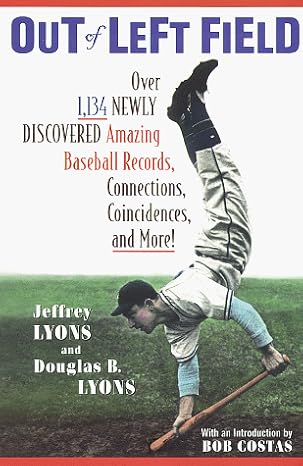
Neglected no more. Gardella rules.
Even though we knew we saw this cover photo somewhere before.
This Elias bio, by all accounts, could have been included in our previous post about the latest dribble of new New York baseball books on old topics. It stands out far to much to be included in what was summarized it all in one word: Gadarene.
Meaning: The gadarene writers of New York baseball history will fly a story into the side of a mountain if it stands to capture at least a few hundred book sales.
With this Gardella book, we’ve generated a new scorebook notation:
Gutsy and grandiose.
If 18 writers and former MLB pitcher Bill “Spaceman” Lee step up to scratch out a blurb of support for this project, what’s the danger in picking it up and adding to your baseball historic knowledge bank?
You can look it up: More to ponder
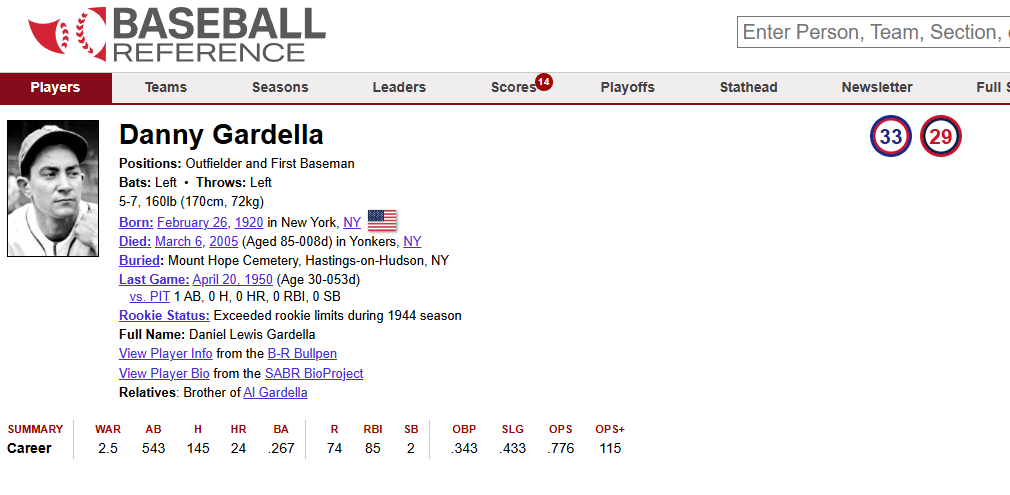
== The glimpse at the BaseballReference.com data:

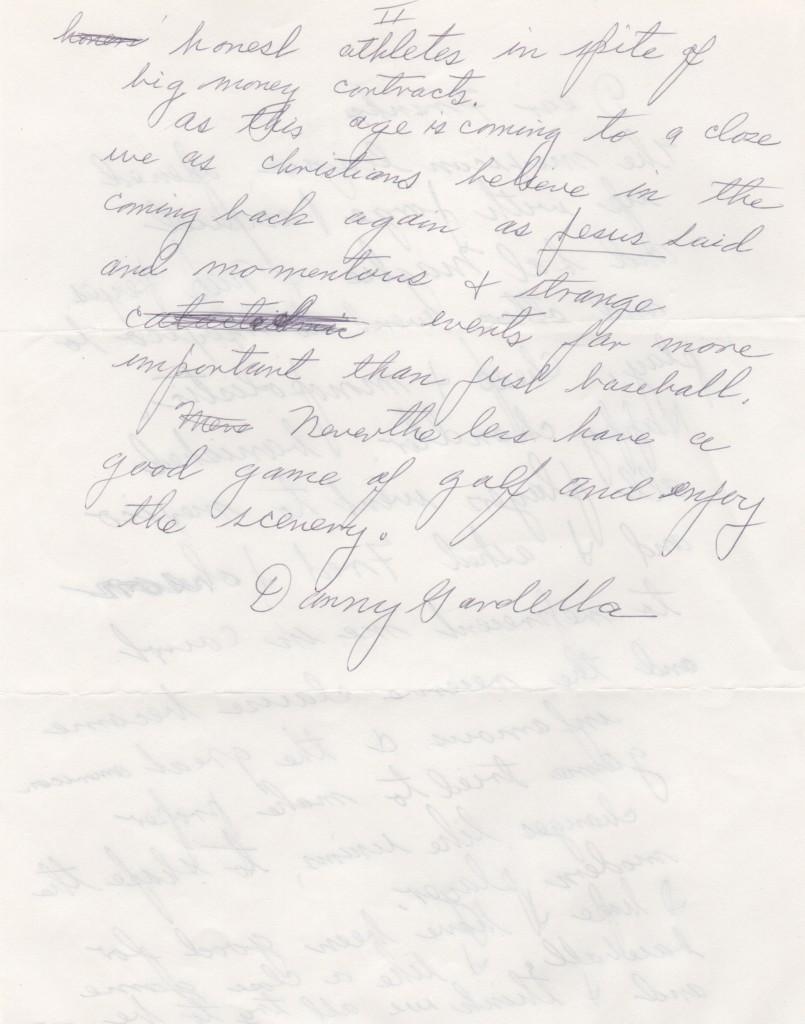
== A letter posted on CooperstownExpert.com where Gardella explains, in his own handwriting, why he went to Mexico to play, referring to Commissioner Happy Chandler as “cheap & monopolistic”:

== A 1994 story from the Los Angeles Times that revisits Gardella’s career and talks to the then-74 year old: “It wasn’t any inflated sense of his worth as a ballplayer that made Danny Gardella want to sue the national pastime. … Nor was the Bronx-born Gardella a closet Stalinist bent on torpedoing American institutions, although no less a baseball god than Branch Rickey would publicly accuse him of ‘“leaning to Communism.’ What really drove Gardella into court was the infuriating idea that the “big-headed guys” who ran baseball would think nothing of drumming him out of their game and then humiliating him in front of a hometown crowd in a meaningless exhibition.”
“I feel I let the whole world know that the reserve clause was unfair,” Gardella said. “It had the odor of peonage, even slavery.”
The story also points out that Dodgers boss Branch Rickey told a congressional committee that Gardella and other opponents of a bill to grant baseball an outright antitrust exemption “lean to Communism.”
Gardella remembers Rickey not as the pioneer who helped Jackie Robinson break the color barrier but as “a Bible-quoting cheapskate.”
== A Baseball Hall of Fame story on Gardella that quotes him from 1980: “All of these things strangely tied in together to form a strange magic carpet of destiny, which I rode into the arena of having to sue [MLB]. It was as though steps were leading up to it. It had a sort of Alexandrian, or you might say, a destiny-marked epoch, like Napoleonic. I’m not trying to really say that I’m a man of destiny, but it was very coincidental that certain things happened. It’s very strange really.”
== Gardella’s SABR bio by Charlie Weatherby at this link.
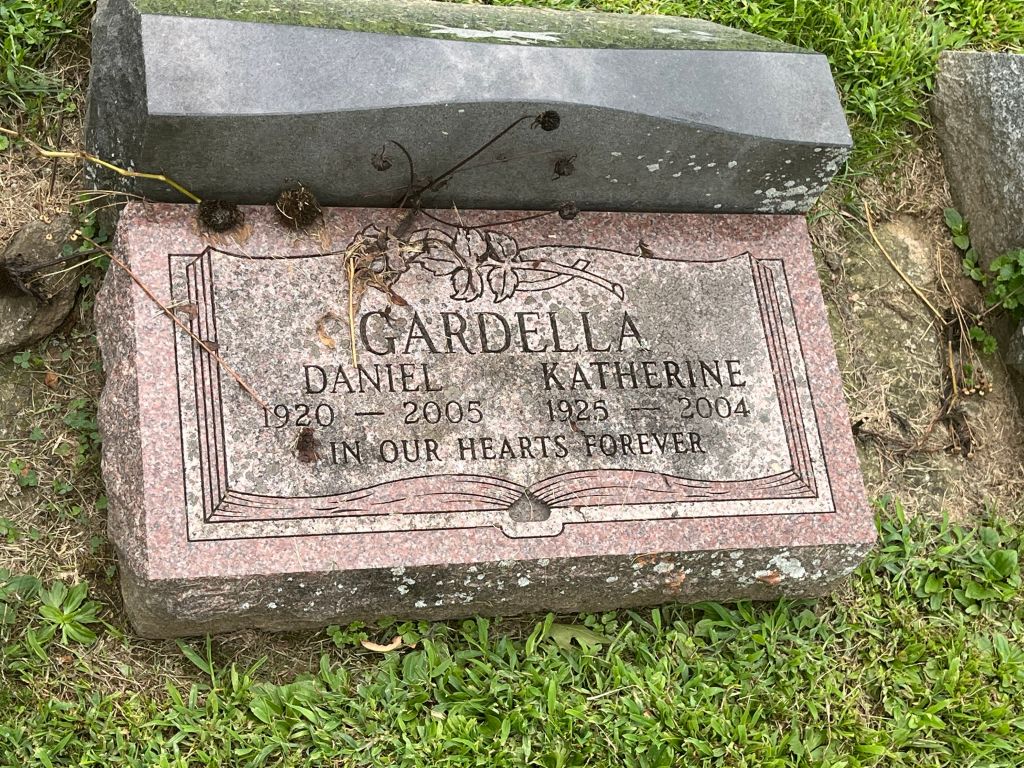
== When Gardella died in 2005 at age 85, it’s somewhat interesting to see who else in the baseball world left that calendar year.

 Tom Hoffarth's The Drill: More Farther Off the Wall
1 thought on “Day 18 of 2025 baseball book reviews: The Gardella Years of Living Dangerously”