
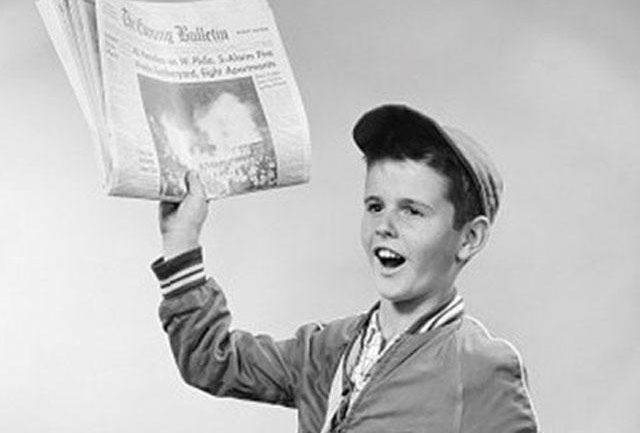

“Baseball Like It Oughta Be:
How a Shoe Salesman’s Madison Mallards
And His Renegade Staff Ignited a
Summer Collegiate Baseball Revolution”

The author: Tom Alesia
The details: August Publications, $18.95; 208 pages, released May 19, 2025; best available at the publishers website and the author’s website
A review in 90 feet or less
Updated 6.2.25

There oughta be a clear path for someone like Lauren Thiesen to write a piece for Defector.com under the headline: “The Savannah Bananas Make Baseball Boring” and not be weary of getting crapped on for it. Especially when she framed it as coming “the perspective of a baseball nut and ‘sports entertainment’ obsessive.”
Read it for yourself. Good points are made.
She followed it up with a Facebook post: “I was a tiny bit miffed by the handful of ‘this reads like an old man wrote it’ responses … You can disagree with my (nuanced!) thoughts, but idk why it would ever be inconceivable that a 30 yr old woman produced them.”
Especially from a target audience member for the traveling hardball show.
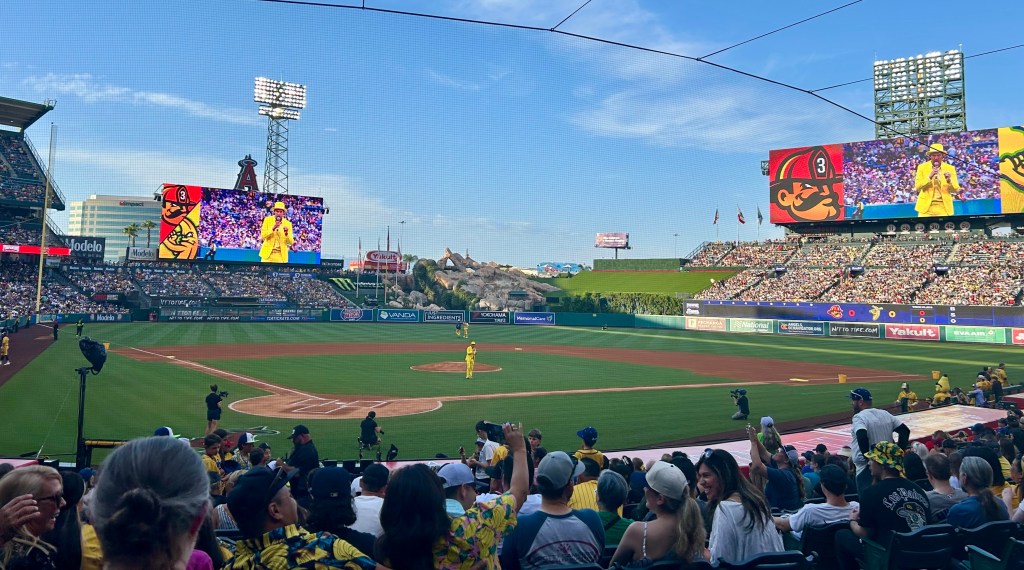
When we visited the Bananas’ second game of a two-day appearance at Angels Stadium in Anaheim this week — perhaps the only two sellouts at the place this 2025 calendar year, coming off a three-game series against the Yankees — we had Thiesen’s words in our head as a frame of reference, as well as local media coverage from the Day 1 game, but otherwise, we tried to be open-minded.
Our take on the whole idea of the Savannah Bannanas and the comparison to the Harlem Globetrotters:
It’s more more “High School Musical” meshed with Horsehide Cirque du Soleil, a wedding reception with a baseball theme wrapped around an activity that looks like a game played at the pace of a batting-practice pitcher grab-and-throw-and-grove. The between-innings experiences of corny planned contests, honoring veterans and first responders, and even a shout out to a non-profit Foster kids program doesn’t drag anything down but allows for catching one’s breath.
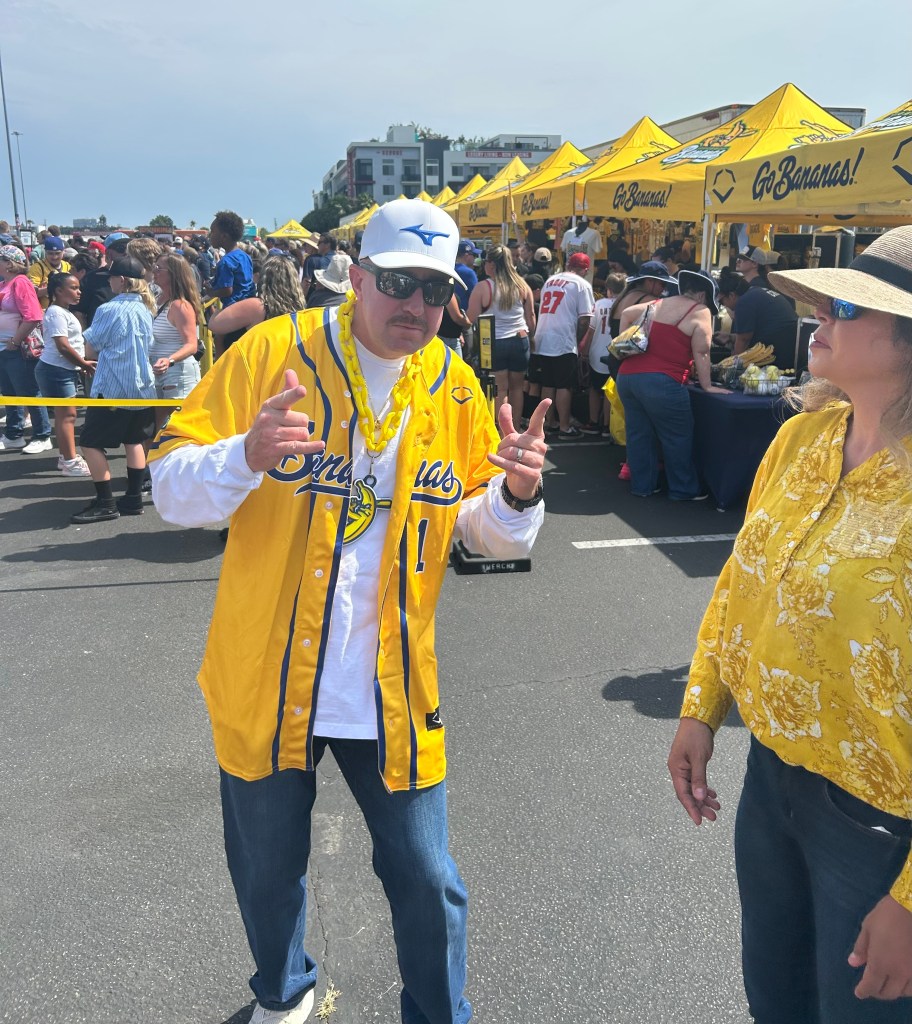
And it works.
A DJ-stage gathering to amp up the noise and energy before, then the “show” starts, then the after-party. Perhaps an exhausting pace for some, but it’s taking the elements of action of a “regular” baseball game and heightening it, expanding it, and amping it up. It takes advantage of incorporating local entertainment nods (Disneyland, for sure) and really knows how to read the room. It works in a baseball stadium best (because of the setup with scoreboards, wifi and capacity seating depth) but wedging it as well into a football stadium or other venue will add to its quirkiness.
It’s scripted schizophrenia, pumped up performance art, wonky scorekeeping and incredible talent on display surrounding the unplanned elements of game that has to be a communal stadium experience in person instead of judging it by a Tik Tok video clip or another high light reel. There are surprise guests. There’s a mascot, “Split,” that, at least in Anaheim, dared go up into the batters’ eye area beyond center field and do what every kid has wanted to do: Roll down the green hill.
Sensory overload, but not in a toxic way. Baseball remains the framework amidst all the improve and sketch comedy. The organizers do all they can to prevent the sale of $75 going for $1,000 or more on the open market, but that’s the world we live in — those taking advantage of a situation. Hopefully, you have karma lottery and get the best seats possible (another key to the experience) and bring in as many friends who otherwise might not enjoy a “real” baseball game to see this thing under the circus tent.
Back to how Thiesen ended her essay: “So what does someone want to see in a Savannah Bananas game? I guess they want to see the players dance. But they saw that already online. There’s no need to go to the stadium and catch it again with a worse view. Just give your minor-league boys a shot this summer. They’re probably doing something almost as weird.”
That’s where Tom Alesia starts making his case for the Madison Mallards.
The book is not just on what this college summer-league team has done, continue to do, and likely will do for years to come, but why it resonates in the community, and why it doesn’t need to try to out-gimmick anyone else by trying to be a national attraction, and how it can be content in how it has kept the game relevant in a non-MLB sphere.
It has a formula. It works.
Comparing Mallards to Bananas is more like Granny Smith apples to Cara Cara oranges. They’re each sweet and special in their own fruity way. (And that’s aside from the fact the forward to Alesia’s book is written by John Kovalic, the creator of the fantastic “Apples To Apples” card game.)

As Alesia clearly explains on page 12:
“The heavily hyped Savannah Bananas formed in 2016 as a summer-collegiate team after the city’s loss of Minor League Baseball before abandoning that level in August 2022. They became a traveling pro baseball circus with countless antics, including players performing dance routines, and left traditional baseball in the dust. The Bananas’ ‘fan first’ marketing battle cry is practically identical to the Mallards’ debut philosophy in 2001.
“But the Mallards predate the Bananas by 15 years — thriving without going bananas on the field. It is plain old, traditional baseball, a cumbersome sport with flashes of excitement. The Mallards dress up every aspect around that game. … The Mallards, expected to be dead on arrival in 2001 — and they almost were — succeeded so far beyond expectations that they are the envy of countless sports franchises seeking even a morsel of their popular and financial success.”

As part of the collegiate Northwoods League that hosts 22 teams in cities across the Midwest from May to August, Madisonians are madly engaged with this family-friendly, fun-guaranteed, nine-inning getaway excursion that doesn’t end after two hours, doesn’t need dance moves and does just fine with players not on stilts.

This isn’t actually a new idea but a gift that keeps on giving. A few miles East to the St. Paul Saints, there’s the independent league that has set up a template for this. Mike Veeck, the son of MLB owner extraordinaire Bill Veeck, wrote the book on this in 2005 when he came out with “Fun Is Good: How to Create Joy and Passion in your Workplace and Career.” He based it on how his organization first focused on making the employees happy, because that fed into making the customers happy, which fed into the creation of so many interesting, pop-culture-related promotions.
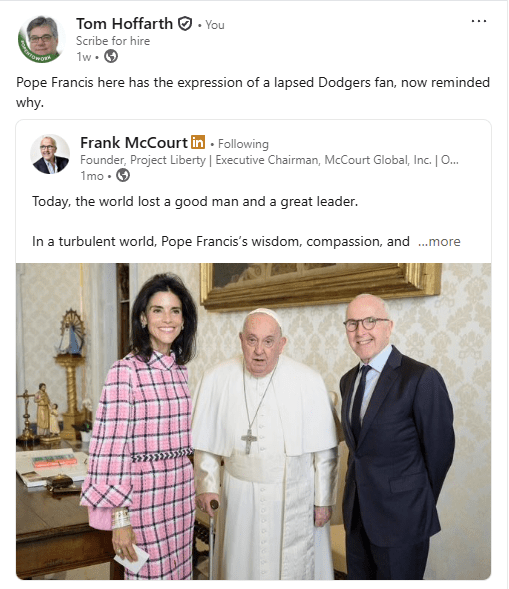
(It was a book that, to be honest, I sent in 2006 to Frank McCourt, who at the time was struggling to find a foothold with the Dodgers after taking over as owner with mixed results. In a note of thanks for sending him the book, he wrote back: “It certainly looks like a fascinating commentary on the success of different types of business environments and I look forward to reading it.” I have no idea if he ever did, but I could see his attention to detail left something to be desired. He misspelled my name).
Last year, we skim reviewed the Jesse Cole/Don Yaeger book, “Banana Ball: The Unbelievably True Story of the Savannah Bananas,” which was actually the third book Cole is credited with creating after 2017’s “Find Your Yellow Tux: How to be Successful by Standing Out” and 2020’s “Fans First: Change the Game, Break the Rules & Create an Unforgettable Experience.”
National attention has followed in many forms, including a nifty CBS Sunday Morning piece last April:
If you attend a Bananas’ event, you’ve got to know it says the “show” starts at 6:30 p.m., after a few hours of parking-lot cheerleading and merch purchasing.
It doesn’t even pretend to be a game, really. It’s something that is likely better experienced in a communal setting versus on a screen swipe.
The beauty of minor-league baseball’s over-the-top successes — including some behind-the-scenes accounts such as the 2023 Ryan McGee book “Welcome to the Circus of Baseball: A Story of the Perfect Summer, at the Perfect Ballpark, at the Perfect Time” that looks back at his experience in North Carolina in the early 1990s at a time when Major League Baseball was losing its charm and forcing its business upon every one of its loyal souring supporters, is still worth re-examining today for historical reference.
Again, it’s Alesia is here to stand up for the Mallard way of getting it done and its history of success.
Like the joy in having more than 10,000 fans show up for the first time at a 6,000-seat facility. The backstory on how it once lured Gary Coleman to attend the game and take an at-bat (almost an ode to Eddie Gaedel, which Coleman didn’t really appreciate but accepted it once he was paid $5,000 in cash), the time current New York Mets star Pete Alonzo spent a summer playing there (that’s him on the cover), and how the Duck Pond is a place people just naturally want to be during a summer’s day.
There’s purpose and meaning in books like this, especially if you take this one to an actual game, hang out in the Duck Blind (the all-you-can eat food and beverage spot built of old shipping containers that includes beer, for a three-and-a-half-hour spot after the gates open) or enjoy the Hangover Bar (covered seating down the right-field line), and consume the material as you enjoy the experience.
Because it’s a different kind of long-term community bonding at a time when minor-league baseball is trying to recover from the contraction — again, leading to a popular book this summer, “Homestand: Small Town Baseball and the Fight for the Soul of America” by Will Bardenwerper about the Batavia Muckdogs — which gave us the launching point to remember the fun times we had at the Launching Pad watching the Lancaster JetHawks.
Alesia hits each chapter to all fields — again as an experienced journalist whose first book in 2022, “Beauty at Short: Dave Bancroft, the Most Unlikely Hall of Famer and His Wild Times in Baseball’s First Century,” was such a pleasant organic find that proves a writer can quickly get in and out of a subject, even one where he’s trying to show why someone isn’t worthy of Baseball Hall of Fame status.
Alesia, who also covered arts and entertainment for the Wisconsin State Journal and is an AmeriCorps worker and literacy assistant at two local middle schools, values the art of storytelling and its historical significance. He can compare, contract and see the beauty it in all.
So when the vision of mascot Maynard G. Mallard makes a zip-line entrance — not so much different with the Anaheim Mighty Ducks used to have its mascot ascent onto the ice at the place they once called “The Pond” — you’ll know you’ve landed at the right place. The team started its 25th season celebration on May 26 against the Found Du Lac Dock Spiders. It has a Frank Lloyd Wright bobblehead giveaway on June 8 against the Wausau Woodchucks, a “Space Cows Night” on June 20 against the Wisconsin Rapids (“grab your tinfoil hats and conspire against them”), a scheduled July 2 double-header against the Mankato Habenaroes (with a single admission price), a meet-and-greet with Kate Flannery from “The Office” promotion on July 20 against the Lakeshore Chinooks, and ends it on Fan Appreciation Night on August 9 against the Green Bay Rockers before the Northwoods League playoffs start.
Yep, Space Cows. It’s a Madison thing. Lean into it.
The Mallards don’t have to go bananas to have an appeal.
Sure, when a foul ball goes into the stands at a Bananas’ game, and a fan catches it, it’s counted as an official out, and the fans cheer. Because the game is getting over sooner?
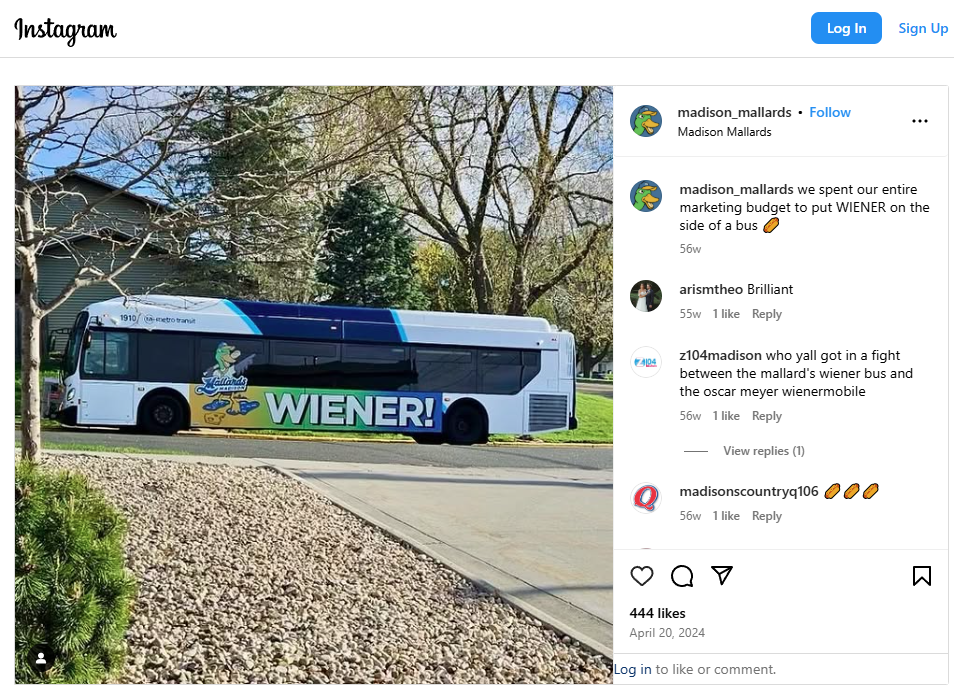
When a foul ball goes into the stands at a Mallards’ game, the public address announcer has to try to beat the crowd into yelling out: “Wiener!”
Because, whoever returns the ball to the snack stand gets a free hot dog. Kinda like Little League.
It’s all part of the team’s marketing slogan now. Even if the fan who grabs the ball rarely does take the team up on that offer.
Which game would you rather pay a ticket to watch? One doesn’t have to be exclusive of the other.
But if you’re not a fan any more of pitch clocks, umpire reviews, relievers forced to pitch to three batters, and the oncoming idea of an automatic strike computerized strike zone (and perhaps another replay challenge that could affect how we determine what is a checked swings), you have better options, wherever you may be.
We can be smarter about it this, show support with our ticket purchases, and know how it came about with time and care, rather than just some brash brush strokes of desperation and change for short-term-attention-span sake.
How it goes in the scorebook
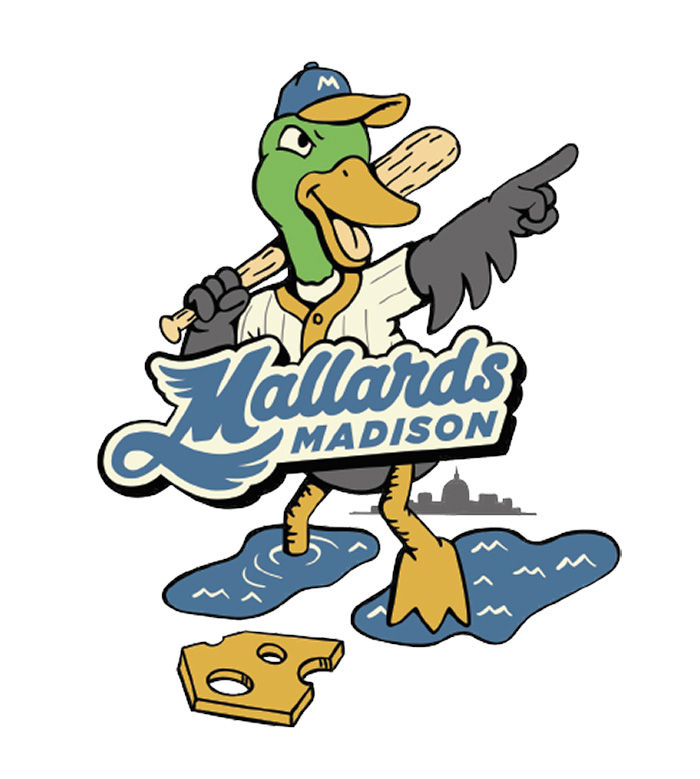
Capitolism at its best. On, Wisconsin.
A “quack fact” on the VisitMadison.com tourist site talking about the Mallards’ logo featuring its mascot: “Maynard is standing in two lakes, referencing lakes Monona and Mendota, which make up the Madison isthmus. In front of him is a cheese-shaped home plate (duh) and behind him is the Madison skyline and capitol building.”
Not to be confused with Oregon’s Mickey Mouse duck mascot for sure.
You can look it up: More to ponder
== More reviews from the Wisconsin State Journal, from the Substack post on AllSportsBookReviews (“Pretty sure it’s the only sports book to mention Hacksaw Jim Duggan, Gary Coleman and Pete Alonso in the same book”) and, why not, from The Patch at Virginia Beach, Virginia.
== Of course, there is a fine line between a successful minor-league baseball promotion and ones that go sideways quickly and draw unwarranted attention. But not necessarily unwanted.
The May 4 episode of HBO’s “Last Week Tonight with John Oliver” went over some of the more bizarre stunts that have happened in recent times. Such as the branding of the Rocket City Trash Pandas in Alabama, the El Paso Chihuahuas’ “dog face” jerseys and Eugene Emeralds’ Exploding Whales promotion/jerseys. We enjoyed hearing about how there was a “Helen McGuckin Night,” where the Charleston RiverDogs attempted to impress a woman who had left a two-star Google review.
As a result, the show says it wants to rebrand a Minor League Baseball team. The St. Paul Saints were one of nearly 50 teams that applied. The Erie SeaWolves of Erie, Pennsylvania are the winners. News platforms eerily erupted.
“They wrote to us with a list of 11 good reasons to pick them, one of which was ‘The SeaWolves play baseball nowhere near the sea,’” said Oliver. “That’s a problem, Erie. We can help you fix that.”
(Can the possibly also help out the Los Angeles Lakers, who are nowhere near a lake, or a Laker, which is a large ship that used to work on the Great Lakes, like Erie?)

== Another relatable book from a more SoCal local angle: The 2024 “ ‘Ster It Up!: The Story of the Santa Barbara Foresters, America’s Most Successful Summer Baseball Team” by Jim Buckley. “The book is a collection of 30-plus years of writing that we’ve done on the Foresters,” Buckley told the Noozhawk.com. “The point of the book is to put as much of the 30-plus year incredible history of the Foresters as I could into one place. The subtitle of the book is America’s most successful summer baseball team, and this book is basically the case to prove it.” Proceeds from the book sale continue to support the Hugs for Cubs Foundation.
== A recent trip down Interstate 5 in Oregon allowed us a quick glimpse of Volcanoes Stadium, home of the Maverick League’s Salem-Keizer Volcanoes, another re-adjusted former minor-league team that focuses on summer home dates now. We read that the stadium won a design award from the American Institute of Architects. We are also reminded of the 40th anniversary of the nearby Mount St. Helens eruption that cause chaos through that region of the Western U.S. and has some remembering what baseball teams did for survival in that time — mostly Gonzaga University and the Triple-A Spokane Indians.
== On the subject of baseball and college kids:


 Tom Hoffarth's The Drill: More Farther Off the Wall
1 thought on “Day 20 of 2025 baseball book reviews: What’s good for the Mallards is good for goosing the game”