
“Field Work: On Baseball and Making a Living”
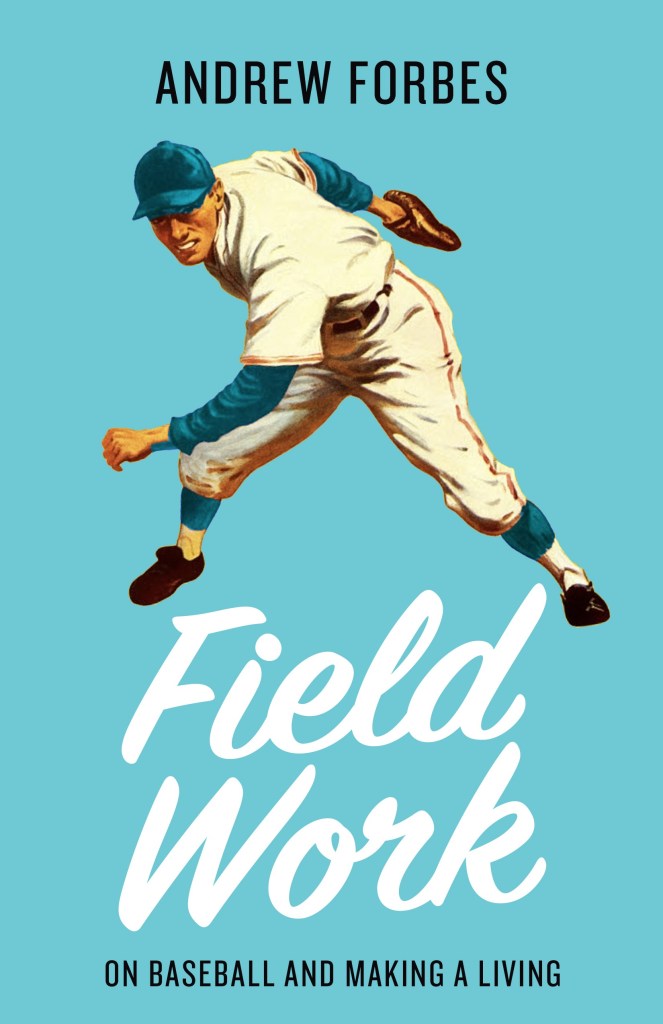
The author: Andrew Forbes
The details: Assembly Press, 222 pages, $17.95, released April 15, 2025; best available at the publisher website and the author’s website.
A review in 90 feet or less
Workshop this idea in a press box near you: The job of anyone writing about the game of baseball today is to make sure the contest below remains imperfectly perfect.
Baseball’s imperfections are what makes it most relatable to its fan base. It’s all a work of failures and resolutions, a work in progress. Yet we seem to define progress oddly in a time of mandated pitch clocks, video reviews by detached persons in New York and the potential of robotic ball-strike calls from a digital platform, all of which looks like a video game, trying to size up an imprecise boundary idea of a strike zone because we aim to get things as right as possible.
Baseball doesn’t even get the definition right of a perfect game.
For years, it’s assumed a contest in which the pitcher (or in today’s game, a bullpen strung along like Christmas lights) gets 27 straight outs without allow a batter to reach base by any sort of feat or accident. I’ve told the story before about being at a game in the ballpark, and a young couple sitting behind me was reduced to boyfriend-splaining.
The guy pointed out to his gal pal that, at the moment, the pitcher had no-hitter going.
“Too bad it’s not a perfect game,” he added.
“What’s that?” she replied.
“A perfect game,” he started, hesitated, and continued, “is when the pitcher strikes everyone out on three pitches.”
I pondered turning around to perhaps tighten up that response, but I resisted because, upon further review in my frontal lobe, he was more right than wrong. Someone in a press box likely called the first one of these things “perfect” — a “perfecto” if they were of another language enabler — and it stuck.
Even then, if someone actually achieved a perfect game as this lad described it, someone would modify the feat and raise the bar to defining it as an Immaculate Game, and then we’d get all the religious zealots involved in hijacking their bibles.
Where does all this brain-wave baseball philosophy come from?
For me, it’s from reading another Andrew Forbes book. And not possible able to match his output but only try to keep pace.
The publisher offers this latest project as “Roger Angell meets Hanif Abdurraqib meets ‘Bull Durham‘,” yet, in our book, Forbes has morphed into a version of Robert M. Pirsig, dissecting an approach to Zen and the Art of Baseballistic Maintenance, motoring and cycling through self-aware, authentic shares of all the small joys that get to the essence of spot-on observations and storytelling, making readers yearn for more.
Forbes has sought his own pursuit of Quality. There can be some Plato and Tao and C.S. Lewis woven into the discussion that cuts through baseball’s current bang-bang-bang, commercial, louder music, scoreboard antics, back to this so it can finish before the 10 o’clock newsdash.
Usually, as Forbes says, the only thing that leads him to his chapters are “coffee and time, mostly. A laptop, instrumental music, often. I like to start early, preferably before the sun comes up. Sometimes there are candles, though those are a nice-to-have, not a need.” Whatever it takes for Forbes to get to the last graphs of an essay that not only sticks the landing but challenges the mind going forward.
A lot of the charm of the game is gone, sure. Hopefully you can find that at other levels of competition — colleges, minor leagues, even overseas. As we’ve, to this point, tried to ensnare in our web of baseball reading.
It’s a business, and a big one, now infiltrated with gambling business partners that, purposefully or not, influence the game and its product to the extent that if you don’t have a wager on this pitch or that score, you’re just not invested enough.
It’s bound to blow up the more we try to make this a more perfect union of performance quality and entertainment value. We don’t need scrolls at the bottom of the polluted scoreboard giving us the out-of-town scores so that we can complete our 21st Century bingo cards and make the team owners even richer to devolve into hedge fund barons.
It only took a couple chapters into Forbes’ latest book for the latest light-bulb moment to occur.
Actually, just a couple of pages, but that’s to be expected with Forbes, our must-read list since he came out with “The Only Way Is the Steady Way: Baseball, Ichiro, and How We Watch the Game” (2021, which we included an author Q&A), which helped us circle back to ““The Utility of Boredom: Baseball Essays” (2016) and then move ahead the marvelous “McCurdle’s Arm,” a 108-page novella released in August of ’24 that we referenced in the start of this review series.
In “Field Work,” the work starts fast — Page 5, chapter 2, getting into what the job of an umpire is, and how it should be more definitive (and it is) in the rule books about how his decisions are final.
But today, they are not.
They are reviewed by someone else. They take the fans out of the game when it comes to simple things like playful jeering. Think about that aspect again. Look a clip of Earl Weaver running to the plate to argue a call. That’s all gone. Not so much for the better entertainment of the spectators. Without that accessibility to umpires, would Weaver have had the same legendary status (again, probably yes, based on the review of the latest bio on him).
Forbes nails it to the wall on page 7 about what baseball is all about, through the prism of respecting an umpire’s decision is all about “developing a barometer.” It’s “learning to navigate moments of ambiguity, to know when to protest, turning your palms heavenward in petition, and when to shut up, drop your bat and head up the line to first.” Even if you know better. Or at least know what’s more accurate.
It’s how life works. And life isn’t perfect. And the more we try to perfect it, we are frustrated with it and don’t realize the beauty if its ambiguity.
Forbes: “It seems to me that truth is less important than maintaining a clear hierarchy of governance alongside jurisdictional transparency. The field ought to belong to the umpire — marshals of order … Fallibility is part of the deal; if perfection is the goal, then once we replace all umps with cameras, I can’t see why we couldn’t just swap the players for robots. Then we can all sit back and place our bets.”
Otherwise, fans continue a trend of “quiet quitting,” another aspect Forbes probes in this soulful soliloquy.
“I resent instant replay because it’s so precise,” Forbes continues. “I believe baseball is a far more approximate game than Bill James and his revolutionary guard would have us believe. It’s better to let imprecise legend reign.”
Here’s where Forbes hits it on the screws:
“Rules are important. Honesty is the best policy. Generally. Baseball is a game, and games are amusements that humans are alone in concocting — placing ourselves in artificial peril in order to experience the thrill of escaping it. In a certain regard, games are akin to a collective hallucination. They’re played within a set of invented strictures. Baseball is the cousin of a verbal contract, an IOU written in disappearing ink. The stakes are essentially fictitious.”
And, to many, they are real. Nothing fictitious. A real deal, life and death.
Forbes can do a bat flip after that line.
And the beauty is, there are still 200 pages more to read.
How it goes in the scorebook
Working on a dream. Free of tariffs.
In having this work come at the end of our 2025 reviews, it’s interesting to see where Forbes’ essays hit upon so many literary projects previously covered the last few weeks.
The first piece on umpires has us thinking about Ron Luciano all over again. A chapter comparing Clint Hurdle to Crash Davis and the magic of “Bull Durham” goes back to our reviews of the books on managers and film. Chapters on both Bill Veeck and his son, Mike Veeck, link to Tom Alecia’s “Baseball As It Oughta Be.” Another on Shucks Pruitt and Babe Ruth hearken back to the slew of latest New York baseball books.
There is an Ohtani reference in chapter about Curt Flood – we visited Dangerous Danny Gardella, the precursor to Flood, and then “Only In L.A.” about Ontani’s first year as a Dodger and retelling the story of the plane flight to Toronto that he wasn’t on.
The chapter on how Albert Pujols couldn’t outrace Father Time in an Angels uniform … OK, maybe there’s no connection there to a 2025 book, but we’ll save that when Pujols’ autobiography eventually comes out.
Canadian asset Forbes, whose fictional works “What You Need” (2015),”Lands and Forest” (2019) and “The Diapause” (2024) are also a sweet diversion from the current world we try to assess, is the best investment in the game’s future we have from a writing and reading and thinking perspective.
We dare to call him the perfect baseball sage at this point in time because, as he knows, working on perfection is a mirage. Perfection doesn’t exist, even in a life one feels is based on a spiritual or religious foundation. Humans in charge of perfection? That’s the definition of insanity.
Making baseball great again? How about settling on “good.”
Don’t even go down that marketing PowerPoint presentation. What’s great to someone now isn’t to those who experienced the mystique of it in the ‘50s and ‘60s, and that can never be recaptured.
Thus, a perfect book blurb is also an ambitious pursuit. They can be helpful, or ambiguous, or neither. As per this recent piece in the New York Times.
But when you see writers, however, like Devin Gordon (“What a mind Andrew Forbes has, and how lucky we are that he’s given over so much of it to thinking about baseball”) or Jason Turbow (“To read this Andrew Forbes book is to lose oneself in a world of baseball mysticism grounded in the decidedly un-mystic world of hard (and sometimes not-so-hard) labour”) or Leese Cross-Smith (“I absolutely trust him with my baseball heart”) humble about their own writing abilities and praising Forbes, it’s legit.
One last side note: It’s revealed that the book was “Printed in Canada by Imprimerie Gauvin (Gatineau, Quebec) using Sustana EnviroBook™ 100% recycled uncoated paper and cover stock milled near Montreal, Quebec.” It’s a crime that the price of the book is $5 more in Canada than in the U.S. The American readers should be required to cough up an extra $20 — call them intelligencia tariffs if needed — for this privilege.
You can look it up: More to ponder
== Forbes discussed what it means to be paid to play a game with TheFanFiles.com and writer Tiffany Babb, who describes herself as “a fan of the tragic Los Angeles Angels and a cultural critic with a decade of experience writing about pop culture and the way we interact with it.”
A piece of that Q&A:
Why did you choose labor as an angle to approach baseball?
That came about for two reasons. One was an artist Amelie Mancini who had a postcard series years ago about baseball players with odd jobs. A friend of mine sent me one about a not particularly famous ballplayer named Ted Wilks, who worked in a power plant. It put me to thinking about what a lot of marginal players did to stay near the game.
Then I was reading Steve Steinberg’s biography of the pitcher Urban Shocker, and just in passing, he mentions Hubert Pruett, who was a pitcher who ended up with the Browns. Hub did not have an extremely distinguished career in baseball, but if he had one thing notable attached to his name, it was that for a couple of years, this rather diminutive lefty had a really surprising ability to strike out Babe Ruth. The more I dug into him, it got more interesting. It turned out that Pruett’s lifelong goal and driving ambition was not to be a pro ballplayer but to fund his studies. He ended up doing so, slowly earning a medical degree and becoming a doctor.
That got me further thinking about the relationship. We think of baseball as something that people would do anything to do as a profession, but for others, it may in fact have been the means to a different end.
It’s really interesting to recognize something as a profession while it is also a game and most people in the world interact with professional baseball as entertainment, and how all that affects how the economies of the whole thing…
The position of the gatekeepers of baseball for many decades was that you should be lucky that we’ll even consider paying you to do this. But it’s hard to know when you as a citizen stop having to pay to play a game and instead get paid by the game.
The positive changes that we’ve seen in the way that Major League Baseball treats Minor Leaguers in the last few years, brought fourth by the players union, you no longer have to live an abject poverty or have three jobs in the offseason just to make those unearning months during the summer feasible. We may have shifted where the guillotine is, but there still seems to be a real threat of insolvency hanging over people chasing that dream. And in baseball especially, there’s such a long period of gestation for a career. It’s not like in the NBA you’ll get drafted and then you can be on a bench or maybe even starting the next year.
I don’t think it’s permanently settled, and I think that Major League Baseball owners being what they are now and have always been, they will be looking for ways to claw some of that back. That’s just the inherent tension in the relationship.
Was there anything you saw in your research that was surprising about this project?
I think that the more I dug into the reserve clause and the struggle against it from its very first appearance in the late 19th century… its ability to ruin careers and lives. You know Curt Flood’s phrase, ballplayers were well paid slaves. And decades before Curt Flood, not well, but paid, slaves. It’s kind of astonishing when you dig into individual stories, both of people ground up in those gears and people who fought against them and were unable to change anything for decades until Flood. It didn’t work immediately after Flood’s court case, but I think it was the tipping point. It began the turn of public opinion that made it impossible for the game to go forward under the old system.
I think it’s safe to say that without Flood’s courage in sacrificing what he thought probably was going to be a year or two of his career, but really in effect ended up being the rest of his career, I don’t think any of that comes to pass, not within that time frame. It may have taken another decade or two.
== In May of 2020, the Los Angeles Times’ Dylan Hernandez did this profile on Dodger Stadium head groundskeeper Jordan Lorenz, who came in after longtime boss Eric Hansen retired after the 2016 season, that included: “There’s times it’s pretty nerve-wracking because you’re dealing with a living organism. There’s a lot of eyeballs on the games and it’s really important for us when everything goes off perfectly.”
Perfection, of course, won’t happen. Just a reminder.

 Tom Hoffarth's The Drill: More Farther Off the Wall
1 thought on “Day 22 of 2025 baseball book reviews: Working on a dream”