

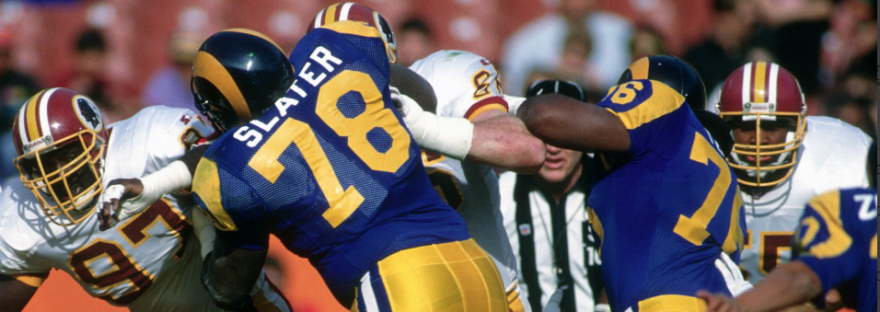
This is the latest post for an ongoing media project — SoCal Sports History 101: The Prime Numbers from 00 to 99 that Uniformly, Uniquely and Unapologetically Reveal The Narrative of Our Region’s Athletic Heritage. Pick a number and highlight an athlete — person, place or thing — most obviously connected to it by fame and fortune, someone who isn’t so obvious, and then take a deeper dive into the most interesting story tied to it. It’s a combination of star power, achievement, longevity, notoriety, and, above all, what makes that athlete so Southern California. Quirkiness and notoriety factor in. And it should open itself to more discussion and debate — which is what sports is best at doing.

The most obvious choices for No. 78:
= Jackie Slater: Los Angeles Rams
= George Achica: USC football, Los Angeles Express
= Art Shell: Los Angeles Raiders
The not-so-obvious choices for No. 78:
= Grenny Lansdell, USC football
= Alex Laferriere, Los Angeles Kings
The most interesting story for No. 78:
Jackie Slater: Los Angeles Rams right tackle (1976 to 1995)
Southern California map pinpoints:
Los Angeles Coliseum, Anaheim Stadium
Jackie Slater’s livelihood was predicated on preventing quarterbacks sacks. Turns out, he can also play a mean tenor sax.
By which, we mean, he can pretend.
If only one person came out with some dignity left after a herd of Los Angeles Rams were talked into recording a 1985 music video “Let’s Ram It!” it was the 6-foot-4, 284-pounder who introduces himself at the top of it as “Big Bad Jackie.”
I’m Big Bad Jackie and I’m starting us off
The Rams getting down so nobody’s soft
And don’t you worry cuz the Rams are rappin’
When game time comes we’ll get back to zappin’
We can’t sing and our dance is not pretty
But we’ll do our best for the team and the city
So get on your feet and clap your hands
Let’s Ram it right now with the L.A. Rams
This by no means defines the career of a Pro Football Hall of Famer who played one of the most demanding positions for 20 straight years — the first 19 in L.A. before its move to St. Louis, where he called it over.
But let the record show, Slater made this record. And broke many others.
A third-round pick out of Jackson State in Mississippi, Slater’s claim to fame (wearing No. 79) then was opening holes for running back Walter Payton through his junior year, then helping Payton’s brother, Eddie, find yardage out of the backfield as a senior.
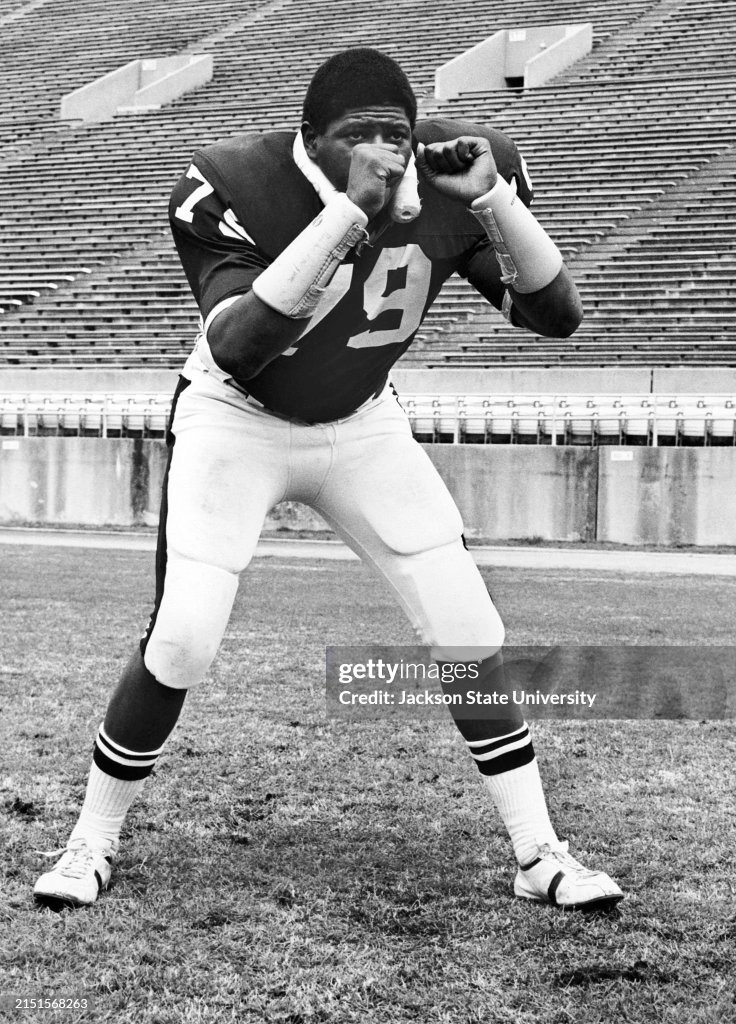
In 1975, the Chicago Bears made Payton its first-round pick, fourth overall.
The next year, the Rams figured Slater must have some value. Slater was available with the 86th overall pick in the third round.
The fact Payton was featured in the Bears’ 1985 video “The Super Bowl Shuffle” should have in no way influenced Slater to become part of a boy band of Rams’ quasi-dancers and lip singers.
Payton recruited Slater, born in Jackson, Miss., to come to Jackson State, where he became a three-time Southwestern Athletic Conference All Star and played in the Senior Bowl after he was done.
Look at all the shapes and sizes and even the no-name offensive linemen picked in the 1976 draft ahead of Slater– Dennis Lick (to Chicago), Pete Brock (New England), Rod Walters (Kansas City), Tom Glassic (Denver), Mark Concar (Green Bay) in the first round; Don Macek (San Dieg0), Ray Pinney (Pittsburgh), Glen Bujnoch (Cincinnati), UCLA’s Randy Cross (San Francisco), Ken Long (Detroit), Ken Jones (Buffalo), Jim Eidson (Dallas), James Files (Pittsburgh) in the second round; Steve Young (Tampa Bay), Long Beach State’s Russ Bolinger (Detroit), Ron Coder (Pittsburgh), Dave Scott (Atlanta), Bob Simmons (New Orleans), Brad Oats (St. Louis Cardinals) and Wes Hamilton (Minnesota) in the third round.
Defensive end Lee Roy Selmon (No. 1 overall to Tampa Bay) and defensive back Mike Haynes (New England, No. 5 overall) are the only two inducted into the Hall of Fame from that class picked ahead of Slater. Linebacker Harry Carson (No. 105 overall) and receiver Steve Largent (No. 117 overall) are the only other two HOFs in that draft, picked after Slater.
With 259 games played, Slater is far ahead of any other offensive lineman from that class — Cross (185 games), Jones (163 games), Macek (162 games), Brock (154 games), as well as more than any other player in that draft, period. (Defensive end and seventh-round pick Carl Hairston, at 224 games, is only remotely close).


Primarily as a backup and special teams player during his first three seasons, Slater became the starting right tackle in 1979.
That happened to be when Rams went to the Super Bowl XIV, losing to the Pittsburgh Steelers at the Rose Bowl.
In 1980, Slater, at 26, was part of an offensive line that surrendered just 29 sacks and helped the Rams’ offense finish second in the NFL in total yards gained with 6,006.
In 1983, with Eric Dickerson coming into play, the Rams’ offensive line gave him room to run for a rookie-record 1,808 yards. The line allowed a league-low 23 sacks. Slater made his first Pro Bowl team. Also that season, on September 25, Slater took exception to New York Jets defensive end Mark Gastineau, who showboated after beating Slater for a sack, leading to a bench-clearing brawl that saw both get ejected.

In 1986, Slater opened the holes for Dickerson as he ran for a playoff record 248 yards and two touchdowns against the Dallas Cowboys in an NFL divisional game. Because he only played seven games in ’84 due to injury, Slater missed out on having played in eight straight Pro Bowls from ’83 to ’90.
Answer to a trivial question that isn’t trivial: Slater is the only player in league history to play for one single team/franchise in three different cities (Los Angeles 1976–1979, Anaheim 1980–1994, and St. Louis 1995).
He only played in one game for that St. Louis team, retiring at 41, fighting an injured elbow. He stayed on the team to help up-and-coming offensive linemen for head coach Rich Brooks.
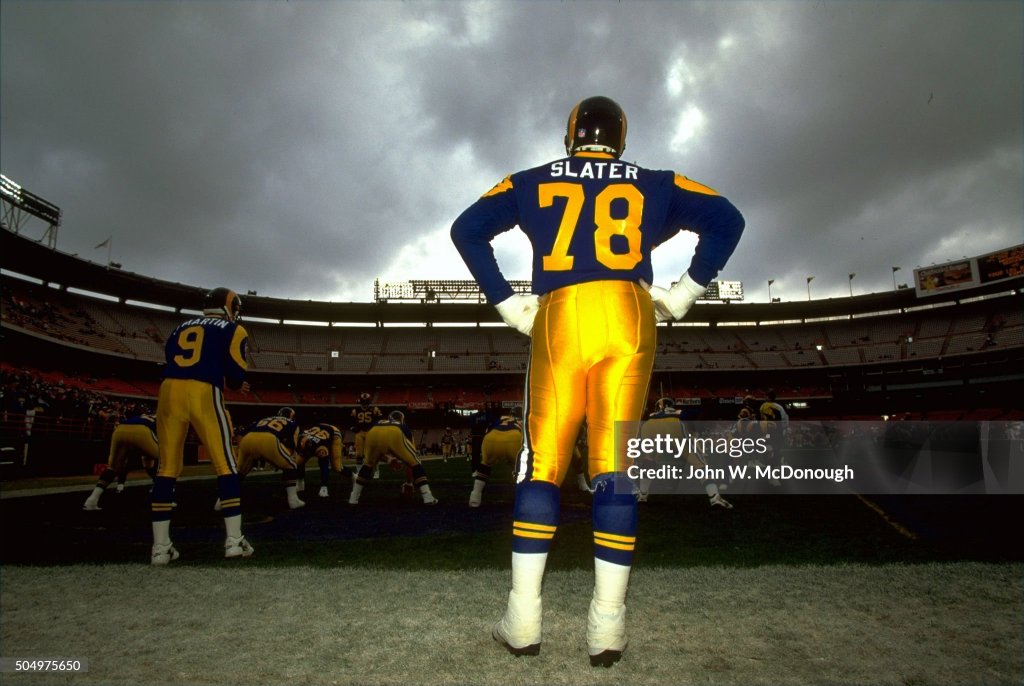
Due to his longevity, Slater became a teammate of Hall of Famers from several eras — from Merlin Olsen to Joe Namath, Dickerson to Jerome Bettis, as well as Issac Bruce. Slater blocked for 24 Rams quarterbacks and was there for 37 running backs.
He is credited by former Rams head coach John Robinson for making defensive lineman Kevin Greene a Hall of Famer.
“I can remember Jackie just crushing Kevin and Kevin jumping up and saying: ‘Thank you Jackie I needed that. Now let’s do it again’,” said Robinson. “That’s how he was, and he got to be really, really good.”
Slater was voted the National Football League Players Association’s NFC Offensive Lineman of the Year four times (1983, ’86, ’87 and ’89) and, by playing in those 259 games from 1976 to 1995, it set a record for offensive lineman durability. His 20 seasons for the same team broke the NFL record of 19 years that Jim Marshall spent with Minnesota.

When his No. 78 was retired by the Rams in 1996, St. Louis Post-Dispatch columnist Bernie Miklasz wrote: “Slater is a living monument to vanishing qualities. It’s a shame St. Louis didn’t get to see Jackie Slater in his prime.”
(Actually, they did, every time the Rams came to play the Cardinals, in their own NFC West division).
After his football career ended, Slater worked for L.A.’s KABC sports programming and continues to do so on exhibition games and in-studio analysis. It was noted in Miklasz’s column that Slater had been so interested in broadcasting, he worked his way from the ground up, making $25 a game doing high school contests on two St. Louis radio stations.
Miklasz’s column ended with the question: How did Slater last so long in the NFL?
“Jackie has a great heart,” said Rams rookie receiver Lovell Pinkey. “He’s been blessed, yes. But his success comes from the Lord blessing him for all the good things he has done for other people, the way he has helped others.”

In 2006, Oakland Raiders head coach Art Shell hired Slater as an offensive line coach alongside Irv Eatman, particulary to mentor Robert Gallery, who was moving to left tackle. Gallery struggled that season and Slater was released by the Raiders for the 2007 season. Slater also became the offensive line coach at Azusa Pacific University.

Slater’s NFL DNA continued when his son, Matthew, born in Long Beach, a star at Servite High and UCLA, was a fifth-round draft pick of the New England Patriots in 2008. He was 9 years old when his dad retired from the NFL.
As a gunner and special teams captain for the Patriots, Matthew Slater’s achievements meant the Slater family piled up 17 Pro Bowl selections, third-most in NFL history the Matthews family (25) and the Manning family. Matthew Slater retired after 16 seasons and has been mentioned as a candidate for the Pro Football Hall of Fame.
A candidate who, if he learns from history, will let his NFL video highlight reel allow others to sing his praises.

In a 2016 oral history of the “Let’s Ram It!” video, Jackie Slater is briefly quoted about his performance: “We found out who could dance and who couldn’t. … I can.”
But teammate David Hill added about Slater’s sax playing: “Jackie was a good actor there.”
Who else wore No. 78 in SoCal sports history? Make a case for:
George Achica, USC football defensive lineman/nose guard (1979 to 1982), Los Angeles Express (1983 to 1985):
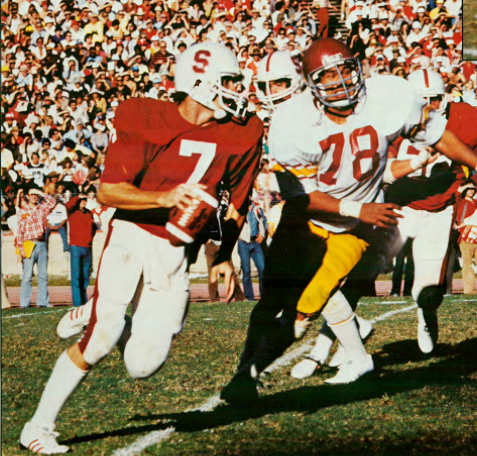
The 6-foot-5, 260-pounder born in America Samoa was a standout California high school state wrestler in San Jose, but named to the Parade All-American team in football his senior year got him the attention of USC. A consensus first-team All-American, the Lombardi Award runner-up, and Morris Trophy winner as a senior in 1982 as the Pac-10’s top lineman, Achica’s defining moment was on Nov. 21, 1981. After Marcus Allen scored a touchdown to give USC a 22-21 lead with two minutes left, UCLA marched back near midfield and Norm Johnson lined up for a 46-yard field goal with four seconds left. A UCLA win would send them to the Rose Bowl. But Achica, who had come out of the game with a bruised right shoulder, begged to go back in. He blocked the kick. Achica was a three-time first team Pac-10 defensive line selection from 1980-1982. As a third-round NFL draft pick by Baltimore in 1983, Achica stayed local with the USFL team, joining the Express in the middle of their 1983 season with a $500,000 deal, wearing No. 75. In ’84, he had five sacks in 18 games and seven sacks in ’85. When the USFL folded, Achica did play for the Indianapolis’ version of the Colts in 1985 for four games in 1985 and was out with a knee injury.

Grenny Lansdell, USC football quarterback (1937 to 1939):
The Pasadena High star who transferred to USC out of Pasadena City College, Grenville “Grenny” Lansdell became known as “one of the last truly great all-around triple-threat stars in college football history.” Those words by L.A. Times’ John Hall were modifying what Braven Dyer wrote for the Times in 1939: “Grenny Lansdell is the best all-around player the Trojans have had in the history of the university.” An All-American in Howard Jones’ “Thundering Herd” power-plus single-wing offense, Lansdell’s official position was quarterback, but as he took every snap, it was his decision to run, pass or punt. Add to that, Lansdell was a fine punt returner and defensive safety.

In USC’s 1937 opener against Pacific, Lansdell came into his first game to throw two touchdowns and run for 117 yards in a 12-12 tie with Oregon State. In ’38, he returned two punts for touchdowns — one of 83 yards against Ohio State in 1407 win, and a 70-yard run for USC’s only points in a 7-6 loss at Washington. In a win over previously undefeated and unscored upon Duke in the ’39 Rose Bowl, Lansdell started and played almost the whole game until Jones, desperate as his team trailed 3-0, suddenly put in backup/passing specialist Doyle Nave on the final drive. Nave’s TD pass to Al Krueger won it, 7-3, with one minute left. During the game, Lansdell had a punt that pinned Duke at the 1-yard line. On the key final drive, Lansdell hit Bob Peoples with a clutch pass for a first down on the Duke 34 with two minutes to go that set it all up.
In ’39, Lansdell went 56 yards for a touchdown with an interception against Oregon State in a 19-7 win. He ran for 101 yards and scored twice in USC’s 20-12 win over Notre Dame. A week later he threw a game-winning touchdown pass against Washington. In the 1940 Rose Bowl, he ran for 51 yards in a 14-0 win over Tennessee to preserve USC’s national title, the fourth in school history since 1928, but the last before another would come in 1962.

Although Lansdell shared his job with other standouts like Ambrose Schindler and Nave, he was USC’s leading ground gainer during the 1938 and 1939 seasons and the team’s leading passer all three years he was at the school. He topped 1,000 yards in total offense in ’39 (1,221), not done again for another 10 years until Jim Powers.

Lansdell also had some of his best games against rival UCLA: He had two rushing and one passing TD against UCLA in 1937. A year later, he had a rushing touchdown in a win over UCLA. In the ’39 game to end the regular season, as Lansdell had 573 yards and nine rushing TDs in USC’s first eight games of the season, he had game-high 100 yards on 15 carries as the Trojans and Bruins fought to a scoreless tie (Robinson had 35 yards on four carries; Washington had 49 yards on 18 carries, and UCLA players were wondering why the two teams couldn’t play again in the 1940 Rose Bowl to settle the deadlock).
On Bill Stern’s 1939 All-American backfield, Lansdell was joined by Michigan’s Heisman winner Tom Harmon and UCLA’s Kenny Washington.
Second-team All-American in 1938 and a two-time first-time All-Pacific Coast Conference player, Lansdell was the 10th overall pick in the NFL draft by the New York Giants, but appeared in just two games (wearing No. 22).
In 1941, he joined the U.S. Army during World War II piloting transports moving troops to crucial battle fronts in the Pacific Theater. After the war, Lansdell moved to Newport Beach in 1947 and flew for TWA airlines, never to play football again. He stayed as an airline pilot until 1978. He died in Corona del Mar in 1984 at age 66. It wasn’t until 2003, in the sixth class, that Lansdell was added to the USC Athletics Hall of Fame.
In 1999, Newport High’s 12-0-1 team was in the news going into the CIF Division VI championship against Irvine. The Sailors roster had two of Lansdell’s grandsons — senior tight-end/nose guard (and student body president) Brad Lansdell Craig, and his younger brother, sophomore backup quarterback Morgan Earl Craig.
Art Shell, Los Angeles Raiders offensive tackle (1982):

The last hurrah of Shell’s 15-year career, all with the Raiders, came as a player in Los Angeles after the team moved from Oakland. That’s where he started as a 22-year-old in 1968 and would be named to eight Pro Bowls, twice All-Pro first team, two Super Bowl titles (and one Super Bowl loss), 1989 entrance into the Hall of Fame and named to the NFL’s 100th Anniversary All-Time Team in 2019 (with Anthony Munoz and Jonathan Ogden). Shell’s status in L.A. grew when owner Al Davis promoted him to head coach five games into the 1989 season, making Shell the first African American head coach in the sport’s modern era (and the second since the 1920s). The Raiders won the AFC West (12-4) the next season (losing the conference championship). Shell lasted through the 1994 season, a 9-7 finish for a six-year run of 54-38 in L.A. (plus 2-14 when he came back to coach the team for the 2006 season in Oakland).
Have you heard this story:
Alex Laferriere, Los Angeles Kings right wing (2023-24 to present):
When the 21-year-old made his NHL debut on Oct. 10, 2023, Laferriere came out swinging. Enough so that it caught the attention of the New York Post, which posted this story about how how he entered a Kings-Avalanche game at Crypto.com Arena (an eventual 5-2 loss) and, in the aftermath of a skirmish in the second period, got into “a heated scrap” with Logan O’Connor. It reached a point when Laferriere “slammed down O’Connor to the ice to end the kerfuffle.” As Laferriere headed to the penalty box, the TV cameras caught his family going crazy happy. “The family loves it,” TNT play-by-play man Brendan Burke said on the broadcast. “I told you he was a good athlete, I didn’t know he was a wrastler,” analyst Darren Pang said jokingly. The Harvard standout via Chatham, N.J., recorded four shots on goal and was also nabbed for hooking penalty in his first game, then changed to No. 14 for his second season.
We also have:
Julio Urias, Los Angeles Dodgers (2016), before changing to No. 7
Michael Grove, Los Angeles Dodgers (2022 to 2023)
Anyone else worth nominating?

 Tom Hoffarth's The Drill: More Farther Off the Wall
1 thought on “No. 78: Jackie Slater”