

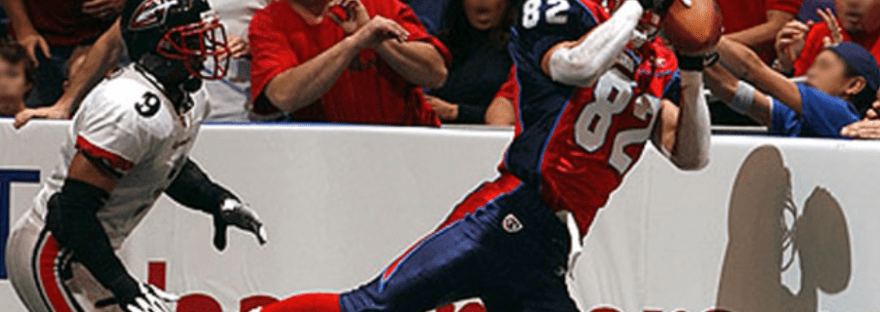
This is the latest post for an ongoing media project — SoCal Sports History 101: The Prime Numbers from 00 to 99 that Uniformly, Uniquely and Unapologetically Reveal The Narrative of Our Region’s Athletic Heritage. Pick a number and highlight an athlete — person, place or thing — most obviously connected to it by fame and fortune, someone who isn’t so obvious, and then take a deeper dive into the most interesting story tied to it. It’s a combination of star power, achievement, longevity, notoriety, and, above all, what makes that athlete so Southern California. Quirkiness and notoriety factor in. And it should open itself to more discussion and debate — which is what sports is best at doing.
The most obvious choices for No. 82:

= Mike Sherrard, UCLA football
= Greg Hopkins, Los Angeles Avengers
The not-so-obvious choices for No. 82:
= Rommie Loudd, UCLA football
= Red Phillips, Los Angeles Rams
The most interesting story for No. 82:
Greg Hopkins, Los Angeles Avengers wide receiver/linebacker (2002 to 2006)
Southern California map pinpoints:
Los Angeles (Staples Center)

Before Robert Downey Jr. had a chance to do it, Greg Hopkins stepped into the role of Hollywood’s version of Ironman.
And a marvelous one at that.
Versatility was a virtuous trait for anyone involved in the Arena Football League, and, as a offensive and defensive standout with the Los Angeles Avengers, Hopkins was nimble enough to add value to a kid’s meal deal.
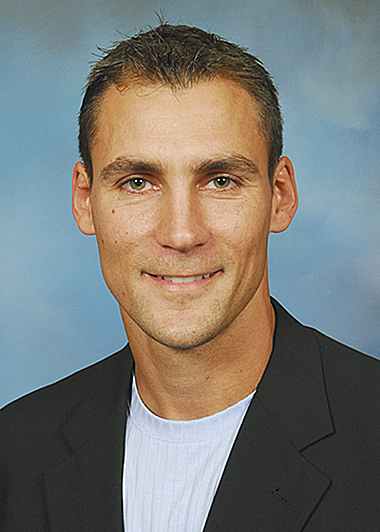
A league and team vying for attention in an entertainment-saturated town obsessed with the latest and greatest meant Hopkins could be a marquee action figure in a Southern California area Carl’s Jr. giveaway.
The quote bubble read:
Greg Hopkins — “Hollywood” Grizzled Veteran in his 11th AFL season is crafty on both sides of the football, comes from the small town of Nineva, Pa. (Population 88) but becomes “Hollywood” during the season … “Movie Star” good looks allow him to do modeling on the side!”
But he still picked No. 82, instead of No. 88. He was that modest.
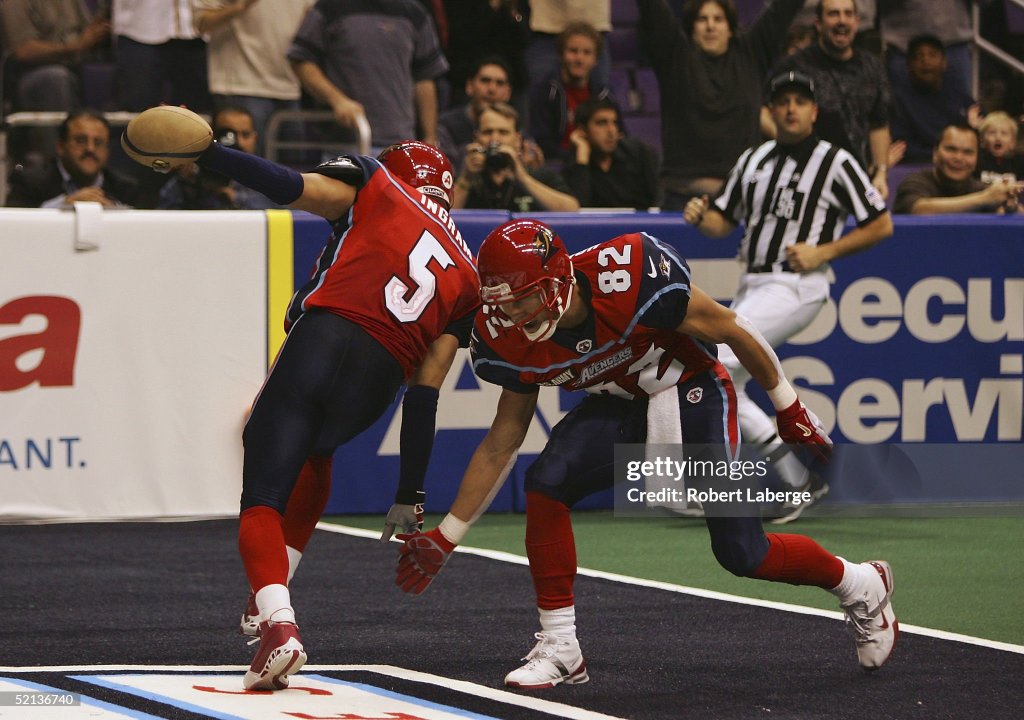
It only took one season playing for the Avengers that Hopkins, a mild-mannered graduate of Slippery Rock University from deep in steel-country Pennsylvania, transformed into the 2002 AFL “Ironman of the Year” honor, a super-hero status in the realm of indoor gridiron gladiators.
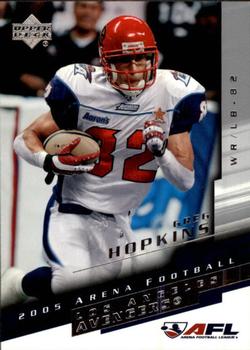
The 6-foot-2, 205-pound receiver on offense, linebacker on defense, was always looking for angles on an green rug field just 50 yards long (with eight-yard end zones), and not even 30 yards wide, wedged into a hockey rink complete with sideboards, netting and extra-loud speakers. The scoreboard, however, produced numbers closer to a college basketball finish.

During that ’02 All-Arena season, Hopkins caught 102 passes for 1,185 yards (11.6 per catch) and scored 29 touchdowns as an offensive threat. He also had 38.5 tackles and five interceptions, three returned for touchdowns, six pass breakups, a forced fumble and two fumble recoveries.
By the time he finished as an Arena participant in ’06, Hopkins was part of the league’s “20 Greatest Players” list to honor its first 20 years of existence.
He was eventually inducted into the AFL Hall of Fame in 2013.

In his 11 AFL seasons, starting in 1996 with the Albany Firebirds, Hopkins career stats read: 833 receptions for 10,206 receiving yards (only five players in AFL history had gone five digits at that point), 196 touchdown catches, 24 carries for six touchdowns; 312 tackles, 42 pass deflections, 26 interceptions, 10 picks returned for touchdowns (to set an all time league mark), 17 fumble recoveries, 13 forced fumbles and 5.5 quarterback sacks.
And his No. 82 retired by the Avengers in 2007.
Two years later, the franchise quietly folded up operations along with the league, declaring bankruptcy.
The league found its kryptonite: Spreadsheets.
The background

The Los Angeles Avengers were the longest-running survivors of a professional indoor football legacy in Southern California that included the Los Angeles Cobras of 1988 playing in the Los Angeles Sports Arena and the Los Angeles KISS from 2014 to 2016 playing at the Honda Center in Anaheim.
(For the record: There is no actual physical AFL Hall of Fame that contains a bust of Hopkins, but the Pro Football Hall of Fame now has an exhibit honoring its existence. Hopkins is the only player to have ever worn a Los Angeles Avengers uniform to have HOF status. Gary Mullen, a receiver/defensive back for the 1988 Los Angeles Cobras, is also in the HOF for his career work. Sherdrick Bonner, a 6-foot-4, 240-pound quarterback out of Azusa High and Cal State Northridge is also in the AFL HOF for his time with Arizona and Chicago.)
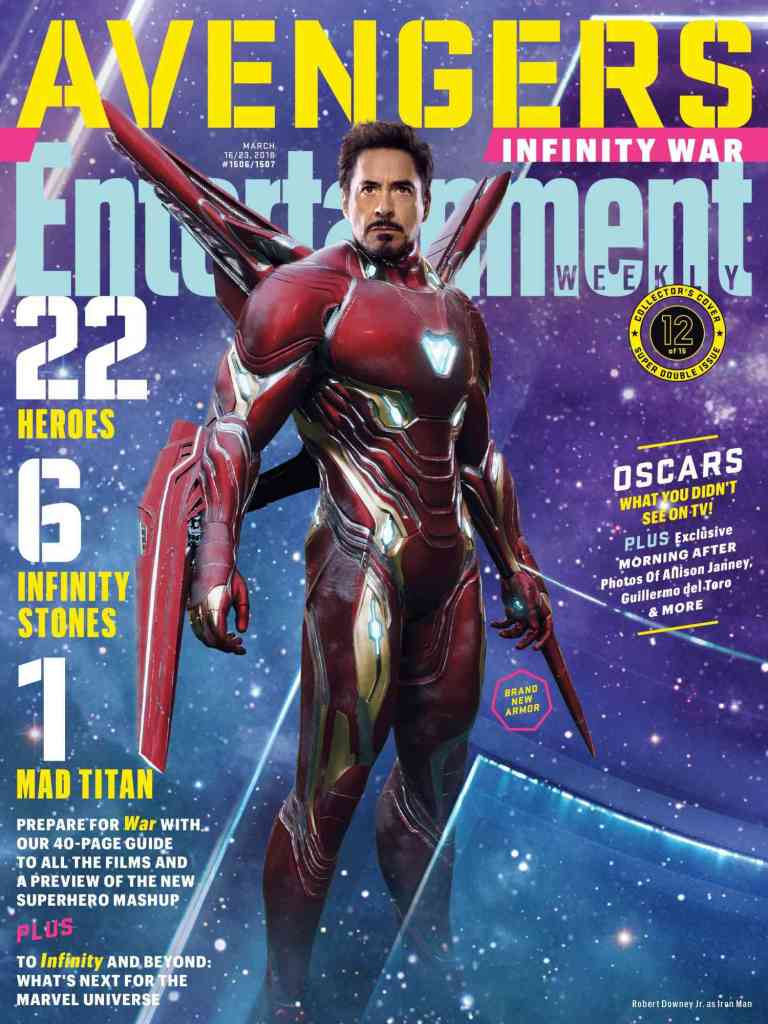
While it was a bit obvious that the KISS was named after and owned by the rock group by the same name, the Avengers, according to legend, were ahead of their time. It has nothing to do with a Hollywood connection to Marvel Cinematic Universe inhabiting the entertainment field. That came years later.
In 1998, a film called “The Avengers” was adapted from the British TV series of the 1960s. The satirical spy action comedy didn’t do too well at the box office. But the name was cool. By the time 24-year-old Casey Wasserman decided to dive into the pro-sports landscape as an owner with his Hollywood inheritance, putting up $5 million for the rights to the Los Angeles Avengers resonated enough for it to become a thing in 1999 as an expansion team for the AFL’s 13th season in April of 2000.
By the time the Avengers joined the Western Conference of the AFL’s American Conference in 2000 — a season delayed already by a players association anti-trust suit filed against the league owners because of benefits they felt were withheld — the team was in eminent entanglements with SaberCats (San Jose), Rattlers (Arizona) and Wanglers (Oklahoma) and finished last at 3-11, failing a very basic path to a playoff berth. Todd Marinovich had been brought in as a big name after his flame out with the NFL’s Raiders.

Hopkins, part of the Albany Firebirds’ 1999 ArenaBowl championship, came to the Avengers as a free agent in 2002. The previous year, after the Firebirds moved from Albany to Indiana, Hopkins was an “Ironman” finalist and had been on the All-Ironman Team twice.
Ed Hodgkiss, hired as the Avengers head coach in 2002, had been the Firebirds’ offensive coordinator during their title season. Hodgkiss happy embraced Hopkins as a free agent signing.

During his five seasons with the Avengers, Hopkins caught 411 passes (second most in team history) for 4,863 yards and 96 touchdowns. He also had all six rushing TDs, used on goal-line situations. On defense, he intercepted 16 passes and returned five of them for TDs.
Avengers quarterback Tony Graziani remembers Hopkins’ work ethic, film study and constant grind having taken a beating on both sides of the ball.
Graziani’s favorite memory of Hopkins was on March 30, 2003, as the Avengers needed to score three TDs in the final two minutes to outlast the Orlando Predators. On the final play after the Avengers recovered an onside kick, Graziani threw a Hail Mary to Hopkins in the back of the end zone. The ball ricocheted off the net, and Hopkins caught it for a 32-yard reception with three receivers and three defensive backs in the vicinity as time expired for a 64-63 win, improving the Avengers to 7-2.
“That was one of the most memorable plays I ever had in Arena Football,” said Graziani. “We actually worked on throwing the ball up as a Hail Mary play. It never really worked in practice. That’s just Greg Hopkins in a nutshell right there. When you needed him most, he came through.”

Hopkins had been a standout in football, wrestling and baseball in high school, shifting from running back to quarterback his final season at West Greene High School in Nineveh, a rural southwestern Pennsylvania community. At Slippery Rock, he also competed in the javelin on the track team, and was a school Hall of Fame inductee.
Wrestling, he said, made him the most mentally tough to spread to all other sports.

Hopkins became part of the Avengers coaching staff after his playing time ended. But what made his final season as a player in L.A. even more versatile and interesting was a run for a Pennsylvania state House of Representatives seat in the 50th district, which included his hometown of Greene County. The townsfolk recruited him to run. The people there knew him and his family — the Hopkins Family Store was pretty much the only business in town, supplying everything from duct tape to 16 flavors of icec ream. They all knew he had a good heart, having seen him help every off season add something new to the local community center.
“I once thought that if I could have played 10 years in this league, I’d be satisfied, and I’ve got it to 11 and haven’t regretted any of it,” Hopkins told us after one the team’s last practices of the year at West L.A. College. “If this is the end, and I don’t know, I knew I wasn’t going to play forever. It’s hard to beat the adrenaline rush, but this (politics) could be where everything goes next.”
His opponents tried to paint him as an inexperienced out-of-towner riding the coattails of Lynn Swan, the NFL Hall of Famer who was also running as a Republican candidate for the Pennsylvania governor’s chair.
“As a football player, I think I’ve developed some leadership skills, but I’ve also developed some thick skin,” said Hopkins who, when he is back home, tended to the family cattle ranch and served as the township auditor. “I can handle this. It’s a big responsibility, but I’ll take a pay cut to do this job because the issues are important.
Hopkins won in the GOP primary but fell short in the general election against the 30-year incumbent Bill DeWeese (D-Waynesburg).
Hopkins knew at the time his football life was likely ending since he had shoulder surgery to repair a torn labrum suffered in the Avengers’ 44-27 season-ending win in May of 2006 that ended their season at 5-11.
“I’m happiest on the farm,” Hopkins said. “It’s time-consuming, but I’m grateful. There’s something about working the land, being around family and giving back to the community that raised you. … I’ve worn a lot of hats. Player, coach, candidate, farmer, but through it all, I’ve just tried to stay true to who I am.”
Mike Pawlawski, the former Troy High of Fullerton standout who became an All-Pac-12 quarterback at Cal, played five seasons with Hopkins in Albany during his NFL/AFL/XFL journey. Now a “performance mindset expert,” Pawalawski said in a recent podcast: “Whenever I looked across at him in the huddle I knew we were going to be OK … I cannot speak more highly of a human being than Greg Hopkins. … He is one of the toughest guys I have ever met. He introduced the phrase to me: Tough enough to take a bite out of an anvil. And that is exactly what he was like as a player.”
His humble nature came through when we once asked Hopkins how he ended up with No. 82 for the Avengers:
“I wore No. 17 at Slippery Rock — it was sort of tossed at me through the equipment-room service window along with something like, `Here, wear this one freshman.’ I wore it my entire career in college. When I started with Albany, No. 17 was already worn by Eddie Brown, who was voted No. 1 of the all-time greats in AFL history. I knew asking for that would probably not be a wise decision in hopes of making the squad. So as history repeats itself, No. 82 was thrown at me with, `Here you go, wear this one rookie.’ I had plenty of superstitions while playing but the No. 82 was never one of them.”

Who else wore No. 82 in SoCal sports history? Make a case for:
Mike Sherrard, UCLA football receiver (1983 to 1985):

Best known: “Mike Sherrard was not a walk-on, he was a stroll-on,” UCLA offensive coordinator Homer Smith once explained. “He literally strolled onto campus and into our office with a girl on each arm. The kid is skin and bones, he’s got girls hanging all over him and he’s telling us he thinks he can play football for UCLA.” The 6-foot-1, 185-pounder out of Chico set a Bruins sophomore record when he caught 48 passes for 709 yards for the 1983 season. Part of three UCLA Rose Bowl winning teams, Sherrard ranks among the school’s all-time receiving leaders, with 124 receptions, covering 1,937 yards and 10 touchdowns. It led to a first-round choice of the Dallas Cowboys in the 1986 draft and a 11-year NFL career.
Not well remembered: Sherrard’s mother, Cherrie, was a sprinter on the 1964 U.S. Olympic team and his father, Robert, played college basketball and semipro baseball.
Red Phillips, Los Angeles Rams end/flanker/tight end (1958 to 1964):
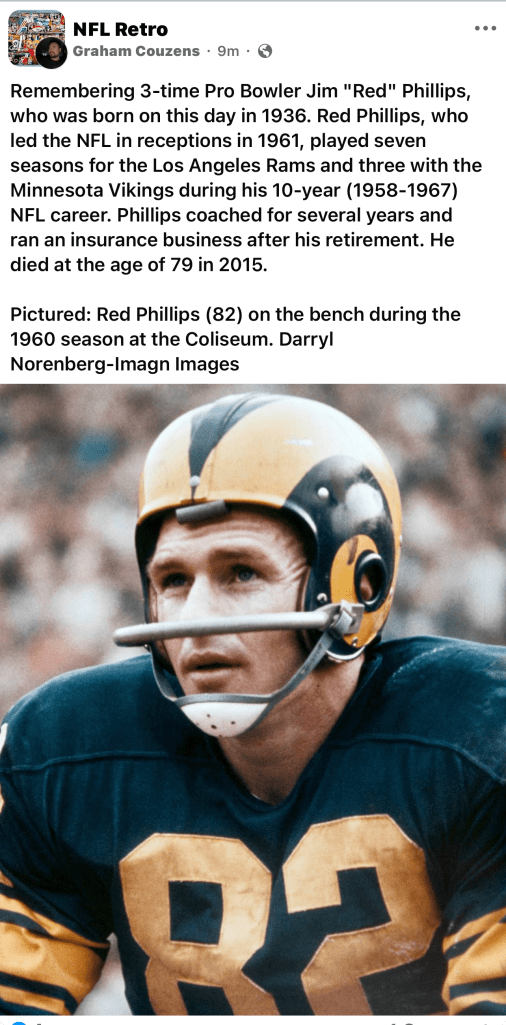
Best known: The Rams’ No. 5 overall pick in the 1958 NFL Draft out of Auburn, James “Red” Phillips led the league during its 14-game 1961 season with 78 receptions and was third with 1,092 yards as Zeke Bratkowski’s favorite target. It was amidst a stretch where Phillps was named to three straight Pro Bowls.
Rommie Loudd, UCLA football linebacker/tight end (1953 to 1955):
Best known: Out of L.A.’s Jefferson High, Loudd was a key member of the Bruins team that won the 1954 Rose Bowl and was declared national champs, he was first-team All-American as a senior. After navigating a pro career through the Canadian Football League and the NFL, Loudd joined the Los Angeles Chargers of the newly formed American Football League in 1960 and played one season at the Coliseum as a linebacker at age 27, wearing No. 51. His legacy was becoming the first Black assistant coach in the AFL (with Boston) and the first Black majority owner of a major-league sports team when he took over the Florida Blazers of the World Football League.
Have you heard this story:
Brenden Rice, Los Angeles Chargers receiver (2024):
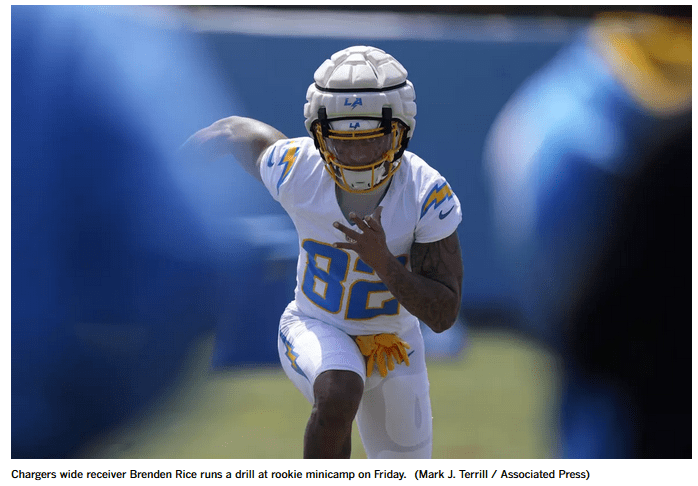
The obvious challenge for the 6-foot-3, 210-pounder out of USC is having to be the football offspring of Jerry Rice, whose Pro Football Hall of Fame bio called him the “most prolific wide receiver in NFL history with staggering career totals.” Brenden Rice at least didn’t wear No. 80 like his dad. Wearing No. 2 at USC for his final two seasons (after two seasons in Colorado), Brenden Rice caught 84 passes for 1,402 yards and 16 touchdowns. The Chargers took him in the seventh round of the 2024 NFL draft (No. 225 overall), but he only got into three games.
Anyone else worth nominating?

 Tom Hoffarth's The Drill: More Farther Off the Wall
1 thought on “No. 82: Greg Hopkins”