
This is the latest post for an ongoing media project — SoCal Sports History 101: The Prime Numbers from 00 to 99 that Uniformly, Uniquely and Unapologetically Reveal The Narrative of Our Region’s Athletic Heritage. Pick a number and highlight an athlete — person, place or thing — most obviously connected to it by fame and fortune, someone who isn’t so obvious, and then take a deeper dive into the most interesting story tied to it. It’s a combination of star power, achievement, longevity, notoriety, and, above all, what makes that athlete so Southern California. Quirkiness and notoriety factor in. And it should open itself to more discussion and debate — which is what sports is best at doing.
The most obvious choices for No. 24:
= Kobe Bryant: Los Angeles Lakers
= Walter Alston: Los Angeles Dodgers
= Freeman McNeil: UCLA football
= Dwayne Polee,Manual Arts High basketball
The not-so-obvious choices for No. 24:
= Marion Morrison: USC football
The most interesting story for No. 24:
Kobe Bryant: Los Angeles Lakers guard (2006-07 to 2015-16), also wearing No. 8 (1996-97 to 2005-06)
Southern California map pinpoints:
Los Angeles (Staples Center), Long Beach, Newport Beach, Thousand Oaks
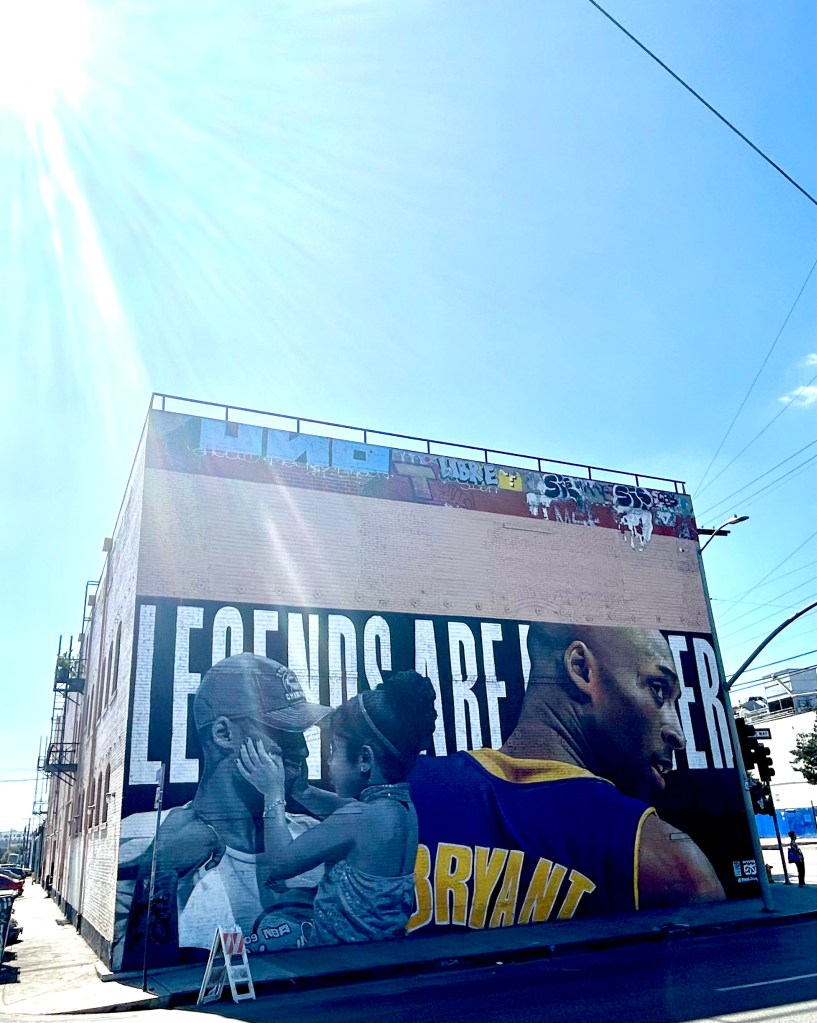
Momba murals, we have come to call them.
Brilliantly splashed across the sides of hotels, apartment complexes, auto part dealers, pawn shops and abandoned warehouses.
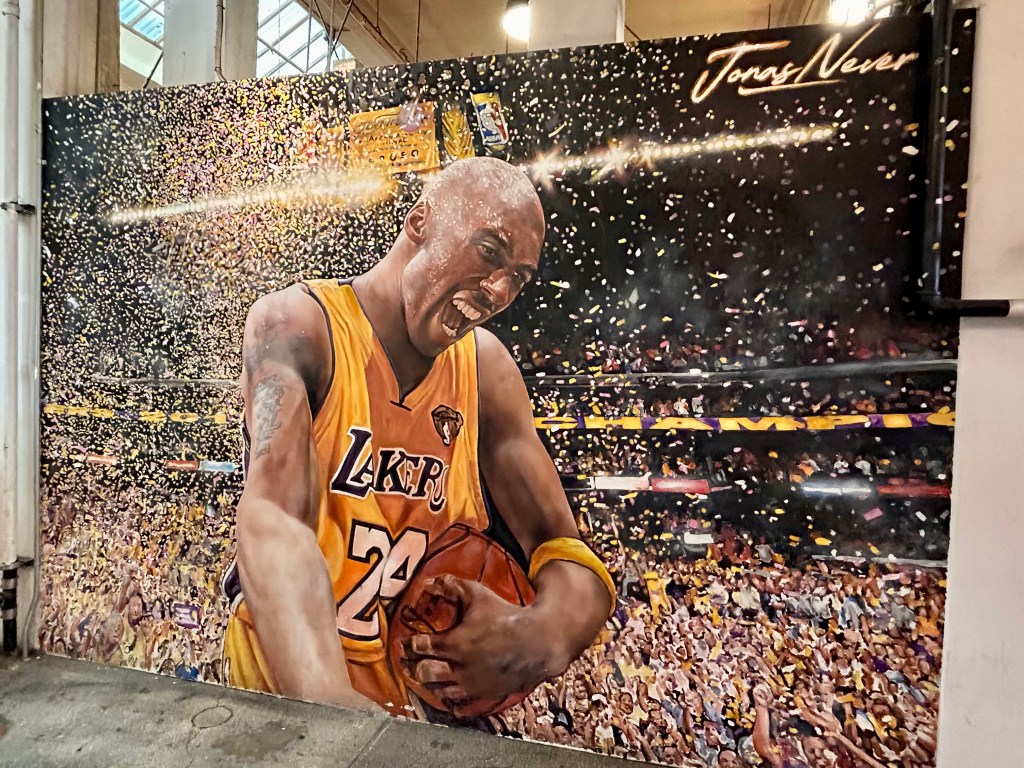
Inside a bustling Grand Central Market on South Broadway to stop and admire with a Villa’s Taco sampler trio plate in one hand and an Oaxacan Horchataan in the other.
They provide varied interpretation and a longing for artists inspired to creatively honor Kobe Bryant and his daughter, Gianna. They have become as much as the city’s fabric and context as much as a place to reflect and ponder “what if” as well as what was.
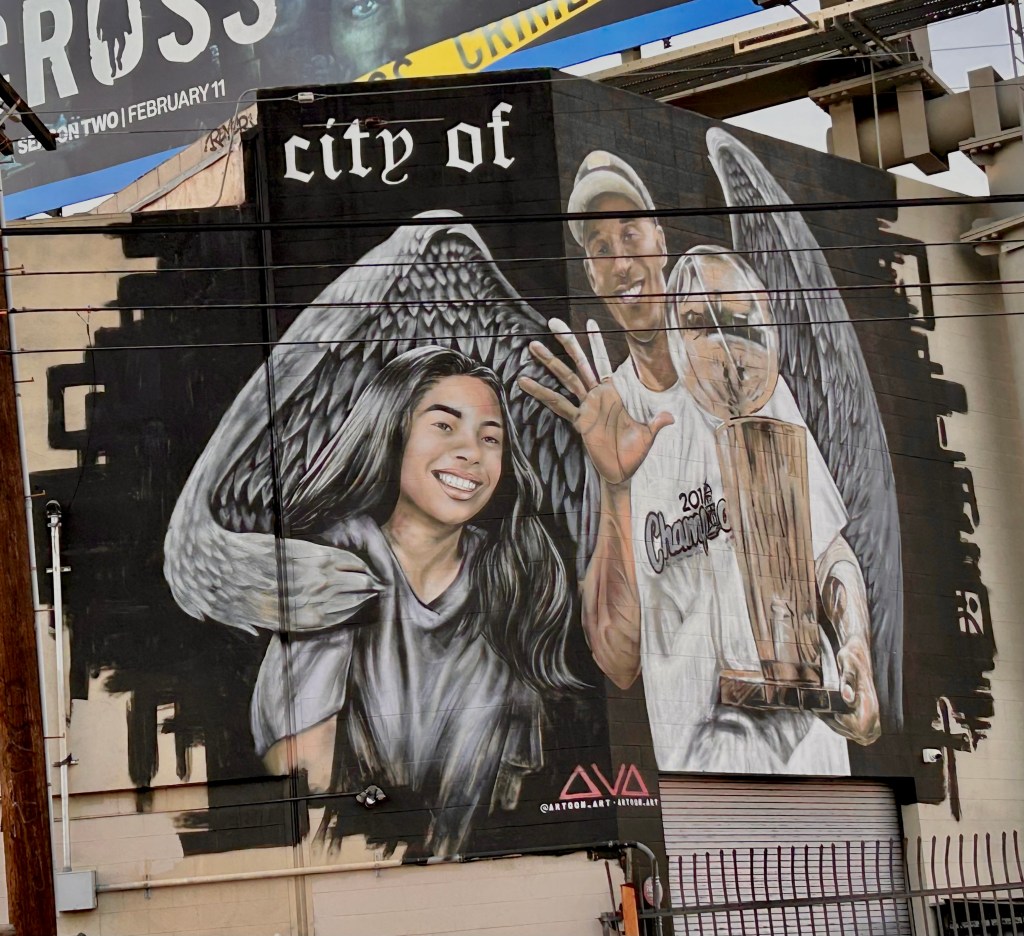
They have become the most visible coping mechanism for the artists who deigned them as an expression of grief mixed with tribute. They’ve become a relief for pedestrians or those in a car passing by them.
One of Bryant hoisting an Academy Award, lined up against his NBA title trophies. Two of them at the world-famous Venice Beach near their outdoor courts. Another wearing a Dodgers’ No. 24 uniform and sharing space with Shohei Ohtani.
“Kobe and Gianna Bryant are everywhere in Los Angeles,” Vanessa Bryant writes. “They watch over pickup games in Venice. They light up the interminable traffic on La Brea and take up an entire block in Elysian Valley; they hover Inglewood, Downey, Glendale and Hollywood. Their faces have become part of Los Angeles.”
At some point, they should be numbered and catalogued as if part of a unique L.A. County art gallery.
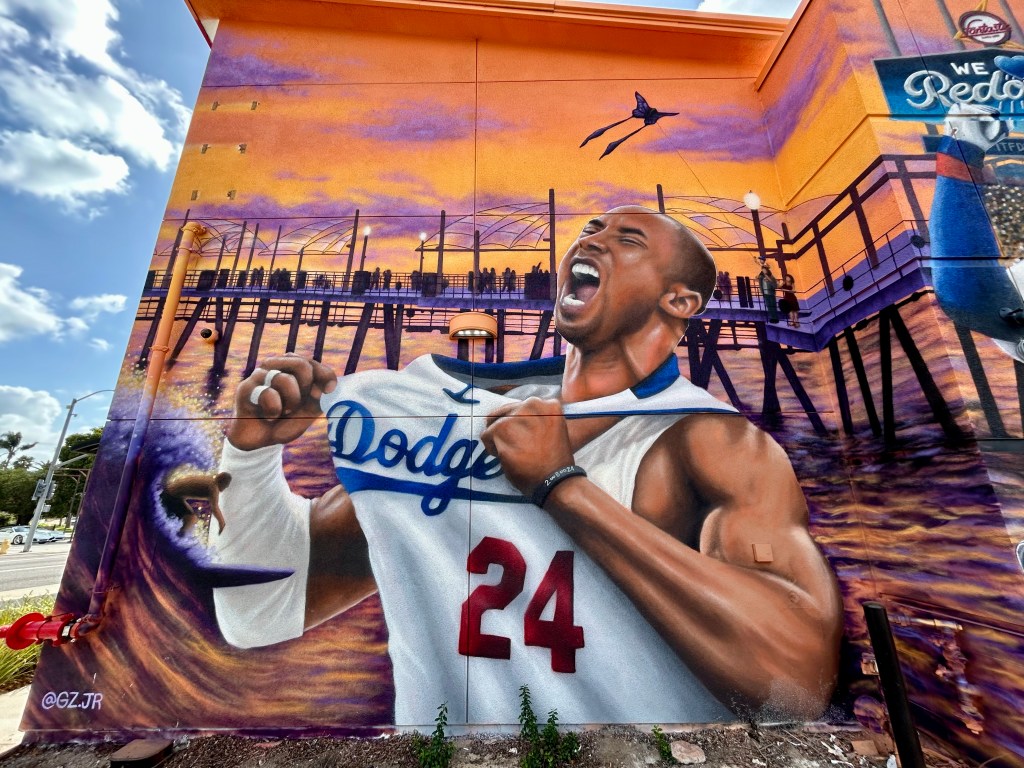
Websites dedicated to these works claim, as one called KobeMural.com says, they can verify nearly 350 renditions just in the greater Los Angeles area. There are more than 450 in the United State. Plus another 175 prominently are around the globe.
They are relentless. Like Kobe Bryant.

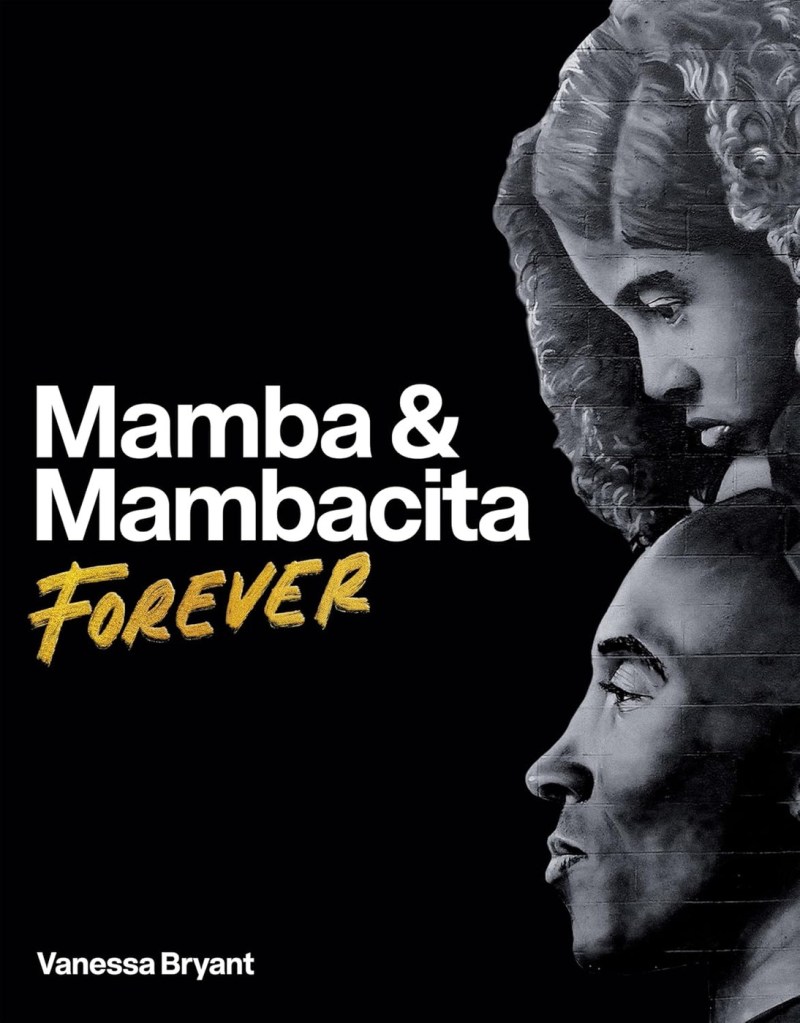
In the 2025 book, “Mamba & Mambacita Forever,” using the work of KobeMural.com’s research, Vanessa Bryant provides the words to go with dozens of photographs of the artistic renderings, an official scrapbook of images and stories behind the tribute.
“The muralists who portrayed Gianana and Kobe at such grand size pay tribute not simply with the images they paint with with the actual difficulty of their work, the athleticism behind the art form,” Vanessa Bryant writes. “What is a mural if not a show of creative and physical strength?”
Jonas Never agrees.
“As a muralist, you have to approach a wall knowing you’re actually going to be able to pull it off. Kobe was so great about that, no stage was too big for him. And I loved that his game changed over the course of his career. As you grow and discover who you are, your strengths and weaknesses, you have to keep adapting and evolving and hopefully keep improving.”
Never had a mural of Bryant on Lebanon Street in L.A., and within hours of Bryant with his 13-year daughter, Gianna perishing in a January, 2020 helicopter crash in the hills of Calabasas that also took seven more friends, mourners went to the image and began to write messages on it.
“On another day, he’d be upset,” Vanessa Bryant writes. “He’d call this defacement and destruction. But here, he realized, it was the start of something massive.”
As the global pandemic hit soon afterward, and L.A.’s city streets went quiet, artists went out to express their feelings.
“They were grief personified into physical forms,” wrote Vanessa Bryant in the book. “Acts of love and heartache … painful reminders, yet also warm hugs, wrapped into one.”
It also proliferated into tattoos, cars, basketball courts, city landmarks. But the murals, soft and bold, told stories.
If something ever happens to these works, people come to the rescue, saving them from getting painted over. One Lakers star put up $5,000 to help restore a mural on the side of a T-shirt shop on Main and 14th street in downtown L.A. after a graffiti artist did a number on it for some reason.
Kobe and Gianna Bryant were on their way from in Newport Beach to a day’s worth of basketball games at what was then called the Mamba Academy in Thousand Oaks. It was on a wistfully foggy Sunday morning, hours after Bryant went to church.
The tragic event created the prodigious hashtag “GirlDad.”
Southern California already had what it called a “Mamba Day” on August 24 of each year – 08.24, also the day after what was his birthday. On Aug. 2, 2024 – or 08.02.24 in numerical language – a statue was unveiled at Crypto.com Arena/Staples Center honoring the dad and daughter.
When writer Sam Amick of The Athletic went to visit it on the fifth anniversary of their death, he wrote that it was “is both awe-inspiring and awful. … It’s a powerful and worthy piece of art …One can feel the affection they shared. An angel’s wings envelops them both from behind, a painful reminder to visitors that they are no longer with us.”
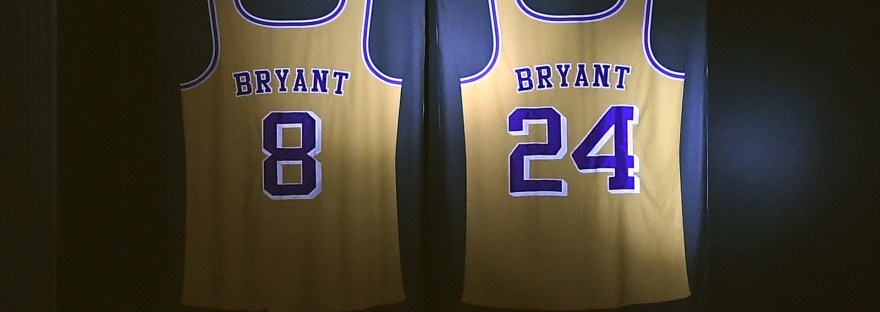
While Bryant wore No. 8 as an 18 year old coming into the league, and kept it for 10 seasons wearing a head of hair and goatee, he switched to No. 24 for his last 10 seasons ending in 2016. Bald and clean. Dad-like. The Lakers decided to retire them both.
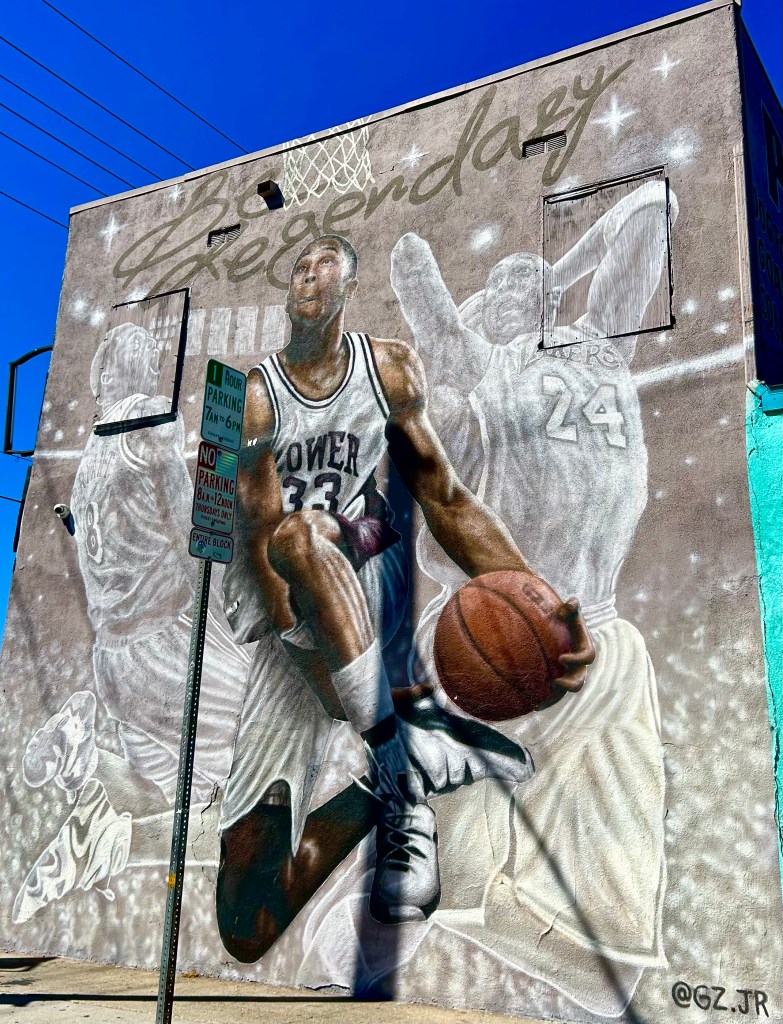
We are led to believe Bryant took No. 8 because he wore it growing up in Italy. And at the Adidas ABCD Camp, he had No. 143, three numbers add up to 8 if you’re that advanced. As the 13th overall pick out of high school in 1996, by Charlotte, Lakers GM Jerry West had already orchestrated a trade for him to Los Angeles. On the Lakers’ roster at the time was George McCloud wearing No. 24, so Bryant said he didn’t feel he had the juice to ask for it as he originally envisioned.
Eventually, Bryant supposedly switched to 24 because, after Shaquille O’Neal left the organization, he wanted a new start, a “clean slate” as he said. “Just start completely fresh, focus on the number that meant a lot to me.”
Also consider: Bryant went through the national spotlight of a rape allegations in 2003. He wasn’t able to get the Lakers moving anywhere near the top like O’Neal did in ’05 and ’06. Bryant was in damage control and a branding crisis.

“When I first came in at 8, is really trying to ‘plant your flag’ sort of thing,” he once told ESPN. “I got to prove that I belong here in this league. I’ve got to prove that I’m one of the best in this league. You’re going after them. It’s nonstop energy and aggressiveness and stuff.
“Then 24 is a growth from that. Physical attributes aren’t there the way they used to be, but the maturity level is greater. Marriage, kids. Start having a broader perspective being one of the older guys on the team now, as opposed to being the youngest. Things evolve. It’s not to say one is better than the other or one’s a better way to be. It’s just growth.
“It’s a new book, 24 — 24 is every day. Because when you get older, your muscles start getting sore. Body starts aching. You show up to practice that day, you have to remind yourself, ‘OK, this day is the most important day. I got to push through this soreness. My ankles are tight, they won’t get loose. I got to go through it, because this is the most important day.’ So, 24 also helped me from a motivational standpoint.”

In the 2009 Lil Wayne song, “Kobe Bryant,” it starts off:
Okay, Ko-Kobe doin’ work, two-four on my shirt
He the greatest on the court, and I’m the greatest on the verse
Going for the fourth ring like it was his first
Gotta get the gleem, do it for Kareem
Two-four so nice, my flow so mean
Catch me at the game sitting next to Goldstein
Ko-Kobe Bryant Nikes, purple gold strings
Ko-Kobe in the game dunkin’ on the whole team, yeah
According to Bryant, Wayne was motivated by his performance in Game 6 of the 2009 Western Conference finals: 35 points, six rebounds, 10 assists and 9 of 9 from the free throw line.

It became the definitive track of NBA 2K24.
None of that is actually covered much in a three-part CNN documentary released in early 2025 called “Kobe: The Making of a Legend.” Maybe because there are too many other elements of his life that better define him. And why his existence became so important to sports fans, as well as the community at large.
As pointed out, Bryant scored almost the same number of points wearing No. 8 (16,777) as when he wore No. 24 (16,886). He won an NBA scoring title in each number. Three of his five NBA titles with the Lakers came wearing No. 8, as well as eight All-Star appearances. And his 81-point game.
His lone NBA MVP award came as No. 24, as well as 10 All-Star appearances, and it is what he wore in the season he was most significant for him – 2012-13 when the team added Steve Nash and Dwight Howard, he ruptured his Achilles, and was never the same again.
“If you separated each of the accomplishments under those numbers,” Lakers owner Jeanie Buss said on the night both were raised to the rafters at Staples Center, “each of those players would qualify for the Hall of Fame.”
From winning an Academy Award for his “Dear Basketball” media project, to establishing the youth academy, writing children’s books, coaching his daughters’ basketball teams, to another new mural to a song … name anything else you choose. Bryant’s mind and artistic talents were working overtime once he was done performing for the Lakers.
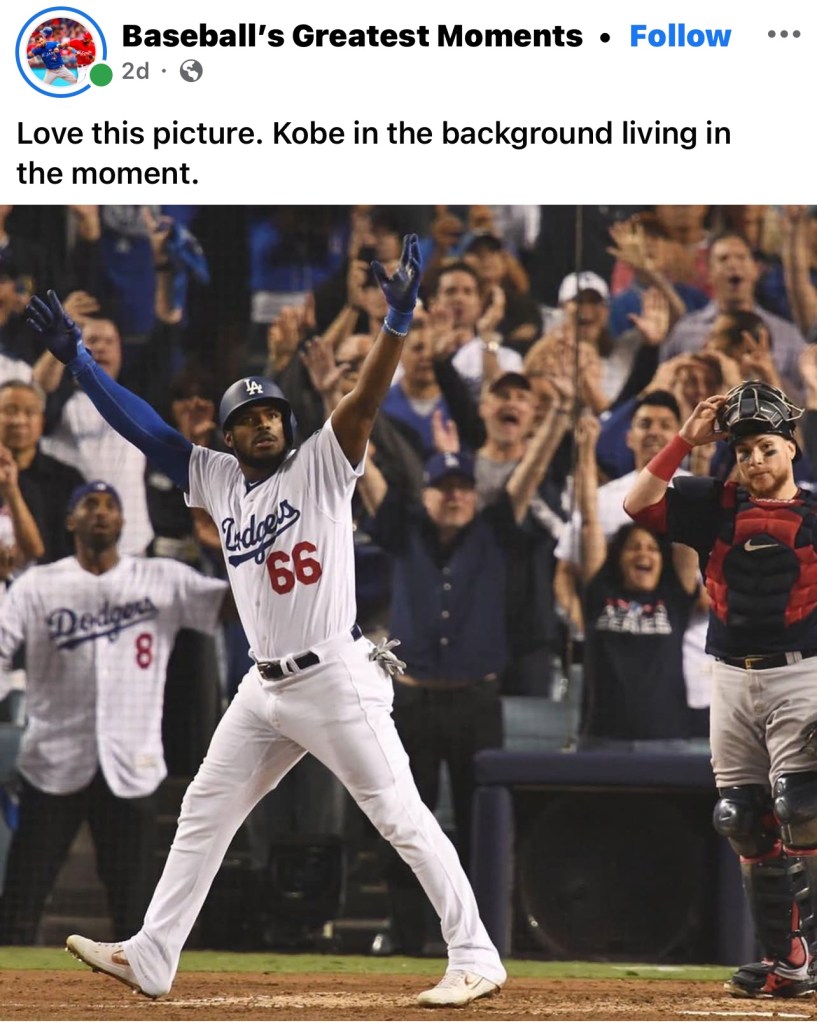
Bryant 8 is great.
Bryant 24 is forever.
The art around town and beyond remind us every day.
“Murals are an exercise in mythmaking and in the communal creation of history,” Vanessa Bryant concludes in the book. “In eras to come, when our world is, perhaps, unrecognizable, vestiges of these tributes will remain. They stories they tell will adapt and endure. And the people they represent will live on.”

Who else wore N0. 24 in SoCal sports history?
Make a case for:

Walter Alston, Los Angeles Dodgers manager (1958 to 1976):
Best known: By 1983, the Baseball Hall of Fame found it fit to induct Alston, whose 23-year span as the Dodgers manager ended after the 1976 season with four World Series titles (’55, ’59, ’63 and ’65), seven National League pennants (two of those teams, ’62 and ’74, won 102 games) and 2,040 regular-season wins, going back to Brooklyn in 1954. He was 64 when he quit. Alston, whose only appearance in an MLB game was for the St. Louis’ Cardinals in 1936 (one at-bat, one strikeout) went by the nickname of “Smokey” because of the heat he threw as a high school pitcher, encouraged by his father to put “smoke on the ball.”
Not well remembered: On his list for MLB.com of the “Best Dodgers players by uniform,” writer Ken Gurnick picked Augie Galan of the Brooklyn era, a two-time All Star first- and third-baseman from 1941 to ’46, even though “the number is synonymous with manager Walter Alston.”
Freeman McNeil, UCLA football running back (1977 to 1980):
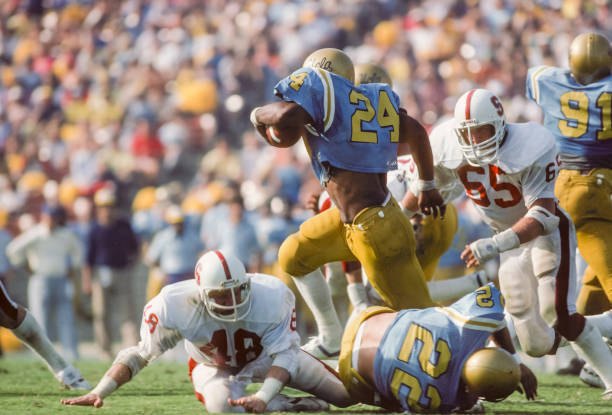
Best known: Out of Banning High in Wilmington, NcNeil racked up 3,195 yards and 21 touchdowns in his four years at UCLA to set school records. That led to him becoming the NFL’s third overall pick in ’80 by the New York Jets, where he stayed with No. 24. A 1992 UCLA Hall of Fame inductee, He rushed for 1,343 yards on 165 carries at Banning, named the L.A. City Player of the Year, State Player of the Year and Mr. Football USA to the top player in the country.
Not well remembered: McNeil was actually an offensive guard at Compton Centennial High when Banning High coach Chris Ferragamo brought him in and moved him to tailback. Two years later, McNeil led the state in scoring with 162 points and broke the L.A. City section record with 27 rushing touchdowns, leading Banning to the first of six L.A. City Section 4A titles in a row.
Kermit Washington, Los Angeles Lakers forward (1973-74 to 1977-78):
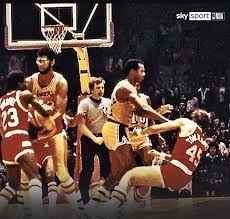
Best known: The lede of his obituary will no doubt touch on how he punched opposing player Rudy Tomjanovich during an on-court NBA brawl in 1977, breaking his jaw and nose. Washington was fined $10,000 and suspended 60 games. It is covered in a fine 2003 John Feinstein book, “The Punch: One Night, Two Lives and the Fight that Changed Basketball Forever.”
Keith Erickson, Los Angeles Lakers forward (1968-69 to 1972-73):

Best known: Upon his NBA retirement in 1977, Erickson moved into the TV/radio analyst chair in ’79 with Lakers legendary broadcaster Chick Hearn and stayed there for eight seasons which, to some, is how Erickson was most identified and remembered in Southern California.
A 12-year pro career that included stops in Chicago and Phoenix included the seven seasons with the Lakers, including their 1972 NBA title squad although he was injured most of the season. His top Lakers season came 1970-71 as he was fifth in scoring (11.3 a game), third in rebounds and fourth in assists.
Not well remembered: Erickson had a multi-sport career at UCLA that included playing basketball (and wearing No. 53), volleyball and baseball, coming over from El Camino College. Erickson ended up in the NBA based on the fact it paid the best — and he was the 21st overall pick in the 1965 draft by the San Francisco Warriors.
Dwayne Polee, Manual Arts High (1978 to 1981):

Best known: California’s Mr. Basketball as a 6-foot-5 senior topped his 32.1 points-a-game average by scoring memorable 43 points — 17 of 20 shooting from the floor — in his team’s 82-69 win over Crenshaw in the L.A. City title game at the Sports Arena before more than 14,000 spectators. “His stats were crazy,” said coach Reggie Morris said. “He didn’t miss a shot in the second half. He’s the leading scorer in the state and the first thing he does in the opening minute is take a charge. He was going to do everything to win the game.” Morris says people still talk about the event: “They say, ‘I was at the Game.’ That’s how the game has been referred to. ‘The Game’.” At Pepperdine (wearing No. 32) he was twice the West Coast Player of the Year in 1985 and ’86 during his three seasons there and inducted into the 2024 WCC Hall of Honor. The Los Angeles Clippers took him in the third round of the ’86 NBA Draft and he made into one game (wearing No. 12).
Not well remembered: Polee would be a coach at his high school alma mater and helped out at USC in an administrative role. His son, Dwayne Jr., was the L.A. City Player of the Year at Westchester High and a star at San Diego State.
Jason Kapono, UCLA basketball guard (1999-2000 to 2002-03):
Best known: The Lakewood High star earned entrance into the UCLA Athletic Hall of Fame’s Class of 2026 as he was the school’s third all-time leading scorer, a first-team All-Pac 12 selection every year he played and Pac-12 Co-Freshman of the Year in 2000. He led the team to three-straight Sweet 16 appearances from 2000 to 2002. He is also the No. 2 all-time 3-point shooter for the program, a career 44.6 percent shooter from beyond the arc.
Not well remembered: Kapono took No. 24 into the NBA with Cleveland first, then wore No. 28 with the Lakers in his last of nine NBA seasons, playing in 27 games in 2011-12.
Pooh Richardson, UCLA basketball guard (1985-86 to 1988-89); Los Angeles Clippers guard (1994-95 to 1998-99):
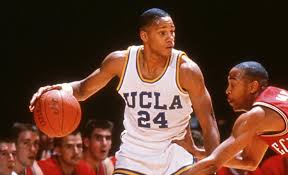
Best known: A 2003 inductee into the UCLA Athletic Hall, Richardson (first name, Jerome) was All-Pac-10 three consecutive seasons after he was picked the Bruins’ most valuable freshman in 1986. Richardson ended his career at as the school’s leader in assists, steals, three-point field goal percentage and minutes played. The Minnesota Timberwolves selected him with the 10th overall pick.
Not well remembered: Richardson spent five of his 10 NBA seasons with the Clippers — first wearing No. 2, because Terry Dehere was wearing No. 24, then switching to the No. 24 he had in college and prior NBA stints.
Jaime Jaquez Jr., Camarillo High basketball (2015-16 to 2018-19); UCLA basketball (2019-20 to 2022-23): The 6-foot-6, 220-pound guard was the Pac-12 Player of the Year as a senior when he averaged 17.8 points and 8.2 rebounds a game for the 31-6 Bruins who finished No. 7 in the polls. He had his Camarillo High No. 24 jerseyretired in 2025 in recognition of being first-team All-CIF Southern Section and scoring 2,653 points in his career, including a school-record 54-point game. His surprise success in the NBA with the Miami Heat, who picked him 18th overall in 2023 — the first UCLA senior picked that high since 2009.
Bob Myers, UCLA men’s basketball (1993-94 to 1996-97): The 6-foot-7 athlete from Northern California was going to walk-on at UCLA’s crew team, but was convinced to come try out for basketball by coach Steve Lavin. In his four seasons — starting just four games as a senior in 76 contests, he averaged only 1.4 points and 1.3 rebounds, but he was part of the NCAA ’94-’95 national title team. After trying to serve as a UCLA radio analyst and as a sports agent, and getting a law degree from Loyola Law School, he was hired by the Golden State Warriors as an assistant general manager as an apprentice role. But he was promoted to GM in less than a year, and became the NBA Executive of the Year in 2015 and 2017 as the Warriors won the NBA title those seasons plus in 2018 and 2022 with Myers as president of basketball operations. Leaving in 2023, Myers became a special consultant to the NFL’s Washington Commanders and was on the Board of Regents for the University of California.
Dan Haren, Los Angeles Angels pitcher (2010 to 2012): The 6-foot-5 righthander born in Monterey Park, a standout at Bishop Amat High in La Puente and then off to Pepperdine University in Malibu, Haren became a three-time All Star over three straight seasons in Oakland and Arizona before the Angels picked him up in a mid-season trade to strengthen their rotation. His 2011 season saw him lead the AL (again) with 34 starts to go with a 16-10 record and 3.17 ERA to garnish some Cy Young votes. His free-agent journey afterward saw him spent one year with the Dodgers (wearing No. 14) in 2014.
Have you heard this story:

Marion Morrison, USC football (1926) via Glendale High:
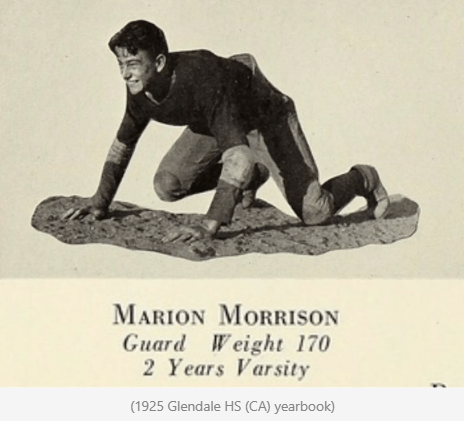
“Duke” Morrison appears in the 1925 Glendale High School yearbook as the senior class president as well as a starting but undistinguished guard on the football team, a 170-pounder who at least gave it a go. Enough to where he earned a scholarship to play football at USC and was a member of the undefeated Trojans freshman team. That got Morrison eventually promoted to varsity by coach Howard Jones.

A story in the San Mateo Times lists Morrison among the up and coming tackles on that ’26 team that finished 8-2 with two one-point losses in the Pacific Coast Conference and was ranked sixth in the nation. Coming into fall camp, Morrison, who by then was a 200-pounder, made the USC traveling squad, which was only about two dozen players then, and substituted in wearing #24 when USC was assured of victories over Santa Clara and Washington State. He did not play in the season-ending Notre Dame game that started the Trojan-Irish series. However, he was mentioned a few days later as a competitor for one of the four interior line spots that would open in 1927 due to graduations. The coach also got him and teammates jobs in the movie business and perform in small roles. Morrison quit school when his football scholarship wasn’t renewed for the ’27 season. A story later emerged that he injured his shoulder while surfing, though that appears to have been the work of a Hollywood publicist. But by the time the 1972 NFL draft came around, the Atlanta Falcons picked John Wayne in the 17th round.
Brad Correll, Lancaster JetHawks outfielder (2007): He was playing Single-A baseball at age 26 when the JetHawks were an affiliate of the Boston Red Sox, and in June, he pulled off the rare feat of hitting four homers in a game during a 16-4 win over High Desert. He did it taking just five swings. It only tied the California League record that had been set 35 days earlier by teammate Aaron Bates. In the “pass the hat” collection the Jethawks took, Correll had to leave the stadium with security. “I saw some big money. That was crazy,” he said. “There were a lot more 10s, a lot more 20s and even a 50. I think my mom might have put that in there. I ended up making more than $1,800 that night.” This all came at the end of Correll’s pro career as he was with the Cincinnati, Philadelphia, Pittsburgh and Florida organizations before this assignment and was done playing by age 29 in the Independent League.
Eddie Fisher, California Angels relief pitcher (1969 to 1972): Nothing really remarkable about the three season he spent in Anaheim during a 15-year MLB career. Except the memory of hearing an Angels game on the radio, and when Dick Enberg mentioned that Eddie Fisher was warming up in the bullpen, my first thought would be: Does Debbie Reynolds and Elizabeth Taylor know he’s pitching in the big leagues, maybe behind their back?
Reggie Theus, Inglewood High basketball (1972 to 1975):

Theus led his Inglewood High team to the semifinals of the CIF 4A tournament averaging 28.5 points and 15.5 rebounds a game before heading to UNLV. Had his No. 24 retired by the school in 2014.
We also have:
Alexander Frolov, Los Angeles Kings left wing(2002-03 to 2009-10)
Roy Hamilton, UCLA basketball guard (1975-76 to to 1978-79)
Jason Kapono, UCLA basketball forward (1999-2000 to 2002-03)
Jaime Jaquez Jr., UCLA basketball forward (2019-20 to 2022-23)
Natalie Williams, UCLA women’s basketball forward (1990 to 1994)
Willie Davis, California Angels outfielder (1979)
Bruce Kison, California Angels pitcher (1980 to 1984)
Gary Pettis, California Angels outfielder (1986 to 1987, also No. 30 in 1982 and No. 20 from 1983 to 1986 )
Sandy Alomar, California Angels catcher (1973 to 1974, also No. 4 from 1969 to 1971 and No. 2 from 1971 to 1972)
Rickey Henderson, Anaheim Angels outfielder (1997)
Gary Matthews Jr., California Angels outfielder (2007 to 2009)
Chili Davis, California Angels outfielder (1988 to 1990, also No. 44 from 1993 to 1996)
Clancy Williams, Los Angeles Rams cornerback (1965 to 1972)
Tommy Wilson, Los Angeles Rams halfback (1956 to 1961)
Jay Wells, Los Angeles Kings forward (1979-80 to 1987-88)
Whitey Herzog, California Angels manager (1974)
Anyone else worth nominating?

 Tom Hoffarth's The Drill: More Farther Off the Wall
1 thought on “No. 24: Kobe Bryant”