"Everything comes to him who hustles while he waits." — Tommy Edison
Author: fartheroffthewall
Tom Hoffarth is a sports journalist in Los Angeles, born and raised (reared is the correct phrase, but it just sounds wrong) and specializing in the sports media business. A USC graduate from the School of Journalism (it still exists, somewhat) in 1984, he is also available for service at https://www.linkedin.com/in/tomhoffarth/
Everyone and their destitute friends want to tell Dr. Patrick Soon-Shiong how to spend his disposable income these days. It’s become an epidemic.
Soon enough, he’ll fritter it all away just as easily by himself.
The Los Angeles Business Journal just released its annual list of the 50 Wealthiest Angeleonos – you can read it online but you only get so many looks before you’re faced with trying to scale a paywall to keep away the illegal riffraff.
Spoiler alert: Soon-Shiong has retained his No. 1 prime-time top spot because of his deteriorating estimated his net worth of $19.1 billion.
According to @LABJnews: Patrick Soon-Shiong is L.A.'s wealthiest man at $19.1 billion. He took a hit from $20.4 bil last year, but is still > $4 bil richer than the No. 2 guy. How soon does Soon-Shiong start dropping L.A. @Angels' beer prices?https://t.co/XGh9AvUnpd
When he was top L.A. dog in 2021, the Brentwood resident and LeBron James neighbor supposedly had $20.4 billion tucked away. Yet he is anything if not consistent – he’s lost six percent of his walking-around money in each of the last two years. Even more if you check other sources of repute.
And still, enough think he’s the person they want to buy the Angels.
There can’t be an Angeleno in his right Charles Schwab ledger who’d own up to wanting to own the Angels these days.
EXCLUSIVE: The billionaire businessman and Los Angeles Times owner Dr. Patrick Soon-Shiong is exploring a bid for the Los Angeles Angels https://t.co/jWot3KW2RN
Soon-Shiong is in the health-care business. He knows a DNR situation when he sees one.
First, no one living in a 25-mile radius of Angels Stadium has even received their first COVID shot. That’s the definition of a dying fan base.
He also has to take into account that Shohei Ohtani, the most remarkable Major League Baseball player we will every witness in our lifetime, will be summonsed back to his home planet soon unless he is compensated according to what Babe Ruth and Cy Young would be paid, combined, in today’s economy. They’ve not created a super calculator with that many digits yet.
Soon-Shiong has to be running out of patience, patients and patents.
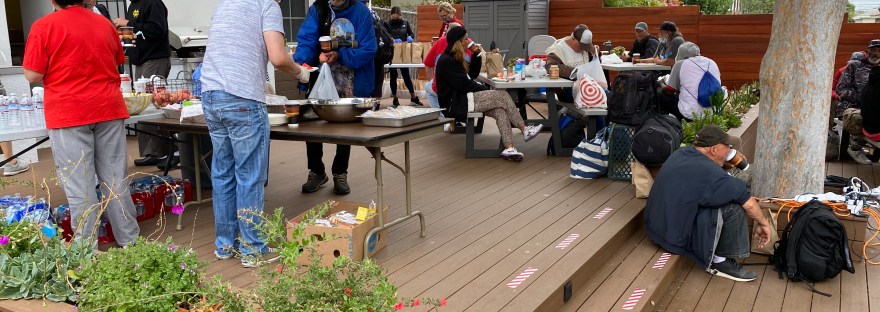
We learn to ask anyone wrestling with the realities of shelter and food insecurity who manage to arrive each Saturday morning at the St. Robert’s Center in Venice a simple question — What do you need?
It is as much a conversation starter as it is a fact-finding mission.
The answers are remarkably simple and ones you might not always default do. But consider the beauty of:
= A hot cup of coffee, please. With as many refills as you can spare. To take the chill off the night before.
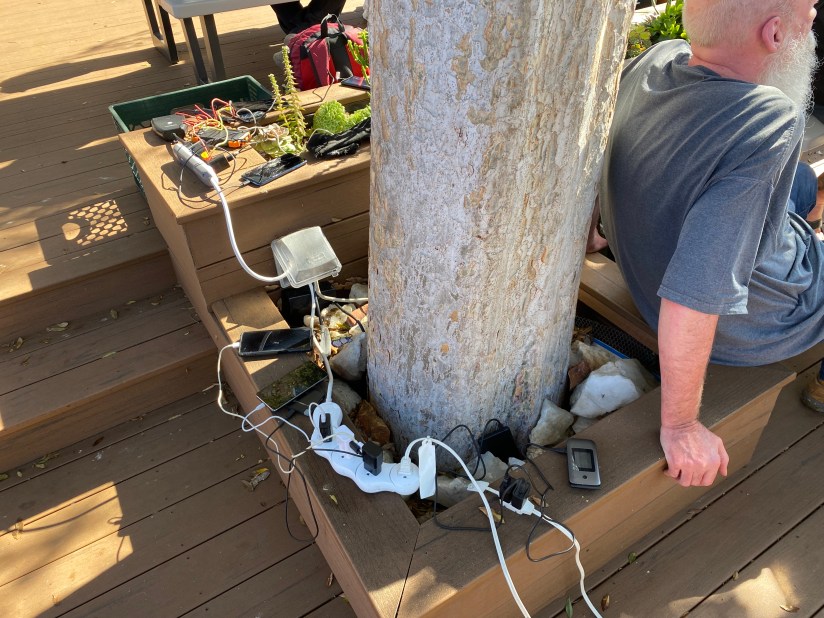
= Access to an electrical outlet, to recharge a phone. How long can I leave it plugged in? This is how I stay connected to the world.
= Five quiet minutes in a restroom, if that’s possible. Just to gather oneself.
The last umpteen months of protocol adjustments brought on by the COVID pandemic have forced Catholic Charities L.A.’s facilities like this one that serve the Santa Monica area into a “grab-and-go” assembly line. Often in a condensed time window.
The basics of offering food, clothing and toiletries are the default essentials, and come from various sources. It was a pivot to pre-made grocery bags and lunch bags — granola bars, fruit cups, cans of soup (stay away from anything condensed), Vienna Sausages and whatever else has easy-to-carry nutritional value – are things regularly ordered and picked up at the Westside Food Bank. More financial donations that allow shopping at the local Smart & Final. About a dozen volunteers from surrounding Catholic churches donate their time and hearts — and often what they can cull from their spouse’s closets — each week to make it flow in whatever direction it will end up going.
Blankets, hoodies, socks, pants and other practical clothing items for men and women are there, depending on what’s available. Same with seizing the day for anyone who could use travel-sized bar soap, toothpaste and shampoo/conditioner. Add masks, hand sanitizers and alcohol wipes to the essential lists.
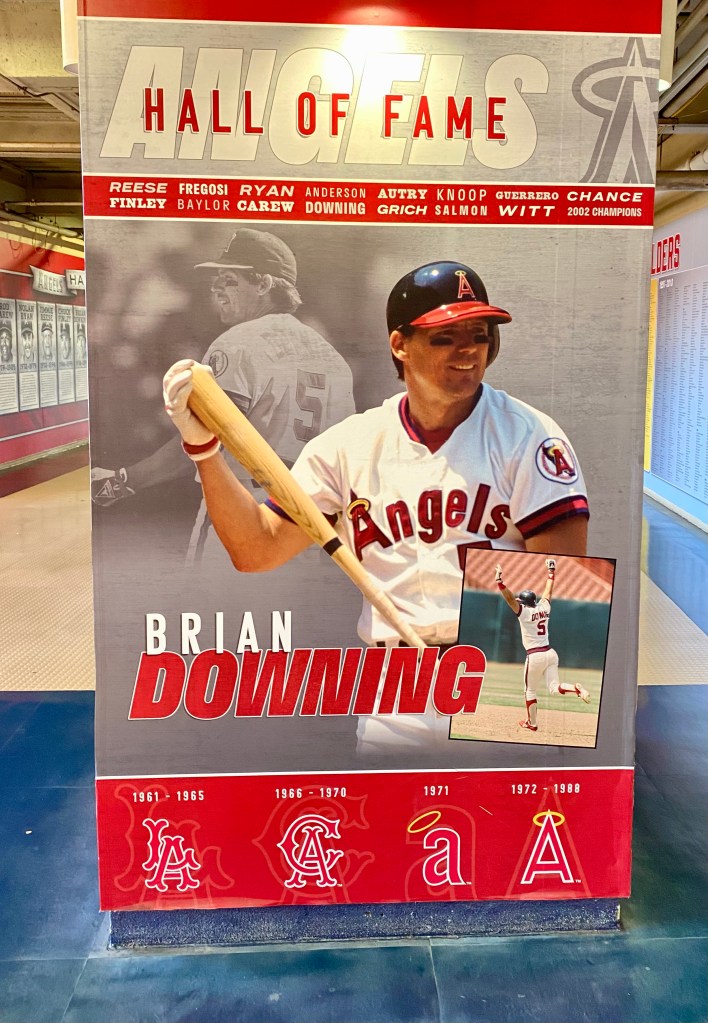
Brian Downing may have gone by the nickname “The Incredible Hulk,” looked far more like Christopher Reeve, and was the most likely Angels in the Outfield candidate to bust through a left-field wall like the Kool-Aid Man in routine pursuit of a fly ball.
(Downing shoulda been in this commercial, not Pete Rose, but then again …)
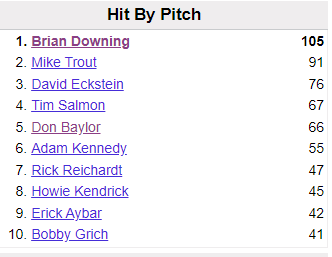
He rode a Harley Davidson motorcycle to the ballpark. He is the Los Angeles-California-Anaheim franchise leader in hit by pitch — more than 100 in the pre-body-armor days.
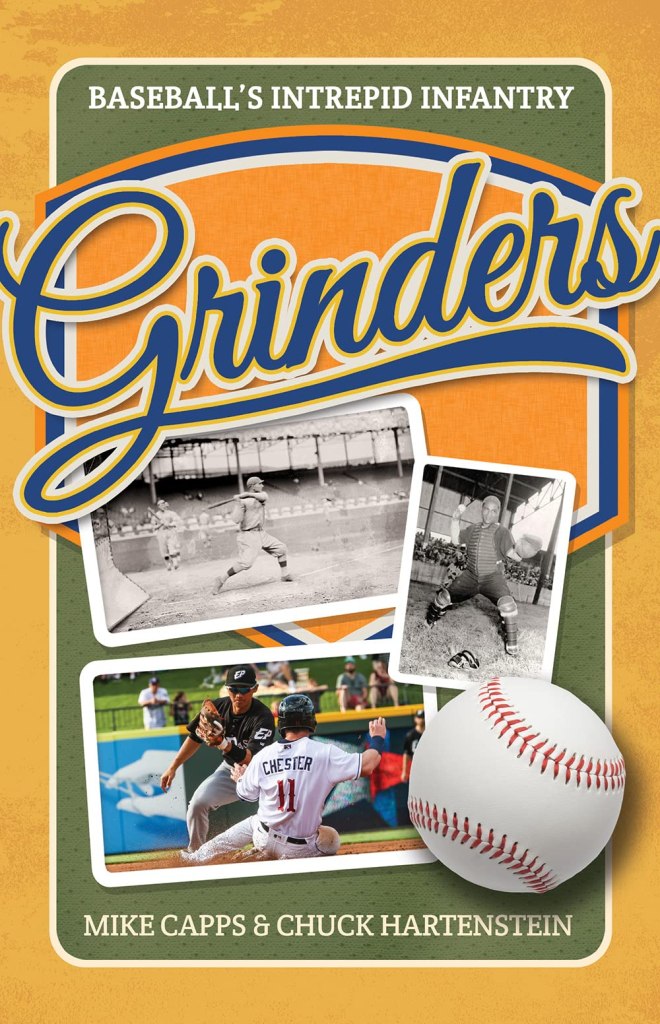
Call him a Grinder – as this new book does, and we heartily applaud – but he was also a Gamer.
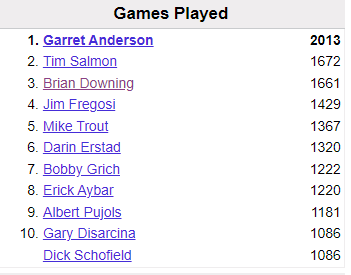
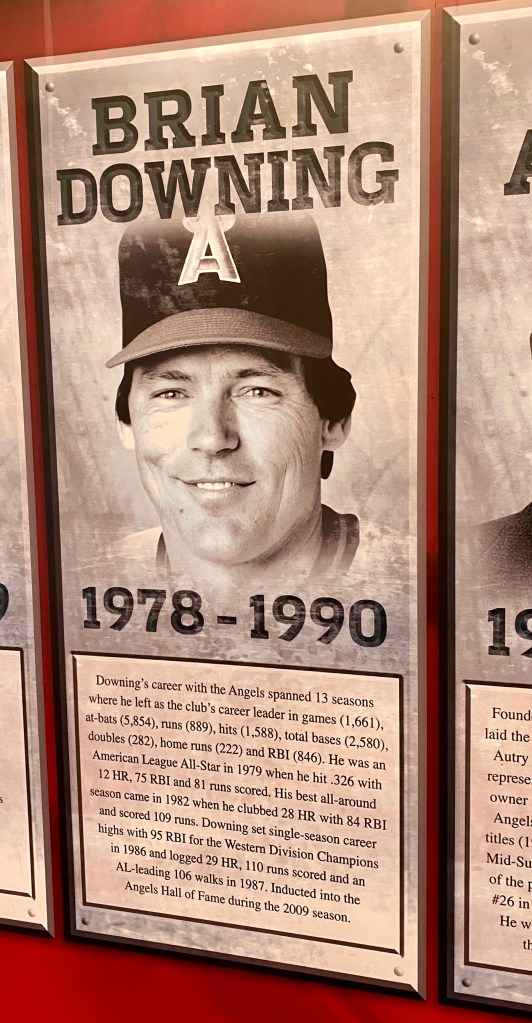
Downing played in 1,661 of them for the franchise. It covered 13 seasons, most in its history when he was incredibly let go by Angels GM Mike Port because, well, the guy was 39 and, by all accounts, kind of expensive to keep around despite … well … we’ll get to that.
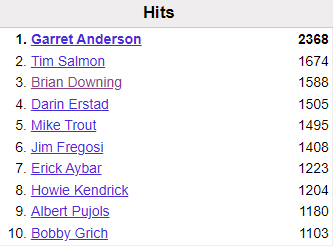
When he arrived via trade in 1978 at age 27, Downing compiled as many grass stains and elbow gashes as he did career stats that would put him pretty much in the club lead in every category, and all these years later, still remaining in the top five in many of them.
From playing catcher (and handling Nolan Ryan and Frank Tanana), then reluctantly moved to left field and then to a dependable DH who could do it from the leadoff spot, Downing was beyond a fan-favorite as the Angels won their first AL West Division title in 1979 (he was an AL All Star and hit .326 with 75 RBIs and 81 runs scored), and added two more titles in ’82 (.281, 28 homers, 84 RBIs, 109 runs) and ’86 (career-high 95 RBIs, 29 HRs, 110 runs). Six times he topped 20 homers in a season.
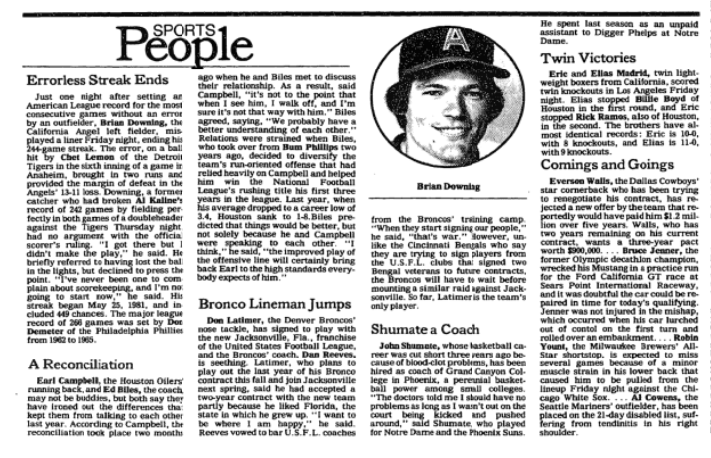
Also consider: That converted catcher broke Al Kaline’s AL record by playing 244 straight error-less games in the outfield from May of 1981 through July of ’83. And he didn’t complain about the scorekeeping call that ended it.
In the middle of the streak, this play even happened – 40 years ago this season, Sept. 21, 1982:
Born in L.A. and trying to make it onto the teams at Magnolia High in Anaheim and Cypress College, he couldn’t get anyone’s attention until a former American Legion coach of his pointed him to a tryout camp with the Chicago White Sox, where he was a part-time scout. Downing acknowledged it was tough to get players his age as the Vietnam War was going on.
Inserted as a third baseman, he lasted one pitch in his his MLB debut on May 31, ’73, coming in as a defensive replacement in the seventh inning. He banged up his knee catching a foul popup and had to sit more than two months.
His trade to the Angels in ’73 in a six-player deal meant Downing could come home.
He created a new batting stance and added in weight training to his 5-foot-10 and solid 194 pound frame.
Yet by the time the Angels kicked him to the curb at the end of the ’90 season — he wasn’t allowed to start the final home game of the season on Fan Appreciation Day, and a month earlier, he was named AL Player of the Week on Aug. 12 — he was making $1.25 million that season, sixth-highest on the team, and already sharing the DH role with Chili Davis.
Because of the way the Angels let him go, Downing remained understandably bitter. Ten years later, in 2000, in an interview with the L.A. Times, Downing said the wounds were still fresh.
“I was pushed out two years too soon,” he said, according to his wife, acknowledging that Downing played two more seasons in Texas as a DH. The Angels decided he could be replaced in that role in ’91 and ’92 with a rotation of Dave Parker, Dave Winfield, Hubie Brooks and other less expensive veteran spare parts.
Still, Downing got in the RV and returned to Anaheim to be part of the team’s 40th Season Anniversary celebration – voted by the fans to be included with in the outfield with Jim Edmonds and Reggie Jackson, honored with manager and shortstop Jim Fregosi, catcher Bob Boone, first baseman Rod Carew, second baseman Bobby Grich, third baseman Doug DeCinces, designated hitter Don Baylor, right-handed starters Nolan Ryan and Mike Witt, left-handed starters Frank Tanana and Chuck Finley and reliever Troy Percival.
Downing’s baseball card of numbers may not have had the Cooperstown-worthy data on it, but it didn’t matter – he finally conceded in 2009 to be added to the Angels’ Hall of Fame. (And on the April night the ceremony was supposed to happen, the Angels lost young pitcher Nick Adenhardt in a car accident, so the game and event was postponed to August).
At that time, he told the Orange County Register: “I’m very conflicted about a lot of things. I know a lot of this night is going to be about the fans, and I appreciate all of them, and all of that. I was always glad to be part of a team, with a bunch of players, but I never wanted to be THE player.”
The story also quotes former teammate Bert Blyleven:
“Brian was what other players called a ‘GAMER.’ … He was the type of player and teammate that came to the ballpark everyday to PLAY.”
Downing move to Texas also meant settling into ranch life with his wife in Celina, Tex., just outside of Dallas.
His last career hit was on the last day of the ’92 season – Sunday, Oct. 4 – described as a line drive single to deep shortstop-third base hole, off the Angels’ Blyleven at Angels Stadium in the first inning. Downing then came out for a pinch runner. They had him in the lineup hitting second and playing second base – a defensive position he wasn’t going to go out and play that day regardless (as he was the Rangers’ DH the previous two games against the Angels in the series).
All-Time Angels Lineup (bWAR): *>40% G at Position*
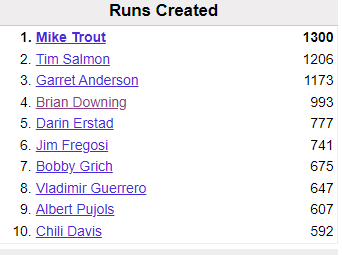
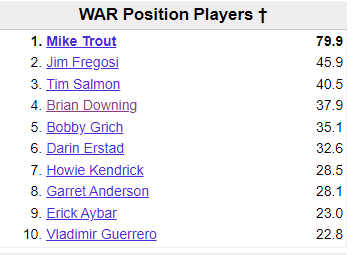
C: Bob Boone (12.1) 1B: Wally Joyner (18.9) 2B: Bobby Grich (35.0) SS: Jim Fregosi (46.0) 3B: Troy Glaus (22.6) OF: Mike Trout (76.1) OF: Tim Salmon (40.6) OF: Brian Downing (38.0) DH: Albert Pujols (12.8) pic.twitter.com/CRG548Dwh7
In the pre-Albert Pujols Anaheim days, Downing was No. 5 – and both are tied for fourth on the franchise’s all-time home run list with 222.
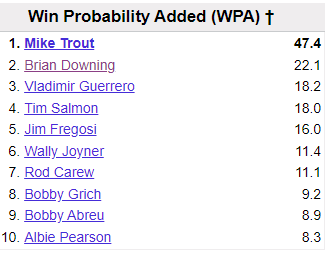
And, on at least this list, he’s No. 6 of the team’s all-time players (behind Mike Trout, Tim Salmon, Chuck Finley, Jim Fregosi and Jered Weaver – and ahead of Nolan Ryan? How about we take another straw poll?). On the NotInHallofFame.com countdown of 50 all-time Angels, it’s Trout, Ryan, Finley, Frank Tanana, Weaver and … Downing is No. 11.
All things considered, too low …
Brian Downing is a player I would put into the Hall of Fame, but he received just 2 votes in his only year of eligibility. A versatile, productive, and extremely consistent slugger deserved far better. pic.twitter.com/gx756JO0Gb
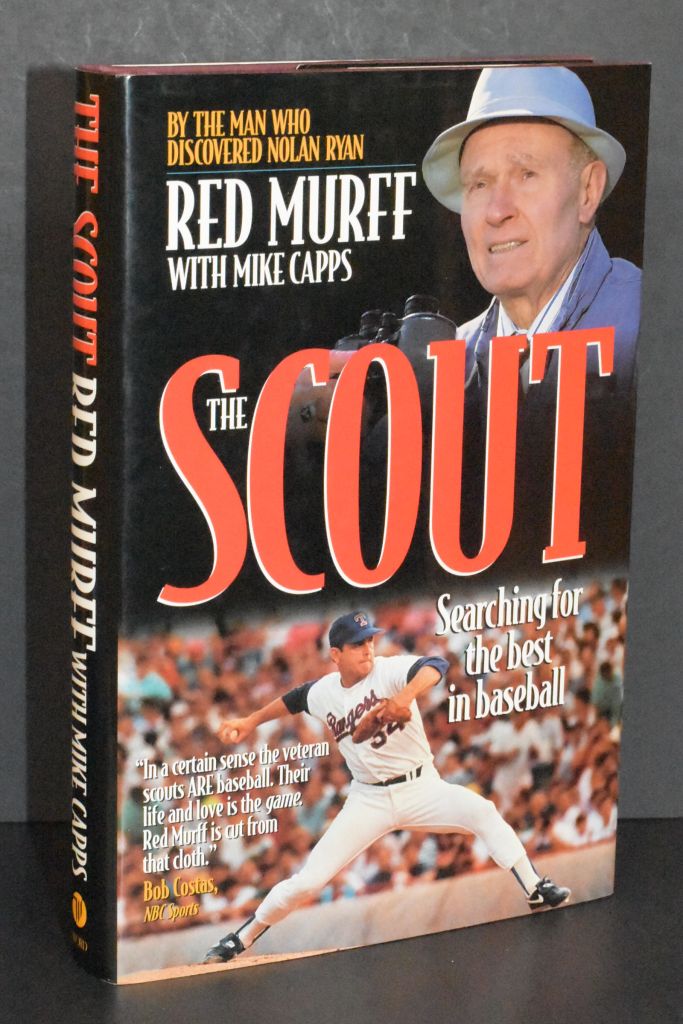
We get to re-remember Downing’s career and impact because of the 15 pages featuring him opening up more about all this in a book pulled together by two grinders themselves.
Mike Capps, the only broadcaster in the Triple-A Round Rock Express’ 22-year existence, did TV and radio news reporting in his prior professional career — 22 years of that at age 24 as a police reporter. He also did the book, “The Scout: Searching for the Best in Baseball” with Red Murff. Earlier this season, Capps logged his 3,000th game at Round Rock, now the Texas Rangers’ top farm club and still owned by Nolan Ryan.
Chuck Hartenstein, who logged 15 years as a relief pitcher known as “Twiggy” for the Cubs, Pirates, Cardinals, Red Sox and Blue Jays between 1966 and ‘77, died last October at age 79. He was the inspiration for the book, and his story became the opening chapter.
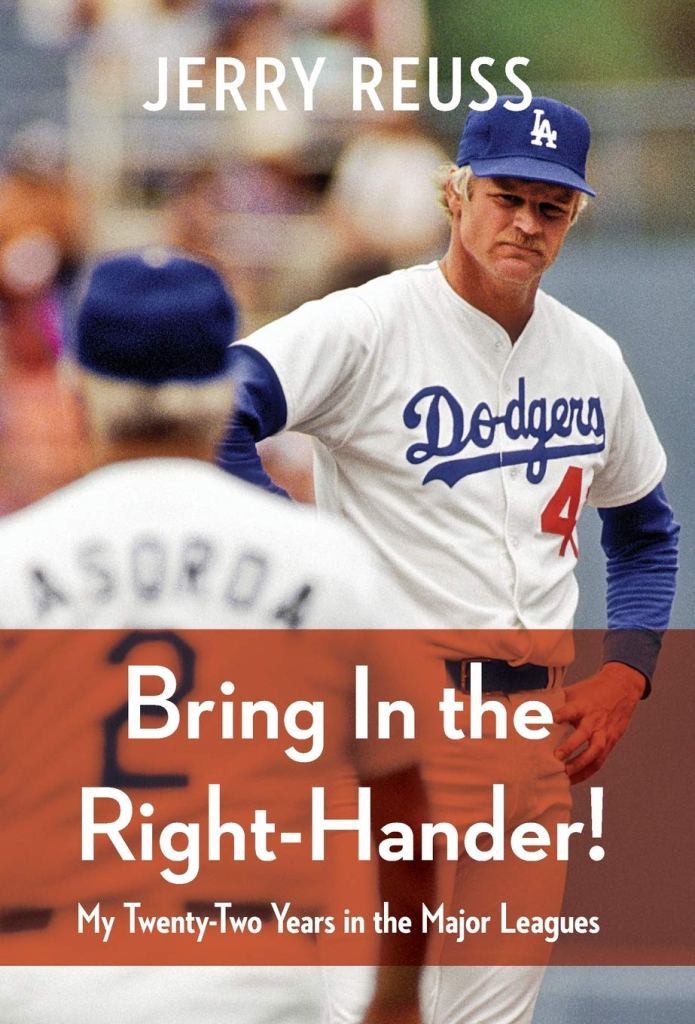
More than 40 players are profiled — including former Dodgers pitcher Jerry Reuss, one-time Dodgers coach Lorenzo Bundy and the three generations of Hairston players that include Jerry Hairston Jr. There are notable names like Kevin Millar, Fred Patek, Ron Swoboda and Jackson Ryan (Nolan’s grandson), plus the great baseball names like Scipio Spinks, Joe Slusarski, Travis Driskill, Kelly Wunsch, Ross Ohlendort and Chase Lambin.
As for Downing ..
The authors reached out to Downing’s wife, Cheryl, who admitted she wasn’t optimistic he would cooperate. “Better than that, he put together on 12 pages of legal pad, filled out both sides, a handwritten account of his career,” the authors explain. “Downing purged his baseball soul … (he) provided one of the best, eloquent and honest responses we’ve ever seen.”
It reveals how Downing was a 7-year-old in L.A. when the Dodgers moved into his hometown, and the first game he saw was when his grandmother took him to Game 3 of the ’59 World Series at the Coliseum.
The White Sox, the Dodgers’ opponent in that series, became his first pro MLB team. And Don Drysdale, pitching in that game for the Dodgers, would call Downing’s career from the broadcast booth.
Downing recalls in the book his first MLB at-bat finally came in August and, on the first pitch he saw, he legged out an inside the park home run during an NBC national TV “Game of the Week” telecast, off Mickey Lolich. Downing was hitting fifth, starting in right field.
(For what it’s worth: Downing’s first MLB AB was the day before in Detroit as a pinch hitter, striking out. And in that next game, he filed out to right in the first inning, then, in third MLB at bat, his first hit is that homer in the fourth).
George, Weezy, Reggie, Brian Downing and Mike Witt all together in one episode is must see TV. pic.twitter.com/sF1G0GGWmp
Downing doesn’t lament much, if at all, in the book about the Angels’ releasing him. But look, with a 20-season career, where he even got a cameo role on “The Jeffersons” when Louise snuck into the Angels’ locker-room looking for Reggie Jackson, to where he could address the Angels Stadium crowd for his delayed franchise Hall of Fame ceremony, things turned out pretty swell.
This book proves it.
Brian Downing was no stranger to struggles. Cut from his high school baseball team and his college team, he excelled in an open tryout for the White Sox. Read more about the powerful catcher’s unlikely major league journey in this week’s #Card Corner. https://t.co/ViL39n61AQpic.twitter.com/S5KnUGToZG
— National Baseball Hall of Fame and Museum ⚾ (@baseballhall) October 27, 2019
If the Angels get around to another anniversary team — they just past 60 seasons, and their 60th season in Anaheim comes up in 2026 — Downing may not be remembered enough to be on it. Mike Trout, Shohei Ohtani, Vlad Guerrero, and a collection of players from the 2002 World Series team might be considered more worthy.
“I just truly appreciate everybody that supported me all those years and the great support our team had,” Downing told the crowd at the Angels Hall of Fame ceremony.
Enough said. End gamer.
Just pulled Brian Downing from the bottom of a box at the swapmeet. Luckily he was unscathed ⚾️😍 pic.twitter.com/a4dnJCMghF
It may show “1B-6” in the book, but it doesn’t show how it was a slow roller to short that took all sorts of determination out of the box to get down the line and beat out the throw. Those qualities aren’t easy to describe. This does a fine job of it.
Rewind back to Jerry Reuss, who pitched nine seasons for the Dodgers in his 22-year career (1979 to 1987, including his 1980 no-hitter at San Francisco.
Reuss tells a story (page 96) about when he pitched for the Cardinals in 1973, six of his games were at Dodger Stadium that year, and he came to enjoy hearing Vin Scully’s voice on transistor radios all around the park.
Reuss remembers looking in for a sign once, and hearing Scully tell a story, so: “As a courtesy to him, I stepped off the rubber, grabbed and threw down a rosin bag. He delivered the punch line, the crowd laughed, and Scully continued: ‘Reuss winds and the pitch on the way …'”
Because of its nature, baseball is a sport that needs grinders almost more than it needs its marque talent that make things look so easy. If baseball only had five players to a side, the grinders fill in the other four spots, making sure the 162-game schedule is completed.
It’s a reflection on life, if you want to get metaphysical about all this. Those who grind stay in the game. Those who have the talent, face adversity and fall back, won’t survive.
Thank you, grinders, for the inspiration. You intrepid bastards.
You can look it up: More to ponder
"[It's] how you get up."@RRExpress broadcaster Mike Capps spoke with us about his newest book: "Grinders" ⚾
== Maybe someday there’ll be a book, or a chapter, on the the Dodgers’ secret weapon to winning the 1988 World Series: Mickey Hatcher, Rick Dempsey, Mike Davis, Franklin Stubbs, Danny Heep, Jeff Hamilton and Dave Anderson. Throw in Mike Sharperson, Mike Devereaux, Chris Gwynn and Tracy Woodson. All hatched off the scrap heap. Pinch hitters. Pinch runners. Defensive replacments. Fill-ins during injuries.
Hatcher gave the Dodgers’ bench crew that name during spring training, knowing that Tommy Lasorda had a roster at the time with the likes of Kirk Gibson, Steve Sax, Mike Scioscia, Pedro Guerrero, Mike Marshall, Alfredo Griffin and John Shelby.
“The thing about the Stunt Men is that we’re never happy,” Hatcher said. “We want to make that clear. You show me a guy happy to be on the bench, and I’ll show you a loser. … Our goal, as stunt men, is to push the (starters). Being a stunt man takes a certain kind of attitude and patience.”
Like being a grinder. Not in the spotlight. Asked to do all the heavy lifting.
Having attended one in Long Beach in 2011, and also traveling for San Diego’s SABR 49 to chronicle the 50th anniversary of The Baseball Encyclopedia, we can vouch they are well worth the time and expense to track them down, a delightful gatherings of men and women who love to share their research with other like-minded folks, a group appreciation of the thrill of the search as well as finding that nugget you didn’t know was out there. And then discussing it all.
This year, they’ve scheduled excursions to an Orioles’ game, touring Babe Ruth’s birth place museum, and tracking down historic ballpark sites in the area (like Baltimore’s old Memorial Stadium). They’ve been having trivia contests, handing out awards, having authors talk about their books, and planting panel discussion on things such as: “Longer Game Lengths … How Much Are Foul Balls to Blame?” or “Meta Pitch Tracking: How The Changes in Pitch Tracking Technologies Should Change How We Look at the Data They Collect.”
Maybe we missed it on the schedule, but we were hoping there would be some recognition of this latest SABR-generated project about our neighbors to the north, and how the game played out in their history.
Call it: “Oh, Canada, Thank You For Thinking of Us”
Canada was the country during COVID that forced its lone MLB team, the Toronto Blue Jays, to shuffle off to Buffalo — if it was to have a season at all in 2020. You can’t do it here. Go there, whey they don’t seem to care about public health as much.
Canada also won’t allow U.S. teams to bring in players who aren’t vaccinated – leaving some squads to shamefully arrive without some of their top stars, and no real explanation for their freedom of personal choice over the safety of those who may come to watch them perform.
Video: Superstar MLB Catcher Doubles Down On Vaccination Stance, Refuses To Play In Canada
This isn’t necessary, considering how the U.S. may have had baseball first – or claim to it – but our foreign trade policy to our neighbors to the north with the game’s professional existence is rather embarrassing.
They once had two Major League Baseball teams, then forced one to legally immigrate and be housed in our nation’s capital. With no apologies. We wish we had the words to explain our appreciation. Is this workable?
Because of that mess, the MLB no longer has in circulation one of, it not the, coolest baseball caps in the sport’s history. Especially when you learn all the nuances of it:
In honor of this book – broken up into two sections, covering the 19th and 20th Centuries, with 37 contributors – and of the SABR convention coming back, and finding out new and cool things to have on file, we’ve decided to make our Top 10 things learned from this oversized research project, if ordered, will land on your porch like a Spiegel catalogue:
Congratulations to Andrew North on this superb book on influential figures and milestones from Canadian baseball history from @sabrpic.twitter.com/VMQV05hcTN
— Journal of Canadian Baseball (@JofCBaseball) May 29, 2022
== The point person, Andrew North, is a retired developer of statistical software, director of the Centre for Canadian Baseball Research and serves on the editorial board of the Journal for Canadian Baseball.
William Shuttleworth: 1834-1903
== In 1793, there is a record of “a game of base ball” in Saint John, New Bruinswick. The first teams were formed in Hamilton, Ontario in 1854. William Shuttleworth formed the country’s first formal team that year called the Young Canadians. The first international game happened between the Burlingtons of Hamilton C.W. (Canada West, now called Ontario) and the Queen Citys of Buffalo in 1860 in a place called Clifton that no longer exists.
== More than 250 Canadian-born players have appeared in the major leagues. More than 130 of them are pitchers. Dodgers first baseman Freddie Freeman (born in Fountain Valley) has Canadian citizenship from his parents. Former Dodgers All Stars Eric Gagne and Russell Martin are among the most local notables born in Canada.
== Did the first official MLB game in Montreal happen with the Expos’ arrival on April 14, 1969 – with a team that needed a win in L.A. over the Dodgers on June 8 of that first year to end a 20-game losing streak? As SABR researcher David Matchett includes in his book-ending chapter about odds and ends he has found over the years, a July 24, 1918 story in the Boston Globe includes a piece about how the Boston Braves were going to play “the Chicago National League team” in Montreal on a Sunday coming up, and “net proceeds will be devoted to patriotic purposes (as this was during World War I) … and if the attendances warrants it, practically every team in the National and American Leagues, it is expected, will play in Montreal on Sundays.”
Blue laws kept Sunday baseball in Boston until 1929. Teams were trying to circumvent it. Then the Globe reported the next day saying the story was in error: “The game in Montreal will be an exhibition game, although both clubs will use their regular players.”
It was played at Delorimier Park, a horse race track that would be the future site of Delorimier Stadium (where Jackie Robinson played with the Brooklyn Dodgers’ top minor-league affiliate in 1946, the Montreal Royals). Boston won with two bases-loaded walks in the bottom of the ninth, 3-2. Only 2,500 attended.
So the Expos still kept the historical date of having a real game first.
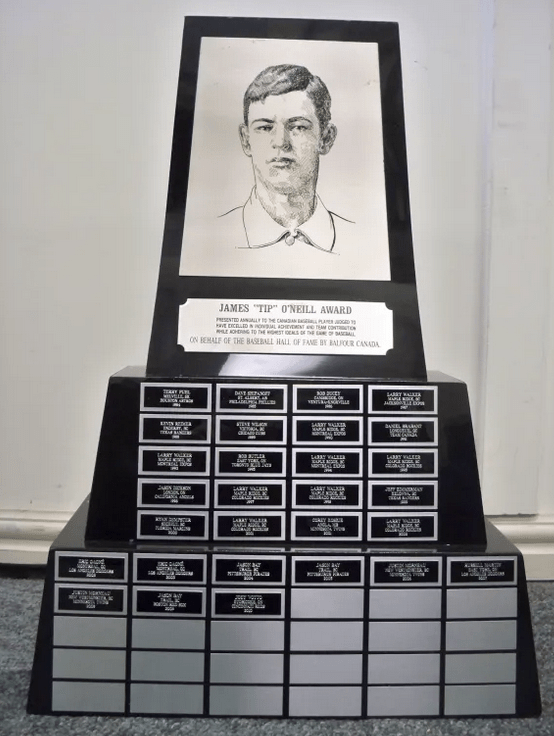
== Springfield, Ontario-born James E. “Tip” O’Neill, dubbed “Canada’s Babe Ruth,” has an award named after him given to the best Canadian baseball player. In 10 seasons considered to be MLB-quality from the New York Gothams, St. Louis Browns, Chicago Pirates and Cincinnati Reds between 1883 and 1892, he won the American Association’s Triple Crown in 1887 with a .435 batting average. That mark, adjusted from .492, is second-best in the game’s history now, so says the Special Baseball Records Committee in 1968. O’Neill is one of seven MLB players in Canada’s Sports Hall of Fame in Calgary (home of the 1988 Winter Olympics). Baseball Hall of Fame inductees Larry Walker and Ferguson Jenkins are there, along with Phil Marchildon, Ron Taylor, John Hiller and Claude Ramond.
= Alfred H. Spink, who with his brother founded The Sporting News, that would become “The Baseball Bible,” was born in the 1852-range in Quebec City, Canada and moved to Chicago, and then St. Louis, as a journalist. The first edition of The Sporting News arrived on March 17, 1886, for 5 cents.
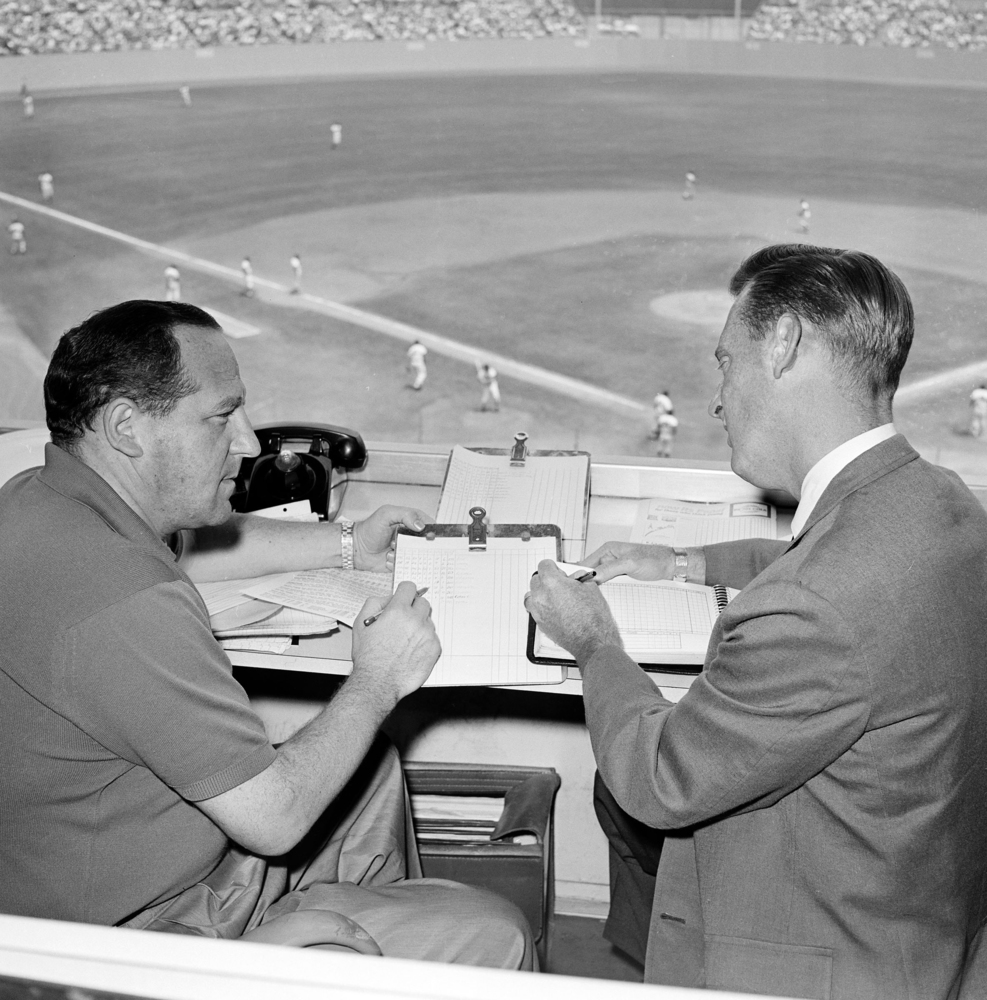
== Allan Roth, credited with pushing baseball analytics to a new level and became Vin Scully’s personal stat man in Brooklyn and L.A., was born in Montreal in 1917. Roth convinced Dodgers president Branch Rickey to hire him as not just a statistician, but someone who could provide proprietary data to the team’s benefits. Roth’s first day on the job with his expanded 17×14 scoresheets: April 15, 1947. He recorded every pitch of the team’s games for the next 18 years and Walter O’Malley moved him into the team’s broadcasting booth in 1954 to join Scully. “If you had some question that came to you in the middle of a game, he would reach down into the bag, and the next thing you knew you’d have your answer – it was marvelous,” Scully told Alan Schwarz, author of “The Numbers Game: Baseball’s Lifelong Fascination with Statistics” for St. Martin’s Press in 2004. Roth went on to work for NBC’s Game of the Week. The SABR chapter of L.A. is named for him. More on his background here.
== Between 1941 and 1953, the Montreal Royals were the gold standard for minor league teams in North America. But it played its final game before 1,016 fans on Sept. 7, 1960, in their antiquated park, by passed for MLB status by five Triple-A franchises in Milwaukee, Baltimore, Kansas City, San Francisco and Minneapolis-St. Paul. By that point, Tommy Lasorda, “the longest-tenured and most recognizable Royal,” left the team after almost coming to blows with manager Clay Bryant, as noted in William Brown’s book, “Baseball’s Fabulous Montreal Royals” in 1996.
== Joseph Lannin, who owned the Boston Red Sox for less than four full years, was a native of Quebec, from Lac-Beauport, was orphaned and, according to legend, walked all the way to Boston. He brought Babe Ruth to the Red Sox as the team won two championships in 1915 and ’16. He then sold the franchise, tired of commissioner Ban Johnson’s “constant interference,” to Harry Frazee and Hugh Ward for $675,000, which included Fenway Park. He was inducted into the Canadian Baseball Hall of Fame in 2004.
And two more for those in Baltimore might get a kick out of these:
== Brother Matthias, credited with finding and shaping the incorrigible George Herman Ruth into a ballplayer while sent off to be at the St. Mary’s Industrial Training School in Baltimore, was born as Martin Leo Boutilier on Cape Breton Island in Nova Scotia in 1872.
Ruth bought Brother Matthias a new Cadillac, but his vow of poverty resulted him in registering it to the St. Mary’s school. One night coming back from an event, the Caddy was stalled on a train track and demolished by a train. Brother Matthias and the boys in the car escaped unharmed. Ruth bought them another Cadillac. The story by Brian Martin is excerpted from his book, “The Man Who Made Babe Ruth” for McFarland in 2020).
How it goes in the scorebook
In celebration of Canada Day, here is a progressive timeline of the All-Time Position Player WAR Leaders who were born in Canada! 🇨🇦
It translates well, even if the exchange rate can be oppressive — $34.95 in the U.S. and $45.99 in Canada. The book is also listed on Canada’s version of Amazon.com (if you didn’t know that existed).
Here’s the deal: First Canadian resident who sees this and requests it, we’ll mail it to them for free.
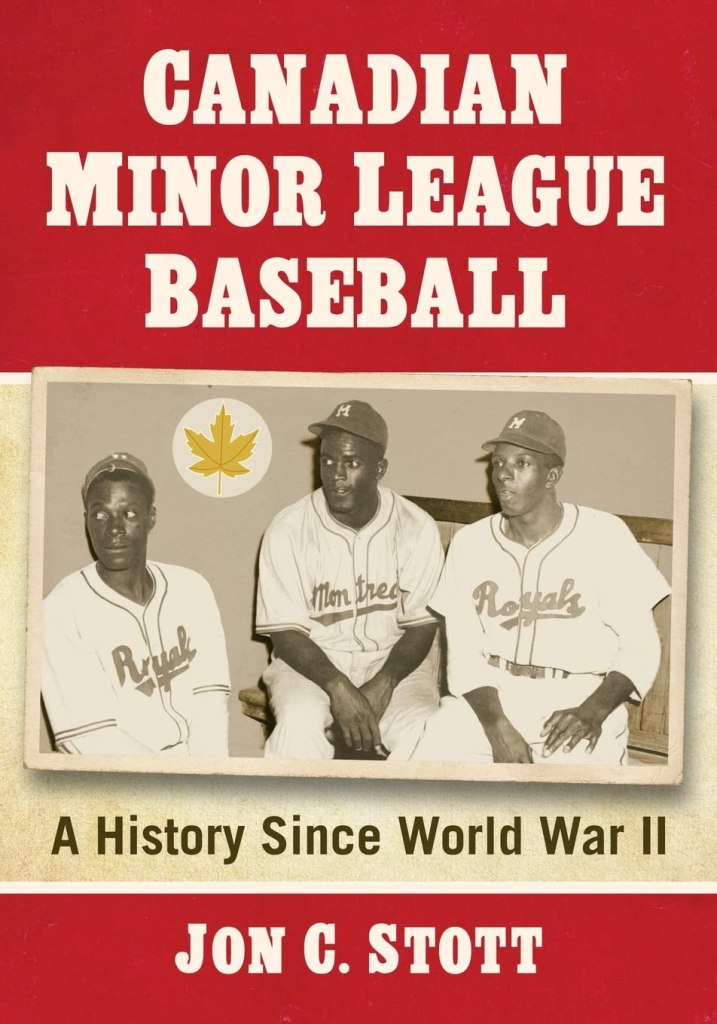
== In January, 2022, a book landed called “Canadian Minor League Baseball: A History Since World War II,” by Jon T. Stott (McFarland, 242 pages), which details how from 1946 through 2020, 71 teams in 21 minor leagues represented 35 Canadian cities. Sixteen of those teams were only around for one season, including eight in the Canadian Baseball League of 2003. The Winnipeg Goldeyes have been around in the independent Northern League and American Association since 1994.
== Another book called, “Our Game, Too,” in 2017 by Billy and Jennifer Simpson, gets into the Asian Pacific Americans who played in the MLB.
== Josh Suchon’s podcast “Life Around The Seams” includes a recent episode with Tom Drees, who, as a member of the Triple-A Vancouver affiliate in 1989, threw three no-hitters, including back-to-back starts. He also threw three no-hit innings in the Triple-A All Star Game. But the Chicago White Sox never called him up the majors? Why? On July 6 of that year, when their paychecks had not arrived, the Vancouver Canadians players staged a walkout and refused to play a game, citing it wasn’t the first time checks were late. The story became national news, the White Sox were livid, and the organization took it out on the players the rest of the season.
Before we allow for a deeper dive into what has become a deepening divide, let that weed germinate for awhile, and we’ll circle back to spray some Roundup on it soon enough.
In this noble pursuit of cultivating tiers of baseball books over the decades, our library has lovingly added two well-researched projects that continue to put some guide rails on this otherwise winding road of collecting for the purposes of maintaining reference, history and reading entertainment.
Landing two decades later in 2013, Ron Kaplan’s “501 Baseball Books Fans Must Read Before They Die” (University of Nebraska Press, 420 pages) takes a giant leap further in hard-bound history, as offered in the introduction: “I make no claim that the five hundred (or so) titles you will find herein are necessarily the best baseball books; that’s too subjective. But I hope they will provide an entry into the fascinating world of baseball literature, with its connections to other areas one might not normally associate with the game: Fiction, history, science, the arts, music and many more.” Kaplan then divides them into categories that include all that above, plus pop culture, analysis, statistics, international, and young readers.
When we talked to New Jersey-based Kaplan about this Ruthian project, as the launch to our 2013 book reviews, we wondered how titles such as W.P. Kinsella’s “Shoeless Joe,” Lawrence S. Ritter’s “The Glory of their Times” or even Roger Kahn’s “The Boys Of Summer” didn’t make his Top 501. Those omissions, Kaplan can now admit, were more as a result of him being too deep into the jungle of his own collection and easily assuming they were already included as he worked feverishly to produce it over the fall and winter. But that’ll happen, right?
All have merit, based on their intent, and what they were able accomplish.
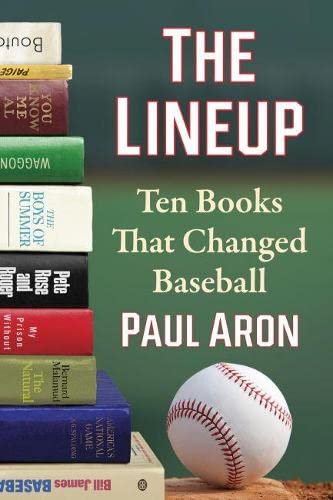
But when one narrows the focus as sharp as Paul Aron, a former executive book editor at Doubleday and Simon & Schuster who was part of the process to acquire baseball titles, there is gravitas in a list that seeks depth and gravity.
Sorry, we are now legally obligated to include this clip:
Aron decided to filter this through his experiences and readily sticks to his game plan – this are most mover-and-shaker pieces of work, pivotal and potent, not so much raised and praised for their popularity, writing excellence or continued circulation on “best of” listings sustainability. As he says in his modest preface:
“Here are ten books that changed America. That’s a pretty grandiose claim, I realize. After all, they’re just books. And no matter how many times one might cite the influence of ‘Uncle Tom’s Cabin’ or works by Darwin or Marx or Freud, a strong case can be made that there have never been enough serious readers in America for any book to have changed the course of our history. Moreover, these are baseball books … I make no claim that there are the best baseball books ever written. … This is a book about the influence rather than the quality of these books.”
Once the plow moves out of park and into drive, there is a joyous ride into discovering how these 10 (and many more) changed the game, the enjoyment of it, the criticism of it and why these still matter.
We can safely reveal, without a spoiler alert, how this Top 10 list covers, in chronological order and spanning about 100 years titles, a lot of brain storming (as well as provide our own snippets of our commentary or additional info we found):
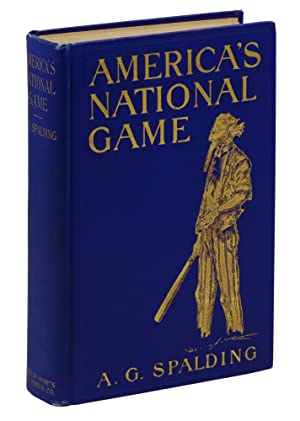
= “America’s National Game,” by Albert G. Spaulding (1911): Published a few years before his death in 1915, one of the game’s first professional players, manager, team owner, and sporting goods magnate writes his own gospel passage for posterity’s sake.
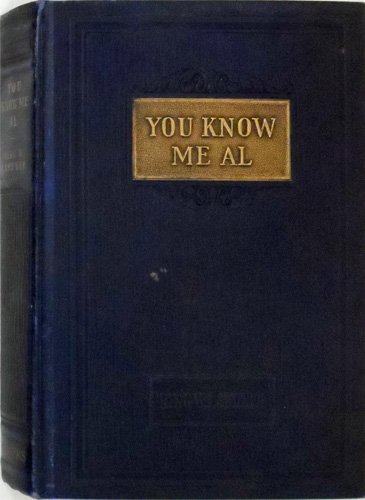
= “You Know Me Al: A Busher’s Letters,” by Ring Lardner (1916): The stories that started in The Saturday Evening Post as letter correspondence telling the story “would change the way Americans viewed their heroes,” writes Aron, and adds: “They would also change the course of American literature.” Because Lardner influenced the likes of Ernest Hemingway and F. Scott Fitzgerald, for starters.
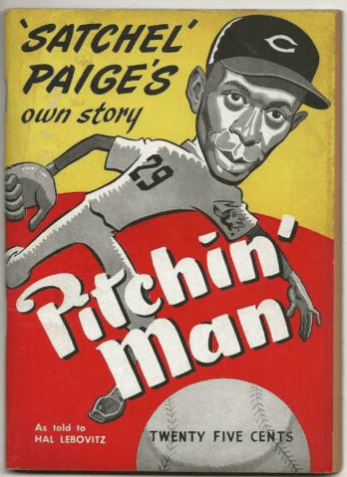
= “Pitchin’ Man: Satchel Paige’s Own Story,” by Satchel Paige (1948): As Aron noted in a Q&A with the Pandemic Baseball Book Club: Both Paige and Jackie Robinson wrote books published that year (Robinson did “My Own Story” as told to Wendell Smith, which was later optioned as a movie in 1950 where Robinson played himself). But on the subject of baseball’s integration, Paige had a longer Negro League career (16 seasons, from age 20 in 1927 to age 40 in ’47) and “his book captured more of the flavor of an era when Blacks celebrated a culture that would fundamentally change American society. … Paige … forced white sportswriters, fans and, ultimately, officials to recognize that Blacks belonged in the majors.”
= “The Natural,” by Bernard Malamud (1952): It was published 70 years ago this week — Aug. 21, 1952 – so naturally, in marking the occasion, we’d like to offer up an exquisite Rich Cohen essay in the Summer 2022 issue of the Jewish Review of Books about why it mattered then and still does now. Remember, the movie with Robert Redford is only based on the book. Here is also a list of tips one may consider when purchasing this as a collectable.
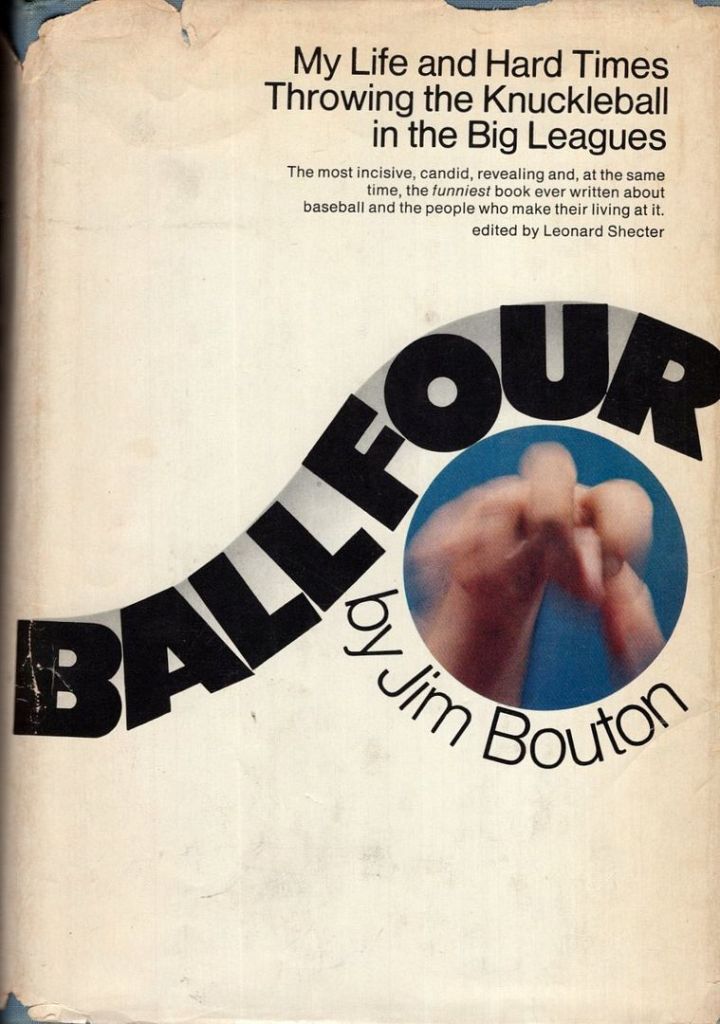
= “Ball Four: My Life and Hard Times Throwing the Knuckleball in the Big Leagues,” by Jim Bouton (1970): Anytime we get more critical analysis of this true classic, bring it in. Aron adds in his PBBC Q&A: “It was a counter-cultural strike against the baseball establishment. It was baseball’s Woodstock.” But Aron also admits: “The foreword warned the book should be rated X, and since it came out the year I turned 14, I readily sought out the sex scenes. Re-reading Ball Four, I was struck by the fact that the book isn’t titillating at all —and what sex there is makes one cringe in this post-Me Too era. To learn about sex, I would have been better off reading two other bestsellers from the same time period: David Reuben’s ‘Everything You Always Wanted to Know About Sex* (*But Were Afraid to Ask)’ or Terry Garrity’s ‘The Sensuous Woman‘.”
= “The Boys of Summer,” by Roger Kahn (1972): About why this made it, but not Roger Angell’s “The Summer Game,” again Aron tells PBCC: “I felt that The Boys of Summer was more influential because it so compellingly conjured up an era — Brooklyn in the’50s — that it very well may have drawn people back to Brooklyn after their families had fled to the suburbs.” Aron adds that there was no love lost between Kahn and Angell, and a story Alex Belth wrote for SBNation.com in 2012 confirmed it.
= “The Bill James Baseball Abstract,” by Bill James (1982): Aron has historical context: He was working at Doubleday in 1981 and “I was one of the editors interesting in publishing James,” who had been self-publishing since 1977 but caught the eye of Sports Illustrated for a story. Aron suggested the book be organized chronologically or thematically rather than going all over the place with its sidetrack thoughts. “What I didn’t grasp was that James’s digressions were not a structural flaw but part of his appeal,” Aron writes. “Sometimes James’s tangents were worth following just because they were funny.” Plus, James’ sabermetric-thinking has expanded to all other sports, as well as political analysts like Nate Silver. “It’s impossible to say to what kind of influence James had on this, but it’s worth nothing that at one point Morningstar, a global financial services firm, instructed its analysts to read James’s work and apply it when judging mutual funds,” Aron told PBCC.
You absolutely cannot be a good sabermetrician, a good stat analyst, if you believe too much in your stat conclusions. The whole point of sabermetrics is to find your way towards what you DON'T know. If you're certain that you already know it, then you're done. You're useless.
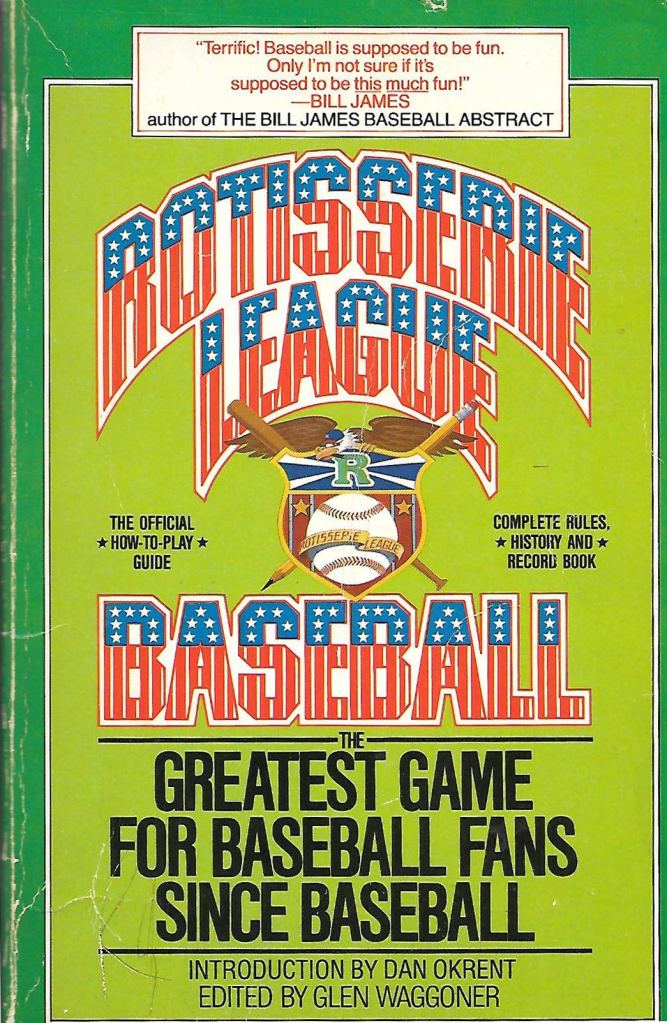
= “Rotisserie League Baseball,” by Glen Waggoner (1984): This Bill James-endorsed tome not only “fueled the growth of fantasy sports,” Aron tells PBCC, but “also of USA Today and even the Internet.” Seriously. On the SABR.com website: “In 1980 Dan Okrent and several of his friends invented a baseball league that allowed ‘owners’ to draft players and be scored based on how the players performed in the real world. Okrent wrote a 1981 Inside Sports article about it, and the game started to catch on. This 1984 book, edited by Waggoner, provided rules, a constitution, and several essays. From there, the entire industry of fantasy sports sprung up, creating a nation of fans who believed they could be a big-league general manager.” Are we better for it? Ask those who have NFL fantasy teams now and make a living at it.
= “Pete Rose: My Story,” by Pete Rose and Roger Kahn (1989) and “My Prison Without Bars,” by Pete Rose with Rick Hill (2004): A two-for-one entry. No lie. At first blush, these are two of the oddest choices to add to a list of this kind of impactful list. But Aron sells us:
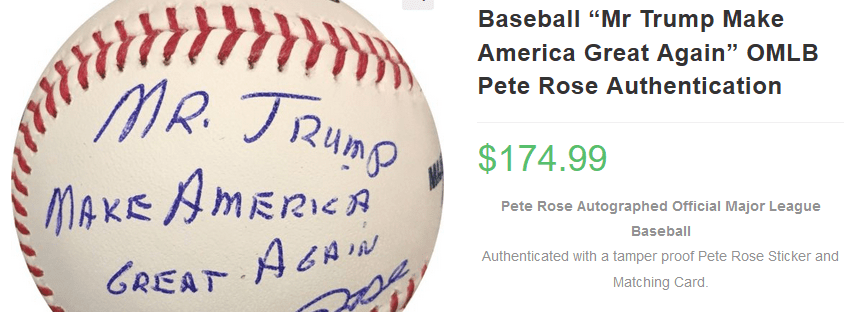
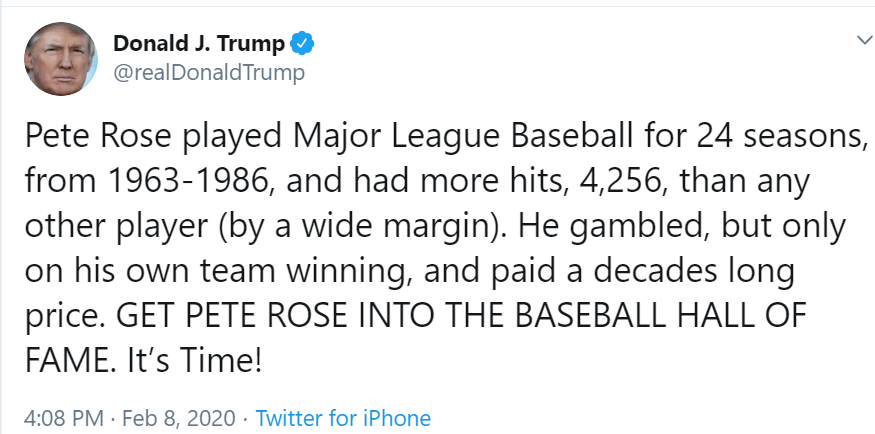
“Here’s one theory to consider: What led to Donald Trump was Pete Rose. … Both are liars … Both appealed to blue-collar workers, especially whites, who overlooked the lies because they saw Rose and Trump fighting against systems rigged against them. … Rose’s supporters may have become so fed up with the baseball establishment that they were more likely to support Trump’s attacks on the political establishment … (And the irony is) both are most certainly not avid readers and both would be quick to dismiss anything that smacked of intellectualism.”
We are tempted, but won’t indulge more into Aron’s exquisite presentation, or even try to condense it, because it would take away the reader’s mind-blowing enjoyment. There are plenty of other dots to connect here, and here, and here, and here.
And here we go into Rose’s latest newsworthiness:
After Pete Rose made his first appearance on the Phillies' field since his MLB ban, he was asked by a female reporter about allegations of having a relationship with a minor in the 1970s. His response? “It was 55 years ago, babe.”https://t.co/zbl7aO2L10
“I'm going to tell you one more time: I'm here for the Philly fans, I'm here for my teammates, OK. I'm here for the Philly organization and who cares what happened 50 years ago.” — Pete Rose | Video by @APgelstonpic.twitter.com/7MxrNrwhCo
Monumentally meaningful, necessary and relevant. A Top 10 list for the ages.
A compendium like this will never lose its charm, even 100 years from now when someone else exorcises this exercise and must admit – this original 10 has to be the foundation. So what have you got lately?
It is easy to be impressed as well with the chapter notes and bibliographic essay that gives this all so much of a foundation. The other treat is plowing more through Chapter 10, set aside for “Other Influential Books” – about 50 more that still carried a lot of weight and make for another great 60 extra pages to ponder.
Such as: = “The Chrysanthemum and the Bat: Baseball Samurai Style,” by Robert Whiting, 1977 = “A Day in the Bleachers” by Arnold Hano, 1955 = “Ball, Bat and Bishop: The Origin of Ball Games” by Robert Henderson, 1947 = “The National Game” by A.H. Spink, 1910 = “Sol White’s Official Base Ball Guide,” by Sol White, 1907 = “Beadle’s Dime Base-Ball Player” by Henry Chadwick, 1860
We have more reading to do apparently…. Gotta run.



















 Tom Hoffarth's The Drill: More Farther Off the Wall