Day 33 of 2022 baseball books: Is it off base for baseball to demonstrate (or demonize) the ways of democracy?

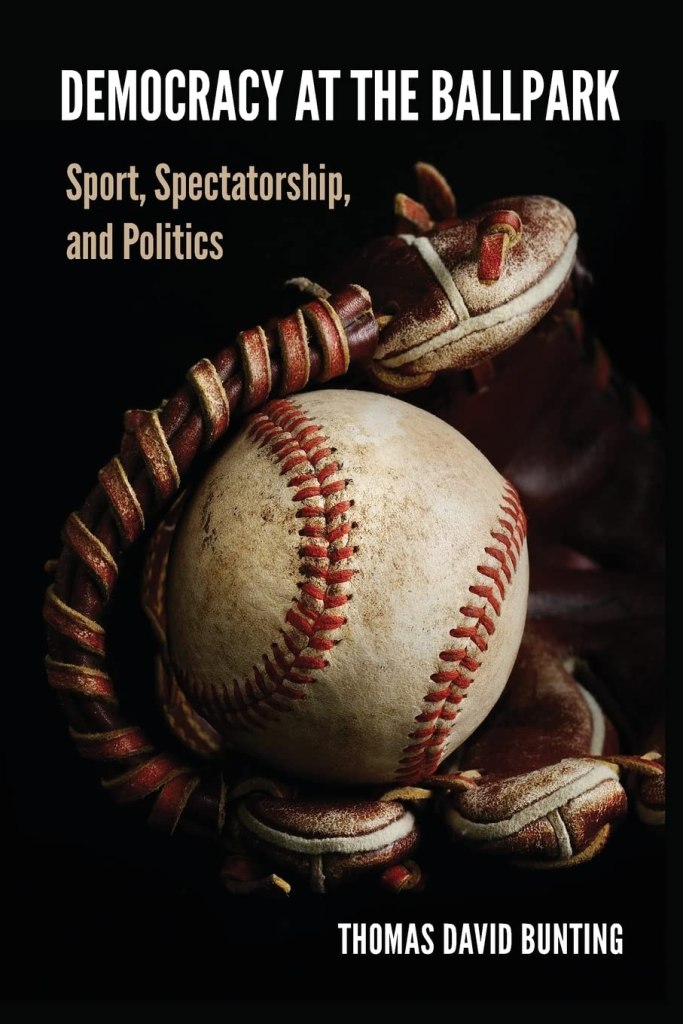
“Democracy At The Ballpark:
Sport, Spectatorship, and Politics”
The author:
Thomas David Bunting

The publishing info:
State Univ. of N.Y. Press
212 pages
$32.95
Released July 2, 2022

The links:
The publishers website
At Bookshop.org
At Indiebound.org
At Powells.com
At Vromans.com
At TheLastBookStoreLA
At Skylight Books
At Diesel Books
At PagesABookstore.com
At Amazon.com
At BarnesAndNoble.com

The review in 90 feet or less

Draw up one of those Venn Diagrams to illustrate a wonderful overlap of “Baseball” and “Democracy,” and we suspect there would still be an incongruent segment that would take the opportunity to explain how that piece of common real estate was more of an interlope and then use it as a platform to talk in circles around it.

The political climate is such that you can’t even have the Congressional Baseball Game somewhere in D.C. — an event since 1909 — and still have it become a social media lightning rod for personal opinion that isn’t necessary.

A game that has on occasion usurped the duties of elected officials actually trying to get work done — The House was once supposed to debate an appropriations bill on Civil War cotton damage, but a quorum was not present because too many were at this heated contest — came back last September and led to California House Democrat Ro Khanna responding to the Republicans winning a 13-12 decision at Nationals Park in D.C. (for an event that is used as a bi-partisan way to raise funds for various non-profit programs):

This is why Twitter might want to have a 20-second delay between someone typing a post and having it actually post. A necessary evil in today’s world?

We’ve experienced enough in our language of action in how baseball and democracy (a word often used interchangeable with “politics”) have a way of intermingling, as a senator “goes to bat” for his constituents, or an idea for a bill is “off base” or came “out of left field.”

One could also find a way to today to incorporate an exaggerated defensive shift or a call for a review to make sure all is fair.

Perhaps our first thought of baseball and democracy as common ground – and maybe for many who hadn’t connected these dots before – came with the oft-quoted speech Crash Davis gives to Nuke LaLoosh during a mound visit in the 1988 film “Bull Durham” (and we referenced just recently in our review of “Church Of Baseball” by Ron Shelton). The veteran catcher tells the empty-headed pitcher: “Relax, all right? Don’t try to strike everybody out. Strike outs are boring. Besides, they’re fascist. Throw some groundballs – it’s more democratic.”

Get everyone involved and let their talents come forth, win (or lose) as a team.

A few other baseball/democratic attempts have also emerged over the years but those who have the nerve and resources to trust its intent.

In 2013, the esteemed Mike Veeck, owner of the independent minor league St. Paul Saints, used an exhibition game to see if it could work with no umpire present. It had been suggested by a grad student at the Citadel. The catchers called balls and strikes. A first-base jury box of fans decided safe and out calls, among other things (until they appeared to get bored and left the box in the sixth inning, leaving a guy in a judge’s robe to finish it off standing behind the pitcher’s mound). Otherwise, no one complained. The Saints won, 4-3.

The main takeaway: The speed of the game flows better when no one is holding it up by arguing. That implies maturity is necessary.

It was a reminder that Veeck’s Hall of Fame father, Bill Veeck, went to another form of Ancient Greek democracy when, as owner of the American League’s St. Louis Browns, he held a “Grandstand Managers Day” in 1951. More than 1,000 fans had placards with “yes” and “no” when a team rep asked of them “Steal?” or “Infield Back?” They also made out the lineup card by voting on it.

Thumbs up: The Browns won the game. Thumbs down: The team finished 52-102 and moved to Baltimore three years later.

Years later, Chicago Cubs owner Philip Wrigley lost his mind and tried a “College of Coaches” committee — eight coaches deciding on things rather one sole manager. More like a psychedelic collage than a collegiate endeavor that actually went from 1961 and ’62. The coaches had internal battles with each other. Leadership was needed rather than rotating personalities. Bringing more people in to make decisions, to share in a discussion, seems democratic, but even as slow as baseball becomes, it is problematic.

But it all circles back – Venn and all – to political commentator George Will, who said in the “Third Inning: 1910-1920” installment of Ken Burns’ rigorous “Baseball” documentary:

Baseball suits the character of this democratic nation. Democracy is government by persuasion. That means it requires patience. That means it involves a lot of compromise. Democracy is the slow politics of the half loaf. Baseball is the game of the long season, where small incremental differences decide who wins and who loses particular games, series and seasons. In baseball you know going to the ballpark the chances are you may win, but you still may lose. There’s no certainty, no given. You know when the season starts the best team is going to be beaten a third of the time. Worst team is going to win a third of the time. The argument, over 162 games — that middle third. So it’s a game you can’t like if winning means everything. And democracy’s that way too.”

If that wasn’t enough for some to start pushing Will as a way to become the commissioner of the game and protect its best interests, Burns himself said in an interview promoting the documentary series in 1994 – whether or not he acquired the opinion through osmosis: “Baseball is an exhilarating democratic sport that manages to exclude as many as it includes. It’s a profoundly conservative game that often manages to be years ahead of its time.”


At MakeOurDemocracyGreatAgain.com. Does not indicate the country in which it was made or assembled.
At the Fox News shop. Does not indicate the country in which it was made or assembled.

Then we land on the world today. Just see the advertisements above.

Where democracy and baseball seem in some kind of peril, maybe unsure of where their compass points, not trusting whose making decisions that seem counterintuitive to the best interest of their constituents/fans.

That seems like a ripe starting point for this renewed discussion, in a very academic yet accessible way, by Thomas David Bunting, an associate professor of political science at Shawnee State University in Southern Ohio better known for its programs in nursing, business administration, sociology, early education, biology, fitness administration and psychology. (Hey, we’re just going by the school recruiting manual here). Bunting, with a Ph.D. and Masters in Political Science from the University of Wisconsin-Madison and a B.A. in Political Theory and Constitutional Democracy from Michigan State University, could be perceived to be a bit off the academic branding radar to some whose baseball-politics range of view starts and ends with George Will. But Bunting’s essays and analysis has appeared in places such as the Washington Post, when he looked at the ramifications of Major League Baseball moving its 2021 All Star Game from Atlanta to Denver in the wake of George’s new voting law that suppresses Black access, and saw Senate Majority Leader Mitch McConnell warn MLB to “stay out of politics” as it always seems to want to play that Anti-Trust Exemption status card against the sport when it does things like become socially activated.

Another example of Bunting’s work can be found in The Constituionalist from last January, where this idea that baseball fandom and spectator democracy are ripe for dialogue.

He also has a 2018 academic work, “Breaking Barriers and Coded Language: Watching Politics of Race at the Ballpark,” that is folded into these expanded chapters of a book — which is must be noted was released in November 2021 at the price still north of $100 but has reversed the trend of inflation and came out this month in a far-more accessible one-third of that sticker shock. (One can even Nook it for $25).

Now, Bunting can ignore the bunt sign and swing away with his historical context and current angst and reach conclusions such as:

When people watch politics at the ballpark, or when the ballpark shapes politics, it does so before a political heterogeneous group of people. Politics, as a force, seems to drive people apart, unfolds within this sphere where something else brings people together. Democracy at the ballpark remains instructive as democracy outside of the ballpark becomes increasingly under threat. … Sport and baseball fill this need for meaning and show much about how people view themselves and their country. I take this everyday perspective seriously because democracy ultimately revolves around regular people and not the great men of history – democracy is about the spectators more than the spectacle. Baseball provides inside into this relationship.”

At the conclusions of his “Conclusion” chapter, he then invokes the name of Hall of Fame broadcaster Ernie Harwell, both in the deep South but beloved by many across all demographics, and a quote he is famous enough for that it still exists in memes:

Is that clear enough?

Our author Q&A

Bunting was generous with his time to offer up these answers to our questions:

Q: Amazon has your book in the rankings under “democracy,” “sports history” and “baseball,” and baseball is kinda last in that list. Would you categorize this as a political science book that touches on the importance of baseball’s history, or – considering the cover photo — a baseball book about its ties to democratic process. Or what other category does it fall under — lying and cheating?

A: It is a political theory book that seeks to start a different conversation in the  the field of democratic theory. What has struck me about democratic theory is how elitist it is—it is dominated by professors at Ivy League schools saying what democracy should be. Very little of these debates resemble anything about how folks around me growing up experienced politics. My argument is basically that baseball shapes how people view politics more than normative, elitist understandings of deliberative democracy. This is the frame of the book, even though most of the book focuses on baseball, what it is pointing towards is a more democratic understanding of how people encounter politics in their everyday lives. I use baseball as a case study and look at politics of spectatorship, community, equality, virtue, and technology. 

Q: You mention at the start the process of trying to start this book some eight years ago, then realizing the importance of it in 2020. How did this book find its way to the front burner? Was it a required reading piece of your class at Shawnee? 

A: I began the book and had it as my primary project in graduate school. My first two years of working at SSU were quite busy so the revisions took longer than expected, but the project was under contract shortly before the pandemic. I have not made this required reading nor do I plan on subjecting students to my writing. I prefer that people decide to read my work of their own free will. 

Q: What do you hope readers come away with after they’ve digested what you’ve given them here? Does it take awhile to process and reflect to capture the full effect? 

A: I am in the early phases of interacting with people who have read the book and I have been struck by how different the takeaways of different readers have been so far. I do not know if this is a good or bad thing, but I hope that speaks to the nature of the project—it is an attempt to describe the worlds of politics and baseball as they are and others can form their conclusions. The big takeaway for me on this project was how important and meaningful even small and sometimes silly things like sport can be for our lives and politics. 
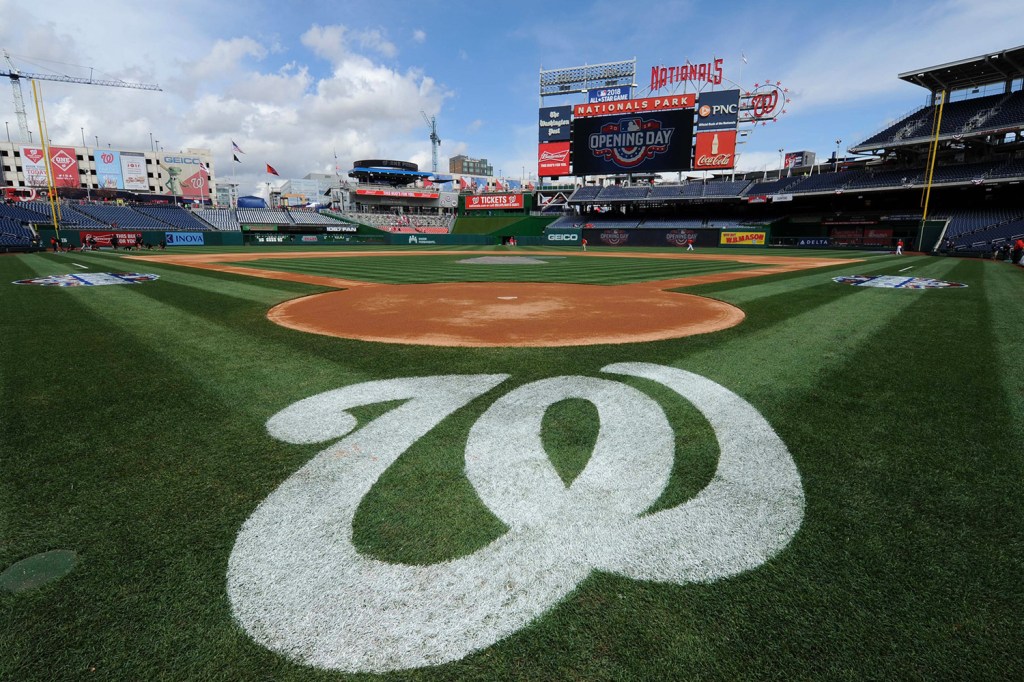
Q: There is a Major League Baseball team in Washington, called the Nationals (formerly the Expos of Montreal). In the past, we’ve had two Washington Senators, one that moved to Minnesota and another that moved to Texas – both still in place. If you were to give that team in D.C. a nickname that was more appropriate to what it represents in the heart of our democratic process, what could you come up? The Washington Whigs, for example, has nice alliteration. …

And on that topic: Is there any evidence you know of that the Presidential Mascot Race conducted every home game between Tom, George, Abe and Teddy – and they also have Taft and Coolidge — doesn’t have a per-ordained winner each night, which would undermine the fairness of it all? 

A: I cannot speak to the mascot race, but I think Washington Senators is the most appropriate option given the Senate’s prominence as an obstructive body that shoots down legislation. 
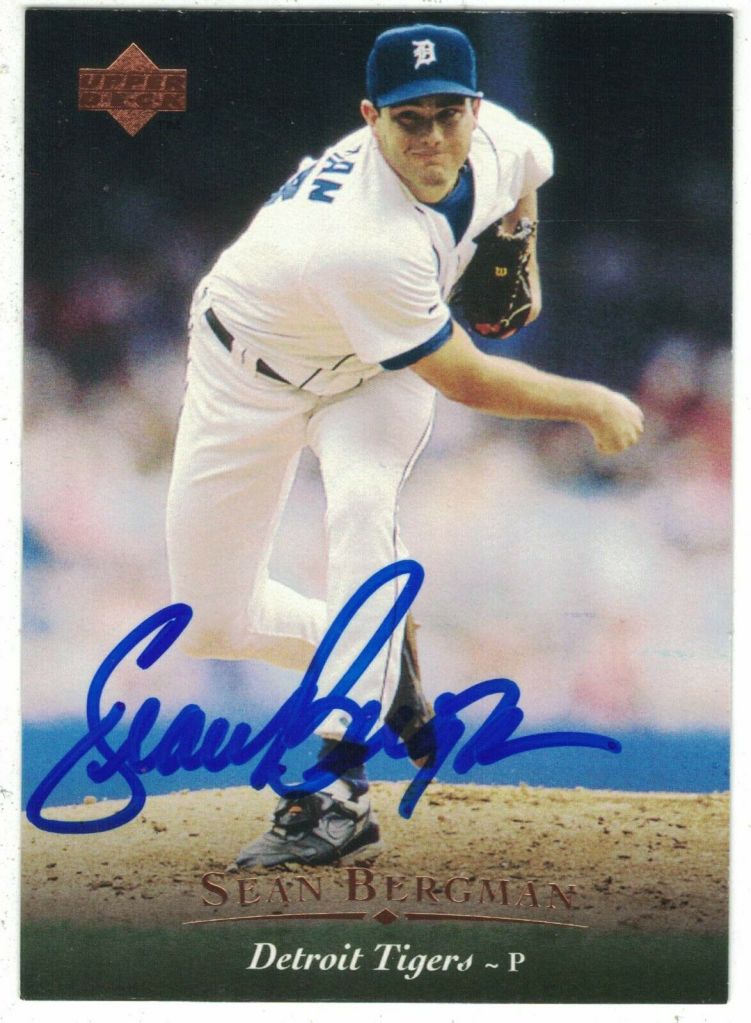
Q: As a Detroit Tigers homegrown fan – just assuming that by photos of you with an old English “D” on it – what are your memories of going to the ballpark and seeing a game unfold (and, as someone here in L.A. may ask, why did the Tigers allow Kirk Gibson to come here and win a World Series in a Hollywood-type way?)

A: My earliest memories were going to Tiger Stadium and feeling in awe of the entire experience. I am from a town of 8,000 people and Detroit seemed massive. I remember loving Cecil Fielder (his son, Prince, was later my wife’s favorite player), and getting an autograph from Sean Bergman, who was a journeyman pitcher. The Tigers in my youth were pretty terrible, so there are not a ton of memories of glory. I also remembered meeting Ernie Harwell at an event in Mt. Pleasant when I was a kid and that had a big impact on me. Re: Gibson — I supposed the Tigers let good players leave as an act of mercy. 

A book by George Will about the 1998 season that has a title with nothing to do with the author’s nickname.

Q: Would George Will have made a fair and balanced MLB Commissioner had he wanted to pursue it? 

A: I am not sure, but he would have to be better than Rob Manfred.

Q: What person in public office, at any level, did you sense had the greatest connection to baseball and what it stood for?

A: I think FDR’s Green Light letter is the best example of someone in public office understanding the importance of games for democratic life. 

Q: Do you foresee a day in our lifetime when a woman president throws out the first pitch of an MLB game?  

A: I am terrible at predicting things, so I will spare everyone the wrong answer to this question. 

How it goes in the scorebook

Circling the bases, with a respectable handshake from the third-base coach heading for home and a safe landing.

While the subject matter can get a little heady, Bunting’s heart is in the right place. Perhaps the most telling part of a book like this is when you scan the index and, as the alphabet separates the names and ideas, you’ll see “Aaron, Henry” with “Achilles;” “Plato” in the same neighborhood as “Piazza, Mike,” or “Nietzchke” and the “Negro Leagues” getting along just as well as French philosopher “Ranciere, Jacques” and “Robinson, Jackie.”

It also shines a light on how president leadership and baseball have always been an interesting litmus test as to what’s best for the country in a time of tension.

Was it prudent for President Trump to attend the Astros-Braves Game 4 of the 2019 World Series in Atlanta, and joyfully participate in the politically insane Tomahawk Chop? Bunting writes in response in his book: “America’s populist leader … (was) booed roundly (by the crowd) and threw his own anti-democratic language back at him, chanting, ‘Lock him up!’ … Baseball is not by essence a platform that omits dissent and gives way to spectacle and populist forces. It is a site of pluralism, vibrant community and resistance. It should not be surprising that a populist, anti-democratic leader would not fare well when exposed to democracy at the ballpark.”

In contrast, Bunting uses the first pages of Chapter 1 to remind how President Bush united the country after the 9/11 attacks by throwing the first pitch out at the Game 3 of the World Series – almost exactly eight years earlier than Trump’s World Series non-field appearance – and “used the game to show that the American way of life was still alive by using the sport as a rhetorical appeal to American leisure and resilience.” Not sure if Bunting thought it was an exploitative move, but it had its merits.

Both were voted in as Republicans. From the other side, Bunting notes how President Obama, during a visit to Cuba and taking in a baseball game (noted on page 68), said that the the sport “can change attitude sometimes in ways that a politician never can change, that a speech can’t change,” and used Jackie Robinson’s courage and integration as a visible example for citizens feeling oppressed to improve their lives. Frank D. Roosevelt also persuaded professional baseball to continue on during World War II as a way to keep Americans feeling somewhat “normal” at such a difficult period, because the game was comforting and lent stability.

“Baseball both reflects that status quo of many political issues and can be a site to challenge politics as they currently exists,” Bunting sums it up on page 149.

“Baseball can only be such a venue, it can only be a powerful metaphor, because it is a place filled with meaning … people invest in the meaning in the game because … they learned about life through the game, they remember people, places and things by touchstones in the game’s history, the formed relationships through the game.

The game taught them to look at the world differently. I encourage people to read narratives such as Potok’s ‘The Chosen’ or DeLillo’s ‘Underworld,’ because when people tell stories about baseball, they are telling stores about much more than baseball.”

That, and a go-back to a couple George Will books, becomes out latest poli-sci/American Lit 101 homework assignment.

You can look it up: More to ponder

== As baseball and democracy give noted scholars a chance to examine their DNA and wonder why that’s all so true, more recent examples can be found in Patrick Dubuque’s piece for Baseball Prospectus in the months before the 2016 President election, wondering how baseball had lost its way just as politics has been doing. Last August, the Baltimore Sun ran this op-ed piece by Jane Lo and Scott Warren (both involved in Generation Citizen, working to transform civics education) which was headlined:  “Democracy And Baseball Are in Trouble for Similar Reasons … Are Their Fixes The Same as Well?” Perhaps the fix is in.

== Also coming up later this year from SUNY Press: “New York’s Great Lost Ballparks” by Bob Carlin ($29.95, 322 pages, expected to ship Oct. 1, 2022)

== In a revelatory soliloquy that is included in the stage play, “Take Me Out,” winner of the 2003 Tony Award for Best Play, an New York Empires’ Darren Lemming announces he’s gay. So how does everyone react in all this messiness? His business manager, Mason Marzac, also opening gay, with no concept about baseball but watches out of due diligence, has this soliloquy in the middle of the first act (written by Richard Greenberg), and given to us from Fangraphs.com, where he discusses now not only why he thinks “baseball is a perfect metaphor for hope in a democratic society” but also “baseball is better than democracy – because unlike democracy, baseball acknowledges loss.”

It goes like this:

It has to do with the rules of play. It has to do with the mode of enforcement of these rules. It has to do with certain nuances and grace notes of the game.

First, it’s the remarkable symmetry of everything.

All those threes and multiples of three – calling attention to – virtually making a fetish of the game’s noble equality. Equality, that is, of opportunity.

Everyone is given exactly the same chance. And the opportunity to exercise that chance at his own pace.

There’s none of the scurry, none of that relentlessness that marks other games – basketball, football or hockey. I’ve never watched basketball, football or hockey, but I’m sure I wouldn’t like them. Or maybe I would but it wouldn’t be the same.

What I mean is, in baseball there’s no clock.

What could be more generous than to give everyone all these opportunities and the time to seize them in, as well? And with each turn at the plate, there’s the possibility of turning the situation to your favor. Down to the very last try.

And then, to insure that everything remains fair, justices are ranged around the park to witness and assess the play. And if the justice errs, an appeal can be made.

It’s invariably turned down, but that’s part of what makes the metaphor so right.

Because even in the most well-meant systems, error is inevitable. Even within the fairest of paradigms, unfairness will creep in.

And baseball is better than democracy – or at least democracy as it’s practiced in this country – because unlike democracy, baseball acknowledges loss.

While conservatives tell you, ‘‘leave things alone and no one will lose,’’ and liberals tell you, ‘‘interfere a lot and no one will lose,’’ baseball says, ‘‘Someone will lose.’’ Not only says it – insists upon it!

So that baseball achieves the tragic vision that democracy evades. Evades and embodies. Democracy is lovely, but baseball’s more mature.

Day 32 of 2022 baseball books: The Year of the Kaat

“Good as Gold: My Eight Decades in Baseball”

The author:
Jim Kaat
With Douglas Lyons

The publishing info:
Triumph Books
304 pages
$28
Released April 19, 2022

The links:
The publishers website
The Baseball Hall of Fame website
At Bookshop.org
At Indiebound.org
At Powells.com
At Vromans.com
At TheLastBookStoreLA
At PagesABookstore.com
At Amazon.com
At BarnesAndNoble.com

The review in 90 feet or less

Six decades into his life — four as an MLB player and coach, two as a broadcaster — Jim Kaat paused after the 2002 baseball season to write what he may have thought was the first and only autobiography he’d need or want to have published — “Still Pitching: Musing From the Mound and the Microphone,” for Triumph Books, released in April, ’03 (with Phil Pepe).

In the acknowledgements, Kaat was wise to include the contents of a note his son had recently sent him. In it, Jim Jr. acknowledged his dad’s final year of Hall of Fame eligibility had come and quietly passed the previous winter — with still no Cooperstown induction. At least he got 26.2 percent of the Baseball Writers Association of America’s vote in his last year (11th place, between Steve Garvey and Tommy John, and ahead of future Hall of Fame inductees Jack Morris and Alan Trammel). That total was a jump from the 19.5 he got in his first year of eligibility in 1989.

Wrote Jim Jr.:

“I just want to take a moment to congratulate you on your 130 writer votes. I know it does not matter to you and you never expressed a real concern, but if it means anything to you, you will always be a Hall of Famer in my book.

And one other thing, Dad, I want you to remember that scene from ‘The Natural.’ Roy Hobbs, played by Robert Redford, asks Max Mercy, a New York sportswriter played by Robert Duvall, ‘Did you ever play the game, Max?’ His answer: ‘No, I never did. But I am here to protect the game.’ And Roy says, ‘Whose game, Max?’ And after an awkward pause, Max says: ‘Either way, Roy, hero or goat, you are going to make me a great story.’ And I say this to you because in the future when your peers on the Veterans Committee vote you into the Hall of Fame, that will be the true measure of your success. Because in the end, writers write — that is all they do well — and players play and there is no higher accomplishment than the respect from your peers. I love you, Dad.”

Well, guess what happened about 20 years later …

Kaat, along with Minnie Minoso, Gil Hodges and Tony Oliva, gathered enough votes by the Golden Days Era Committee (looking at players from the 1950-1969 era) and squeezed into the Baseball Hall of Fame’s Class of 2022 for ceremonies conducted this afternoon.

Kaat needed 12 of the 16 voters’ approval to get to 75 percent — and got exactly that (as did Hodges and Olivia)

His second autobio was actually ready to roll before that. Back in November, 2021, when some of the baseball-related books scheduled to come out this spring were posted on websites, note the tentative cover. So with that, Team Kaat could update the cover plate, and do so in plenty of time to coincide with his formal Hall pass in Cooperstown, N.Y.

So what changed? Peer pressure and perspective? Stats and stories? His consistent presence in the game as a broadcaster? Probably all that and more.

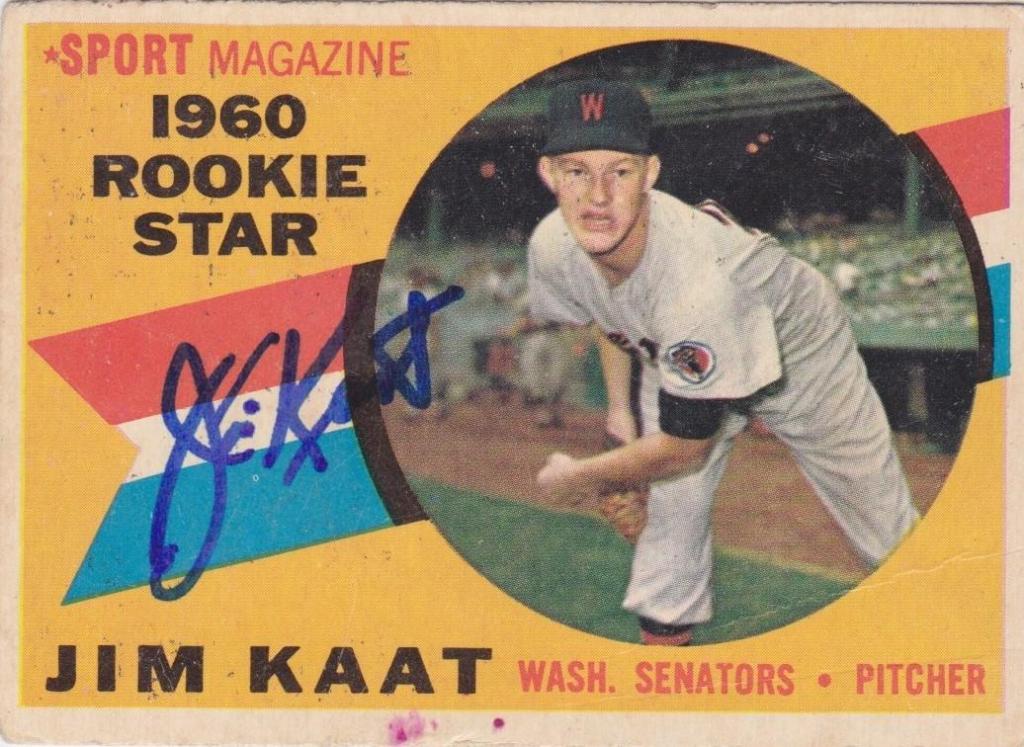
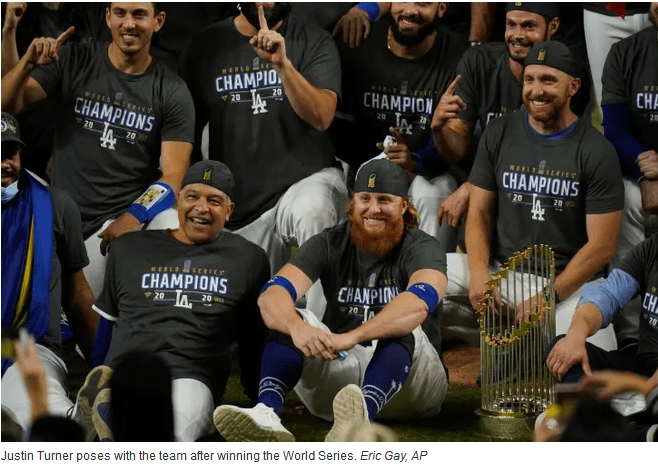
Kaat’s baseball card number obviously hadn’t changed — 25 MLB seasons, starting in 1959 when he was 20 and played for the original Washington Senators franchise. Trips through the Chicago White Sox, Philadelphia and the New York Yankees, then winding down in fan-friendly St. Louis for ages 42, 43 and 44 (and finally on a World Series title team) when it all wrapped up in 1983.

(And now that we’ve become interested in such things about a player’s “last time out,” we see Kaat came in the eight inning, gave up a single to Dave Parker and then finished off Joaquin Andujar’s 13-6 win at Pittsburgh on July 1 with a 1-2-3.)

In 2021, Kaat still had 283 wins in 898 games, 180 complete games, 31 shutouts, and 4,500-plus innings to record 2,461 strike outs. A career WAR of 50.5 — which didn’t exist as as a measuring stick back then — was nothing to snort at.

A Game 7 matchup against Sandy Koufax in the ’65 World Series gave him a sizeable spotlight at the height of his career. Kaat defeated Koufax in Game 2 at Minnesota, 5-1, where Kaat drove in two runs with an eight-inning single. Koufax’s four-hit shutout defeated Kaat in Game 5 at Dodger Stadium, 7-0.

(Original Caption) Closeups of Jim Kaat of the Minnesota Twins pitching in the fifth game of the World Series. The Twins ultimately lost the game 7-0.

Kaat could have had another Series appearance: On the last Saturday of the ’67 season, he went to the mound against the Red Sox at Fenway Park. The Twins were one win from wrapping up the AL pennant. Minnesota was up 1-0 in the third when Kaat came out with an elbow injury. The Red Sox won, then took the pennant on Sunday.

Three All-Star selections, three 20-win seasons, including leading the AL with 25 in 1966, where he had 41 starts, 19 complete games and 304 2/3 innings.

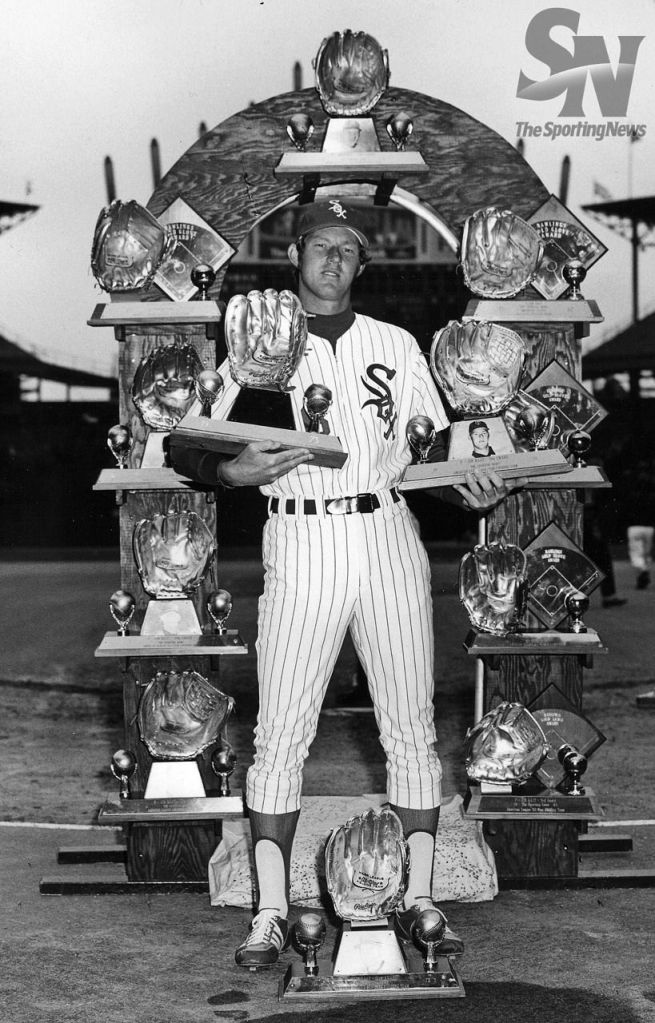
But here’s the catch: What seemed to separate him – and put him into a Greg Maddux-type conversation for comparison’s sake – was 16 Gold Glove awards. His abbreviated whip-it-up-there windup put him in perfect position to be an extra defender.

Even in 1969, when he had eight errors and a career-low .826 fielding percentage, he still won a Gold Glove, following the previous six seasons and continuing what would be seven more in a row.

As Baseball-Reference.com points out, there are a few ways of sizing up his stats that don’t measure up to an “average HOFer.”

The “average” Hall of Fame pitcher – which seems to be an oxymoron — has a 73.0 career WAR. But something called the “Hall of Fame Monitor” very much (lately) played in his favor – his was 130, with a “likely HOFer” was pulling about 100.

This ball signed by Jim Kaat acknowledging “Mickey Mantle hit 7 HRs off of me — all solo HRs” is on eBay.com for about $250.

That stat is a creation of Bill James and attempts to assess how likely an active player might be to making the Hall. A 130 is called a “virtual clinch.” It’s based on a point system James assigned to various statistical plateaus and honors reached during individual seasons as well as career totals. Kaat racks up most of his calculated numbers with career games (30 points), career wins (25 points, at being above 275), 15-or-more win seasons (36 total points) and one each for the Gold Gloves. Even though he was fifth in the AL MVP voting in 1966 and the only pitcher in the top five with his 25-13 record and 2.75 ERA with 304 2/3 innings, there was only one Cy Young Award given out at that time. That season, it went unanimously to Sandy Koufax (27-9, 1.73 ERA, 317 strikeouts). The next year, 1967, they finally gave one in each league.

An AL Cy in ’66 would have given Kaat five more total points.

It is undoubtedly a career accumulation that gets it done in a Don Sutton-esque fashion, and a body of voters who understand that.

But don’t overlook the decades in between when Kaat has been one of the most concise, sensible and knowledge TV broadcasters in the game, helping keep his voice in play as well as his “brand,” to a point where the game could give him added validaity had it only went the extra yard to induct him into the Hall as a player.

At age 83, with more than 50 years associated with the game, it has finally happened, and James Lee Kaat is here to experience it.

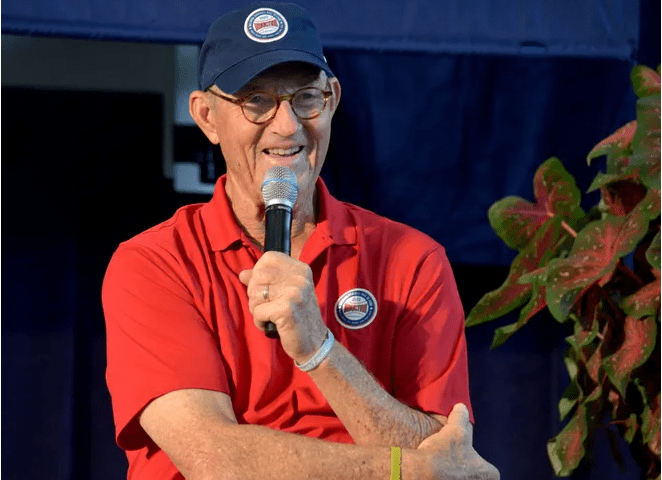
Jim Kaat speaks to the media in Cooperstown on Saturday, July 23 prior to his Sunday Hall of Fame induction.

And how does any of that figure in the context of this new book? It keeps Kaat’s consistent, congruent and clear-and-present-danger commentary relevant as today’s game continues to try to figure out what it’s trying to accomplish.

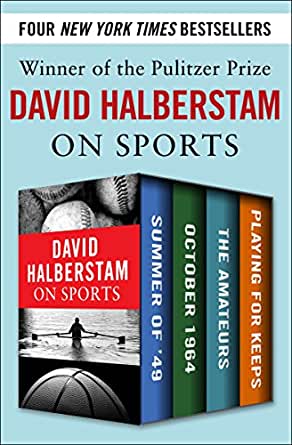
Amazon offers a $35 Kindle edition of four of David Halberstam’s most important sports-related titles. In our book, “Breaks of the Game” on the 1977 Portland TrailBlazers belongs in this company.

In that 2003 autobiography, esteemed journalist David Halberstam wrote an introduction and included a story about how he had been listening to a Yankees broadcast and couldn’t help but be captured by what he heard:

“At a certain point it struck me: Even though I am a lifelong baseball fan, there is still much for me to learn about the game. … It was great fun and listening to Jim Kaat gradually pulled me away from my work. After a few weeks, I wrote in an ESPN column that, in what was a damaged year in baseball, one in which the treat of a strike hung over most of the season, Kaat was my hero because he seemed to reflect what the game is all about. Gradually it struck me that I was listening to one of the best broadcasters I’d ever heard.”

In that July 2002 column Halberstam references, he also wrote: “One of my great pleasures has been a surprising one — the simple delight I take in listening to Jim Kaat, as he broadcasts the Yankee games. Quietly with no blather and bombast, he gives what is one of the most enjoyable and thoughtful ongoing seminars on pitching I’ve ever heard. Jim Kaat, you’re right up there for my MVP.”

Kaat already had the credibility as an observer of the game decades ago. But the game has changed much over the last 20 years, and consider this an important and viable refresh with much more circumstances to examine and help give us more to consider, whether on social media or, at last, in book form.

With Bob Costas often as his wingman on national MLB Network or TBS broadcasts — Kaat “retired” after the 2006 season from the Yankees’ YES Network but was likely forced out — Kaat’s conversations are in the same ballpark as what we enjoyed hearing a contemporary, Al Downing, when he was with the Dodgers as part of their broadcasting team many years ago. Speaking from experience on how the game was once played and how it presents itself today, one could argue it’s neither better nor worse, but just different.

In an easy-to-get-through chapters and presentations, Kaat will get his points across in a polite discourse — mostly in Chapter 6 — where he’ll comment on things such as:

Released in 2009.

== The game’s best time period: “I would have loved to have played in the era right after the players came back from World War II. There were just 16 teams. You played each team 22 times and traveled by train. I love train travel. That was baseball’s golden era for me: 1946-1957. When the Dodgers moved to Los Angeles and the Giants moved to San Francisco in 1958, Western civilization began to go downhill. Not really. THat’s just the voice of an old dinosaur who loved the hit-and-run, lead-off triples, squeeze plays and pitchers who could field their positions like Bobby Shantz.”

== Today’s players: “I’m happy whenever the Dodgers catcher Will Smith gets a big hit. He had no chains, beard or visible tattoos. He’s my kind of young man.”

== The 2020 and ’21 seasons: “Sixty games (in ’20, and a Dodgers World Series title)? That’s like playing 40 holes at the Masters and celebrating like you actually won it. Not legitimate. It should have been started earlier so they could have played at least 100 games. Stubborn leadership on both sides prevented that from happening. There were some disappointing parts of the 2021 season. With the friendly atmosphere on the field between players, some games looked like they’re intrasquad practice games. … and nine no-hitters! The influence of science is evident. With overthinking and input from the dugout the analytics department, the games lack a rhythm. … The game needs a more positive vibe.”

== Analytics: “Oh, how I wish those analytic people would have been working for the Los Angeles Dodgers in Game Seven of the 1965 World Series! We had a couple of men on base, and Sandy Koufax was going through the batting order for the third time. He worked out of the jam and shut us out 2-0. That was the last seven-game World Series where every win was a complete-game win.”

(Make the time to enjoy NBC’s beautifully restored black-and-white coverage of that game with Vin Scully and Ray Scott on the call:)

== Alex Rodriguez and steroid use: In context, Kaat documents an odd exchange he once had as a Yankees broadcaster and had to comment about Alex Rodriguez’s inability to push across runners in late-inning situations. ARod didn’t appreciate it and they had a talk, and “we have been fine ever since, though I don’t think it’s right that he gets all the exposure he does on TV and was even a candidate to buy the Mets. If I was commissioner, he would have been banned for life after his second offense. He is a well-mannered but insecure individual who seems to crave attention.”

Right on target as usual. He said as much in a 2014 blog post: “I have a question for Commissioner Selig as he heads into retirement. Why is Alex Rodriguez still allowed to play baseball and Pete Rose is serving a lifetime suspension? I don’t agree with what Pete did and I wish he had been remorseful. He didn’t admit he made a mistake and that hurt him. But Alex has not been overly remorseful, if remorseful at all. Unfortunately, his Hall of Fame numbers and talent will not be how he is defined. I think he will be remembered as the most selfish, arrogant, and self-centered player in history. Maybe a compromise since he wasn’t banned for life a couple years ago, which I certainly think he should have been. Start a fund for former players who are indigent, ill and/or have not much quality of life. Maybe name it the Alex Rodriguez I Wish I Had Been More Humble, Honest and Respectful of the Integrity of the Game Fund. Just a thought.”

Ultimately, the game has become something he doesn’t connect to as well as he once did, and it’s a fact that he could be done with it.

On page 199: “Tony Kubek … passed his job as the analyst on the MSG Network on to me because he lost interest in the way the game was being played and operated. I’m afraid my day of feeling that way is coming. I hope the way it is operated and played attracts a lot of new young fans. But it is far from its original concept of watching a couple of hours of action on a warm spring or summer afternoon where it was quite enough to hear the ball hit the bat sitting in the stands. I’m 83 as I write this. I am concerned about the game appealing to young fans in the years to come. I hope I’m wrong.”

So do we. And this is the right place to express that opinion.

How it goes in the scorebook

This is a fitting calling card for “Kitty” Kaat to have with him in Cooperstown.

Yet, deep down, we all know it a bronze plaque amidst the game’s immortals could hardly measure up to this … glass vase? — he recently received from the New York Yankees.

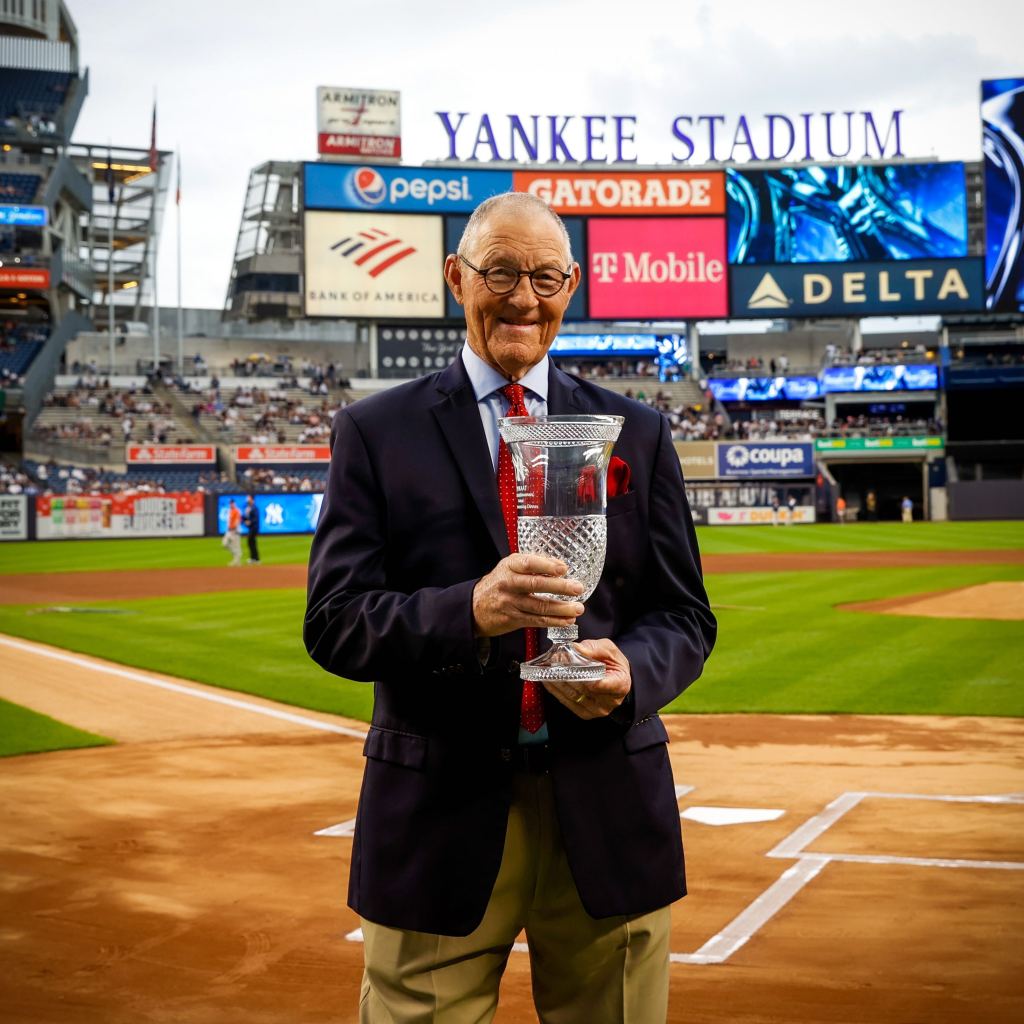
In late June, Kaat was made to stand near home plate and hold the New York Yankees’ Lifetime Achievement Award.

Why? Why not. But it comes perhaps with some shade thrown in.

During a Yankees-Twins telecast on MLB Network earlier in June, Kaat had been talking up Yankees pitcher Nestor Cortes ability to mow down hitters. “Nestor The Molester” was the phrase Kaat decided to use in describing Cortes’ nastiness.

The blowback was … notable in these days of social media shaming and all that involves. Kaat apologized. Cortes said he wasn’t offended.

And when it was decided by someone in the Yankees front office (George Costanza?) that Kaat needed some sort of public atonement with a dubious recognition that sounds like things the former president gave out to his friends like pardon, and they had run out of room in Monument Park, the team had Cortes present it to Kaat prior to a game he did with Costas for MLB Network.

Because, after all, Kaat did pitch 44 of his 898 games in Yankees pinstripes, none as a starter, covering the back half of 1979 and the first month of the 1980 season, and amassing a 2-4 record and 4.12 ERA before they sold him off to the Cardinals.

Imagine the Dodgers trying to hijack Rickey Henderson’s Hall of Fame induction by giving him the same kind of “lifetime” contribution to their franchise for the 30 games he played at the end of 2003 — highlighted in our review of Howard Bryant’s new biography on Henderson.

Kaat, by the way, was also pushed into another head-scratching moment eight months ago when, last October, he apologized after saying teams should try to “get a 40-acre field full of” players who look like Chicago White Sox infielder Yoan Moncada. Ask Spike Lee for some context to that — the reference to how the U.S. government once promised freed slaves 40 acres and a mule following the Civil War.

It didn’t sound like Kaat was referring specifically to that, but … are we good now?

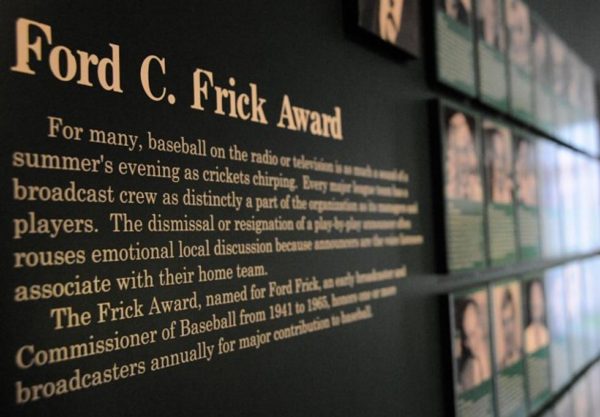
One more thing to consider: Is there anyone whose been voted into the Baseball Hall of Fame as a player and then won the Ford C. Frick Award honoring one’s work as a broadcaster?

Nope.

Could Kaat be the first? That could be the MLB EGOT.

Kaat, who studied speech and journalism while playing baseball at Hope College before signing with the Senators in 1957, has frequently been on first-draft Frick Award ballots that often get winnowed down to a final eight-or-10 names. In 2004, he was already being considered, having logged 17 years working for the Yankees, Braves and Twins, plus his time with CBS, ABC, ESPN and The Baseball Network.

Of the 340 members now enshired in the Baseball Hall of Fame after today’s ceremonies — that includes players, managers, umpire, executive, owners and contributors — the ones who’d have strongest consideration to also get a Frick Award might be Richie Ashburn, Bert Blyleven, Lou Boudreau, Dizzy Dean, Don Drysdale, Harry Heilmann, Ralph Kiner, Joe Morgan, Jim Palmer, Pee Wee Reese, Phil Rizzuto and Don Sutton.

Perhaps John Smoltz or Pedro Martinez, if there is a length of time involved in their mike careers.

One could make a case for Blyleven, Boudreau, Rizzuto and Reese not even deserving of getting in as a player, but had the benefit of a broadcasting career keeping their names in circulation for voters. Dean barely logged in the necessary 10 years required for Hall of Fame induction as a player and compiled just 150 wins mostly from 1932 to ’41, but that included a stretch of 18, 20, 30, 28 and 24 – very Koufaxian. Then came the 1937 All-Star game injury and a spiral. Dean got into the Hall as a player in ’53, staying in the public eye as a colorful broadcaster for the Cardinals and Browns of St. Louis, then the Yankees, followed by national broadcasters Mutural Radio, ABC and CBS through 1965. Dean was among the finalists for the Frick Award in 2021, ’17, ’16, ’15, ’10, ’07, 06, ’05 … at some point, someone figured he’d just get in by voter exhaustion.

Drysdale was also a Frick finalist in ’21 (won by Al Michaels) and ’17 (won by Bob Costas). Morgan and Reese were also a finalist in ’17. Heilmann, elected as a player in 1952 after 19 years primarily with the Detroit Tigers and Cincinnati Reds (1913-32), was the Tigers’ radio voice from 1934-1950. He was on the Frick ballots in 2019, ’16 and ’15. Ashburn and Kiner were among the 10 candidates for the Frick in ‘15.

After the first Frick award was given in ’78, seven former players won it — Jerry Coleman, Jack Graney, Joe Garagiola, Bob Uecker, Tony Kubek, Tim McCarver and Ken Harrelson. But none were really in Hall of Fame player discussion. Graney, after 14 years as an outfielder with Cleveland, was the first former big leaguer to broadcast a game, and he did it for 22 years, as a pioneer on the medium.

Something to think about … And to begin preparing to happen for Kaat’s sake, and his stake in the game.

You can look it up: More to ponder

== While we’re in this Hall of Fame moment, consider a pre-order on “Baseball Memories and Dreams: Reflections on the National Pastime from the Baseball Hall of Fame” (National Baseball Hall of Fame Books, $29.95, 265 pages, due out Oct. 4, 2022). It is said to be “recollections of Hall of Famers and narratives from top baseball writers” picked up from the Baseball Hall of Fame’s member magazine, “Baseball Memories & Dreams.” Included are postings by Johnny Bench, Peter Gammons, John Grisham, Tim Kurkjian, Ichiro Suzuki and Joe Torre.

== Kaat talks about his book on SportsBylineUSA.com.

== The Holland (Mich.) Sentinel excerpts all the Kaat material about him growing up in Zeeland, Mich., a town today with a population of about 5,000, near Lake Michigan just southwest of Grand Rapids. Kaat dedicated his first book to his father, John Kaat, who worked at the local Dutch turkey hatchery but “known as ‘Mr. Baseball’ in Zeeland and who took Jim to his first game at Briggs Stadium in 1946.

== One other previous Kaat-scratched-out book for Triumph: The 2015 “If These Walls Could Talk: New York Yankees,” with Greg Jennings. Also, in April 2023, a paperback of “Good As Gold” is scheduled to be released for $18.95, perhaps with a reflection of his Hall of Fame induction experience as the new intro.

== More books by co-author and SABR member Douglas Lyons include “100 Years of Who’s Who in Baseball” (Lyons Press, 2015); “Can You Believe It?: 30 Years of Insider Stories with the Boston Red Sox,” (with Joe Castiglione, Triumph Books, 2012),” “Out of Left Field, Short Hops and Foul Tips: 1,734 Wild and Wacky Baseball Facts,” (with brother and famous movie critic Jeffrey Lyons, Taylor Trade Publishing, 2005), “Catching Heat: The Jim Leyritz Story,” (co-authored with Leyritz and brother Jeffrey Lyons, HCI, 2011), “Curveballs and Screwballs: Over 1,286 Incredible Baseball Facts, Finds, Flukes, and More!” (with brother Jeffrey, Random House, 2001), and “From an Orphan to a King: Eddie Feigner” (with the famous softball star Feigner, Immortal Investments Publishing, 2004).

Day 31 of 2022 baseball books: Shenanigans, again and again, and the doctrines that go with ’em

“Intentional Balk: Baseball’s Thin Line Between Innovation and Cheating”

The authors:
Daniel R. Levitt
Mark Armour

The publishing info:
Clyde Hill Publishing
258 pages
$22
Released July 12, 2022

The links:
The publishers website
The book’s official website
At Mark Armour’s website
At Daniel Levitt’s website
At Bookshop.org
At Indiebound.org
At SkylightBooks.com
At DieselBookstore.com
At Powells.com; at Vromans.com; at TheLastBookStoreLA; at PagesABookstore.com
At Amazon.com; at BarnesAndNoble.com

The review in 90 feet or less

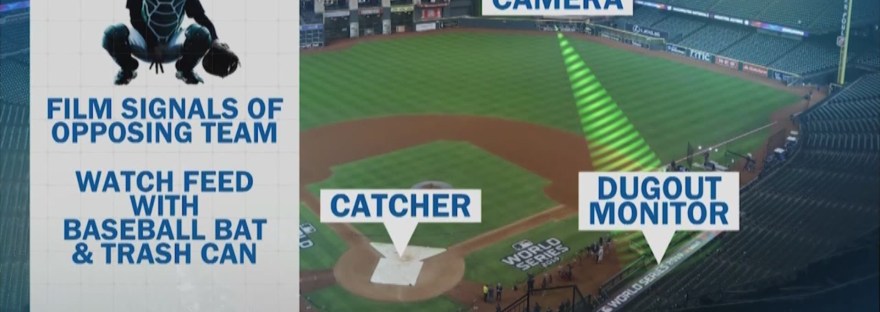
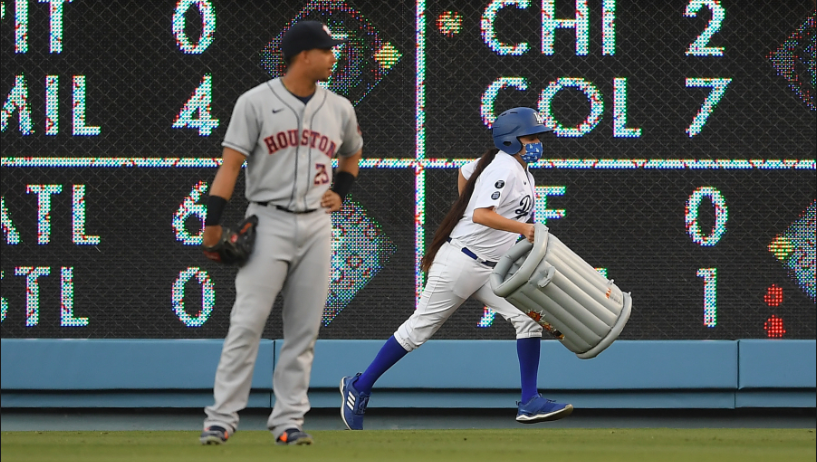
A Dodgers’ ball girl removes an inflatable trash can thrown onto the field as she runs behind Houston Astros right fielder Michael Brantley during the first inning of the Astros-Dodgers game Aug. 3, 2021 at Dodger Stadium. Many in the crowd of 52,692, the largest attendance at a game that season, jeered Astros players, feeling they had been cheated out of the 2017 World Series title. A half-dozen inflatable trash cans got tossed on the field, a reference to the Astros’ banging on real trash cans to signal opponents’ pitchers in their scam. (AP Photo/Marcio Jose Sanchez)

Consider the headline in the Washington Post last April: “Cheating Is Part of Baseball, Says MLB. A Federal Court Agrees.”

Say it ain’t so, Jose Altuve.

The U.S. Court of Appeals for the Second Circuit had just rejected a lawsuit by fans who were already duped into thinking they’d make money with the fantasy baseball website DraftKings.com, but now claimed their betting results were compromised by a couple of illegal sign-stealing scandals that happened between 2017 and 2019.

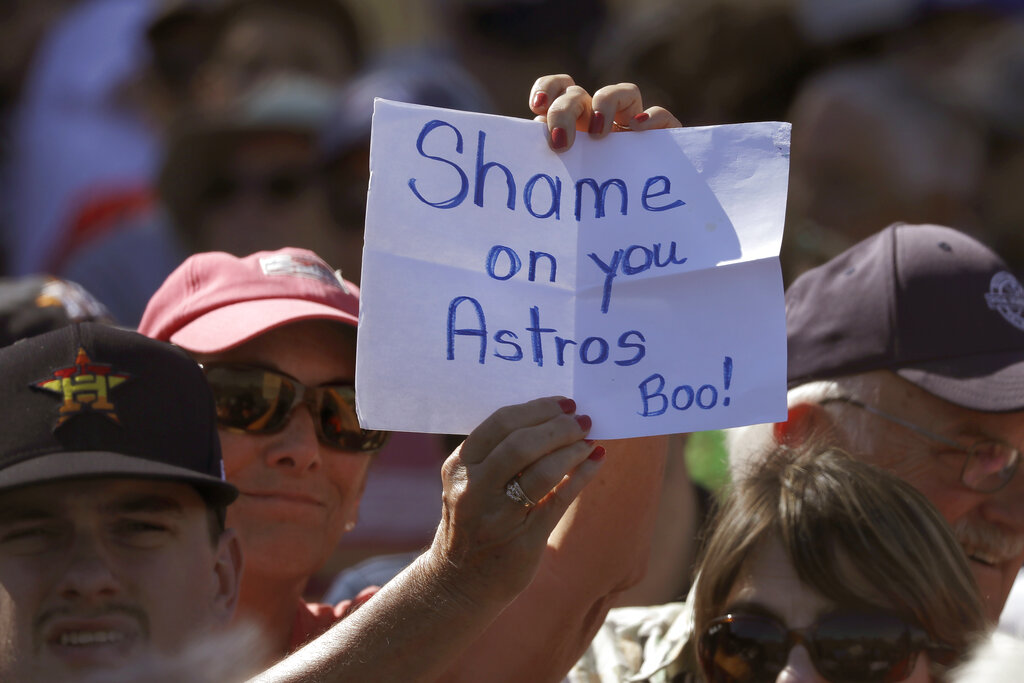
A fan holds a sign during a spring training baseball game between the Houston Astros and the Washington Nationals in February, 2020 in West Palm Beach, Fla. (AP Photo/John Bazemore)

The plaintiffs, who meticulously built their faux teams with real players and lived and died on the points they gained based on those real players’ performances, claimed they were protected by the MLB’s plausibility that all games would be played fairly. That didn’t happen. A league investigation found the Houston Astros and the Boston Red Sox violated rules that bar stealing signs via electronic means. In the DraftKings’ fans eyes, that meant their player performances were skewed by inaccurate fantasy stats.

If only this was a victim-less crime.

The court wasn’t asked to decide whether cheating actually occurred. Or whether the MLB misrepresented its product. Or if the plaintiffs relied on the MLB’s credibility. The question was whether all of these claims, if proved, would give rise to liability.

It did not, the MLB insisted in its defense. The judges agreed. They said: “(A)ny reasonable spectator or consumer of sports competitions — including participants in fantasy sports contests based upon such sporting events — is undoubtedly aware that cheating is, unfortunately, part of sports and is one of many unknown variables that can affect player performance and statistics on any given day, and over time.”

The court of public opinion may disagree. But that’s the deal, bro. Go have a fantasy parade for your team now.

Somewhere in his home at Vero Beach, Fla., Fay Vincent’s head exploded. That incident has yet to be updated on the Wikipedia page: “Cheating in Baseball.”

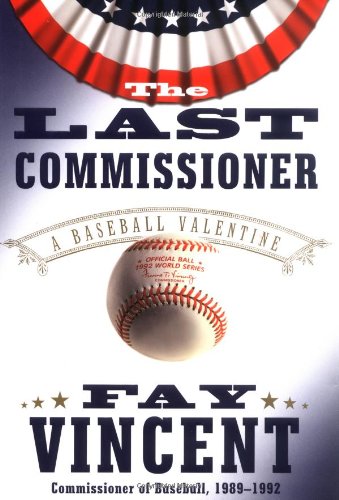
In 2002, Fay Vincent wrote this book for Simon & Schuster.

Vincent, a former entertainment lawyer, securities regulator and business executive who became the accidental MLB commissioner following the passing of Bart Giamatti in 1989, bared his baseball soul in a 2013 interview with America magazine, an intellectual weekly publication by Catholic Jesuits about faith and culture. The church of baseball is always in their crosshairs.

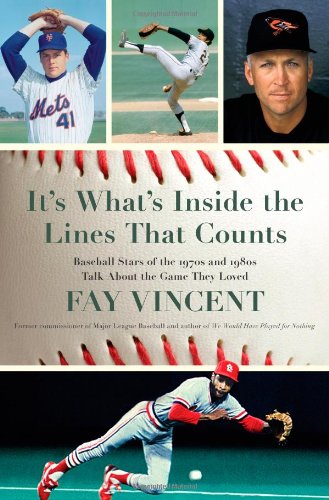
In 2010, Fay Vincent wrote this book for Simon & Schuster.

On the subject of the morality of baseball, Vincent was asked to expand on an op-ed piece he had done published in the Wall Street Journal that gave him real estate to talk about what he would have done with players who were caught using performance-enhancing drugs. That headline read: “Tell the Baseball Druggies: Strike Out, You’re Out.”

For American magazine, according to a transcript of the interview, Vincent laid it out there about the sport’s seemingly acceptance of various shades of defrauding, deception and dishonesty:

I think all cheating is dangerous and pernicious … I think one of the problems with sports, especially with baseball, is we sort of smiled at spitballs, tinkering with bats. Those seemed to us to be innocent forms of cheating. But it’s like saying we’re going to permit a little cheating on your income tax. I mean if you cheat, you cheat and I think this kind of performance enhancing drugs is a major form of cheating. It’s also illegal. It’s violative of the prohibited substance act. The federal statute says: You can’t be using these drugs without a prescription, you can’t be selling them in any event. I think one of the problems with baseball has been that we’ve been too tolerant of what we call innocent forms of cheating. There is no such thing as innocent cheating.”

Vincent’s run as commissioner was brief, ending in 1992 when some baseball owners decided he was too much a threat to their business and could have someone like future Hall of Fame inductee and Milwaukee Brewers owner Bud Selig there instead to watch out for them with a strike/walkout looming.

America editor in chief George W. Hunt was moved to address the situation that sent Vincent away from his lofty post: “Ever since that bite of the tasty fruit, the way of the world has been that third-raters conspire to denigrate or oust first-raters in their midst. ’Twas ever so in playgrounds, factories, boardrooms, even churches, since the same Tree of Knowledge feeds the appetites of ignorance and stupidity as well. This sad tale was retold again recently when a handful of dissident owners, alarmed at integrity and intelligence, persuaded some straddlers to vote ‘no confidence’ in the Commissioner of Major League Baseball, Mr. Fay Vincent Jr. The vote was 18-9, with one abstention, requesting his resignation. Mr. Vincent originally intended to contest this dubious decision and fight to the end. Fortunately, he changed his mind, and his leave-taking was as dignified and forthright as his conduct in office has been.”

In this new book about the history of how the game has managed to survive despite those who find gray areas to manipulate in its credibility, SABR stalwarts and unimpeachable historians Daniel R. Levitt and Mark Armour aren’t demanding a call to action that pushes current commissioner Rob Manfred to do a better job cleaning up the sport from its cheating past, present and likely future.
Whatever you think of his performance since he took over in from Vincent’s predecessor, Bud Selig, in 2015, Manfred has already seen plenty of pushback from how he handled the Houston Astros’ sign-stealing scandal — doing his best to appease the owners by punishing team GMs and managers involved – but not players – in the wake of a longer investigation.

He says he has the best interest of the game’s future – mostly because sports wagering is becoming a business partner, and fans (see above) want guarantees about the game being conducted on the up and up. It is ultimately why you’ll someday soon see robotic umpires at home plate on balls and strike calls, and a likely expansion of replay to make sure everything is as close to perfect as possible.

Levitt and Armour, as MLB historian John Thorn writes in an endorsement of the book, “may raise an eyebrow at this infraction or that one, but they are not moralists. For them, play is serious fun, and so is their book.”

We start there because, if you’re looking for a revolutionary chapter after chapter of essays damning the game and throwing intense shade on those who’ve failed to do something about it, that’s not the point. Instead, it’s something much more entertaining, educational and enlightening.

Continue reading “Day 31 of 2022 baseball books: Shenanigans, again and again, and the doctrines that go with ’em”

Day 30 of 2022 baseball books: Looking an MLB Draft horse in the mouth (and look up draft horse, it’s a real thing)

“Feeling a Draft: Baseball Scouting
And the first 50 Years of the Amateur Player Draft”

The authors:
Fred Day
Ray McKenna

The publishing info:
Self published/
iUniverse Publishing
408 pages
$33.99
Released Nov. 18, 2021

The links:
The publishers website
The authors website
At Bookshop.org
At Indiebound.org
At Powells.com
At Vromans.com
At TheLastBookStoreLA
At PagesABookstore.com
At SkylightBooks.com
At DieselBooks.com
At Amazon.com
At Barnes & Noble.com

The review in 90 feet or less

So what do you hear about “The Hispanic Titanic?”

It’s a person, not a place or thing.

And it could be a really big thing someday.

Perhaps you can become one of his OG fanatics.

So we’re watching the MLB Network last Sunday morning, and up comes an interesting segment about hitting mechanics. The subject is Ivan Melendez, a 6-foot-3, 225-pound, Jose Canseco-looking first baseman from the University of Texas. He just won the Golden Spikes Award in 2022 as college baseball’s best player – .387 average, school-record 32 home runs, 94 RBIs for the Longhorns, who returned to the College World Series.

The show about getting to “The Show” was another in a series related to the upcoming 2022 MLB Draft — the first round starts July 17, this year held in the LA Live plaza for the first time, as another element of the All-Star Game festivities in Southern California. (ESPN will also cover the first round on that Sunday at 4 p.m. in place of an MLB game). The draft doesn’t end until two days later.

So, no, you didn’t miss that MLB draft that usually comes in early June during the College World Series. Starting last year, it was pushed back (despite the wishes of teams who lose a month’s worth of time in development) to make it all more … Compelling? Convenient? Consolidated with the All-Star Game stretch that has actual life-affecting news attached to it.

In the order of picking for 2022, the Angels have the 13th choice overall. The Dodgers would have had No. 30, but — after these sandwich rounds for compensatory picks to help teams that lost free agents players, and a “competitive balance” round where small-market teams get some extra juice — they had to forfeit 10 picks and now, at No. 40 to start the official second round, this is payback for “exceeding the competitive balance tax threshold.”

This 2022 Dodgers lineup valued at $261,273,489 (with $35,333,333 in suspended animation) is your tax dollars at work.

Continue reading “Day 30 of 2022 baseball books: Looking an MLB Draft horse in the mouth (and look up draft horse, it’s a real thing)”

Day 29 of 2022 baseball books: When Murphy’s Law in Chicago meant there was no wrong way to run the Cubs

“Charlie Murphy: The Iconoclastic Showman
Behind the Chicago Cubs”

The author:
Jason Cannon

The publishing info:
University of Nebraska Press
400 pages
$36.95
Released June 1, 2022

The links:
The publishers website
At Bookshop.org
At Indiebound.org
At Powells.com
At Vromans.com
At TheLastBookStoreLA
At Skylight Books
At Diesel Books
At PagesABookstore.com
At Amazon.com
At BarnesAndNoble.com

The review in 90 feet or less

Murphy’s Bleachers, the human circus with the green awning holding down the corner of Waveland and Sheffield, is among the must-observe places in Chicago’s Wrigleyfield when soaking up the neighborhood vibe before a Cubs’ game. Perhaps even break through the fence and order a beer if time allows.

From the center-field bleachers at Wrigley Field, you can look down upon it, but don’t look down on it. You find yourself asking: What I am doing up here if all those folks are jammed into that brick-building patio below seem to be having so much fun?

It started as a hot-dog-and-beer stand in the 1930s right after prohibition. It became Ray’s Bleachers in ’65. It was sold to a Chicago police detective named Jim Murphy in 1980, and his family has taken care of it ever since (his name is even officially posted on the street corner sign).

Charles Webb Murphy, the pre-Wrigley caretaker of the Cubs franchise from 1906 until he was forced out in 1913, doesn’t seem to have any familial roots to the place. Too bad. That would make it all the more historic and hysterical.

So let’s pretend anyway.

“You don’t know the history of the Chicago Cubs until you know the story of” this “ebullient and mercurial owner” of the franchise that, under his watch, won four National League pennants plus the 1907 and ’08 World Series titles — then went into championship hibernation for about 108 years.

The book-jacket blurb to encourage picking up this heavy-duty biography also wishes you to know this gentleman with the bowler cap, sporty mustache and holding a cigar on the cover has also been labeled as, in no particular order: Impetuous, lucky, sharp, lovable and loathable. Full of brash, bluster and hustle with explosions of creativity. Act first, apologize later.

“Hate him or love him, he is always interesting, and that is something,” said his longtime friend and sportswriter Hugh Fullerton, the famous whistle blower in the Black Sox Scandal (played by Studs Terkel in the 1988 movie, “Eight Men Out.”

He’d also refer to “Murph” as someone whose “spectacular success, and his brilliant showmanship naturally made enemies, especially of other club owners. He out-witted them, out-traded them and out-talked them.”

Continue reading “Day 29 of 2022 baseball books: When Murphy’s Law in Chicago meant there was no wrong way to run the Cubs”