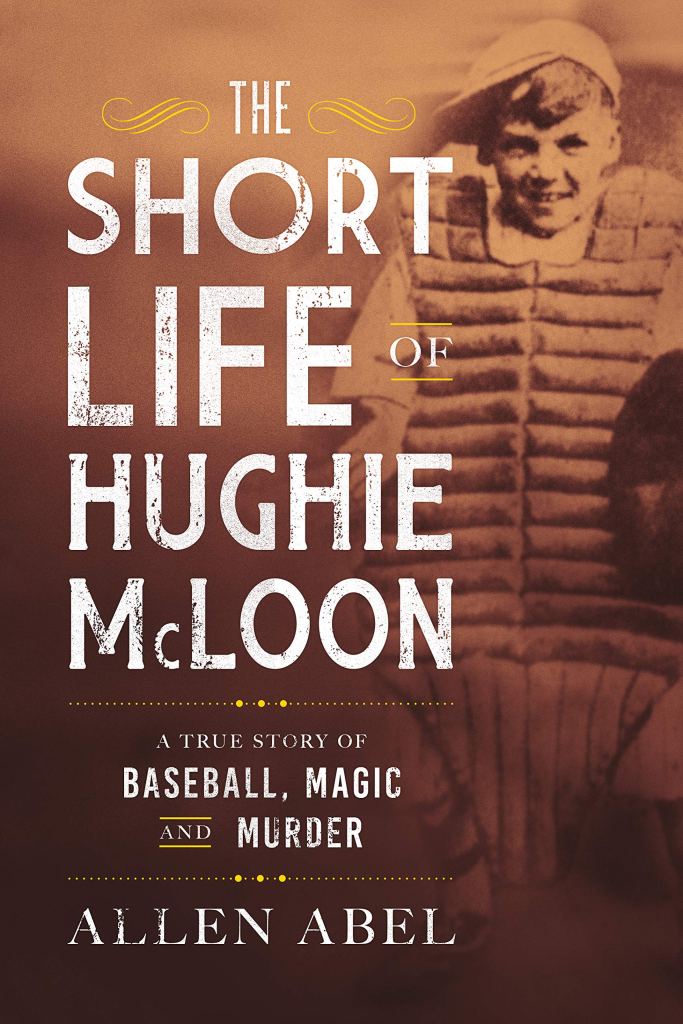
“The Short Life of Hughie McLoon:
A True Story of Baseball, Magic and Murder”
The author:
Allen Abel
The publishing info:
Sutherland House
220 pages
$22.95
Released March 9, 2021
The links:
At the publisher’s website
At Indiebound.org
At Bookshop.org
At Powells.com
At Vromans.com
At The Last Book Store in L.A.
At PagesABookstore.com
At Amazon.com
At BarnesAndNoble.com
The review in 90 feet or less
In much the same way our last review, “The Best Little Baseball Town in the World,” was about “a story that reads more like fiction than nonfiction,” the cover blurb atop “The Short Life of Hughie McLoon: A True Story of Baseball, Magic and Murder” has this declaration by former Sports Illustrated scribe Michael Farber: “This could be a great work of fiction. The damndest thing is it’s all fact.”
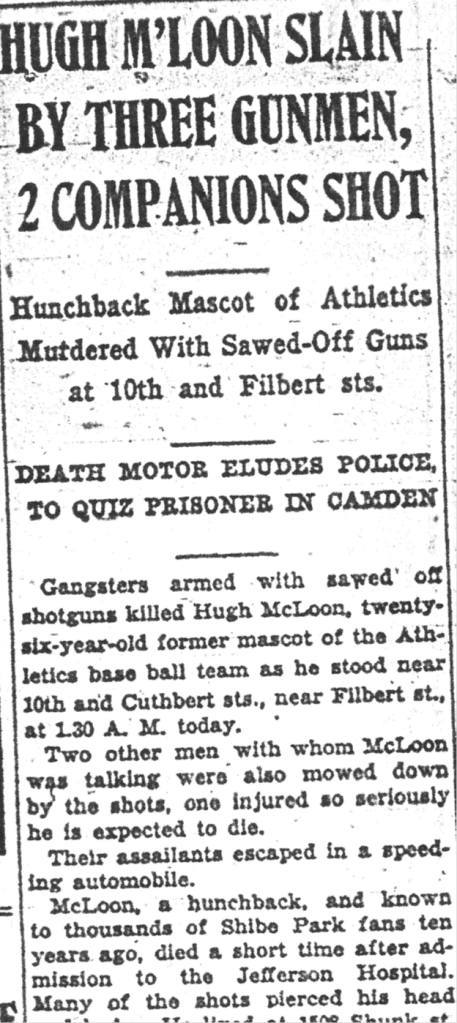
Fact it, it’s as accurate as one can glean from a gaggle of Philadelphia newspapers in the roarin’ ’20s.
So here’s the front-page scoop as we’re told:
Hughie McLoon, who grew to just 50 inches tall and only 80 pounds because of a spine injury suffered when he fell off a seesaw at age 3, was once the team mascot for Connie Mack’s hapless Philadelphia Athletics at a time when major-league teams were not only eager but sought out boys who had deformities to come aboard in hopes of giving them good luck.
“I tol’ him I’d bring him luck an’ I did!” McLoon is once quoted as saying he told Mack.
That depends on what your definition of luck might be. The Athletics, who would end up losing 117 games (out of 154) in 1916, decided to bring in McLoon during a stretch when the team, playing 23 in a row at home at Shibe Park, had already lost 11 straight, 15 of 16 and 26 of 28. When McLoon joined, they lost the first game of a double header against the St. Louis Browns, but somehow won the second game, 3-0.
The Athletics then went on to win once in their next 28 games.
One of the takeaways from this book is that, as messed up as that sounds, having cripples invited to hang around with a team as a bat boy, or simply as a mascot, was all too common. Abel explains on page 5:
The genesis lies in humanity’s deepest superstitions, our yearning to bring a sense of control to lives riddled with uncertainty. Stir our unyielding, if ridiculous, faith in fairies, charms and totems together with our competing feelings of pity, curiosity and revulsion for the disabled and deformed, then combine them with the maddening difficulty of hitting a speeding, spinning sphere with a hickory bat, and the product is Hughie McLoon. … Hughie discovered to be the luckiest, you first had to be unlucky. Then you had to convince the gods of the diamond that the crucible of your own suffering rendered you a guardian against ill fortune.”
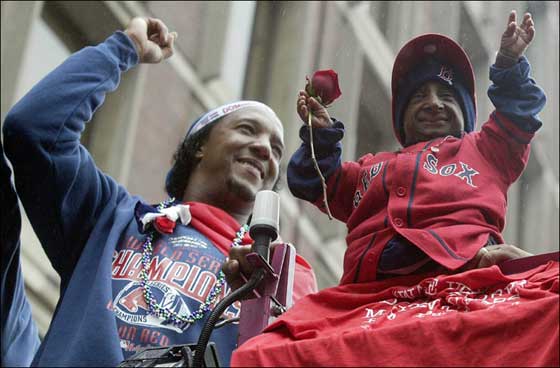
(We need only to think back to the Boston Red Sox’s run to their 2004 championship, and Pedro Martinez’s infatuation with tiny Dominican actor Nelson de la Rosa, carried around as the team’s “good luck charm.” De la Rosa’s death at age 38 less than two years later merited an obit in the New York Times.)
McLoon actually replaced another cripple and was following the line of those living a “charmed” MLB life such as Ulysses Harrison, Louis Van Zelst, Charlie Faust, Eddie Naughton and Eddie Bennett. While McLoon was connected to this version of the Athletics that were often then called the “Pathetics” from July of 1916 through 1918, they were trying to recapture something from their recent run as a three-time World Series champions, yet they never really pulled out of that pre-World War I skid.
Continue reading “Day 19 of 30 baseball book reviews in 2021: Long unsolved story short, something’s looney about a Philly mascot named Hughie” →






 Tom Hoffarth's The Drill: More Farther Off the Wall