Day 18 of 2021 baseball book reviews: A minor-league story told in a major-league way, ‘rice and easy’

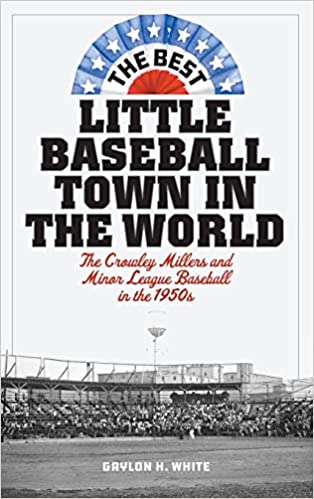
“The Best Little Baseball Town in the World:
The Crowley Millers and Minor League Baseball
in the 1950s”
The author:
Gaylon H. White

The publishing info:
Rowman & Littlefield
278 pages
$38
Released on April 21, 2021

The links:
At the publisher’s website
At the author’s website
At Indiebound.org
At Bookshop.org
At Powells.com
At Vromans.com
At The Last Book Store in L.A.
At PagesABookstore.com
At Amazon.com
At BarnesAndNoble.com

The review in 90 feet or less

There’s always a decent chance one might judge the decision to further investigate a book by the blurb on its back cover. Try this one on for size:
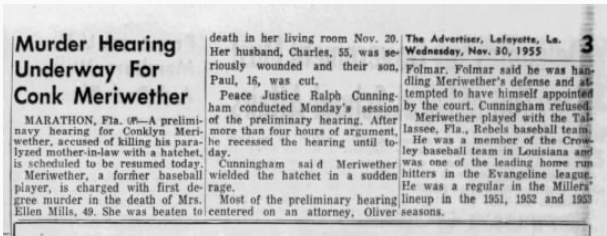
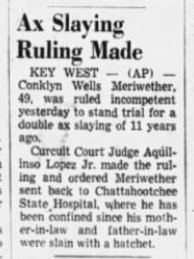
“(It) tells the fun, quirky story of Crowley, Louisiana, in the fifties, a story that reads more like fiction than nonfiction. To start, the Crowley Millers’ biggest star was Conklyn Meriwether, a slugger who became infamous after he retired when he killed his in-laws with an axe. Their former manager turned out to be a con man, dying in jail while awaiting trial on embezzlement chargers. The 1951 team was torn to pieces after their young center fielder was struck and killed by lightning – during a game. But aside from the tragedy and turmoil, the Crowley Millers played some great baseball.”

It’s all accurate, for sure. A story that must be told, actually, and a reminder that sometimes truth is more compelling than things that could be made up. But in a way, while that is a lot of what’s going on here and setting the tone for the adventure, it doesn’t fully capture the essence of what Los Angeles-born Gaylon White has actually done here with his latest deep dive into the history of minor-league baseball.

We won’t suggest the reader jumps to the final chapter — after White lays out all the details about the team and this effort to get pro baseball into the community only to have it disappear after a few short years.

But if only for this exercise, consider how White comes to cover the rebirth of historic Miller Stadium, and the pride of the community. This is a ballpark, White notes, located near the railroad tracks used by the rice mills. It earned the nickname of “Rice Capital of American” in this southern Louisiana city just east of Lafayette. It’s a place, they say, where “Life Is Rice and Easy.”
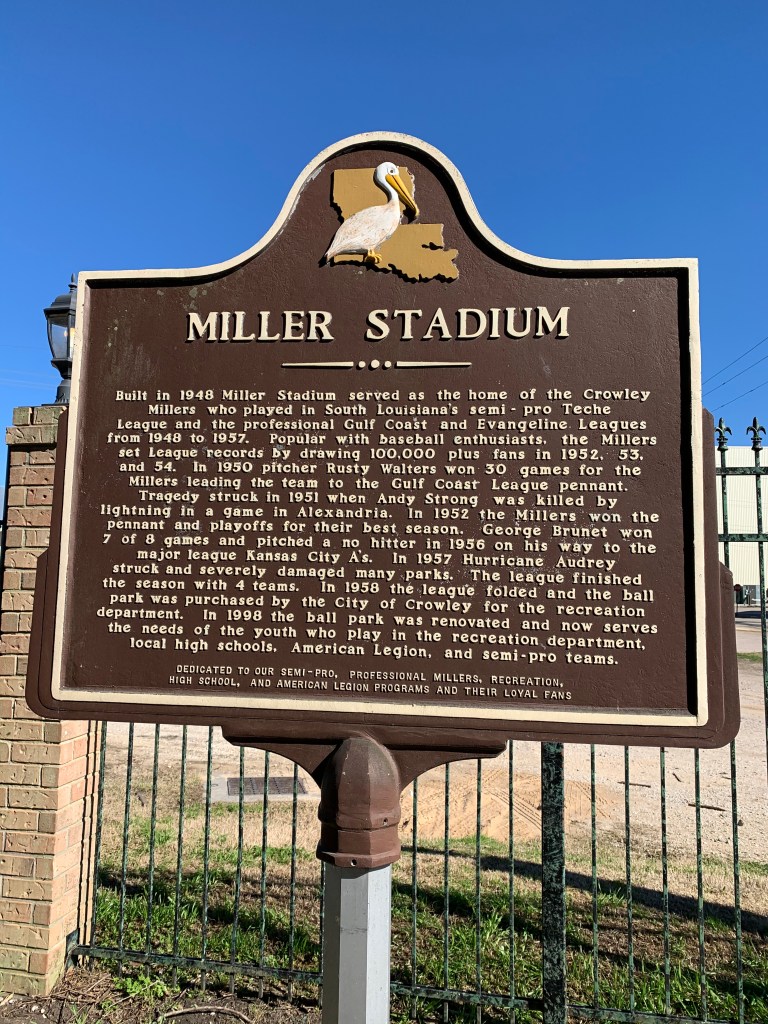
Photo by Gaylon White.

Back in the day, White continues, fans parked along the track, but in the middle of the games the public address announcer would call out the license numbers of cars that had to be moved for a train to pass through.

The town had a population of about 12,500, and they’d sometimes get 7,000 attending games there.

About 20-plus years ago, the ballpark was restored and upgraded as it fell apart from neglect.
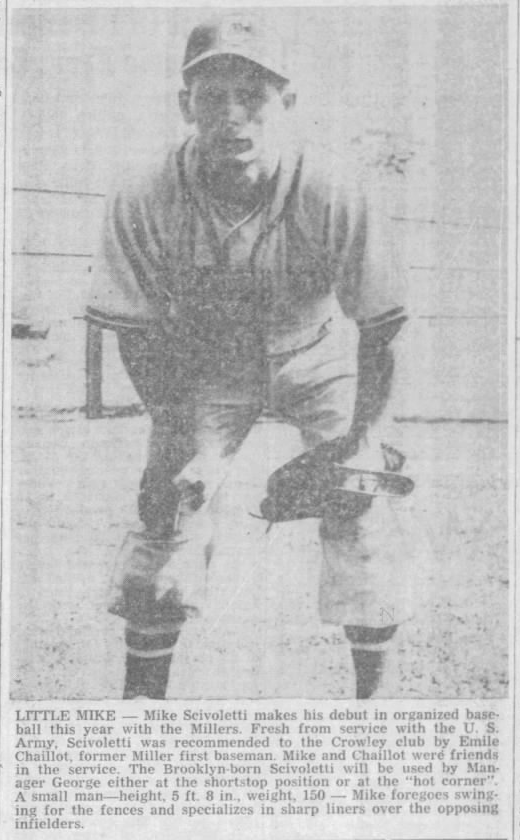
From the April, 1952 Crowley Post-Signal.

Richard Pizzolato, known around town as Coach Pizz, said he was at the field one day in 1998, when a man in a heavy Brooklyn accent asked: “Is this Miller Stadium?”

Coach Pizz confirmed it was. In his own Southern drawl, he added: “It’s great to have you back Mr. Scivoletti.”

Mike Scivoletti, a shortstop for the Millers in their glory years of 1952-to-’53, was the visitor, and he was shocked to be recognized.

“How do you know who I am?” asked Sciovletti.

“You were my hero when you played here,” Coach Pizz said.

Pause for one of those “Field of Dreams” crying moments.

At a confounding time when Major League Baseball has decided to compromise its future by streamlining its minor-league organization and eliminating more cities and small towns from the pride of having a pro team, White has fortuitously seized a moment to recall a franchise that once existed, then vanished, and merits just two generic paragraphs on a Wikipedia entry.

Here’s the Millers, and their trenchant story during the 1950s when the city decided to build a ballpark and then hope a team would come. They did, and then came the post-WWII Class C version of the Evangeline League.

The league’s name itself is a thing of literary beauty. It’s the epic poem by Henry Wadsworth Longfellow called “Evangeline: A Tale of Acadie,” which focuses on Acadian farmers, descendants of a group of French-speaking settlers who migrated from coastal France in the late sixteenth century to establish a French colony called Acadia in Canada and parts of what is now the state of Maine. Forced out by the British, many resettled in southern Louisiana. They are now more popularly known as Cajuns.

Continue reading “Day 18 of 2021 baseball book reviews: A minor-league story told in a major-league way, ‘rice and easy’”

Day 17 of 30 baseball book reviews in 2021: On Patriots’ Day, 35 years later, there’s no way to 86 the ’86 Red Sox

“Two Sides of Glory:
The 1986 Boston Red Sox in Their Own Words”

The author:
Erik Sherman

The publishing info:
University of Nebraska Press
288 pages
$29.95
Released April 1, 2021

The links:
At the publisher’s website
At the author’s website
At Indiebound.org
At Bookshop.org
At Powells.com
At Vromans.com
At The LastBook Store in L.A.
At PagesABookstore.com
At Amazon.com
At BarnesAndNoble.com

The review in 90 feet or less

Kiki Hernandez hit a fly ball that barely went over the Green Monster for a lead-off homer and did a dance at home plate with teammate Alex Verdugo, later saw Verdugo hit a solo homer, and the Boston Red Sox used 10 Ks from Nathan Eovaldi to secure an 11-4 victory over the Chicago White Sox on Patriots’ Day this morning/afternoon at Fenway Park, which was not followed by the running of the Boston Marathon. It must also be noted that White Sox Hall of Fame manager Tony LaRussa used two position players to soft toss off the mound to get through the seventh and eighth innings just to get it over with. The paying fans must feel they got extra value. Just brutal.

Time will tell if this is a pivotal point in this season for the 11-6 Red Sox, leading the AL East with the help of the three aforementioned former Dodgers. They are just 5-5 at home and don’t have their first of 19 against the New York Yankees until — seriously? — June 4.

Time, context and a whole lot of forgiveness is also an well-cured formula that works over and over again when determining when it is most prudent to revisit an important moment in history.

Sports, in particular. Baseball, to be specific. Otherwise, too many open wounds and emotional trauma can affect judgment.

In the 35 years since the 1986 MLB season climaxed with a New York Mets-Boston Red Sox World Series – the 95-win Red Sox were on the cusp of their first title in centuries, but it rolled away from them to allow the Mets to claim it instead – much has happened.

One of those things was in spring 2016, when Eric Sherman produced “Kings of Queens: Life Beyond Baseball with the ’86 Mets” (Berkley Books, 352 pages, $29), it was with a rather simplistic but purposeful approach – it’s 30 years later, let’s go out and visit about a dozen members of that team that had the most compelling lives, see how they’re doing and talk about that magical time. Sherman had already done a book with Mookie Wilson a couple years earlier, and had his blessings for this project as well.

Then it was off to track down and interview Dwight Gooden, Darryl Strawberry, Lenny Dykstra, Kevin Mitchell, Ed Hearn, Doug Sisk, Wally Backman, Keith Hernandez, Bob Ojeda, Danny Heep, Howard Johnson, Rafael Santana … and include a chapter on the late Gary Carter, by talking to his wife and teammates.

Once that was done, it kinda begged the question: What about the other team that didn’t win it, but had a quite magical year all to their own – from Roger Clemens’ 20-strike out game, to the incredible ALCS against the Angels, and now, one strike away from claiming their first title since 1918 … it didn’t happen.

A perfect entry point was Sherman attending a live public appearance featuring Wilson with the Red Sox’s Bill Buckner – the two key figures in the Game 6 little roller up along first – and how they’d decided to talk about that moment for those who still cared for their insight.

For all the right reasons, Buckner was the starting point in Sherman’s next quest to do for the Red Sox in what he did for the Mets – find 14 key players to tap into their memory banks and what perspective they’ve gained.

Continue reading “Day 17 of 30 baseball book reviews in 2021: On Patriots’ Day, 35 years later, there’s no way to 86 the ’86 Red Sox”

Day 16 of 30 baseball book reviews in 2021: Life before April 15, ’47: As the last of the Negro Leaguers are just trying to be remembered, a kid arrives

“Comeback Season: My Unlikely Story of Friendship
with the Greatest Living Negro League Baseball Players”

The author:
Cam Perron
with Nick Chiles
Forward by Hank Aaron

The publishing info:
Gallery Books/
Simon & Schuster
272 pages
$27
Released March 30, 2021

The links:
At the publisher’s website
At the author’s website
At Indiebound.org
At Bookshop.org
At Powells.com
At Vromans.com
At The LastBook Store in L.A.
At PagesABookstore.com
At Amazon.com
At BarnesAndNoble.com

The review in 90 feet or less

Good for Cam Perron.

Perhaps you’re already aware of him and his story – one of those feel-good pieces that has had a decent shelf-life the last 15-plus years.

The shortstop version: In 2007, here’s Perron, this white teenager from a Boston suburb who somehow forges a friendship with hundreds of former Negro League players simply by reaching out to them. First, it’s via letters, to see if he might get their autograph. Then by phone, wanting to hear their stories. Now it’s all sorts of platforms to help give them exposure, reunite those still alive, and see if there’s financial compensated due.

Here’s the lineup if you haven’t been invested in the journey thus far:

  • In 2011, when Perron was 16, the Boston Globe caught up with him as “local teen does good” angle.
  • A year later, MLB.com makes the connection.
  • That draw the attention of HBO’s Real Sports and Bryant Gumbel:
  • In 2013, he gets his own TED talk:
  • More room for his story in Huffington Post. That leads to a 2017 HBO followup, as well as the Baseball Reliquary giving him its Hilda Award for distinguished service to the game.

The book, which seems to be best geared for Young Adult readers based on its larger typeface and breeze style, has a title comes from Perron’s explanation in Chapter 14 that as more Negro League players pass away — more than a third are now gone from those who joined the first reunion Perron helped organize in 2010 — “that makes me even more intent on trying to ensure that these guys not only get their due right now, but that they have a great time in the process. I want them to experience every sort of comeback that they possibly can, while they can, no matter how late it is in the season of their lives — to know for a fact that their stories matter, their memories will be preserved and to get whatever money is owed to them by MLB. It’s really been hitting me hard in the last few years because family members of players have started asking me to write eulogies for these men, my friends. … It makes me feel right about the work we’ve been doing.”

Since he joined the Center for Negro League Baseball Research, more than 1,500 living players have been identified.

Continue reading “Day 16 of 30 baseball book reviews in 2021: Life before April 15, ’47: As the last of the Negro Leaguers are just trying to be remembered, a kid arrives”

Day 15 of 2021 baseball book reviews: It’s Jackie Robinson Day, and his core relevance in a BLM-injected society may be more needed than ever

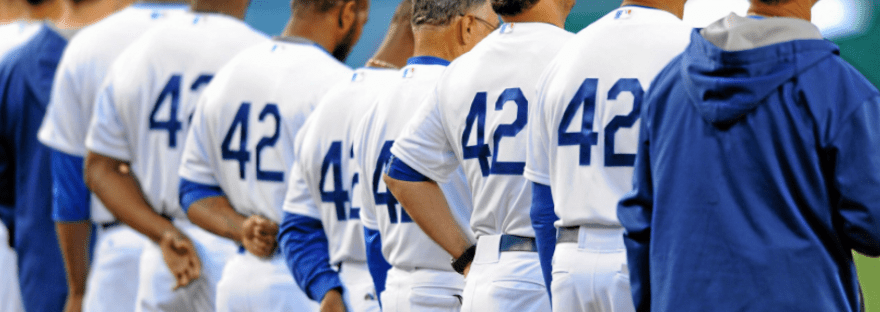
“42 Today: Jackie Robinson and His Legacy”

The editor:
Michael G. Long
Forward by Ken Burns, Sarah Burns and David McMahon
Afterword by Kevin Merida

The publishing info:
New York University Press
Washington Mews Books
256 pages
$27.95
Released Feb. 9, 2021

The links:
At the publisher’s website
At Powells.com
At Vromans.com
At The Last Book Store in L.A.
At PagesABookstore.com
At Amazon.com
At BarnesAndNoble.com
At Target.com
At Indiebound.org
At Bookshop.org

“Jackie: Perspectives on 42″

The editors:
Bill Nowlin
Glen Sparks
Len Levin
Carl Riechers

The publishing info:
Society for American Baseball Research
$29.95
324 pages
Released March 19, 2021

The links:
At Amazon.com

The reviews in 90 feet or less

In the second chapter of the new Tom Callahan book, “Gods at Play: An Eyewitness Account of Great Moments,” the author writes about being at Game 2 of the 1972 World Series and finding Jackie Robinson was on the field.

Robinson was 53 “but looked 73,” Callahan writes, “white-headed and virtually blind from diabetes. Nine days later he had a heart attack and died. …

“I followed Jackie as he was led into the Reds’ dugout and up the ramp to the clubhouse, where Jim Murray of the Los Angeles Times was standing.
“ ‘Jackie, it’s Jim Murray,’ he said.
“ Aw Jim, aw Jim,’ Robinson said. ‘I wish I could see you again.’
“ No Jackie,’ Murray said. ‘I wish we could see you again.’”

Each year, it’s our hope to see another new book or two that puts Robinson in greater context, knowing so much has already been committed to ink and binding that the challenge becomes greater over time. The books then get the spotlight on the annual Jackie Robinson Day in April.

In 2021, does the angst of our current life and times make Robinson even more relevant as an historical marker?

“Legacies are never easy to describe with accuracy and certainty,” Michael Long writes in the introduction for “42 Today.” “They’re like moral character – best viewed from many different angles, in historical context, and over a long period. Like studies of character, explorations of legacies also lead to a culminating question: Is there anything that ties the different parts together? In this case, is there a unifying element in the various legacies that Robinson left us?”

If one writer/author/historian can only take Robinson through his prism of expertise, why not try more than a dozen?

In the leadoff spot, if anyone could be best suited for the role, it’s Long, an associate professor of Religious Studies and Peace and Conflict Studies at Elizabethtown College, a few hours West of Philadelphia. He’s at the top of the lineup based on three previous notable works on the subject that we have previously reviewed and endorsed:

== “First Class Citizenship: The Civil Rights Letters of Jackie Robinson” in 2007
== “Beyond Home Plate: Jackie Robinson on Life After Baseball,” in 2013
== “Jackie Robinson: A Spiritual Biography,” with Chris Lamb in 2017

Dedicating this book to Rachel Robinson, Long’s non-sabremetic approach really is about numbers – those he calls “esteemed contributors … filmmakers, writers, journalists, scholars and activists …  (who add depth and nuance to the Jackie Robinson that our culture has unjustly frozen in 1947.”

Seventeen voices are assembled, with Ken Burns, Sarah Burns and David McMahon, who did the three-part, four-hour Robinson bio project for PBS in 2016, using the forward to re-emphasize Robinson’s “meaningful change” by trying to “remember him in full.”

Continue reading “Day 15 of 2021 baseball book reviews: It’s Jackie Robinson Day, and his core relevance in a BLM-injected society may be more needed than ever”

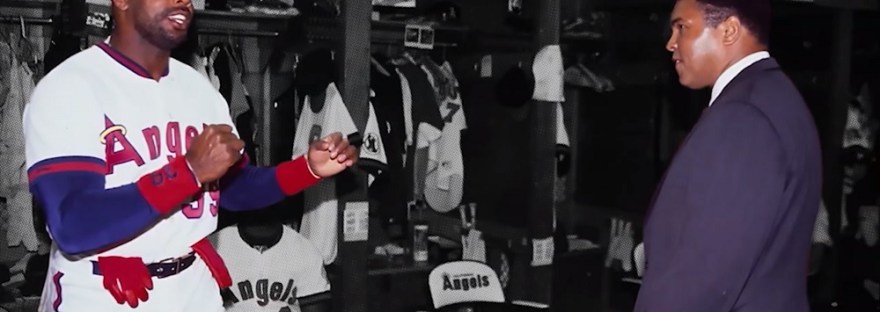
Day 14 of 30 baseball book reviews in 2021: Dave Parker snakes his way back into the conversation

“Cobra: A Life of Baseball And Brotherhood”

The author:
Dave Parker
and Dave Jordan

The publishing info:
University of Nebraska Press
480 pages
$34.95
Released April 1, 2021

The links:
At the publisher’s website
At Powells.com
At Vromans.com
At The Last Book Store in L.A.
At PagesABookstore.com
At Amazon.com
At BarnesAndNoble.com
At Indiebound.org
At Bookshop.org

The review in 90 feet or less

Let’s overthrow the cut-off man and cut to the chase here: Does Dave Parker and all his bad-assery belong in the Baseball Hall of Fame? Has he been unjustly wronged by having been overlooked during his 15-year eligibility that ended in 2000, and then coming up short in two subsequent special committees in 2017 and 2019?

How do we fix this? Or is the fix in?

Because if that’s not on the forefront of the reader’s mind as he ponders the impetus for this piping-hot and pleasantly plump Parker memoir landing with a thud 30 years after his retirement, then you’re not connecting dots.

Indulge us in creating a timeline on the life and times of the man they coolly called Cobra:

= June 9, 1951: Born in Grenada, Mississippi

= June 24, 1973: After three months at Triple-A Charleston, Parker tells the team “I’m out of here” – it’s either a promotion to the big league Pittsburgh Pirates or back home to Cincinnati. When Pirates outfielder Gene Clines is injured on July 10, Parker is brought up, but manager Bill Virdon says it will be a platoon, benching him against left-handers.

= July 12, 1973: About seventh months after the death of Roberto Clemente, the Pirates put 22-year-old Dave Parker into right field, batting leadoff in his major-league debut, as he goes 0-for-4 in the Pirates’ 4-0 win at San Diego. He finishes with a .288 average in 139 games. Three years later, he’s third in the NL MVP voting at age 24.

= 1978: With a league-leading .334 batting average (and a second straight batting title), a league-best .585 slugging percentage to go with 30 home runs and 117 RBIs, he wins the NL MVP award.

= January, 1979: Parker signs a $5 million, five-year contract, making him the first athlete in team sports to earn $1 million a season.

= July 17, 1979: All-Star Game Most Valuable Player in NL’s 7-6 win at Seattle, highlighted by Parker throwing out Jim Rice trying to stretch a double into a triple at third base in the seventh inning, and throwing out Brian Downing trying to score at home in the eighth inning to send the game into the ninth tied 6-6.

= April 2, 1984: After 11 years in Pittsburgh, where fans were more and more disenchanted with his abilities and playing condition, Parker lands with his hometown Cincinnati Reds, who sign him as a free agent to play under manager Pete Rose.

= Feb. 28, 1986: Parker is one of 11 players suspended, and seven handed a whole-season suspension, by commissioner Peter Ueberroth,  later exchanged for fines and community service. It stems from their involvement in testifying during the 1985 Pittsburgh drug trials, one of the game’s biggest scandals. Parker’s testimony in exchange for immunity led to the conviction of six Pittsburgh men for distributing cocaine. 

= Dec. 1987 to Sept, 1991: Traded to Oakland (a member of the Athletics’ 1988 ALCS champion team and ’89 World Series winners); signed as a free agent with Milwaukee, traded to the Angels for Dante Bichette; released by the Angels after 119 games, after he put up a .233 average with 11 homers and 56 RBIs as a DH, signed as a free agent with Toronto.

= Oct. 2, 1991: Final game is a 1-for-2 effort in the Blue Jays’ eventual 6-5 win at SkyDome against the Angels. After his sixth-inning double off Scott Bailes, the 40-year-old Parker is taken out for a pinch-runner.

His 19-year career totals: 2,712 hits, 339 homers, a .290 batting average, .810 OPS, 154 stolen bases, 40.1 WAR, three Gold Gloves (a league-best 26 assists from right field in 1977), seven All Star appearances, twice named Edgar Martinez Award for top AL DH, three World Series appearances, two championships.

= 1996: In his first year of eligibility for the Baseball Hall of Fame, he receives 85 votes (17.5 percent). The next year is his best result – 116 votes (24.5 percent). He topped 20 percent only one more time (1999) in his 15-year run that ends with 15.3 percent in 2010.

= 2017: One of the 10 candidates up for consideration for the Baseball Hall of Fame through a vote of the committee judging the Modern Era of Baseball (players whose greatest contributions came from 1970 to ’87). Jack Morris and Alan Trammel receive enough votes; Parker was listed among six who received fewer than seven votes. The voting panel consisted of executives Sandy Alderson, Dave Dombrowski, David Glass, Walt Jocketty, Doug Melvin and Terry Ryan, media members/historians Bill Center, Steve Hirdt, Jack O’Connell and Tracy Ringolsby, plus Hall of Fame players George Brett, Robin Yount, Rod Carew, Dennis Eckersley, Eddie Murray and Ozzie Smith.

= 2019: Again, in the pool of 10 considered for Hall induction by the Modern Era committee, Parker receives seven of 16 votes (43.75 percent), but is fourth best, trailing electees Ted Simmons and Marvin Miller. The same 16 voted on these 10 as they did on the 10 two years earlier. “I think it’s all political,” Parker says of the latest vote. “I’m the best damn player that they had in my era. I did all I could do.”

= April, 2021: “Cobra,” Parker’s memoir, is released.

= November, 2023: The next time Parker’s name comes up for consideration again by the Modern Era Committee.

And the discussion begins all over.

Continue reading “Day 14 of 30 baseball book reviews in 2021: Dave Parker snakes his way back into the conversation”