"Everything comes to him who hustles while he waits." — Tommy Edison
Author: fartheroffthewall
Tom Hoffarth is a sports journalist in Los Angeles, born and raised (reared is the correct phrase, but it just sounds wrong) and specializing in the sports media business. A USC graduate from the School of Journalism (it still exists, somewhat) in 1984, he is also available for service at https://www.linkedin.com/in/tomhoffarth/
In documenting any parts of the incredible Negro League baseball history, when an author can’t differentiate fiction from fact, and the pursuit of a true and accurate biography becomes one more hand-woven by legend and other indisputable yarns, perhaps there’s frustration in the process for the researcher and the reader.
Or, it’s one very cool, dog-gone delightful journey.
Lonnie Wheeler, who ends up finishing his time on the planet with this project, leaves us with a perpetual smile and pure enjoyment in not just finding out more about Baseball Hall of Famer James Thomas “Cool Papa” Bell — for all that was wrong about why the Negro Leagues existed, Bell was one of many unable to ushered into the more wide-spread “Big League” movement — there is a way that skillful prose and the turn of a simple sentence in what might otherwise be a difficult double play makes the experience far more appreciated.
And Wheeler admits for many years, he struggled to find a way to do this. More on that soon.
But for starters, how cool is this: You may know that line Satchel Paige told about how Bell was “so fast that when he goes to bed, he can turn out the light and be under the covers before it’s dark” … it has its roots in L.A.
Saunter over to Chapter 13, page 143. There’s another dose about the value of the California Winter League and its impact on interracial baseball in the early part of the 20th Century (which we previously learned from William F. McNeil’s incredible 2008 book, also by McFarland). As Wheeler amplifies, this was an annual respite where black players could come to L.A. as “a place to regroup and thrash some white teams.”
Los Angeles had its own All-Black White Sox Park in Boyle Heights (not so much in South L.A. as is recorded here) for the start of it in the 1920s, but then games moved to the Pacific Coast League’s far more credible Wrigley Field (future home for the inaugural years of the 1961 Los Angeles Angels). Accounts of these lucrative out-of-season contests between the White and Black All Stars of their day were endorsed by “the Los Angeles press …(that) took the maverick attitude that good baseball is good baseball.”
Wheeler decides the genesis of the Paige-Bell yarn “almost certainly derives from the 1934-35 Winter League season” as Paige and Bell, as roommates in a hotel or boarding house that had some funky fluorescent lighting. Bell recalls it as an opportunity to dupe Paige – and even take some money from him. Bell realized that when he hit the off switch, as the lights took a few seconds to flicker off, he says it was “the only time I ever saw Satchel speechless. Anyway he’s been tellin’ the truth all these years,” as Bell recounts in a 1981 Negro League reunion, documented in a St. Louis magazine, and given new examination here.
Question: You’ve been settling in to watch an exhibition baseball game from Arizona, where you know fans paid three-times face value for social-distanced seating and half of them from the center-field camera shot on home plate are still just looking at their phones, and then finding out these “games” might end after five innings, or seven innings, or after two outs in an inning … does that make the overall viewing experience from afar seem terrific, tolerable, terrifying or trivial?
There is no “none of the above” option. But if you’ve got one, we’ll listen.
All of which brings up today’s trivia question (in our best Ross Porter voice): In 2020, during that abbreviated 60-game schedule, the Dodgers won a league-best 43 games. They did so using 21 pitchers. Of that group, only one hurler won more than three games. Who was it and how many did he win?
The correct response is below, somewhere, so keep aimlessly scrolling.
Next query: Is that the sort of question you’d hope to find in the newest Dodgers’ book of trivial history?
No. As a matter of fact, we pulled that from an essay highlighting the quirkiness of the 2020 season in the 2021 Bill James Handbook. Even knowing that many find pitching victories the most trivial of any standard stat used by James or anyone else in baseball parlance.
So if we were to extract an actual question from this particular book in question — let’s go to Chapter 1, Page 3: The Dodgers have won numerous NL pennants and World Series in their illustrious history. How many World Series championship have they won, to be exact? a. 4 b. 6 c. 9 d. 12
Glenn Burke, through the unassuming prism of a Young Adult story-telling format, can become living history for adults who might have been too young to know what was really going on when they once were aware of his existence.
Consider being of the age where you actually saw and experienced Burke play Major League Baseball. You had some of his Topps cards. Watched him run or throw or chase down a ball in the Dodger Stadium setting. Thought it was curious how he made it onto the Dodgers’ star-studded 1977 World Series roster and then ended up in the starting lineup.
In the grand scheme of the Dodgers’ mid-to-late ’70s NL dominance, Burke’s trade to Oakland actually made sense when presented to the public through the team’s publicity department, no matter that teammates were telling the newspaper reporters that something wasn’t right. We captured this from a distance, going through our own high school experience, paying attention but unaware.
Dance forward a few years. As we’re in college processing the art and craft of journalism, there’s the salacious teaser on the October 1982 issue of Inside Sports that read: “The Dodger Who Was Gay.” Is this what they do to sell magazines? If this was so groundbreaking, why wasn’t he named, or his photo on the cover? Was it just something far more curious, and far less serious?
When that issue landed, there was a subsequent media-made coming-out party. A somewhat less-than-revealing Burke sit-down interview with Bryant Gumbel on NBC’s “Today” show (which apparently made Gumbel nervous, we now read). There was also an L.A. Times piece Randy Harvey did on Burke headlined “Tired of Torment, Burke Searches for Inner Peace.”
Burke was outspoken during his career, but never revealed the fact he was a homosexual, the story explained. Within the context of our life and times, it still wasn’t registering an awful lot of anything mainstream.
But in the last 10 years, things changed. Evolved is a better word. Better understood is more spot on.
In 2014, Major League Baseball used its July All-Star Game as a time to recognize Burke as a “gay pioneer” and launched its own department of inclusion, eventually headed up by another former Dodgers outfielder, Billy Bean. To frame the event, a New York Times piece by John Branch headlined “Posthumous Recognition” helped explain things better. Aside from that, an ESPN “30 For 30 Short” 10-minute piece, “The High Five” directed by Michael Jacobs, was another entry point.
Last year, a YA novel called “A High Five For Glenn Burke” crossed our radar for a review, taking a story we were familiar with but turned it into a narrative from a kid who was questioning his own true self in the setting of his Little League team.
Check out the cover of The New Yorker magazine in 1929. Back then, the future of baseball looked pretty … well … futuristic … as now held up for consideration by baseball’s esteemed historian:
This New Yorker cover (Oct 5, 1929) by Theodore Haupt has always intrigued me, as a peephole into Futurism. pic.twitter.com/eQvpk2yMSz
We’ve got some 20-20 hindsight, and nearly a century of perspective: Did 2020 mesh tradition with the future, try new things out of necessity that will stay around, provide a new prism for us to process baseball in light of fandom, boredom, distractions, in what we could control and what we couldn’t?
Or was that whole wild, wackadoo COVID-19 experience just a weird dream based on the virus messing with our circadian rhythms?
Bill James uses his newest edition of the 2021 Handbook — does the cover suggest this will now cost us $340 million in payments stretching 14 years? — that his eperience, printed last November and going to press before the World Series even ended, wasn’t all that nutty:
Despite all of the troubles of the 2020 season, I really enjoyed the season. I don’t mean that I enjoyed it more than a normal season; obviously when this is in the rear-view mirror, not many people are going to look back over the seasons and pick this one as a particularly good season. But I thought they made the best of it.
It was kind of a free play. In football, when the defense jumps off side, the offense has a free play, so the quarterback usually throws a deep pass, because you don’t have to worry about the interception, and, if it happens to click, so much the better.
The powers that be treated 2020 like a free play. OK, this season is a mess; let’s go deep and see what we can make happen. Let’s throw everything against the wall and see what sticks.
And it worked, or at least it did for me. I didn’t like ALL of the innovations, but I didn’t hate any of them as much as I thought I would.
It seemed to me that a lot my fellow sportswriters were just absurdly negative about the season. A lot of writers were convinced that there was no way baseball could get through this season, with the constant high risk of Covid-19 outbreaks. Well, that’s OK; people are entitled to their own opinions, but writers continued to write that and say that even after it was really obvious that they were going to make the season work.
I felt that a lot of writers were rooting for baseball’s effort to stage a baseball season to fail. In the end, every game except two was played—two of the revised, 60-game effort. Good for the commissioner, and good for the players, for making it work despite the nattering nabobs of negativism. And I enjoyed the show.”
During the entire experience, we never rooted for failure. Just prayed, for common sense and safety and a little consideration of how others felt. More than 500,000 deaths later, those baseball fans aren’t coming back. That’s a sliver of the tragedy we can’t overlook.That number is a filled Dodger Stadium times 10. And many of the victims are in about a 10-mile radius of the stadium in areas of the city that were badly affected.
We sensed a lot of things that had to go correctly for any sort of success to be proclaimed. Still, that unsettling sight of Justin Turner sitting in a Dodger team championship photo without a mask not long after he was pulled from the deciding game because of a positive COVID test may sum up our anxiety in one vision.
Later in the James Handbook, Mark Simon tried to wrestle with how to process the most significant MLB rule changes — the universal DH, three-batter minimum for relievers, roster expansion, seven-inning doubleheader games, the extra-inning runner on second base – and came to the conclusion that how fans view all of that “may turn out to be what matters most.”
Simon also tried to conjugate the 2020 season in a chapter called “Major League Weirdness” that processed the “the good, the bad, and the weird. A 60-game season produces a lot of good numbers and a lot of bad numbers. But it also produces a lot of weirdness … (and) this will appear on their permanent records.”
And in our permanent memories.
“The weirdest stat of all is going to be when we look back at 2020 and see a 0 for regular season attendance,” Simon adds. “Weird. And Sad.”
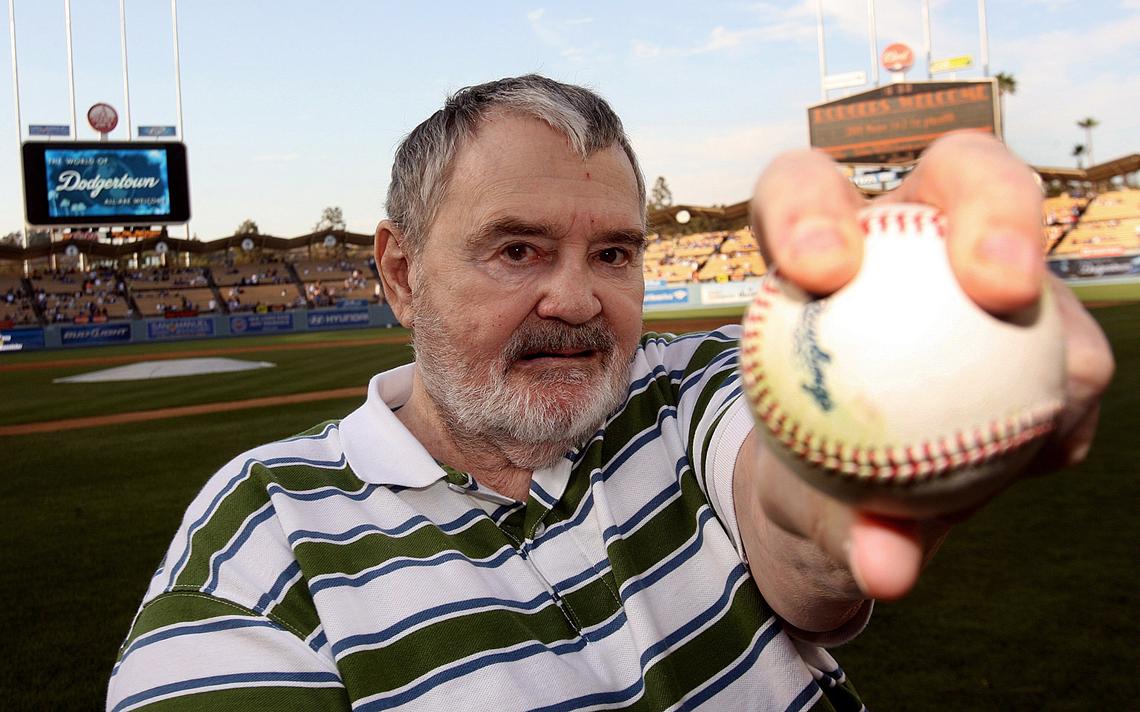
Steve Dalkowski, as he appeared at Dodger Stadium in July, 2009, before a first pitch ceremony. (Photo by Keith Birmingham / San Gabriel Valley Tribune / Zuma Press / TNS )
Dalko: The Untold Story of Baseball’s Fastest Pitcher
Dalko: The Untold Story of Baseball’s Fastest Pitcher
The authors: Bill Dembski Alex Thomas Brian Vikander
The publishing info: Influence Publishers $26.95 304 pages Scheduled for release Oct. 27, 2020
OPENING SCENE: EXT. NIGHTTIME – HIGH OVERHEAD SHOT: The headlights from a caravan of four worn-out, late-model 1950s station wagons are snaking their way down a dirt road through the Utah desert. Zoom in to see a car with members of Class A Tri-City Atoms, a lowest rank of minor-league farm teams belonging to the Baltimore Orioles, as they are driving back to their home base in Kennewick, Washington. There is no team bus. The team can’t afford one. This is how they travel to games. STEVE DALKOWSI,age 26, in his eighth and final year of his professional career, is sitting in the middle of the back seat, still in uniform and cap. He is downing bottles of beer. He throws an empty bottle out the window, missing a teammates’ head, before he cracks open another one from the case down between his legs. On the car radio, the “Joe Garagiola Sports Show” is playing. The host says that the show tonight will be about “the legendary Steve Dalkowski.” RADIO VOICE: “I don’t expect you to know who this person is, but you should understand his importance to professional baseball.” CLOSE UP OF DALKOWSKI:Belch, another bottle out the window. The driver of the car, a 22-year-old who looks to be about 15, asks the others to quiet down so he can hear the show. TIM SOMMER,in the backseat next to Dalkowski, elbows his teammate in the ribs. “Hey, Steve, they’re talkin’ about you.” CLOSE UP OF DALKOWSKI rolling his eyes. RADIO VOICE: “Dalkowski is said to have delivered the fastest pitches in baseball history – some say more than 110 miles per hour. Astory in the July 1960 issue of Time magazine made mention of him as the ‘hardest thrower in organized baseball’.” DALKOWSKIlifts his beer as a toast and nods. His teammates around him cheer. RADIO VOICE:“But he was known to be, how can we say this, just a little wild. He once threw a ball through a backstop screen on a wild pitch, scattering the fans.” DALKOWSKInods again. His teammates roar in approval. RADIO VOICE:“In one minor-league game – the second game he ever pitched in the pros – he ripped the ear off a batter after his pitch hit the guy in the head!” DALKOWSKIscrunches up his face. DALKOWSI: “I didn’t rip the guy’s ear off. I just hit him on the earlobe and there was a lot of blood!” Teammates cheer again and high-five each other, realizing they are in the midst of a baseball legend.
If someone ever does get around to making a movie about the life and times of Steve Dalkowski, they can use the above – taken straight from Chapter 14 in this new book. The story comes from former teammate Tim Sommer, whose 2014 book, “Beating About the Bushes: Minor League Baseball in the ‘60s” chronicles stories about his eight-year pro career.
Sommer was a 22-year-old teammate of Dalkowski on that 1965 roster, on his way up the ladder of the minor-leagues while Dalko was in a free fall from any more chance at fame.
The sad irony is that Garagiola was talking about Dalkowski in the past tense. But there was the man himself, listening to the show in what could have sounded like Tom Sawyer at his own funeral. If he was sober enough to understand it all.
Continued on page 166:
“Steve’s teammates were of two opinions about him by now. On the one hand, he stayed drunk and embarrassing much of the time. He was taking up a valuable slot in the rotation and also a place on the team roster. On the other hand, he was the friendliest and most honest person any of them knew. He still borrowed heavily between paydays, then every two weeks he would ask each player what he had borrows and return it on payday without questions. The wives of married players couldn’t believe the wild man they heard about was the quiet, polite Steve Dalkowski they met. At dinner at one player’s house, Steve was a good conversationalist, drank frugally, and absolutely charmed all the ladies. The wives later accused their husbands of being jealous so Steve’s polished personality.”
To get a true personality profile of this baseball legend – a label applied by Garagiola – it has taken a team of three writers, researchers and interviewers to piece the Dalkowski story together. Regrettably, it comes just five months after Dalko’s passing, a COVID-19 related death, at age 80 at a group home in his native New Britain, Conn.
As authors Dembski, Thomas and Vikander explain, each tapped into their own strengths to make this four-year project come to life, one they call “exhilarating and exhausting.” Dembski, author of more than 20 books with doctorates in math and philosophy as well as a Master of Divinity in Theology from Princeton Theological Seminary, adds the soul into the project as he developed the idea as he was curious about the science of pitching. Dembski had worked with Thomas, who had ghostwritten and co-authored some 20 books himself on a variety of subjects. They collaborated on “It Takes Ganas: Jamie Escalante’s Secret to Inspired Leaning” in 2016, based on the life of the high school math teacher from East L.A. Vikander comes at this as a pitching coach for 30 years in mental skill preparation and mechanics, working with former MLB pitcher Tom House at USC in bio-mechanics. Vikander is also a world-traveled photojournalist.
Driven to clarify myths that have often been passed along as facts, and plug facts into the holes that have existed for decades, the trio came to discover there had been no real in-depth research project done on Dalkowski despite several start-and-stop attempts at other books and movies, which were based a few long-form magazine pieces that seemed only to perpetuate inaccuracies for the sake of sensationalism.
Was Dalko the fastest pitcher of all time? There were no real accurate measurements, despite some flimsy attempts, to put a number on his fastball’s top speed. Only those who once hit against him and those who tried to catch him can express what it was like with a rough estimation.
What kind of special delivery or dexterity did this man of somewhat average size and weight have to result in this somewhat inhuman act? There exists no film or reliable description of his windup. “How the greatest arm in history could have escaped being captured in motion seems inexplicable,” they wrote on page 70. “Yet the effacing effects of time have worked their magic in scrubbing any video of Dalkowski.”
Even so, that “wasn’t a deal-killer for this book,” the authors admit. “The heart of the story wasn’t a technical analysis.” For that aspect that still fascinates some, they were smart enough to move that material to a complimentary website, http://www.DalkoBook.com, where they plan to catalogue such information.
Instead, these three are intrigued by how Dalkowski “combines mortality and myth … his story has it all: zenith, nadir and everything in between.” It then plays out like HBO’s “Eastbown and Down” meets the Loch Ness Monster, a too-good-to-be-true talent unfilled if only for the time it occurred — before the investment in mental coaches or Tommy John surgery — and the inability of those around him (including a long run with future Hall of Fame manager Earl Weaver or future Hall of Fame GM Pat Gillick as his roommate) to solve his demons. And to disprove the idea that he had a low IQ, except for an unwise decision to hang out too much with minor league teammate Bo Belinski at one point. Yes, once he even tried wearing glasses.
The introduction by former MLB fireballer Sam McDowell helps set a nice tone to where this book will go, having seen Dalkowski up close and now in the field of coaching such things that fix some of those pitching mechanics. McDowell is one of several “I saw it” contributors to the book that give the story a new voice. We find out more why Dalko was a very mild-mannered, quiet, self-effacing “choir boy” who transformed “into a human rocket launcher.” It wasn’t just the speed of his pitches, but the sound it created that turned heads – a buzz, a sizzle, a crackle – that had the illusion his pitches rose as they came into the batter (when truth is, they were thrown so hard, they rarely dipped as gravity is apt to cause).
We come across new true stories — Dalkowski’s time in Mexico (once with teammate Boog Powell as they dated Connie Stevens and Angie Dickinson!), his high school football fame, and more about his sad post-career journeys. Also, in piecing together accounts and box scores from local Hartford, Conn., newspapers, as well as those cities from his travels in the minor leagues, there is finally a reconstruct of game facts to verify – yes, there was once an 24-strikeout, 18 walk game that he won 7-5, but that may not even be the craziest – as well as track down childhood friends, former teammates and even his first wife to add far more context than what we assume was the wild idea for Ron Shelton’s character, Nuke LaLoosh, in the movie “Bull Durham.”
But wait, there’s more feats of Ripley’s that come to light — on page 37, a time when he was pitching in an exhibition at a fair near his home while in high school with two other local prep stars. Consider this as another scene in the Dalkowski movie:
“When his turn came, Steve threw a rocket that went over the catcher’s head, over the backstop and disappeared into the distance. A few minutes later a surprised and upset man walked into the nurse’s station at the fairground. He explained that he had briefly stopped into the woods to take care of some personal business and suddenly felt a sharp blow in his back. He’d heard no one, and nobody seemed to be around. Then he saw a baseball roll to a stop beside his feet. To prove his story, he held up the offending ball and lifted his shirt to show a big welt on his back. He wasn’t seriously hurt. Evidently neither he nor the nurse ever pieced together — or could have imagined — the whole scenario.”
Dalko never made it to the major leagues, hurting his left money-maker in a final 1963 exhibition game for the Orioles against the New York Yankees in Miami after striking out Roger Maris and Elston Howard, who wanted no part of him. Earlier that spring, he struck out the Dodgers’ Bill Skowron, Wally Moon, Maury Wills, Tommy Davis and Don Drysdale in an exhibition — and even got a hit off Drysdale – during three hit-less innings.
By then, Topps already had him on a baseball card, No. 496, shared with the Dodgers’ Jack Smith and the Angels’ Fred Newman. The stats on the back of the card should have been a red flag about the trials and tribulations of Dalkowski to that point: A career 26-62 record with 1,099 strikeouts and 1,136 walks in 697 innings over 158 games, supported by a 6.15 ERA. No mention of the season records he had set in various leagues for wild pitches.
What added up to become Dalkowski’s final BaseballReference.com statistical profile is even less impressive.
Here, we finally get a full-framed shot of the Dalkowski experience. We were fortunate as well to help journal his journey, when in 2009 he came to Los Angeles on what was likely his final road trip to accept induction into the Baseball Reliquary’s Shrine of the Eternals, and have Shelton give his induction speech.
It was a glorious trip for Dalkowski, who also threw out a ceremonial first pitch at Dodger Stadium – a place that at one point was to be a proving ground that he could still be of service to someone in his late 20s as team after team was releasing him or turning him away. A Dodgers tryout camp was there in the early 1970s. Dalkowski never made it there.
At a time when Dalkowski’s tour through the minor leagues will all sorts of failed achievement — his lack of confidence, inability of coaches or managers to resolve his mental issues, and his alcoholism that always sidetracked any confidence he could instill into those in the front office trying to decide on how long to wait for his overnight success — it’s also interesting to picture his trajectory at a time that went parallel with Sandy Koufax’s Dodgers career. Koufax finally figured things out en route to a Hall of Fame career. Dalkowski never did. His journey through the Knoxville Smokies and Aberdeen Pheasants gave him a chance to pitch only once in a major-league park, at Baltimore’s Memorial Stadium, in the ninth inning of an exhibition game against the Cincinnati Reds — striking out Alex Grammas, Dee Foudy and Don Hoak on 12 pitches. The Angels had a chance to take the exposed Dalkowski in the 1960 expansion draft, but passed.
And that’s the story that finally gets told, in as total as possible, here for us to ponder “What if?” with as much new information, insight and context as could be extracted. Like the time Dalkowski struck out then No. 1 overall draft pick Rick Monday in a 1965 minor-league game, screamed at Monday about the money he reportedly signed for, and Monday had to restrain himself from charging the mound. Dalkowski was released by his team after that contest, tried to come back later at an Angels’ minor-league camp in Fullerton, got released again …
We could read these stories on and on …
How it goes in the scorebook
We may be a little biased but this book is an incredible read and we cannot wait for it to be in the hands of other baseball enthusiasts like ourselves. This will be the perfect fall read for you too; pre-order your copy today! https://t.co/L67jvchXKl
The story goes on page 41 that one high school scorekeeper during Dalkowski’s prep days left his scorecard “chock full of scribbled symbols that showed balls, strikes, walks, Ks, HBP, errors, players advancing on wild pitches and an occasional hit.”
We’ll go with that assessment, but tie it together with a complete-game account. Or as complete as one can be.
Don’t be a speed reader through this. Enjoy the journey through newspaper archives, first-hand accounts from those who remember and don’t need to exaggerate, and the dispelling of myths and half-truths.
More stories on Dalkowski, reference in the book
= From Ron Shelton, in the Los Angeles Times, from July 2009: “Stuff of Legends” which included this last paragraph: “He had it all and didn’t know it. That’s why Steve Dalkowski stays in our minds. In his sport, he had the equivalent of Michelangelo’s gift but could never finish a painting.” = From George Vecsey in the New York Times also in July, 2009 as Dalkowski was to be enshrined in the Hall of the Eternals: “A Hall of Fame for a Legendary Baseball Pitcher” = From Richard Goldstein in the New York Times – the Dalkowski obituary in April, 2020, as part of a series about people who have died during this coronavirus pandemic. = From Tom Verducci for Sports Illustrated on the death of Dalkowski in April, 2020 = From Joe Posnanski for NBCSports.com: “How Do You Solve a Problem Like Dalkowski” = From Pat Jordan for Sports Illustrated in 1970: “The Wildest Fastball Ever” which included a myth about Ted Williams facing him in batting practice that could not be verified. = From Don Amore in the Hartford Courant in May, 2019: “Face to face with Steve Dalkowski, and baseball’s timeless tale”
From our own archive
From own own archive, obtained in 2009 at Dodger Stadium.
The fragile fable of Steve Dalkowski takes a wonderful, curious detour through Hollywoodland this weekend, and nearly 50 years later, even those who make movies still can’t figure out what to believe any more about his life. Based on a true legend? That might be the only thing you read beyond this point that actually can be verified. Baseball’s quirkiest historians have embraced any archeological digs related to the man once referred to as “White Lightning,” tormented by a nine-year minor-league career so hell-bent that screenwriter Ron Shelton couldn’t help but use pieces of Dalkowski lore as the inspiration for the Tim Robbins character, Nuke LaLoosh, in the 1988 classic “Bull Durham.” A fresh chapter of the Dalkowski epic is added Sunday, when the Pasadena-based Baseball Reliquary inducts him, along with Roger Maris and Jim Eisenreich, to their fan-friendly Shrine of the Eternals in a ceremony scheduled at the Pasadena Central Library. Shelton will introduce Dalkowski to the audience. The eclectic group relishes those who have made the game fun, memorable and inspiring, many of whom are overlooked by the Cooperstown version on the other coast. Maris, you know. Eisenreich, you should remember. Dalkowski, once you get started on him, you never forget it. You simply elaborate. He’s Hall of Fame material
– – –
The hard stats show that, between 1957-65, Dalkowski put up a miserable 46-80 record in the minors, with a dubious 5.59 ERA. In 995 innings, he struck out a phenomenal 1,396. And walked an egregious 1,354. And hit 37 batters. With 145 wild pitches. He threw only 24 innings in Triple-A. According to one story author Pat Jordan had in his book, “The Suitors of Spring”: In 1958, Ted Williams spotted this 5-foot-11, 170-pound left-hander — a shy teenager fresh out of high school with the Baltimore Orioles’ organization — throwing in a Miami, Fla., spring-training camp. The Red Sox legend got into the batting cage, signaled for Dalkowski to pitch — and then admitted he didn’t even see the ball that whizzed past his chin. Williams dropped his bat and vowed he’d never face Dalkowski again if he didn’t have to. Did it happen? Doesn’t matter. Dalkowski never made it to a big-league game. So curious were the Orioles about this insecure prospect’s abilities (and marketability), they took him to an Army base to try to see how fast he really threw. It was from flat ground, and he had just made 150 pitches the night before. Still, he hit 93.5 mph on the contraption they’d set up, but all who were there knew it was a failed experiment. In an era where there were no radar guns but only educated guesses, Dalkowski still is considered to be the hardest thrower in baseball history. People such as his minor-league manager, Earl Weaver, insist it’s accurate. According to some estimates, whatever Dalkowski could see squinting through his glasses, his pitches would reach 105 mph. Or 110 mph. Or more. “Once, they told me it was 120,” Dalkowski said. “Can you believe that? I didn’t believe it either until the guy timing me said, ‘You threw 120.’ I said, ‘You’re crazy.’” That fact, Dalkowski seems to easily remember. He conveyed it during a conversation over the phone this week before he flew out to L.A. It’s just that, as hard as he threw, he had an incurable lack of control. Tragically, Dalkowski also could have been one of the game’s hardest drinkers. Again, uncontrollably.
– – –
Alcohol abuse, and the dementia that resulted from it, drove Dalkowski into a darkness that few ever emerge from, left him brain damaged and destroyed much of his ability to corroborate any of these tallish tales about himself. He tries. But the connections are tough to find. Adding to his bizarre story, after he left the game, he became a migrant farmer in central California for a long time in his adult life. He has been married and widowed, once living north of Bakersfield in a town called Oilville, he he often can’t recall his former wife’s name, Virginia. A baseball assistance team finally tracked him down to offer help, but found he was spending their money on more booze and cut him off. By some miracle, he made it to his 70th birthday last month, having spent the past 15 years in the Walnut Hill Care Center near his birthplace of New Britain, Conn. The facility is about a 10-minute drive from the home of Dalkowski’s only sibling, Patti Cain, a sister four years younger and once estranged. A hospital administrator, Patti is the self-proclaimed “biggest baseball fan who’s ever walked the face of the Earth” and a Boston Red Sox supporter since she was 6 years old. Just don’t get her started on what she thinks these days of Manny Ramirez. The fact Dalkowski is alive and somewhat well at this point is news. Many assumed he’d simply disappeared, last seen on a ballfield in San Jose, the California Angels’ Single-A affiliate, before flaming out. Some remember the headline in The Sporting News upon his exit in 1966: “Living Legend Released.” Before this latest journey was approved by Dalkowski’s doctors, Patti says the last time her brother was in Southern California was in the early ’90s, when she found him at a halfway house in Hawthorne, after he’d received treatment and a health diagnosis at a Los Angeles hospital. Dalkowski abruptly left the Hawthorne facility, and was found four months later at a laundromat in Glendale. He moved with his wife to Oklahoma City a year later, and, after Virginia’s death, Patti eventually found him there and brought him back to Connecticut, where he could get a final shot at treatment. “The doctors once told us he’d only have a year to live, so how remarkable is it that he’s here and has a run of the place?” Patti said from the care facility. “Of course, some days are better than others. Same with me. When he wants to talk baseball, he’s still full of stories. But nothing’s easy. He’s laying down now. He needs his rest.” Patti said her brother receives constant mail from all over the country, inquiring about his health and asking for an autograph. The owner of the local Minnesota Twins’ minor-league affiliate, the New Britain Rock Cats, is a former teammate of Dalkowski and invites him out frequently.
– – –
A brief Q-and-A with Dalkowski over the phone continued: How have you been feeling these days? “Pretty good. I try to go to ballgames, work around the yard, see a lot of family. I don’t know.” Are you able to understand what this honor by the Shrine of the Eternals is all about? “Sorta. I don’t know. It sounds pretty good.” What memories to you have most about your baseball career? “Well, when I was goin’ good, I don’t know. The good times. The guys. I remember the guys.”
– – –
A new book is in the works on Dalkowski’s seemingly larger-than-life existence. A crew making a documentary on him will be at Sunday’s ceremony and put the finishing touches on a project that started 17 years ago. To date, no one has uncovered any kind of film of Dalkowski pitching. In a way, he’s almost like a Sasquatch sighting. What do you believe? Did he really exist? The Shrine of the Eternals had Dalkowski on its ballot for 10 previous years before its members voted him in this past spring. “Maybe that was a blessing,” Baseball Reliquary curator Terry Cannon said. “If this was five years ago, there’s no way his health would have allowed him to come out. Eleven years ago, I’m not sure we’d even know where to find him.” Friday, there he was – “Stevie,” as Patti loves to call him – getting out of his wheelchair and standing on the Dodger Stadium infield, throwing out the ceremonial first pitch after arriving by cross-country plane just hours earlier. Today, the brother and sister act plans to do some sightseeing. Sunday, Dalkowski receives his loving induction. Monday, he’s back home, hoping to remember much of what’s happened to him these past few days so he can tell everyone who continues to take care of him. And, truth be told, those who’ll see him now won’t soon forget it.
Fact or fiction: Among the embellished tales – some actually documented – about Steve Dalkowski’s pitching career that started in 1957, at age 18, in the Baltimore Orioles’ Class-D team, and ended in 1965, at age 26, with the Angels’ Single-A San Jose squad:
==In high school, he had an 18-strikeout, 18-walk no-hitter. ==On Aug. 31, 1957, in an Appalachian League game, he struck out 24, walked 18, hit four batters, threw six wild pitches, and lost 8-4. ==In one Northern League game, he threw a one-hitter, striking out 15, but walked 17 and lost 9-8. ==In the California League, he threw a four-hitter, striking out 19, and lost 8-3. ==In an extra-inning game in the Eastern League, he struck out 27 and walked 16, throwing 283 pitches. ==One time he was pulled in the second inning after throwing 120 pitches. ==A Dalkowski pitch once tore off part of a batter’s ear. Another time, he struck a batter on the helmet and the ball rebounded to second base. ==In one game, Dalkowski threw three pitches that penetrated the backstop screen, sending fans scattering. ==On a bet, Dalkowski fired a baseball through a wooden outfield fence. Also on a bet, he once threw a ball from second base over the roof of a clubhouse beyond the center-field fence. – Source: Hardballtimes.com
A sidebar to that story posted on insidesocal.com/TomHoffarth that was used as a reference in the new “Dalko” book:
If there’s someone who deserves more than a little credit in helping Dalkowski reach a point to where his current health condition is far better than it was years ago, it’s Tom Chiappetta and his pursuit of trying to tell the Dalkowski story. The executive director of the Fairfield (Conn.) County Sports Commission had left his job as a media relations director at Fox Sports Net in 2005 when he decided he wanted to try to finish a documentary he had started a decade earlier on Dalkowski’s life. The project goes back to when Chiappetta was working at an Equitable Old Timers game in Baltimore, where he was, as he said, “an unofficial Orioles historian, as well as a memorabilia collector” who knew of Dalkowski’s story — and the fact they are both Connecticut natives. He brought up the documentary idea to a former Orioles catcher, Frank Zupo, who happened to be one of Dalkowski’s friends and teammates from his days in the minor leagues. Chiappetta contacted a film production partner about the idea, and, with Zupo, they flew to Oilville, California, just north of Bakersfield, to meet with Dalkowski and his wife, Virginia, in August of 1991. “We interviewed him, talked with both of them and before we left, Frank ultimately asked them if Steve wanted help,” said Chiappetta, noting that Dalkowski was in trouble with alcohol abuse. “He said he did.” Chiappetta and Zupo contacted the Baseball Assistance Team (BAT) to get him initial help, which started with having Dalkowski hospitalized in Los Angeles in Oct., 1991, to start with getting him nourished properly, diagnose his ailments, and begin detoxification — which lasted three months. Dalkowski was then sent to a halfway house in Hawthorne called the Rickman Center — but in late ’92, he walked out and disappeared for about four months. A woman in Glendale found him in a laundromat, got enough information from him to contact his wife, and the Rickman Center, and he was readmitted. Eventually, he moved to Virginia’s hometown of Oklahoma City in Jan., ’93. When Virginia suddenly passed away, Dalkowski’s sister, Patti, went out and brought him back to his home in New Britain, Conn., in 1994, entering him into an extensive care facility where he’s been the last 15 years. And that’s what laid the groundwork to Dalkowski’s current rehab and his unlikely arrival back in L.A. this weekend — a first visit to Southern California since his days at the halfway house, and throwing out the first pitch at Friday’s Dodgers-Astros game at Dodger Stadium.
Update: Only 30 years in the making, Chiapetta has finished his documentary, and it will debut Saturday, Oct. 10, on Connecticut Public TV (7 p.m. EDT/4 p.m. PDT). The premiere can be views nationally on streaming at this website. Connecticut Magazine has a story on the film linked here.










 Tom Hoffarth's The Drill: More Farther Off the Wall