Extra inning baseball book reviews for 2020: Glenn Burke, high-five alive, for kids who need to know his story

ee0683a2a627d5abc510a861a6ea4a9c
On the last day of the 1977 season, Glenn Burke, left, gives Dusty Baker what’s documented as the first “high-five” celebration, after Baker’s home run that gave him 30 for the season. Burke then came up and homered, the first of his too-short big-league career. (Associated Press)

“A High Five for Glenn Burke”

9169iA5AGHL
The author:

Phil Bildner

The publishing info:
Farrah, Straus and Giroux/MacMillian
For ages 10-13/Grades 5-7
$16.99 hardcover
$7.99 paperback
288 pages
Released February, 2020

The links:
At the publisher’s website
At Amazon.com
At BarnesAndNoble.com
At Powells.com
At Indiebound.org
At the author’s very cool website

The review in 90 feet or less

My two kids are a couple decades removed from this early-teen age range, yet I never stop wondering how a middle-schooler purposefully navigates today’s world with everything thrown at them.
BBURKE
Glenn Burke (Associated Press)

We remember some of our own experiences in the 1970s. We saw our own son and daughter work through the trial-and-error stages at their own pace, with school as a foundation and sports/dance/clubs/music as an extension of finding path to what interested them. This is on top of having divorced parents. They might not have realized how they were figuring out lessons about becoming more independent while realizing the benefits of teamwork, how individual achievement can be enjoyed when looking back at the ways hurdles were overcome in the process. There’s self esteem and empathy and all those esoteric things that later would have far more defined labels, but at this point, were just concepts to wrestle with.

In 2020, how might a kid process such adult-based media concept about the increasing acceptance amidst the stigmas that continue to push back about an LGBTQ “authentic” existence? What do kids in this age range stumble upon watching YouTube or social media that affects their thinking and image?

The way author Phil Bildner finds an entry point into this topic for this age group, having done noteworthy work with his baseball-based “Sluggers Book” series (2009-’10) for age 8-12, is through a multi-layered baseball story.

Dodgers followers who may know various elements of the Glenn Burke story — the athletic center fielder with star potential who was on the 1977 NL pennant-winning roster, but then oddly traded to his hometown of Oakland in the middle of the ’78 season to his teammates disappointment. He was out of the game after four MLB seasons. Burke’s sexuality was acknowledged and accepted by many of his Dodgers teammates, but not by management.

9780698196612In 1995, Burke was able to work with writer Erik Sherman to author his autobiography, “Out At Home: The True Story of Glenn Burke, Baseball’s First Openly Gay Player.” Burke died that year, in May, at age 42. More about Burke’s life and times can be found in OutSports.com, a 2010 documentary, “OUT: The Glenn Burke Story” produced by Doug Harris, and a marvelous 2014 story in the New York Times by John Branch. An ESPN “30 For 30” film “The High Five” directed by Michael Jacobs is also in circulation.

In Bildner’s novel, sixth-grader Silas Wade is already navigating the rapid-paced life of a mom who just started a coffee house but practices “self care” and a dad with tight schedule as a CPA. His two younger sisters also demand attention – especially one with special needs. He find comfort in the friendship of a classmate, Zoey, a member of the school’s robotics team, as they juggle schedules, share rides to practices and events, and become intertwined in their successes and failures.

Introducing Burke into Silas’ world as the subject of a school presentation – who invented the high five? – also gives Silas a starting point to see how he feels about what Burke endured as a baseball player, and afterward. Silas wears No. 3 on his baseball team – like Burke (but also as a nod to Benny “The Jet” Rodriguez from the movie “The Sandlot,” who, in the sweet ending to the flick, also ends up playing for the Dodgers).

Bildner doesn’t sugar-coat any of the Burke facts – pointing out how Dodgers general manager Al Campanis tried to pay him to get married, and how managers  Tommy Lasorda and Billy Martin dealt with it in their own insecure ways. In pulling from stories and books done about Burke, Bildner builds the story.

By chapter 8, Silas is already struggling with how to tell Zoey about his feelings. Continue reading “Extra inning baseball book reviews for 2020: Glenn Burke, high-five alive, for kids who need to know his story”

Extra inning baseball book reviews for 2020: In hindsight, Hynd’s reward for remembering the end of Ebbets Field is a salad bowl of information

last game ebbets
Gil Hodges approaches the plate in this May 30, 1955 game between the Dodgers and the Pirates at Ebbets Field. The Dodgers would win their only World Series in Brooklyn that year. Two season later, they moved to L.A. (John C. Wagner/National Baseball Hall of Fame and Museum)

“The Final Game at Ebbets Field”

71HDgsm9SLL

The author:
Noel Hynd

The publishing info:
Red Cat Tales Publishing LLC/Los Angeles
241 pages
$14.95
Released June, 2019

The links:
At Amazon.com
At Powells.com
At Indiebound.org

The review in 90 feet or less

From what we’ve come to find out about Noel Hynd — piecing together bios of him on the Internet Movie Database (imdb.com), something called the FantasticFiction.com site, more from Amazon.com’s author info, a touch more from Encyclopedia.com, and another tale spun on GoodReads.com — we’ve got something of a good read on this prolific writer, born somewhere between 1947 and 1952, far more known in the world of fiction novels, New York born and now based in Culver City.

From what we really don’t know about the last game played at Ebbets Field – a Baseball Hall of Fame story notes the end “came quietly, with just 6,702 fans watching … the cheers, however, resound to this day” — added up to a 2-0 Dodgers win on Tuesday, Sept. 24, 1957, with someone named Danny McDevitt going the distance. The two-hour, three-minute exercise seemed to be a bit of a footnote to the history of the place.

It wasn’t the last games played by the Brooklyn Dodgers. They went to Philadelphia, lost two of their last three, and polished off a 84-70 season, 11 games behind NL champion Milwaukee.

With those two points on the map, the intersection of Hynd and Dodger history in these self-published pages is an odd burst of non-conformist confusion, inspiration and, when we’re done, splendid bliss.

It’s also award worthy. Continue reading “Extra inning baseball book reviews for 2020: In hindsight, Hynd’s reward for remembering the end of Ebbets Field is a salad bowl of information”

Extra inning baseball book reviews for 2020: Zen and the art of believing that baseball is Buddhism, and baseball is ourselves

Buddha-Fenway-1024x683
Buddha in the dugout/Photo by Gary Baldwin. From Tricycle.org: “Are The Cubs America’s Buddhist Baseball Team?” from 2016 (after they won the World Series. Finally).

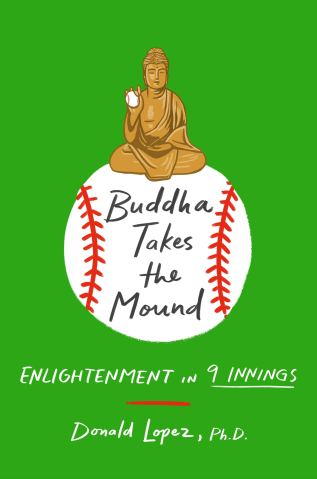
“Buddha Takes the Mound:
Enlightenment in 9 innings”

71wl09CbkPL
The author:

Donald S. Lopez Jr., Ph.D.

The publishing info:
St. Martin’s Essentials/Macmillan
$19.95
192 pages
Released today, May 5

The links:
At the publisher’s website
At Amazon.com
At BarnesAndNoble.com
At Powells.com
At IndieBound.org

The review in 90 feet or less

From this rather cosmically whimsical cover, it might not reveal to us that Lopez is kind of a big deal in the Buddha world. Wikipedia kind of big,  if that actually supersedes Encyclopedia Britannica largeness.

200072132The Arthur E. Link Distinguished University Professor of Buddhist and Tibetan Studies at the University of Michigan, and part of the Department of Asian Languages and Cultures, Lopez received a BA in Religious Students in 1974, an MA in Buddhist Studies in 1977, and a doctorate in Buddhist Studies in 1982 at the University of Virginia. He is married to another prominent Religious Studies scholar, Tomoko Masuzawa.

Lopez is also referred to as the “only public intellectual in the field of Buddhist Studies.” Can we assume most of them are pretty quiet people otherwise?

The takeaway from Lopez adding to the betterment of our humanity, aside from this piece, is the mind-blowing idea that not only is Buddhism integral to baseball, but baseball is Buddhism, and baseball is ourselves.

If only we could spend all day in the on-deck circles talking in circles about this.

Baseball is about suffering and failure. A public display of errors documented in the media. Relief pitchers are rewarded for averting disaster. There are all sorts of connections in the metaphysical world. Continue reading “Extra inning baseball book reviews for 2020: Zen and the art of believing that baseball is Buddhism, and baseball is ourselves”

Extra innings past 30 in new baseball book reviews for 2020: Fitts’ fitting tribute to Japanese immigrant baseball has a clear L.A. connection

IMG_0341

“Issei Baseball: The Story of the
First Japanese American Ballplayers”

81Gr3LlSaFLThe author:
Robert K. Fitts

The publishing info:
University of Nebraska Press
$29.95
344 pages
Released April 1

The links:
At the publisher’s website
At Amazon.com
At BarnesAndNoble.com
At Powells.com
At Indiebound.org
At the author’s website

The review in 90 feet or less

Chapter 4, Page 37 begins a story about Los Angeles at the turn of the 20th Century. As this melting pot of a city incorporated in 1850, a year before statehood, continued to take shape, the Japanese population numbered fewer than 100 in 1890. By 1907, it was up to 6,000.

Nearly all these new residents were men. Known as birds of passage — deseki in Japanese — they planned to stay in the United States a short time, earn as much money as possible and return to Japan with enough money to purchase a farm of business and start a family. … Most were located around North San Pedro Street and First Avenue, an area that became known as Little Tokyo.

That’s also when a couple of students at USC — 25-year-old Seijiro Shibuya and 26-year-old Masaharu Yamaguchi — launched the Rafu Shimpo (Los Angeles Currier) in April 1903, written by hand and mimeographed, with offices soon to be at 128 N. Main Street, where City Hall now stands. It became a daily paper on Feb. 1, 1904.

“The writers were a young, rowdy bunch,” writes Rob Fitts, a former archaeologist with a PhD from Brown University who left academics to follow his passion of Japanese baseball. The writers often had to be awakened with hangovers after sleeping in segregated bathrooms, some sticking their heads into the dirty water of the toilet, flushing it, and ready to work again.

This matters why?

“On weekend afternoons, when they were not working, drinking or whoring, the young reporters played baseball,” Fitts tell us.

On May 17, 1905, the Japanese Baseball Club of Los Angeles is big enough to draw an article in the Los Angeles Herald. Continue reading “Extra innings past 30 in new baseball book reviews for 2020: Fitts’ fitting tribute to Japanese immigrant baseball has a clear L.A. connection”

Day 30 of (at least) 30 baseball book reviews for spring/summer 2020: Bouton, the final chapter … -30-

Author’s note: Updated 8.17.20 with new reviews posted on various media outlets:


cards1e
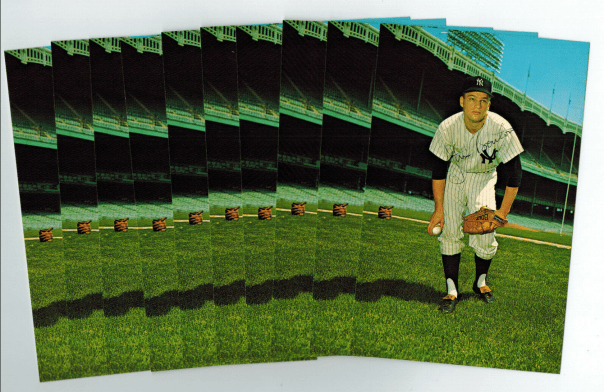
A ’64 Yankees Jim Bouton on a set of 10 Requena postcards, via eBay.com

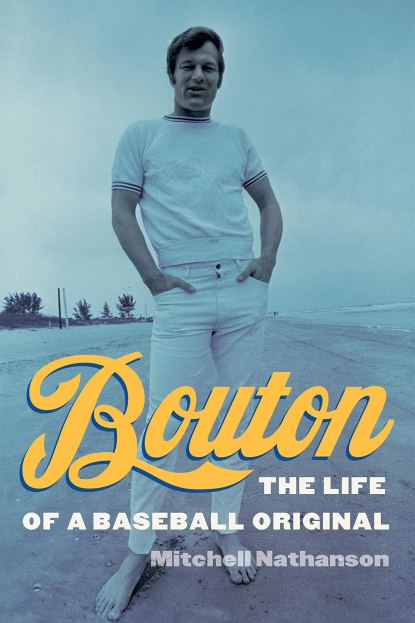
“Bouton: The Life of a Baseball Original”

911c8hBWIWL


The author:

Mitchell Nathanson

The publishing info:
University of Nebraska Press
$34.95
448 pages
To be released May 1

The links:
At the publisher’s website
At Amazon.com
At BarnesAndNoble.com
At Powells.com
At the author’s website

The review in 90 feet or less

It’s right in the middle of Chapter 14 – the one with the endearing heading of “Fuck You, Shakespeare.”

Mitchell Nathanson writes about how Jim Bouton and Leonard Shecter were tossing around potential titles for this new book they were writing about Bouton’s experience during the 1969 Major League Baseball season.

There were ideas like “There’s More to Baseball than the Score.” Or “Take Me out to the Ballgame,” “Hiya Baseball,” and “How’s Your Old Tomato?” There was the inspired  “Constant Replay,” a twist on the 1968 book “Instant Replay” that Dick Schaap did with the Green Bay Packers’ Jerry Kramer.

As Nathanson explains:

‘Sports books always had these upbeat titles, “Running to Daylight,” Bouton said … “You never heard of a sports book called ‘Running to Darkness.’ … But when a drunk woman at the Lion’s Head (a bar in New York) overheard Bouton and Shecter debating possible downbeat titles (the working title for the book as described in the publication agreement with World was ‘Baseball Journal’), she slurred her way to literary gold by suggesting a title that evoked failure rather than success: ‘Whyyyyy don’t you caaaaauuull it Baaaaallllll Fooooouuuuuuuuurrrrrr?’ After rejecting it out of hand, they realized she was onto something.

ca-times.brightspotcdn.com

It was a deja vu moment all over again.

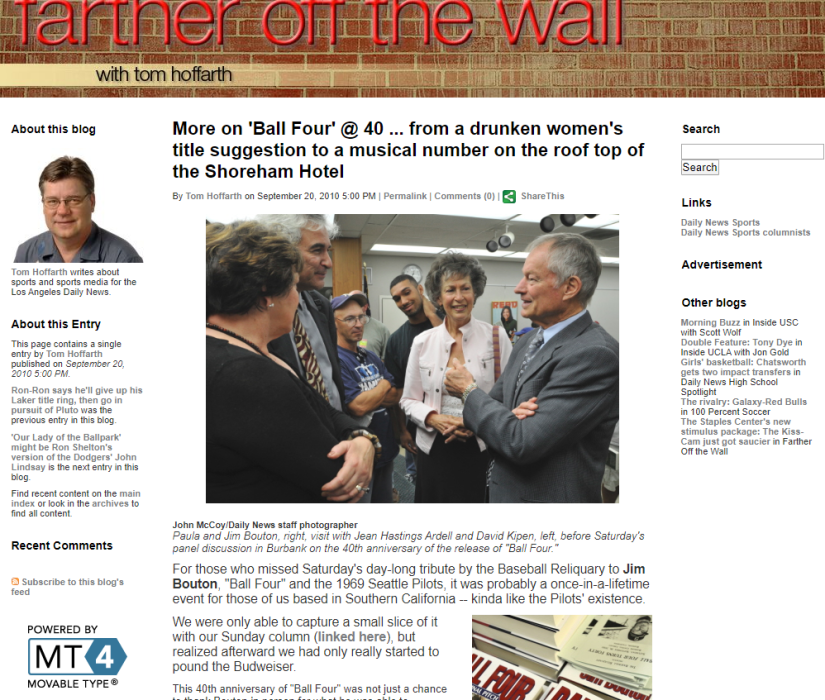
The paragraph included a couple of numbered footnotes, so we flipped to the back to the notes section and found Nathanson had two references: “Hoffarth, ‘More on “Ball Four” @ 40.”

Even further into the bibliography: “Hoffarth, Tom. ‘More on “Ball Four” @ 40 … From a Drunken Women’s Title Suggestion to a Musical Number on the Roof Top of the Shoreham Hotel.’ Farther Off the Wall with Tom Hoffarth, September 20, 2010, http://www.insidesocal.com/tomhoffarth.”

We were magically dumbstruck.

First, the link to that information no longer exists. The Southern California News Group erased it all shortly after my January, 2018 layoff. That was among thousands of paragraphs of original material – much of it we couldn’t fit into a standard 800-word newspaper piece. It was perfect for this platform. All the extra stuff. But some of it even stand-alone stories we could post. We’re resigned to the fact they’re all gone now. For whatever reason.

********

(Author’s note on May 23, 2020: Thanks to those who reminded us of the “Way Back Machine” website that captures snapshots of the internet at various times and is able to save things. We have found the link to this notated September 2010 post and are thrilled to read all the material we were able to include in this).

B4.2010.No1

**********

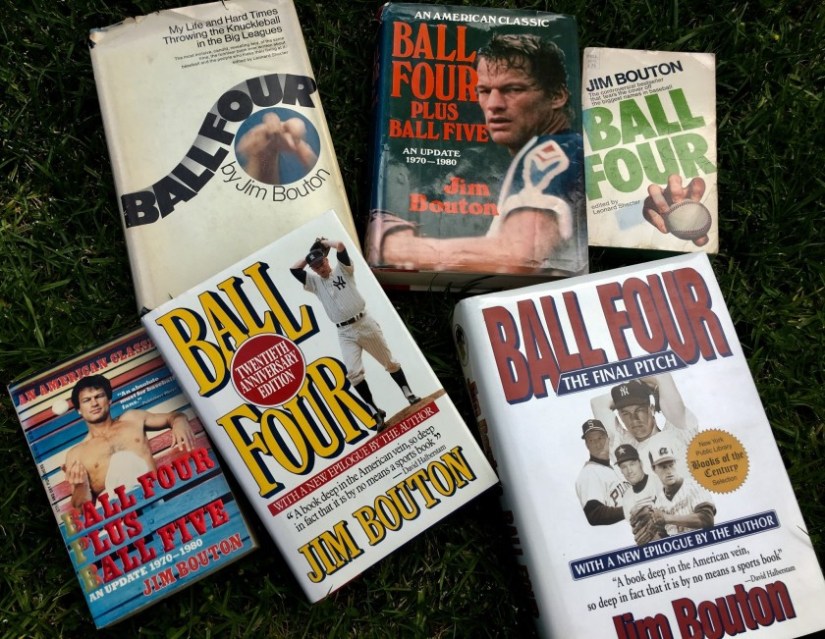
Second, we realized as well how emotionally frayed we were about this revelation. It was somewhat profound moment of how we’ve become enormously emotionally invested in Jim Bouton, again. If this biography that we expect to read, and re-read a few times, becomes as important enough to share the same shelf as all our personally signed versions of “Ball Four,” acting as a book-end to a man who became very much a sports hero in our own journey, this best be worth it.

However we can help make this something that smokes ’em inside, outside, and all around the strike zone.

LOOK MAG
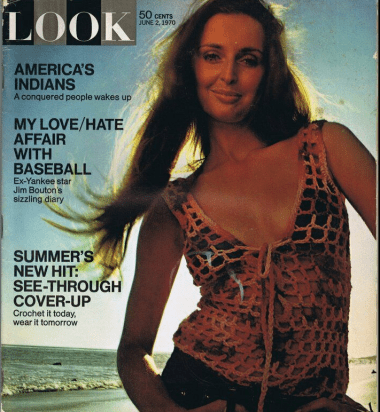
The June 2, 1970 issue of Look magazine, where the first excerpt of “Ball Four” was printed, and forced the early publishing of the book moved up from November because of the buzz created.

Nathanson, a Villanova University law professor who teaches writing at the school’s sports law center, was thankfully able to capture those nuggets of information we once posted — given to us directly from Bouton about the creation of “Ball Four” during a 2010 interview. Those notes are filed away, preserved as part of the “Ball Four” legacy. We were surprised that of all the tiems Bouton may have told that story, we had documented it and it was retrieved for this excavation.

As “Bouton: The Life of a Baseball Original” was one we’ve long awaited to read, review and learn from, we also came to the realization that it gives us the capability to remember.

Why Nathanson decided to tackle this project, there’s a personal connection as well as a curiosity as to to explore more about who he felt were the most influential ballplayers of the 1960s — Bouton, Dick Allen and Curt Flood. The later had some decent biographies about him. In 2016, Nathanson took it upon himself to rectify some of that with “God Almighty Hisself: The Life and Legacy of Dick Allen,” for University of Pennsylvania Press. The mercurial Allen, aka Richie, had been another of our MLB childhood favorites, if only because of the one year he played in L.A. for the Dodgers drove Walter Alston to demand he be banished to Chicago, where we saw him develop into an AL MVP and punctuate a career still missing Hall of Fame recognition in Cooperstown.

But with Bouton, Nathanson writes that he “was my white whale.” Continue reading “Day 30 of (at least) 30 baseball book reviews for spring/summer 2020: Bouton, the final chapter … -30-“