Day 24 of (at least) 30 baseball book reviews for spring/summer 2020: We’ve got more than 24 reasons to slot “24” here in our annual list …

MFBM5TREIVFWPKHN5HJKM2IMC4
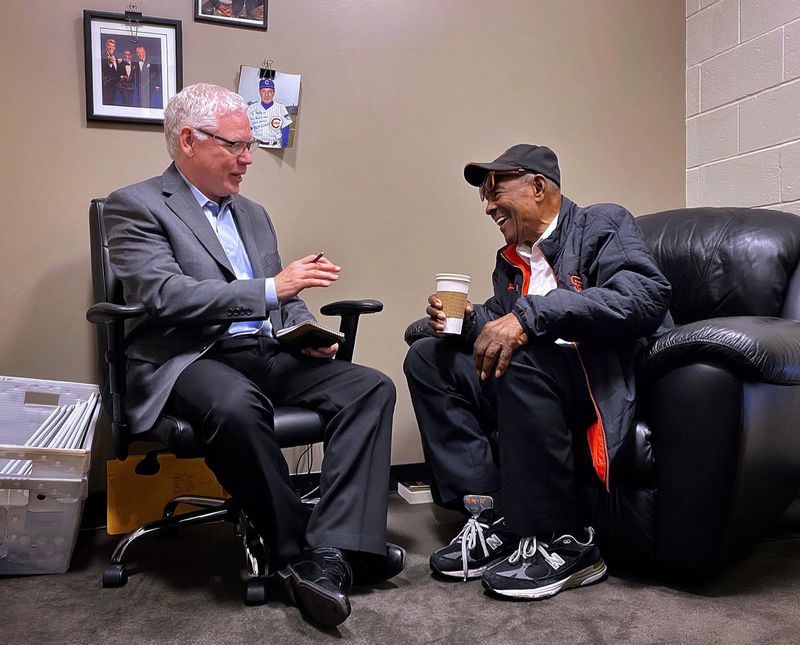
John Shea interviews Willie Mays in the Giants clubhouse on Feb. 3, 2020, at Oracle Park in San Francisco. (Photo by Brad Mangin/ via a book review in the Chicago Tribune in April, 2020.

“24: Life Stories and Lessons from The Say Hey Kid”

819Jk6f27YL
The authors:

Willie Mays
and John Shea

The publishing info:
St. Martin’s Press/MacMillan
$28.99
384 pages
To be released May 12

The links:
At the publisher’s website
At Amazon.com
At BarnesAndNoble.com
(The Barnes and Noble edition promises to have an exclusive issue of the book with additional materials)
At Powells.com
At IndieBound.org
At Shea’s website
At Mays’ website

The review in 90 feet or less

When Vin Scully is selling you on why he believes Willie Howard Mays was the best player he ever saw, you buy it.

Just as when a list is created to celebrate the 100 greatest MLB players in history, compiled by a very well-regarded scribe, and Mays comes up at No. 1, you pay attention.

If any Giant can become the center of attention at a Dodgers’ home game, it’s also Mays.

There’s a memory we have of going to Dodger Stadium in 1971 for a Giants-Dodger game on my dad’s birthday, May 25. Surely, I was far more insistent on him taking me than with this being his birthday wish, but it remains a father-son moment. And we couldn’t understand why the Dodgers – of all teams – would wheel a bunch of cakes out to home plate for Mays, who had just turned 40 a few weeks earlier on May 6.

This was to actually a way to acknowledge Mays’ 20th year in major league baseball.

11 71 mays dodger honor

(We asked Dodgers team historian Mark Langill if he had any evidence of this occurrence, and he, of course, quickly produced a program from that year that included the photo of Mays and explained more about the cake. I was too busy trying to piece together how the Dodgers lost that game — I have a vision seared in my head of Juan Marichal hitting a three-run home run off Bill Singer in the sixth inning that landed in the Dodgers’ bullpen and secured the win. Mays started that game. I remember that as well. …. Hey, is that “Dodger Way to Play Baseball” still available for a buck-fifty? And they consider it worthy  of selling at “any of the novelty stands”?)

So who are we kidding? Mays may no longer be a kid, but we can keep him that way as long as we wish, knowing that it’s been more than 40 years after his Hall of Fame induction.

Yet when a book that brings so much joy and positive energy in a time like this,  constructed in a way to rightfully discuss the merits of two dozen ways to improve your outlook on life as you know it, it’s more than just a giant achievement.

Sharing all this with Shea, a longtime San Francisco sportswriter and author, gives is structure and a path to success.

It’s the right book, at the right time, in this moment, that again puts a smile on the face of any baseball fan, or a fan of human beings. Continue reading “Day 24 of (at least) 30 baseball book reviews for spring/summer 2020: We’ve got more than 24 reasons to slot “24” here in our annual list …”
Day 23 of (at least) 30 baseball book reviews for spring/summer 2020: Why David Nemec still rules

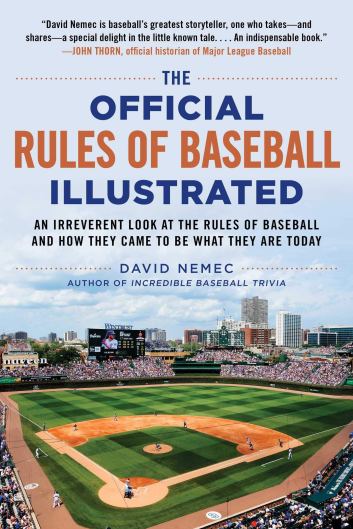
“The Official Rules of Baseball Illustrated:
An Irreverent Look at the Rules of Baseball and how they Came to be What They Are Today”


81PJl4AmEULThe author:

David Nemec

The publishing info:
Sports Publishing/Skyhorse Publishing
360 pages
$16.99
Released April 14

The links:
At the publisher’s website
At Amazon.com
At BarnesAndNoble.com
At Powells.com
At Indiebound.org

The review in 90 feet or less

David Nemec rules. Let’s call that a catch without any further review.

The Henry Chadwick Award winner by the Society of American Baseball Research is one of the most prolific baseball historians, often caught up in what can appear to be trivial matters but often they are launching points, connecting to stories that explain why we’ve gotten to this place.

51E8D975BNL._SX356_BO1,204,203,200_91s5SvDtb5LAs a Laguna Woods/Leisure World of Orange County 80-something resident who started publishing in the 1970s, Nemec has nailed us to the late-night reading lamp in previous years with “The Beer and Whisky League” from 1995, focused on the creation of the rebel American Association, as well as “The Rank and File of 19th Century Major League Baseball: Biographies of 1,084 Players, Owners, Managers and Umpires” in 2012.

We also use both volumes of his “Major League Baseball Profiles, 1871-1900” as light reading on a rainy day.

Nemec-David-Chadwick-200x248A playwright, novelist and former Ohio State University baseball player has so much of his own resource material handy that it’s no coincidence in this revised edition of the Illustrated Rules – it first came out in 1999 but hasn’t been touched since a 2006 version — he has himself mentioned in the index four times. Even that seems a bit too modest.

(A Dwight Chapin story for the San Francisco Chronicle back in 1997 shows the value of Nemec’s work way back yonder. Anytime we can bring Chapin into a conversation, we’re proud of ourselves.)

We should also note: We are not a rule follower, in the sense we tend to first question why that rule would be needed in a society, try to understand the logic, then accept it and, most likely, defend it to others who may doubt its usefulness.

With that, the general rule we have about baseball books is … none really, which makes a book about the rulebook even more profoundly entertaining beyond what we’d normally find when just trying to figure out the precise language of the infield fly rule. Continue reading “Day 23 of (at least) 30 baseball book reviews for spring/summer 2020: Why David Nemec still rules”

Day 22 of (at least) 30 baseball book reviews for spring/summer 2020: What’s the ballpark figure on how many connect Earth Day with a fond baseball green cathedral memory? Let’s read (at least) two

91hkl4d-s0L

“Ballparks Then And Now”

IMG_0080The author:
Eric Enders

The publishing info:
Pavilion Books/Rizzoli
160 pages
$22.50
Published in July, 2019

The links:
At the publisher’s website
At Amazon.com
At BarnesAndNoble.com
At Powells.com
At IndieBound.org


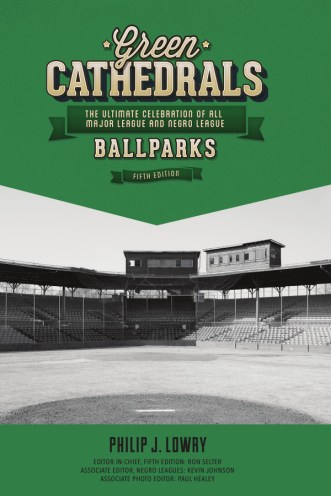
“Green Cathedrals: The Ultimate Celebration
of all Major League & Negro League Ballparks”

Green-Cathedrals-V-cover-600x900The author:
Philip J. Lowery

Fifth edition editors:
Ron Selter, Kevin Johnson, Paul Healey

The publishing info:
Society for American Baseball Research (SABR)
29.95
330 pages
Released March 12

The links:
At the publishers website
At Amazon.com
At Barnes&Noble.com

The reviews in 90 feet or less

Where on Earth might you rather be, on this 50th Earth Day, than outside enjoying the sensory overload of a ballpark experience this afternoon?

The Dodgers would have been in our nation’s capital in the middle of a six-game road trip. The Angels would have been playing host to the Orioles, ending a six-game homestand.

91wiqBL3m9LThe ballpark has always been one of the great American public spaces, as Paul Goldberger figured out when he did his magnificent book last year, “Ballpark: Baseball in the American City,” which allowed the New York Times architect writer to explain how and why the ballpark is the perfect example of a Hamiltonian/Jeffersonian compromise in urban and rural values embedded in the American experience. Alexander Hamilton could see a commerce-driven city within the city. Thomas Jefferson could enjoy a lush, Technicolor-green field, even if there’s a wall bordering it.

“In the baseball park, the two need each other,” Goldberger writes. “The structure of the grandstand exists to allow people to watch what is happening on the field, while the field exists to give the grandstand its purpose.” Our extended Q&A with Goldberger last year also brings out how he felt Dodger Stadium was a metaphor for the city that wants movement and privacy. It’s difficult to often move into the stadium but once you’re there it does feel very secluded.

“In spite of the fact it’s too big, or entirely automobile dependent – which is the worst possible model – Dodger Stadium is nevertheless one of the nicest places in America to watch a ballgame. It’s just horrible to get to and horrible to get out of. But it’s just nice when you’re there.”

As for the current Angel Stadium, Goldberger says: “I’m a great believer in the idea that ballparks should all be different and do things that identify their places. I really thought the Big A scoreboard (a 230-foot tall, 210-ton red metal structure with a halo on the top created in 1966 behind the left-field fence but is relegated to the parking lot off first base) was a sort of funnier and cooler and nicer and more endearing weight than the whole center field water thing they have now.”

(Thanks for the excuse to revisit this exquisite book about the how and why of ballparks as we can weld it into today’s reviews).

On a day that also marks the 144th anniversary of the first Major League Baseball game, featuring the Boston Red Caps and Philadelphia Athletics played at Athletic Grounds in Philadelphia long before naming rights were wrong, let’s get a ballpark figure on some numbers we have going around in our heads now: Continue reading “Day 22 of (at least) 30 baseball book reviews for spring/summer 2020: What’s the ballpark figure on how many connect Earth Day with a fond baseball green cathedral memory? Let’s read (at least) two”

Day 21 of (at least) 30 baseball book reviews for spring/summer 2020: Stay Inside. It’s the new Law

Pujols Moreno
“Albert Pujols has been an Angel for a long time,” says an Orange County Register headline upon his Dec. 2011 signing, as team owner Arte Moreno helps him on with his new jersey. https://www.ocregister.com/2011/12/17/pujols-has-been-an-angel-for-long-time/


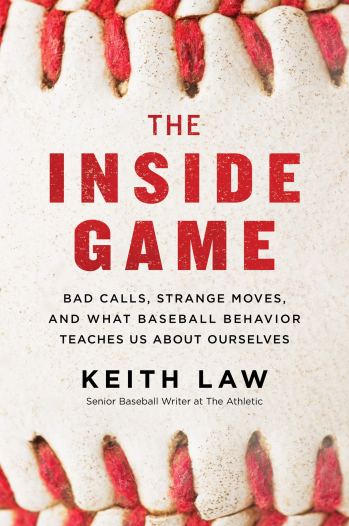
“The Inside Game: Bad Calls, Strange Moves, and What Baseball Behavior Teaches Us About Ourselves”

81TgstpiOzLThe author:
Keith Law

The publishing info:
William Morrow/Harper Collins
$28.99
304 pages
Released April 21

The links:
At the publisher’s website
At Amazon.com
At BarnesAndNoble.com
At Powells.com
At Indiebound.org
At the author’s website

The review in 90 feet or less

The stories look as if they have some  news value, but then you realize you’ve  been blindsided by another hit-and-run post with an alluring headline. A debate starter. An incentive to click and be challenged, pretending most times there’s even some kind of analytical dissertation that allows for some critical thinking.

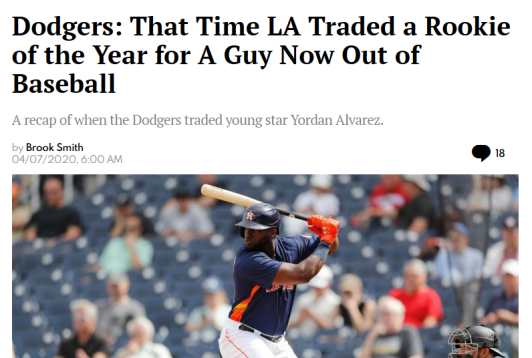
Emphasis on critical. Such as this recent post on DodgersNation.com:

story 1

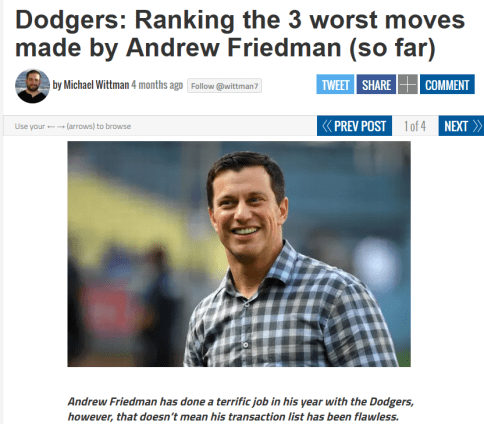
There was also this recent SI.com post on the history of Dodger trades by Andrew Friedman, which dovetailed into this from DodgersWay.com:

story 2

Fred Claire must feel relieved. The one thing that people would never let go from his time as the Dodgers GM was the Nov., 1993 trauma of trading 22-year-old pitcher coming off his rookie season Pedro Martinez to Montreal for 23-year-old and 16th in NL MVP voting second baseman Delino DeShields, straight up. Claire still admits it’s the one he would “regret the most… my focus was on a single position (filling in a starting second baseman) and not the potential of Pedro. It was a major mistake.” DeShields lasted three seasons in L.A. and was out of the game by age 33 in 2002. Martinez, at 5-foot-11 and 170 pounds, threw 2,872 innings, was a seven-time All Star, three-time Cy Young Award winner, five-time ERA leader, with a 219-100 record in retiring at age 37 in 2009, then going into the Hall of Fame in 2015.

Was it the worst deal in Dodgers’ history? History says it’s likely so, even if Tommy Lasorda’s temp-GM move sent 22-year-old rising star Paul Konerko to Cincinnati for relief pitcher Jeff Shaw at the 1998 All-Star break. It’s almost as silly as the Mike Piazza-to-Florida deal that happened on Claire’s watch, but he had nothing to do with it and quit after that).

Looking back at how it turns out is far less entertaining that trying to guess at the thinking behind moves like this, at the time they happen. When you get someone like Claire to reveal his thought process, and realize there’s some logic to it, it can be easier to accept. Then, the Dodgers needed a second baseman. With Konerko, they were desperate for a closer and he was deemed expendable (and then the Reds traded him to the White Sox for Mike Cameron, which may be even more tragic. As for Piazza, it was new Dodgers ownership trying to secure a sports regional network deal with the Florida Marlins. For real.

Any animated examination of the decision-making process of the modern game has become a whole industry on its own, here’s a Keith Law approach that really does draw on his media abilities (now a senior baseball writer for The Athletic, plus ESPN and The Baseball Prospectus) and his time in the Toronto Blue Jays front office to focus more on behavioral science.

From issuing a take sign to taking a risk on a pitcher who just had Tommy John surgery, there has to be an onion-peeling exercise of what the thinking is behind it, and if learning anything from history is even a factor any longer. What motivates some may discourage others, and both may make perfect sense. Don’t overthink it – this can also help in other walks of life and business. Continue reading “Day 21 of (at least) 30 baseball book reviews for spring/summer 2020: Stay Inside. It’s the new Law”

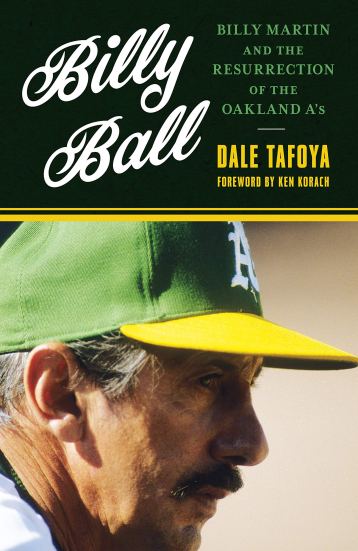
Day 20 of (at least) 30 baseball book reviews for spring/summer 2020: When Billy Martin came out swingin’ for the A’s in Oakland, it was an ’80s celebration

“Billy Ball: Billy Martin and the
Resurrection of the Oakland A’s”

91vnJr9tKkLThe author:
Dale Tafoya

The publishing info:
Lyons Press
$24.95
264 pages
Released April 1

The links:
At the publisher’s website
At Amazon.com
At BarnesAndNoble.com
At Powells.com
At Indiebound.org

The review in 90 feet or less

Two events early during the 1981 Major League Baseball season knocked me off my hardball moorings.

(Actually, there were far more than only two, considering the mid-season strike and all the other drama that went along with it.)

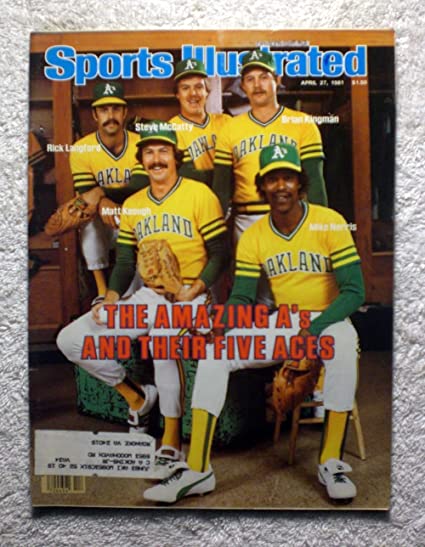
71XjSJIG9zL._AC_SX425_As the cultural phenomenon known as “Fernandomania” was in an  upsurge in Los Angeles early in the season, an April 27 issue of Sports Illustrated landed with a cover proclaiming: “The Amazing A’s and their Five Aces.”
On this day in 1981 — April 19 — the Athletics broke the MLB record by starting the season 11-0 after the first game of a doubleheader – they had actually jumped out to an 8-0 mark after a four-game sweep of the defending AL West champion Angels in Anaheim when Mike Norris, Mike Langford and Matt Keough had back-to-back-to-back complete-game wins (against Geoff Zahn, Andy Hassler and rookie Mike Witt). So now we see those three A’s aces, plus Steve McCatty and Brian Kingman,  in their yellow road jerseys — taken in the Anaheim Stadium clubhouse. Those five starters had nine complete-games in the first 10 wins.

The Ron Fimrite story had the headline: “Winning Is Such A Bore.”

(To be fair, Valenzuela was only 5-0 with five complete games and a 0.20 ERA with four shutouts at that point in the season. The SI Fernando “Unreal!” cover came on May 11 when he was 7-0 with a 0.29 ERA and five shutouts and seven straight complete games. He would soon lose his first game. SI jinx for what it’s worth).

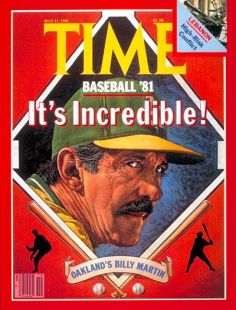
time billy ball.1But then in May, Time magazine decided to Billy Martin on its cover – an artistic rendition, with the headline “Baseball ’81: It’s Incredible!” and a B.J. Phillips-authored piece that included: “Oakland’s record would be impressive if it belonged to the 1927 Yankees. The astonishing truth is that it is held by virtually the same team that, two seasons ago, was the worst in baseball. But there is one huge difference, a stormy, unpredictable figure with fire in his eyes and victory on his mind, Alfred Manuel (“Billy”) Martin.”
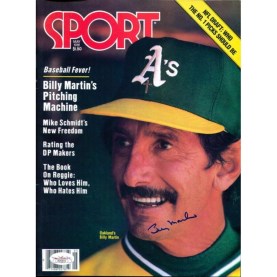
billy-martin-autographed-may-1981-sport-magazine_ss2_p-10683965+u-orxopbpn08vrtah02cxj+v-35c48a457d4044cc9854de2439709418Also that month: The cover of Sport Magazine, with “Billy Martin’s Pitching Machine.”

“That exploded the whole ‘Billy Ball’ story,” says Matt Levin on page 171 of this new Dale Tafoya book.

Levin is identified more than 100 pages earlier as a consultant contracted by the Oakland-Alameda Coliseum board to file a lawsuit against A’s owner Charles O. Finley in 1979, asked to document “what the standards of marketing were in Major League Baseball and contrasting them to the A’s practices.” They Coliseum felt Finley breached a contract to not market this franchise – which four seasons earlier completed its third straight World Series title, defeating the Dodgers, but was now decimated by the new free-agent movement – and as a result, the attendance was the most abysmal in all of the sport, and visiting teams were not getting much of a share of gate receipts, and not happy about it.

The Coliseum was also watching Al Davis’ NFL Raiders tank as well – they would move to L.A. in 1982 after years of litigation. Having the A’s tank in the same way wasn’t going to help the sterile stadium experience any more than if the Golden State Warriors – also underachieving at the time – played its games on an outdoor court at second base for the sheer gimmick of it all.

If Martin had not somehow landed in his hometown of Oakland after his latest firing by the New York Yankees following the 1979 season, none of this would have been even thought possible.

It was enough to persuade Tafoya, who watched the A’s growing up and then contributed to the Oakland Tribune, Contra Costa Times and Modesto Bee, to jump on this untapped story, the residue of once doing research on a story about how the A’s in early April, 1979 once crew 653 fans to a game.

Martin arrived 10 months later. Continue reading “Day 20 of (at least) 30 baseball book reviews for spring/summer 2020: When Billy Martin came out swingin’ for the A’s in Oakland, it was an ’80s celebration”