Blog

Day 4 of 2024 baseball book reviews: A light-bulb moment in the Deadball mysteries

“The Keystone Corner: Thomas Edison Turns Two”

The author:
J.B. Manheim

The publishing info:
Sunbury Press; 241 pages; $22.95; released Jan. 10, 2024

The links:
The publishers website; the authors website; at Bookshop.org; at Powells.com; at BarnesAndNoble.com; at Amazon.com

The review in 90 feet or less

A lot of electricity was generated in October of 2002 at Edison International Field of Anaheim when the Anaheim Angels lit up the Halo for their first (and so far only) World Series title.

It also cause some to blow a fuse.

“It’s particularly sour to see Edison’s name in lights because consumers in Southern California are shelling out billions of dollars to bail it out,” said Doug Heller, a senior consumer advocate at the Santa Monica-based Foundation for Taxpayer and Consumer Rights told the Los Angeles Times in a story that ran in its finance section at the time. “It’s unsavory to see their name associated with the baseball glory of the Angels.”

Heller’s point was that while Edison International had been caught up in the stadium naming rights game — putting up as much as a reported $50 million in a 20-year deal so its brand would be plugged into all mentions of the place — there were new surcharge increases approved by the state Public Utilities Commission.

Who was really footing the bill for this folly, trying to normalize the new name having the media play around with it and refer to the Big A as “The Ed”?

The end was near for The Ed.

Anaheim Stadium went 20 years without a title sponsor before Edison came in for 1997. The team juiced up its profile in the World Series. Then it opted out early after the 2003 season when billboard mogul Arte Moreno took over franchise ownership from Disney. The place has been called Angel Stadium of Anaheim ever since.

Southern California Edison explained how, at the turn of the century, there was a intrinsic value having its name out there, with about 12 million customers in the area at the time. It helped to put a positive spin on its existence.

“It lends itself to what you look for in naming rights — the halo effect,” Charles Basham, a senior project manager at Edison, also told the Times.

We see what you did there … Angels … halos …

Imagine if Thomas Alva “Big ‘A’ In the Middle” Edison could have seen his name affixed to a Major League Baseball ballpark — especially as the game was embracing the Juiced Ball Era.

There might have been some satisfaction as well to see the Angels’ World Series opponents, the San Francisco’s Giants, go through their own ballpark naming rights issues. A series of communication companies like Pac Bell and AT&T kept being bought out and consolidated, so the name kept changing to everyone’s confusion.

And then there was once the energy giant Enron that failed as a naming rights partner in Houston. Poof …

Continue reading “Day 4 of 2024 baseball book reviews: A light-bulb moment in the Deadball mysteries”

Day 3 of 2024 baseball book reviews: Two guys and a girl, but no pizza place — or when Harry met Maya, Maya met Daniel and Daniel wished Harry could just get over his college playing days

“The Catch: A Novel”

The author:
Jon Weisman

The publishing info:
Self-published; 378 pages; $13.99; released Nov. 1, 2023

The links:
At the author’s website; at the author’s Substack site; at the author’s IMdB.com site; at Bookshop.org; at Powells.com; at Vromans.com; at TheLastBookStoreLA; at Skylight Books; at PagesABookstore.com; at BarnesAndNoble.com; at Amazon.com

The review in 90 feet or less

Give Jon Weisman the benefit of the doubt. In the lengthy process it took him to purge his first novel from his artistic soul, baseball somehow had to be stitched, baked, sautéed and seared into the plot, the twists, the detours and the final out.

Just don’t go into this thinking it’s a “baseball” book. Which can be a McCovey-like stretch since the author has been the Dodgers’ vice president of communications since September of 2023, and the team’s former Director of Digital and Print Content (2013 to 2017) is the creator of the website DodgerThoughts.com and the author of the regularly updated “100 Things Dodgers Fans Should Know & Do Before They Die” (Triumph Books, 368 pages) as well as the 2018 fantastically researched “Brothers in Arms: Koufax, Kershaw and the Dodgers’ Extraordinary Pitching Tradition” (Triumph Books, 384 pages). And, from a silver screen perspective, he’s also one of the story lines in the 2009 documentary “Bluetopia: The L.A. Dodgers Movie.”

Weisman is wise enough not to just dodge baseball altogether here. One of his three main characters is a) the son of a hard-ass baseball coach who becomes the inspiration for his own best-selling book, b) a former University of Texas outfielder whose claim to fame is running down a long fly ball for the final out of a College World Series win against USC (we looked it up — that is complete fiction) and c) has an adorable mom who watches as many games as possible on TV and loved her time as a host for minor-league players in her North Carolina suburb.

But other than that …

Continue reading “Day 3 of 2024 baseball book reviews: Two guys and a girl, but no pizza place — or when Harry met Maya, Maya met Daniel and Daniel wished Harry could just get over his college playing days”

Day 2 of 2024 baseball book reviews: Can baseball sell, or save, its soul in Seoul?

“Save Baseball: A Prescription for the Major Leagues”

The author:
Larry Hausner

The publishing info:
McFarland; 208 pages; $35; released Feb. 9, 2024

The links:
The publishers website; at Bookshop.org; at Powells.com; at Vromans.com; at Target.com; at BarnesAndNoble.com; at Amazon.com

The review in 90 feet or less

Was it just a dream, half-awake watching the Dodgers and Padres lap it up in South Korea thousands of miles away from their home bases on official business.

Or has March Madness taken on a ultra-sharp visual experience with our new Apple Vision Pro?

We are still learning what’s going on today and looking at tomorrow in the same glimpse. And what Korean-style baseball is all about. Now what are we supposed to do with the rest of our day/night? Listen to day-long replays of the Dodgers’ radio play-by-play as a sleep activator?

It kinda reminded me of when, during the early days of COVID-19 lockdown and ESPN desperate to fill air time and generate ad revenue, someone decided to throw on live Korean Baseball Organization games in 2020.

KBO-Oh no you didn’t. With 2020 hindsight, was that a good idea now?

We learned baeball isn’t just baseball. Quality of play matters. Player identification draws connection. Team logo recognition helps. We couldn’t even bet on those things, so why were we even engaged (more on that later)?

Continue reading “Day 2 of 2024 baseball book reviews: Can baseball sell, or save, its soul in Seoul?”

Day 1 of 2024 baseball book reviews: Bill James values his intentional walk

“The Bill James Handbook 1990-2023: Walk-Off Edition”

The authors:
Bill James
& Sports Info Solutions

The publishing info:
ACTA Sports; 252 pages; $24.95; released Oct. 30, 2023

The links:
The publishers website; the authors website; at Bookshop.org; at Powells.com; at BarnesAndNoble.com; at Amazon.com

The review in 90 feet or less

Win shares. Runs created. Range factor. Similarity scores. Power/Speed.

And nut cases.

Go to war with all that if need be. Or accept it as collateral damage to your value system of HR, RBIs, W-L and ERA.

Bill James created Sabermetrics, and Sabermetrics changed Baseball. And Baseball Today is what it is because of, in a lot of ways, George William James, aka The Professor of Baseball. It can be a rough road to traverse, navigating a baseball world of new and improved weights and measures, if you don’t really look back at who tipped the scales into a modern-day mishmash of numerical mayhem.

James not only did that, but he provided context. And that’s why it has worked out, kicking and screaming. Don’t be a baby about it as you soak in your bathwater.

With this particular book project, a 34-year run ends. All good things do.

The way James changed the entire dynamics on how baseball is sized up, dissected and reconstructed is coming to a natural conclusion. And he’s now allowed to take his name out of the lineup.

The trick isn’t that the 75-year-old historian/writer/statman created the name “sabermetrics” after the Society of American Baseball Research. It was that, for someone who started pounding out essays while working as a night-shift security guard at the Stokley-Van Camp’s pork and beans cannery after leaving the U.S. Army ended up included in Time magazine’s 2006 edition of one of the 100 most influential people in the world.

Continue reading “Day 1 of 2024 baseball book reviews: Bill James values his intentional walk”

Your 2024 baseball book review automatic renewal … this time aligned on South Korea time

Of all the speed bumps, detours and roundabouts we encountered since leaving the 2023 Major League Baseball season – we’ve been told the Rangers won out, outlasting the Diamondbacks, yet we’re still not convinced it wasn’t a COVID nightmare – we hesitate to ramp to the 2024 campaign that begins with the Dodgers and Padres officially on a working good-will vacation in South Korea — 16 hours ahead from L.A., and 6,000 miles West into the future — showing off Shohei Ohtani to a new part of the world, and, with that, relaunching the annual baseball book review project.

For those who aren’t up to our speed ball, this has been an exercise in empathy for the authors and efficiency on our end trying to crank out (at least) 30 reviews of new spring baseball books and post them, once a day, during the month of April. It was deemed something of a success for many years starting in 2011*. We were on target with 30 reviews in 2023.

*Our memory is fading and we weren’t actually sure, but that’s the best guess, since we’ve got The Wayback Machine to find things we’ve posted going back on InsideSoCal.com going back to our first posts in 2006.

Our ’24 baseball book review list again deviates a bit from its original intent. We’ve reigned that we can’t do it as before as life’s challenge intercede but the spirit is still there. We’ve started a bit pre-April early (because the MLB season keeps backspacing itself on the calendar leading to a November conclusion) and try to time the landing of reviews to dates that make sense – such as April 15’s Jackie Robinson Day.

We promise to be as diligent and perhaps less wordy with these reviews. The point it to let readers know these works exist, should you be temped to pick them up for purchase without knowing their caveats. It’s also a way to uncover projects that otherwise might be off the radar.

So let’s crack this thing open …

On the Dodgers’ SportsNet LA telecast of a Monday exhibition from South Korea, the video screen shows one of the fan activities between innings: Two women see who can drink a beer the quickest with a straw.

Among the books we look forward to highlighting this spring/summer:

= “Don Drysdale: Up and In — The Life of a Dodgers Legend” by Mark Whicker (although just checking the latest projection is it won’t come out until 2025)

= “The Last of His Kind: Clayton Kershaw and the Burden of Greatness,” by Andy McCullough

= “Under Jackie’s Shadow: Voices of Black Minor Leaguers Baseball Left Behind” by Mitchell Nathanson

= “Schoolboy: The Untold Journey of a Yankees Hero” by Waite Hoyt, with Tim Manners, where some 40 years after the death of the one-time Brooklyn Dodgers pitcher, a memoir has been uncovered.

= “Baseball: The Movie,” by Noah Gittell, touted to be the definitive history of the game as portrayed on film since 1915.

= “Remembering Torn-Down Ballparks, Over a Cold Beer: A Beer Table Book Celebrating Lost Ballparks” by Ken Finnigan, providing a 10 inch-by-8 inch manuscript that you can put your beer stein on (with a coaster … or is the coaster provided?)

Add to that the fact we have been undangling participles and prepping punctuation for “Perfect Eloquence: An Appreciation of Vin Scully,” submitted to University of Nebraska Press editors for a May 1 release. We also been cultivating another media project called (at least for the moment): SoCal Sports History 101: The prime jersey numbers from 00 to 99 that uniformly, uniquely and unapologetically create an authentic all-time roster.  One of those numbers assigns No. 67 to Scully, which somewhat deviates from the premise of a jersey or uniform number, but on the other hand, how many organic Scully 67 jerseys have been seen at Dodger Stadium over the last handful of years? We also pulled a story from our “Perfect Eloquence” about the time Scully did don a real Dodgers jersey and sit in the dugout for a game at Wrigley Field.

More side notes before going forward

A post-Christmas and pre-New Year’s trip to Portland (please, bring this great city back to what it once was) led to another pilgrimage through Powell’s City of Books. I picked up three first-edition copies of baseball books I’ve long wanted to put on my shelf that are reminders/relics of where baseball journalism has evolved.

Book 1: George Plimpton’s “Out of My League” (1961, Harper and Brothers Publishing, 150 pages, purchased for $19.95) recounts the day in 1958 when he talked his way onto the mound at Yankee Stadium to see what it would be like if an Average Joe (he was a 31-year-old known-enough-around-New York scribe) actually pitched against real All Stars. It’s fascinating how rudimentary this all came to happen – and it’s a keen reminder about how the participatory sports journalism we came to know him for was really inspired by Paul Gallico’s work decades earlier. We had thought this was only done for a Sports Illustrated story – it involved hiring an SI photographer to document it, and the magazine put up $1,000 as a “contest” prior to an exhibition game for Plimpton to get the attention of Willie Mays, Mickey Mantle, Frank Robinson, Gil Hodges and other legends of the day to buy into it. It doesn’t end well, as an exercise for Plimpton’s ego, but he so creatively tells how it devolved in front of his blurry eyes and what he took away from it. Even more impressive is the book has a blurb endorsement from Ernest Hemingway, and it launched Plimpton’s mission to become a Detroit Lions quarterback and Boston Bruins goalie.

Book 2: Jim Brosnan’s “The Long Season” (1960, Harper and Brothers Publishing, 273 pages) has a brief mention in Plimpton’s “Out of My League,” which shares the same publisher. There is a strange overlap in these two that could have put the idea into Plimpton’s head to journal about bring a big-league pitcher. Yet Brosnan’s diary is of his 1959 season (months after Plimpton’s stunt). It started with him as a member of the St. Louis Cardinals and diverts with him to Cincinnati during a June trade. He had been in the league 12 years at that point. Excerpts of this book were printed in SI. Brosnan’s book, of course, is often cited as a precursor for Jim Bouton’s more well known “Ball Four,” which launched in 1970 and also is fortunate for Bouton in some regards that he was also traded in the middle of that season, from the expansion Seattle Pilot misfits to the Houston Astros after already having built a career with the New York Yankees (and would come back years later with the Atlanta Braves).

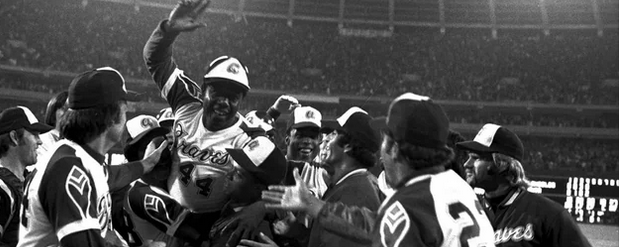
Book 3: Tom House’s “The Jock’s Itch: The Fast-Track Private World of the Professional Ballplayer” (1989, Contemporary Books, 129 pages) calls this his “Ball Four-esque” attempt to tell it like it was when the former USC pitcher somehow made it through an MLB career with Atlanta, Boston and Seattle that ended in the late 1970s. It goes deeper into his post-life, trying to figure things out based on lessons not learned as a pro baseball player, and always having that “itch” to get back into it as a coach. (And, yes, he was the Braves’ relief pitcher who caught Hank Aaron’s 715th home run while in the bullpen, despite Bill Buckner’s attempt to climb the wall and get it). House, at the time, was starting as a Texas Rangers pitching coach who created new techniques – like warming up with a football – to launch a whole new career as an expert in this new field of mental and physical training, leading to a dozen more books on the subject. This first-person account of what it was like for him doesn’t try to call out former illicit teammates, only the circumstances they all faced in what was a somewhat mature-deficient situation made worse by hero worship.

The three together form a nice trilogy of work that now give more meaning to my expanding collection of Bouton’s “Ball Four” editions that I’ve collected over the years and was fortunate enough to have him sign several of them before his 2019 passing (and provided so much context for a tribute we were able to do about him for the Los Angeles Times – note, we took the picture of the book covers as we laid them out on our backyard lawn to give it a nice baseball-looking background texture.)

Now, upward and onward.