Blog

Yesterday’s news: Lessons one can still learn on a college campus

Tom Hoffarth / FartherOffTheWall.com

If you’ve got a few minutes, watch this clip from the sadly short-lived NBC series, “The Richard Pryor Show,” from 1977. In this skit, Pryor is the first U.S. Black president, holding a press conference, fielding questions from a new mix of folks now in the media corp.

We will circle back to this shortly. Lights please:

COMM 387: Sports and Social Change is a four-unit course offered at USC for an hour-and-a-half on Tuesdays and Thursdays. The focus: “Application of critical, sociological and rhetorical theories to sports events and sports media; examination of the role of sports in enacting social change.”

Sign me up.

There’s room for about 100 students in the old Annenberg School of Communication Building Room 204, and it was nearly full when I found my way in, per invitation by Dr. Dan Durbin, the director of the USC Annenberg Institute of Sports, Media and Society.

Julianna Kirschner is the class instructor, and I became part of a panel discussion with ESPN’s Jason Reid and filmmaker Marvin Towns Jr. to talk about issues of sports and social change, particularly race, from the perspective of media members who have documented it over the last 40-plus years.

Towns got into his unique relationship with Muhammad Ali and the impact the heavyweight champ had on so many levels back in the day. He encouraged the students to take their knowledge and talents and move to other parts of the country to help educate others on this subject.

Reid, the senior NFL writer for Andscape.com, has just come out with a new book, “Rise of the Black Quarterback: What It Means For America” (Andscape Books/Buena Vista, 282 pages, $26.99) and could talk about why Patrick Mahomes, Lamar Jackson and Kyler Murray are here today because of the foundation laid by James Harris, Randall Cunningham, Doug Williams decades ago.

He also addressed questions about the pros and cons of Black ownership in the NFL and the effect it might have moving forward. Reid, a ’93 USC grad, has been to the campus already this fall to discuss the book and its subject matter, as well as other important media shows and platforms.

What could I possibly add, as a 60-plus white journalist who grew up in L.A., graduated from USC in ’84 and tried to be a keen (and sometimes caustic) observer of how sports and culture intersected from decade to decade?

Continue reading “Yesterday’s news: Lessons one can still learn on a college campus”

The Sports Media Misery Index: November 2022

Tom Hoffarth / FartherOffTheWall.com

Our monthly Sports Media Misery Index is a standard check and imbalance of what we’ve loathed, liked or learned from a measured consumption of various media platforms.
Now we regurgitate. Follow along at your own risk.

TESTING OUR PAIN THRESHOLD

This 2022 World Series should be remembered years from now as the baptism of broadcaster Joe Davis, preserving his historic calls during what sets up to be an intriguing Houston-Philadelphia match up. The real shame, at least on our end, is we’ve stopped watching since after the first inning of Game 1. And we were even warned.

Maybe that, in a small way, will be information Fox Sports and its parent company can use to better understand why World Series viewership continues on a downward spiral. It has already reported that 11.6 million viewed Game 1 between TV and streaming, and it was 10.9 million on Saturday for Game 2.

Whatever metrics Fox chooses in the end to spin this, it won’t be as fowl as the “Citizens for Sanity” ads.

Fox has apparently no shame in accepting payment for and airing them during the sports’ most important national prime-time exposure. Worse, Major League Baseball remains compliantly silent as well as Commissioner Rob Manfred can’t even man up and address it properly when asked for accountability by media members.

So you may ask – as does the ad – how did we get here?

Continue reading “The Sports Media Misery Index: November 2022”

The writing on (and off) the wall: Springsteen’s L.A. Grammyland tour … so we’ve gone a little long, like his concerts

Tom Hoffarth / FartherOffTheWall.com

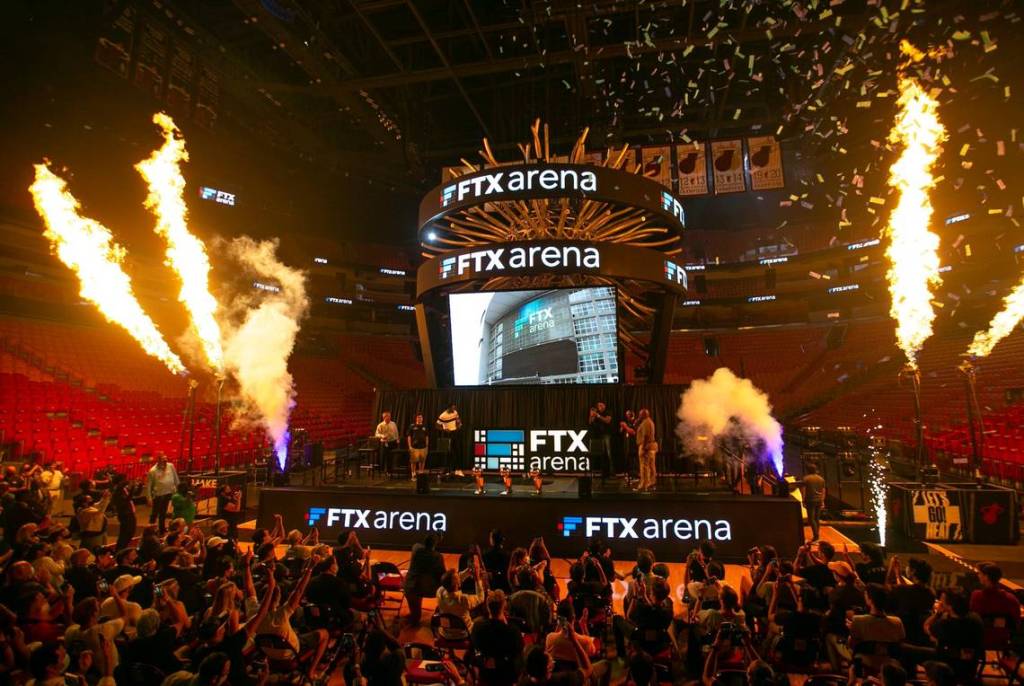
The opening act at the massive downtown L.A. arena once known as Staples Center on Oct. 17, 1999: Bruce Springsteen’s Reunion Tour with the E Street Band.

The first of four shows, before any Lakers, Kings or other sporting event at the $400 million palace, inspired L.A. Times music critic Robert Hilburn to write:

“At a time when rock ‘n’ roll’s future is once again being questioned, Bruce Springsteen & the E Street Band showed Sunday at lavish new Staples Center just how glorious the music can still be. … By the end of the concert, Springsteen had done more than simply stir us once again with his music. He showed why he is such a major figure in the history of rock.”

Three months later, the Grammy Awards ceremony, which had danced around various venues in Southern California from the 1960s to the ’90s, quickly gravitated to Staples Center for its 2000 show. It has been the home base pretty much ever since, where Springsteen has often been present as a performer, a nominee (50 times since 1981) or an award recipient (20 of them since 1985).

His 2003 show-ending rendition of the Clash’s “London Calling” – a tribute to the recently departed Joe Strummer — with Elvis Costello, Dave Grohl and Steve Van Zandt remains one of our favorite mashups of talent and music.

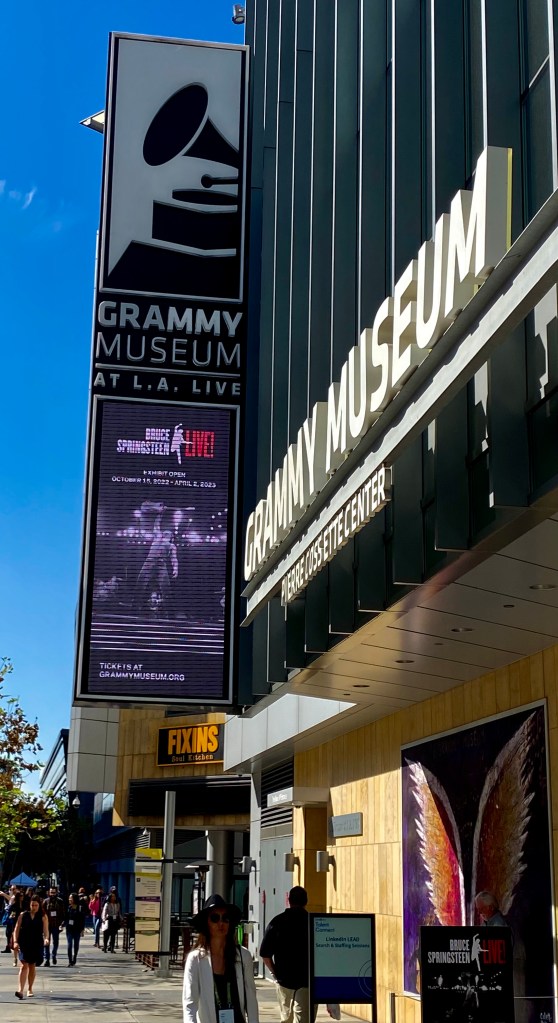
When the Grammy Museum across the street at L.A. Live cleared the second floor for a new exhibit – “Bruce Springsteen Live!” – it seemed like an appropriate as a way to honor New Jersey’s famous son. Dust off some memorabilia and see how it goes.

It actually goes as far as the mind and heart want it to go.

Continue reading “The writing on (and off) the wall: Springsteen’s L.A. Grammyland tour … so we’ve gone a little long, like his concerts”

The writing on (and off) the wall: Ain’t it grand how the Olympic Auditorium can find its audience again

Tom Hoffarth / FartherOffTheWall.com

Back in the day, when a boxer had a particularly successful night at The Grand Olympic Auditorium, celebrants in the crowd of some 10,000 tossed coins into the ring.

The opposite could also occur.

When a referee’s decision went against someone – most likely a favorite kid who lived in the neighborhood – watch your head. Chairs could be ripped off their mourning. Cups full of beer went airborne like lobbed grenades.

That was beer? Maybe at one point …

You’re in for a treat – with no threat of urine projectiles – whenever the opportunity comes to experience the new documentary “18th & Grand: The Olympic Auditorium Story.

Orange County adjacent on Saturday night is the next stop, a place for history and nostalgia converging into some humorous hysteria. Fight your way through traffic, wrestle for a parking spot and skate over to the Regal Irvine Spectrum. It’s just a couple of sawbucks at the box office (or these days, online pre-paid codes for your phone) to feel a connection to this landmark.

This isn’t a true “Rocky Horror Picture Show”-type of experience, but there is a time warp happening. That’s on purpose. Writer/director/producer Steve DeBro says his 83-minute documentary is meant to whet the appetite — and be seen in a theater rather than your laptop or home TV screen. Communal bonding works on many levels.

Seeing it with viewers who rock to the music, roll with the punches and can recite their shared experiences of this den of dust and dirt, grime and crime figures, Hollywood elite and the common man of the neighborhood just looking to release some energy.

“I tried to make it where you’re carried on a journey that’s almost disorientating, and it should feel like you’re in the Olympic — energetic, fast moving, something that takes you out of yourself,” said DeBro. “That’s why in a theater is the best way you don’t get distracted.”

The screening may be just a one-off event, promoted by boxing matchmaker Roy Englebrecht and his Fight Club OC company, but it doesn’t minimize its journey to this point — and may even confirm the reach it can have beyond its L.A.-based audience. Englebrecht has seen the flick several times and wanted to see if he could generate an audience for it in his neck of the woods.

As some who’ve already seen it live, like Englebrecht, there are repeat customers following these showings.

“The Olympic really had a following from Central California to the Mexican border, and attracted champion boxers like Carols Palomino (born in Mexico and growing up in Westminster),” said DeBro, who could be among the special guests at this O.C. event. “I’m just grateful to them to get the word out and grateful, eager for more to see it, because I think when they see it, the word spreads and spreads.

“We’re thrilled to be able to work with Roy and his team to have the film screened in Orange County. So many great fighters and fans would make the drive from the O.C. to downtown to the fights — this time they won’t have to travel so far to see the action. They’re in for a great night.”

With stops and starts because of COVID infiltration, the doc is back in business and can ramp back up an anticipation we first had when a 2016 piece in the Los Angeles Times gave many of us the promise to revisit a place that has fallen not into disrepair, but more off the radar. That was a year after a Kickstarter campaign launched to get funding for a film that was finally ready for official release in 2021.

The old place can use a new narrative. The one it has now makes it look like it’s doomed to disappear.

In one of grittiest parts of town, some signs try to show the old Olympic still exists. It really doesn’t. It’s a mirage.

The warehouse-like building that today houses a Korean church on weekends and homeless encampments the rest of the time, looking down at it while whizzing past it off the 10 Freeway likely doesn’t resonate for anyone under 40 years old, lest they attended one of the punk rock events trying to prove that it had an indestructible nature. A few more boxing cards took place during its short revival period of the early 2000s, but eventually, it kind of went into its own coma.

The lighting trellis that once hovered above the smoke-filled boxing and wrestling ring and commanded the Roller Derby matches of the L.A. Thunderbirds is now providing illumination over a church’s altar. That’s where we are at this point. It isn’t designated a state historic or cultural landmark – yet – so there’s a chance it could become a teardown upon the current landlord’s wishes, if he sees the property worth far more than the structure.

The film can re-energize a revival of what shape up up as a multi-platform, multi-media experience. It uses a home base with a magnificent website, and links to a collection of videos on its YouTube.com channel, all channeling a neat merchandise store. Thanks, and yes, we’ve already got the “RI.9-5171” T-shirt. It was one of two phone numbers we had memorized as a 4-year-old watching Roller Derby at our grandparents house on Manchester and Vermont (the other was their number: PL.1-8096). No area code necessary for those Richmond and Plaza rotary dial prefixes.

There is a strong social media presence on Twitter, Instagram, and and Facebook. If only Aileen Eaton had access to this stuff decades ago when she ran the place from near collapse at its original incarnation to its own house of worship until her passing in the late ’80s and was then inducted into the International Boxing Hall of Fame.

DeBro, the mastermind of this whole adventure through his GenPop Entertainment company, thought he had its first debut in March 2020, a premier set to go at the Cinerama Dome in Hollywood. COVID canceled it, with more than 600 tickets sold and sure to be a sellout, along with a live music event.

In the midst of pandemic recovery, it poked its head out at a drive-in – the closing event at the Slamdance Film Festival in February, 2021, at the City of Industry’s Vineland Drive-in. Last March, it made its indoor screening debut with a three-day run at Laemmle’s across L.A., with special appearances at the theatre’s Royal, Noho and Pasadena Playhouse locations. It has been part of the last March’s San Diego Latino Film Festival and the recent Bushwick Film Festival in Brooklyn, N.Y.

And now, this in the O.C.

In the future: The release of a Blue-Ray, a local TV airing, and the anticipation of an exhibit at La Plaza de Cultura y Artes on Main Street in downtown in L.A. near Union Station, set for the summer of 2023. There is expected to be a book project with this as well featuring the art of photographer Theo Ehret, who recorded 20 years of its history as the staff photographer.

His passing in 2012 — 10 years ago — reminds us that nearly a dozen people interviewed on screen for “18th And Grand” are also gone – Gene LeBell, Don Chargin, Rowdy Roddy Piper and Dick Enberg among them.

The presence of LeBell’s mother, Eaton, is a driving force not just in this documentary, but could have one done on her all to herself. At least this is there to capture what she did and how she did it. Without her, it’s likely there is no Olympic Audition, which almost collapsed under its own bankruptcy a couple years after its 1925 opening, staying around to host boxing and wrestling in the 1932 Summer Olympics in L.A.

It was supposed to be L.A.’s answer to New York’s Madison Square Garden. It instead tells the history of the city perhaps like no other venue still around – like the L.A. Coliseum or Pasadena Rose Bowl, each in their 100th anniversary mode.

Our vision of the Olympic, even in its present demoralizing form, is somewhat ethereal as it is surreal. The iconic mosaic of Jack Dempsey above the main entrance wasn’t just painted over, but sandblasted away forever. The place just keeps morphing away like a photograph of Marty McFly’s family in “Back To The Future.”

The Olympic’s history, with Dick Lane’s voice resonating in our heads, takes us back to a place thanks to this doc’s brilliance. It’s non-stop entertainment because of all the music DeBro, a former Atlantic Records exec, invested in its storytelling.

Just realize the Olympic Auditorium exists precariously these days, almost in perpetual purgatory. Perhaps like the Forum in Inglewood, it could get off the mat and make some sort of legitimate, reasonable comeback. Maybe even as a part of the 2028 Olympics back in L.A.?

It also could be bracing to be put it out of its misery like so many other L.A. historic sports venues.

Say it ain’t so, “Classy” Freddie Blassie.

If not now, then catch “18th & Grand” as soon as more opportunities arise. A Saturday meet up among friends in the O.C. is as a good as any place to reconnect. Prepare to cheer, and cheer up, again.

Urine may be discouraged, but if we saw a few coins tossed at the screen afterward, we’d probably smile.

The writing on (and off) the wall: Amazon. Have you bought into it? Can you get out of it?

Tom Hoffarth / FartherOffTheWall.com

Something to chew on the next time you lazily flip over to Al Michaels bemoaning why he didn’t take an early retirement and is instead stuck trying to quantify a Week 6 Bears-Commanders game on a Thursday night exclusively streaming on Amazon Prime:

Ordering stuff on Amazon isn’t a slippery slope. It’s a slip-n-slide that can confuse us into becoming an existential death spiral.

The sooner one upon another upon another recognizes this mucked-up reality, there is a greater chance we can try to turn this away from the iceberg and survival options don’t have to default to ordering more life preservers from some giant cloud that can be parachuted in for an extra handling fee.

With all the other things in the world we’ve been told to keep an eye on – climate change, the economy, personal freedoms – somehow Amazon.com is not a part of the solution.

Not at all a hyperbolic way.

“How to Resist Amazon And Why: The Fight For Local Economies, Data Privacy, Fair Labor, Independent Bookstores and a People-Powered Future” by Danny Caine, the owner of the Raven Book Store in Lawrence, Kansas, is the most instructive take-away we can offer on this tale-of-the-boiling-frog subject.

The first pass was written and published (by Microcosm Publishing of Portland, Ore.) in 2019, well before Amazon got its claws on NFL live product for the 2022 season and beyond.

We find no irony in that Amazon.com offers a first-pass paperback for $3.95 new, $1.46 used. That’s a 20-page version. Ranks #312,137 in books, #316 in business ethics and #99 in retailing industry (books). It has three and a half stars out of 18 ratings.

A mashup of some of the “five-star” reviews read:

Continue reading “The writing on (and off) the wall: Amazon. Have you bought into it? Can you get out of it?”