Blog

The writing on (and off) the wall: Just try to top Topgolf for self deprecation

Tom Hoffarth / FartherOffTheWall.com

Shot a respectable 176 playing Pebble Beach Golf Links the other day.

Pounded down a couple of George Lopez brews, tipped the valet and got home in time to take a nap before the Chargers-Chiefs game.

Thanks, Topgolf.

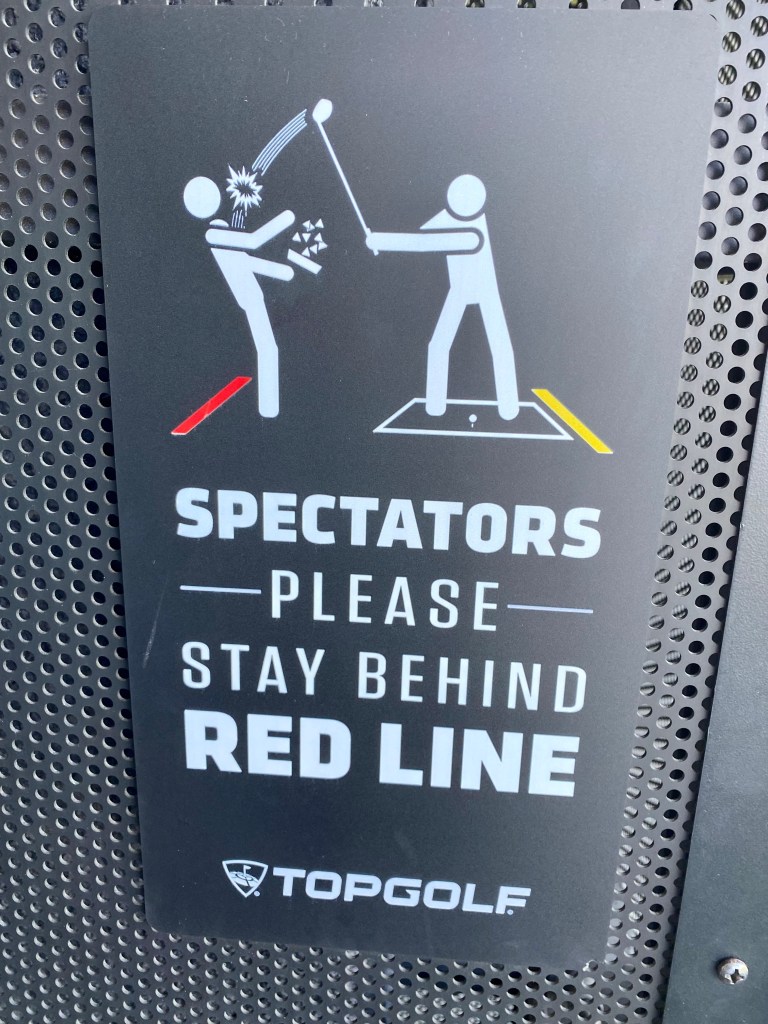
If you’re driving toward, away from, or involved in a police pursuit near from LAX on Pacific Coast Highway, and this magnificent black-and-gray kingdom East of El Segundo’s landmark Chevron Oil Refinery catches your attention, perhaps you’ve reached your unintended destination. Proceed with caution.

One must be prepared there is a seduction into believing a) golf really isn’t all that challenging, demanding or demeaning, b) you’ve got time to prove that theory and c) your credit card limit can be extended in emergency circumstances.

Or, just leave your wallet in El Segundo and pursue another quest.

For the last 20-some years, Topgolf has become this bedazzled and beguiled business model on how to successfully spray tee shots to all corners yearning for legalized torture chambers under the ruse of an entertainment venue.

Sparked by its successes in Las Vegas, Austin, Scottsdale, Nashville and all the other up-and-coming 21st Century upwardly mobile resorts, Topgolf somehow seizes onto one of God’s historically problematic endeavors — as in, “G-D-it, I just lost another $5 Top Flight in that ditch” — and dupes all comers into considering this could be as recreational enjoyable as when their grandparents ran off on Saturday nights for their bowling leagues back in the ‘60s and came home smelling like a carton of Lucky Strikes.

There’s crying in golf. Tears, and fears. And no bumpers in the gutters. It spares no one.

Topgolf is stimulation through simulation. A grip-and-rip, multi-tiered launching pad that makes you forget it’s a multilevel marketing scheme.

It took until last April before getting this escape room pried opened in Southern California (after one was strategically planted first near the Ontario Airport). Airport-adjacent sites seem to be targeted now in Southern California where property can be easily transformed. It’ll only get worse if California passes sports betting legalization.

This one here in L.A. non-proper came after years of resistance from the local neighbors, led to believe this would attract the most undesirables elements. You know, the Bogey-Man Syndrome.

Now, look at the parking lot, on any day, any time. It looks like a new Carvana just set up shop.

For the uninitiated and somewhat inebriated, think of a typical mundane golf driving range now amped up with an assortment of bells, whistles and cart girls hustling over a range of food and beverage — and advice — that will push you down a path of ego punishment.

They provide the clubs, an arsenal of Callaway drivers, hybrids and wedges, all compliments of Topgolf’s new parent company. The have the balls, filled with electronic diodes, for you to whiff over, top, slice, hook and fade, by accident or on purpose. The fake grass and the rubber tees are standard. Now add in more flatscreens than the video section at Costco that tell (or mock) you, upon impact, just what your recorded as far as trajectory, speed, arch and landing spot. It’s as if you’re on a CBS telecast, the celeb partner of Phil Mickelson’s at the AT&T Pro-Am.

(Maybe a poor choice of PGA Tour pro to use here, since he’s taken his talents to that farcical Saudi league to pay down his latest gambling debt.)

So, yeah, that’s a faux Pebble Beach Course, all right. One of four in the simulator’s evil storage unit. You trust it is telling you the truth on where to aim and, when you’re a decent distance from the pin, how to chip toward the 57-yard target, make it in the middle part of the netting, and somehow accept responsibility for a triple-bogey. If at any point you use more than 10 swings, an alert pops up — you’ve exceeded your limit — so you’re stamped a certified loser and ushered ahead to the next hole. By the time you’ve taken the walk of shame to the Famous No. 18, the phony Pacific Ocean on the left and the phony sea lions barking at you is a welcome relief.

But wait, there’s more.

Continue reading “The writing on (and off) the wall: Just try to top Topgolf for self deprecation”

Yesterday’s News: Avoiding ‘Ted Lasso’ doesn’t make you an a**so

Tom Hoffarth / FartherOffTheWall.com

The Emmy Awards scoreboard from last Monday night shows that “Ted Lasso” kicked the crap out of the competition with a four-goal victory over at the big fancy theater in L.A. Live.

The Outstanding Comedy Series. The Outstanding Lead Actor and Outstanding Supporting Actor in a Comedy Series. Outstanding Comedy Director. The Hollywood Reporter reports it, and we honestly believe it to true.

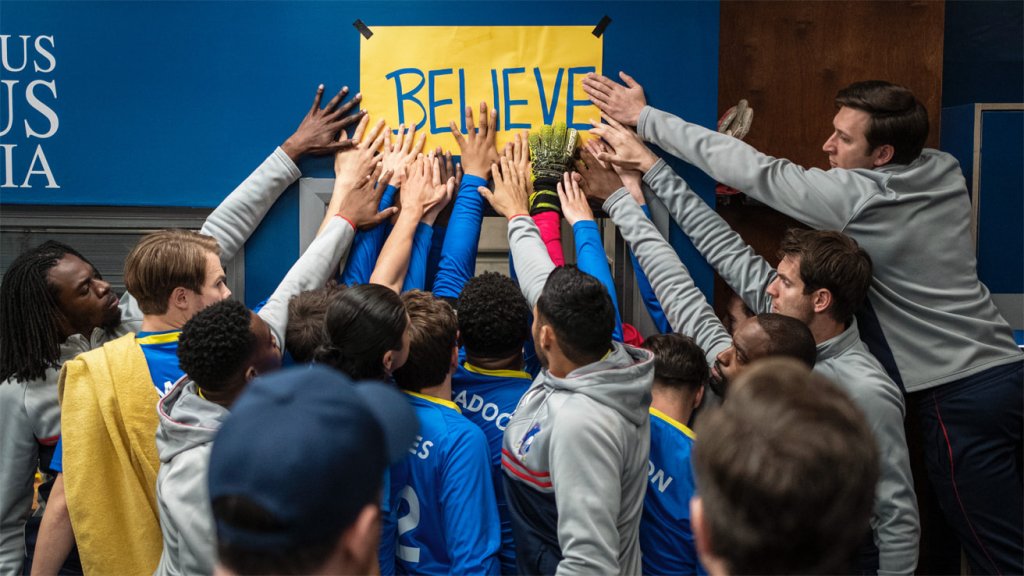
You likely know this whole thing, an expanded NBC soccer promo somehow morphed into a script, goes on about an American college football coach who lands in England to coach up a bunch of real football players just to miff the owner’s ex-husband. Somehow, infectious optimism abounds. It’s the old goldfish-out-of-water plot, just across the pond.

Reviews of the show in quick-blurb form:

“Wickedly Funny” – New York Times.

“Laugh-Out Loud Funny” – Entertainment Weekly.

Funny thing: We still haven’t watched one bloody minute of it.

It’s been around now, what, 14 years? It could still be airing in extra time for all we know. Forgive us, but we’re still in a COVID fog since our 2020 vision went blurry.

We remember glossing over a series of L.A. Times stories about this from its esteemed soccer writer, why it happened, how it was a “tonic for our trying times,” and how it had lasso’d the football world to rally around it.

Not watching “Ted Lasso” — and to this point, any of its reported 22 episodes — doesn’t make us an a**so.

A friend with swell intentions — and a family member with a SAG-AFTRA card — slipped us one of those “For Your Consideration” screeners. Yes, we all have one of these pals with media contraband.

The other day, we went searching for the DVD out of curiosity and found it in the office desk-top organizer between a menu for Gus’s Fried Chicken and a Readers Digest renewal form. It was tempting to throw it into the old-time Blue Ray machine just to see if the thing still works.

Nope, didn’t happen.

Why this aversion to “Ted Lasso”? Without the aid of a Zoom therapy session, we tend to believe it has to do with:

= It airs on Apple TV+.

Sorry, that’s where it streams — a concept our 3-year-old grandson is still trying to figure out when he sprints to the bathroom after another gallon of apple-plus juice.

On our household spreadsheet, Apple TV+ is a net minus. In downsize mode, we’re not apt to add more apps and passwords and all other sorts of nonsense. We understand that our iPhone has an ApplePay thing to make charging everything extremely easy. It also tracks our every move and randomly adds fees to the monthly statement that have something to do with Apple.com Storage and stuff we can’t control.

Continue reading “Yesterday’s News: Avoiding ‘Ted Lasso’ doesn’t make you an a**so”

The writing on (and off) the wall: Dr. Soon-Shiong and the DNR Angels? That’s rich

Tom Hoffarth / FartherOffTheWall.com

Everyone and their destitute friends want to tell Dr. Patrick Soon-Shiong how to spend his disposable income these days. It’s become an epidemic.

Soon enough, he’ll fritter it all away just as easily by himself.

The Los Angeles Business Journal just released its annual list of the 50 Wealthiest Angeleonos – you can read it online but you only get so many looks before you’re faced with trying to scale a paywall to keep away the illegal riffraff.

Spoiler alert: Soon-Shiong has retained his No. 1 prime-time top spot because of his deteriorating estimated his net worth of $19.1 billion.

When he was top L.A. dog in 2021, the Brentwood resident and LeBron James neighbor supposedly had $20.4 billion tucked away. Yet he is anything if not consistent – he’s lost six percent of his walking-around money in each of the last two years. Even more if you check other sources of repute.

And still, enough think he’s the person they want to buy the Angels.

There can’t be an Angeleno in his right Charles Schwab ledger who’d own up to wanting to own the Angels these days.

Soon-Shiong is in the health-care business. He knows a DNR situation when he sees one.

First, no one living in a 25-mile radius of Angels Stadium has even received their first COVID shot. That’s the definition of a dying fan base.

He also has to take into account that Shohei Ohtani, the most remarkable Major League Baseball player we will every witness in our lifetime, will be summonsed back to his home planet soon unless he is compensated according to what Babe Ruth and Cy Young would be paid, combined, in today’s economy. They’ve not created a super calculator with that many digits yet.

Soon-Shiong has to be running out of patience, patients and patents.

Continue reading “The writing on (and off) the wall: Dr. Soon-Shiong and the DNR Angels? That’s rich”

The power of the ask: When someone’s basic needs for survival go beyond the obvious

Originally posted December, 2021

By Tom Hoffarth

We learn to ask anyone wrestling with the realities of shelter and food insecurity who manage to arrive each Saturday morning at the St. Robert’s Center in Venice a simple question — What do you need?

It is as much a conversation starter as it is a fact-finding mission.

The answers are remarkably simple and ones you might not always default do. But consider the beauty of:

= A hot cup of coffee, please. With as many refills as you can spare. To take the chill off the night before.

= Access to an electrical outlet, to recharge a phone. How long can I leave it plugged in? This is how I stay connected to the world.

= Five quiet minutes in a restroom, if that’s possible. Just to gather oneself.

The last umpteen months of protocol adjustments brought on by the COVID pandemic have forced Catholic Charities L.A.’s facilities like this one that serve the Santa Monica area into a “grab-and-go” assembly line. Often in a condensed time window.

The basics of offering food, clothing and toiletries are the default essentials, and come from various sources. It was a pivot to pre-made grocery bags and lunch bags — granola bars, fruit cups, cans of soup (stay away from anything condensed), Vienna Sausages and whatever else has easy-to-carry nutritional value – are things regularly ordered and picked up at the Westside Food Bank. More financial donations that allow shopping at the local Smart & Final. About a dozen volunteers from surrounding Catholic churches donate their time and hearts — and often what they can cull from their spouse’s closets — each week to make it flow in whatever direction it will end up going.

Blankets, hoodies, socks, pants and other practical clothing items for men and women are there, depending on what’s available. Same with seizing the day for anyone who could use travel-sized bar soap, toothpaste and shampoo/conditioner. Add masks, hand sanitizers and alcohol wipes to the essential lists.

Continue reading “The power of the ask: When someone’s basic needs for survival go beyond the obvious”

Day 40 of 2022 baseball books: We’ve been lucky enough to grind out this far …

“Grinders: Baseball’s Intrepid Infantry”

The authors:
Mike Capps
Chuck Hartenstein

The publishing info:
Stoney Creek Publishing
415 pages
$19.99
Released July 18, 2022

The links:
The publishers website
At Bookshop.org
At Indiebound.org
At Powells.com
At Vromans.com
At TheLastBookStoreLA
At Skylight Books
At BarnesAndNoble.com
At Amazon.com

The review in 90 feet or less

Brian Downing may have gone by the nickname “The Incredible Hulk,” looked far more like Christopher Reeve, and was the most likely Angels in the Outfield candidate to bust through a left-field wall like the Kool-Aid Man in routine pursuit of a fly ball.

(Downing shoulda been in this commercial, not Pete Rose, but then again …)

He rode a Harley Davidson motorcycle to the ballpark. He is the Los Angeles-California-Anaheim franchise leader in hit by pitch — more than 100 in the pre-body-armor days.

Call him a Grinder – as this new book does, and we heartily applaud  – but he was also a Gamer.

Downing played in 1,661 of them for the franchise. It covered 13 seasons, most in its history when he was incredibly let go by Angels GM Mike Port because, well, the guy was 39 and, by all accounts, kind of expensive to keep around despite … well … we’ll get to that.

When he arrived via trade in 1978 at age 27, Downing compiled as many grass stains and elbow gashes as he did career stats that would put him pretty much in the club lead in every category, and all these years later, still remaining in the top five in many of them.

From playing catcher (and handling Nolan Ryan and Frank Tanana), then reluctantly moved to left field and then to a dependable DH who could do it from the leadoff spot, Downing was beyond a fan-favorite as the Angels won their first AL West Division title in 1979 (he was an AL All Star and hit .326 with 75 RBIs and 81 runs scored), and added two more titles in ’82 (.281, 28 homers, 84 RBIs, 109 runs) and ’86 (career-high 95 RBIs, 29 HRs, 110 runs). Six times he topped 20 homers in a season.

Also consider: That converted catcher broke Al Kaline’s AL record by playing 244 straight error-less games in the outfield from May of 1981 through July of ’83. And he didn’t complain about the scorekeeping call that ended it.

In the middle of the streak, this play even happened – 40 years ago this season, Sept. 21, 1982:


Born in L.A. and trying to make it onto the teams at Magnolia High in Anaheim and Cypress College, he couldn’t get anyone’s attention until a former American Legion coach of his pointed him to a tryout camp with the Chicago White Sox, where he was a part-time scout. Downing acknowledged it was tough to get players his age as the Vietnam War was going on.

Inserted as a third baseman, he lasted one pitch in his his MLB debut on May 31, ’73, coming in as a defensive replacement in the seventh inning. He banged up his knee catching a foul popup and had to sit more than two months.

His trade to the Angels in ’73 in a six-player deal meant Downing could come home.

He created a new batting stance and added in weight training to his 5-foot-10 and solid 194 pound frame.

Yet by the time the Angels kicked him to the curb at the end of the ’90 season — he wasn’t allowed to start the final home game of the season on Fan Appreciation Day, and a month earlier, he was named AL Player of the Week on Aug. 12 — he was making $1.25 million that season, sixth-highest on the team, and already sharing the DH role with Chili Davis.

Because of the way the Angels let him go, Downing remained understandably bitter. Ten years later, in 2000, in an interview with the L.A. Times, Downing said the wounds were still fresh.

“I was pushed out two years too soon,” he said, according to his wife, acknowledging that Downing played two more seasons in Texas as a DH. The Angels decided he could be replaced in that role in ’91 and ’92 with a rotation of Dave Parker, Dave Winfield, Hubie Brooks and other less expensive veteran spare parts.

Still, Downing got in the RV and returned to Anaheim to be part of the team’s 40th Season Anniversary celebration – voted by the fans to be included with in the outfield with Jim Edmonds and Reggie Jackson, honored with manager and shortstop Jim Fregosi, catcher Bob Boone, first baseman Rod Carew, second baseman Bobby Grich, third baseman Doug DeCinces, designated hitter Don Baylor, right-handed starters Nolan Ryan and Mike Witt, left-handed starters Frank Tanana and Chuck Finley and reliever Troy Percival.

Downing’s baseball card of numbers may not have had the Cooperstown-worthy data on it, but it didn’t matter – he finally conceded in 2009 to be added to the Angels’ Hall of Fame. (And on the April night the ceremony was supposed to happen, the Angels lost young pitcher Nick Adenhardt in a car accident, so the game and event was postponed to August).

At that time, he told the Orange County Register: “I’m very conflicted about a lot of things. I know a lot of this night is going to be about the fans, and I appreciate all of them, and all of that. I was always glad to be part of a team, with a bunch of players, but I never wanted to be THE player.”

The story also quotes former teammate Bert Blyleven:

“Brian was what other players called a ‘GAMER.’ …  He was the type of player and teammate that came to the ballpark everyday to PLAY.”

Downing move to Texas also meant settling into ranch life with  his wife in Celina, Tex., just outside of Dallas.

His last career hit was on the last day of the ’92 season – Sunday, Oct. 4 – described as a line drive single to deep shortstop-third base hole, off the Angels’ Blyleven at Angels Stadium in the first inning. Downing then came out for a pinch runner. They had him in the lineup hitting second and playing second base – a defensive position he wasn’t going to go out and play that day regardless (as he was the Rangers’ DH the previous two games against the Angels in the series).

In the pre-Albert Pujols Anaheim days, Downing was No. 5 – and both are tied for fourth on the franchise’s all-time home run list with 222.

And, on at least this list, he’s No. 6 of the team’s all-time players (behind Mike Trout, Tim Salmon, Chuck Finley, Jim Fregosi and Jered Weaver – and ahead of Nolan Ryan? How about we take another straw poll?). On the NotInHallofFame.com countdown of 50 all-time Angels, it’s Trout, Ryan, Finley, Frank Tanana, Weaver and … Downing is No. 11.

All things considered, too low …

We get to re-remember Downing’s career and impact because of the 15 pages featuring him opening up more about all this in a book pulled together by two grinders themselves.

Mike Capps, the only broadcaster in the Triple-A Round Rock Express’ 22-year existence, did TV and radio news reporting in his prior professional career — 22 years of that at age 24 as a police reporter. He also did the book, “The Scout: Searching for the Best in Baseball” with Red Murff. Earlier this season, Capps logged his 3,000th game at Round Rock, now the Texas Rangers’ top farm club and still owned by Nolan Ryan.

Chuck Hartenstein, who logged 15 years as a relief pitcher known as “Twiggy” for the Cubs, Pirates, Cardinals, Red Sox and Blue Jays between 1966 and ‘77, died last October at age 79. He was the inspiration for the book, and his story became the opening chapter.

More than 40 players are profiled — including former Dodgers pitcher Jerry Reuss, one-time Dodgers coach Lorenzo Bundy and the three generations of Hairston players that include Jerry Hairston Jr. There are notable names like Kevin Millar, Fred Patek, Ron Swoboda and Jackson Ryan (Nolan’s grandson), plus the great baseball names like Scipio Spinks, Joe Slusarski, Travis Driskill, Kelly Wunsch, Ross Ohlendort and Chase Lambin.

As for Downing ..

The authors reached out to Downing’s wife, Cheryl, who admitted she wasn’t optimistic he would cooperate. “Better than that, he put together on 12 pages of legal pad, filled out both sides, a handwritten account of his career,” the authors explain. “Downing purged his baseball soul … (he) provided one of the best, eloquent and honest responses we’ve ever seen.”

It reveals how Downing was a 7-year-old in L.A. when the Dodgers moved into his hometown, and the first game he saw was when his grandmother took him to Game 3 of the ’59 World Series at the Coliseum.

The White Sox, the Dodgers’ opponent in that series, became his first pro MLB team. And Don Drysdale, pitching in that game for the Dodgers, would call Downing’s career from the broadcast booth.

Downing recalls in the book his first MLB at-bat finally came in August and, on the first pitch he saw, he legged out an inside the park home run during an NBC national TV “Game of the Week” telecast, off Mickey Lolich. Downing was hitting fifth, starting in right field.

(For what it’s worth: Downing’s first MLB AB was the day before in Detroit as a pinch hitter, striking out. And in that next game, he filed out to right in the first inning, then, in third MLB at bat, his first hit is that homer in the fourth).

Downing doesn’t lament much, if at all, in the book about the Angels’ releasing him. But look, with a 20-season career, where he even got a cameo role on “The Jeffersons” when Louise snuck into the Angels’ locker-room looking for Reggie Jackson, to where he could address the Angels Stadium crowd for his delayed franchise Hall of Fame ceremony, things turned out pretty swell.

This book proves it.

If the Angels get around to another anniversary team — they just past 60 seasons, and their 60th season in Anaheim comes up in 2026 — Downing may not be remembered enough to be on it. Mike Trout, Shohei Ohtani, Vlad Guerrero, and a collection of players from the 2002 World Series team might be considered more worthy.

“I just truly appreciate everybody that supported me all those years and the great support our team had,” Downing told the crowd at the Angels Hall of Fame ceremony.

Enough said. End gamer.

How it goes in the scorebook

It may show “1B-6” in the book, but it doesn’t show how it was a slow roller to short that took all sorts of determination out of the box to get down the line and beat out the throw. Those qualities aren’t easy to describe. This does a fine job of it.

Rewind back to Jerry Reuss, who pitched nine seasons for the Dodgers in his 22-year career (1979 to 1987, including his 1980 no-hitter at San Francisco.

Reuss tells a story (page 96) about when he pitched for the Cardinals in 1973, six of his games were at Dodger Stadium that year, and he came to enjoy hearing Vin Scully’s voice on transistor radios all around the park.

Jerry Reuss’ 2014 autobiography.

Reuss remembers looking in for a sign once, and hearing Scully tell a story, so: “As a courtesy to him, I stepped off the rubber, grabbed and threw down a rosin bag. He delivered the punch line, the crowd laughed, and Scully continued: ‘Reuss winds and the pitch on the way …'”

The story was retold by Rick Reilly in a Washington Post appreciation column.

Because of its nature, baseball is a sport that needs grinders almost more than it needs its marque talent that make things look so easy. If baseball only had five players to a side, the grinders fill in the other four spots, making sure the 162-game schedule is completed.

It’s a reflection on life, if you want to get metaphysical about all this. Those who grind stay in the game. Those who have the talent, face adversity and fall back, won’t survive.

Thank you, grinders, for the inspiration. You intrepid bastards.

You can look it up: More to ponder

== Maybe someday there’ll be a book, or a chapter, on the the Dodgers’ secret weapon to winning the 1988 World Series: Mickey Hatcher, Rick Dempsey, Mike Davis, Franklin Stubbs, Danny Heep, Jeff Hamilton and Dave Anderson. Throw in Mike Sharperson, Mike Devereaux, Chris Gwynn and Tracy Woodson.  All hatched off the scrap heap. Pinch hitters. Pinch runners. Defensive replacments. Fill-ins during injuries.

You say Grinders. We still say “Stunt Men.”

Hatcher gave the Dodgers’ bench crew that name during spring training, knowing that Tommy Lasorda had a roster at the time with the likes of Kirk Gibson, Steve Sax, Mike Scioscia, Pedro Guerrero, Mike Marshall, Alfredo Griffin and John Shelby.

 “The thing about the Stunt Men is that we’re never happy,” Hatcher said. “We want to make that clear. You show me a guy happy to be on the bench, and I’ll show you a loser. … Our goal, as stunt men, is to push the (starters). Being a stunt man takes a certain kind of attitude and patience.”

Like being a grinder. Not in the spotlight. Asked to do all the heavy lifting.

Hollywood, man.