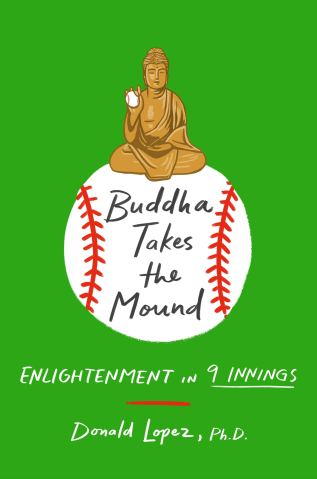
From this rather cosmically whimsical cover, it might not reveal to us that Lopez is kind of a big deal in the Buddha world. Wikipedia kind of big, if that actually supersedes Encyclopedia Britannica largeness.
The Arthur E. Link Distinguished University Professor of Buddhist and Tibetan Studies at the University of Michigan, and part of the Department of Asian Languages and Cultures, Lopez received a BA in Religious Students in 1974, an MA in Buddhist Studies in 1977, and a doctorate in Buddhist Studies in 1982 at the University of Virginia. He is married to another prominent Religious Studies scholar, Tomoko Masuzawa.
Lopez is also referred to as the “only public intellectual in the field of Buddhist Studies.” Can we assume most of them are pretty quiet people otherwise?
The takeaway from Lopez adding to the betterment of our humanity, aside from this piece, is the mind-blowing idea that not only is Buddhism integral to baseball, but baseball is Buddhism, and baseball is ourselves.
If only we could spend all day in the on-deck circles talking in circles about this.
Chapter 4, Page 37 begins a story about Los Angeles at the turn of the 20th Century. As this melting pot of a city incorporated in 1850, a year before statehood, continued to take shape, the Japanese population numbered fewer than 100 in 1890. By 1907, it was up to 6,000.
Nearly all these new residents were men. Known as birds of passage — deseki in Japanese — they planned to stay in the United States a short time, earn as much money as possible and return to Japan with enough money to purchase a farm of business and start a family. … Most were located around North San Pedro Street and First Avenue, an area that became known as Little Tokyo.
That’s also when a couple of students at USC — 25-year-old Seijiro Shibuya and 26-year-old Masaharu Yamaguchi — launched the Rafu Shimpo (Los Angeles Currier) in April 1903, written by hand and mimeographed, with offices soon to be at 128 N. Main Street, where City Hall now stands. It became a daily paper on Feb. 1, 1904.
“The writers were a young, rowdy bunch,” writes Rob Fitts, a former archaeologist with a PhD from Brown University who left academics to follow his passion of Japanese baseball. The writers often had to be awakened with hangovers after sleeping in segregated bathrooms, some sticking their heads into the dirty water of the toilet, flushing it, and ready to work again.
This matters why?
“On weekend afternoons, when they were not working, drinking or whoring, the young reporters played baseball,” Fitts tell us.
It’s right in the middle of Chapter 14 – the one with the endearing heading of “Fuck You, Shakespeare.”
Mitchell Nathanson writes about how Jim Bouton and Leonard Shecter were tossing around potential titles for this new book they were writing about Bouton’s experience during the 1969 Major League Baseball season.
— Mitchell Nathanson (@MitchNathanson) May 15, 2020
There were ideas like “There’s More to Baseball than the Score.” Or “Take Me out to the Ballgame,” “Hiya Baseball,” and “How’s Your Old Tomato?” There was the inspired “Constant Replay,” a twist on the 1968 book “Instant Replay” that Dick Schaap did with the Green Bay Packers’ Jerry Kramer.
As Nathanson explains:
‘Sports books always had these upbeat titles, “Running to Daylight,” Bouton said … “You never heard of a sports book called ‘Running to Darkness.’ … But when a drunk woman at the Lion’s Head (a bar in New York) overheard Bouton and Shecter debating possible downbeat titles (the working title for the book as described in the publication agreement with World was ‘Baseball Journal’), she slurred her way to literary gold by suggesting a title that evoked failure rather than success: ‘Whyyyyy don’t you caaaaauuull it Baaaaallllll Fooooouuuuuuuuurrrrrr?’ After rejecting it out of hand, they realized she was onto something.
It was a deja vu moment all over again.
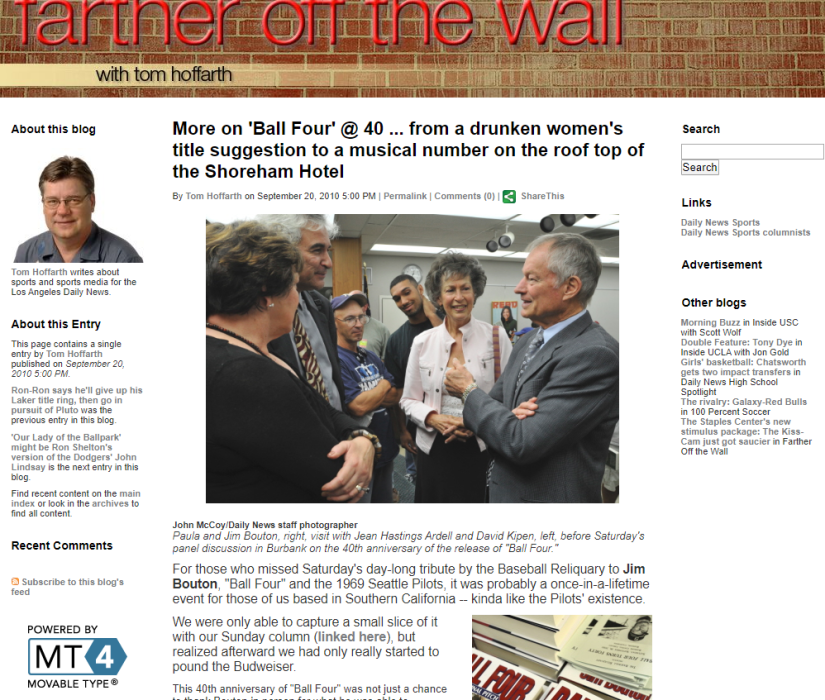
The paragraph included a couple of numbered footnotes, so we flipped to the back to the notes section and found Nathanson had two references: “Hoffarth, ‘More on “Ball Four” @ 40.”
Even further into the bibliography: “Hoffarth, Tom. ‘More on “Ball Four” @ 40 … From a Drunken Women’s Title Suggestion to a Musical Number on the Roof Top of the Shoreham Hotel.’ Farther Off the Wall with Tom Hoffarth, September 20, 2010, http://www.insidesocal.com/tomhoffarth.”
We were magically dumbstruck.
First, the link to that information no longer exists. The Southern California News Group erased it all shortly after my January, 2018 layoff. That was among thousands of paragraphs of original material – much of it we couldn’t fit into a standard 800-word newspaper piece. It was perfect for this platform. All the extra stuff. But some of it even stand-alone stories we could post. We’re resigned to the fact they’re all gone now. For whatever reason.
********
(Author’s note on May 23, 2020: Thanks to those who reminded us of the “Way Back Machine” website that captures snapshots of the internet at various times and is able to save things. We have found the link to this notated September 2010 post and are thrilled to read all the material we were able to include in this).
**********
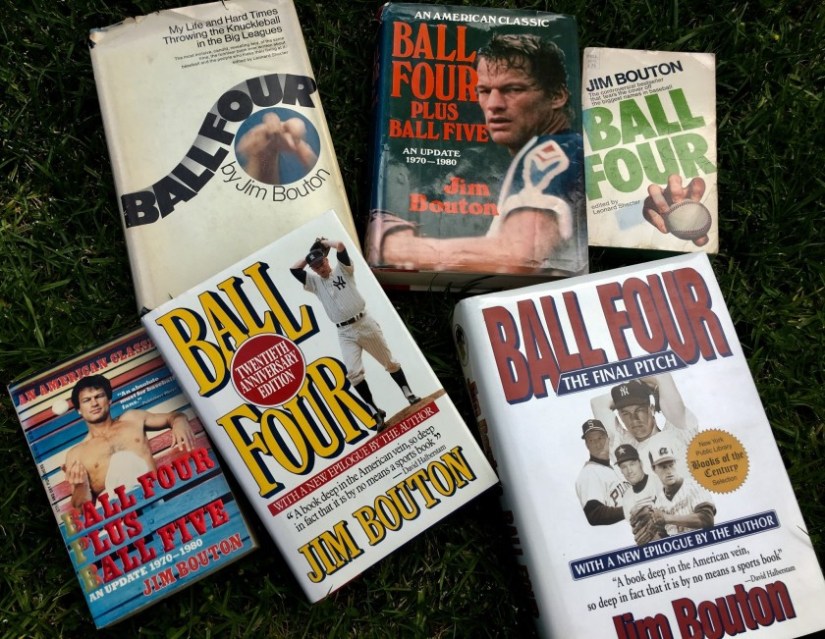
Second, we realized as well how emotionally frayed we were about this revelation. It was somewhat profound moment of how we’ve become enormously emotionally invested in Jim Bouton, again. If this biography that we expect to read, and re-read a few times, becomes as important enough to share the same shelf as all our personally signed versions of “Ball Four,” acting as a book-end to a man who became very much a sports hero in our own journey, this best be worth it.
However we can help make this something that smokes ’em inside, outside, and all around the strike zone.
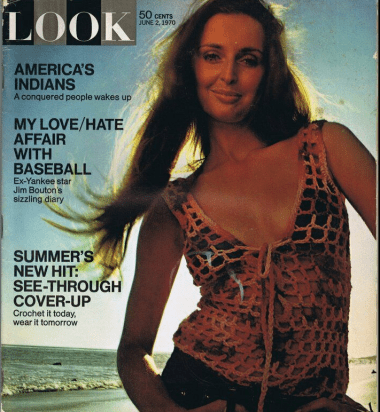
The June 2, 1970 issue of Look magazine, where the first excerpt of “Ball Four” was printed, and forced the early publishing of the book moved up from November because of the buzz created.
Nathanson, a Villanova University law professor who teaches writing at the school’s sports law center, was thankfully able to capture those nuggets of information we once posted — given to us directly from Bouton about the creation of “Ball Four” during a 2010 interview. Those notes are filed away, preserved as part of the “Ball Four” legacy. We were surprised that of all the tiems Bouton may have told that story, we had documented it and it was retrieved for this excavation.
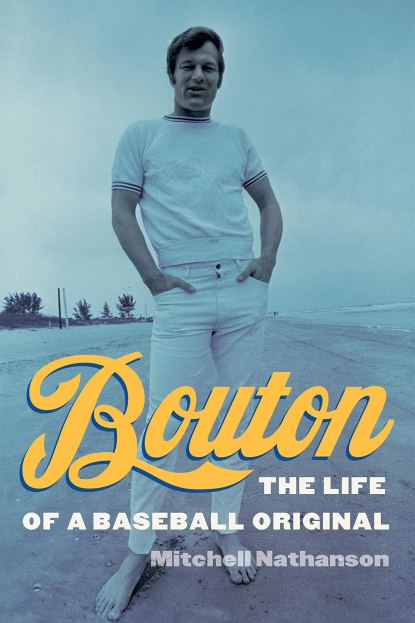
As “Bouton: The Life of a Baseball Original” was one we’ve long awaited to read, review and learn from, we also came to the realization that it gives us the capability to remember.
Why Nathanson decided to tackle this project, there’s a personal connection as well as a curiosity as to to explore more about who he felt were the most influential ballplayers of the 1960s — Bouton, Dick Allen and Curt Flood. The later had some decent biographies about him. In 2016, Nathanson took it upon himself to rectify some of that with “God Almighty Hisself: The Life and Legacy of Dick Allen,” for University of Pennsylvania Press. The mercurial Allen, aka Richie, had been another of our MLB childhood favorites, if only because of the one year he played in L.A. for the Dodgers drove Walter Alston to demand he be banished to Chicago, where we saw him develop into an AL MVP and punctuate a career still missing Hall of Fame recognition in Cooperstown.
During the 2016 World Series broadcast, Fox Sports’ Ken Rosenthal wore a bow tie honoring Rod Carew and the American Heart Association’s “Heart of 29” campaign. Apparel is available through Twitter’s HopeActiveWear account and CarewMedicalWear.com
“Rod Carew: One Tough Out:
Fighting off Life’s Curveballs”
Rod Carew was a known fastball hitter – interestingly, at anything pitched anywhere except down the heart of the plate. That would freeze him up. His unorthodox crouch-and-finesse batting stance from the left side actually changed pitch by pitch. That made sense to him, signaling where he thought the pitch would be coming and adjusting — or forcing the pitcher to pitch to his stance and then adjust to that thinking.
Curve balls, literally and metaphorically, gave him heartache.
It seems he’s now finally able to adjust to some of life’s major change ups without knuckling under.
Fittingly from Triumph Books, here is a triumphant reflection that comes from the heart. Specifically, it comes after a delayed heart transplant that now 74-year-old received in 2016 and the astounding story that unfolded along the way.
There are only two previous books attributed to the Hall of Famer: A 1979 bio written with Ira Berkow, when the 33-year-old left Minnesota after 12 years and came to the Angels, and a 1986 instructional book, “Rod Carew’s Art and Science of Hitting,” with Frank Pace and Armen Keteyian, the year after Carew retired at age 39 and starting a new career as a hitting instructor. Both were re-released in the mid 2000s.
While we definitely were in need of a refresh, we had to wait until he had the fortitude to come through with it.
Carew breaks this all down in three stages. The first 160-plus pages recap a life we may have read about before, but he corrects inaccuracies — all about growing up in Panama near the famous canal, moving to Manhattan with his mother as a way to flee his father, signing with the Twins, curious about how he was referenced in the 1967 Baseball Digest as a “Panamanian Negro,” becoming disenfranchise by the baseball business, forcing a trade to Anaheim, then taking No. 29 into retirement by both franchises once he passed the 3,000-hit milestone in his final season, securing a Hall of Fame election in 1991.
(For the record: He was born aboard a racially segregated moving train in the town of Gatun. The doctor who tended to him was named Rodney Cline – where Rodney Cline Carew would get his first two names. But Carew clarifies he was actually delivered by a nurse named Margaret Allen. “Once the wails of a newborn rang out, the conductor summoned a physician from the white section – Dr. Cline, of source. While Dr. Cline became the inspiration for my name, Mrs. Allen became my godmother.”)
Nope, no way, no how did the Dodgers of 1988 have any business squashing the Oakland A’s in the World Series. But it happened. Nor did the Nationals of 2019 have any realistic chance of knocking out the two-time defending NL champion Dodger in the NLDS. It happened, too.
Now it’s a chance for Joan Ryan to peel back the onion.
By adding that satirical quip in the introduction of her book, Ryan gets to flex her investigative reporting skills she used for several decades as a San Francisco Chronicle columnist and self discover if there’s a tangible way to define and quantify what we all can talk about in esoteric terms as they pertain to success in team sports.
@GrandCentralPub is reissuing Little Girls in Pretty Boxes in July with a new introduction about @USAGym, Nassar and sexual abuse. Thank you to Olympian Jame Dantzscher @dantzscher — the first gymnast to file a civil suit against Nassar & @USAGym — for writing the foreword. pic.twitter.com/jlKyw8YIiR
And our heart remains with her personal story from 2009, “The Water Giver: The Story of A Mother, a Son, and Their Second Chance,” that focuses on her 16-year-old learning disabled son named Ryan (his dad, Joan’s husband, is acclaimed sports broadcaster Barry Tompkins) who fell off a skateboard, and she documents the medical ordeal that followed from crisis to crisis.
Since 2008, Ryan has been a media consultant with the San Francisco Giants, so it’s somewhat a natural she’s able to hold up the construction of the 2010 Giants roster that won the first of its three World Series titles in a five-year span as a test case about how team chemistry seems to have worked. This was, as described in Andrew Baggarly’s book, “A Band of Misfits.” Especially when she can compare that to the 2007 Giants roster that has been “cliquey and snippy as a middle-school cafeteria.” Three years later, there was a new openness, and the chaos subsided.
She starts with the premise that asks three questions: