Day 19 of 2022 baseball books: Dale Scott’s true calling, and what can make a pride of umpires proud 

“The Umpire is Out: Calling The Game
and Living My True Self”
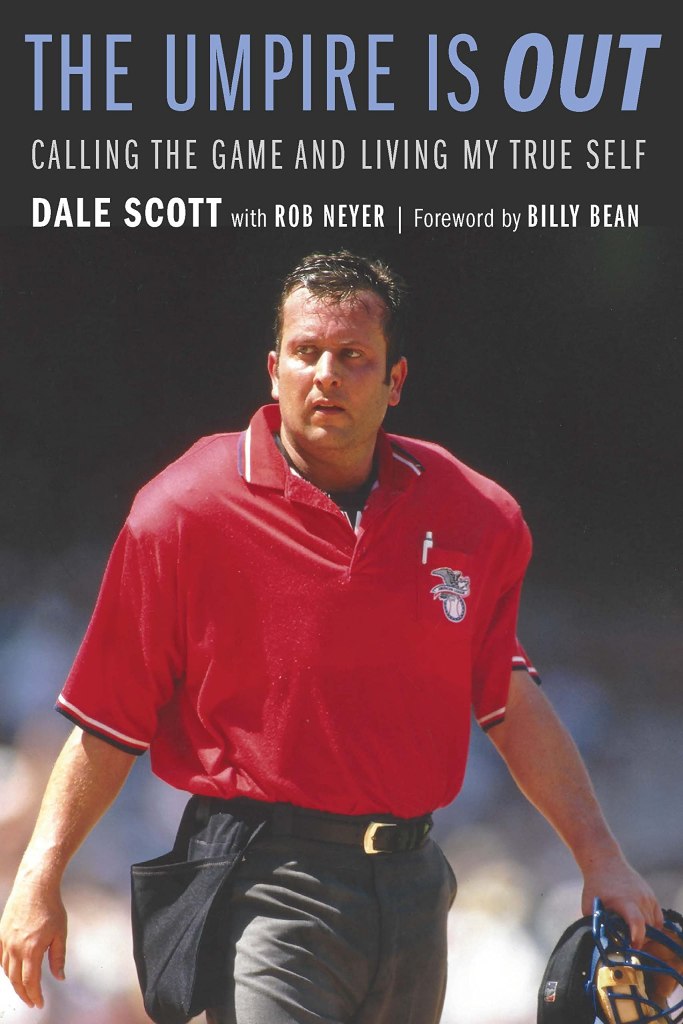
The author:
Dale Scott
With Rob Neyer

The publishing info:
Univ. of Nebraska Press
312 pages; $34.95
Released May 1, 2022

The links:
The publishers website
The authors website
At Bookshop.org
At Indiebound.org
At Powells.com
At Vromans.com
At TheLastBookStoreLA
At BookSoup.com
At Amazon.com
At BarnesAndNoble.com
At the Baseball Hall of Fame

The review in 90 feet or less

A kiss isn’t always just a kiss.

Danielle Goldey and Meredith Kott went to a Dodgers game on Aug, 8, 2000, shared their affection with a passionate smooch whilst in their Dodger Stadium seats during a seventh inning celebration, and, soon enough, eight security people descended on them to show them the exit. Those complaining said kids ought not be watching this stuff.

Patt Morrison of the L.A. Times would write about it weeks later under the headline: “A Smooch Too Far.” Bill Plaschke also verified for the Times’ sports readers that this was in fact a French kiss, “but witnesses say it was nothing blatant or inappropriate.” Good thing we had impartial witnesses. Plaschke also had a quote from Goldey: “If we started disrobing, started feeling each other up, that would be inappropriate. We knew there were kids around. We know there are things you don’t do in public. My mother raised me to know right from wrong.”

(Morrison also noted that Goldey’s mother was in the real estate business and sold several Dodgers their homes over the years. Gotta know when to play that ‘Do you know who my mom is? card.)

The couple went to their lawyer, who talked to the Dodgers, who instead of trying to talk their way around it, went the extra yard. Then-team president Bob Graziano not only issued an organizational apology, but donated 5,000 tickets to gay-rights groups, and worked it out so that Sept. 6 would be the first Gay and Lesbian Night at Dodger Stadium, co-hosted by GLADD and the LA Gay & Lesbian Center. The couple got seats for that game behind home plate.

What’s now called the Dodgers’ Pride Night has evolved into a prideful moment on the promotion schedule – it happens this Friday when the Dodgers take on the New York Mets, followed by fireworks. We are starting national LGBT Pride Month that honors the 1969 Stonewall Uprising in Manhattan. It was established as a national event in 2000, and expanded by President Obama in ’11 to its current name.

The staff at Outsports.com – a sponsor of the event — reminds us that LGBTQ trailblazer Glenn Burke will be honored this time. Family members of the late Dodgers outfielder will throw out the first pitch. Last year, the Oakland A’s did the same honoring of Burke on their Pride Night.

(Catch up on your Burke history with the review of “Singled Out: The True Story of Glenn Burke:
The first Openly Gay MLB Player and Inventor of the High Five”
from 2021).

This year, as a rainbow-colored “LA” logo will be etched on the ground behind the pitcher’s mound, players will wear jerseys with the Dodgers script logo decked out in coloring scheme that would make the 1980s Houston Astros envious.

On hand for pre-game ceremonies includes former Dodgers outfielder and MLB ambassador for inclusion Billy Bean, transgender MMA fighter Fallon Fox and Military Hero of the Game Lieutenant Belita Edwards. Somewhere, Dodgers co-owner Billie Jean King will have a presence.

Dale Scott will be there too.

The retired umpire who came out in 2014 as the first openly gay MLB umpire — also the first active male official to come out in MLB, the NFL, NBA or NHL — was present and accounted for in 2018 Pride Night to throw out the first pitch. That was a year after he retired following 33 MLB seasons and nearly 40 overall in pro baseball, as he knew it was for his better health after suffering frequent concussions over the years (he worked exactly 1,000 games behind home plate).

The Dodger Stadium inclusion of Scott, who turns 63 in August, lines up nicely with the release of a gratifying autobiography about his life and career that is one of the more enjoyable and poignant reads of this baseball season.

Dale Scott, center in Dodgers’ jersey, with MLB umpires (left) Todd Tichenor and Alan Porter, plus Bill Miller and Angel Hernandez (far right), as well as NBA referee Bill Kennedy (with rainbow NBA logo shirt) as Scott threw out the first pitch on Pride Night at Dodger Stadium on June 8, 2018. (Photo by Jayne Kamin-Oncea/Getty Images)

When sorting out a list of what to include in the annual book reviews, one thing that drew us toward investing in this came from a recent post on Outsports.com by Ken Schultz that included: “When I tell you that Scott’s autobiography made me legitimately laugh out loud numerous times in the first chapter alone, that in and of itself is one of the highest tributes I can give … One of the best things I can say about the book is that Scott and co-author Rob Neyer seamlessly transferred his honest and self-effacing voice to the page and made it look effortless. In reality, I know how hard that is to do and it goes a long way toward making the decades of baseball stories he tells that much more entertaining.”

Over the last few decades, it feels as if there are three sorts of “umpire tells all” we’ve come across:
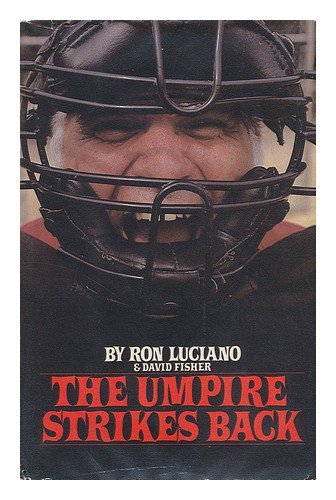
== The 1982 book by Ron Luciano, “The Umpire Strikes Back,” which he unleashed so funny stories it led to a TV gig with NBC Sports on MLB games as well as three sequels (“Strike Two” in ’84, “The Fall of the Roman Umpire” in ’86 and “Remembrance of Swings Past” in ’88). Those all came after the 1998 book: “You’re Out and You’re Ugly Too! Confessions of an Umpire With an Attitude” by Durwood Merrill. That may have opened the door on the jovial demeanor of umps we weren’t always allowed to see, some of which was also in the book, “Three and Two! The Autobiography of Tom Gorman, The Great Major League Umpire” in 1979 (as told to Jerome Holtzman).

== In 2014, two books came out — “They Call Me God: The Best Umpire who Ever Lived” by Doug Harvey, and “Called Out but Safe: A Baseball Umpire’s Journey” by Al Clark (the first Jewish umpire in AL history). Matter-of-fact, how it works, experiences we’ve had, etc. Same with Bill Nowin’s 2020 book, “Working A ‘Perfect Game’: Conversations with Umpires,” which we reviewed. And some of that as well with “As They See ‘Em: A Fan’s Travels in the Land of Umpires” by New York Times writer Bruce Weber in 2009.
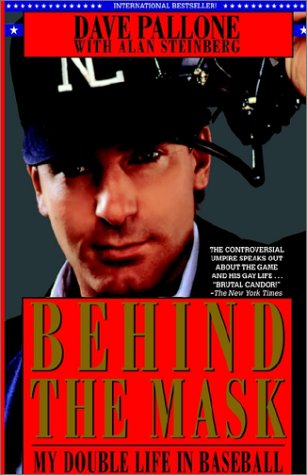
== Dave Pallone’s “Behind the Mask: My Double Life in Baseball,” which came out first in 1990, was updated in 2002, pulling a New York Times review excerpt: “The controversial umpire speaks out about the game and his gay life … brutal candor!” Pallone may have been the “first” gay umpire to talk about it, but it wasn’t by choice, more of being forced into it going back to how his counterparts resented him for crossing a picket line to umpire in the late ‘70s and then stay for a decade.

(And on the topic of umpires and barriers broken, there is “Unbelievable! The Life Journey of Art Williams, Baseball’s First Black National League Umpire,” by Dr. Audie Williams, independently published, released May 21, 188 pages, written by his youngest brother).

Scott, who has umpired in three World Series, six league championship series and 12 divisional series, goes an authentic route that combines three things: Self-deprecating humor, a seriousness about his work, and the current hot topic of LBGTQ.

The best example we found:

In 2005, Scott is in the middle of a messy situation around the ejection of Angels pitcher Brendan Donnelly for using a foreign substance on his glove. Washington Nationals manager Frank Robinson, tipped off about Donnelly’s glove from one of his players who was a former Donnelly teammate, called for the inspection as Donnelly was taking his warmups. Angels manager Mike Scioscia tried to divert the ejection by having Donnelly change gloves before he actually threw his first official pitch. Scott, as the crew chief, takes us through how he no choice but to eject him, no matter how much Scioscia protested.

The story expands to how Scioscia came out the next inning to point out the Nationals’ pitcher had a glove with strings that were too long and could be a distraction. Scott had to agree, based on the rules, and took care of that.

Which led to some exchanges that Scott was nice enough to document:

Scioscia: “That’s fucking bush league, Frank! You’re better than that!”
Robinson: “You’re a fucking cunt.”

(Scott later writes about the tension: “Because there was never much chance of someone actually getting hurt, we all sort of enjoyed that one.”)

The Society of American Baseball Research put out it own version of the story — how did Robinson know? Donnelly got a 10-game suspension (reduced to eight games) and Scioscia and Robinson had a one-game suspension.

And what was Scott’s eventual take-away from the whole thing?

Frank Robinson, left, is held back by Tim Tschida, center left, and Dale Scott holds back Mike Scioscia after Angels pitcher Brendan Donnelly was ejected for having a foreign substance in his glove on June 14, 2005.
(Photo by Matt A. Brown / AP Photo / Orange County Register)

“The next day in the L.A. Times sports section, above the fold, I saw a photo of me and (umpire Tim Tschida trying to get between both managers. In this photo – and frankly the angle wasn’t doing either of us any favors – I looked like a walrus. I had so much fucking fat underneath my chin – or should I say, chins – that they seemed to be multiplying like guppies … the only thing I could hear in my mind was the Beatles, “I Am The Walrus.’”

(The photo isn’t included in the book. We tracked it down above).

So on one of his days off that summer, Scott found a plastic surgeon to undergo liposuction. Before Scott and his partner Mike Rausch went on a European vacation after the season, Scott also got a face lift. A few years later, he admits he got a Bosley hair transplant.

“So now, I can check off the ‘You’re So Vain’ and ‘stereotypical gay man’ boxes,” he writes to finish the chapter.

One more revealing moment about how Scott treasured his work comes when he discusses his involvement in the 2009 ALCS between the Angels and Yankees.

“The first three games, for our perspective anyway, were uneventful. The fourth game was a shithouse,” he writes.

In Game 4, the Angels tried to pick the Yankees’ Nick Swisher off second base. Scott calls him safe, then looks up at the video replay and realizes Swisher was really out. There is no video review/manager challenges then.

A few moments later, umpire Tim McClelland rules Swisher was out for leaving second base too early trying to tag up on a fly ball and go to third. The video board (and TV) replays again suggested McClelland erred, even if it, in effect, made up for the first blown call.

The Yankees’ Jorge Posada (20) is caught in a rundown between third and home, resulting in what should have been a double play for the Angels after he and Robinson Cano, right, were tagged out. (Photo: Barton Silverman/The New York Times) from a NYTimes score headlined “Umpiring Stumbles to the Fore” in 2009.

An inning later, the Yankees’ Jorge Posada is in a rundown between third and home, as teammate Robinson Cano also arrives at third. Both are on the same base. Both are confused and step off the base. Both are tagged.
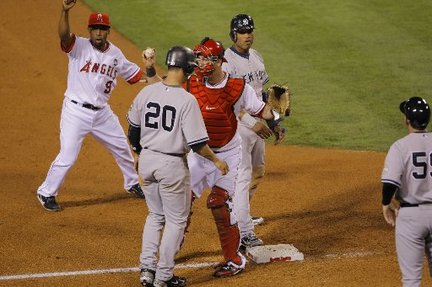
Angels catcher Mike Napoli appears to tag out both Robinson Cano and Jorge Posada in the fifth inning, but only Posada is called out by third-base umpire Tim McClelland. (John Munson/The Newark Star-Ledger)

Writes Scott: “It should have been a double play, which was obvious to everyone watching on TV … but (McClelland) didn’t realize Cano was off the base when tagged and left him safe at third. I didn’t see Cano off the base when he was tagged, either, although I wasn’t looking for it. I was behind second base looking down the baseline toward third while keeping an eye on the batter-runner Swisher and if he was continuing on to second. Everything happened with a lot of moving parts. … The Yankees ended up winning 10-1, but all anyone wanted to talk about us was us.”

The next day, in Game 5, Clark had what he calls “a wacker” at first base — Johnny Damon is called out to end an inning. Replays showed Scott erred again. On the Fox broadcast, Joe Buck is talking now about all the blown calls in the series.

Writes Scott: “I’m not sure that anyone who has never umpired or officiated knows how low you feel when you miss a call, even moreso when it’s in a postseason or extremely important regular-season game. It haunts you, follows you, and can (unfairly) brand you not only for the rest of your career but well after you’ve left the field.”

He referred back to how he had made “10 nutcutter correct calls” in the 2001 World Series Game 3, but those are now “wiped out, forgotten with just one big miss. Fair? Not really. Inevitable? Unfortunately yes .. All of us know it’s part of the package when we sign up for this.”

That off season, three key umps – Marty Springstead, Rich Garcia and Jim McKean – were fired by MLB.

“We didn’t see it coming and we were not happy,” Scott explains. “It felt the moves were made out of spite.”
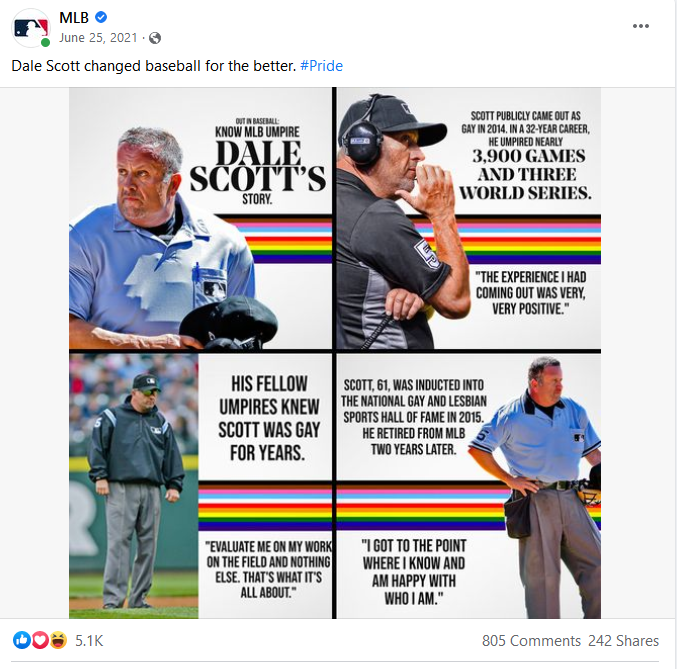
An MLB Facebook post in June, 2021.

Scott doesn’t mince words when he comes to how he felt about Jimmie Lee Solomon, the executive vice president of baseball operations, who made the decision, or the explanation by Rob Manfred, then the vice president of labor relations and human resources.

Just like an historic kiss, you can’t just give lip service to something or someone you feel has been wronged.

How it goes in the scorebook

After further review, a grateful thank you.

If we were going to Friday’s Dodgers-Mets game – or happened to be in his hometown of Portland when he and Neyer will appear at world-famous Powell’s for a signing on June 8 — we’d want to let him know how much we appreciated the education and entertainment, context and comedy, and true human feelings spread out along the way. Nothing sugar coated or trivialized. The importance of the umpire and how they feel about what they do needs to be told better, like this.

A late May blurb about the book in this New York Times roundup: “It’s a rare victory for the blue.” Agreed.

We’re also curiously appreciative of an appendix that includes five pages of every person he’s ejected in his career — his first in the MLB was the Angels’ Doug DeCinces in 1986 for arguing a called third strike. Plus a list of every umpire he’s ever worked with (partnered with Derryl Cousins and Joe Brinkman the most — 2,123 times, and interesting to see how he was with Augie Donatelli and Jocko Conlan more than 1,000 times, and Joe West just once).

You can look it up: More to ponder

== In a Q&A with the Pandemic Book Club, co-writer Rob Neyer explains:

What’s your book about?
Eighty percent great baseball stories from a fascinating baseball guy, 20 percent a story nobody’s read before from a great person.
Why this book? Why now?
I got lucky, because Dale Scott’s story is  just as unique now as it was seven years ago when he first took the field as an “out” MLB umpire. He’s still the only one who’s done that! In that respect his story remains as relevant now as then, especially considering that there is not a single out player in affiliated professional baseball, which remains both disheartening and inscrutable.
Who had the biggest influence on this book?
To some degree, the book simply continues a long lineage of umpire memoirs, all of which I’ve read (I think). At least subconsciously, all those books influenced my work. Also subconsciously, I hope a bit of Ed Linn rubbed off on me. His books with Bill Veeck and Leo Durocher are so great because you don’t feel you’re reading an Ed Linn book; you feel you’re hearing the voices of Veeck and Durocher, even though of course Linn must have done a great deal of work to shape not only the narratives, but the voices as well. If you’re reading Dale’s book and you suddenly think, “Oh, Rob must have written that” … then I’ve failed, at least in that particular spot. Whatever talent and work I might bring to this book, they should always be in service of Dale’s story and his voice.

== Scott talks to the MLB Network’s Hot Stove League crew with Matt Vasgersian and Harold Reynolds:


== An excerpt of the book published on Outsports.com focuses on a night in the late ‘90s when he joined other umpires at a bar in Tempe, Ariz., during spring training:

One of those nights, Derryl Cousins and I were sitting at a table off to the side. Out of the blue, Derryl said: “Scotty, I know you have a different lifestyle than most of us. I just want you to know I think you’re a great guy, and I would walk on the field with you any day. So it’s not an issue.”

Now my full defense mechanisms fired up immediately. For one thing, I’ve got no idea why this came up. So I just said, “I appreciate that, Derryl.” But I didn’t really admit to anything; I just took the compliment and moved on to something else. Later that spring, Rick Reed did the same thing, and I responded the same way, not really responding.

But if those guys knew? It seemed likely that just about everyone else did too.

In my first full season as a chief, in 2002, my crew was Jimmy Joyce, Jeff Nelson, and Ron Kulpa. But we all had single weeks off during the first month of the season. So our first game on the field together, as a complete crew, wasn’t until May 7. And our first opportunity for a crew dinner was May 18 in San Francisco. After our Saturday afternoon game, we went to Morton’s, one of our favorite hangouts.

After we’d ordered and the wine had been poured, Kulpa pipes up, “Okay, chief. Let’s talk about the elephant in the room. Dale, we know you’re gay. We don’t care. We want to be able to joke and bust balls this season without walking on eggshells.”

At that, Jimmy grabbed the wine bottle and tipped it up, making it look like he was guzzling it, while I’m pretty sure Jeff did a spit take across the table. I froze for a second and then smiled, not too surprised Ron would make a statement like that, since he basically has no filter.

I was actually happy about Ron putting it out there. 

== From Palm Springs Life magazine in December 2014:

Dale Scott (left) and Michael Rausch (right) flank Palm Springs Mayor Steve Poughnet, who officiated their marriage in November 2013. (Photos courtesy of Dale Scott)

Day 18 of 2022 baseball books: How will you remember Ken Caminiti? Here’s the Good way

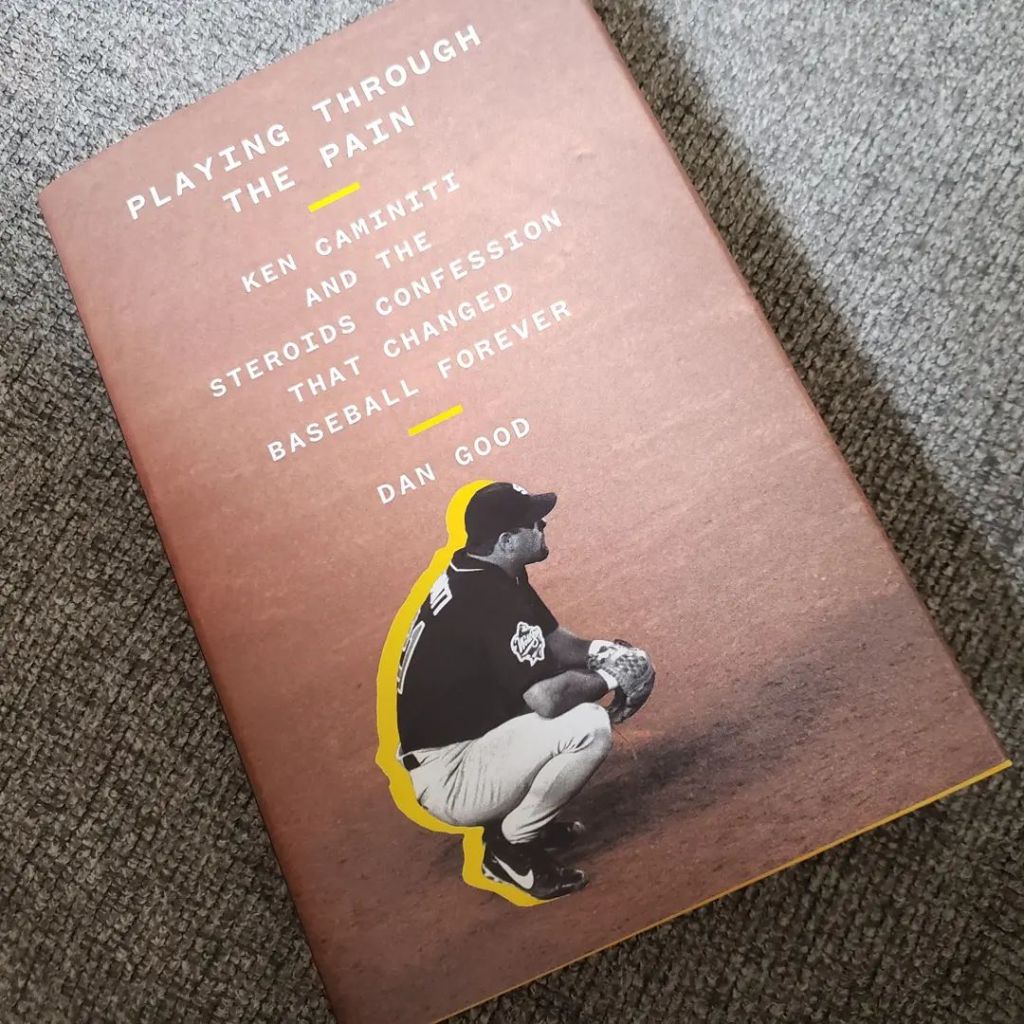
“Playing Through the Pain: Ken Caminiti and
The Steroids Confession That
Changed Baseball Forever”

The author:
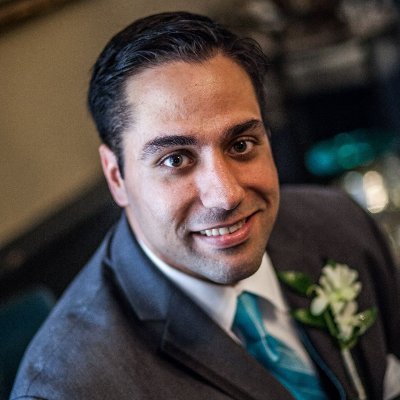
Dan Good

The publishing info:
Abrams Books
384 pages
$27
Released May 31, 2022

The links:
The publishers website
The authors website
At Bookshop.org
At Indiebound.org
At Powells.com
At Vromans.com
At TheLastBookStoreLA, at PagesABookstore.com, at Amazon.com, at BarnesAndNoble.com

The review in 90 feet or less

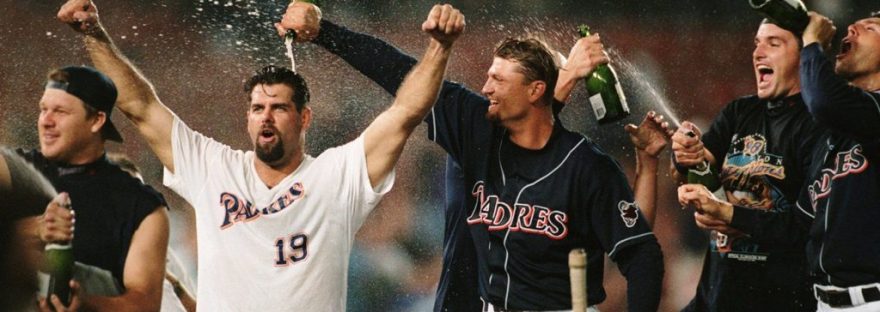
Dan Good already knew the good, the bad and the tragic as it related to the late Ken Caminti.

When Caminiti died in October of 2004 of a drug overdoes at 41, three years after he was out of the game and a mess of a man, Good was a journalism student at Penn State. The death affected him deeply for some reason.

He wrote about it in a column, which he shared in a Nov. 2021 substack post titled “Why Ken Caminiti?”

Good was simply a baseball fan who admired Caminiti’s grit. He wanted to read a book about him, but couldn’t find one in 2012 that was complete.

“I wondered what was stopping me from writing it myself, and I began deeply researching his life — I was working the graveyard shift at the time and my days were wide open. I started interviewing people in 2013 and kept at it over the years, continuing to chip away at the project and track people down. All told, I ended up interviewing 400 people.”

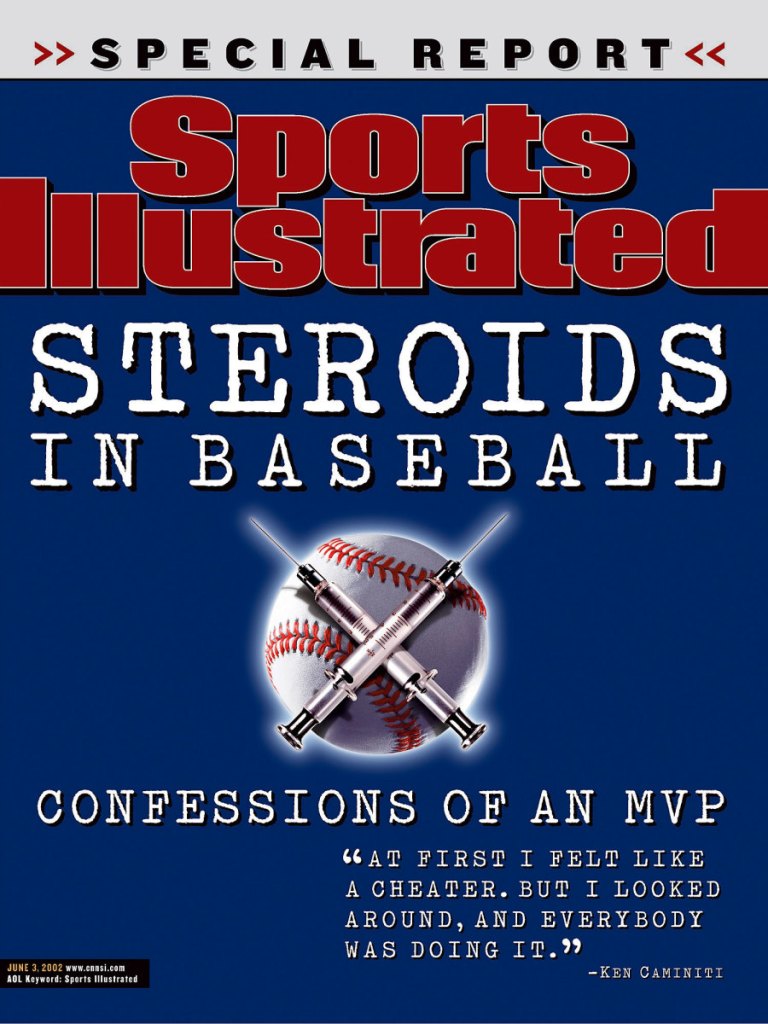
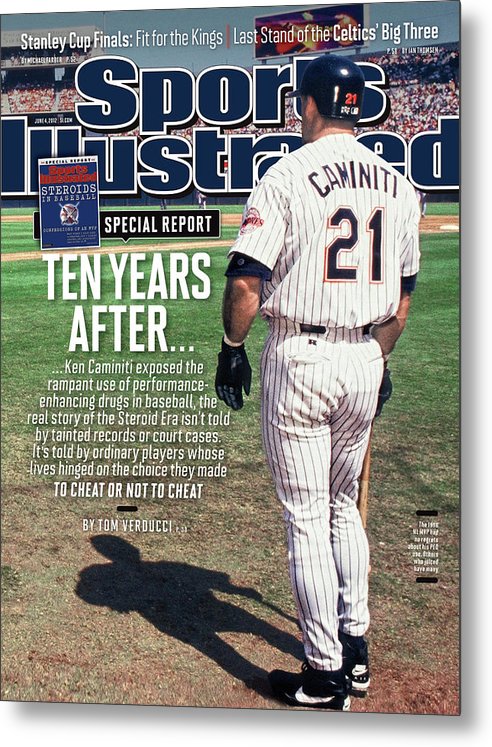
One of them was Tom Verducci, who did the original 2002 Sports Illustrated cover story, “Steroids in baseball: Confessions of an MVP” that used Caminiti’s honest account as a springboard to its investigation.

There was a followup in 2012 titled: “Ten Years Later: To Cheat or Not to Cheat: A decade after Ken Caminiti helped pull baseball’s steroid problem out of the shadows, those who chased the big league dream in a dirty era still wrestle with how they dealt with the dilemma of a generation.”

Another subject was Caminiti’s steroid distributor. He talked to those who went into rehab with Caminiti. He talked to those who knew him way back when, and in the last days.

Good’s grief — and long, difficult excavation — has finally resulted in the publication of his project.

“I’m certainly biased, but I believe Ken Caminiti’s story is the most important in baseball over the past quarter-century because it touches on so many themes, from the will to be great and our societal views on addiction, to trauma and the moral ambiguities around performance-enhancing drugs in baseball during the 1990s,” Good also writes in that post. “Ken’s life had a deep impact, one that went far beyond the things he put into his body or the manner in which he died. And for me, after a decade of work and hundreds of interviews, his good heart continues to shine through.”

Let’s put it this way: Some books you can’t put down. They might be best finished cover-to-cover in one sitting. Then there are these. You need to nudge yourself into starting it, and remind yourself it’s OK to set aside for a moment. Re-read to make sure it’s clear. Give it another rest.

And don’t do it before you go to bed. You’ll be too restless. You won’t sleep well.

Take it from our experience.

Continue reading “Day 18 of 2022 baseball books: How will you remember Ken Caminiti? Here’s the Good way”

Day 17 of 2022 baseball books: A swinging whiff by the nowhere YES man to lead off the Yankees’ annual murderous row of literature

“Swing And A Hit: Nine Innings of What
Baseball Taught Me”

The author:
Paul O’Neill
with Jack Curry

The publishing info:
Grand Central Publishing
272 pages
$29
Released May 24, 2022

The links:
The publishers website
At Bookshop.org
At Indiebound.org
At Powells.com
At Vromans.com
At TheLastBookStoreLA
At PagesABookstore.com
At Amazon.com
At BarnesAndNoble.com


The review in 90 feet or less

Any time you manage to cram the word “kerfulffle” into a website headline of questionable credibility, more word power to you.

As in: “Paul O’Neill’s strange broadcast season continues with WFAN kerfuffle,” on an aggregation-powered website called ESNY, which stands for Elite Sports NY, with the assumption you know what “NY” stands for.

Here’s the gist of it:

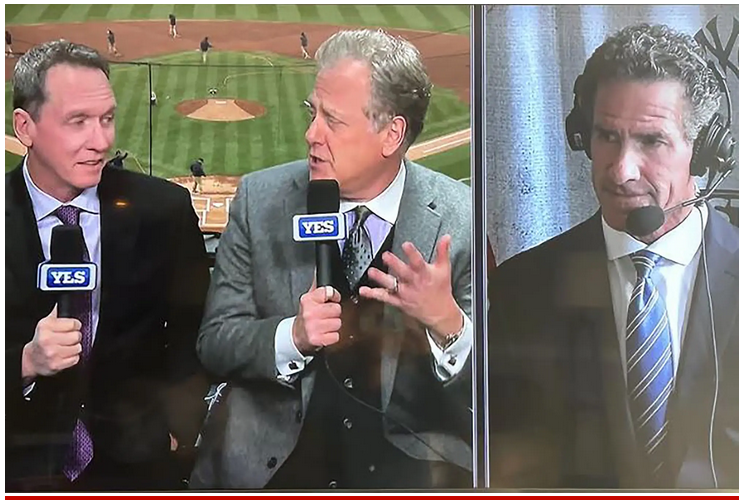
== O’Neill is 18 seasons in as an analyst on the Yankees’ YES Network, which is one more year than his entire MLB career that ran from 1985 to 2001.

From April 2022: Paul O’Neill, right, from his home in Ohio as part of the Yankees-Blue Jays broadcast with David Cone and Michael Kay, left and center, who were at Yankee Stadium. (New York Post screengrab via YES Network)

Is he actually doing games these days in the YES broadcast booth? No. He remains unvaccinated. In 2020, he did games from the basement of his home in Ohio, which they refer to as “Studio 21.” O’Neill is back there this season. Per company policy.

(Also note: This sadly seems to not be all that unusual. Al Leiter and John Smoltz ares no longer on MLB Network after a vaccination policy took effect last fall. Smoltz remains Fox Sports’ No. 1 analyst with new partner Joe Davis, but Davis is already used to this new protocol of where Smoltz is allowed to be in the broadcast booth, but not go into the restricted areas, which means he will have to converse with players, managers and coaches over Zoom. The same applies to Orel Hershiser on SportsNet LA home broadcasts).

Monday, the Yankees’ radio flagship station, WFAN, was going to have O’Neill join Brandon Tierney and Tiki Barber on their mid-day show to promote his new book – this one here – but also talk about the recent toxic news surrounding Yankees third baseman Josh Donaldson and Chicago White Sox shortstop Tim Anderson.

O’Neill, perhaps wisely, didn’t want any part of that discussion. So he wasn’t brought on the air. Tierney told the listening audience exactly why that happened.

Writer James Kratch finishes the story:

“Tierney is absolutely correct. He cannot let O’Neill hawk his book without asking him about the biggest story around the team. O’Neill (and his PR handlers) should know better as well. He was going to get maybe two questions on the matter. Answer them and move on.
“As for the YES broadcasts: If O’Neill doesn’t want to get vaccinated, that’s his call. But let’s not forget all the bellyaching there was last year about the Yankees broadcast teams not being at road games. And rightfully so. Audacy and YES deserved to get raked over the coals for their cheapness. This isn’t a minor league team in Topeka; these are the New York Yankees.
“That is why it is baffling how it’s suddenly acceptable for O’Neill to call the games from his basement. It’s not like YES is hurting for bodies to put into the booth. And while O’Neill is a good broadcaster, he’s not Vin Scully here.”

Again, any time you manage to deftly insert the name “Vin Scully” into a copy block, even more word power to you.

So, back up: Paul O’Neill wrote a book. Sure, OK. He did one before, something about him and his dad maybe 20 years ago. Now we’re supposed to, what, buy this one, read it and ponder the wisdom it imparts? Because … ?

Because, he’ll forever be known as a Yankee Great, with a capital “Why” and an understated “Gee.”

Nine of his 17 seasons as an MLB right fielder/DH came with the Yankees, and you’d be incorrect to assume that, in 1992, he willingly left his hometown Cincinnati Reds to see a huge free-agent deal with New York, because he was actually part of a non-blockbuster trade (with a minor league teammate thrown in) to the Yankees in exchange for Roberto Kelly.

From the Paul O’Neill SABR.com bio

So 1,426 of his 2,105 total hits came in New York, as did 185 of his 281 home runs and 858 of his 1,269 RBIs. So did four of his five All-Star game selections, and five of his six World Series appearances (a combined .261 batting average, 0 HRs, 7 RBIs in 27 games and 109 at bats). All that somehow earned him a place in the Yankees’ Monument Park, with his nickname “The Warrior” emblazoned at the top, recognizing his intensity and leadership, and “his relentless pursuit of perfection.” Is also notes his 1994 batting title, without the asterisk that his .359 post came in 103 games and just 443 at bats during the strike-shortened season, but … it still counts, two points higher than Cleveland’s Albert Belle.

O’Neill’s 162-game season average would pencil out as a reliable 22 homer, 100 RBI season with a .288 average. His JAWS for a right fielder is 65th in MLB history at 33.2. Compare him to Bernie Williams, Matt Holliday, Bobby Bonilla or Shawn Green – except playing in New York on all those playoff teams makes your resume look far more glossier.

His YES broadcasting bio also notes: From July 23, 1995 until May 7, 1997, O’Neill played 235 games in right field without making an error. In 1997, he led the American League in hitting with men on base with a .429 average. On Aug. 25, 2001, O’Neill became the oldest major leaguer to steal 20 bases and hit 20 home runs in the same season. He was inducted into the New York State Baseball Hall of Fame in November 2017. In 2008, O’Neill was named “Father of the Year” by The National Father’s Day Council at its 67th Annual Father of the Year awards dinner in New York.

So, listen up: He’s a winner, not a wiener. And you’re still in the media of NY spotlight, so you’re entitled to impart whatever you can be paid for.

Which brings us to the book highlights:

Continue reading “Day 17 of 2022 baseball books: A swinging whiff by the nowhere YES man to lead off the Yankees’ annual murderous row of literature”

Day 16 of 2022 baseball books: Oh, Henry … and Moore of it

“The Real Hank Aaron: An Intimate Look at the Life
and Legacy of the Home Run King”

The author:
Terence Moore

The forward:
Dusty Baker
The publishing info:
Triumph Books
272 pages, $28
Released May 17, 2022
The links:
The publishers website
At Bookshop.org
At Indiebound.org
At Powells.com
At Vromans.com
At TheLastBookStoreLA
At PagesABookstore.com
At Amazon.com
At BarnesAndNoble.com

The review in 90 feet or less

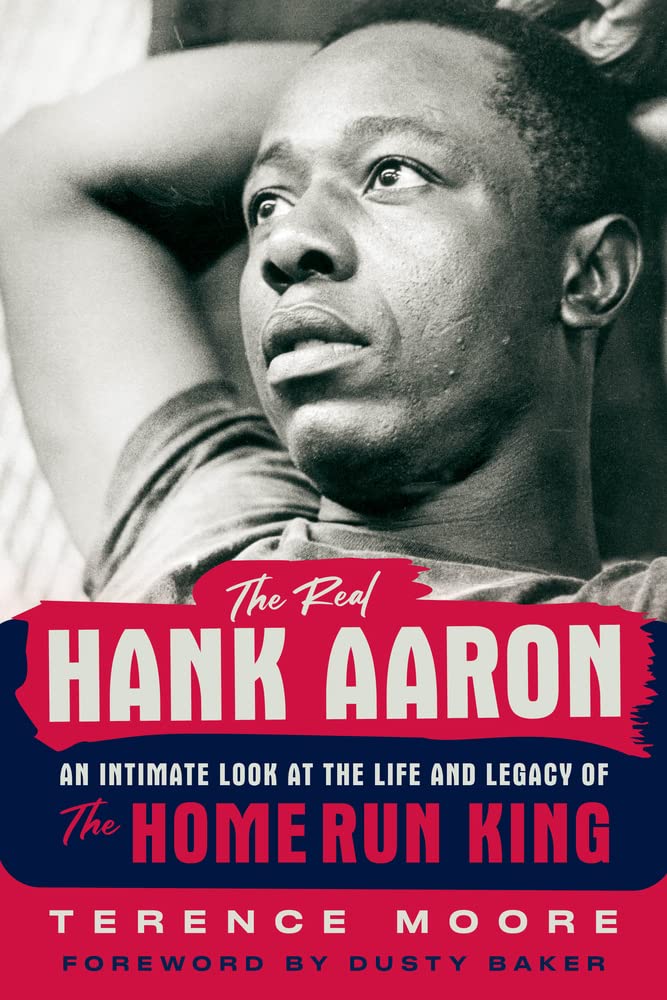
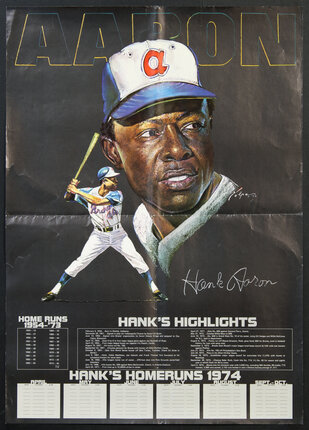
This was the poster of Hank Aaron that hung on my bedroom wall almost 50 years ago — and considering how there wasn’t a lot of wall space to divvy up with two younger brothers sharing this less-than 200-square foot area, that’s a monument commitment we all agreed upon was worth allocating. (But since I was oldest, I think I had any tie-breaking vote).

I saw this every morning before riding my bike off to middle school. I saw it again every night after baseball practice and my paper route, then huddling with the transistor radio to listen to Vin Scully calling another Dodgers game.

Dodgers team historian Mark Langill confirms this was given away to fans at the May 17, 1974 “Hank Aaron Poster Day” at Dodger Stadium — a Friday night, the first trip the Atlanta Braves came to L.A. that season, about a month after Aaron broke Babe Ruth’s all-time career home run mark against the Dodgers’ Al Downing in Atlanta. Downing actually started this game and went the first eight innings in a 5-4 loss to the Braves in 11 innings (where Aaron went 0-for-3 against Downing). A scan of the poster is on display in the pavilion area along with the left field pavilion plaque from his last homer and a photo of Vin Scully interviewing Aaron in the dugout.

The beauty of this poster is that it was a chart so kids could document Aaron’s home runs in 1974 — and we dutifully logged in the information. We participated. We were invested in recording history.

When Terence Moore was 12, he says he also kept a treasured poster of Aaron. It was one Aaron would autograph years later: “Best wishes to Terry.” Simple and sweet.

Moore, who spent nearly 25 years as a sports writer at the Atlanta Journal-Constitution from late 1984 through the spring 2009, is also now in his 60s, a 1978 graduate of Miami University in Oxford, Ohio, where he continues to teach as well as contribute to Forbes, CNN and MSNBC.

He was, as he says, “The Hank Aaron Whisperer.”

When Aaron died in January of 2021, Terence Moore became an honorary pall bearer at the funeral. He also helped Aaron’s wife, Billye, write the obituary for the program.

They were that close, because through Moore’s journey as a sportswriter in the deep South, he experienced first hand some of the same racism and ignorance Aaron had gone though. Aaron admired what Moore endured, and vice versa.

Tribute publications that popped up for Aaron in the months after his death, as the 2021 pandemic-cloaked season was ramping up, included a special one from the Atlanta Journal Constitution, pulling together stories, columns and photos from its rich archive, a 128-page publication through Triumph Books. In stories spanned from 1974 to 2021, highlighting the works of writers such as Furman Bisher, Steve Hummer, Dave Kindred, Thomas Stinson, Jeff Nesmith, Wayne Mishew, Tim Tucker, Mark Bradley and sports editor Jesse Outlar.

But nothing from Moore.

If that was an oversight, Moore has more to offer with his own tribute, more than double the size, but also enlisting Triumph to house his collections of interviews, insights and interactions.

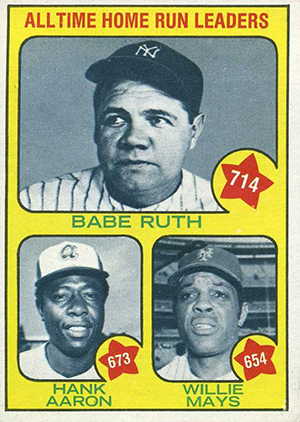
Topps 1975 No. 1 card

As Moore explains in the introduction, he had proposed a book idea with Aaron in late 2020, but Aaron’s lawyer had promised someone else exclusive conversations with Aaron that would lead to a publication in 2024, the 50th anniversary of his home-run record. Moore understood, but it also sparked him to take a new approach, starting his own excavation of their conversations about their mutual admiration for Jackie Robinson and the lessons they took with them over the years, about their mixed emotions watching another scorned Black man in his home-run record-breaking journey in 2006.

Topps 1974 No. 1 card

“I had enough material to make the real Hank Aaron shine more than whatever came before or whatever would come in the future,” Moore writes, noting their last on-the-record interview was in October, 2020 for a Baseball Hall of Fame publication story. “I had four decades of those Hank conversations — many of them recorded — and all of my other exclusive dealings with Henry Louis Aaron.”

Topps 1973 No. 1 card

Washington Post columnist David Von Drehle wrote in 2021 in a piece headlined “Henry Aaron did as much as anyone to redeem the South” that “I’m going to call him Henry in this column because that was the name he preferred, as opposed to ‘Hank,’ a nickname attached to him by a PR man who thought White fans might find it friendlier.”

Moore hammers home that distinction as well, separating the public Hank from the private Henry. Because of Moore’s access, he has examples of Aaron’s humor, wisdom and foreshadowing expertise on history. He can be miffed, angry, numb and reflective. He saved hate mail not so much as a motivational mechanism, but as something historians could use to judge just how much present day isn’t that much different from the past when it comes to how some choose to display personal fear and insecurities.

Moore can also speak more about how in 2014, Aaron’s slip-and-fall on an icy patch of driveway led to a hip replacement and a life-threatening moment many weren’t fully aware about — as the two were doing a CNN special on the 40th anniversary of the 715th homer, which Moore uses as a thread to tie together his 10 chapters, seeing him in a wheelchair, ailing, and wondering if this might be it.

“Hank was so much more than 715, his final home run total of 755, or anything else involving what he liked to call ‘the game of baseball’,” Moore writes. “Even so, his grade under pressure while catching and passing The Great Bambino showed the essence of Henry Louis Aaron to everyone as much as anything else.”

Continue reading “Day 16 of 2022 baseball books: Oh, Henry … and Moore of it”

Day 15 of 2022 baseball books: The ultimate romantic rounders road trip on the ‘vehicle of dreams’ from Chicago to L.A., with The Mick in between

“Grassroots Baseball: Route 66”

The photographer: Jean Fruth
The preface: Jeff Idelson. The forward: Mike Veeck. The introduction: Johnny Bench. The afterward: Jim Thome. The essays: Thome, Bench, Adam LaRoche, Paul Matney, Billy Hatcher, Ryan Howard, Alex Bregman, George Brett
The publishing info: Sports Publishing LLC/Skyhorse, 256 pages, $70, to be released May 24, 2022
The links: The publishers website, the organization’s website, the photographer’s website, at Bookshop.org, at Indiebound.org, at Powells.com, at Vromans.com, at TheLastBookStoreLA.com, at PagesABookstore.com, at Amazon.com, at BarnesAndNoble.com

The review in 90 feet or less

In August of 2017, my good pal Chuck and I prayed to our Heavenly Mother and hit the Mother Road. Potholes be damned.

He shipped his convertible to a cousin’s house in a Chicago suburb and we flew in shortly thereafter. We could have floated the next 2,000-plus miles back home. Instead, we found the most beat-up versions of Route 66 to retrace. Much of it is replaced by superhighways now. The original heart and soul started in the 1930s is buried in asphalt and gravel somewhere in there.

Progress.

We had a rough idea how it could be tamed, but the key was flexibility, creativity, patience, an ability to live off gas-station food, no advanced hotel planning, a AAA map, a phone app, sun screen, and an appetite for adventure.

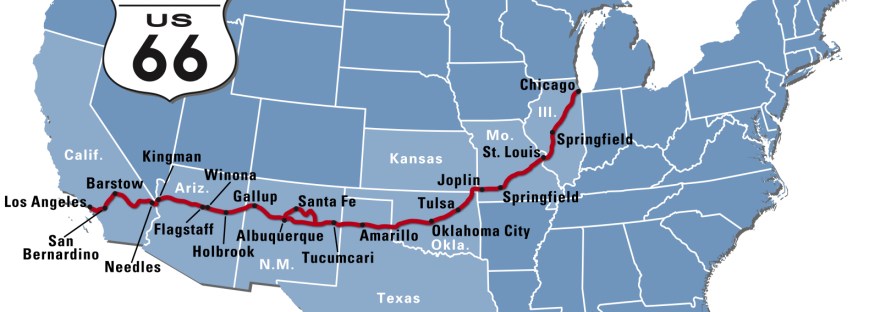
We know in general if Route 66 could be framed as a baseball road trip, it begins at Wrigley Field, ends at Dodger Stadium, blows past Busch Stadium, can happen upon minor league teams in Oklahoma City, Albuquerque, San Bernadino … Y’know, Phoenix isn’t that far south from Flagstaff if you want to catch a Dodgers-Dbacks game during a pennant race …

The drive, as well as the game, is meant to breathe as a living organism, more calming and cathartic as a car ride as long as you’re not speeding toward an end point.

If you stay alert, there can be magic moments. Like winding out of Missouri, chipping off that corner of Kansas, and pointing toward Oklahoma. The mileage marker mentions an approach into a place called Commerce.

Ah, so this is where “The Commerce Comet” came from?

Short detour time.

The barn next to the boyhood home of Mickey Mantle in Commerce, Okla.
A sign on the Mantle home needs some restoration. (And please, no apostrophe between “1950” and the “s”)

Mickey Mantle’s birthplace in the Cherokee Nation-adjacent Spavinaw, Olka., and his home in Commerce aren’t usually a point of reference in Route 66 guidebooks. Just just gotta sorta know and show up with appropriate attire.

The Will Rogers Turnpike (Route 44) that overlays much of the original 66 requires finding E. 50 Road merging into 560 Road South, past the L&M Convenience Store, and the statue of Mantle outside Commerce High School. Finding his simple white childhood home is a side trip up some narrow roads to 319 South Quincy Street. A recent New York Times story about the city explains that while the town has pride in the Mantle name, even painting the base of the water tower with Yankee pinstripes and a No. 7, there is a depressed area that needs some attention and economic support.
Ironic, sure, for a town still called Commerce.

We became very in tune with the baseball part of this trip very quickly, and the hundreds of photographs with our iPhone had a good percentage related to things about the game.

It started with attending a Cubs-Nationals contest on a Friday chilly afternoon, planted in the center-field bleachers under the scoreboard at Wrigley Field (Washington wins 4-2 behind two homers from Daniel Murphy).

There was a must-stop at the original Ted Drewes Frozen Custard in St. Louis — our “Terramizzou” came in a red Cardinals’ helmet, which helped as it quickly melted upon an attempt to eat it in the hot sun — and a trip over to see the newest Busch Stadium.

In between, the Dodgers’ Triple A affiliate in Oklahoma City comfortably rests at Chicksaw Bricktown Park, where there is a statue of local hero Johnny Bench, born in OKC but prepped in a tiny offshoot 60 miles west called Binger, Okla. Conveniently, the Dodgers’ Double-A team in Tulsa, Okla., known as the Drillers and playing in the art deco designed park known as Oneok Field, are just 100 miles East of OKC, also on the route.

So, too, the Albuquerque Isotopes, part of the Colorado Rockies’ family now after it was a former Dodgers’ breeding ground (note the Joc Pederson reference in this pix). It’s a must-visit for fans of “The Simpsons,” right next to the University of New Mexico sports facilities even on a non-game day.

Eventually, you land at the feet of the Inland Empire 66ers’ home diamond near the Wigwam Motel in San Berdo.

They’re called the 66ers for a reason, right? Not far from the original McDonald’s site, the stadium entrance has an arched sign featuring a character of car mechanic swinging a giant wrench like a baseball bat. The team logo is like a Route 66 highway sign. They’ve only been the 66ers since 2003, a team previously known as the Stampede and Spirit until the current ownership team decided to pay homage to the famous strip that often isn’t even marked on road maps any longer.

There are many sports-related sites to acknowledge on the 66 trip, from Chicagoland Speedway in Joliet, Ill., to Santa Anita Race Track in Arcadia. But pump the breaks.

But there is also something called “The Field of Dreams” baseball park, near a tiny three-square mile town called Baxter Springs, Kansas, which locals insist is the “First Cow Town in Kansas” (there’s a specific Cow Town Mural on the corner of 11th and Military Ave., to mark the proper ID). It does sit in the middle of a cornfield, but on the Kansas state tourism board website, there is a simple post about it: “This baseball/softball complex on ‘Old Route 66’ was the dream of a local high school teacher and coach. Community support allowed the dream to become reality.”

Now picture this: Boys and girls playing the game in cities and places these days that almost look forgotten in Rand McNally’s atlas. On fields full of weeds, near junk yards and abandoned gas stations. Places where those who once traveled Route 66 as a major highway really were needed, but now can be forgotten.

Photographer Jean Fruth, former Baseball Hall of Fame president Jeff Idelson and a host of others attached to the 501c3 known as Grassroots Baseball won’t let the game, or this path, be lost to history.

Extending on a project that first came to light in 2019 with “Grassroots Baseball: Where Legends Begin” — where San Francisco bay-area based Fruth published more than 250 photographs of her journey from the Dominican Republic, Mexico, Cuba, Japan and several U.S. events (and we gave a shout-out in the L.A. Times at the time) – the focus this time is on the left side of America, the Mother Road that built in the 1920s allowed easier, measured and accommodating migrating travel from Illinois, Missouri, Kansas, Oklahoma and Texas out to New Mexico, Arizona and California.

Back in ’19, the Grassroots Baseball pilled in an RV, loaded up with baseballs, gloves and Big League Chew, and made stop after stop, putting on clinics in under-served areas, sometimes bringing the game to kids for the first time.

It’s called mothering in some cultures. Nurturing in others.

The cover sets the scene: A 1968 Chevy pickup in El Reno, Okla., with three players from the Binger High Bobcats riding in the back.

Remember, Johnny Bench … Binger, Okla., headquarters of Caddo Nation with has a population of 672 by the last census, down from its peak of 849 in 1930. There is a Route 66 Diner on the main street.

Opposite the title page, there’s four kids playing a pickup game amidst rusted farm equipment in Claude, Tex., just east of Amarillo  (population: 1,196).

Baseball in Claude, Tex., captured by Jean Fruth.

The photos of baseball interchange with whatever Fruth finds of historical context on Route 66 – Wigwam Hotels, statues on the corner of Winslow, Ariz., and wild burros in Oatman, Ariz., are as prevalent in the narrative as an AIA state playoff game in Flagstaff, Ariz., or U-16 game in River Valley High.

By the time we make it to California, places such as Edward Vincent Junior Park in Inglewood, Los Amigos Park in Santa Monica and Santa Monica beach at dusk just north of the pier are featured landmarks where kids are doing their bat and ball stuff.

Former SI writer Steve Wulf helps shape the MLB-related essays delivered on a state-by-state basis, starting with Jim Thome in Illinois, through George Brett in California, and including Bench in Oklahoma.

Brett’s essay on page 223 includes the line: “Just like Hollywood actors, baseball players get discovered. My showscase game was the 1971 state high school championship game at the Big A in Anaheim – our El Segundo Eagles beat the Lompoc Braves and their ace, Roy Thomas, 5-2. Thomas was taken in the first round of the draft by the Phillies, and I was taken in the second round by the Royals. Two years later, I was in the majors and three years after that I made my first of 13-straight All-Star teams.”

Thomas? Here is a great fork in the road.

He went 20-13, 3.82 ERA, 419 IP and 289 Ks. That’s over an eight-year career, not one season. Once untouchable in the Phillies’ farm system, he was traded to the Chicago White Sox (in a deal that included Jim Kaat coming to Philadelphia), taken by the Mariners in the 1976 expansion draft, traded to Houston, converted to a reliever, taken off waivers by the Cardinals (a Route 66 team), went back to a starting role, hit Ellis Valentine in the face with a pitch to shatter his cheekbone, was picked by the A’s in a Rule 5 draft, traded back to the Mariners, had a sore elbow and was released, came back as a non-roster invitee, had a run of seven straight wins for the ’85 M’s, hit with more tendinitis, down to the minors, one more trip to the bigs with the M’s in ’87 and won one more game, then pitched for the St. Lucie Legends and Sun City Rays of the Senior Professional Baseball Association from ’89-’90 until the league folded. He went on to be a middle-school math teacher in the state of Washington, the moved to Las Vegas.

Some players end up on the well-paved road to Cooperstown. Others get stuck in the muck of the Cadillac Ranch, take the road more traveled, and hopefully enjoy the scenery. From Lake Michigan to the Santa Monica pier, you can do it, too. Bring a bat and ball. The sand is nice.

How it goes in the scorebook

Get your kicks with this picture-perfect portfolio that captures more than the essence of the game and its long and winding journey. Bring your best baseball friend. And don’t forget Winona.

Reflecting back on our recent review of “Remarkable Ballparks,” this is an example of a photo spread that executes and excites, having a narrative fleshed out by the photographer who experiences the trip and conveys it with visual artistry. It makes it personal, professional and prolific.

You can look it up: More to ponder

== A beauty of a Q&A with Fruth for BrianSmith.com, photography blogger includes:
Q: Most readers are probably jealous of your access to major league baseball – yet any of them could easily cover a little league game in their hometown, do grassroots games give you allow you to shoot from vantage points you could never get access to at a major league game?
A: I am spending more time teaching sports photography these days and I can’t stress enough that it’s the “what” not the “who” that makes great pictures. When you let go of “the who” and just focus on your angles, light and creativity, you can make something great. In professional sports, so much of the time we are making the same picture. I prepare just as much for a little league game as I do for a professional game. I shoot my subjects as if they are professional players, but with so much more ability to be creative.


== If you’re so moved, click the donate button and make a tax-deductible donation to support the mission to promote and celebrate the amateur game around the globe. A $100 donation gets you this book, signed, and the extra $30 goes toward the cause.

== Thanks to Baseball-Reference.com, there is an incredible data-sifting interactive map of Route 66 that allows users to pinpoint any of the 1,065 players it has determined were born within 50 miles of this stretch of road and whose last year was 1926 — the year Route 66 was commissioned and then fully paved by the late 1930s. The list is lead (by those with a career WAR of 100 or better) by Barry Bonds (Riverside), Rickey Henderson (Chicago) and Mickey Mantle (Spavinaw, Okla.)

The pull-down menu of cities are an easier way to make connections. Take, for example, Fullerton. The 10 names that show up (in order of career WAR) are led by Jim Edmonds, Phil Nevin, C.J. Cron and Austin Barns. So, what about Walter “Big Train” Johnson?

The Fullerton High graduate who pitched 21 seasons for the Washington Senators starting in 1907 as a 19 year old (417-279, 2.17 ERA, 110 shutouts) was actually born in Humbolt, Kansas in 1887. From our mapping, that’s about 93 miles from the closets point on Route 66 in that area – Galena, Kansas, which is about the only major outpost in the state that Route 66 cuts through between Missouri and Oklahoma. Johnson’s family moved from Kansas to Orange County when he was 14 in 1902. He was discovered by the Senators while living and pitching in the Idaho State League.

The same confusion might come from tracking George Brett. The only player on the Baseball-Reference menu pull down from El Segundo, Calif., is Lars Nootbaar, the current outfielder for the St. Louis Cardinals. Brett was born in far-off Glen Dale, West Virginia, and his family moved to El Segundo when he was starting elementary school, graduating from El Segundo High in ’71 behind his three older brothers (who were born in Brooklyn). Robin Yount, who played at Taft High in Woodland Hills, was another who was born elsewhere – Danville, Ill., about 130 miles south of Chicago – before moving in the Route 66 “50 mile radius” when he was infant.

From Los Angeles, there are 150 position players and 75 pitchers listed, including Hall of Famers Tony Gwynn, Eddie Murray, Duke Snider, Joe Gordon and Bobby Doerr, plus Darryl Strawberry, Bob Watson, Brett Butler, Eric Davis, Ken Landreau, Hubie Brooks, Bob Ojeda, Bill Singer and Dock Ellis.

== The booktour and signings by Fruth and others started May 14 in her hometown of Healdsburg, Cal, and will reach L.A. at Dodger Stadium on June 4 (with Alan Trammell, the Detroit Tigers’ Hall of Fame shortstop born in Garden Grove). Other stops include Cooperstown, N.Y. on Hall of Fame induction weekend (July 22), Williamsport, Pa., in time for the Little League World Series (Aug. 20) and a gallery exhibit in Chicago from Sept. 8-30.

Fruth’s pinned tweet on Twitter: