


This is the latest post for an ongoing media project — SoCal Sports History 101: The Prime Numbers from 00 to 99 that Uniformly, Uniquely and Unapologetically Reveal The Narrative of Our Region’s Athletic Heritage. Pick a number and highlight an athlete — person, place or thing — most obviously connected to it by fame and fortune, someone who isn’t so obvious, and then take a deeper dive into the most interesting story tied to it. It’s a combination of star power, achievement, longevity, notoriety, and, above all, what makes that athlete so Southern California. Quirkiness and notoriety factor in. And it should open itself to more discussion and debate — which is what sports is best at doing.
The most obvious choices for No. 34:
= Fernando Valenzuela, Los Angeles Dodgers
= Shaquille O’Neal, Los Angeles Lakers
= Bo Jackson, Los Angeles Raiders
The not-so-obvious choices for No. 34:
= David Greenwood, Verbum Dei High and UCLA basketball
= Nick Adenhart, Los Angeles Angels
= Paul Pierce, Inglewood High, Los Angeles Clippers
= Paul Cameron, UCLA football
The most interesting story for No. 34:
Fernando Valenzuela, Los Angeles Dodgers pitcher (1980 to 1990)
Southern California map pinpoints:
Dodger Stadium, East L.A., Boyle Heights, Los Feliz, La Canada-Flintridge

On November 1, 2024 — the first of the annual two-day celebration of Dia de la Muertos, a Latino-cultural event where family and friends gathering to pay respects to those close to them who have died — Fernando Valenzuela would have turned 64 years old.
But since Valenzuela had quietly passed away just nine days earlier from a bout with liver cancer, it made that special observance, and the powerful nature of that tradition, all more poignant.
Valenzuela’s death two days before the Los Angeles Dodgers started the 2024 World Series against the New York Yankees promoted the team to wear No. 34 patches on their shoulder in his honor.
When November 1 rolled around, the Dodgers were celebrating a five-game championship series victory, riding double-deck buses through the city. Many players, and fans, wore the familiar Valenzuela 34 jersey.
Also on that fall day, artist Robert Vargas finished the first of a three-panel project on the side of the Boyle Hotel, facing the First Street on-ramp to Interstate 101 in Boyle Heights. The multifaceted image of Valenzuela seemed to make him come to life again.
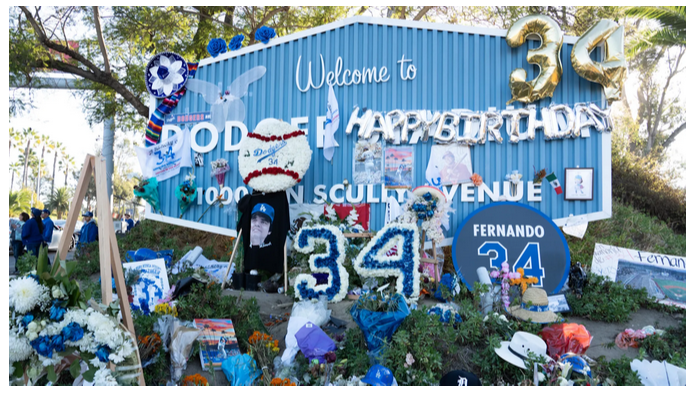
Scores of ofrendas popped up up at the base of site, as well as near the freeway and the street. Same at Dodger Stadium and the roads leading into it.
Visiting the mural site almost became going to a religious shrine.
The experience ignited vivid memories of 1981, when fans of all backgrounds swarmed on Dodger Stadium to witness the then-20-year-old from Mexico who only spoke Spanish do things never seen before on a Major League Baseball diamond. Words, in any language, couldn’t describe it.
Especially, as this was happening on the site that once was a dilapidating housing complex for low-income Latino families who unceremoniously were evicted in the late ’50s when the City of L.A. gave the property to the Dodgers to build upon.
At the Vargas mural site, the drone of cars passing by on the freeway provided a constant soundtrack. It was broken up each day Vargas did the mural by a mariachi band, which came from nearby Mariachi Plaza, performed each day at 4 p.m. to give the artistic process a blessing.
“It’s about unity and representation and bringing different cultures together, which Fernando is still doing as we speak,” Vargas told reporters who called him off the scaffolding for interviews.
Boyle Heights born-and-raised, Vargas had, a few months earlier, depicted his vision of newest Dodger star Shohei Ohtani on the side of the Miyako Hotel in Little Tokyo. It was just a mile West of this Valenzuela site, across the bridge that spanned the Los Angeles River. The murals could now serve as cultural touchstones of the city.
As the mural inspired by “Fermandomania” was named “Fernandomania Forever, finished up by early November. To Vargas, and most others who ever saw him play, it reflects an inate feeling that Valenzuela will live forever in the minds of those who still talk about his feats in excited, as well as reverent, tones.
Continue reading “No. 34: Fernando Valenzuela” Tom Hoffarth's The Drill: More Farther Off the Wall