

This is the latest post for an ongoing media project — SoCal Sports History 101: The Prime Numbers from 00 to 99 that Uniformly, Uniquely and Unapologetically Reveal The Narrative of Our Region’s Athletic Heritage. Pick a number and highlight an athlete — person, place or thing — most obviously connected to it by fame and fortune, someone who isn’t so obvious, and then take a deeper dive into the most interesting story tied to it. It’s a combination of star power, achievement, longevity, notoriety, and, above all, what makes that athlete so Southern California. Quirkiness and notoriety factor in. And it should open itself to more discussion and debate — which is what sports is best at doing.
The most obvious choices for No. 23:

= Kirk Gibson: Los Angeles Dodgers
= LeBron James: Los Angeles Lakers
= David Beckham: Los Angeles Galaxy
= Eric Karros: Los Angeles Dodgers
= Dustin Brown: Los Angeles Kings
The not-so obvious choices for No. 23:
= Harold Minor: USC basketball
= Diana Taurasi: Don Lugo High School girls basketball
= Jackie Joyner: UCLA women’s basketball
= Jonathan Franklin: UCLA football
= Kenny Washington: UCLA basketball
The most interesting story for No. 23:
Ryan Elmquist, Caltech basketball guard (2007-08 to 2010-11)
Southern California map pinpoints:
Pasadena, Whittier, Pomona, LaVerne
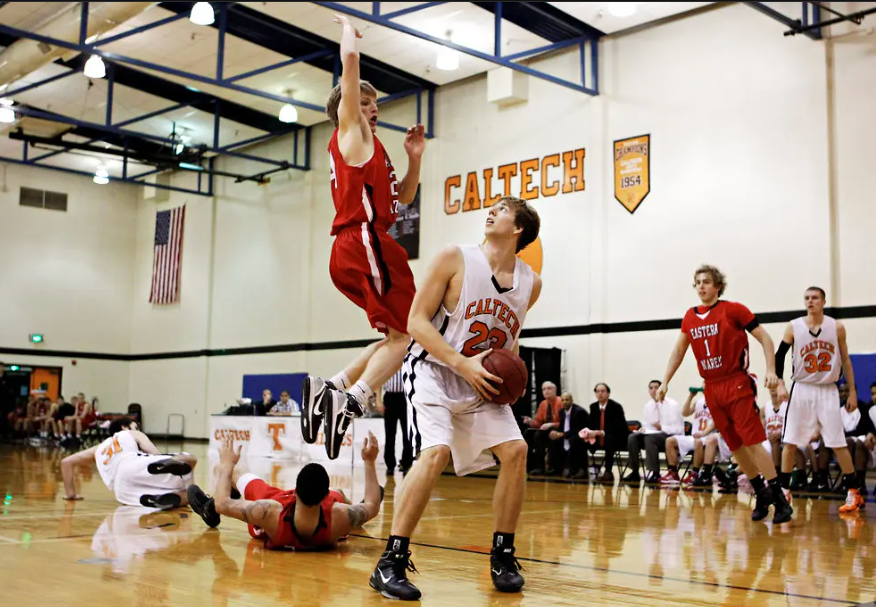
Ryan Elmquist scored 36 on his ACT college entrance exam, which surely impressed his classmates at Woodbury High in Minnesota, just East of the Twin Cities.
It was a perfect score. It also gave him a ticket to dig out of the Midwest snow, head to Pasadena and enroll in California Institute of Technology — better known to “The Big Bang Theory” fandom as Caltech — to study computer science.
And play basketball.
Around Caltech, Elmquist is far better remembered when he scored one not-so-lousy free throw on February 22, 2011.
The last of his 23 points came with 3.3 seconds left, accounting for the final margin in a 46-45 for the Beavers over visiting Occidental College on their home Braun Athletic Center
It not only impressed his smarter-than-smart peers, but most of its Nobel Laureate-rich staff. It was the perfect ending to his senior season. It was the last game he played. And it ended Caltech’s streak of 310 consecutive losses in Southern California Intercollegiate Athletic Conference (SCIAC) competition. A streak started before Elmquist and his teammates were born, in January of 1985.
But who’s counting. Unless you are a campus full of math nerds.
Bazinga.
An NCAA Division III school that doesn’t give out athletic scholarships, has a modest $1.1 million athletic budget and has just 2,200 of the smartest kids in the country enrolled, Caltech did something mindblowing in a general non-scientific sense.
It took that streak ending to get mention on not only every sports network, but it wast on the CBS Evening News with Katie Couric and the ABC World News with Diane Sawyer.
“Probably for the first time in Caltech’s illustrious history of Nobel Prizes and brilliant students and faculty, there was a press conference in the gym,” the school’s official website noted in a post headlined “A (freethrow) shot heard around the sports world.“
To note: Caltech, finishing 1-13 in conference and 5-20 overall, still hadn’t had a winning season since 1954. But it was a moment that mattered.
“I feel like I just won an NCAA championship,” said Caltech coach Oliver Eslinger, who has a Ph.D. in Education and Counseling Psychology and head of the men’s hoops program since 2008, the year after Elmquist enrolled. “I’m so proud of Ryan Elmquist.”
As Elmquist told the CBS Evening News: “I can’t think of a better storybook ending.”

The 6-foot-5 forward ended up as Caltech’s leading scorer that season — a 15.8 point-per-game average might not be as sparlking as a 4.0 grade point average, but you do the math.
It was quirky enough that most of his scoring abilities were a result of his free-throw accuracy. He held the school record for most free throws made and attempted — 17 of 19 — in one game as well as those made and attempted — 414 of 660 — in a career.
In that win over Oxy, 15 points came at the line with 19 tries. He also had nine rebounds and four blocked shots.
Eureka. And such a relief.
Caltech players may know they’re not athletically the ones pro scouts come calling on, but it doesn’t mean they have to be targets of insults, especially from opponents. One time when Caltech was a visiting team, someone came into its locker room, wiped off all the Xs and Os the coach had put up for their offensive plays, and replaced it with math problems to solve. Just to taunt them.
“Of course we could solve the problem, but we never did,” said Elmhurst. “We wiped it right off and tried to focus on the game.”

Before he graduated early and headed north to start a job with Google, Elmquist put his name in the Caltech books second all-time in scoring with 1,254, first in blocked shots with 157, and the only player with 1,000 career points and 500 rebounds.
A three-year captain, three-time team MVP and CoSida Academic All-American first-teamer, Elmquist eventually was a 2024 entry into the Caltech Hall of Honor. Which honors athletes, really. It could be called an Athletic Hall of Fame. But why confuse it?
It has its own separate ongoing list of Nobel Laureates, MacArthur Fellows, National Medal of Science Recipients and National Medal of Technology and Innovation Recipients. No apparent mention of Professor Proton, however.
Aside from his career stats, Elmquist’s honor was a reflection of the free throw that secured Caltech’s five-win season, the most it had collected against NCAA opponents in 50 years.
Google all that when you get a chance.

The sports heritage
Numbers matter at Caltech.
The men’s basketball team, one of 16 divisible varsity programs on the campus, rallies behind the workmanship of mascot Bernoulli Beaver (or Berni for short, officially named in 2023 by a vote to pay homage to the Bernoulli family of 18th Century mathematicians).
The Beaver nickname also acknowledges a species known as “nature’s engineers.” (Look it up: The Massachusetts Institute of Technology also has the beaver as its mascot, for the same exact reason. Its beaver is named Tim. Maybe because it’s “MIT” spelled backward).
With its orange-and-white color scheme, Caltech seems to create an illusion that this is a Southern branch of Oregon State University. Leave it to the Beavers to be willing to take on the roll as cannon fodder for more athletic-savvy schools of higher learning.
While Caltech fielded an actual football team for 100 years — once defeating USC in 1896 — its most glorious moments in or near a gridiron involve two well-remembered Rose Bowl pranks. The school even documents them for posterity on its website.

On Jan. 2, 1961, in what became known as “The Great Rose Bowl Hoax,” a small band of ingenious students surreptitiously altered a University of Washington halftime flip-card routine so that it showed the Caltech Beavers mascot and then spelled out “CALTECH” instead of what Washington planned to be an American flag.” NBC broadcasters Mel Allen and Chick Hearn broke out in laughter on the air when the stunt occurred. It involved changing the 2,400 cards kept in the Huskies’ cheerleader dorm on the Long Beach State campus.
On Jan. 2, 1984, during the UCLA-Illinois Rose Bowl, Caltech students were able to sabotage the scoreboard and display: “Caltech 38, MIT 9” in the third quarter. Two students were charged with misdemeanors, admitting they spliced a remote-controlled computer and other electronic gadgets into the wiring of the scoreboard.

(Do you notice the dependency of a Jan. 2 Rose Bowl date may be cause to send Caltech students offkilter?)
When the then-known Throop Institute created a football program 1893, two years after the opening of what would eventually be California School of Technology, its record-keepers duly noted that it suffered 60-0 loss against USC. In 1896, Caltech defeated USC, 22-0, for the program’s first recorded victory.
It won the SCIAC titles in 1930 (5-3-1) and ’31 (6-2-1), actually playing some of its home games at the nearby and vastly oversized Rose Bowl. It stopped competing in the SCIAC in 1968 (after a 1-7 season)and moved to becoming a JV, a club and a school recreation sport until it was retired in 1993 with a cumulative record of 179-371-18. Officially, its final game of 1993 was a 32-13 loss to the Hawthorne Cougars.

Because our own brain can’t always tackle this kind of subject matter, we asked Google AI if it could generate a list of the greatest athletes in Caltech sports history. That seemed an appropriate method of attack.
This is what it spit out:
The choice of the “greatest” often depends on whether one values single-sport dominance or multi-sport versatility. Determining the single “greatest” athlete is subjective, but several standout individuals are recognized in the Caltech Athletics Hall of Honor (established in 2014) for their exceptional dominance and records. Notable candidates include:

Sarah Wright, Class of 2013: She competed on the men’s soccer team (Caltech did not have a women’s team at the time, but eventually did) as well as the women’s basketball team and the track & field team. She still holds the school record in the heptathlon and ranks in the top ten in numerous other track and field events. Her trailblazing role in women’s sports at Caltech is also a significant part of her legacy. (Inducted in 2023) (Note: In 2012, she founded a non-profit called Engineers Beyond Borders Caltech chapter)
Steven Sheffield, Class of 1972: A dominant force in the pool who was a multi-sport athlete in men’s water polo and swim & dive, he set multiple program records across several swimming events and earned All-SCIAC honors in both sports. (Inducted in 2023)
Jim Hamrick, Class of 1986: All-SCIAC honors during the four years he played baseball, setting single-season and career program records for home runs and RBIs. (Inducted in 2016).
Nice, but … the AI search, however, wasn’t all that inclusive. It passed over these gems easy to find in the Hall of Honor:

Grant Venerable, Class of 1932: The San Bernardino High grad went to USC, Cal Berkeley and UCLA (some eight years before Jackie Robinson did) before transferring to Caltech as its first Black graduate. He spent two years on the school’s track and field team. (Inducted in 2020).
Fred Newman, Class of 1959: All-SCIA in baseball, basketball, football and soccer, he also set a Guinness Book of World Records mark in basketball shooting ability — making 20,371 free throws out of 22,049 attempts in a 24-hour period from Sept. 29-30 in 1990. At age 60, he also made 88 straight free throws while blindfolded and 209 straight 3-point shots. Field of expertise: Computer programming. (Inaugural class of 2014).

Glenn Graham, Class of 1926: Captain of the school’s track team, he won the silver medal in the pole vault at the 1924 Olympic Games in Paris, clearing 3.95 meters, and losing in a jump-off to American Lee Barnes. (Inaugural class of 2014).
The 1953-54 Men’s Basketball team: Winners of the first outright conference title in program history, taking the SCIAC with a 6-2 record. (Inducted in 2016).
And, there’s also Elmquist.
The streak

In 2007, the year Elmquist entered Caltech, a rather shallow documentary dropped called“Quantum Hoops.” The tagline: “Before they change the world, they need to win ONE game.” Ben Stiller was given the project by Disney to make it into a feature film which still apparently is on the grease board.
The doc jumped into following the basketball team amidst its then-21-year losing streak as the 2006 season winded down. At that point in time, Caltech had a 60-game overall losing streak and hadn’t won a Division III game in 11 years.

The New York Times was rather dismissive of the doc, calling it “just the cutest thing” under the headline: “This Is Basketball, Boys; It’s Not Rocket Science.”

The film’s all-over-the-place presentation — more on the Caltech history than its hoops — pointed out the school could claim the highest ratio of Nobel Prize winners to faculty and a men’s basketball team to losses. About 35 percent of the Caltech graduates go on to earn a Ph.D, and 25 percent of the students arrived this fall with SAT scores of 2,330 (out of 2,400) or better.
It also once had a player named Huckleberry Seed, a 6-foot-7 center who dropped out in his sophomore year to become a professional gambler and went on to win World Series of Poker. While basketball is excellent, playing poker in your pajamas has its perks.
It also featured San Antonio Spurs’ Hall of Fame-bound coach Gregg Popovich, who had a Pomona-Pitzer team that once lost to Caltech and then later rebounded to win the SCIAC conference.
Peter Roby, director of Northeastern University’s Center for the Study of Sport in Society, had said in the Christian Science Monitor in 2007: “It is a tribute to their unwillingness to compromise their [academic] standards that they have endured for as long as they have.”
In January of 2007, after the film’s release, Caltech snapped its 207-game losing streak to D-III schools when it outlasted Bard College, a private liberal arts school in Annandale-on-Hudson in New York, 81-52.
But it wasn’t until the win over Occidental in 2011 that Caltech could claim its first SCIAC win as it went up against the likes of Cal Lutheran, Claremont-Mudd-Scripps, Redlands, Whittier, La Verne and Chapman over more than a half century.
The men’s hoops team was hardly alone in carrying out losses to the nth-degree in that time period.
The women’s team lost 50 in a row until it won its first SCIAC game, also in January of 2007, defeating Pomona-Pitzger’s Sagehens. The school’s baseball team had lost 412 consecutive conference games since 1988, and 170 consecutive games over all, dating to 2003. The streak would end in 2013.
The Los Angeles Times’ Bill Plaschke had been keeping tabs on the Caltech basketball story back to the 20th Century. At that point, in 1997, the Beavers had a 12-year, 110-game D-III losing streak. They almost broke that but fell to Occidental, 44-40, in January of ’97.
Plaschke started a piece with a quip about how Beavers guard Josh Moats was about to throw an inbounds pass in a game against Cal Lutheran, and someone from the stands yelled: “Shouldn’t you be home doing your homework?”
To which Moats said later: “I was thinking: ‘You know, that guy was right’.”
Caltech once considered dropping out of the SCIAC, where it was a founding member in 1915. For four years in the mid-1980s, it even dropped varsity basketball entirely. The students eventually wouldn’t allow it to be.

When the 2010-11 basketball season for the men and women started with its Oct. 16 “Midnight Madness” celebration for the first official day students could practice in the Braun Gym, Plaschke was back noted that there was a pep band riling up the crowd of about 500 with one cheerleader.
“Pep band?” asked Elmquist. “Since when do we have a pep band.”
Since three days ago, Plaschke wrote.
For the students, a half-court shooting contest took place where the winner received an autographed basketball with the signatures of five Nobel Prize winners who teach at Caltech.
The men’s team started the ’10-’11 season on a predictable trajectory. Non-conference losses at the Milwaukee School of Engineering, no hope against Hope International, sluggish against UC Santa Cruz. A win on Dec. 4 in the seventh-place game of the Fulmer Tournament in Redland came up against American Sports University, which snapped a 44-game losing streak (it had last won in January of 2009 against NYU-Polytechnic). Elmquist had a game-high 25 points, including 13-for-14 at the free-throw line, and was given the tournament’s Sportsmanship Award.
Caltech actually ran off three wins. In a row. (One had to be vacated because of an NCAA infraction, but we’ll get to that later). It outlasted UC Santa Cruz in a rematch, 63-62, in the SCIAC Classic at Braun Gym. Elmquist had 17 points, four blocks and six rebounds in 38 minutes and became the 11th player in the program to go past 1,000 points. He also broke the school mark for career blocks.
“Ryan has worked so hard for four years and today is a great testament to that hard work. He is a great example of what a Caltech student-athlete should be,” Eslinger said.
Continue reading “No. 23: Ryan Elmquist”
