

“Baseball Like It Oughta Be:
How a Shoe Salesman’s Madison Mallards
And His Renegade Staff Ignited a
Summer Collegiate Baseball Revolution”

The author: Tom Alesia
The details: August Publications, $18.95; 208 pages, released May 19, 2025; best available at the publishers website and the author’s website
A review in 90 feet or less
Updated 6.2.25

There oughta be a clear path for someone like Lauren Thiesen to write a piece for Defector.com under the headline: “The Savannah Bananas Make Baseball Boring” and not be weary of getting crapped on for it. Especially when she framed it as coming “the perspective of a baseball nut and ‘sports entertainment’ obsessive.”
Read it for yourself. Good points are made.
She followed it up with a Facebook post: “I was a tiny bit miffed by the handful of ‘this reads like an old man wrote it’ responses … You can disagree with my (nuanced!) thoughts, but idk why it would ever be inconceivable that a 30 yr old woman produced them.”
Especially from a target audience member for the traveling hardball show.
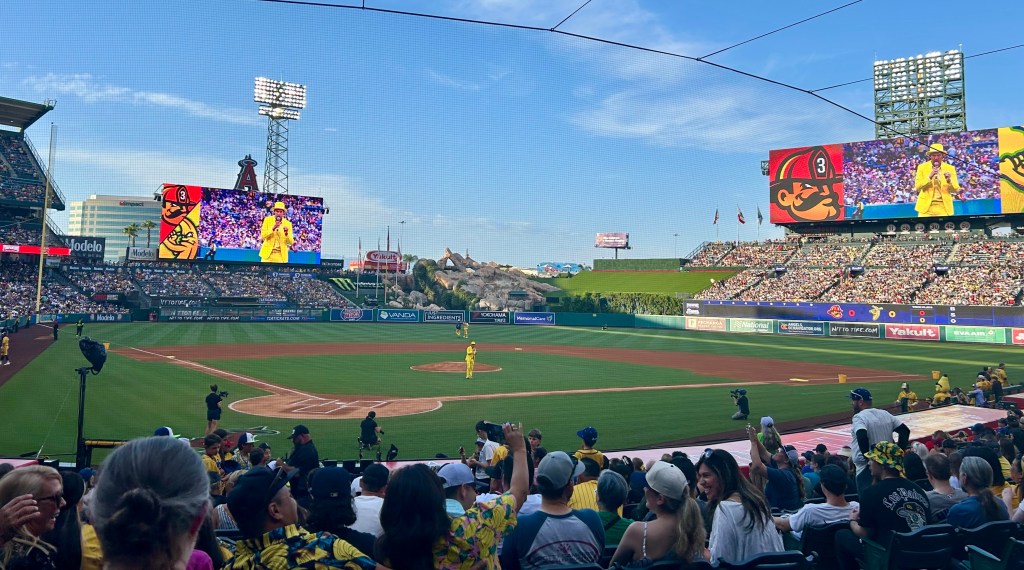
When we visited the Bananas’ second game of a two-day appearance at Angels Stadium in Anaheim this week — perhaps the only two sellouts at the place this 2025 calendar year, coming off a three-game series against the Yankees — we had Thiesen’s words in our head as a frame of reference, as well as local media coverage from the Day 1 game, but otherwise, we tried to be open-minded.
Our take on the whole idea of the Savannah Bannanas and the comparison to the Harlem Globetrotters:
It’s more more “High School Musical” meshed with Horsehide Cirque du Soleil, a wedding reception with a baseball theme wrapped around an activity that looks like a game played at the pace of a batting-practice pitcher grab-and-throw-and-grove. The between-innings experiences of corny planned contests, honoring veterans and first responders, and even a shout out to a non-profit Foster kids program doesn’t drag anything down but allows for catching one’s breath.
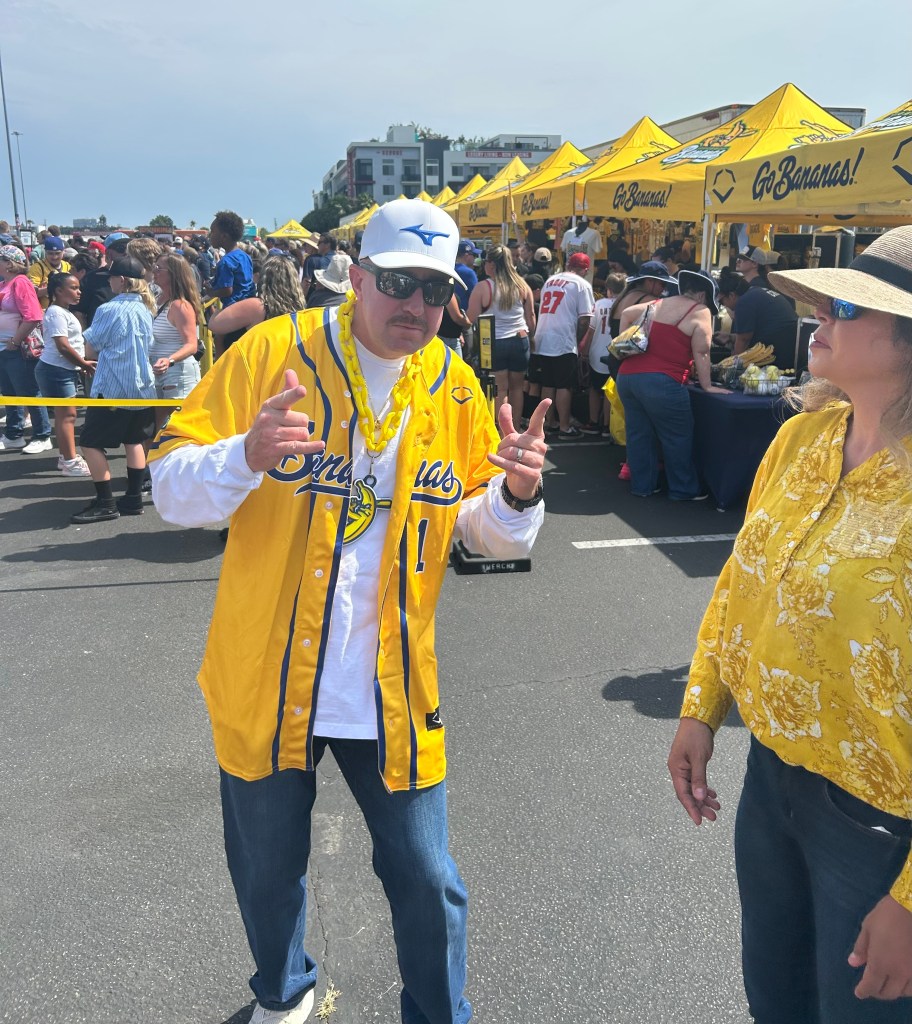
And it works.
A DJ-stage gathering to amp up the noise and energy before, then the “show” starts, then the after-party. Perhaps an exhausting pace for some, but it’s taking the elements of action of a “regular” baseball game and heightening it, expanding it, and amping it up. It takes advantage of incorporating local entertainment nods (Disneyland, for sure) and really knows how to read the room. It works in a baseball stadium best (because of the setup with scoreboards, wifi and capacity seating depth) but wedging it as well into a football stadium or other venue will add to its quirkiness.
It’s scripted schizophrenia, pumped up performance art, wonky scorekeeping and incredible talent on display surrounding the unplanned elements of game that has to be a communal stadium experience in person instead of judging it by a Tik Tok video clip or another high light reel. There are surprise guests. There’s a mascot, “Split,” that, at least in Anaheim, dared go up into the batters’ eye area beyond center field and do what every kid has wanted to do: Roll down the green hill.
Sensory overload, but not in a toxic way. Baseball remains the framework amidst all the improve and sketch comedy. The organizers do all they can to prevent the sale of $75 going for $1,000 or more on the open market, but that’s the world we live in — those taking advantage of a situation. Hopefully, you have karma lottery and get the best seats possible (another key to the experience) and bring in as many friends who otherwise might not enjoy a “real” baseball game to see this thing under the circus tent.
Back to how Thiesen ended her essay: “So what does someone want to see in a Savannah Bananas game? I guess they want to see the players dance. But they saw that already online. There’s no need to go to the stadium and catch it again with a worse view. Just give your minor-league boys a shot this summer. They’re probably doing something almost as weird.”
That’s where Tom Alesia starts making his case for the Madison Mallards.
The book is not just on what this college summer-league team has done, continue to do, and likely will do for years to come, but why it resonates in the community, and why it doesn’t need to try to out-gimmick anyone else by trying to be a national attraction, and how it can be content in how it has kept the game relevant in a non-MLB sphere.
It has a formula. It works.
Comparing Mallards to Bananas is more like Granny Smith apples to Cara Cara oranges. They’re each sweet and special in their own fruity way. (And that’s aside from the fact the forward to Alesia’s book is written by John Kovalic, the creator of the fantastic “Apples To Apples” card game.)
Continue reading “Day 20 of 2025 baseball book reviews: What’s good for the Mallards is good for goosing the game” Tom Hoffarth's The Drill: More Farther Off the Wall