


This is the latest post for an ongoing media project — SoCal Sports History 101: The Prime Numbers from 00 to 99 that Uniformly, Uniquely and Unapologetically Reveal The Narrative of Our Region’s Athletic Heritage. Pick a number and highlight an athlete — person, place or thing — most obviously connected to it by fame and fortune, someone who isn’t so obvious, and then take a deeper dive into the most interesting story tied to it. It’s a combination of star power, achievement, longevity, notoriety, and, above all, what makes that athlete so Southern California. Quirkiness factor sin. And it should open itself to more discussion and debate — which is what sports is best at doing.
The most obvious choices for No. 7:
= Bob Waterfield: UCLA football; Los Angeles Rams
= Steve Yeager: Los Angeles Dodgers
= Lamar Odom: Los Angeles Clippers; Los Angeles Lakers
= Matt Barkley: USC football
= Don Rogers: UCLA football
The not-so-obvious choices for No. 7:
= Todd Marinovich: Mater Dei High football, Capistrano Valley High football
= Mark Harmon: UCLA football
= Jay Schroeder: UCLA football
The most interesting story for No. 7:
Todd Marinovich, Santa Ana Mater Dei High School and Capistrano Valley High football quarterback (1985 to 1989), USC football quarterback (1988 to 1990), Los Angeles Raiders quarterback (1991 to 1992), Los Angeles Avengers quarterback (2000 to 2001)
Southern California map pinpoints:
Mission Viejo, Santa Ana, Los Angeles (Coliseum, Staples Center), Newport Beach, Irvine, Indio
Proceed with caution if you decide to use Todd Marinovich as sports’ poster boy for the ultimate “cautionary tale.” It’s old news in this case.
The label can still a bit addicting for journalists who think they’ve accurately reported on his creation story, going back to his time as a high school quarterback in Orange County setting California state high school passing records. They then observed his personal and playing career arch reveal extreme highs and lows at USC, the NFL’s Los Angeles Raiders, circling back to Los Angeles for a run with an Arena League team to support a drug habit, and eventually landing on a Palm Springs football field near the age of 50 still trying to find himself.
Tale as old as time, but one that needs a fresh angle every now and then.
In a 2019 piece for the Chicago Tribune by Rick Telander, the “cautionary tale” reference got its latest rewind when dissecting Team Marinovich and the mess it seemed to make in the public eye:
“You’ll recall that Todd was the young man manipulated from birth (actually pre-birth) by his father to be the best, purist, greatest quarterback the world had ever seen. Marv had played football at USC, and he wanted, for reasons buried deep within his own inadequacies, to create a boy who would have the sporting genetics for quarterbacking and be trained incessantly, focused unfailingly and driven like a sled dog toward the apex of the country’s most popular game.”
Telander dragged that trope out because he just read something in Sports Illustrated by Michael Rosenberg, titled “Learning To Be Human Again.” As if Marinovich was emancipated from some reverse metamorphic process.
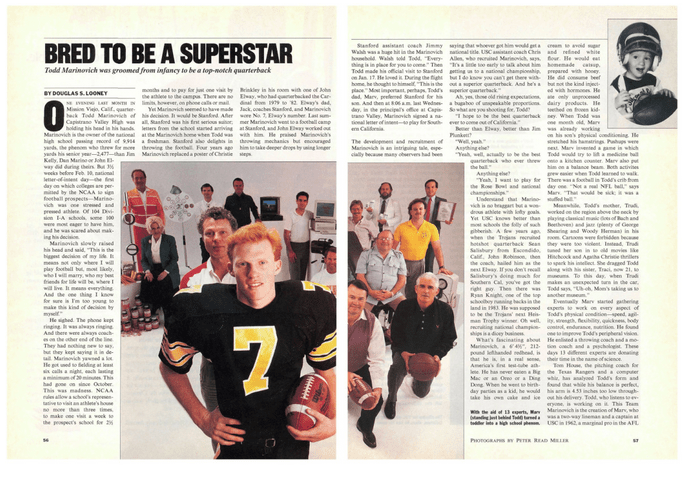
Rosenberg’s launching point was actually a purposeful revisit of that 1988 Sports Illustrated spread Doug Looney laid out titled “Bred to be a Superstar” that likely started the whole social science shebang on judging the Marinovich Parental Method and its doomed-to-fail, real-world predictions.
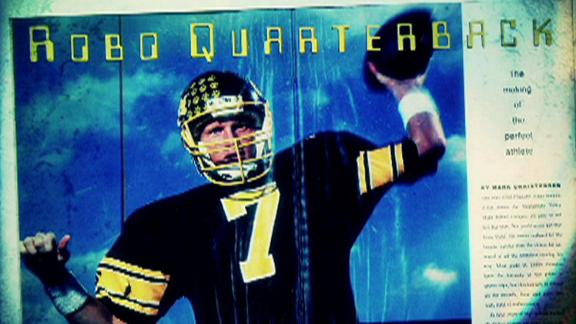
Before that piece, California magazine dropped one with the headline “Robo QB: The Making of the Perfect Athlete.” Then came a People magazine profile in 1987.
That was the fragile framework created for Todd Marinovich, no matter where he went from there. The poor kid, readers could easily conclude. Talented, kind-hearted, fun-loving, well mannered. Able bodied.
Call Child Protective Services.
We seem to have the idea that one who is abused and manipulated as a kid is set up to abuse himself later in life and continue a genetic pattern of human frailty. Unless that person figures things out with help, counseling and avoiding some sort of tragic ending.
Maybe the “worst sports father” adjective just won’t go away years later. Even if his father literally went away.
But Todd Marinovich can explain better how it happened with him as a willing participant, trying to navigate the life of a high school kid in full media spotlight, and how it really turned out.
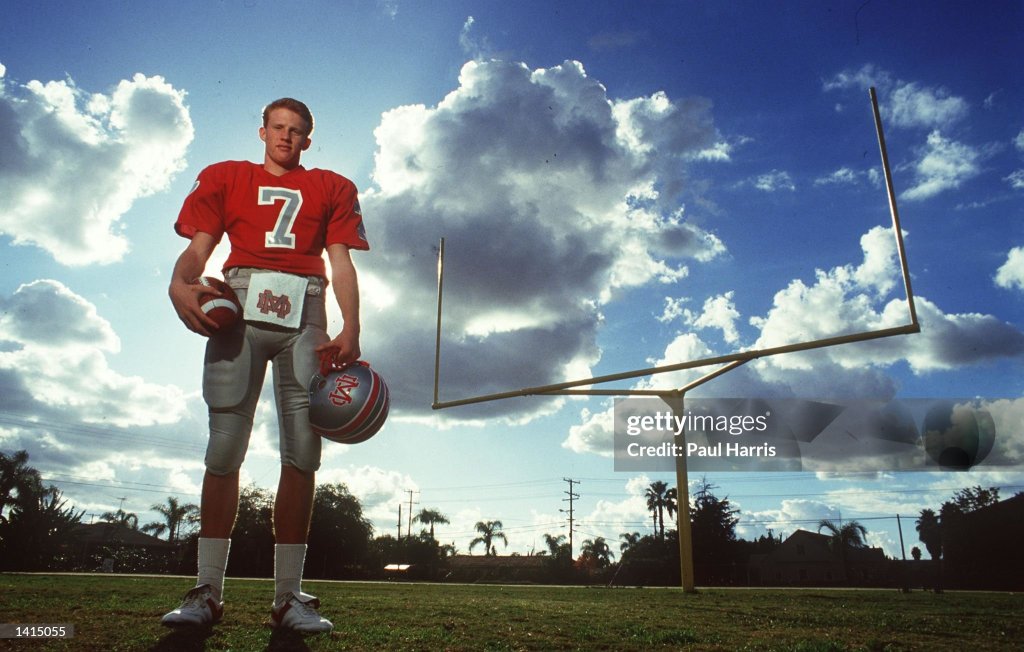
That Todd Marinovich was born on the Fourth of July in 1969 may have added to the storyline that started with him on a All-American pathway.
He played a lot of sports, perhaps exceeding most in basketball, but football would be the real test. First were the years at Mater Dei High in Santa Ana, a football factory that had produced Heisman Trophy winners before and after Marinovich’s brief appearance there. That was followed by a surprise transfer to Capistrano Valley in Mission Viejo.
The switch to Capo Valley by his father Marv would be one of things listed on his parents’ separation filing in the courts. Todd has no say in it. He would live with his dad an an in-law quarters at the house of head coach Dick Enright, likely a CIF violation.
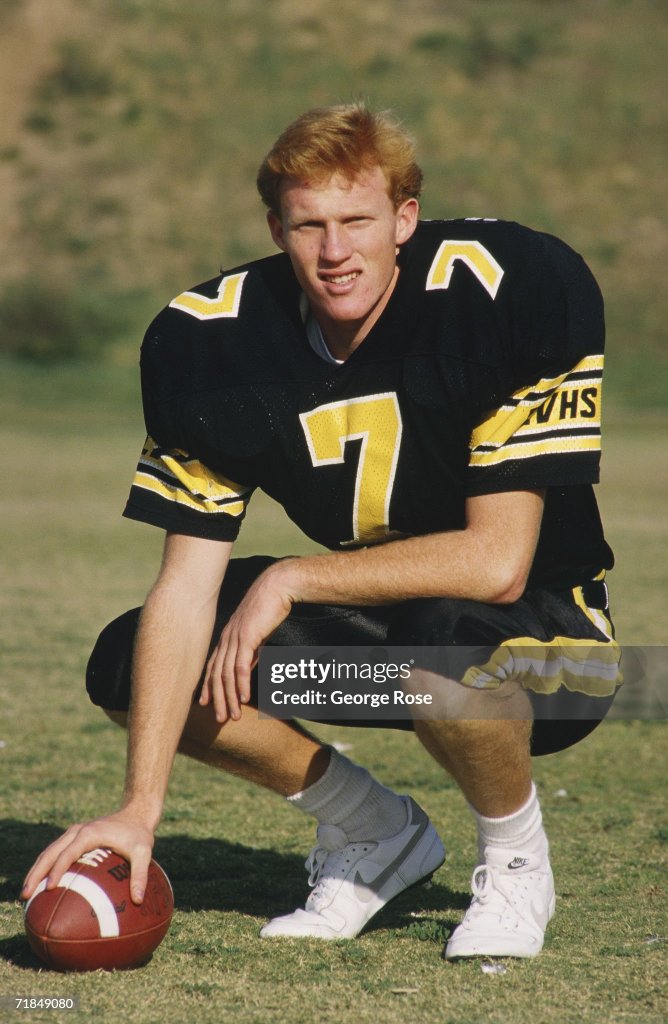
While wearing No. 7, Marinovich went up against rival quarterback Bret Johnson in 1987 when ESPN televised its first-ever high school game, between Capo Valley and El Toro.
Continue reading “No. 7: Todd Marinovich” Tom Hoffarth's The Drill: More Farther Off the Wall