


Updated: 2/4/26
This is the latest post for an ongoing media project — SoCal Sports History 101: The Prime Numbers from 00 to 99 that Uniformly, Uniquely and Unapologetically Reveal The Narrative of Our Region’s Athletic Heritage. Pick a number and highlight an athlete — person, place or thing — most obviously connected to it by fame and fortune, someone who isn’t so obvious, and then take a deeper dive into the most interesting story tied to it. It’s a combination of star power, achievement, longevity, notoriety, and, above all, what makes that athlete so Southern California. Quirkiness and notoriety factor in. And it should open itself to more discussion and debate — which is what sports is best at doing.
The most obvious choices for No. 17:
= Shohei Ohtani: Los Angeles Angels and Los Angeles Dodgers
= Bill Kilmer: UCLA football
= Phillip Rivers: Los Angeles Chargers
= Jari Kurri: Los Angeles Kings and Mighty Ducks of Anaheim
The not-so-obvious choices for No. 17:
= Puka Nacua: Los Angeles Rams
= Carl Erskine: Los Angeles Dodgers
= Jeremy Lin: Los Angeles Lakers
The most interesting story for No. 17:
Shohei Ohtani: Los Angeles Angels pitcher/designated hitter/outfielder (2018 to 2023); Los Angeles Dodgers pitcher/designated hitter (2024 to present)
Southern California map pinpoints:
Anaheim, Los Angeles (Dodger Stadium)
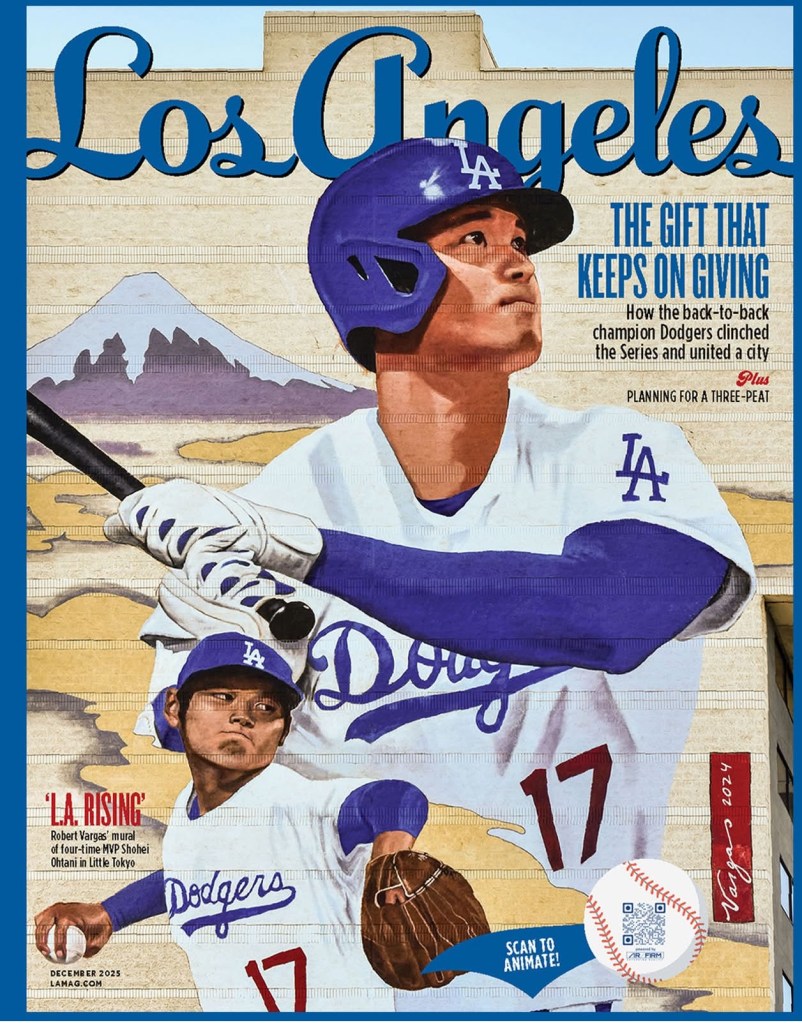
Everything everywhere all at once, Shohei Ohtani’s supernatural existence in a Major League Baseball uniform might be best captured with an English-created adjective. It’s not in any global dictionary. Yet.
The word is “Ohtanic.” Figure out a way to create a Japanese character equivalent, and it’s likely the slogan of his latest endorser. We just added it to our Microsoft Word reference list so it’s not red and underlined any more.
In a June 2025 Substack post, Doug Glanville, the former MLB player-turned-media analyst, landed on that as the most appropriate way to summarize what he has seen from the Los Angeles Dodgers’ pitcher/hitter to that point in time.

“I landed on ‘Ohtanic’ … ‘When Shohei Ohtani does something that only Shohei Ohtani can do.’ ” Glanville explained. “Circular? Yes. True? Also yes. … He exists in this strange stasis. Maybe like the Last Action Hero or Batman — super, but without superpowers. Ohtani does not need smoke and mirrors. He is right there, in the open. And that is the point. …
“He embodies a kind of limitless greatness, rooted in craft, powered by discipline, and entirely human. And still, that does not quite capture the essence of who he is and what he does.”
Glanville wrote that nearly four years after Ohtani made the AL All-Star team, both as a hitter and pitcher, batting leadoff as the DH and starting on the mound, getting the first outs, and credited with the win as a member of the Los Angeles Angels.
“Ohtanic” was also generated nine months after Ohtani had what some called “one of the greatest performances in MLB history.” Going 6-for-6 with three homers, 10 RBIs and two stolen bases, reaching 50 homers for the season as well as 50 stolen bases, which clinched the NL West Division for the Dodgers as they would win a World Series. That also clinched Ohtani’s first NL MVP Award to go with the two he had previously in the AL.
At that moment, Joe Posnanski wrote on Sept. 20, ’24: Did Shohei Ohtani just have the greatest game in baseball history? … Let’s instead call it the most amazing game in baseball history. Let’s instead call Ohtani the most amazing player in baseball history. All the great players in baseball history, Ruth and Mays and Aaron and Bonds and Gehrig and Clemente and Pujols and Bench and Ichiro and Charleston and Mantle and Morgan and Griffey and Gibson and Trout and on and on… and we’ve never seen anyone like Shohei Ohtani.
Then came Game 4 of the National League Championship Series at Dodger Stadium, on Oct. 16, 2025, four months after Glanville’s dictionary suggestion.

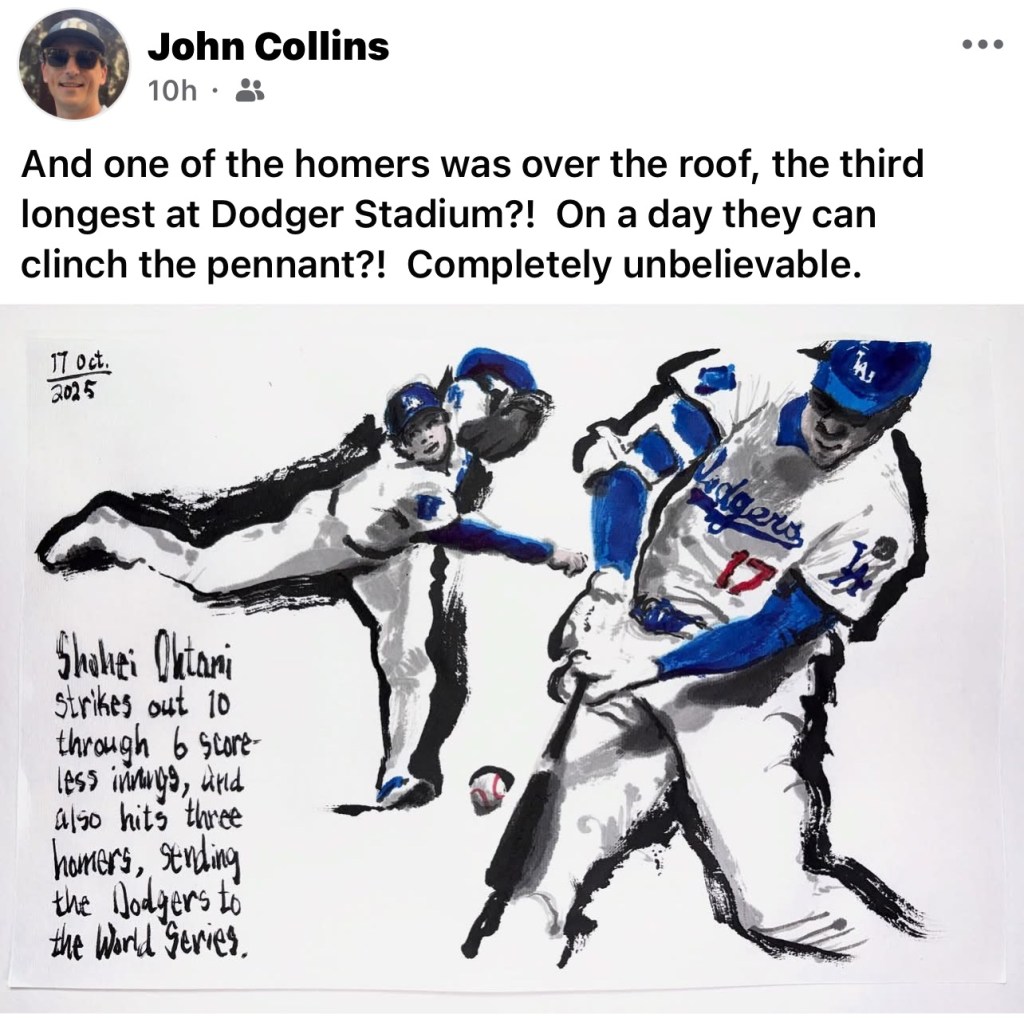
Ohtani, the starting pitcher, went into the seventh inning before coming out after allowing the first two batters to reach. He was credited for throwing six shutout innings (because the relievers didn’t allow anyone to score), striking out 10.
Ohtani, the lead-off hitting DH, smacked solo homers in the first, fourth and seventh innings, off three different pitchers, including one that went over the right-field pavilion roof listed at 469 feet, one of the greatest hit in the stadium’s history (and not even the longest he ever hit). His homer in the first gave the Dodgers a 1-0 lead. His homer in the fourth gave the Dodgers a 4-0 lead. His homer in the seventh gave the Dodgers a 5-0 lead, that he aimed to continue before he was pulled after 100 pitches (66 strikes).
Sportswriters, historians and pop culture hyperbolic hyperbolists squeezed all available digital thesaurus to see what was left to use for someone already referred to as “The Unicorn” or “GOAT of MLB history.”
The Washington Post’s Chelea James: “This was Beethoven at a piano. This was Shakespeare with a quill. This was Michael Jordan in the Finals. This was Tiger Woods in Sunday red. This was too good to be true with no reason to doubt it. This is the beginning of every baseball conversation and the end of every debate: Shohei Ohtani is the best baseball player who has ever played the game … Friday night, (he) was Mona Lisa.”
New Yorker writer Louisa Thomas checked in with: “It was the greatest performance by the greatest player in history.”
Jayson Stark, writing for The Athletic/The New York Times under the headline “Ohtani, the Greatest Shoh on Earth, just had the greatest game in baseball history” declared: “A man named Ohtani had the single greatest game any human has ever had on a baseball field … assuming that term,’human,’ even describes him.”
This one in The Atlantic, “A Truly Awesome Performance,” had a lede by Peter Wehner that read: “On Friday night at Dodger Stadium in Los Angeles, fans witnessed perhaps the greatest game by a player in the history of baseball, and one of the handful of greatest individual performances in any sport ever. But Shohei Ohtani’s performance shouldn’t be of interest just to sports fans. His triumph offers all of us a ray of hope at a troubled time.”
The piece ended: “So enjoy Shohei Ohtani while you can. He embodies athletic excellence, which will bring you joy, and moral excellence, which will bring you hope. We could benefit from some of both these days.”

Michael Weinreb, on his “Throwbacks: A Newsletter About Sports History and Culture,” wasn’t convinced so much in: “Ohtani Is a Hero for the AI Age.”
While Ohtani had perhaps the most remarkable playoff performance by a single athlete in the history of baseball, and “I recognize it is too soon to process how these accomplishments might wind up being filtered through the lens of history. … (But) then I began to wonder if Ohtani’s performance will wind up meaning much of anything at all outside of baseball itself. And I wondered if — through no real fault of his own — Shohei Ohtani could wind up becoming the avatar of an empty cultural age. … He is everything and he is nothing. And you might argue, in an era where everyday life in America feels increasingly detached from reality, he is the quintessential hero of our age.”
A fictional (?) story that appeared in the Onion days earlier plays up this disconnect. With the headline, “Teammates Unnerved As Interpreter Begins Referring To Ohtani As ‘The Host’,” it suggested that Ohtani was taking on demi-god status.
“The Ascension, the Ascension, the Ascension—he’s always going on about the Ascension,” said first baseman Freddie Freeman, admitting he was baffled by Ohtani tracing an ancient symbol on his forehead and sprinkling rosin in a spiral over his cleats. “I asked him what it meant, and he just smiled. Then Will said, ‘The hour grows near when all will know. The Ascension stirs beneath the red soil.’ It made me really uncomfortable.”
Breath deep and meditate on this:
In November and December of 2025 came a fourth career unanimous MVP Award, The Associated Press Male Athlete of the Year Award for the fourth time (in company with Lance Armstrong, Tiger Woods and LeBron James; and the only MLB player to win this more than once was Sandy Koufax in ’63 and ’65), his third consecutive Hank Aaron Award as the top hitter in the league, his fourth Silver Slugger and his fifth straight Edgar Martinez Outstanding Designated Hitter award.
He was included in the New York Times’ list of the “67 Most Stylish People of 2025,” for turning “a hand gesture originally featured in a Japanese cosmetics commercial into something of a craze” as he ran around the bases after a homer. (As long as he wasn’t flashing “6, 7” to the crowd).
In January of 2026, he was declared the world’s most marketable athlete based on making about $100 million in revenue just from endorsements.

Christmas came early for the Los Angeles Dodgers in 2023. The Los Angeles Angels were left with nothing more than a lump of … coal-ish something or other.
Not only did Shohei Ohtani come gift-wrapped, courtesy of the Angels, but a 10-year, $700 million deal (with much of it craftily deferred) made it the most expensive gesture and pivotal moment in Southern California professional baseball. It showed that there was a distinct business intersection of sports and entertainment.
It morphed into full-on, no shame, global Sho-business.
There had been welcome-to-L.A./SoCal galas in the past for Wayne Gretzky, LeBron James, Shaquille O’Neal, David Beckham and Albert Pujols. A welcome back for Kareem Abdul-Jabbar. Same for the Los Angeles Rams.
Shohei Ohtani’s re-entering the SoCal galaxy as a re-imagined global icon raised the bar spectacularly to heights not seen before.
A press conference in the afternoon at Dodger Stadium on Dec. 14, 2023 made sure it was prime-time morning viewing in Japan the next day. It came six years after he already dazzled Orange County agreeing to play for Los Angeles’ Angels.
Even before then, the Southern California media market knew what it was seeing.
A 2017 piece on CBS’ “60 Minutes” explained to all of the U.S. what his profound achievements already were in Japan by age 22. Earlier that fall, Dylan Hernandez of the Los Angeles Times went to Japan as well to write about how “Japanese baseball star Shohei Ohtani could be double threat in big leagues.”
The story started: “SAPPORO, Japan — The best player on the baseball team pitches and bats fourth. Not on a Little League team. Not on a high school team. On a professional team that plays at this country’s highest level. Shohei Ohtani has the kind of extraordinary talent that could change the sport. He’s done it here, and he soon could do it in the major leagues, all the while maintaining the innocence of a boy playing a kids’ game despite the scrutiny and pressure he faces as Japan’s most-popular athlete.”
Now at Dodger Stadium, Ohtani said through then-interpreter Ippei Mizuhara: “I am very humbled and happy to see all of you guys here … I was told that it was only media today, so I was not expecting this.”
Dodgers broadcaster Joe Davis interjected: “It actually is only media.”
Continue reading “No. 17: Shohei Ohtani” Tom Hoffarth's The Drill: More Farther Off the Wall