

A recent fact-finding expedition to the local Barnes & Noble led to three somewhat kismet discoveries:

First: Who knows more about this Lego typewriter above?
It’s astonishing, for what looks like the combination of what might spit out of a 3-D printer, and what’s essentially something you attempt to assemble with more than 2,000 little kids’ snap-together sea-foam colored blocks. Given it’s not a workable machine, we can still work with that premise. The $250 price tag (we have since found it on line much less expensive) discourages an impulse buy (unless you’re Tom Hanks) but then again, we didn’t think twice when paying about that much in extra baggage fees during a couple airline trips this year. We’d have gladly tried to carry it all on (and learn to pack more light) if the reward was this little engineering marvel.Bravo, Lego.
(At the Lego website, we see it has a 4.5-out-of-5 rating based on about 170 reviews. Those who’ve given it the highest raves still aren’t completely satisfied it doesn’t act more like a real typewriter — a lack of spring in the keys, a clumsy rolling bar. C’mon. It passes the eye test. Those most frustrated seem to be taking it out on the vague instructions. Builder beware).
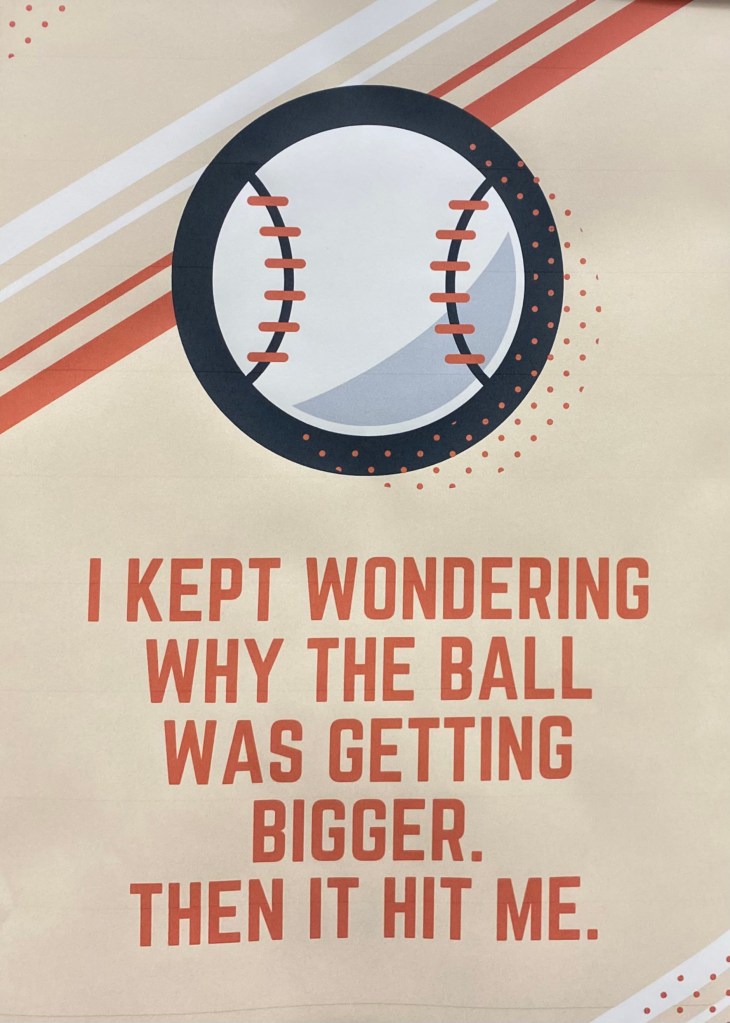
Second: This is a sign we saw set up at a table with all the new-ish baseball books that have been released.
Dad joke? Probably. It worked with us.
What slipped our mind is that we’d likely seen is several times this summer — and photographed it in late June, during Post 20 when we reviewed Tim Brown’s “The Tao of the Backup Catcher,” noticing his book had been out for sale a couple weeks before it’s scheduled release date. That sign wasn’t the focus of the photo.
This time, we actually read it. And laughed. Because, well, it finally hit us.

Third: This is a 36-pack card game available amidst all the things we get to look at and touch and hold and smell and ponder in the moments before we get to the check-out register.
It’s produced by a company called eeBoo.com, which frames it as educational toy and puzzle company “women owned and mother run.” Plus it’s “sustainable” and “always good.”
We feel the good, green vibes and appreciate the retro artwork that makes it unique.
The game involves anyone age 5 and older — we check that box — and players flip over a card that shows what the batter does as your team is on offense. A paper fold-able field helps visualize what the runners are doing. It encourages using pennies or jellybeans for runners.
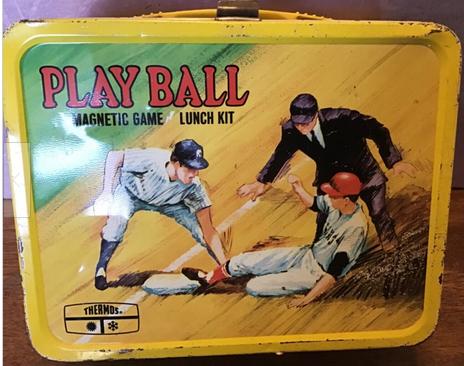
We had a flashback to fifth grade when we had the MLB-approved Thermos metal lunch box with the generic players — and the spinner game on the back with magnetic players.
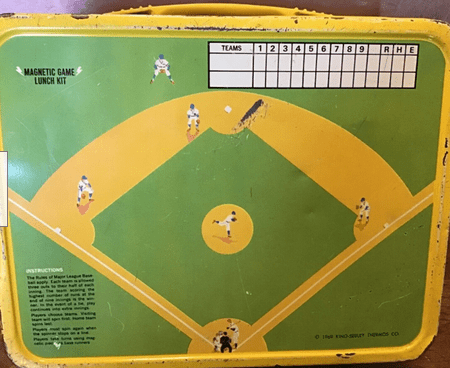
It was a daily recess and lunchtime activity that still seems like yesterday as much as it seems like 100 years ago.
The card game was the 10th temptation of that bookstore visit we respectfully resisted — along with a variety of book purchases we’ve noted. And even if they weren’t $250, they were things we can file away in the memory back as possibly justification for purchase to fulfill an obligation of a birthday, anniversary or Grandfather-Grandson Day activity.
We slid into home at the counter, used our B&N membership discount, and came away with the simply copy of Consumer Reports issue that is all about how to take better care of oneself.
Healing Through Baseball sounds like a much better proposition.
We touched a bit on that in the last post, recalling the work our friend and baseball documentarian Jon Leonoudakis, who we quoted in our 50th anniversary of the Baseball Encyclopedia story for the L.A. Times, can tell you more about the wonderful project he has involved with baseball history and trying to use it as a platform to help those suffering with memory loss find something to grab onto and fire up the synapses.
Our baseball book therapy program has closed for ’23, restored with the following 30 posts that covered more than 40 books released this year (or late last year that were relevant).
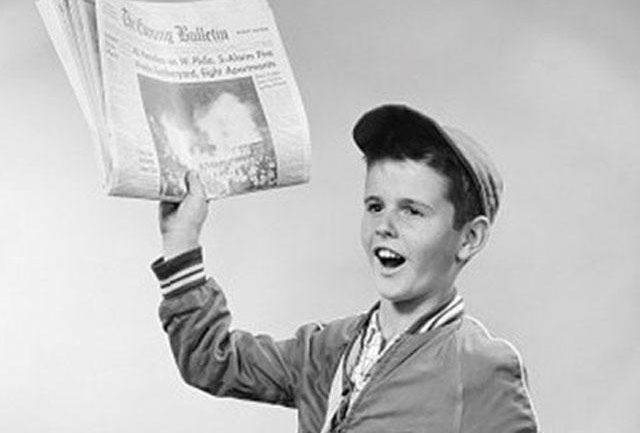
It’s also therapeutic when we read stories about public school book banning — even some that involved baseball — that finally get resolved by with more level-headed decision making. The books? They’re in the photo above. Third-grade level. On Hank Aaron and Roberto Clemente.
Pretty controversial in Florida apparently.
So here’s how the books posting ended up, and how we’d rank and file them:
TOP SHELF:
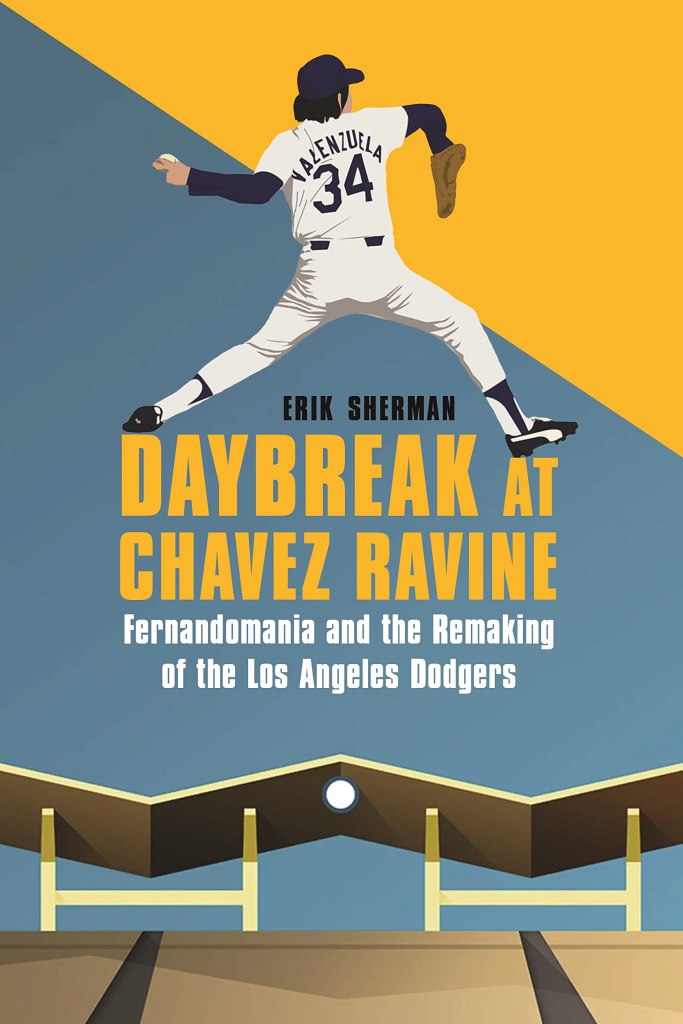
Day 11: “Daybreak at Chavez Ravine: Fernandomania and the Remaking of the Los Angeles Dodgers,” by Erik Sherman for University of Nebraska Press.
Sherman can be thanked for finally shaming the Dodgers organization (at least the current ownership) to finally retiring Valenzuela’s No. 34. The context is all here for those who were unclear all these years after his final pitch, and his current goodwill as a Spanish-language broadcaster.

Day 30: “Why We Love Baseball: A History in 50 Moments,” by Joe Posnanski for Dutton Books.
For the many fans of the author, this could easily be reframed as “Why We Love Joe Posnanski.” The first story is his admiration for Duane Kuiper. And the love affair with the game builds from there. It’s easy to share the love.

Day 20: “The Tao of the Backup Catcher: Playing Baseball for the Love of the Game,” by Tim Brown for Twelve Books/Hatchette.
Former big-league backup catcher Erik Kratz is the focal point in proving that taking one for the team is an art unto itself. Journalist Tim Brown is a perfect sherpa for this journey having already chronicled the true grit of Jim Abbott and Rick Ankiel.
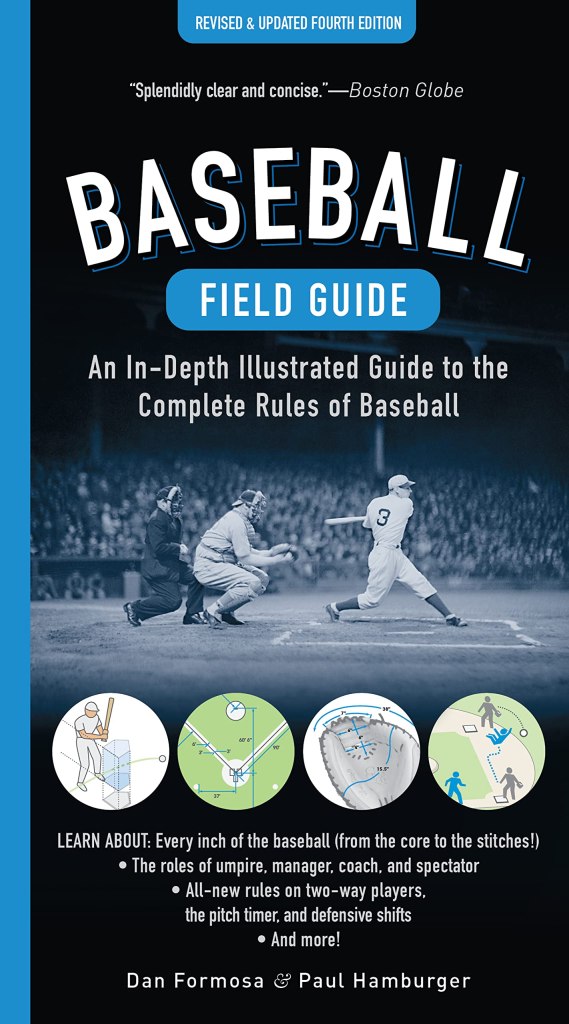
Day 12: “Baseball Field Guide: An In-Depth Illustrated Guide to the Complete Rules of Baseball” by Paul Formosa and Dan Hamburger for The Experiment LLC.
Version 4.0 is blue-ribbon work. If the book isn’t dog-eared, bookmarked with adhesive note pages, highlighted with yellow marker and held together with paperclips by its fifth use, you aren’t handling it properly. And if this isn’t kept near the real, confusing Official MLB Rule Book on one’s shelf, it’s a missed opportunity.

Day 1: “Cooperstown at the Crossroads: The Checkered History (and Uncertain Future) of Baseball’s Hall of Fame,” by G. Thomas Scott for Niwanda Books (released late 2022).
The hope is that someday “Tungsten Arm” O’Doyle makes it to Cooperstown, maybe in the same class as Shohei Ohtani. Thomas could make that happen with all the changes he suggests to fix this somewhat dysfunctional shrine/museum/nostalgic warehouse.

Day 21: “Baseball: The Turbulent Midcentury Years,” by Stephen P. Gietschier for University of Nebraska Press.
Six-hundred plus pages explaining the game from the end of World War II to expansion in the early 1960s. It ain’t heavy lifting. It’s high heat. It’s history come alive and brilliant. You’ll end up far more educated than you anticipated. Also enjoy the cover art by Graig Kriendler.

Day 10: “Welcome to the Circus of Baseball: A Story of the Perfect Summer, at the Perfect Ballpark, at the Perfect Time,” by Ryan McGee for Doubleday.
Shelve it right there next to “Clubbie: A Minor League Baseball Memoir,” by Greg Larson, which we enjoyed reviewing in 2021. The insight Larson gave in “Clubbie” runs parallel to McGee here. Full of delight. The meaning of delightful. And shedding light on a subject that needs more historical perspective.

Day 18: “Making It Home: Life Lessons From A Season of Little League,” by Teresa Strasser for Berkley Books.
It’s about dealing with good grief, with diamond therapy. Kids do all the heavy lifting. Parents observe and ruminate. The Hallmark Channel might not want to secure the rights to this one, but some brave network will see this has having all the hallmarks of a winning scripted series.

Day 3: “A Damn Near Perfect Game: Reclaiming America’s Pastime,” by Joe Kelly with Rob Bradford for Diversion Books.
The former Dodgers relief pitcher has his say about the state of the game. By the time it started circulate during the summer, he was somehow perfectly back in L.A. working with full mariachi jacket again.
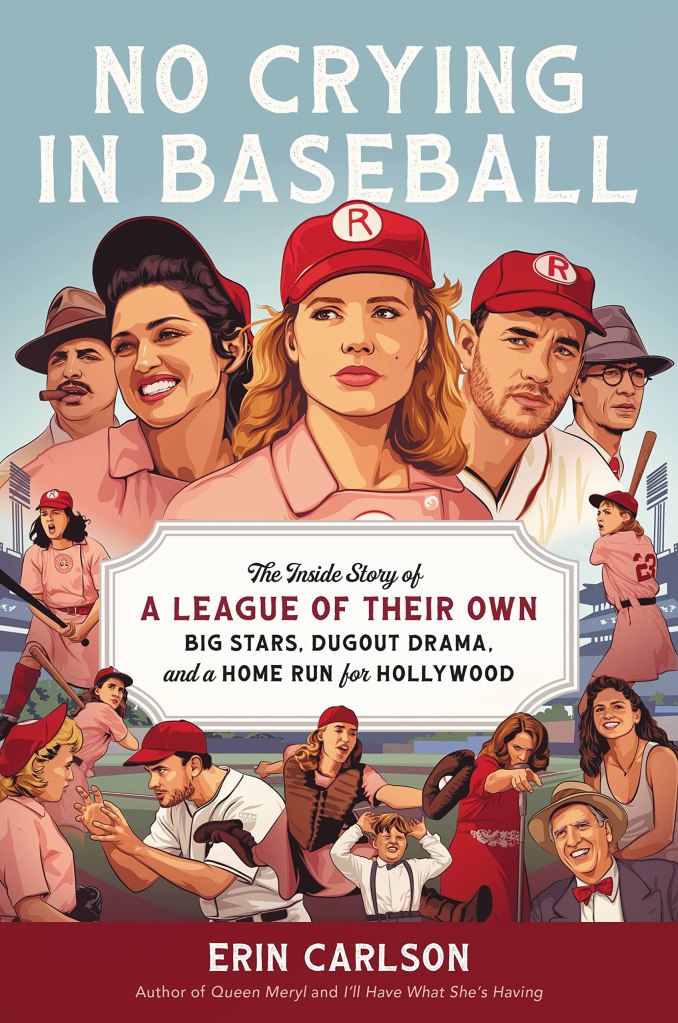
Day 29: “No Crying in Baseball: The Inside Story of ‘A League Of Their Own’ – Big Stars, Dugout Drama and a Home Run for Hollywood,” by Erin Carlson for Hachette Books.
After further review, it is confirmed: The girls just wanted to have fun in 1992. And they did, making history along the way. Thanks to Penny Marshall and this refresh of a story that continues to resonate with an Amazon/Prime series.
THEY ALSO MADE US SMARTER:

Day 28: “There’s a Bulldozer on Home Plate: A 50-Year Journey in Minor League Baseball,” by Miles Wolff for McFarland.
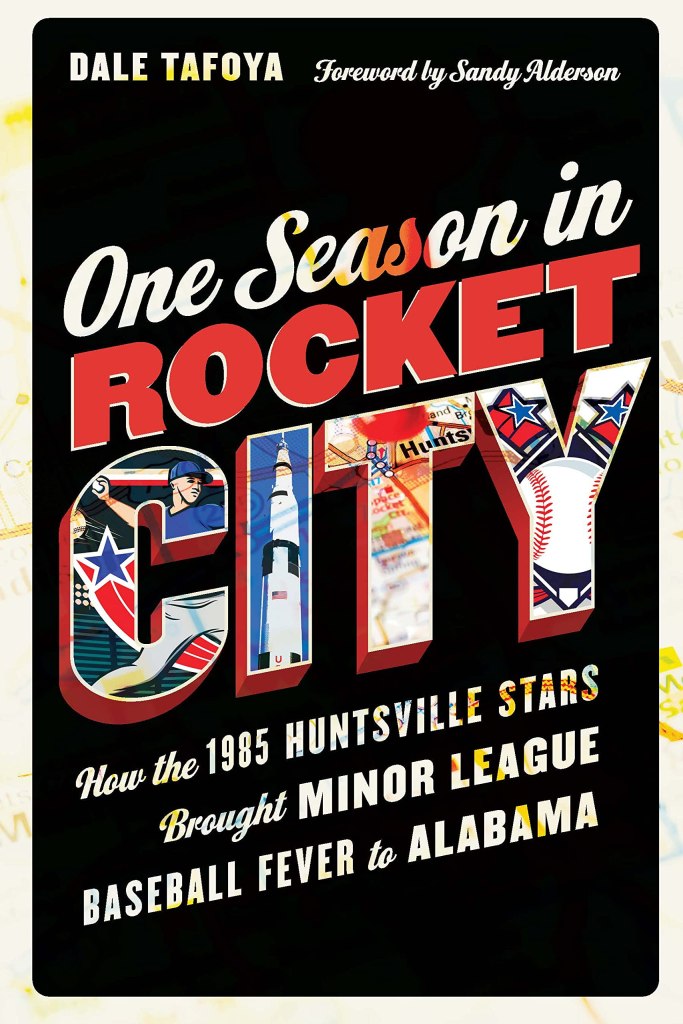
Plus: “One Season in Rocket City: How the 1985 Huntsville Stars Brought Minor League Baseball Fever to Alabama,” by Dale Tafoya for University of Nebraska Press; “Bush League, Big City: The Brooklyn Cyclones, Staten Island Yankees and the New York-Penn League,” by Michael Sokolov for State University of New York Press; and “Tales from the Dugout: 1,001 Humorous, Inspirational and Wild Anecdotes from Minor League Baseball,” by Tim Hagerty for Cider Mill Press.
It’s all about the minor leagues in a major way. And we’re still awaiting “The Encyclopedia of Minor League Baseball: A Complete Record of Teams, Leagues and Seasons, 1876-2019” by Lloyd Johnson and Miles Wolff.

Day 24: “Smart, Wrong and Lucky: The Origin Stories of Baseball’s Unexpected Stars,” by Jonathan Mayo for Triumph Books.
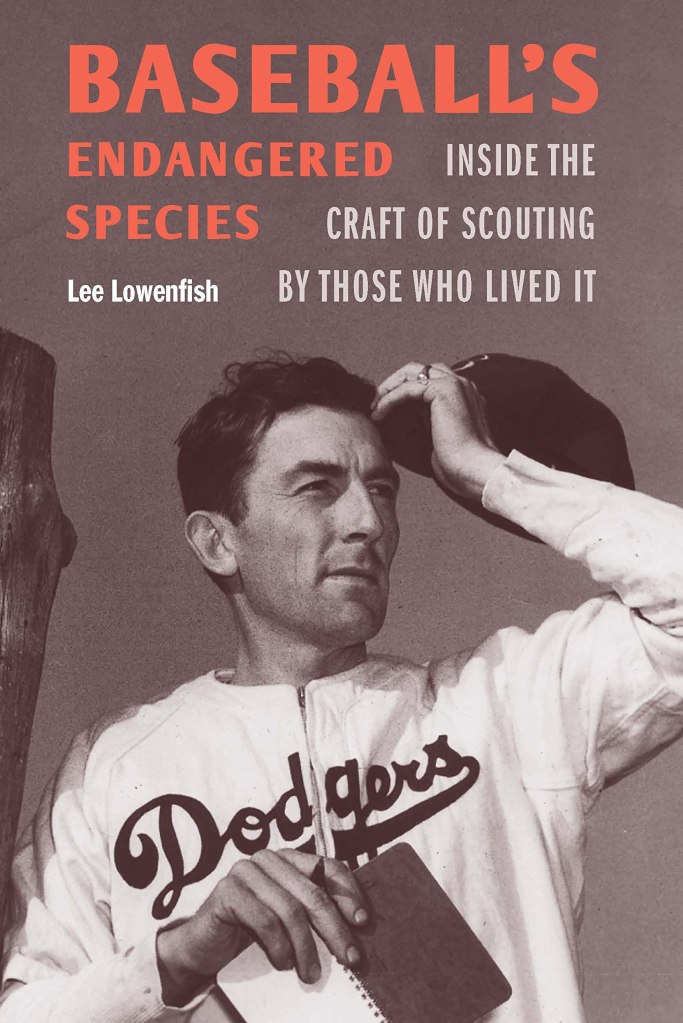
Plus: “Baseball’s Endangered Species: Inside the Craft of Scouting by Those Who Lived It,” by Lee Lowenfish for University of Nebraska Press.
Two well crafted looks at the art of guessing a player’s upside. Smart, wrong and lucky are three ways. The other is being bold and calling a kid’s bluff.
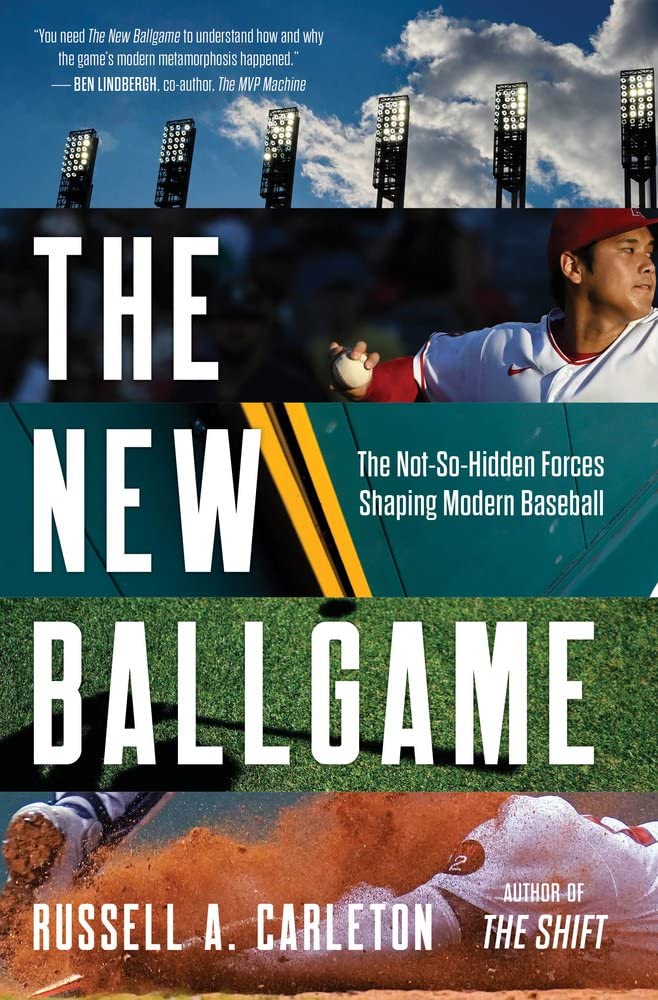
Day 23: “The New Ballgame: The Not-So-Hidden Forces Shaping Modern Baseball,” by Russell A. Carlton for Triumph Books.
A follow up to “The Shift: The Next Evolution in Baseball Thinking,” Carlton is back with an analogy about how relief pitchers are like an invasive flock of finches who migrate into an eco system and mess it all up. Our feathers are appropriately ruffled.

Day 27: “Mallparks: Baseball Stadiums and the Culture of Consumption,” by Michael T. Friedman for Cornell University Press.
Plus: “Game of Edges: The Analytics Revolution and the Future of Professional Sports,” by Bruce Schoenfeld for W.W. Norton & Co.
You’ll never look at Dodger Stadium the same way, or figure out what they’re trying to do in Anaheim to help the Angels, when you figure out how it’s been redesigned to pick your pocket.
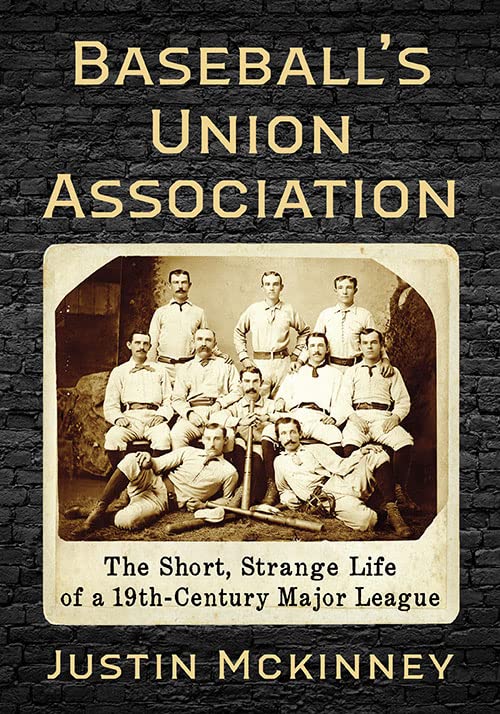
Day 17: “Baseball’s Union Association: The Short, Strange Life of a 19th-Century Major League,” by Justin McKinney for McFarland.
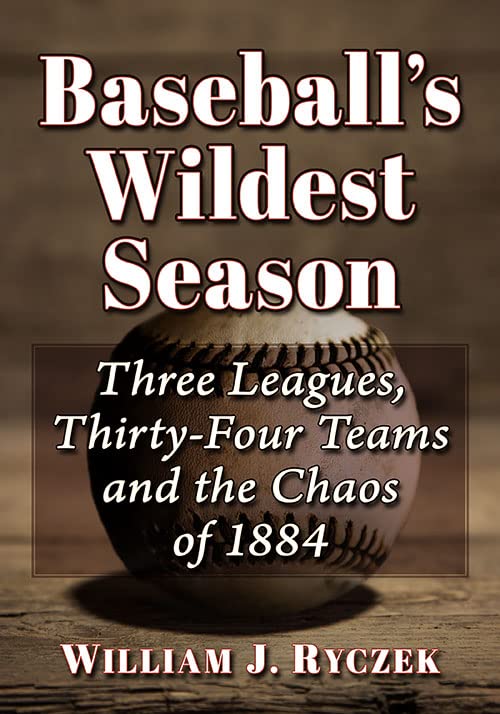
Plus: “Baseball’s Wildest Season: Three Leagues, Thirty-Four Teams and the Chaos of 1884,” by William J. Ryczek for McFarland.
Look for the Union League label when searching for your baseball history about 150 years ago.
NEW BIOS … BECAUSE?

Day 15: “Penguin Power: Dodger Blue, Hollywood Lights and My One-in-a-Million Big League Journey,” by Ron Cey with Ken Gurnick for Triumph Books.
A high 5. Yet, as triumphant a look back at the life of the Dodgers all-time franchise third baseman — as he backs up with new stats — how did this not end up published by Penguin Press?

Day 5: “Spitter: Baseball’s Notorious Gaylord Perry” by David Vaught for Texas A&M University Press.
Gaylord willing, a spit-shine revival on the life and times of the Hall of Fame twirller may actually may change how we remember him. This all gave us a lot to chew on.
MARKS FOR CREATIVITY:

Day 2: “The Ballpark Bucket List: The Ultimate Scorecard for Visiting All 30 Major League Parks,” by James Buckley Jr. for Quarto Publishing Group.
If you’re scoring at home, or if you’re just alone, this is your new little brown faux-leather book. Journal your way to another book idea, kids.
CONVERSATION STARTERS:
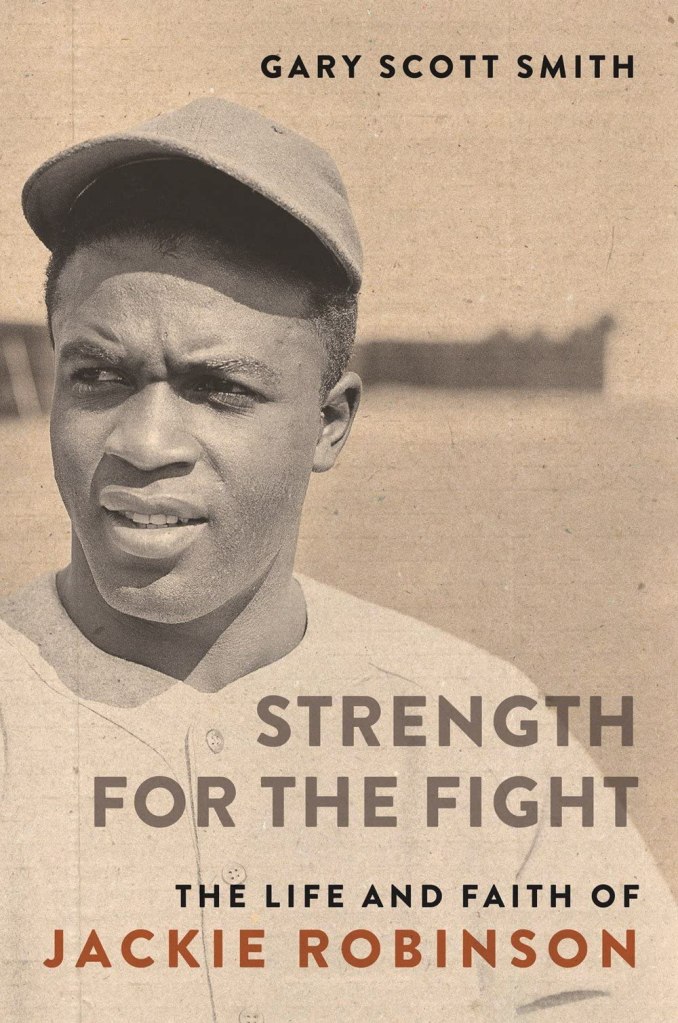
Day 8: “Strength for the Fight: The Life and Faith of Jackie Robinson,” by Gary Scott Smith for Wm. B. Eerdmans Publishing (released late 2022).
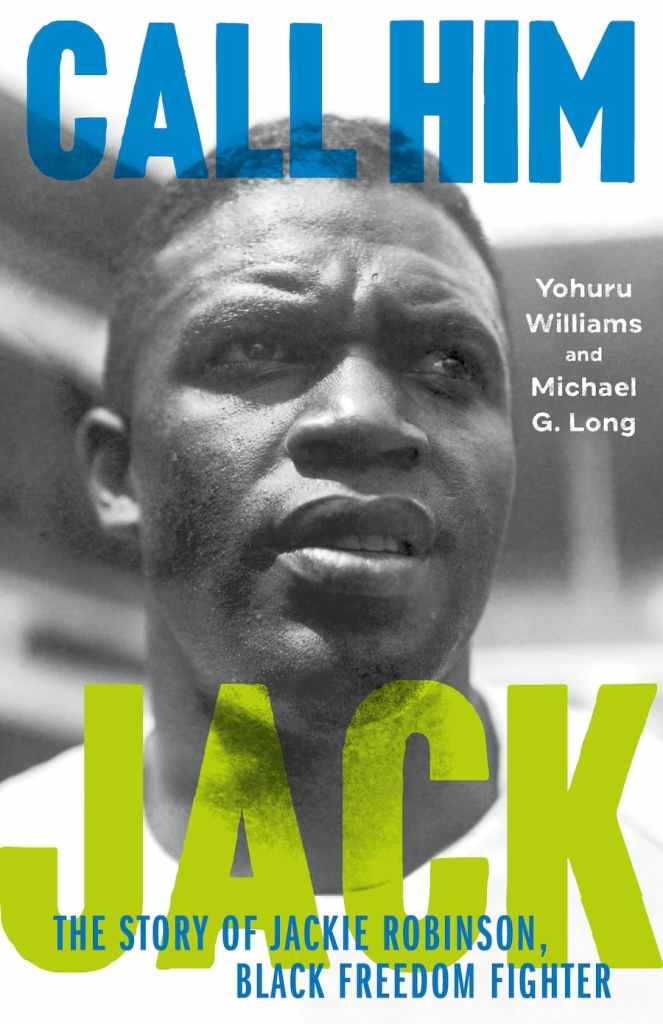
Plus: “Call Him Jack: The Story of Jackie Robinson, Black Freedom Fighter” by Michael G. Long and Yohuru Williams for Farrar, Straus and Giroux (released late 2022).
For the April 15, 2023 Jackie Robinson Day, we had to step back in time a bit to find relevant new books on his life and times. The lesson learned: Call him Jack. That’s on his Hall of Fame plaque. That’s his true first name. It’s what his wife Rachel called him. Otherwise, maybe you don’t know Jack.

Day 22: “The Black and White of Baseball: Overcoming Bias in Baseball and Life,” by George F. Wrighster, through Elite Publications.
The grandfather is disturbed by what he sees his grandson going on through on the Little League diamond. Racism? Sure looks like it. How do we make this a teachable moment?
SOFT PASS:

Day 14: “Banana Ball: The Unbelievably True Story of the Savannah Bananas,” by Jesse Cole with Don Yaeger for Dutton Books.
Turns out, the guy who created this phenomenon has already two previous books about his claim to fame. No one has said he’s not a good promoter. He’s also figure out how to manipulate supply and demand. Bananas foster more ideas.

Day 9: “Sons of Baseball: Growing Up with a Major League Dad,” by Mark Braff for Rowman & Littlefield.
The chapter on the son of former Dodgers outfielder Henry Rodriguez is a little disconcerting. Otherwise, be aware: There are no interviews done with the fathers of any of these sons, if it was possible (a few have passed away). It might have added more depth and context to the stories of their relationships. Maybe that’s for the next round of expanding on this book’s idea.

Day 7: “The Voices of Baseball: The Game’s Greatest Broadcasters Reflect on America’s Pastime,” by Kirk McKnight for Rowman & Littlefield.
A fortuitous re-release of the book first issued in 2015, but now with Vin Scully gracing the entire cover, and fortified with more of his peers talking about his greatness.

Day 6: “Winning Fixes Everything: How Baseball’s Brightest Minds Created Sports’ Biggest Mess,” by Evan Drellich for Harper.
The fix is still in: Let’s dredge up the Houston Astros’ cheating scandal again. Especially after they won the 2022 World Series and manager Dusty Baker put a happy face on the franchise again.We’ve moved on.
TIRED OF THE RETREDS:

Day 26: “The New York Mets: Celebrating Six Decades of Amazin’ Baseball,” by the editors of Sports Illustrated for Triumph Books.
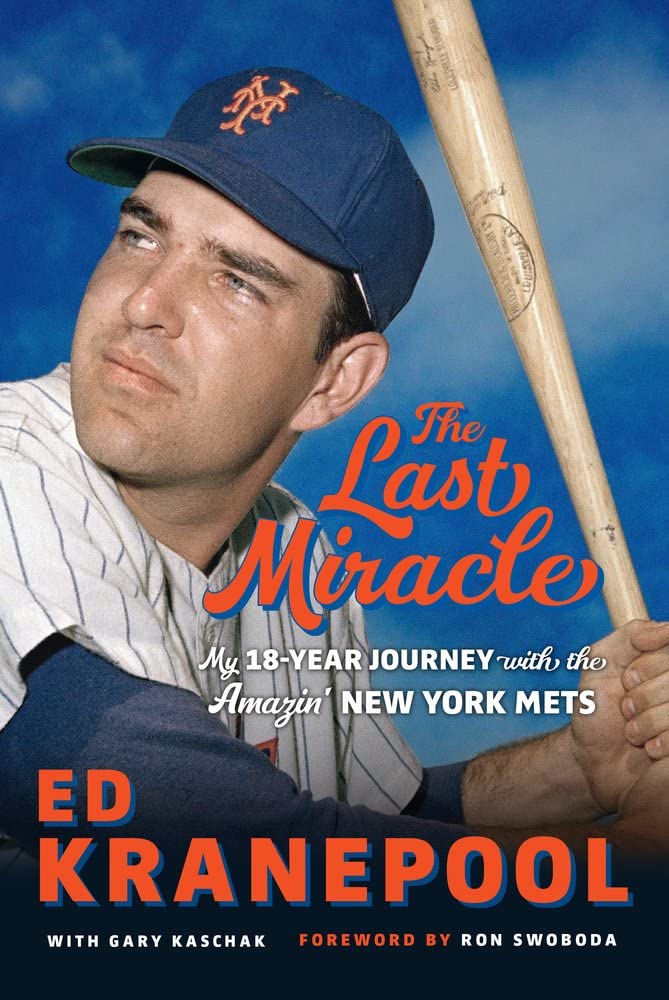
Plus: “The Last Miracle: My 18-Year Journey with the Amazin’ New York Mets,” by Ed Kranepool with Gary Kashak for Triumph Books.
We curb our enthusiasm every time another crop of books honoring the Mets happens. It’s amazin’ there are still miracles to drain from the swamps of Flushing.

Day 13: “Baseball at the Abyss: The Scandals of 1926, Babe Ruth and the Unlikely Savior Who Rescued a Tarnished Game” by Day Taylor for Rowman & Littlefield.
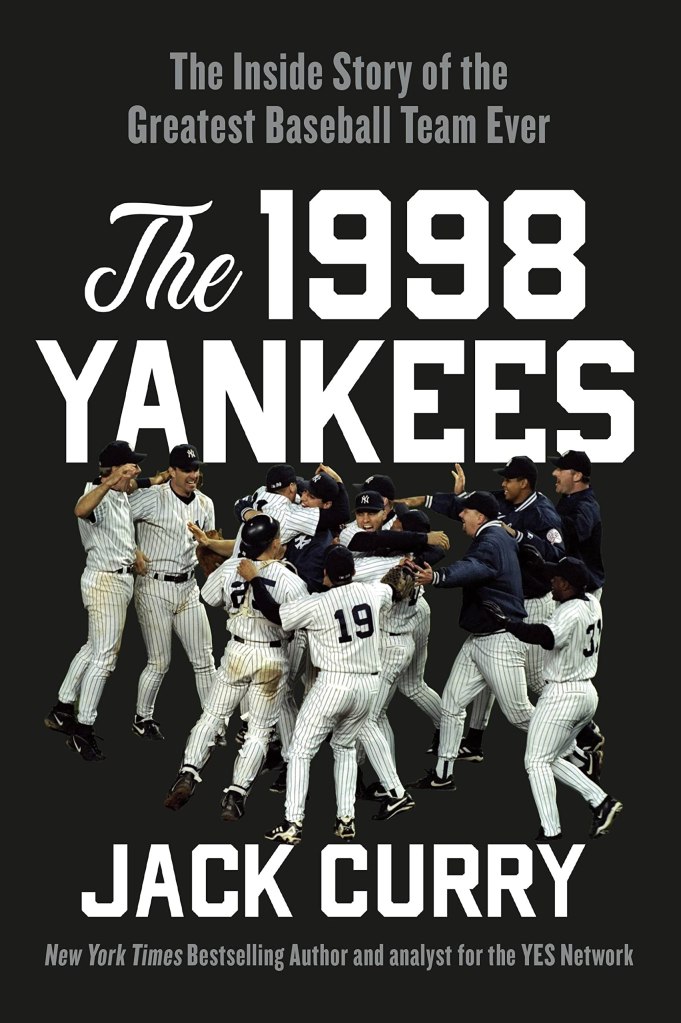
Plus: “The 1998 Yankees: The Inside Story of the Greatest Baseball Team Ever” by Jack Curry for Twelve Publishing.

Plus: “Road to Nowhere: The Early 1990s Collapse and Rebuild of New York City Baseball” by Chris Donnelly for University of Nebraska Press and “Thurm: Memoirs of a Forever Yankee,” by the late Thurman Munson with Marty Appel for Diversion Books.
The blight of the Yankees’ book brigade reminding us about its franchise greatness. And did you notice: Aaron Judge was the AL MVP in 2022 instead of Shohei Ohtani. How? Because Judge is a Yankee and Ohtani isn’t. And by the way, the new Yogi Berra documentary was created on flawed logic and should have gone straight to video. It was criminal. Not our words.
REWRITE, PLEASE:

Day 25: “Bonus Baby: A Long Walk Off The Mound,” by Josh Wilson.
A cautionary tale about … we’re not sure. Don’t be an immature idiot like me? It was a promising premise penned by a former Cardinals farmhand who never made it to the bigs, with relatively minor in lessons learned. Unless he’s pitching this as a script for “East Bound and Down.”

Day 19: “Baseball’s Memorable Misses: An Unabashed Look at the Game’s Craziest Zeroes,” by Dan Schlossberg for Sports Publishing/Skyhorse.
Plus: “The Baseball Maniac’s Almanac: The Absolutely, Positively and Without Question Greatest Book of Facts, Figures and Astonishing Lists Ever Compiled,” edited by the late Bert Randolph Sugar with Ken Samelson, for Sports Publishing/Skyhorse.
Yes, a miss. And missed opportunity. Turns out to be a zero-sum game when you’re trying to collect all the things in the game that don’t add up.We tried to do an intervention. Maybe help out the common publisher. Maybe that only made us feel better.

Day 16: “Field of Magic: Baseball’s Superstitions, Curses and Taboos,” by John Cairney for McFarland.
Pretty heady stuff for things you like to think are just circumstantial. If you can plow through all the academics of it, there’s some fun to be had. Unfortunately, not enough fun, and too many high-falootin’ overthinkin.

Day 4: “The Fireballer: A Novel” by Mark Stevens for Lake Union Publishing/Amazon.
We had faint hopes this was based on the life of Steve Dalkowski. Not sure the author even knows who that was. The book somehow had more than 1,000 global ratings on Amazon.com just a week after its launch, a 4.3 out of 5 consensus. It made us suspicious as much as duped into thinking there was a good reason for it. Perhaps that the benefit of having Amazon Publishing as the owner of the Lake Union Publishing imprint (among many others). Another lesson about the book publishing world.
As for the books we didn’t get to (and we apologize, but still can give you some background):
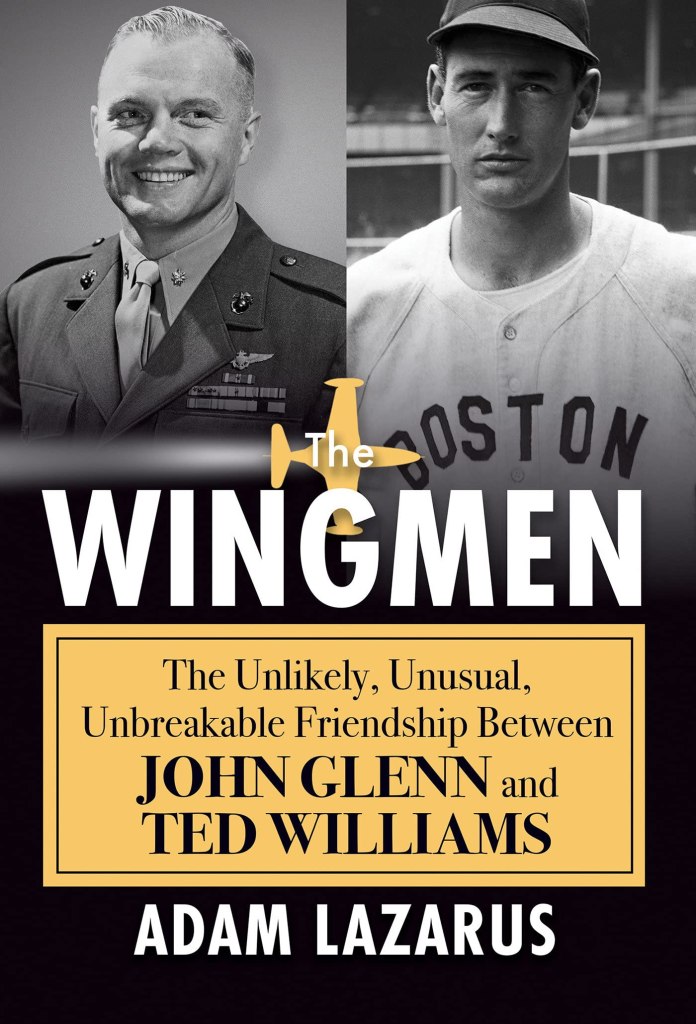
= “The Wingmen: The Unlikely, Unusual, Unbreakable Friendship Between John Glenn and Ted Williams,” by Adam Lazarus for Kensington (to be released Aug. 22): The two Marines, better known as American heroes in other fields, are crossing the 38th Parallel together into Communist airspace in 1953’s Korean War. Sounds like a great Veteran’s Day read.

= “Bill Virdon: A Life in Baseball,” by David Jerome for McFarland (released in March, 2023). The 12-year MLB outfielder, 1955 NL Rookie of the Year (the Cardinals moved Stan Musial from the outfield to first base to accommodate his coming up), and manager for four teams in 13 seasons died at age 90 in 2021.
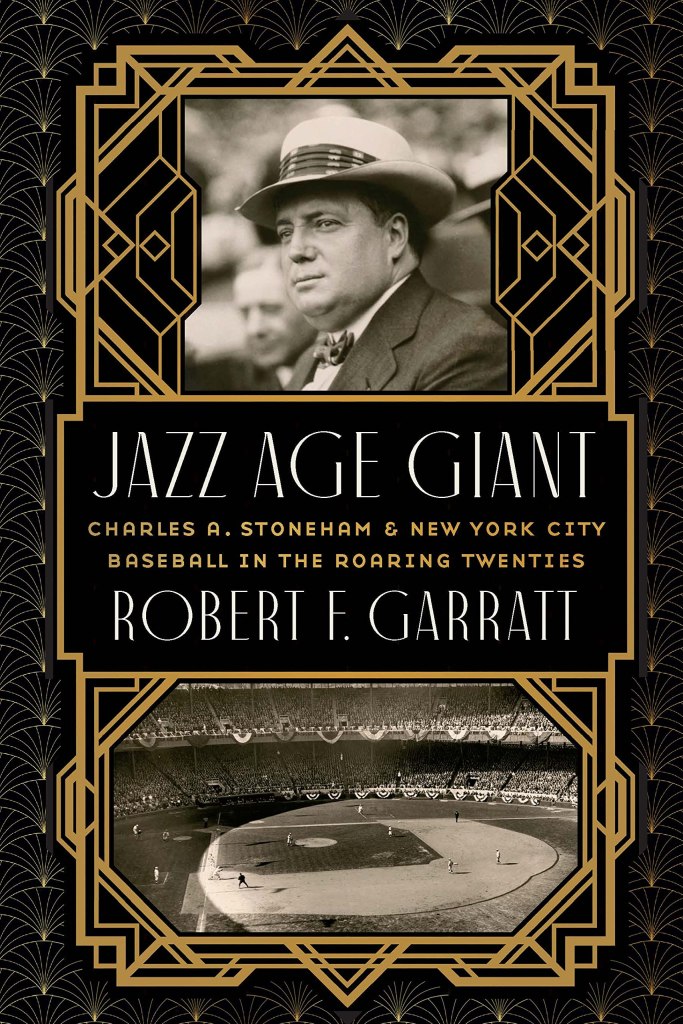
= “Jazz Age Giant: Charles A. Stoneham and New York City Baseball in the Roaring Twenties,” by Robert F. Garratt for University of Nebraska Press, (released in April, 2023). Stoneham bought the New York Giants for $1 million in 1919, the largest amount ever paid for an American sports team. He came to epitomize the high life and the changing mores of American culture during the 1920s, and the importance of sport, especially baseball, during the decade when his team won four consecutive National League pennants and two World Series, both against the rival Yankees.

= “The Year Without A World Series: Major League Baseball and the Road to the 1994 Players’ Strike,” by Robert C. Cottrell for McFarland (to be released Sept. 6, 2023). It was one baseball’s most self-inflicted injuries, calling off the 1994 MLB season in August, watching the World Series disappear, and then having the ’95 season start late (and was shortened to 144 games) because the labor dispute continued — and it was almost at a point of having “replacement” players keep it going. That 1994 debacle was also the beginning of the end of the Montreal Expos. Not sure what the value is in going back to relive all that — except maybe to learn from mistakes made?

= “Baseball, Nazis, and Nedick’s Hot Dogs: Growing Up Jewish in the 1930s in Newark,” by Jerry Izenberg for the Sager Group LLC (released in March, 2023). The sports columnist for the New Jersey Star-Ledger for more than 70 years is a survivor. “This story begins on a winter night in 1930 when Harry Izenberg and Sadye Weiser Izenberg threw back the covers, put their arms around each other and created me,” is how it begins. “Thank God for romance. If either of them had begged off with a headache, I wouldn’t be here and neither would this book.” Harrumph.

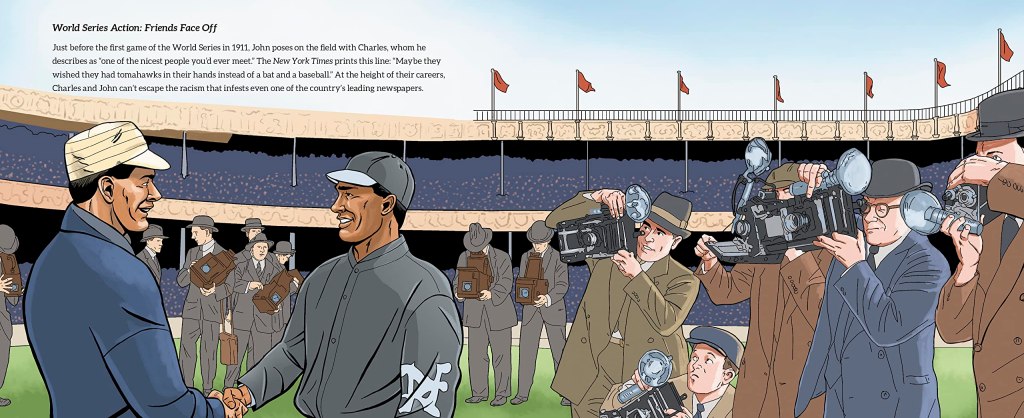
= “Contenders: Two Native Baseball Players, One World Series,” by Traci Sorell for Kokila/Penguin Books. The illustrations by Arigon Starr for project aimed at grades 1-to-4 brings to life the time when New York Giants catcher John Meyers (who later played for the Brooklyn Dodgers) and Philadelphia A’s star pitcher Charles Bender became the first two Native pro baseball players to meet in a World Series. Meyers was from the Cahuilla reservation near Riverside. He hit .300 (6-for-20) in the 1911 World Series and, according to his 1971 obituary, he threw out 12 runners, a record for the most assists by a catcher in the Fall Classic. After losing 2-1 to Christy Mathewson in Game 1, Bender was the starter and winning pitcher against Mathewson in Game 4, and then won the Game 6 clincher, 13-2, giving him three complete games. Meyers went 3 for 11 against Bender in the three games with two doubles.
Do we need to add that both Meyer and Bender were more commonly known by their same nickname, “Chief”?
How about we end it with this illustration from the book:

 Tom Hoffarth's The Drill: More Farther Off the Wall