
This post is part of a media project called SoCal Sports History 101: The Prime Numbers from 00 to 99 that Uniformly, Uniquely and Unapologetically Reveal The Narrative of Our Region’s Athletic Heritage. Pick a number, and consider the list of athletes attached to it. Who wore it best? Or, what’s the most compelling story linked to it? Any person, place or thing is in play with Southern California connections. Star power, transformational achievement, longevity, notoriety and quirkiness all factor in. Whatever leads to a lively discussion and interpretation.
The most obvious choices for No. 18:

Yoshinobu Yamamoto: Los Angeles Dodgers
Roman Gabriel: Los Angeles Rams
Bill Russell: Los Angeles Dodgers
Dave Taylor: Los Angeles Kings
Cade McNown: UCLA football
J.J. Stokes: UCLA football
The not-so-obvious choices for No. 18:
Jack Robinson: UCLA basketball
Rudy Bukich: USC football
The most interesting story for No. 18:
Roman Gabriel: Los Angeles Rams quarterback (1962 to 1972)
Southern California map pinpoints:
Los Angeles Coliseum; Pomona
Reference books on the subject:
“Player of the Year: Roman Gabriel’s Football Journal,” by Roman Gabriel with Bob Oates, 1970
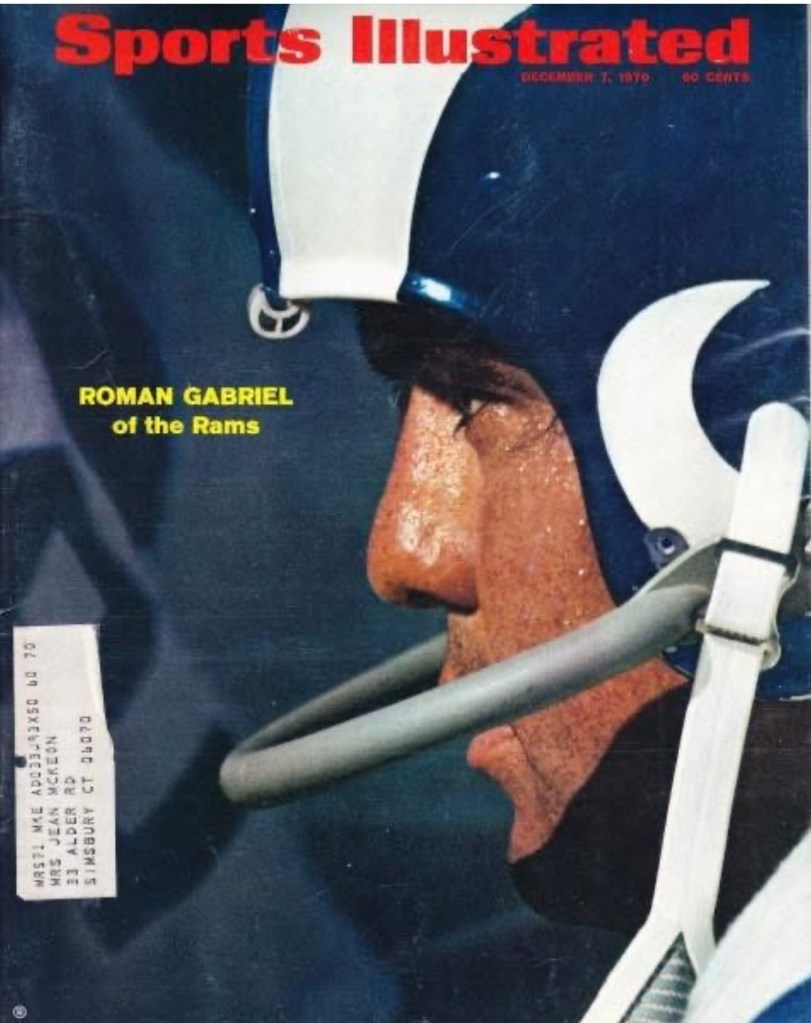
Roman Ildonzo Gabriel Jr., became the first NFL quarterback of Filipino-American descent when he came to Los Angeles in the 1960s. And this also remains true:

Any kid who grew up in Southern California with a poster of him on their wall, or had another copy of Sports Illustrated come in the mail with him on the cover, might have thought it was more important than ever to eat Roman Meal bread to make us bigger and stronger.

It didn’t matter if Roman Gabriel wasn’t part of that branding. It was just seared into our vision of the world at that point in time.

His name was as much Hollywood blockbuster as it was an angelic figure from the Book of Genesis, trumpet in hand. An talent agent couldn’t have given him a better calling card.
In his 11 seasons spent in Los Angeles, Gabriel made three Pro Bowls and was the 1969 NFL Most Valuable Players Award, having finished runner-up for the honors to Johnny Unitas in ’67.
And he came to Los Angeles somewhat reluctantly. But he had been here before to scout it out. Twice.

In 1962, the North Carolina State quarterback ninth in the Heisman voting was the No. 1 overall choice by the new-ish American Football League’s Oakland Raiders, in the league’s second year of existence. He was also the NFL’s No. 2 overall pick by the Rams, who secured in a deal with the New York Giants by way of Minnesota. Ernie Davis, the Heisman winning running back from Syracuse, went No. 1.
It was a draft where the Rams not only secured Gabriel, but, with the No. 3 overall pick as well, scooped up Utah State defensive tackle Merlin Olsen — one spot behind Gabriel as well, at No. 10, in the recent Heisman vote.
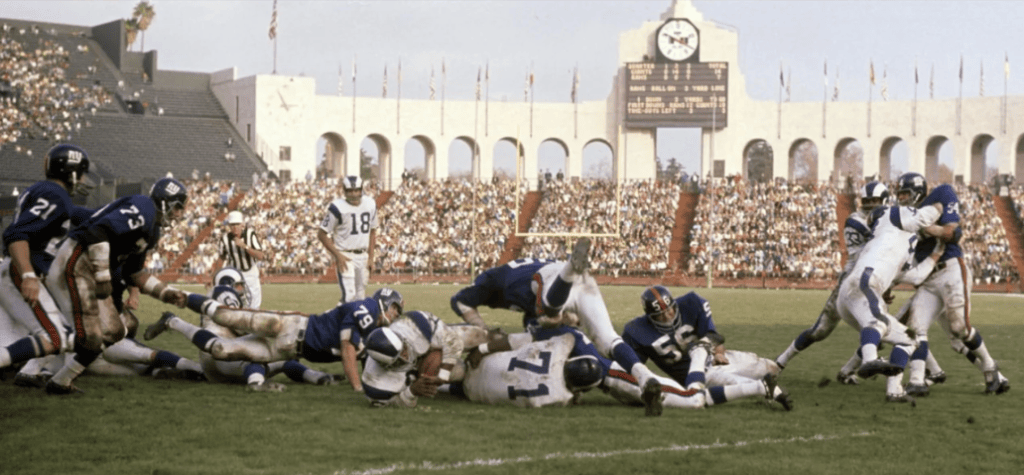
Gabriel had played at the L.A. Coliseum in his sophomore year of college as his Wolfpack lost to UCLA, 21-12, in November of 1959.
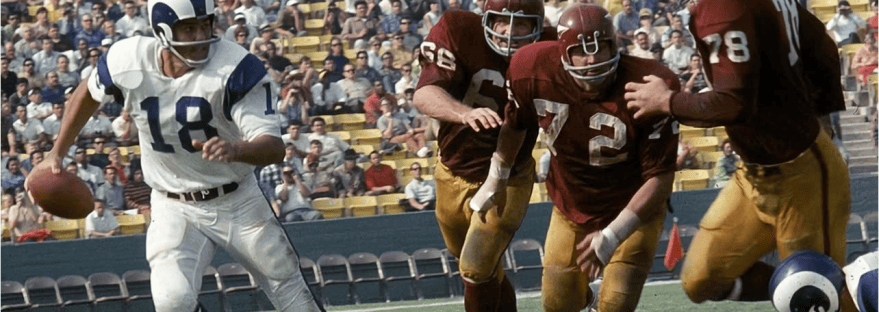
At 6-foot-5 and 240 pounds, he put on the garb and played a leading man played the role on the floor of the Los Angeles Coliseum, a gladiator using his catapults against encroaching Vikings and Giants.
In a return visit in October of 1960, Gabriel matched up against UCLA’s Billy Kilmer, and the Bruins snuck away with a 7-0 win.
His first four years employed by the Rams at the same quarry was just as frustrating.
Gabriel angled for playing time with Zeke Bratkowski, Terry Baker and Bill Munson. Yet, when given a chance to start, which he did 23 times over that stretch, Gabriel led the team to an 11-11-1 result. The other three combined: 4-27-2 . Couldn’t blame him if he loved being in L.A. but hated it at the same time.
In 1965, with Harland Svare as the new Rams head coach, Gabriel made his mark when he engineered impressive wins over the eventual NFL-champion Green Bay Packers, 21-10 in Week 11. He then directed a 42-7 win in Week 13 against the 11-3 Cleveland Browns. Those two wins were half of an otherwise forgetful 4-10 season.
The pivotal point in Gabriel’s L.A. run would come when George Allen took over as the Rams’ head coach.
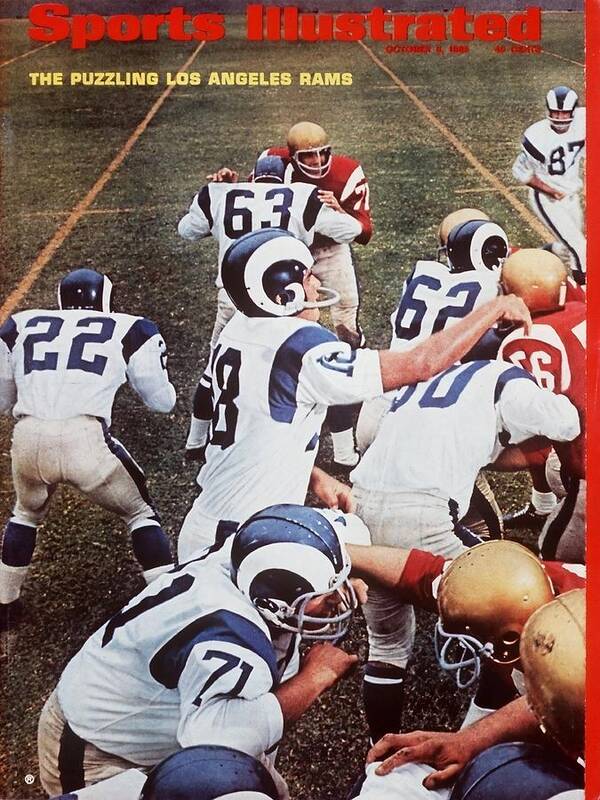
Gabriel was ready to bold and cash in on the rival league with the Raiders — a $300,000 deal for three years, plus a $100,000 signing bonus. He already signed and took a $32,000 payment, more than the $22,500 he was making with the Rams.
Allen not only told Gabriel to send back the check but promised him a $32,000 salary for the 1967 season, plus a $100,000 bonus when he retires. Gabriel believed in Allen, content by officially having the starting job.

After a 8-6 finish in ’66, Gabriel and the Rams posted division titles in 1967 (11-1-2) and ’69 (11-3) under Allen. Gabriel was not only the offensive engineer, but was a vastly reliable short-yardage runner, piling up 28 rushing touchdowns – most in franchise history by a quarterback. His 22 rushing TDs from 1966 to 1972 were more than any of the team’s other running backs.
Bernie Casey, whose NFL career in L.A. during the ’67 and ’68 seasons led to his post-playing career as an actor, painter and poet, had the leading role as Gabriel’s primary receiver those seasons. The most memorable Gabriel-to-Casey connection was a 1967 game-winner with less than 30 seconds left in the Rams’ 27-24 comeback victory in the next-to-last regular season game against Green Bay. That kept their divisional hopes alive. The next week, Gabriel was 18 of 22 passing for three TDs in a 34-10 win over the Baltimore Colts at the Coliseum.
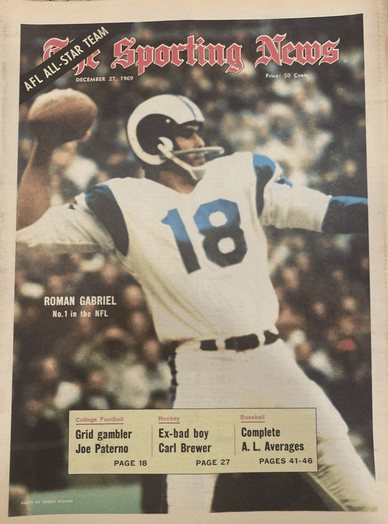
Gabriel’s first Pro Bowl season, along with Casey’s, had him record 2,779 yards passing and 25 touchdowns in ’67. But in the playoffs, the Packers eliminated the Rams, 28-7.
Gabriel’s MVP season: 2,549 passing yards, 24 touchdowns against seven interceptions, and a league-best 156 yards rushing and five more TDs as a quarterback. Again, a heart-breaking playoff loss to Minnesota ended that season.
In Week 13 of the 1970 season, the Rams made their first Monday Night Football appearance in the Coliseum. It was ABC’s first season for this prime-time TV package — but the game was blacked out in L.A. with a 9 p.m. local kickoff. Gabriel showed the rest of the country his value as he threw for 334 yards and rallied the Rams from a 21-6 deficit, scoring 17 in the fourth quarter, of an eventual 28-23 loss to Detroit, leaving them just behind the Lions in the NFC wildcard spot with one game left.
That seems to be a script Gabriel was frequently handed — get to the cusp of something special, and come up short. Even if the Rams were 41-14-4 with Gabriel running the offense from ’67 to ’70, there was nothing to show for it.
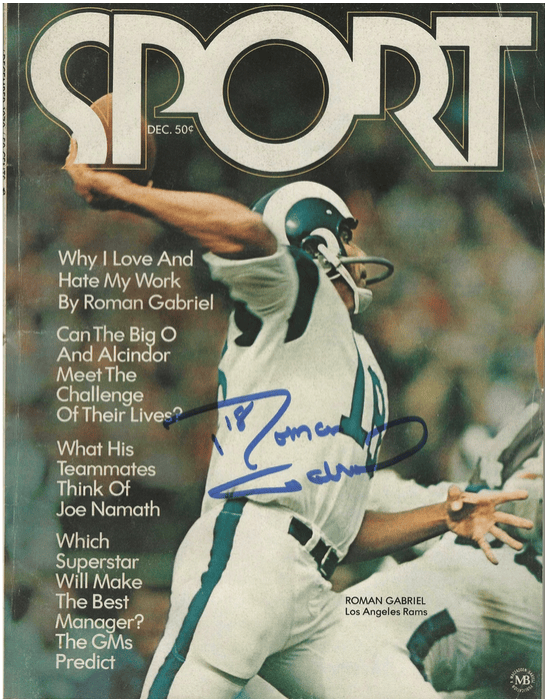
Allen left in 1971, and knee injuries limited Gabriel. The Rams lost to Allen’s Washington Redskins 31-24 in a key Monday night game where an interception thrown by Gabriel and returned for a touchdown killed the Rams’ chances. (That was also the game when a kid from L.A. named Andy Reid won a punt, pass and kick competition at halftime that became legendary).
During a 6-7-1 season in ’72 with coach Tommy Prothro — one that has been referred to as the “Silence of the Rams” — Gabriel’s consecutive games played streak of 89 over eight seasons finally ended. He threw more interceptions (15) than touchdowns (12).

The Rams decided to not only swap out their head coach (in came Chuck Knox) but also their quarterback (also incoming were John Hadl and James Harris). Gabriel actually considered a $100,000 offer from the Las Vegas Casinos of the fledgling Southwestern Football League. Eventually, he saw a window of opportunity when he was traded to Philadelphia to obtain Harold Jackson, who’d become their top receiver for four of the next five seasons.
Gabriel switched from No. 18 to No. 5 with the Eagles, overcame knee and arm issues, and won the league’s Comeback Player of the Year as he threw for a league-best 3,219 yards (270 completions in 460 attempts) and 23 touchdowns. All were career highs. Yet the Eagles went 5-8-1. Nothing newsworthy again.
In 1976, he went back to No. 18, and started the season 1-3 before he was benched. His final year of ’77 was 13 games off the bench, completing one pass.
In the history of the Rams’ franchise, starting in 1937 based in Cleveland, Pro Football Hall of Famers like Norm Van Brocklin, Bob Waterfield and Kurt Warner were part of the legacy. But Gabriel played more games at quarterback – 130 – and posted more regular-season wins — 74 — than any of them. Jim Everett (1986-1993) comes next closest in wins at 46. During Gabriel’s NFL days, only Hall of Famer Fran Tarkenton had more victories.

Gabriel remains the franchise career leader for touchdown passes (154), passes attempted (3,313), fourth-quarter comebacks (13), and 1,146 rushing yards as a quarterback. The later puts him No. 38 on the franchise list of all rushing leaders.
In Football-Reference.com’s statistic called Approximate Value (AV), an attempt to attack a numerical value to every player-season season since 1960, Gabriel (99) is first among any franchise quarterback. Everett is second at 79.
Gabriel was one of the few QBs of his era with a positive TD-to-INT ration (201 to 149).
By the numbers, the Rams have retired eight numbers — Bob Waterfield’s No. 7, Marshall Faulk’s No. 28, Eric Dickerson’s No. 29, Merlin Olsen’s No. 74, Deacon Jones’ No. 75, Jackie Slater’s No. 78, Isaac Bruce’s No. 80 and Jack Youngblood’s No. 85. Those eight are great.
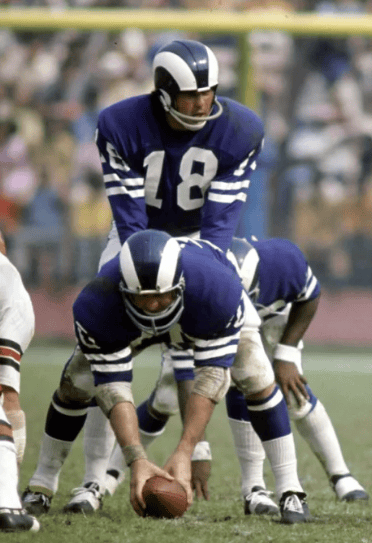
There has been discussion to also honor Warner’s No. 13, Torry Holt’s No. 81, Orlando Pace’s No. 76 and, eventually, Aaron Donald’s No. 99.
Gabriel?
Since he left the franchise, No. 18 has been seen on the backs of receivers Cooper Kupp and Jimmy Raye, Jr., of kickers John Carney and Glen Walker and, in 2025, on tight end Terrance Ferguson.
If throwing for more than 29,000 yards in his career overall, and leading his teams to 86 wins doesn’t seem enough for a Pro Football Hall of Fame recognition, would the Rams, at the very least, consider pulling No. 18 out of circulation for him?
The legacy
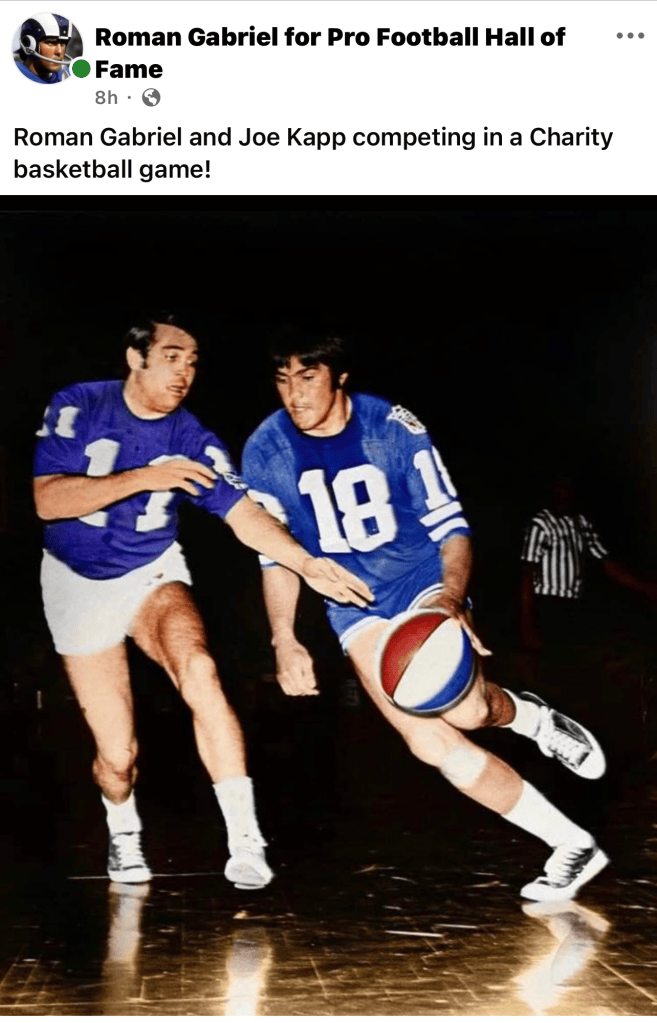
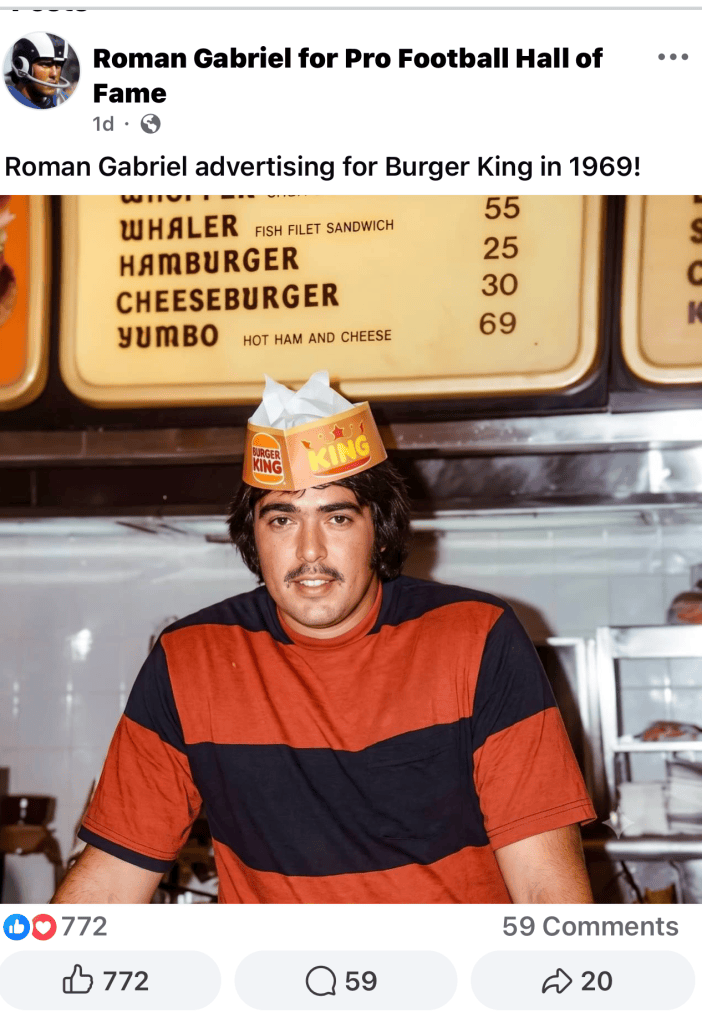
Like any athlete in and around L.A., Gabriel could use his exotic looks and muscular physique to tempt producers of TV and film – even while he was still an active player.
Heck, when he was doing razor blade commercials, it looked as if he was vying for the role of Herman Munster.

Don’t read too much about the time Gabriel played a headhunter on an 1966 episode of “Gillian’s Island” without any lines.
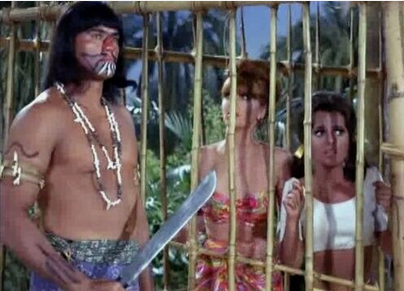
He was a prison guard in the 1968 flick “Skidoo,” with Jackie Gleason, made by Otto Preminger.
He was more notable playing a Native American named “Blue Boy” in “The Undefeated,” a 1969 flick with John Wayne and Rock Hudson. Typecasting presented opportunity.
More nobly, Gabriel had the distinction of becoming the head football coach at Cal Poly Pomona for the program’s last two years of existence, 1980 to ’82, despite pulling together a 8-24 record.
The lede to an 1983 New York Times story about Gabriel, as he was trying to catch on as a coach in the upstart USFL, began: “Roman Gabriel could throw a football 70 yards into a receiver’s lap while three defensive linemen clutched at his body, a body that Vince Lombardi once described as ‘’a big telephone pole.’”
Gabriel was also involved in pro baseball, as president of minor league teams in Charlotte, N.C., and Gastonia, N.C., near his hometown.
“Here’s one for you,” Gabriel once said. “In Baseball Weekly, there was an article where this dad had named his sons after me. Roman Slaybaugh and Gabriel Slaybaugh. Roman was No. 18, the quarterback, and Gabriel was No. 81, the receiver. They both graduated from the University of Indiana and played football there several years ago.”
Their Wikipedia page says the Slaybaugh twins are now male models in Paris.
When Gabriel died in 2024 at age 83, the New York Times for some reason featured him in a No. 5 Eagles jersey. But many never forgot what he did in L.A.
The Rams reposted a tribute video to him. It was called “The Book of Roman: The NFL’s Original Gunslinger.”
“I wouldn’t call myself a gunslinger,” he says. “I”d call myself a snub-nosed .38 because I was kept under wraps most of the time. …”
Considering how famous his life became, Gabriel concluded: “Outside of my college education, there aren’t a lot of things I couldn’t have been able to have than from being a Ram. … For me not having been a quarterback, I could have been on Skid Row being the best garbage man my dad said I could be.
“I don’t know any other Filipino-Irish quarterback that’s played in the NFL. It’s great to know you had a chance to do it for 16 years. Do it the best you could. And the fact that people do remember what you did means you must have left your mark and done something right. I was just lucky.”
Who else wore No. 18 in SoCal sports history?
Make a case for:

Jack Robinson, UCLA basketball (1939-40 to 1940-41):
UCLA basketball coach Wilbur Johns once said of Westwood’s multi-sport star with a deadly outside shot and quick hands: “His timing was perfect, his rhythm was unmatched, he had the valuable faculty of being able to relax at the proper time.” Robinson’s arrival as a junior in 1939 came when the team hadn’t won a Pacific Coast Conference game in more than two years. Robinson’s game-winning shot against Cal broke a 30-game conference losing streak and helped them go 5-19 in the PCC that season.
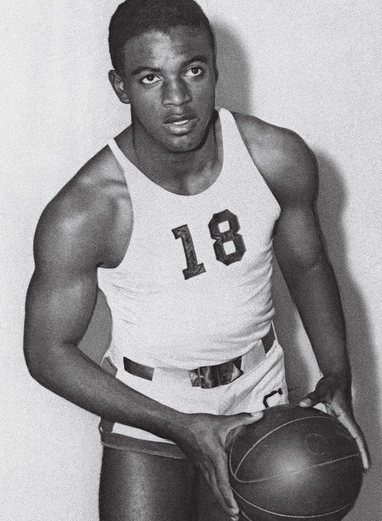
As a senior, Robinson won his second of back-to-back PCC Southern Division scoring titles. He averaged 12.4 and 11.1 points game in his two All-PCC Southern Division seasons. Robinson accounted for nearly 40 percent of his team’s points during that time. Just a couple years later, George Mikan would be doing the same for his DePaul teams. Could Robinson have launched his abilities into an NBA career? He was probably too far ahead of his time, in a league not yet mature enough to allow him to make a living. In the 1946-47 National Basketball League’s season, Robinson joined the Los Angeles Red Devils for their Nov. 8 season opener. Three other future pro basketball players were on the roster — guard Irv Noren, forward George Crowe and guard Ziggy Marcell. Robinson played his last game for the Red Devils in mid-January after Brooklyn Dodgers general manager Branch Rickey asked him to just focus on baseball and his pending MLB career.
Dave Taylor, Los Angeles Kings forward (1977-78 to 1993-94):
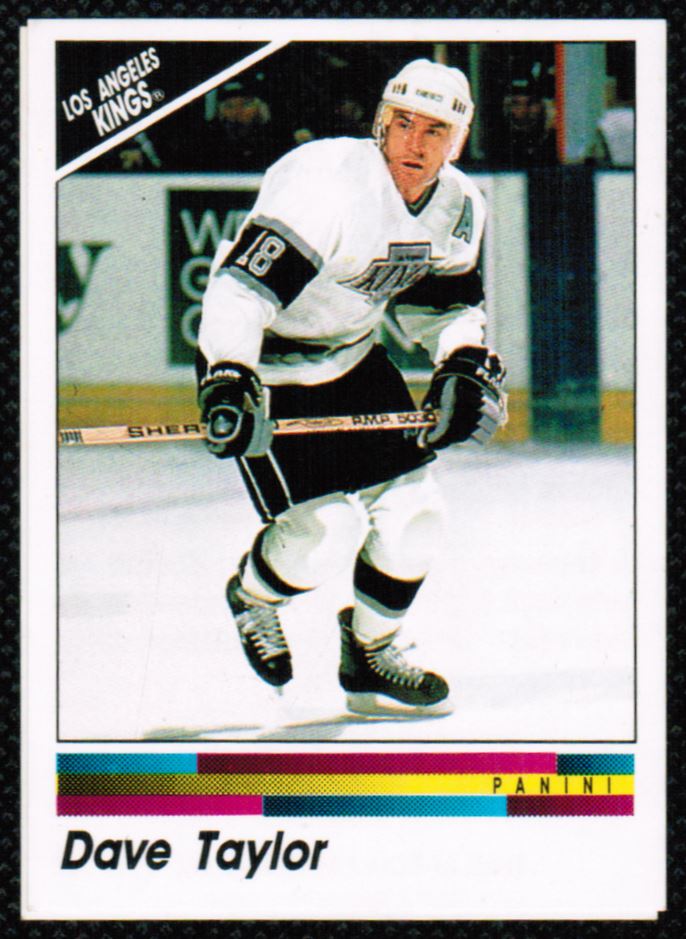
His 17 seasons with the franchise and having played in 1111 games (which had been the franchise leader until Anze Kopitor, Dustin Brown and Drew Doughty passed him up in recent years) will be included in our upcoming posting about the team’s Triple Crown line (with Marcel Dionne and Charlie Simmer). It is fitting that Taylor is the franchise all-time leader in plus/minus (+186, and nearly 80 better than runner-up Dionne) because of his stoic contribution to the team’s success. He ranks currently third all-time in goals (431), fourth in assists (638) and fourth in points (1,069). He’s also fourth in game-winning goals (47) and third in power-play goals (123) to go with eight hat tricks. The Kings made No. 18 the third never they ever retired, in 1994, and it’s hanging from the rafters. He was also the Kings’ general manager starting in 1997 (just three years after his retirement) and kept it through 2006 — responsible for drafting Kopitar, Brown and Jonathan Quick. His 290-261-74-31 record as a GM makes him the winningest in team history.
Yoshinobu Yamamoto, Los Angeles Dodgers pitcher (2024 to present):

Best known: The Most Valuable Player of the 2025 World Series was celebrated in a New York Times story that included: “Gangster. Gutsy. Greatness. Yoshinobu Yamamoto authors a World Series for the ages.” In the Dodgers’ seven-game win over Toronto, securing a title repeat, Yamamoto threw a complete game, 105-pitch win during Game 2, kept the team from elimination by going six innings and 96 pitches in Game 6, and then return to pitch the final eight outs/34 pitches of an 11-inning, Game 7 win, giving him his third victory against the Blue Jays in a week’s time. He was also up in the bullpen near the end of what became an 18-inning win in Game 3, ready to go back if there was a 19th inning. “I don’t think you’ll ever see somebody do what Yama did tonight,” said Clayton Kershaw. To go with a 3-0 record in the World Series, Yamamoto also had a 1.02 ERA (in 17 ⅔ innings) with two earned runs, two walks and 15 strikeouts. He actually faced two “Golden Pitch” scenarios, a rare circumstance in which any pitch could win or lose a World Series for either team.

He also had a rare complete-game victory in Game 2 of the NL Championship Series against Milwaukee, a first in the playoffs since 2017. In that game, Yamamoto did not allow an opponent to bat with a runner in scoring position. Turned out, the Dodgers didn’t have anyone throw a complete game in the regular season in 2025 otherwise.
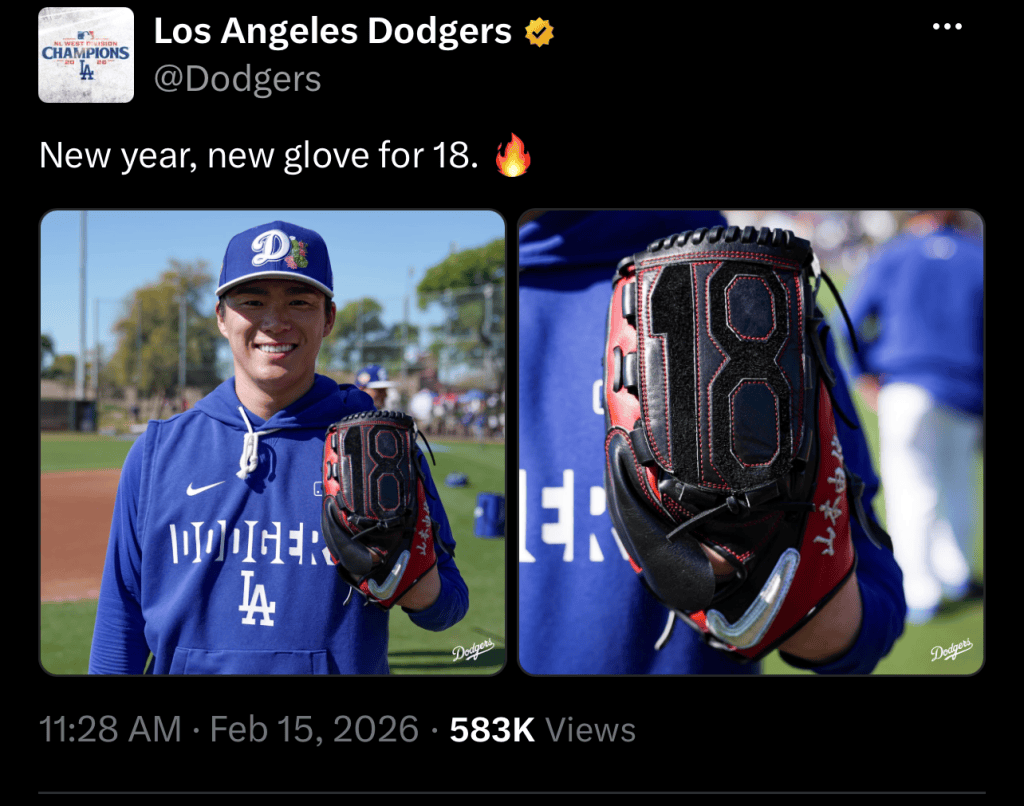
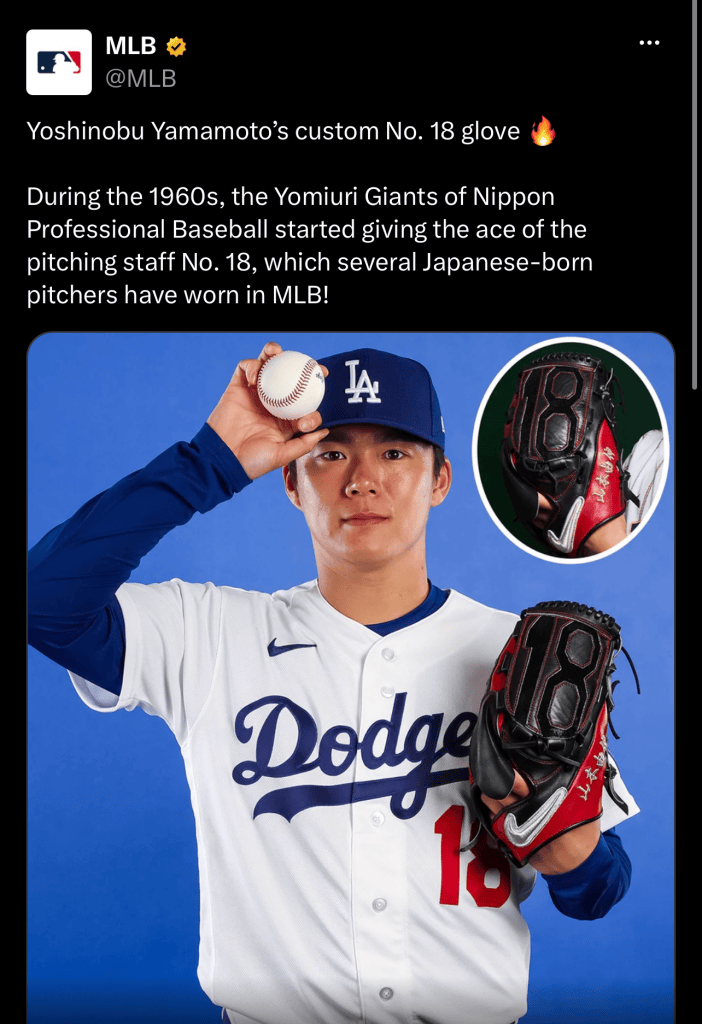
In 2026 — the season Yamamoto started to show the No. 18 logo on his glove — he had the team’s only complete game pitched in the regular season, leading the team with 28 starts, 22 quality starts, 14 wins, 182 strike outs, and a 2.53 ERA.
The Dodgers made Yamamoto the highest-paid pitcher in baseball when they signed him for 12 years and $325 million in December 2023. He was 75-30 with a 1.72 ERA in Japan, all through age 25. He also decided to sport a number that had been worn by previous Dodgers’ Japanese pitchers Hiroki Kuroda (2008 to 2011) and Kenta Maeda (2016 to 2019).
Not well known: The New York Yankees tried to sign him by already having a No. 18 pinstripe jersey made for him during their meeting. The Yomiuri Giants’ championship dynasty of the 1960s and ’70s was noted by the fact that uniform No. 18 was given to the ace of their pitching staff, and ever since, on teams all over Japan, wearing that number conveys an implicit stature and respect on a pitcher for what it signifies. But Yamamoto said during his first media gathering that he once visited Dodger Stadium at age 19 and saw Kenta Maeda pitch for the Dodgers in a 2017 NL playoff game. It left an impression front and center as he moved forward in his career.
Bill Russell, Los Angeles Dodgers shortstop (1969 to 1986), coach (1987 to 1991 and 1994 to 1996) and manager (1996 to 1998):
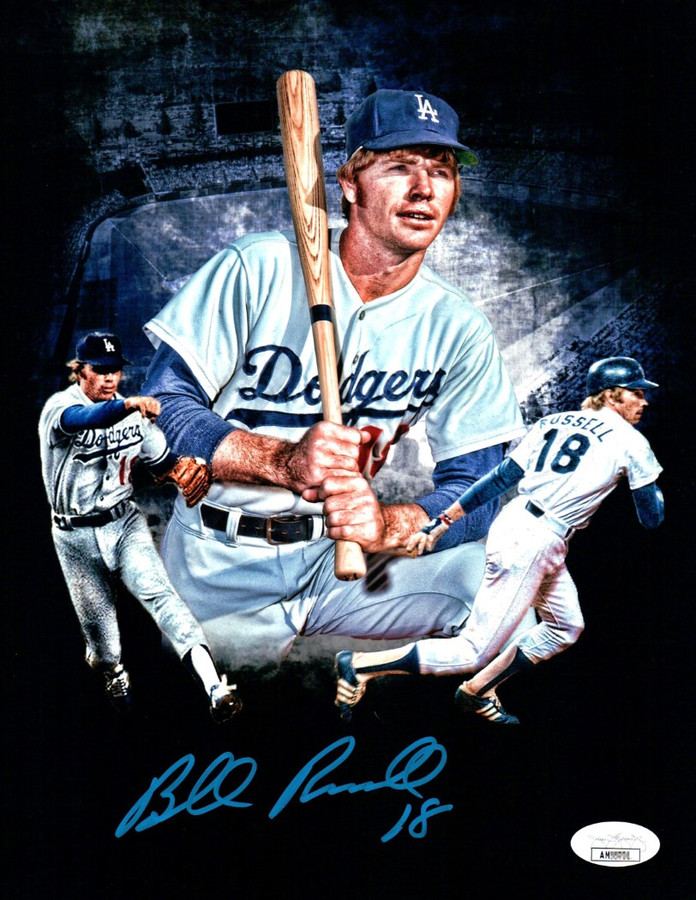
Best known: No one in the Dodgers franchise history wore any number for as long as Russell did – 18 years as a player, seven years as a coach and nearly three seasons as a manager. Only Zack Wheat played more games as a Dodger – and that Hall of Famer played at a time when players did not wear numbers. Russell also played more games with the team since their move to L.A. The three-time NL All Star played all 2,181 games with the Dodgers (15 more than Pee Wee Reese), was on four pennants and one World Series win. And about as nondescript as possible in the legendary infield of Garvey-Lopes-Russell-Cey. Two notable playoff moments: In Game 3 of the 1977 NLCS against Philadelphia, Russell’s ninth-inning single to center field capped a three-run comeback, all with two outs, to create a 6-5 win. And in the 10th inning of Game 4 in the 1978 NLCS, also against the Phillies, Russell’s single dropped in front of center fielder Garry Maddox (whose rare error allowed Dusty Baker to prolong the inning) and resulted in a walk-off win and a repeat trip to the World Series.
Cade McNown, UCLA football quarterback (1995 to 1998):

Best known: Voted into the College Football Hall of Fame in 2020, the bio for his 2009 UCLA Athletics Hall of Fame induction points out he started 44 of his 47 games as the Bruins’ QB between 1995 and 1998, including the final 43 straight. During his senior season, McNown was a consensus 1st Team All-American, third in the Heisman Trophy balloting (eighth the previous year), won the Johnny Unitas Golden Arm Award, and was a finalist for the Davey O’Brien Award. In his award-winning senior season McNown set single season UCLA records for passing yards (3,470), TD passes (25), and total offense (3,652). McNown also set single game records in those same three categories (513, 5, 515) in a 49-45 loss at Miami. About that loss at Miami … when UCLA was ranked No. 2 and needed the win to play in the national title game … it came the week after UCLA crushed USC for the eighth-straight time … but that game ended strange with a McNown naked bootleg and 23-yard run … and USC thought he was rubbing it in … and then UCLA lost to Wisconsin in the Rose Bowl as their consolation prize … and UCLA never has seemed to be back on track since then … Want more evidence? Holy Toledo, read more here. And then there’s his Playboy lifestyle during his time with the Chicago Bears that perhaps was some karmic payback to those still not sending him Christmas cards … He’s lately put his BA in history degree to some use in the financial world.
Rudy Bukich, USC football quarterback (1950 to 1952), Los Angeles Rams quarterback (1953 to 1956):
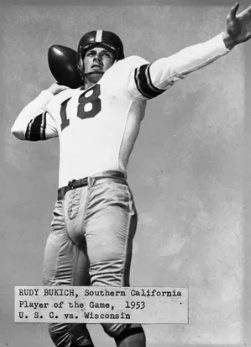
Best known: Bukich found himself named the 1953 Rose Bowl MVP during a game when he came off the USC bench for the injured Jim Sears (a broken leg in the first quarter) and drove the Trojans down the field, completing a 22-yard touchdown pass to Al Carmichael for their only score in a 7-0 win over Wisconsin. “The coaches were down on Rudy,” Carmichael said once. “He was very outspoken, kind of a rebel, and he had left the team back in October. He had come back a week later, but that sort of got him off on the wrong foot. Four days before the game, one of the coaches said to him, ‘Rudy, you’re not on offense anymore. You’re on defense.’ They didn’t like his personality and his makeup. I don’t think he would have gotten in the game at all if Sears hadn’t been hurt.” Inducted into the Rose Bowl Hall of Fame in 2014, “Rudy the Rifle,” who came to USC as a transfer from Iowa, was a second-round draft pick by the Los Angeles Rams in ’53. He took two years off with the U.S. Army before returning to the Rams in ’56, later to play in the NFL with Washington, Chicago and Pittsburgh.
Sam Dickerson, USC football receiver (1967 to 1970): In the 1969 USC-UCLA game, the Trojans trailed, 12-7, late in the fourth quarter at the Coliseum when a Bruins defender guarding Dickerson was called for a pass-interference on fourth down. On the next play, USC quarterback Jimmy Jones lofted a pass toward the left corner of the end zone and Dickerson made a sliding catch on his knees for a 32-yard touchdown with 1:32 left to give the Trojans a 14-12 victory. Dickerson caught 24 passes, six for touchdowns, and averaged 19.6 yards per reception in 1969. The Trojans went on that season to beat Michigan in the Rose Bowl, 10-3. As a senior, he led the nation with a reception rate of 22 yards per catch (24 receptions, 527 yards, four TDs), and the San Francisco 49ers took him in the third round of the 1971 NFL draft, but then released him. He was in training camp with the Green Bay Packers in ’72 and the Oakland Raiders in ’73. The World Football League’s Southern California Sun added him in February of ’74, but he was traded to the Portland Storm (16 catches, 289 yards, two TDs). In 1976 he also tried out for Winnipeg of the Canadian Football League. He did of cancer at age 66 in 2015.
J.J. Stokes, UCLA football receiver (1991 to 1994):

Seventh in the Heisman voting as a junior — and the only underclassmen in the Top 10 — it acknowledged his leading the nation with 17 touchdown receptions and more than 1,000 yards, his senior year was derailed a bit by a season-opening injury but he was the 10th overall pick in the 1995 NFL draft by San Francisco. Stokes still holds UCLA school records for receiving TDs in a season and in a career (28), receiving yards in a game (263 vs. USC in 1992) and receptions in a game (14 in the 1994 Rose Bowl vs. Wisconsin). He was inducted into the UCLA Athletic Hall of Fame in 2009.
Bret Saberhagen, Cleveland High baseball pitcher (1979 to 1982):
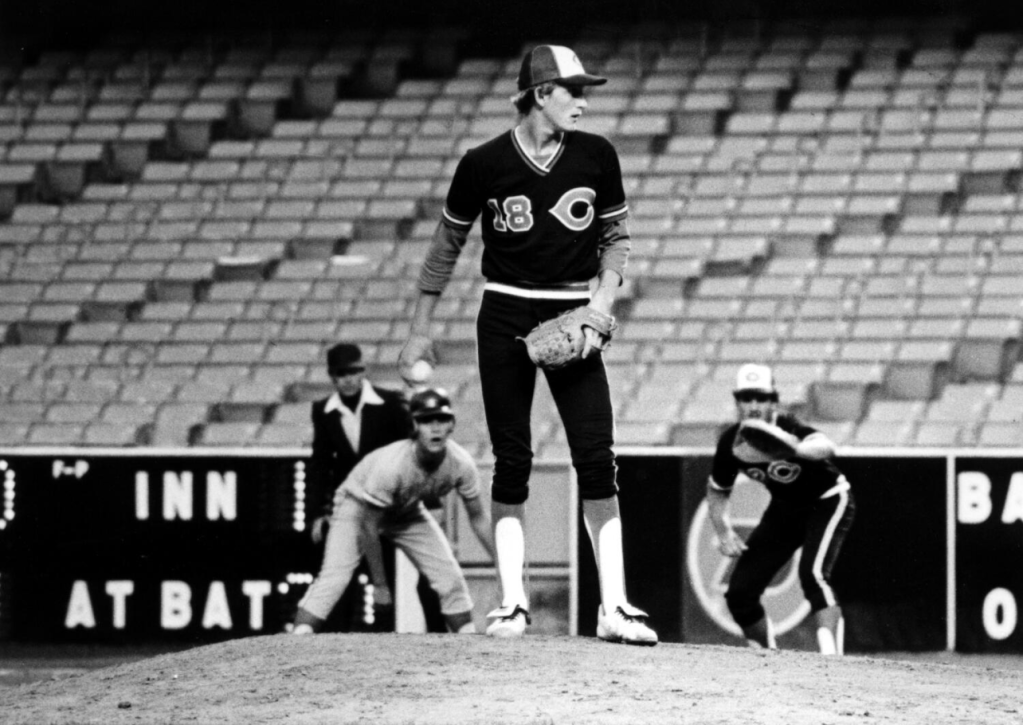
At Dodger Stadium, Saberhagen threw the only no-hitter in Los Angeles City Section history when he brought his team to the 1982 title in a 13-0 victory over Palisades High, setting down 21 of the 22 batters he faced. A 19th-round pick by the Kansas City Royals, Saberhagen made his MLB debut at age 19 in 1984 and won the AL Cy Young Award in 1985 with a 20-6 record and 2.87 ERA, pitching the final out of the team’s World Series title and being named the series MVP with two complete-game wins, including Game 7. In a 16-year MLB career, Saberhagen also won the 1989 AL Cy Young and made three All Star teams. He switched from No. 31 to his high school No. 18 for the Royals from 1987 to 1991 and kept it when he moved onto the New York Mets in 1992.
Sasha Vujacic, Los Angeles Lakers guard (2004-05 to 2010-11), Los Angeles Clippers guard (2013-14): Nicknamed “The Machine,” the 3-point specialist from Slovenia made his mark coming off the bench and set a team record with a 43.7 percent from long range in 2007-08. The Lakers’ 2004 pick near the end of the first round from a team in the Italian league ended up on two of the Lakers’ title teams and was in three Finals. He hit two Game 7 free throws to seal their 2010 win over Boston. Vujacic’s 10-day contract appearance with the Clippers (two games in ’13-14) came between the four seasons when he was playing in Turkey and Spain. His other claim to fame: Once engaged to tennis star Maria Sharapova.
We also have:

Jun Endo, NWSL Angel City FC forward (2022 to present)
R. Jay Soward, USC football receiver (1998 to 2001)
J.T. Daniel, USC football quarterback (2018 to 2019)
Bill Rigney, Los Angeles Angels manager (1961 to 1969)
Bob Berry, Los Angeles Kings left wing (1970-71 to 1976-77), who became the team’s head coach from 1978-79 to 1980-81 during the Triple Crown line era.
Kurt Rambis, Los Angeles Lakers forward (1993-94 to 1994-95): He wore No. 31 in seven seasons as a Lakers from 1981-82 through 1987-88, and came back at age 35 and 36, By then, Sam Bowie had glomed on No. 31 during Rambis’ seven-year absence in Charlotte, Phoenix and Sacramento.
Anyone else worth nominating?


1 thought on “No. 18: Roman Gabriel”