

This is the latest post for an ongoing media project — SoCal Sports History 101: The Prime Numbers from 00 to 99 that Uniformly, Uniquely and Unapologetically Reveal The Narrative of Our Region’s Athletic Heritage. Pick a number and highlight an athlete — person, place or thing — most obviously connected to it by fame and fortune, someone who isn’t so obvious, and then take a deeper dive into the most interesting story tied to it. It’s a combination of star power, achievement, longevity, notoriety, and, above all, what makes that athlete so Southern California. Quirkiness and notoriety factor in. And it should open itself to more discussion and debate — which is what sports is best at doing.
The most obvious choices for No. 72:
= Miguel Rojas, Los Angeles Dodgers
= Don Mosebar: USC football and Los Angeles Raiders
The not-so-obvious choices for No. 72:
= Jack McDowell: Anaheim Angels
= Art Alper: UCLA basketball
= Kent Hill: Los Angeles Rams
The most interesting story for No. 72:
Bailey, Los Angeles Kings mascot (2007 to present)
Southern California map pinpoints:
Los Angeles (Staples Center/Crypto.com Arena)

Before we take the temperature in the room …
In 2008, when Belle met Bailey, something magic seemed to be happening.
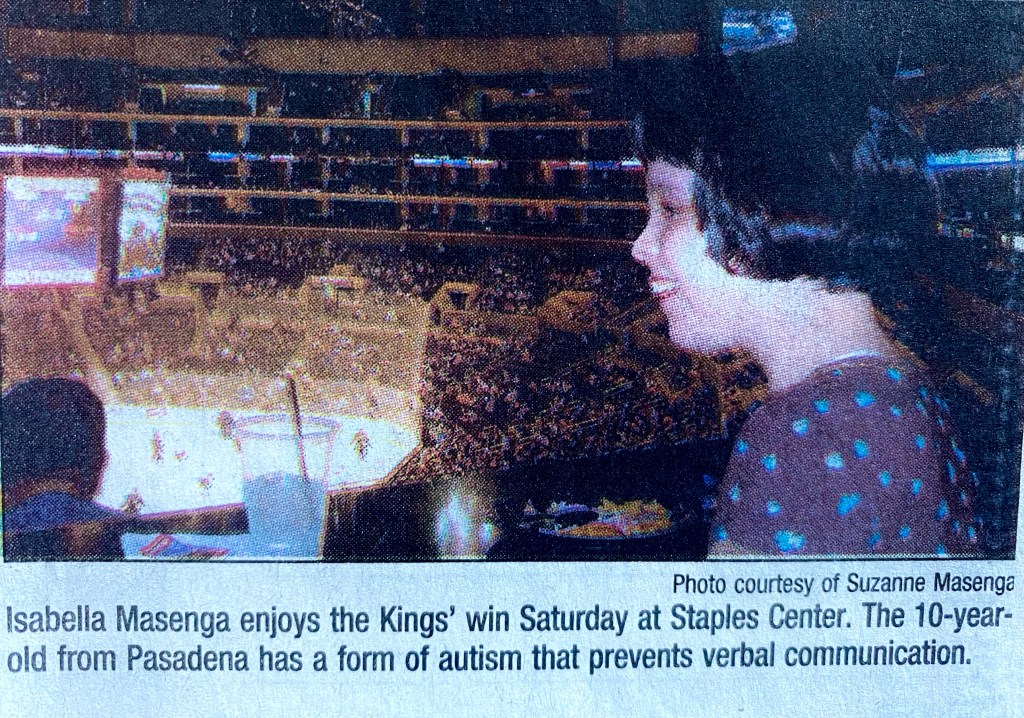
Isabella Masenga, whose parents call her Bellie, was almost 10 years old when she asked if they could take her to a Los Angeles Kings’ hockey game at Staples Center. They didn’t even realize she knew hockey existed.
Her mom said it was “probably the best day of her life” at the time. Her dad said it was “the happiest I’ve ever seen her.”
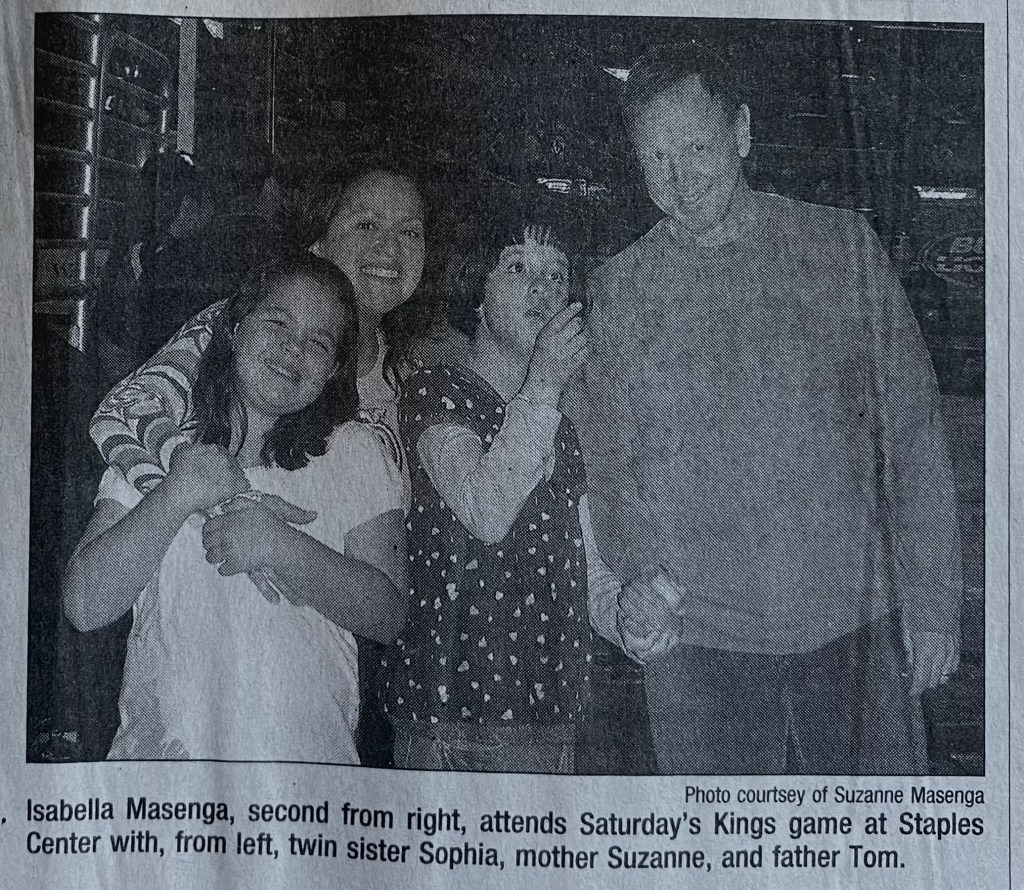
As we wrote in a story for the Southern California News Group at the time, what made it special was that Bellie’s wish to see a Kings game could only be communicated through a special portable word processor. She had a form of autism that prevented her from verbal interaction.
A group of 12 went with her, including her two caretakers, and her twin sister Sophia. None knew how Bellie might react with all the audio and visual stimulation.
They arranged to have a suite at Staples Center, and Kings personnel made it a VIP experience.
Including having their team mascot, Bailey, pay a visit. Bellie knew who he was. They embraced.
The Kings won in a shootout that Saturday afternoon against Dallas. They also crowned a new fan. That was the goal. Assist to Bailey.
The courageous humans who squeeze into exaggerated over insulated costumes and prance around at a sporting event impersonating a team mascot – occasionally wearing a jersey with a number attached – need to be recognized.
Along with the caveat: Why do any L.A. or O.C. teams even need to cheapen themselves with this idea? Because others do it? It’s fan-friendly? It’s great PR – no matter how bizarre the figure (see: Gritty, Philadelphia).
Of all the non-primal mascots in Southern California history, perhaps the NHL’s Los Angeles Kings is likely the most identifiable. And the largest.

Bailey, the 6-foot-6 stuffed lion, sports No. 72 because …. think about it. The average temperature is L.A. is 72 degrees, even if it’s outside an arena chilled by the ice.

This may be the best story associated with a number in this whole project. If that’s supposed to get into the heads of the opponents, maybe it’s working.
According to team records, the one and only to ever wear 72 was right winger/ penalty minute eater Shane Churla during his one and only (partial) season in L.A. (which amounted to 11 total games in 1996, with a plus-minus of -9). Then he was purged.
There’s been discussions on the team’s Reddit feed asking if any “real” Kings players are allowed to wear No. 72.

Bailey’s name was inspired to honor Garnett “Ace” Bailey, the team’s director of pro scouting for seven seasons who died in the Sept. 11, 2011 terrorist attack. Bailey wore Nos. 14 (Boston), 12 (Detroit), 24 (St. Louis) and 9 (Washington) during his 10-year NHL career.

Bailey the lion is actually a refresh of the Kings mascot once named Kingston, a snow leopard that appeared in the 1990s and has since become the mascot of the team’s minor league affiliate in nearby Ontario.
Bailey isn’t just seen and heard banging a loud drum during games.
He’s always on team excisions to children’s hospitals and other events of that nature.
He’s also got his own Fathead.com line of decals for kids’ walls and is appreciated by many with a small, furry replica plush doll line.
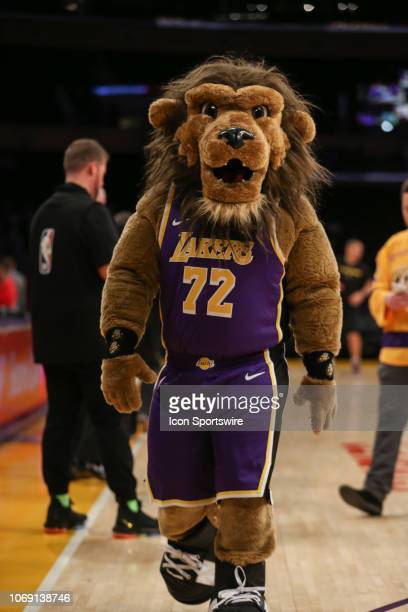
He’s also inducted into the Mascot Hall of Fame.
In February of 2026, the Kings picked up Artemi Panarin from the New York Rangers. He wanted to keep his regular No. 10, but the Kings’ Corey Perry had it. Panarin decided to go with No. 72, which he wore as a star for SKA St. Petersburg in his native Russia and his first two NHL seasons with the Chicago Blackhawks. But, of course, Bailey had it. So Panarin gave Bailey a Rolex watch for the right to share the No. 72 with him. Bailey obliged. For five games. When the Kings traded Perry at the end of February, No. 10 was available, Panarin took it back. And Bailey kept the watch.
It all worked like clockwork.
Bailey’s bio has been in circulation for some time, especially when he attends local schools and libraries year-round in Los Angeles County. His favorite read is “B is for Bailey” a L.A. Kings children’s book that raises funds for the KingsCare Foundation.
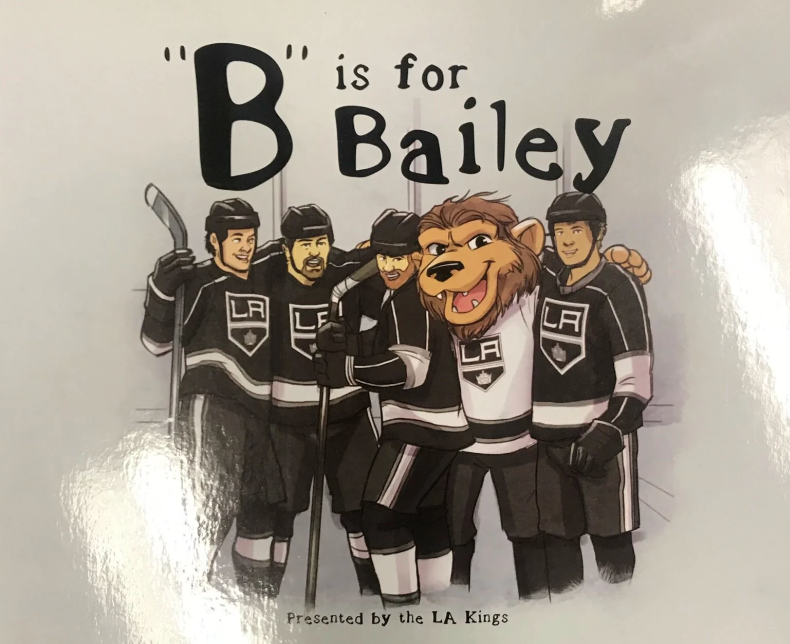
Multi-talented Bailey has also appeared during Lakers’ games and Rams’ games with his No. 72 as well as wearing a Dodgers’ No. 72 jersey promoting events.
Bailey will apparently promote anything you ask him to do.
What else do we got in this SoCal mascot mayhem?
A lot of furry things claiming to be No. 1.
== The Los Angeles Rams have Rampage, described on his Wikipedia page as a “an anthropmorphic ram who wears a Rams uniform” with the No. 1. He was introduced to the franchise when it was in St. Louis in 2010. The fans were allowed by vote to give it its name (instead of Rammer, Rammer and Rush). It also seems to have replaced something called “Ramster” which seemed to disappear in 1996. So now ewe’ve been told. Here’s his official bio.
== The Los Angeles Chargers don’t have an official, team-sanctioned costumed mascot. It had something called “Boltman,” a lifelong fan who also wore No. 1 going back to its days in San Diego. Dan Jauregui retired in 2019 after 22 years. The team tried to have semi-mascots with service dogs – Bolt and Brisket have been names given. But no more.


== The Los Angeles Clippers have latched onto Chuck the Condor, wearing the unique number 213, after the city’s area code. Back in the 1980s, when the team moved to L.A. from San Diego, there was something called “Sam Dunk,” who ran around the Los Angeles Sports Arena wearing No. 1.
== The Los Angeles Lakers appear to have no employed mascot, outside of Jack Nicholson. It is one of four NBA teams to go without. We’ve seen things in sportings good stores that might suggest otherwise.
== Joe Bruin wears No. 1 for UCLA. In 1996, he came out as bigger and brawnier. “We think the new Joe preserves as much of the lovable aspect of the mascot as we could, but also draws out the more aggressive, powerful and winning attitude that goes with our athletic department,” said Carol Anne Smart, chief operating officer for the Associated Students of UCLA.

== Loyola Marymount University has what appears to be its own version of Bailey, wearing No. 00. Iggy The Lion is also in the National Mascot Hall of Fame. With this blurb: According to the Oct. 5, 1923 edition of the school newspaper, the Los Angeles Loyolan, the Lion mascot was suggested by an enthusiastic fan after 1919 when St. Vincent’s College became Loyola College. Noting the Loyola football player’s fierce competitiveness, that unknown fan described the Loyola players as Lions. “What is to be the battle cry of this new scholastic year?” the paper said. “Is it to be the tawdry, age-old, Rah! Rah! Stripped of any spirit and sentiment, or are we at last about to recognize our mistreated mascot, the ‘Loyola Lion’?”

Here’s more from the 2011 issue of LMU magazine, which also points out: There’s the hazy, mythical Hollywood connection. A 2005 New York Times article reported, in passing, that Loyola adopted the lion after Louis B. Mayer, of Metro-Goldwyn-Mayer, allowed the school to use his aging, and real, MGM lion as mascot. But MGM was founded in April 1924, months after the Loyolan article appeared. In 2025, Iggy went through a modification.
== Some may protest and say none of this has had the impact, staying power or controversy surrounding as much as the Angels’ Rally Monkey. But that’s just half the story.
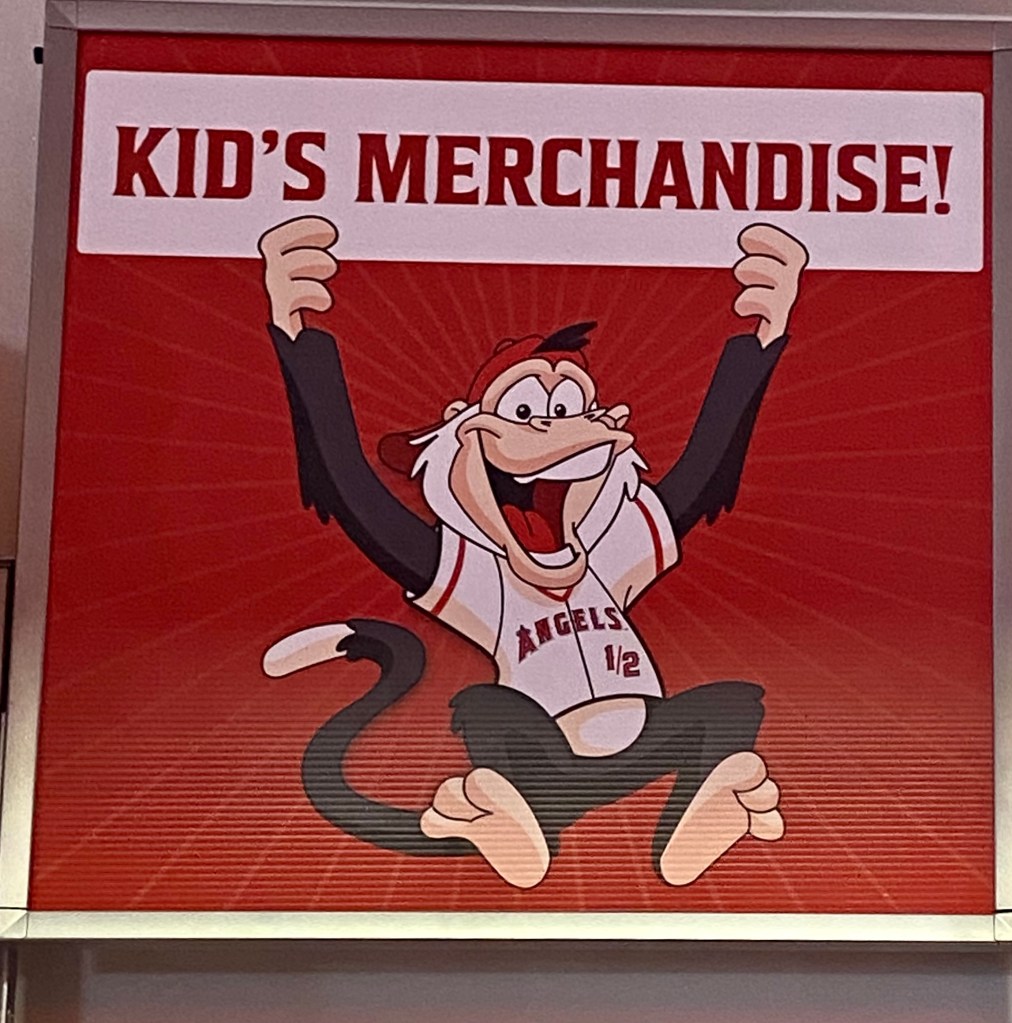
The Rally Monkey was given the number one-half in the months after it came into existence as a video-board gimmick at Angel Stadium in 2000. It took over as a national phenomenon when the team won its one and only World Series title in 2002.
The data showed that when the Rally Monkey made a video board appearance 45 times during that ’02 season, the team came back to win 27 times. In the post-season, it had a six-out-of-seven record, capped by the sixth game of the World Series when a Scott Spiezio home run erased a five-run deficit against the San Francisco Giants and led to a seventh-game triumph.
Some 20 years later, there’s a debate if the Rally Monkey is even a “thing” any longer.
Amidst the 2005 season, the Orange County Register ran a full-page story in its news section asking” Is it time to bench the Rally Monkey?”
They went to the data again: From 2003-05, the team was just 51-91 in games the Rally Monkey threw a monkey wrench into everything. That included a 17-30 record in 2005.
In 2012, another published essay came about questioning the Rally Monkey’s effectiveness – not so much as someone who could change the course of a game, but be an actual “thing” in the stands.

The writer reasoned that it’s “nothing more within the stadium than a (video) clip (and) unable to interact with fans. … There’s true excitement to high-fiving your team’s mascot as he walks through the concourse.”
Maybe the Angels fans were just too sophisticated for that nonsense.
Word went around that the People for Ethical Treatment of Animals (PETA) asked the Angels to give it a rest instead of “forcing live Capuchin monkeys to participate in photo ops and public appearances.” It suggested in a letter to Angels ownership that the team consider instead “cruelty-free options such as a human in a monkey costume or a monkey puppet with an animal rights message. Or forgo the monkey theme altogether and consider creating a costumed Angelfish mascot who would teach children about these fascinating animals.”
This is the same group that has tried to get MLB to change the name of the bullpen to the “arm barn,” so as not depict this area of a baseball field isn’t named after a place that corrals a wild volatile beast.
The Angels fans may be shaking their plush Rally Monkey toys for the cameras to capture on the giant video screen, but lately, it appears to have backed off pre-planned video presentations that would likely implore the crowd to beg for a comeback in the late innings of a game the Angels seem to be miserably trailing.

The Rally Monkey’s name, image and likeness, however, is alive and well. Especially in the team stores where plush toys are sold including an illustration for people to find the children’s related merch (including its own bobblehead, wearing No. ½).
The team never misses an opportunity as well to have a Rally Monkey-themed promotional night. In 2023, it was the plush wearing a “City Connect” uniform. Sometimes he’s in bright lime green. He has been dressed as a wookie, as Hans Solo, or as a Star Wars jedi. He once was called “Shark Rally Monkey,” inside a shark costume. In 2016, he was “Groovy” Rally Monkey, with a peace-symbol bandana and a scarf. He was a cowboy in ’14, a surfer in ’13, in Cinco de Mayo attire for ’12, and even a Chia Pet in ’11 and a soap dispenser in ’10.
For what it’s worth, the Angels could do worse. Imagine a giant cherub floating by a cable like Peter Pan swooping over the field, offering prayers. Like Doc Brown did it in the flick “Angels in the Outfield.” Or are getting our past, present and futures confused?
On second thought, that might be more productive.
Who else wore No. 72 in SoCal sports history?
Make a case for:
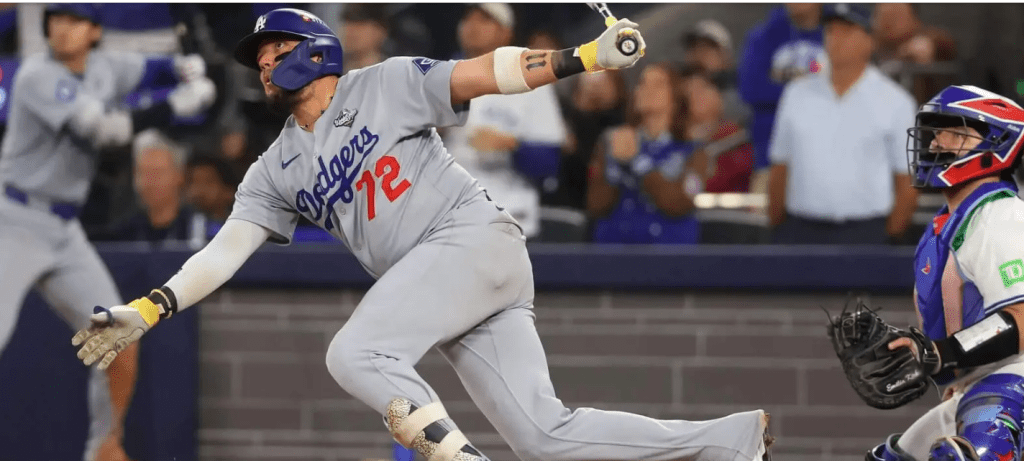
Miguel Rojas, Los Angeles Dodgers infielder (2014, 2023-to-2026):
Best known: Batting in the No. 9 spot of the Dodgers’ World Series Game 7 lineup, Rojas’ improbable solo homer in the top of the ninth inning tied the contest two outs from elimination. Here is a pitch-by-pitch account of that at-bat. Then, in the bottom of the ninth, his clutch throw to the plate with a pulled-up infield from second base cut down the winning run at home and pushed the contest into extra innings, allowing the Dodgers to wrap up the championship. Until then, Rojas had watched from the bench the first five games of the series. He started Game 6 as a way to shake up the offense as the Dodgers trailed, three games to two, and the series moved back to Toronto. Rojas had only one extra-base hit in 20 prior postseason games in his career before his Game 7 homer. Before that, in Game 6, Rojas was on the back end of a game-ending double play after left fielder Kike Hernandez caught a shallow fly ball and threw to second to double up the go-ahead runner.

Not well known: In Rojas’ rookie season, he took No. 72 and was the starting third baseman on June 18, 2014, when teammate Clayton Kershaw pitched his one-and-only no-hitter against Colorado. In that game, Rojas, who made his MLB debut just 12 days earlier, broke open the score in the third inning with a bases-loaded double that scored three and gave the Dodgers a 7-0 lead. His key contribution for Kershaw’s purposes was, in the seventh inning, fielding a sharp grounder by Troy Tulowitzki down the third base line and maing a difficult throw to first to get the out and preserve the no-hitter.
Also of note: Returning to the Dodgers in 2023, Rojas wore No. 11 for two seasons. He gave it up to rookie pitcher Roki Sasaki for 2025 and took back the No. 72 he was once given in spring training his first year.
Don Mosebar, USC football offensive lineman (1979 to 1982) and Los Angeles Raiders offensive lineman (1983 to 1995):

Best known: For 15 seasons, Mosebar wore the same number 72 from his college days through a professional career — and every one of his home games was at the L.A. Coliseum. The four-year starter and an All-American tackle as a senior at USC was the newly-branded L.A. Raiders’ first pick of the NFL draft, No. 26 overall. He was then moved to center as part of a linage of just three Raiders who played the from 1960 to 1994, spanning 35 years — from Hall of Famer Jim Otto, to Dave Dalby, to Mosebar, who started 156 of 173 games played over that stretch and made three Pro Bowls.
Not well known: Mosebar was taken by the Raiders in the 1983 draft one spot ahead of Miami taking Dan Marino.
Jack McDowell, Anaheim Angels pitcher (1998 to ’99):

Best known: The graduate of Notre Dame High in Sherman Oaks was five years removed from winning the 1993 Cy Young Award with the Chicago White Sox (22-10, 3.37 ERA) when he signed as a free agent with the Angels in ’98 and ’99 to finish his career. In two seasons in Anaheim, he went 5-7 with a 5.68 ERA and retired at age 31.
Not well known: McDowell wanted to wear his preferred No. 29 with the Angels, but it wasn’t available: the team retired it by then for Rod Carew. McDowell considered just reversing the numbers to 92, and did so at the outset of spring training. Then he decided to take No. 72 and honor his former White Sox teammate for his first seven seasons, Hall of Fame catcher Carlton Fisk.
Art Alper, UCLA men’s basketball guard (1948-49 to 1950-51):

Best known: The 6-foot-3 All-City first-team and Western League player of the year guard out of Los Angeles High became a three-year starter for John Wooden’s first three Pacific Coast Conference teams in Westwood. for the Pacific Coast Conference. At the time, starting players often wore umbers in the 70s — such as Eddie Sheldrake (75), George Stanich (73), Don Seidel (74) and captain Ron Pearson (78).
Not well known: Alper turned to volleyball full-time after basketball days, learning the outdoor game in Manhattan Beach and the indoor game as a key member of the Hollywood ‘Y’ Stars, who won the U.S. National Open Championships from 1956 to 1959. Alper was an All-American on three of the four straight title teams and a starting outside hitter on U.S. National teams from 1955 to ’59. In 2009, Alper received the USA Volleyball ‘All-Time Great Player’ Award for his indoor career.
Kent Hill, Los Angeles Rams offensive left guard (1979 to 1986):
A five-time Pro Bowl selection from 1980 to ’85, he started 95 out of 107 games for the Rams opening holes for running back Eric Dickerson.
Anyone else worth nominating?
Brent Boyd, UCLA football lineman (1975 to 1979): His story is attached to the entry for No. 62.
Al Cowlings: USC football defensive tackle (1968 to 1969): His story is attached to the entry for No. 70 with the Los Angeles Rams.

 Tom Hoffarth's The Drill: More Farther Off the Wall
1 thought on “No. 72: Bailey (and all the other mascots)”