

This post is part of a media project called SoCal Sports History 101: The Prime Numbers from 00 to 99 that Uniformly, Uniquely and Unapologetically Reveal The Narrative of Our Region’s Athletic Heritage. Pick a number, and consider the list of athletes attached to it. Who wore it best? Or, what’s the most compelling story linked to it? Any person, place or thing is in play with Southern California connections. Star power, transformational achievement, longevity, notoriety and quirkiness all factor in. Whatever leads to a lively discussion and interpretation.
The most obvious choices for No. 25:

Gail Goodrich: UCLA basketball and Los Angeles Lakers
Tommy John: Los Angeles Dodgers
Jim Abbott: California Angels
Troy Glaus: UCLA baseball and Anaheim Angels
Norm Van Brocklin: Los Angeles Rams
The not-so-obvious choices for No. 25:
Rafer Johnson: UCLA basketball
Paul Westphal: Aviation High of Manhattan Beach, USC basketball
JK McKay: USC football
Frank Howard: Los Angeles Dodgers
The most interesting story for No. 25:
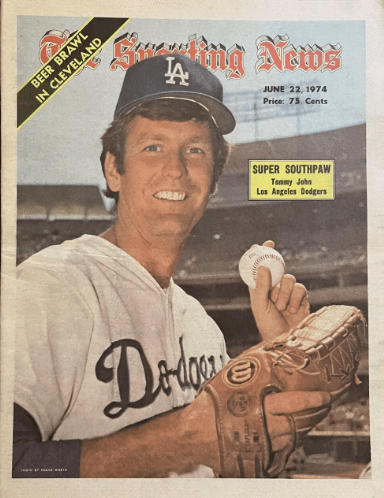
Tommy John: Los Angeles Dodgers pitcher (1972-74, 1976-78), California Angels pitcher (1982 to 1985)
Southern California map pinpoints:
Inglewood (The Kerlan-Jobe Orthopaedic Clinic at Centinela Hospital, known today as the Cedars Sinai Kerlan-Jobe Institute in Santa Monica); Downey (Rancho Los Amigos Hospital); Los Angeles (Dodger Stadium), Anaheim (Angels Stadium)
Reference books on the subject:
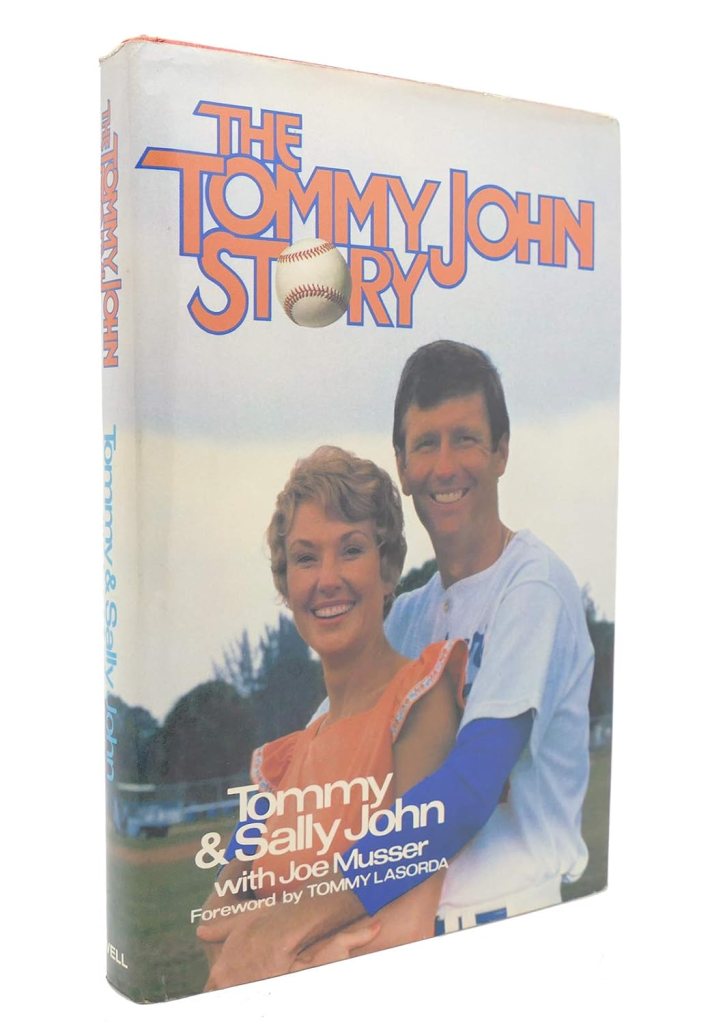
“The Tommy John Story,” by Tommy and Sally John, with Joe Musser, 1978
“The Sally and Tommy John Story: Our Life in Baseball,” by Tommy and Sally John, 1983
“T. J.: My 26 Years in Baseball,” by Tommy John, with Dan Valenti, 1991
“Athletic Forever: The Kerlan-Jobe Orthopaedic Clinic Plan for Lifetime Fitness,” by Frank Jobe, 1999
“The Arm: Inside the Billion-Dollar Mystery of the Most Valuable Commodity in Sports,” by Jeff Passan, 2016
“Minimize Injury, Maximize Performance: A Sports Parent’s Survival Guide,” by Dr. Tommy John with Myatt Murphy, 2018
“The Tommy John Protocol: How to Rebuild Your Arm, Your Mind, and Your Faith,” by Tejay Antone, 2026
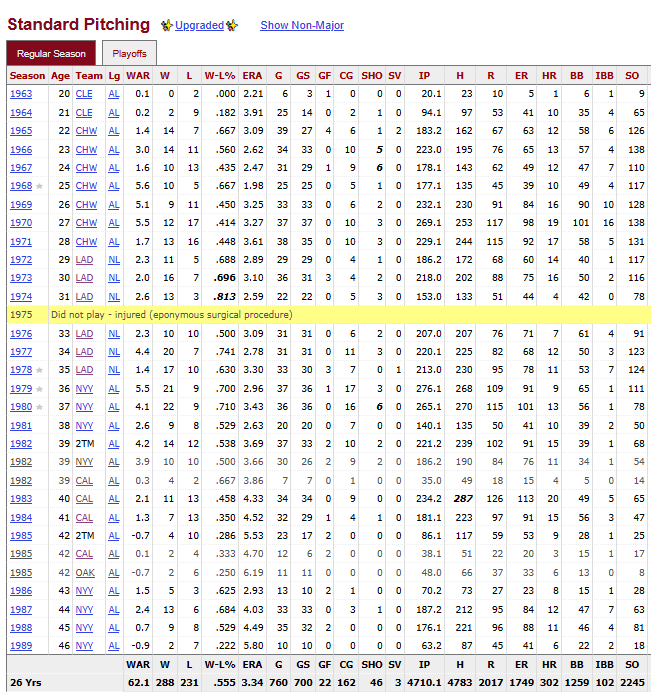
When Tommy John’s 26-season career totals as a Major League Baseball pitcher between 1963 and 1989 unravel like a sales receipt from CVS, there’s a breaking point. Scrunched into a Baseball Reference website template, and splits into two distinct hemispheres, the 1975 midway line/equator clearly reads: “Did not play – injured (Eponymous Surgical Procedure).”
Something is eponymous if a person, place or thing is named after someone. In the world of eponymics, Tommy John Surgery is right there in baseball lore with Lou Gehrig’s Disease, the Pesky Pole, the Mendoza Line or the Cy Young Award.
Since 2019, Merriam-Webster dictionary defined it, along with the proper phonetics:

The restoration hardware needed to rebuild the integrity of a Ulnar Collateral Ligament has declared Tommy John to be Patient Zero. Someone had, either out of desperation or a sense of adventure, to trust a doctor’s creative mind, and then be brave enough to try something unorthodox. Maybe it felt like a Thelma-and-Louise moment with their careers pointed toward the Grand Canyon.
All in all, what did Tommy John have to lose?
The story
Tommy John took the mound at Dodger Stadium against Montreal on July 17, 1974 already with an inoperable chip on his shoulder.
The Dodgers’ 31-year-old lefthander had an NL-best 13-3 record with five complete games and three shutouts for a 2.59 ERA. But he found out earlier that National League All-Star manager Yogi Berra left him off the roster for the Midseason Classic set in a couple weeks. Instead, teammates Andy Messersmith and Mike Marshall were picked to join fellow Dodgers’ position players Ron Cey, Steve Garvey and Jimmy Wynn.
“I guess I didn’t kiss the right behind,” John said of the New York Mets’ skipper. “Yogi Berra picks All-Stars like he manages. Pitifully.”
By the third inning, the first two Expos hitters that John faced with a 4-0 lead on a cool Wednesday night got on base — a single by former Dodger Willie Davis and a walk to Bob Bailey. John was greasing up his sinker ball induce another double-play grounder — a stat he would come to dominate like no other pitcher in the game’s history.
Then, all of the sudden, Tommy John broke.
On an 0-and-1 pitch to Hal Breeden, John knew something didn’t feel right. The second pitch that went all the way to the backstop screen made him feel worse.
“I felt like I’d left my left arm somewhere else,” John would say. “It just flew away, independent of the rest of me. … I can describe the pitch vividly. I heard this banging sound in my elbow and felt this sharp pain.”
Manager Walter Alston came to the mound.
“You better get somebody, I just hurt my arm,” John told him, walking back to the dugout after facing 12 batters. Adding insult to injury, John would get tagged for three runs that inning after reliever Geoff Zahn struck Breeden out but couldn’t fully clean up the mess.
On Retrosheet.org, this is how that moment was documented:

Dr. Frank Jobe showed up within minutes in the Dodgers’ clubhouse to consult with John, his duty as the team physician. The initial diagnosis was a torn ligament, and a second doctor agreed after looking at what was then the state-of-the-art X-ray in the locker room. They didn’t have diagnostic tools like magnetic resonance imaging (MRI) or computerized tomography (CT). Exploratory surgery was the most barbaric way to know whether the ligament was just strained or pulled completely off the bone.
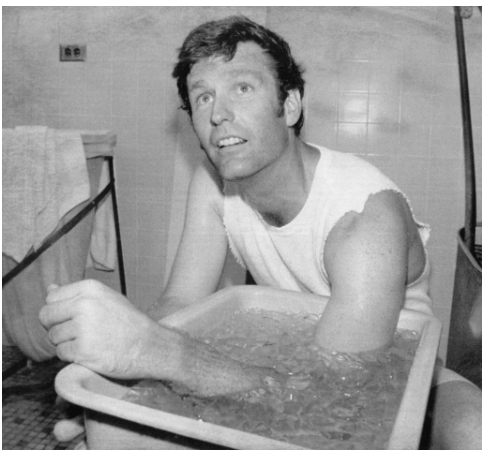
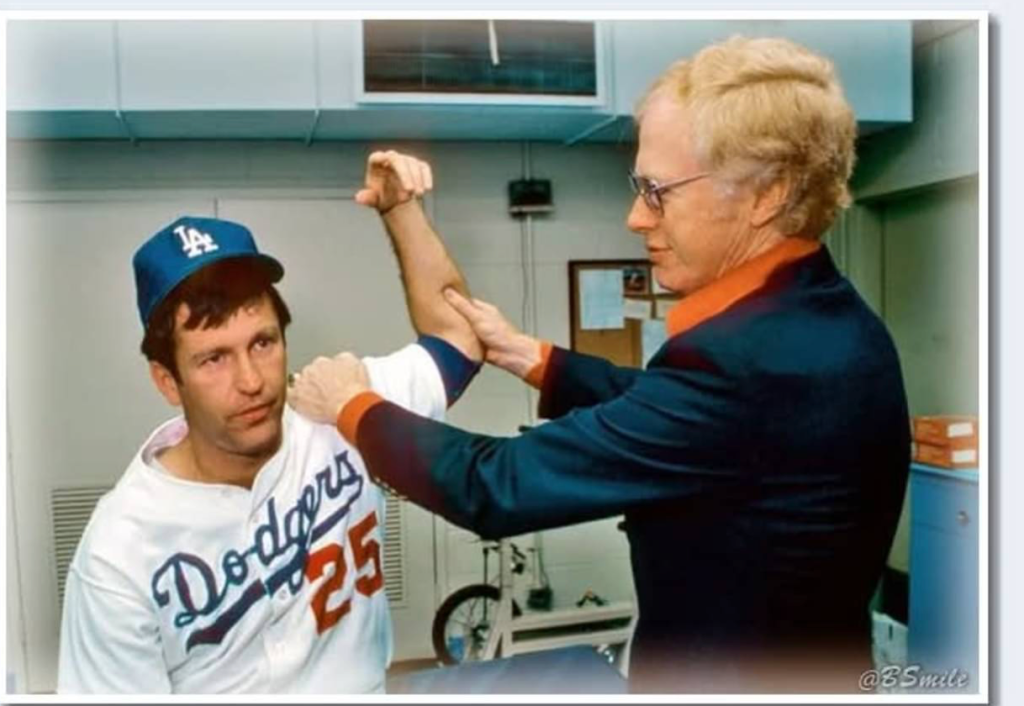
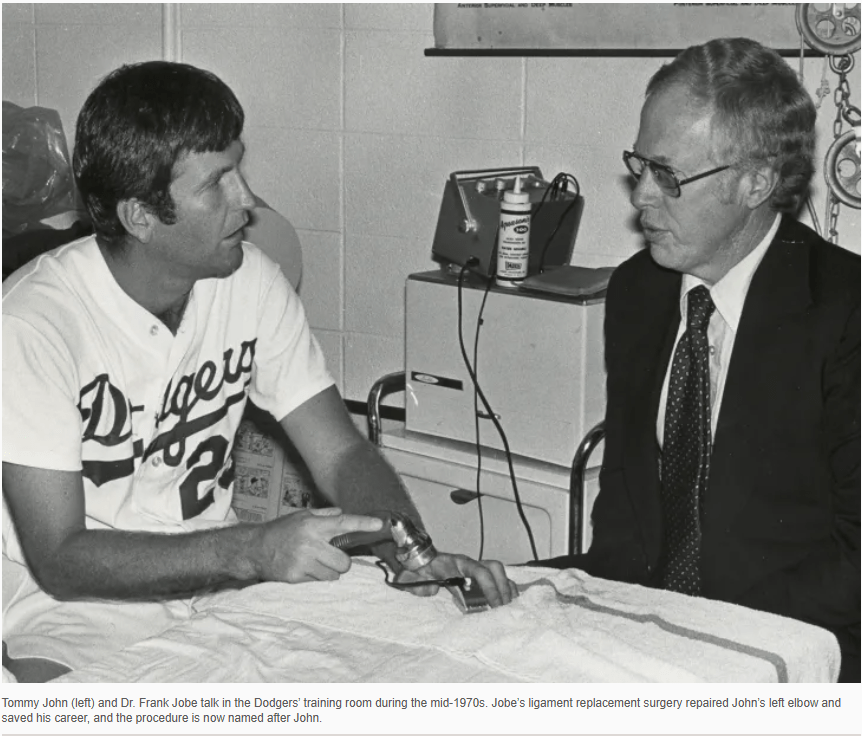
John’s trust in Jobe went back to the end of the 1972 season, after John jammed his left elbow into the ground sliding home and dislodging bone chips. Five days later, Jobe and partner Dr. Robert Kerlan removed the fragments, which shut down John for the last month.
In this case, Jobe thought it best that John go on the 21-day disabled list, rest up, start back slowly and see if the arm improved.
John tried. But he couldn’t throw.
John’s wife Sally was pregnant at the time with their daughter Tamara. John thought he’d be back in time to pitch again before Tamara’s Sept. 10 due date.
When John and Jobe met again to confer, Jobe’s inclination was to tell him to just retire because this was a rare UCL tear. Find another line of work.
But John kept searching.
Somewhere out of left field, an idea came to Jobe. He had been doing work with polio patients as Rancho Los Amigos Hospital in Downey and knew Dr. Herb Stark, who figured out a way to repair hands by grafting tendons taken from elsewhere in the patient’s body. Jobe work-shopped an idea at his Orthopedic Clinic in Santa Monica. John listened to his idea of how to try go graft tendons into his elbow.
Since it hasn’t been tried, especially on an active athlete, Jobe gave John at best a one-in-100 chance of this thing working. Maybe it would work on fingers and ankles, but in a pitching elbow?
“He said, ‘Well, if I don’t do anything, I’ve got zero chance’,” Jobe told the MLB.com in 2013. “And then he came in about a week later and said, ‘Let’s do it,’ and those words pretty much changed sports medicine.”
John would also add: “If he would have told me to go stand naked at Dodger Stadium, that it would heal my arm, I would have done it. It would have made everybody laugh, but … I believed in Frank Jobe.”
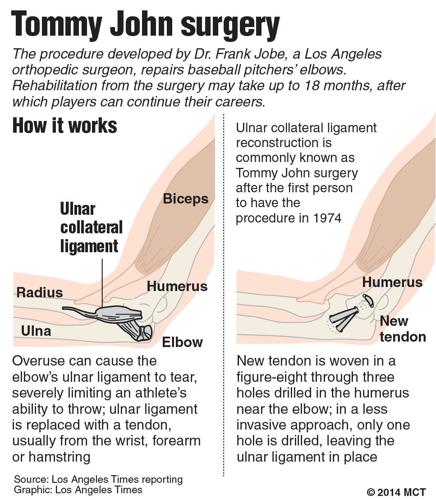
On Sept. 25, more than two months after the injury, Jobe and several colleagues opened up John’s left elbow and confirmed a ligament tear. A four-hour procedure followed. Jobe removed about six inches of tendon from John’s right wrist, drilled holes into his left elbow bones, threaded the tendon in a figure-eight pattern, anchored it tight, and sewed up the incision.
And he probably said a small prayer.
John showed up for the start of the Dodgers’ 1974 World Series against Oakland wearing a large cast on his left arm and did an NBC interview. The cast, eventually signed by Jobe and Hall of Fame broadcaster Vin Scully, was donated to the Smithsonian Institution in June 2022.
Three months after the surgery, Jobe had to reroute John’s ulnar nerve that had been damaged by scar tissue. John’s fingers lost a sense of touch at that point. Two of his fingers had been paralyzed.
A year and nine months after the surgery, John and Jobe decided — again, with no real gameplan — that he could test-drive the left elbow again on a big-league mound based on the spring training work and some work months before that in the Arizona Instructional League. He was penciled in as the Dodgers’ No. 5 starter in the rotation.
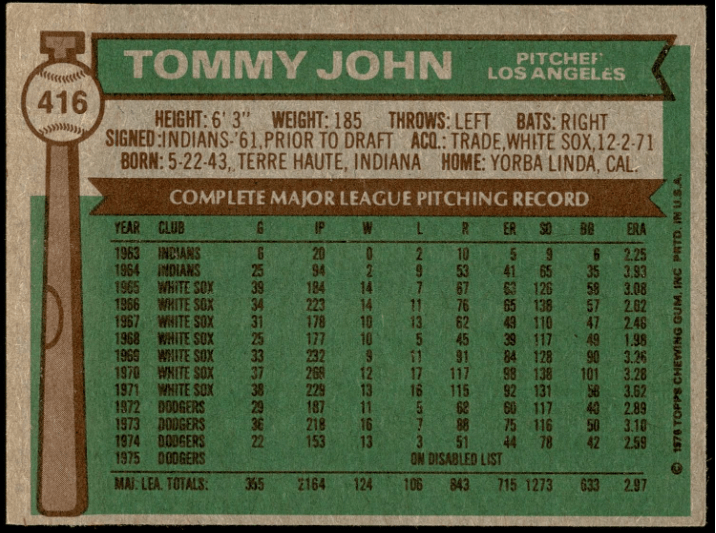
In an April 1976 game in Atlanta, with only some 15,000 fans in attendance, John started the game for the Dodgers. He made it through the first five innings, faced 24 batters, gave up a three-run homer to Darrell Evans in the fifth, and took the loss in a 3-1 decision.
But, in reality, it was a major victory.
Teammate Mike Marshall, who had a doctorate in kinesiology, told the Los Angeles Times: “What Tommy John did tonight qualifies him for the Comeback of the Year award. He wins it, flat out. What he has done in coming back from that injury is the greatest accomplishment I’ve ever seen.”
Tommy John Surgery still didn’t have a proper name yet. But it had been spoken into the sports universe loudly enough.
John’s sinker ball still worked and he allowed the fewest homers per inning in the league, and his 3.09 ERA was well below the league ERA of 3.50. It wouldn’t be for another four years before Jobe dared try the operation again on another pitcher, needing to establish some track record and maybe adding new layers to the procedure.
In a 2020 story posted in The Athletic, John’s story was named No. 12 in the series of the 40-greatest comebacks in sports history. It was, on in the sport’s progress on treating injuries and keeping players active, a comeback for the ages.

John, who came to the Dodgers after the 1971 season in a deal with the Chicago White Sox for Dick Allen, would leave L.A. to be a free agent after the 1978 season and joined the New York Yankees when he was about to turn 36 but was coming off an All-Star appearance.
His post-operation career also included wearing No. 25 for the California Angels — half of ’82, all of ’83 and ’84, and half of ’85. John went went 1-1 against Milwaukee in the ’82 ALCS. He pitched for the Yankees against the Dodgers three times (two starts) as the Dodgers won the 1981 World Series.
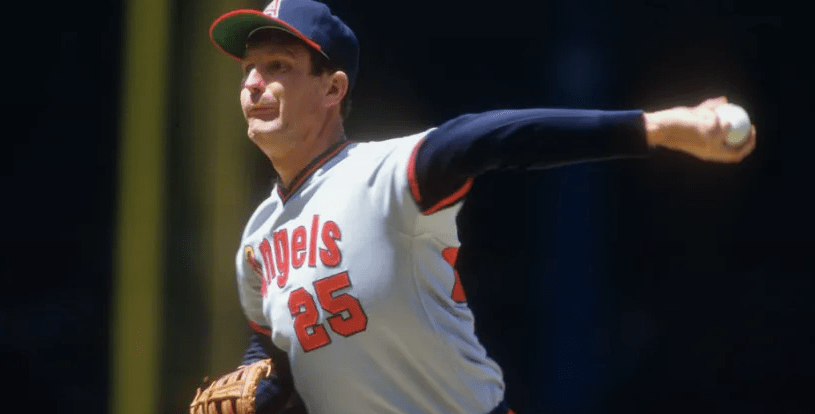
Those 14 additional years John was given to pitch, from age 33 to 46, included three 20-win seasons, two second-place finishes in the Cy Young voting, and three All Star games. He exceeded 200 innings in a season seven times after 1976, compared to the five 200-inning seasons prior to the surgery.
He made more starts after the surgery (382) than he did before (312), and did not miss a start for the 13 years. Add to that in 14 post-season appearances, John posted a 6-3 record and 2.65 ERA.
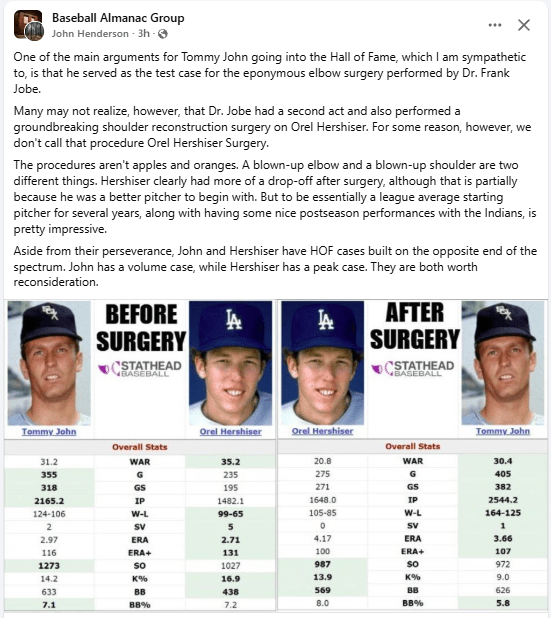
To this point, John has been considered for, but never got enough support, for a plaque in Cooperstown, N.Y., even if purely statistical measurements of his career put him a comparable company with Hall of Famers like Jim Kaat, Bert Blyleven and Tom Glavine. His BaseballReference.com similarity scores are also in line with Fergie Jenkins, Robin Roberts and Early Wynn.
Until then, John and Jobe are charter members of the UCL Hall of Fame.
Tommy John has the naming rights. Dr. Frank Jobe can cut to the front of the line.
The co-conspirator
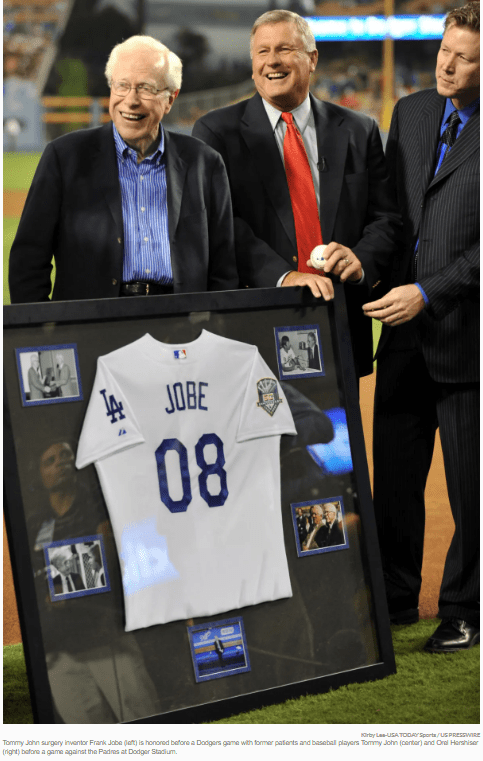
Dr. Frank Jobe spent some intense time for the U.S. Army in World War II before graduating from La Sierra College in Riverside in 1949, then going to medical school at nearby Loma Linda University.
He completed clinical studies at White Memorial Hospital and Los Angeles County Hospital and received his M.D. degree in 1956. Developing an interest in orthopedics, Jobe continued his training in a three-year residency at the USC.
His relationship with the Dodgers started in 1964, and the first of his surgeries came removing a bone chip from the left elbow of Dodgers pitcher Johnny Podres.
He and Dr. Robert Kerlan, one of his medical teachers, founded the Kerlan-Jobe Orthopedic linic in ’65. One of their first major projects was trying to preserve the career of Sandy Koufax, battling an arthritic left elbow.
“Sandy Koufax teases me, or did one time,” Jobe said. “He said, ‘Why weren’t you smart enough to come up with that (Tommy John Surgery) 10 years before and I think it could be called the Koufax operation?’ ”
It really isn’t the same comparison. Koufax’s career ended at age 30 due to a different elbow issues. Jobe said he believed he could have tried UCL surgery to save his talents nevertheless even on Koufax’s circulatory issue.
Jobe’s official capacity on the Dodgers’ medical staff spanned 40 years, from 1968 until 2008. His second most famous Dodger-related surgery that also made medical history was reconstructing the right shoulder of Orel Hershiser in 1990 with a new procedure that repaired cartilage damage and tighten the ligaments.
“If the Tommy John procedure remains the Mona Lisa of sports surgeries,” as Times sportswriter Chris Dufresne once declared, “then Jobe’s landmark 1990 operation to rebuild the right shoulder of then-Dodger Orel Hershiser could be enshrined down the hall in the Louvre.”
That line was in Jobe’s Los Angeles Times obituary, as he died in March of 2014, less than a year after he was recognized for his work by the Baseball Hall of Fame induction weekend of 2013.
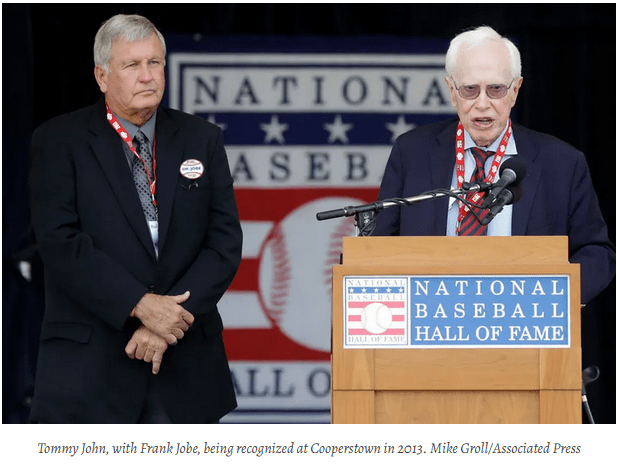
According to a Google doc sheet called the Tommy John Surgery List, which is about as accurate as any data base has been in this field, more than 2,700 players have had the elbow surgery after Tommy John was No. 1 in line.
Some who have had surgery aren’t included on this list because of a slightly different procedure done. It’s basically the same, with several modifications and improvements.
In a 2016 book titled “The Arm: Inside the Billion-Dollar Mystery of the Most Valuable Commodity in Sports,” author Jeff Passan begins quite graphically with a play-by-play of a four-hour surgery by Dr. Neal ElAttrache as he scrambles to repair the right elbow of one-time Dodgers pitcher Todd Coffey.
During the procedure, Passan writes about how ElAttrache cut open Coffey’s legs and started digging round for a usable tendon “like MacGyver.” He ended up using a cadaver tendon that was shipped in.

If a pitcher on any level — high school, college, professional — could sit through a documentary to witness what goes on during one of these operations, would they think twice about having it done to them? Or just cringe and bear it?
“One thing I know about athletes: No matter how awful or off-putting something is, if they think it will heal them or help them improve, they’ll do it,” Passan told me. “Much as I’d love to see a black-and-white ‘Tommy John Madness’ film in widescreen, there’s no such thing as ‘Scared Straight’ in sports.”
A 2026 story from The Athletic explains further how Cincinnati Reds pitcher Tejay Antone had initial torn UCL surgery as a minor leaguer in 2017, followed by a second surgery on the joint in 2021, missed all of 2022, came out of an early-April 2024 game with more elbow issues, and was trying to make a return from three Tommy John surgeries. At age 32. After missing all of 2025.
Why do so many pitchers have this surgery, and why does it feel far too normalized? There are many hypothesis to whether it has reached epidemic proportions. Key moments in time are noted. Modest proposals are offered to stem the tide.
But no matter the discussion, Tommy John’s name elbows out everyone else as a starting point.
With an estimated 35-to-40 percent of all MLB pitchers experiencing Tommy John Surgery, and several needing it multiple time, the distinction is whether it was done after a full or a partial tear of the UCL. It’s success rate has often been attributed to the fact most are partial tear repairs with a quicker recovering time as well.
I asked Passan in regards to his book: After talking to both John and Jobe, you seem to admire the fact they were both in this process together. They knew it was kind of the blind leading the blind. So why did they try it?
“I marvel at Frank Jobe’s courage,” said Passan. “It takes some kind of self-assurance to pioneer a procedure. Tommy’s approach was as much about self-preservation as it was innovation. He never set out to have his name intertwined with something so ubiquitous. He just wanted to throw because retirement sounded like a bummer.”
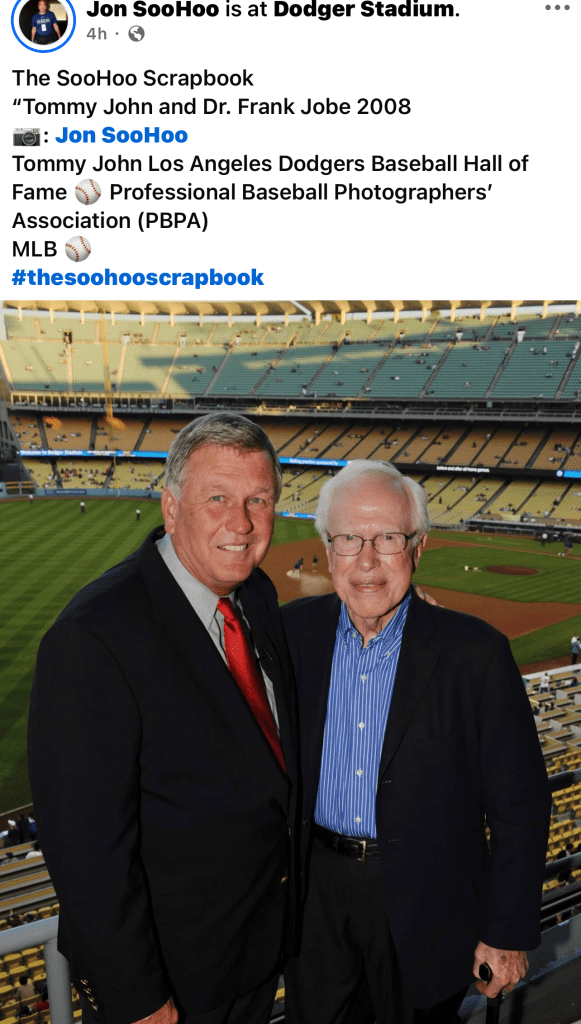
In January of 2012, I talked to the then-87 year old Jobe as he was recognized for his contribution to the sport by the Professional Baseball Scouts Foundation at their annual “In The Spirit of the Game” banquet at the Century Plaza Hotel. When I asked Jobe if he felt worthy of being inducted into Cooperstown for his life’s work, he admitted he would have been “happy to accept” it, but “I’m not sure if I know what ‘worthy’ means.”
From that Q&A, more came to light:
Q: You were inspired to be a doctor when you joined the Army and worked in a medical supply unit in the 101st Airborne Division during World War II. You watched how doctors saved other soldiers’ lives. Do you ever think about what you might have done with your professional career had you not gravitated toward the medical field?
A: I really don’t know. I signed up for the Army when I was 18 and right out of high school. I didn’t think of anything else. I thought I’d decide once I got out. The doctors I saw were 36, 38 years old. I thought I could go back to school and do something worthwhile. So I headed to medical school.
Q: It’s been said you’ve done more than 1,000 Tommy John surgeries yourself and have changed or saved the career of 1,800 athletes with your orthopaedic procedures. Does that sound accurate?
A: Well, it might even be more. The reason I say that, is just from this particular operation that’s been named after Tommy John, it’s hard to know really how many you did. After we started doing them and found they could be successful, and the failure rate was fairly low, people all over the country started doing them – maybe one or two a week now. The practice load lends itself to doing this on baseball players because there are so many more of them than in other sports – and on so many levels.
Q: Talk us through how you were able to convince Tommy John to do that first experimental operation — you gave him a 1 percent chance of recovery at the time, and about an 18-month recovery period, so why would he have taken that?
A: I think the discussion about the surgery itself was a very interesting thing. Should I have done it or shouldn’t I? Every circumstance is different. Tommy happened to be in my office talking, and we already had told him about all the potential complications. I was ready to sign his papers for retirement. I wasn’t even sure I should have brought (the operation idea) up in our conversation. I had no idea if it would be successful. I really wasn’t sure. We got to a point where we kind of looked at each other and he said, “That makes sense, let’s do it.” I think those were the three words that changed the course of baseball medicine for the rest of time. “Let’s do it.” He had so much expression in his voice when he said it.
Q: So what would have happened if that first pitcher who had the surgery wasn’t named Tommy John? What if it was J.J. Putz? Tim Spooneybarger? Would that have changed the popularity of the surgery moving forward? Shouldn’t it have been called the Frank Jobe surgery?
A: I’ve often thought that same thought. It’s such a nice name, Tommy John. It rolls off the tongue very nicely. I thought about (Frank Jobe surgery), too, but I think it works better as “Tommy John,” don’t you? After a while, everyone was calling it that. It’s nice. It just fits.
Later in 2012, Dr. Jobe was inducted into the Pasadena-based Baseball Reliquary’s Shrine of the Eternals. It’s not a reach to find stories campaigning for Jobe to receive his own official Cooperstown plaque.
Steve Busby is still around, willing to submit his own testimony.
Dr. Jobe, Steve Busby, and the first rotator cuff surgery
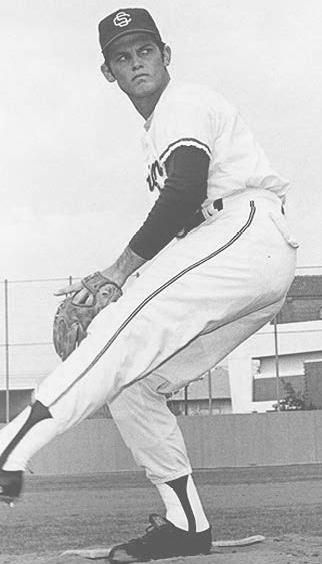
Two years after orchestrating Tommy John’s elbow surgery, and 14 years before rebuilding Orel Hershiser’s shoulder, Jobe performed what became the first rotator cuff procedure on an active MLB pitcher.
In 1976, the Kansas City Royals’ two-time AL All Star right-hander Steve Busby, a star at Fullerton High and USC who had thrown two no-hitters during his first two full MLB seasons, was at a crossroads and did what John essentially did when it came to his shoulder.
Busby missed all of the 1977 season, then came back. He appeared in only 40 games following his surgery.
Why wasn’t that procedure now known as Steve Busby Surgery?
“His was successful,” Busby said in 2022, referring to John‘s post-op career. “He was able to come back and pitch successfully another seven, eight, 10 years. I didn’t make it back all the way. We’ve come to find out since that the rehabilitation and success rate of elbow surgery is much higher than the shoulder. That’s the best I can figure.
“Injuries don’t get as far along the road as mine did. I was given a prognosis of, ‘We’re not sure [of what it is]’, but go ahead and pitch until you can’t pitch anymore and then we’ll try to fix it.’ A lot more is understood about it now. They can prevent damage with exercise programs and take specific cautions that were not understood then.”
Busby played three sports at Fullerton High — a star linebacker and punter on the football team, but he injured his right knee in the second game of the season, leading to two operations. He almost had to switch schools for his senior year and attend Troy High when it opened across the street from his house in the late 1960s. His family found a end-around: Fullerton offered a Russian class that Troy didn’t have, so Busby took it as part of the curriculum that allowed him to stay at the school.
Busby, who idolized Dodgers pitchers Sandy Koufax and Don Drysdale, admitted he wasn’t much of a California Angels fan despite their close proximity.
The San Francisco Giants took him in the fourth around of the 1967 MLB draft, but weren’t willing to give him much of a contract. That drew Busby to USC, where he once hoped to play football but was right away on the freshman baseball team. He sat out his sophomore season after undergoing surgery to realign a nerve in his right arm. Jobe’s clinic did the proceedure.
“After the operation, the strength in my forearm was gone and so was my fastball. I knew I had to come up with something else if I wanted to stay around,” he said. “I learned to pitch that year.”
In 1971, Busby was the team’s leading pitcher. He lost an early-round game to Southern Illinois in the College World Series but redeemed himself striking out Southern Illinois’ Bob Blakely with the bases loaded to seal the 7-2 victory for the Trojans in the clincher. That capped an 11-2 record with a 2.28 ERA and first-team All American honors. His nine complete games are second in school history while his .875 winning percentage is third all-time.
Kansas City took Busby in the second round of the 1971 MLB draft, No. 39 overall, and a season later, he was making his MLB debut, throwing a complete-game win in early September over Minnesota. Busby had two more complete games, including one against the Angels in Anaheim, and finished the month 3-1 with a 1.58 ERA in 40 innings, striking out 31.
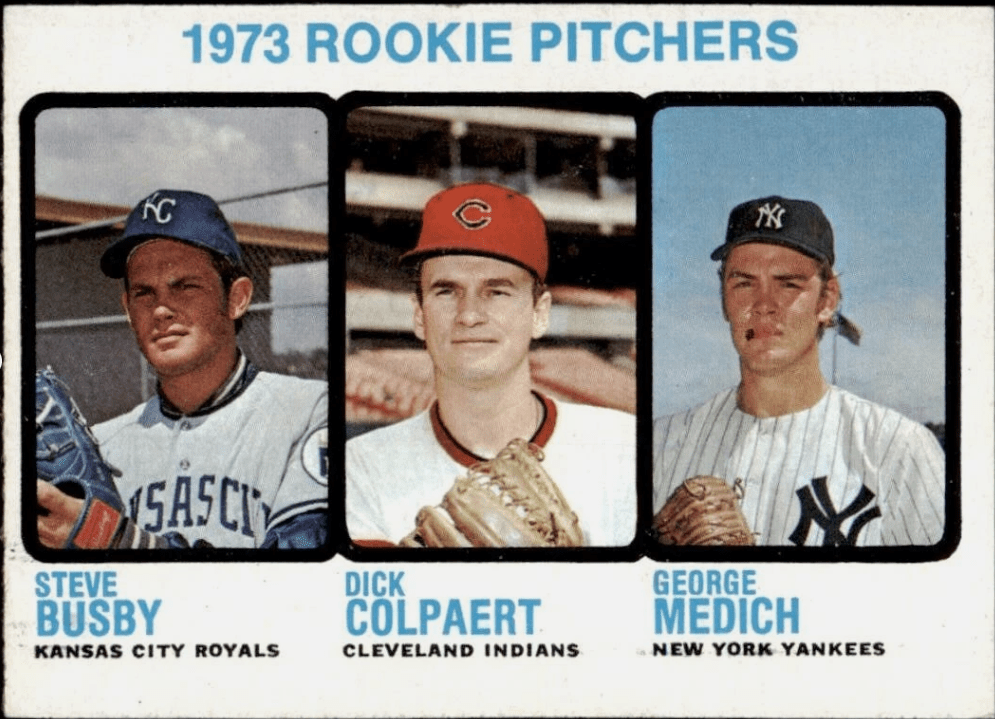
Wearing No. 40, Busby was tabbed the Royals’ 1973 Opening Day starter against the Angels in Anaheim and finished third in AL Rookie of the Year voting.
“I’ve never seen such an accomplished pitcher who has been in pro ball such a short time,” said Royals teammate Cookie Rojas, “unless it was (Tom) Seaver.”
Busby was at the top of his game in the first half of the 1975 season — 11-5 with a 2.42 ERA through 18 starts – but everything changed following a 12-inning complete-game win at Anaheim Stadium in late June against the Angels, where he faced 50 hitters. In his prior four starts, he had an eight-inning, complete-game 1-0 loss in Baltimore, a 10-inning complete-game win at home against Cleveland, and two nine-inning complete game wins at Oakland and then against the Angels in Kansas City. Busby’s shoulder wasn’t just sore. Rest between starts didn’t help. He still grinded through six complete games to finish the ’75 season.
“I was trying to fight through the weakness and the lack of velocity and movement was what I noticed,” he said. “I don’t think I panicked because every pitcher goes through periods where he is bothered from one thing or another. Pitching is not the most comfortable thing for an arm so I just chalked it up to one of those times when you don’t bounce back as fast.”
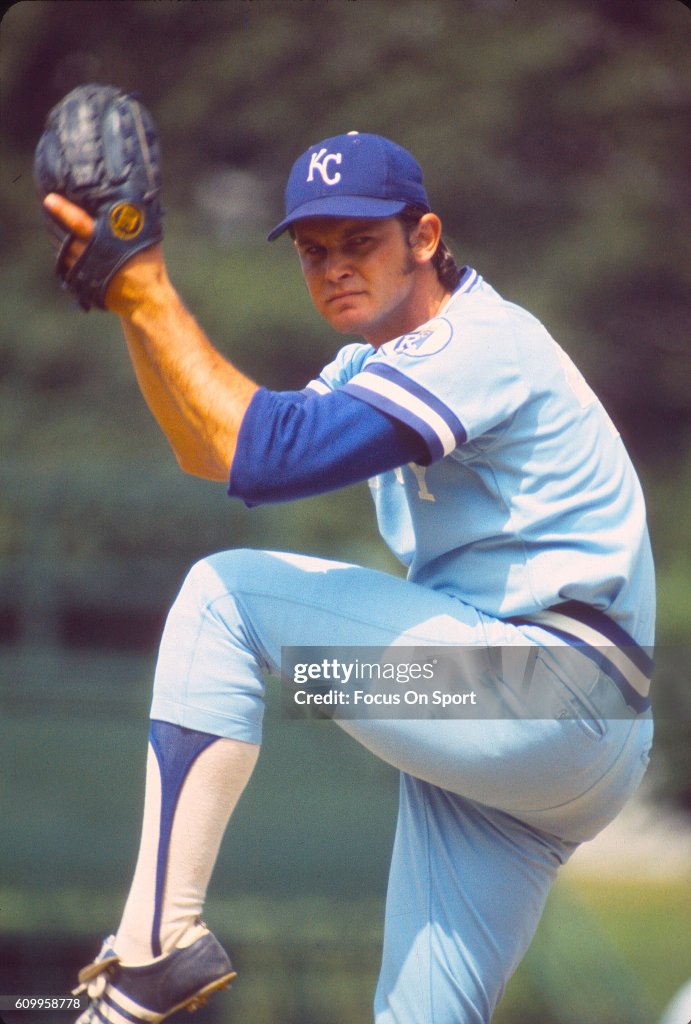
For the ’74 and ’75 seasons, Busby picked up 22 and 18 wins, but he also piled up 38 complete games in 72 starts.
That offseason, Busby connected with Jobe and Kerlan, who had seen him during his high school arm trouble days. The doctors prescribed different therapies. Busby thought his problems had been caused by bad mechanics and began an offseason training program.
This time, Jobe recommended Busby pitch until he could no longer be effective.
“They did a lot of tests and they told me they thought they knew what it was without every saying rotator cuff,” Busby said. “We tried rest and injections and hoped it would clear up before spring training but it didn’t work as well as they hoped it would. As soon as I started to try and throw [in the spring] I knew there was something still there. I don’t know if you’d classify it as tired arm or tendinitis. Dr. Jobe said they’d keep after and try and get me through the season as best they could.”
Busby started ’76 with a 3-3 mark and 4.08 ERA after 13 appearances, his season delayed by a trip on the disabled list. He went back to the Jobe-Kerlan clinic for a shoulder arthrogram that revealed the rotator cuff issue.
“Rest wouldn’t help an injury that serious,” Busby said. “If I were to pitch again, I would have to have surgery. He decided to try the rotator cuff surgery in July because I had gotten to a point where I could not throw overhand.
“The shoulder was fine but above it was an impingement syndrome. It was the unknown that scared me. Dr. Jobe told me they had never performed this surgery on an active pitcher. With that in mind, we didn’t know what was going to happen. We didn’t know about rehab or what the chance of recovery would be.
“So, with all those unknowns, I was a little bit scared.”
On top of that, he was depressed not to be part of a Royals team heading to their first AL West division title.
Surgery lasted 3½ hours and required the shoulder to be cut open, a hole sewn up, another three-quarters of an inch taken off the shoulder bone and more shaving to the back of the upper arm bone to reduce the friction. Jobe had done the surgery before with tennis players.
Jobe actually recommended that Busby seek other employment, but Busby wasn’t ready to give up. But there was no timetable for his return. There was no one to compare to his situation and surgery.
“Nothing worked the way I remembered it working,” Busby said of his recovery period of throwing and resting. “Whether it was my mind playing tricks, I don’t know. But I felt completely out of character. I don’t think I ever got that feeling back. It was a searching process and I never found a solution to it. The next four years were frustrating.”
Busby appeared in one minor-league rehab start and didn’t feel right — plus, he re-injured his left knee altering his delivery and strengthening his shoulder. Jobe now had to do another knee operation. Eventually, Busby would have more offseason arthroscopic surgery on his oft-injured right knee.
Busby went 8-9 with an ERA above 5.00 the next three seasons — the last part of 1978 through 1980. He was released two days before he would have been eligible for the playoffs with the Royals. He tried to come back with St. Louis in the spring of 1981 where his former Royals manager Whitey Herzog was now in charge, but Busby was finished at age 30.
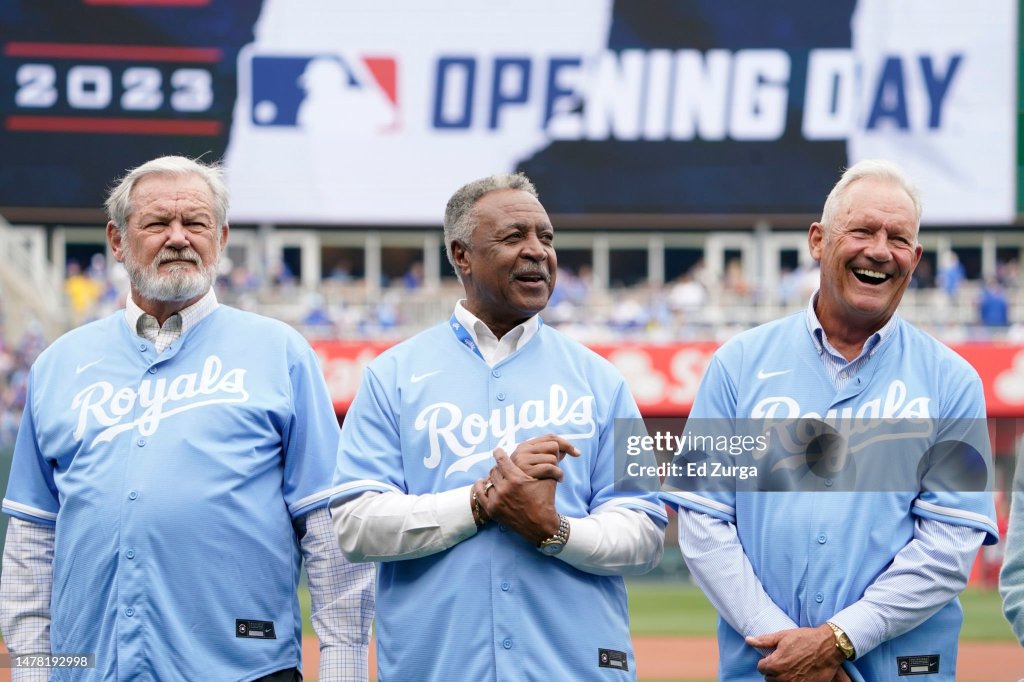
In 1986 Busby and Amos Otis were inducted as the inaugural members of the Royals Hall of Fame. At that point, Busby was amidst a 30-year MLB broadcasting career.
“Broadcasting worked out great … maybe I just accepted that my days as a player were finished,” he said. “I didn’t envy the players and their chance to play. The only thing I ever envied was their ability to compete. Competition is what I enjoyed the most.”
Postscript
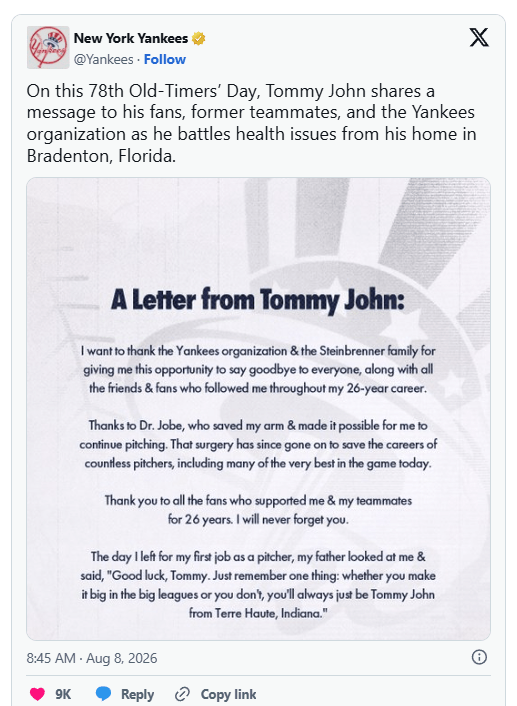
In early August of 2026, John issued a statement through the New York Yankees about why he wasn’t able to attend their annual Old Timers’ Game because, at 83, he was in hospice care. A story on MLB.com noting John’s update also included how the starting pitchers on both ends of Saturday’s Yankees game against the Atlanta Braves were both All-Star pitchers who had their careers saved by Tommy John surgery – Gerrit Cole for the Yankees, and Chris Sale for the Braves.
“Chris and I are a great example of taking it to the max as long as you can, then being given a fresh set of tires after a pit stop at the end,” said Cole, who had the surgery in 2025. “I think it’s a good opportunity to point that out, because he had an incredible career, both pre and post.”
A March, 2024 story for the Associated Press by Jay Cohen started: There is a bridge that runs from Tommy John and Dr. Frank Jobe in 1974, all the way to Shohei Ohtani, Justin Verlander and Bryce Harper. A thread that connects an increasing number of baseball’s biggest stars. Mostly on the mound, but at the plate, too. An operation that changed everything.
Others who benefited from Tommy John Surgery to save their careers on the mound: John Smoltz, Max Fried, Stephen Strausburg, Adam Wainwright and Yu Darvish.
Dr. Neal ElAttrache, who began learning the procedure when he was a fellow at the Kerlan-Jobe Orthopedic Clinic in 1990 from Jobe himself, has said: “It should have been called the Frank Jobe operation. But with Frank being the man he was, it was all about the person he was treating. It wasn’t about him.”
ElAttrache also said in the wake of John’s passing: “You could see that he was proud of the identification with the surgery because he knew that it changed the sport.”
When John died, Josh Suchon did research as to when the media started using the phrase “Tommy John Surgery” as common place. He found a piece in 2020 by Dr. Christopher Ahmad that pinned the first published report of Tommy John Surgery in The Journal of Bone and Joint Surgery in 1986. Suchon then found in the March 26, 1980 edition of The Houston Chronicle a reference to the comeback of former USC pitcher Brent Strom as a non-roster player who was around “after undergoing ‘Tommy John Elbow Surgery’.” Strom was the second Jobe patient to try the surgery.
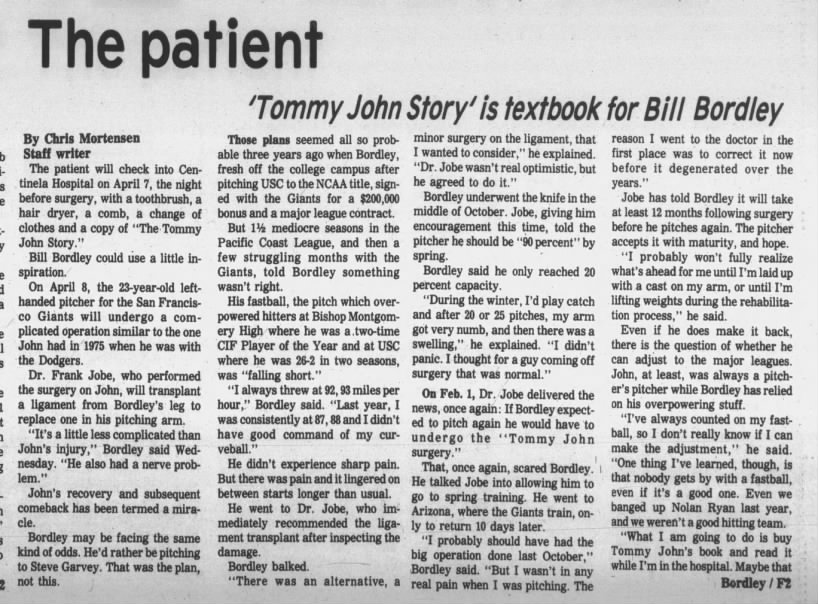
A year after that, in March of 1981, the Daily Breeze’s Chris Mortensen was writing about how Bill Bordley, another USC pitcher who starred at Bishop Montgomery High in Torrance, would be next up, and was reading up on John’s story to find out what to expect.
John’s death led to renewed support for his enshrinement in the Baseball Hall of Fame — just on his statistical resume alone. John had already wondered aloud about what bar he failed to reach in this vetting process.
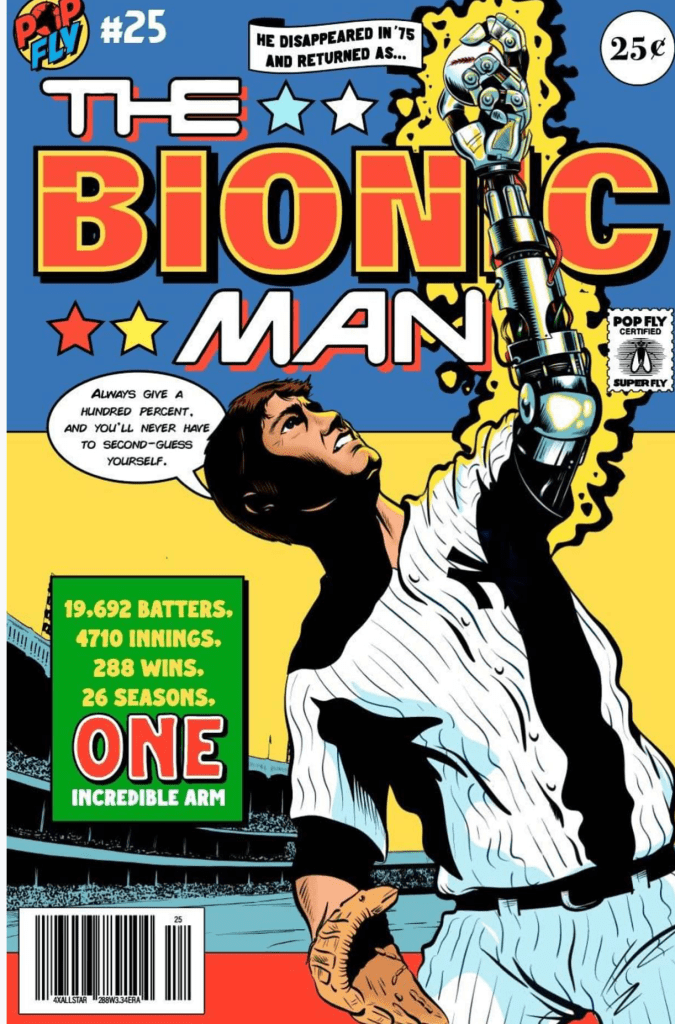
“Twenty-six years, 288 wins and [an MLB-record] 188 no decisions,” John once said when asked how the committee should value career longevity. “Your arm was in good shape, and you must be doing something right or you wouldn’t be going out there every five days. If I had a say, I would vote me in. But I don’t.”
Had just a quarter of those 188 no decisions just broke in John’s favor, he would have exceeded 300 wins. Among left-handers in MLB history, his 700 starts are second all time, his 4,710 innings are third, his 288 wins are seventh and his 46 shutouts are fifth. He also induced an MLB record 605 double plays, or some 140 more than runner-up and former White Sox teammate Kaat.
If one considers that John made his major-league debut as a 20-year-old with Cleveland during the final months of President John F. Kennedy’s life, and yet was still pitching as a New York Yankee in the first months of President George H.W. Bush’s administration, and he was the oldest winning Opening Day starter ever as he approached his 46th birthday, that alone is worthy of … something.
In the game’s modern era, only Nolan Ryan played more seasons (27) than John did.
John remained eligible with the Baseball Writers’ vote until 2009, but he never received more than 31.7 percent of the 75 percent required. Five times, John has been on a veterans’ committees re-vote. In 2024, he received seven of 16 votes but needed 12.
Joe Posnanski, in a piece titled “The Man Who Changed Baseball, concluded: “I’ve been a proponent of Tommy John’s Hall of Fame case for many years, but as we learn today of his death at 83, I wish I’d been louder about it … He died outside the Hall of Fame. It isn’t right.
Wrote Mark Whicker: “It wasn’t just the baseball writers who whiffed this one, after 15 years of eligibility. The Veterans Committee, which uplifted Jeff Kent into the Hall this year, has had no time for John either. The process is consumed by numbers these days, with WAR and OPS (for hitters) as the main vehicles. There is no room to consider a player’s impact on the history of the game, the things that he paid forward, the tickets that fans bought to see him, the memories he spread. … The proper and most innovative solution would have a shared plaque, with John and Jobe as an entry, but there are procedures to follow here, you know …”
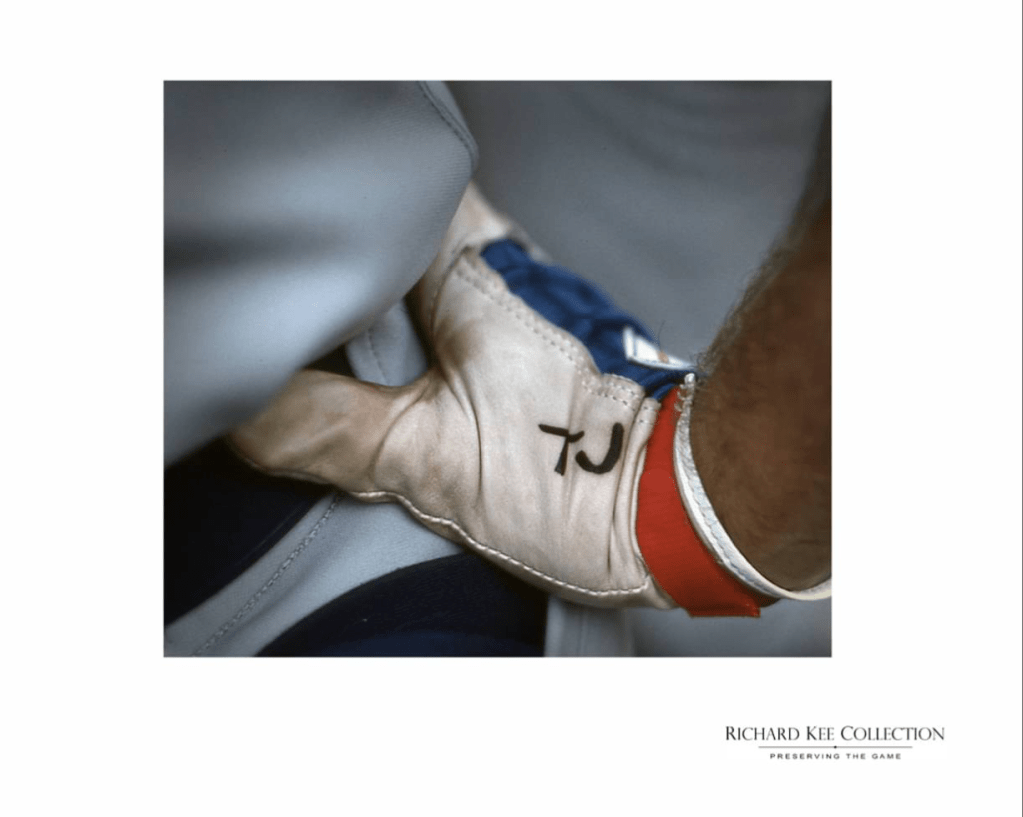
In a first-person story for AARP magazine in 2018, Tommy John said he wanted it known he doesn’t think a surgery named after him is something he necessarily would endorse. But he understands it.
“It doesn’t bother me to watch my legacy being upstaged by an operation that has saved plenty of ballplayers’ careers,” said John. “What does bother me is that my name is now attached to something that affects more children than pro athletes. I was in my 30s and playing major league ball for nearly a dozen years before needing the operation. Today, 57 percent of all Tommy John surgeries are done on kids between 15 and 19 years old. One in seven of those kids will never fully recover.”
He was able to get that data from his oldest son, Dr. Tommy John, a chiropractor who wrote the book, “Minimize Injury, Maximize Performance: A Sports Parent’s Survival Guide.”
Strange to hear Tommy John refer to himself in the third person, but that’s what it had become.
As Mike Kupper wrote in the lede of an obituary that had been stored in the Los Angeles Times’ archives and used on Aug. 16, 2026, about a year after Kupper’s own passing: “It’s right there in the medical books, along with Belsey fundoplication, Heineke-Mikulicz pyloroplasty and Keller’s excision arthroplasty: Tommy John surgery.”
Who else wore No. 25 in SoCal sports history?
Make a case for:
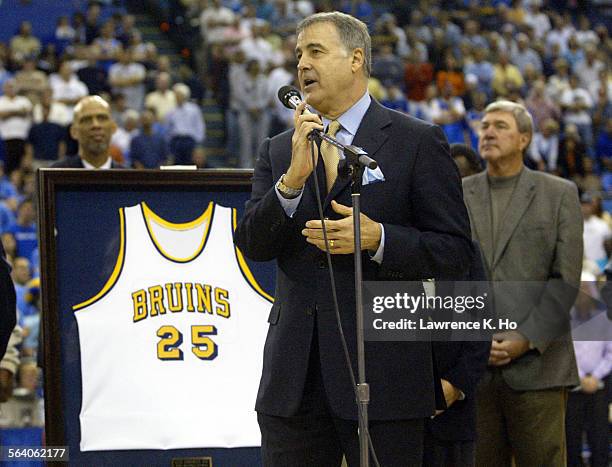
Gail Goodrich: UCLA guard (1962-63 to 1964-65), Los Angeles Lakers guard (1970-71 to 1975-76) via Poly High in Sun Valley (1956-57 to 1960-61):
Best known: His number went up on the Lakers’ retired uniform wall after he gained National Basketball Hall of Fame status, predicated on a) being a vital part of the starting quartet of the Lakers’ 1972 title team, along with four All-Star seasons and b) two NCAA titles achieved at UCLA, which were the first two for coach John Wooden.
Goodrich, who went from 5-foot-8 and 145-pounds as a junior at Poly High in Sun Valley to a 5-11 point guard, led his high school team to the 1961 L.A. City championship by scoring 29 points in the title game despite breaking his ankle in the third quarter against Manual Arts. The Poly High school gym was named for him in 2025.

Goodrich set a national record 42 points when UCLA beat favored Michigan in the 1965 NCAA championship, and he was the Bruins’ program all-time leading scorer when he left. UCLA went 78-11 during his career, including 30-0 in the ’64 title season.
Goodrich’s arrival with the Lakers as the No. 10 overall (and territorial) draft pick led to him wearing No. 11 as a 22-year-old from 1965-66 to 1967-68, backing up Jerry West, former UCLA teammate Walt Hazzard and Archie Clark. Of all the players picked in that 1965 draft, Goodrich had more NBA seasons (14), games (1,031), points (19,181) and assists (4,805). With the Lakers, teammate Elgin Baylor decided to call him “Stumpy,” because of the short legs on his 6-foot-1 frame. Goodrich lasted three years before he was wrangled away by the expansion Phoenix Suns, who made him a starter and All-Star. The Lakers reclaimed Goodrich after the 1970 season in a deal for Mel Counts, and Goodrich was teamed with West as the new fulltime backcourt.
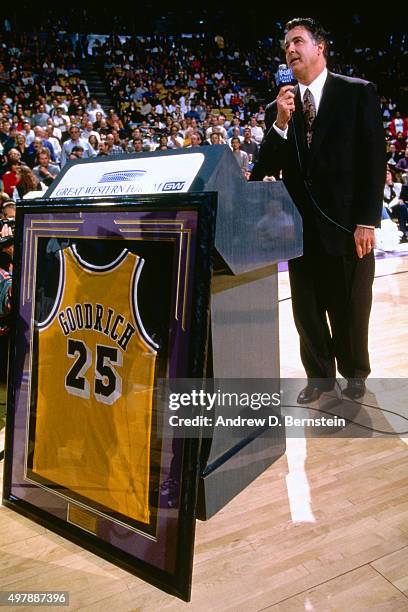
Goodrich was the team’s leading scorer and fifth in the league when he averaged a career-best 25.9 points a game on a Lakers’ team that ran off the 33-game win streak and an NBA-best 69-13 record. Goodrich also led the Lakers in scoring during their five-game NBA Finals series against New York at 25.6 per game. His 2,145 points in the regular season was fourth in the NBA. In ’73-’74, Goodrich was first-team All-NBA, averaging 25.3 points a game (fourth in the league), leading the league with 508 free throws (in 588 attempts).
Not well remembered: Growing up in North Hollywood, Goodrich wanted to go to USC, where his dad, Gail Sr., was the captain of the 1939 team and an All-West Coast player. But Coach John Wooden wooed him.
And an important asterisk to Goodrich ending his run with Lakers came after he signed with the New Orleans Jazz as a free agent after the 1976 season — three years, $1.4 million, teaming up with Pete Maravich. For compensation, the Jazz gave the Lakers its No. 1 draft pick for 1979, then finished with the worst record in the league. The Lakers took that pick, won a coin flip with Chicago, and were able to draft Magic Johnson. You’re welcome.
Norm Van Brocklin, Los Angeles Rams quarterback (1949 to 1957):
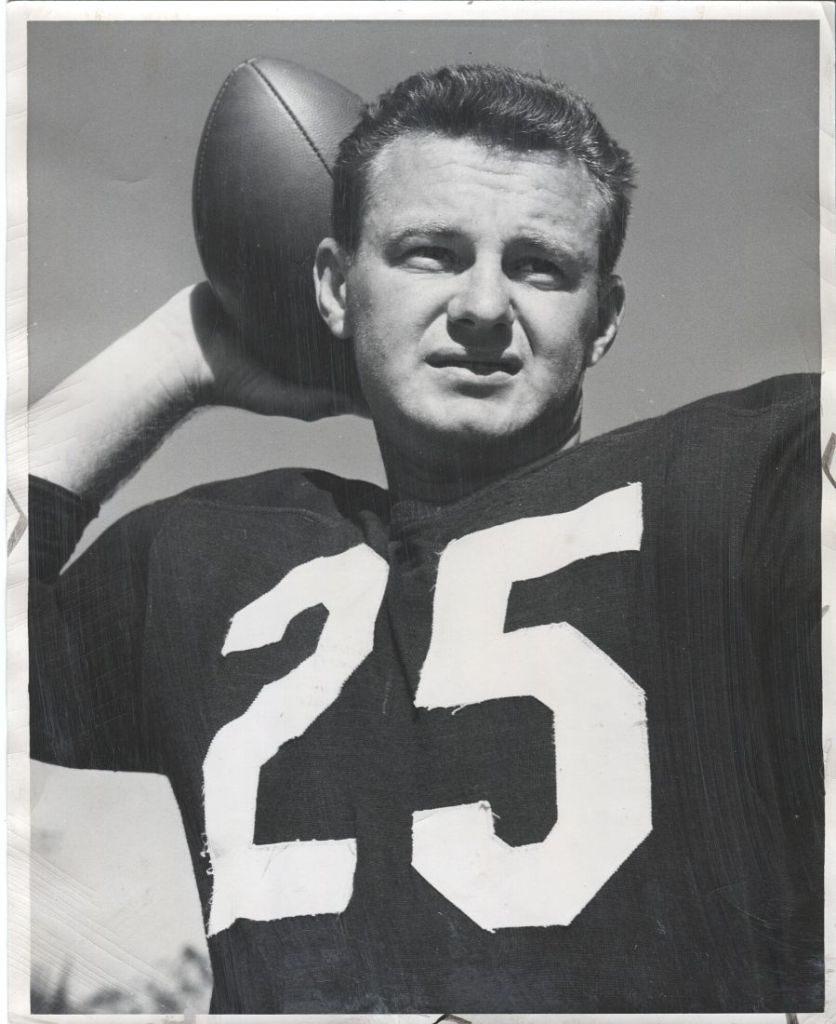
Best known: On the opening day of the 1951 season, Van Brocklin threw for an NFL-record 554 yards and five touchdowns in a 55-14 win over the New York Yankees. He enjoyed wearing No. 25, just as he did as a star at the University of Oregon. Van Brocklin also played the whole game — important to note, since Bob Waterfield was injured so there was none of the regular back-and-forth substituting the two experienced for awhile with the Rams. Even with the increase in passing stats in NFL teams decades later, the single-game yardage record has survived more than 70 years. As Doug Kelly wrote in a 2022 New York Times story: “It’s the N.F.L.’s most confoundingly persistent record.” Van Brocklin only started eight games in his first three seasons, posting a 6-2 record, because that was because he shared time with Waterfield. Both would become Pro Football of Famers. So who was the greatest quarterback in Rams’ history? Van Brocklin was inducted into the Pro Football Hall of Fame in 1971.
Not well remembered: Van Brocklin wore No. 25 his first three seasons with the Rams (1949 to 51), playing in two Pro Bowls. He switched to No. 11 from 1952 to 1957, led the Rams to the 1955 title game (hosted at the L.A. Coliseum), and in 1958, he announced his retirement from pro football after nine seasons, the final year with Philadelphia.
Troy Glaus, UCLA baseball third baseman (1995 to 1997); Anaheim Angels third baseman (2000 t0 2004):
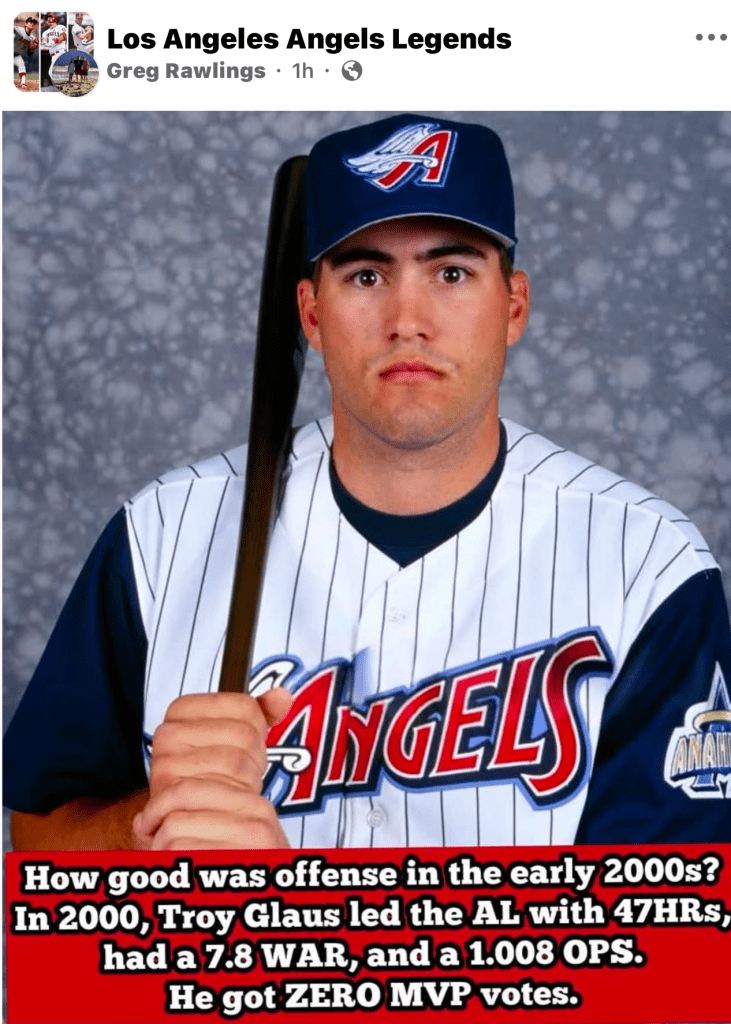
Best known: Born in Tarzana and emerging from Carlsbad High, Troy Glaus’ senior year at UCLA saw him hit .409, set a Pac-10 record in home runs with 34 (eclipsing Mark McGuire’s 32 at USC) and tied for the conference lead with 91 RBI. Those Bruins went to their first College World Series appearance since 1969.

As a sophomore, Glaus was picked to the 1996 US Olympic team and helped lead Team USA to a bronze medal, hitting .342 with 15 home runs and 34 RBI during preliminary games and four homers during the Olympics. The Angels drafted him after his junior year with the No. 3 overall choice in 1977. In 2000, he became the first Angel to score 100 runs, drive in 100 and walk 100 times, leading the AL with 47 homers. The 2002 World Series MVP (hitting .385, three homers and eight RBIs in the seven-game series) led Anaheim to its one and only championship, capping a career that included AL All Star appearances in 2000, ’01 and ’03. He was inducted into the UCLA Athletic Hall of Fame in 2007.
Not well known: Glaus wore Nos. 12 and 14 for the Angels from 1988 to 1989 but was able to get the No. 25 he had at UCLA after the Angels traded Jim Edmonds to St. Louis in spring training.
Frank Howard, Los Angeles Dodgers outfielder/first baseman (1958 to 1964):
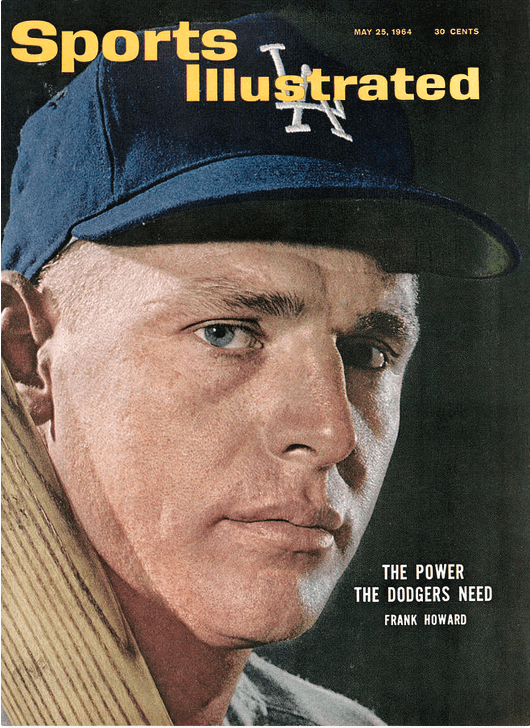
Best known: The 6-foot-7, 228-pounder was the first of a bushel of Los Angeles Dodgers’ versions of the NL Rookies of the Year winners when, at age 23, he his 23 homers and drove in 77 with a .268 average in 1960. Howard had just brief call-ups in the 1958 and ’59 seasons, but his legend preceeded him. “I only saw Babe Ruth a time or two,” said Dodgers manager Walter Alston, “but I know about the tape measures they get out for some of Mickey Mantle’s homers. This fellow hit ’em as far as Mickey. Farther. I guarantee you he won’t miss.” Writer Joe Posnanski wrote in a 2025 assessment of Howard: “I think there’s an argument that coming into 1960, he was the greatest baseball prospect in the history of the game.” During his first full season at Dodger Stadium in ’62, known as a pitcher’s ballpark, Howard led the Dodgers with 31 home runs and a .562 slugging percentage, fourth in the NL behind Frank Robinson, Hank Aaron and Willie Mays. When the Dodgers clinched the 1963 World Series title at Dodger Stadium with a four-game sweep of the Yankees, the final game saw Howard have the only two Dodgers’ hits to support Sandy Koufax’s complete game — a single in the second inning off New York starter Whitey Ford and a 450-foot homer in the fifth off Ford that landed on the Loge Level. Going back to Game 1 at New York, Howard hit a ball 460 feet to left-center off Ford that ended up recorded as the longest double in the-then 41-year history of Yankee Stadium, landing near the monuments that had been in the field of play in that era. When Gil Hodges became the manager of the Washington Senators, he pushed for his team to acquire Howard, his former Dodgers teammate. That happened in 1965 in a multi-player deal where the Dodgers got pitcher Claude Osteen. Howard led the AL with 44 homers in 1968 and ’70, had a career best of 48 homers in between that in ’69. He hit 123 of his career 382 homers in a Dodger uniform.
Not well known: In Howard’s first big-league game (Sept. 10, ’58) facing future Hall of Famer Robin Roberts, his first hit in his second at-bat was a home run at Connie Mack Stadium that was hit so hard, Phillies center fielder Richie Ashburn said when it bounced off a metal sign above the wall, it sounded like a cannonball blast and he worried the sign would fall on his head.
JK McKay, USC football receiver (1972 to 1974), Southern California Sun receiver (1975 to 1976)
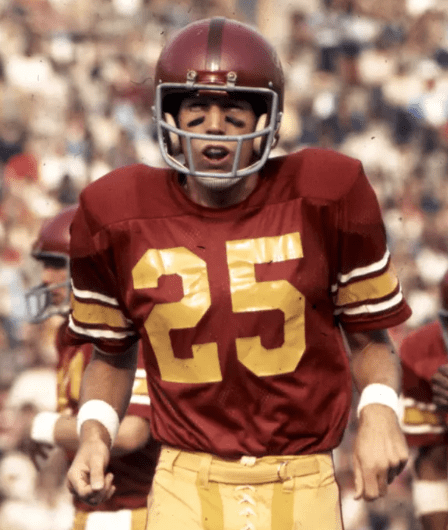
Best known: As the son of legendary USC football head coach John McKay, it was easier for John Kenneth McKay to go by the name “J.K.” The co-MVP of the Trojans’ 1975 Rose Bowl win (with teammate Pat Haden, his former Bishop Amat High c0hort who threw him a 38-yard touchdown pass in the contest) was on two national title teams and inducted into the Rose Bowl Hall of Fame in 1998.
Not well known: McKay was general manager for the one and only season of the XFL’s Los Angeles Xtreme (2001, as it won the league title) before he became Senior Associate Athletic Director at USC in 2010 under head AD Haden.
Jim Edmonds, California and Anaheim Angels center fielder (1993 to 1999):
Best known: Drafted locally out of Diamond Bar High in the ’88 draft, Edmonds made the AL All Star team as a 25 year old when he hit 33 homers with 107 RBIs and a .290 average. He won also Gold Gloves in ’97 — highlighted by the catch above against Kansas City — and again in ’98. Also in ’98, he hit .307 with 184 hits, 42 of them doubles, to go with 25 homers and 91 RBI. The next six Gold Gloves would come with other teams over the next 12 seasons.
Not well remembered: In spring training of 2000, Edmonds was traded to St. Louis in a deal primarily to get pitcher Kent Bottenfield, who had been an 18-game winner and NL All Star in ’99. Also in the deal: Second baseman Adam Kennedy, who became the Angels’ ALCS MVP in 2002. Bottenfeld lasted less than one season with the Angels and went 7-8 in 21 games before he was dealt to Philadelphia at the trade deadline for a new center fielder, Ron Gant.
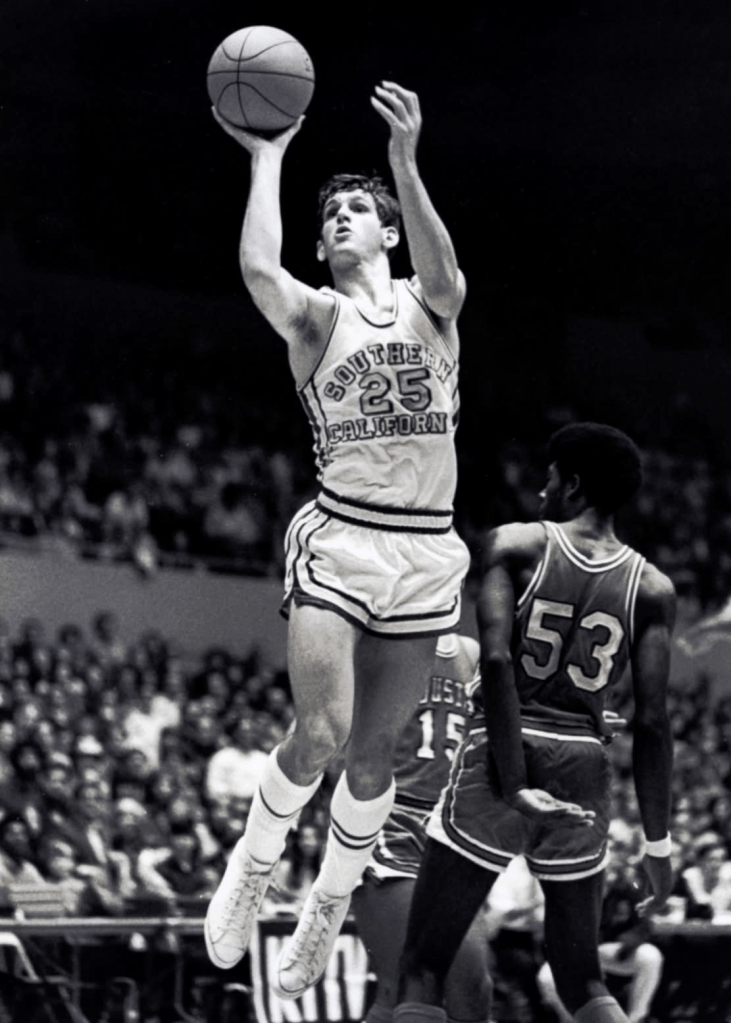
Paul Westphal, USC basketball guard (1969-70 to 1971-72):
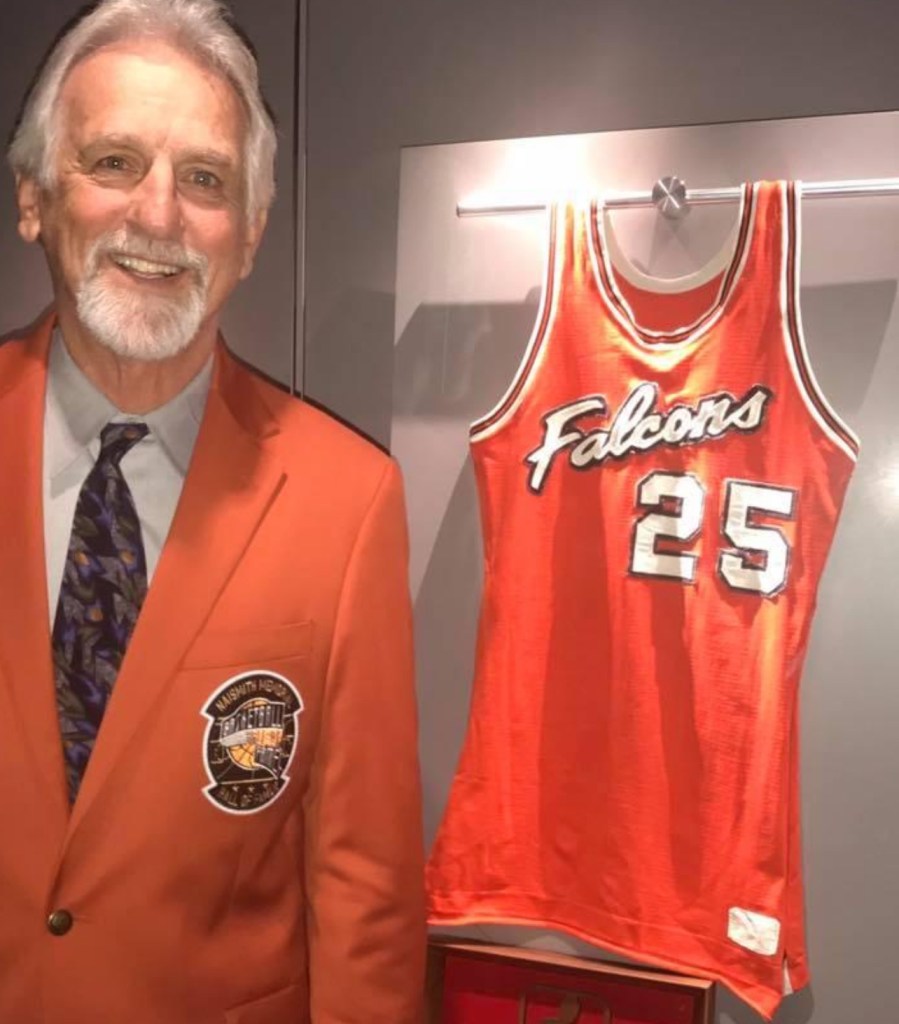
Best known: At Aviation High in Redondo Beach, Westphal established himself as a multi-purpose scorer and passer, and USC won out in a recruiting battle with UCLA. Aas a sophomore, Westphal was a key member of the 1971 Trojans team that posted a 24-2 record, the most wins in school history and a still-standing USC mark for best winning percentage (92.3 percent). As a senior, Westphal was All-American first team and team captain as he led the team in scoring with a 20.3 average to go with 5.1 assists a game as a senior. The Trojans started the season ranked No. 3 in the nation (behind No. 1 UCLA) but went 16-10 (9-5 in the Pac-8) including two losses to the Bruins. He averaged 16.9 points a game in his Trojan career and the school retired his No. 25 in 2007. He was inducted into the College Basketball Hall of Fame in 2018.
Not well known: When Westphal was inducted into the Basketball Hall of Fame in Springfield, Mass., in 2019, less than two years before he died from brain cancer, he was presented with a No. 25 Falcons jersey from his Aviation High Days that celebrated his All-CIF career.
Don Baylor, California Angels designated hitter (1978 to 1982): Two seasons after he arrived in Anaheim (and wore No. 12 in ’77), he was the AL MVP with 36 homers, a league-best 139 RBIs and 120 runs scored, with 186 hits and 22 stolen bases. That was also his only All Star season, and the only time in his 19 seasons he topped 100 RBIs (although he had 99 with the Angels in ’78).
Tommy Edman, Los Angeles Dodgers infielder/outfielder (2024 to present): The 2024 National League Championship Series MVP was given to a utility player that the Dodgers picked up at the trade deadline in a three-team transaction, after he had been stuck on the disabled list and virtually out of sight. Edman was 11 for 27 (.407) with three doubles, a home run and 11 RBIs, with 17 total bases, going back and forth from center field to shortstop, from No. 9 in the lineup to No. 4, in a six-game win over the New York Mets.
Darrin Nelson, Pius X High football running back (1974 to 1977): The 5-foot-9 All-CIF performer was inducted into the College Football Hall of Fame for his career at Stanford, where he excelled as a runner and receiver in coach Bill Walsh’s offensive scheme. Nelson was the first in NCAA history to rush for more than 1,000 yards and catch more than 50 passes in a season — a feat he accomplished three times. He led Stanford with career rushing yards (4,033), receptions (214), touchdowns (40) and set an NCAA record with 6,885 career all-purpose yards. He had an 11-year NFL career with Minnesota and San Diego. He became a senior associate athletic director at Stanford and UC Irvine.
Ronald Jones, USC football running back (2015 to 2017): The Top 10 list of the Trojans’ all-time career rushing yards starts with Charles White (5,598, from ’76 to ’79) then goes to Marcus Allen (4,682 from ’78 to ’81) and then … neither Ricky Bell, Anthony Davis, Mike Garrett, Reggie Bush nor O.J. Simpson. It is Ronald Jones who is third at 3,619, on 519 carries, thanks to a junior season where he had 1,550 yards on 261 carries. His career average of 6.1 yards per carry is third only to Bush (7.3) and Joe McKnight (6.3) with at least 300 career carries. Jones’ 39 rushing touchdowns is also fifth on the all-time list. And his total yards from scrimmage of 3,921 is fourth all time.
John Lee, UCLA football kicker (1982 to 1985): Maybe the most prolific kicker in NCAA history, the two-time All-American set school records for field goals in a game (6), season (32, in 1984) and career (85, including bowl games). He held the NCAA highest career percentage record (85.9). A 2001 inductee into the UCLA Athletic Hall of Fame.
Have you heard this story:
Rafer Johnson, UCLA basketball guard/forward (1957-58 to 1958-59):
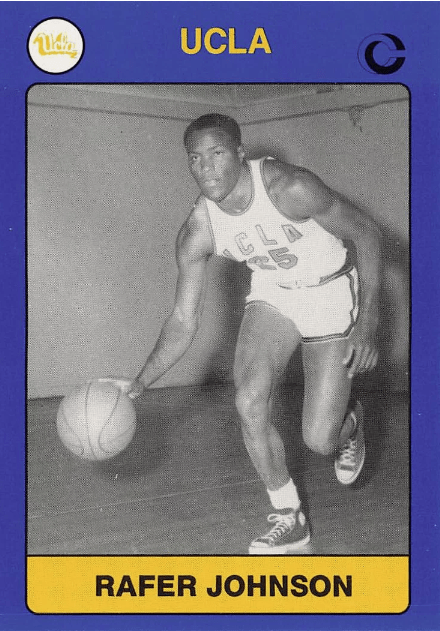
One of the world’s all-time greatest athletes — the gold medalist setting a world record in decathlon during the 1960 Summer Olympics in Rome (wearing No. 447) after winning silver in 1956 in Melbourne — the eventual charter member of the UCLA Athletic Hall of Fame in 1984 spent his training time in between Olympiads playing basketball for UCLA coach John Wooden during his senior year in Westwood.
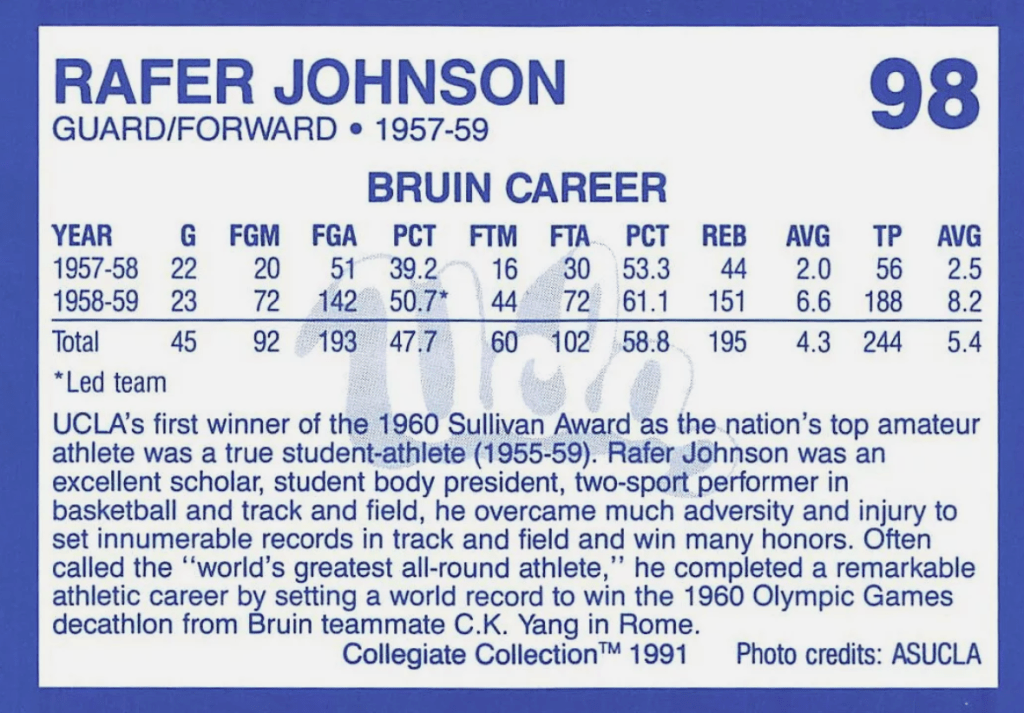
The starting 6-foot-3 swingman on a 1958-’59 team that went 16-9 led the squad with a 50.7 field-goal percentage, according to his stats for one year on Sports-Reference.com. Above, UCLA records on a trading card includes 22 games he also played as a junior during the time in 1957 and in 1959 when he took time off from the decathlon global competition to recover from some injuries.
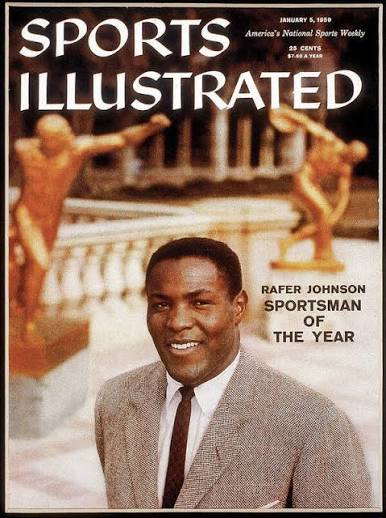
Joe Posnanski wrote about Johnson in Sports Illustrated in 2010: “Wooden remembered him as a great defensive player … one of his great coaching regrets was holding back some of his early teams. ‘Imagine,’ Wooden would sometimes say, ‘imagine Rafer Johnson on the break.’ Johnson remembered Wooden’s bits of advice, the small and carefully crafted mottos that encapsulated all that Wooden learned about sports. Understand that by the time Johnson played basketball at UCLA, he was already an international sensation. He was named Sports Illustrated Sportsman of the Year in 1958. He was class president at UCLA and a popular speaker for various causes and someone who bridged the gap, made everyone across all lines feel good about America. But he was also an athlete, and he was hungry for the ultimate success, and perhaps more than anyone else he listened to Wooden, wrote down the words, studied them, memorized them, repeated them to himself while he competed. ‘You know what excuses are?’ Johnson said. ‘Excuses are just ways to fool yourself.’”
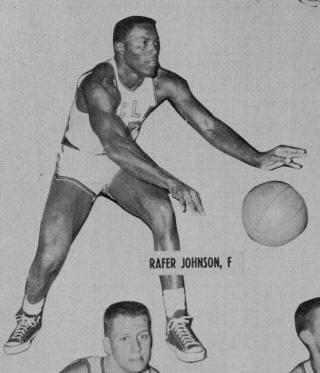
Johnson, also the 1960 winner of the Sullivan Award as the world’s top amateur athlete, was a 28th-round pick by the Los Angeles Rams in the 1959 NFL Draft, slotted as a running back. The American Basketball League’s Los Angeles Jets also drafted him as a territorial pick in the first year of its existence in 1961-62. Johnson passed on both of them.
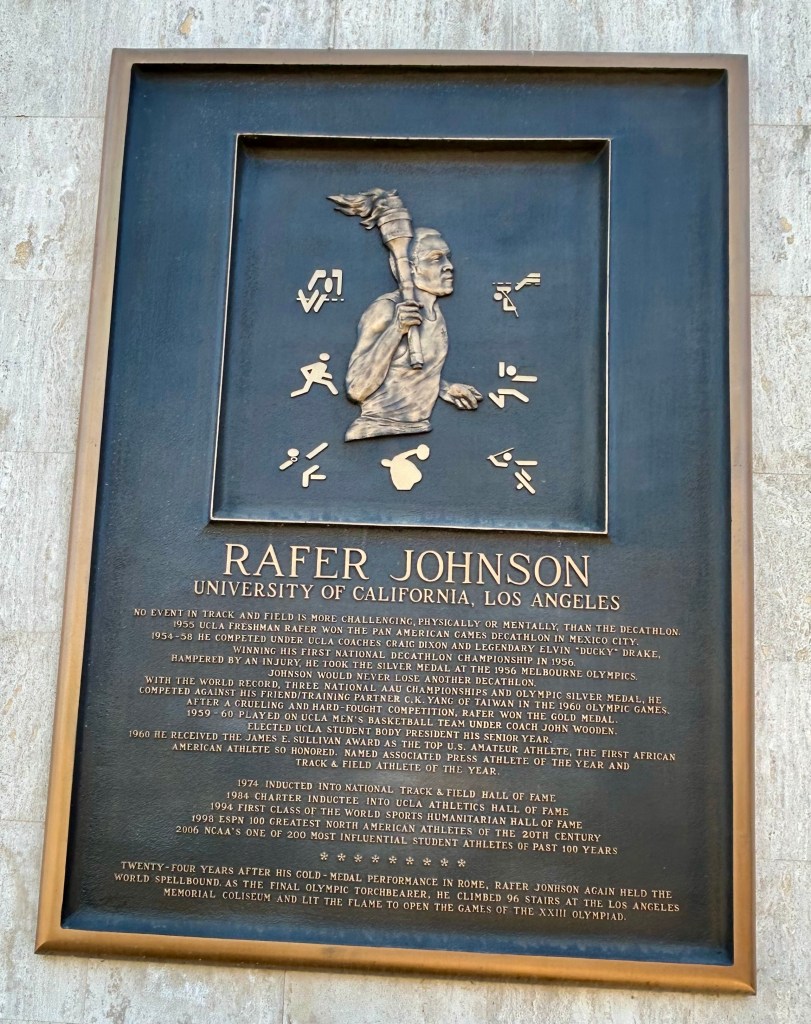
Johnson, who entered UCLA as a freshman in 1954, also won gold in the decathlon at the 1955 Pan American Games in Mexico City. The next year, he led UCLA to its first NCAA track and field championship. He was the U.S. team’s flag bearer at the 1960 Olympics and lit the Olympic caudron atop the Los Angeles Coliseum to start the 1984 Summer Games. He was instrumental in starting the Southern California Special Olympics in 1969 and remaining on its leadership team until his death in 2020 at age 86 in Sherman Oaks.
He has a bronze plaque dedicated to his life at the Los Angeles Coliseum:
Jim Abbott, California Angels pitcher (1989 to 1992, 1995 to 1996):
How could someone born without a right hand survive in the major leagues as a pitcher? Jim Abbott had just won the 1987 Sullivan Award as the top amateur athlete in the U.S. and the first baseball player honored. At the University of Michigan, he posted a 26-8 career record and was named the 1988 Big Ten Conference Male Athlete of the Year and the 1987 Golden Spikes Award, plus he lead the U.S. National team to a silver medal at the Pan American Games and pitched the 5-3 gold medal-clinching victory over Japan at the 1988 Olympics. The Angels took him No. 8 overall in the 1988 MLB Draft after Abbott was disregarded in more than 70 percent of the other MLB team’s preferential draft lists. He went on to become one of only three pitchers during his decade to win their first professional game and had 12 wins his rookie season without having spent a day in the minors. The 18 games he won at age 23 in his third season in Anaheim, with the AL fourth-best 2.89 ERA in 243 innings, led him to third in the Cy Young voting. In 1992, Abbott was awarded the Tony Conigliaro Award, given annually by the Boston Red Sox to a Major League player who overcomes an obstacle and adversity through the attributes of spirit, determination, and courage.
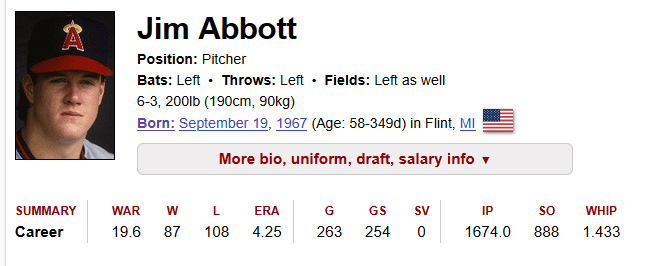
Not well remembered: Although he was traded to the New York Yankees in a deal that included J.T. Snow — and threw a no-hitter with that team — he was traded back to the Angels from the Chicago White Sox at the 1995 deadline and reversed his number — to No. 52 – to pitch for another season and a half with the Angels (going 2-18 with a 7.48 ERA in 27 games in 1996). He sat out a year and actually pitched two more seasons in the big leagues with the White Sox and Brewers.
Mickey Flynn, Anaheim High football running back (1954 to 1956):

Just before Disneyland opened, the main attraction in Orange County was Anaheim High’s two-time CIF Player of the Year known as “The Galloping Ghost of La Palma Park.” Some of that had to do with the fact that in the 1950s, he was playing on the dimly lit fields, and it would appear that Flynn came in and out of the shadows and then reappeared downfield to finish a long gain.
The first time he touched the ball in a varsity game as a sophomore, he ran 95 yards for a touchdown. As a junior, Flynn had 76 carries for 1,184 yards and 22 touchdowns. He was the only non-senior named to the All-Southern California CIF 1955 team.
It all came together in what’s still called the Greatest High School Football Ever Played in Southern California History — the 13-13 tie in dense fog at the Coliseum when his 12-0 Anaheim team faced Randy Meadows and 12-0 Downey High for the CIF championship on Dec. 14, 1956. Flynn had 17 carries for 134 yards and a 62-yard first-quarter TD run as well as a third-quarter TD for both his team’s main scores.

Meadows, who injured his shoulder tackling Flynn in the first quarter, came back and had 112 yards rushing on 10 carries and scored on a 69-yard TD run, also in the first quarter. The game has been documented in the film “A Last Hurrah.” The late Times sportswriter John De La Vega had described in the paper the morning of the contest that it was “the dangedest football Donnybrook in Southland prep annals.”
Flynn would score 55 touchdowns and accumulate 3,681 yards in three seasons as a 5-foot-7 tailback. He and Meadows became teammates at the following Shrine East-West All Star game, which drew another 85,000 fans at the Coliseum. Flynn, who averaged about 14 yards a carry in his career, was the first athlete enshrined in the Orange County Sports Hall of Fame in 1986. Flynn played a season at Long Beach City College, moved on briefly to Arizona State under Frank Kush, but was gone before anyone really knew he was there.
Dick Wantz, Los Angeles Angels pitcher (1965):
Born in South Gate and a graduate of Artesia High in Lakewood, Wantz had an impressive spring training for the Angels in 1965. The former pitcher at Cerritos College in Norwalk went to Cal State L.A., where he had a 5-1 record in 1961 and was named to the California Collegiate Athletic Association All Star team.
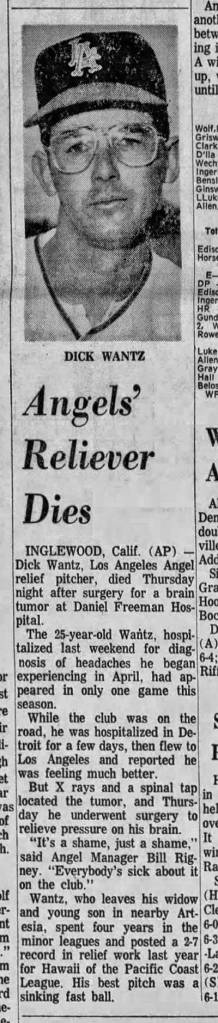
From the Angels’ D-League team up through Triple-A, Wantz never had a win-loss record above .500 until he was 2-1 in the Arizona Instructional League in 11 games and five starts.

Wantz’s big-league debut came in the season opener on May 13, 1965, two days after his 25th birthday. Entering the eighth inning at Dodger Stadium with the Angels trailing Cleveland 5-0, Wantz struck out Max Alvis. He gave up back-to-back doubles and a single that resulted in a pair of runs, but then struck out Ralph Terry before getting Dick Howser to ground out to shortstop Jim Fregosi. The Angels pinch-hit for him in the bottom of the eighth in a game they would lose, 7-1.
But soon, Wantz was hospitalized. He had a brain tumor surgery when he never regained consciousness. He was hospitalized while the Angels were on a road trip to Detroit after complaining of migraine headaches, and then sent home to Artesia to recover.
He was back in the hospital and put on the disabled list when he had headaches, which team Dr. Robert Woods suspected was the result of a blood virus. After three neurosurgeons were put on the case, the operation came on his cerebral spinal canal and it was discovered that cancer in both sides of his brain. Woods said Wantz lapsed into a coma and never came out of it.
The 6-foot-5, 195-pound righthander died a month later at Daniel Freeman Hospital in Inglewood.
In an obituary for Wantz that appeared in the San Bernardino County Sun, Angels pitching coach Marv Grissom said after seeing what he did in spring training: “He can be a great pitcher.” Grissom was a pallbearer at his funeral as was Angels farm system director Roland Hemond. Wantz, who left a wife and 5-year-old son, played basketball, golf and baseball at Artesia High and at Cerritos JC, he led the team to league titles in 1959 and ’60.
Mark Lee, Pepperdine University baseball pitcher (1975 to 1976):
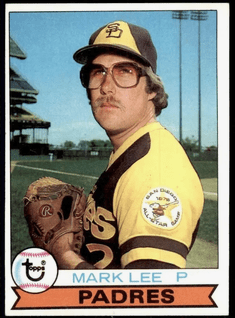
After playing at Hawthorne High and El Camino College, Lee became the West Coast Conference Player of the Year for Pepperdine in 1976 on a staff that included future NL Cy Young Award winner Mike Scott. Lee remains Pepperdine’s all-time leader in career ERA (1.80) after going 22-8 in two seasons, including 14-5 in ’75.
Drafted in the sixth round by Baltimore in 1973, the ninth round by Baltimore in 1974 and the 13th round by San Diego in 1976, Lee got in four seasons and 118 games in during his MLB career.
He then became part of baseball lore for the way he retired.
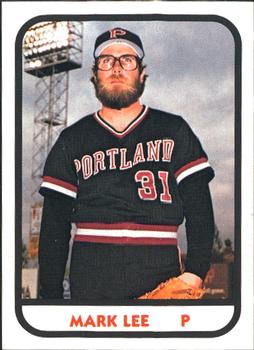
In August of 1982, Lee, who split time in Detroit’s and Pittsburgh’s organization, was a 29-year-old sinkerball pitcher with the Portland Beavers of the Triple-A Pacific Coast League when he came into the game out of the bullpen in the ninth inning to protect an 8-3 lead. Lee, who had an 0-5 record and 4.08 ERA with the last-place Beavers but had a team-best eight saves, got the first batter out on a popup. He then struck out Vancouver’s Bob Skube for the second out. Lee then called manager Tom Trebelhorn out to the mound and said: “Nothing against you, Treb, but I’d rather go out this way.”
He walked to the dugout, threw the ball back to the infield, threw his glove down, tossed his cap into the air and pulled off his jersey and threw it to the ground. He left the ballpark. Before the game, Lee said he was told by Portland’s parent team, the Pittsburgh Pirates, that he was being released. “If they say I’m done, I’m gonna pick when I’m gonna leave,” he told the New York Times. “It was my way of saying, ‘You guys can control some of the things, but you can’t control all of the things in my life.”
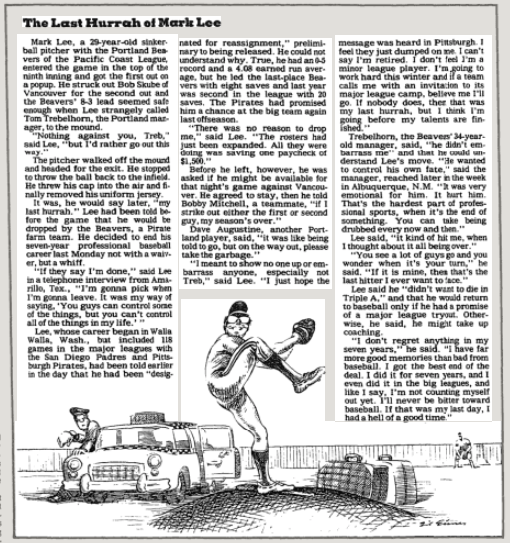
Lee received some invites to come back as a minor-leaguer, but declined, staying in Amarillo, Tex., and selling insurance. He said someone mailed him the jersey about a month after he quit, with no return address. Lee kept it. He was inducted into the Pepperdine Athletic Hall of Fame in 1984. “I always wanted to strike out the last batter I ever faced,” Lee would say.
Bernie Casey, Los Angeles Rams flanker (1967 to 1968):
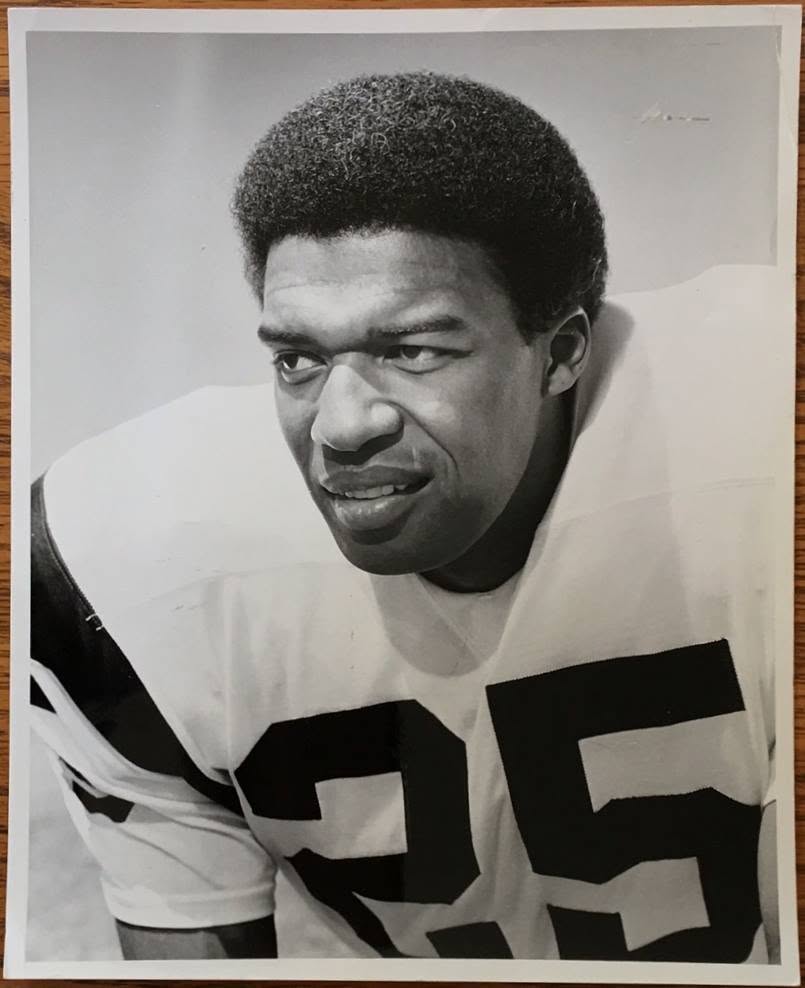
The last two seasons of his eight-year NFL career were in L.A., first going to the Pro Bowl in ’67, when he amassed 871 yards receiving for eight touchdowns in starting all 14 games. He averaged 19.5 yards a catch in 1968. Then he was caught up in finding acting roles, retiring at age 29 before the 1969 season. That year, he appeared in “Guns of the Magnificent Seven,” and then made some films with former NFL star Jim Brown. Casey also devoted his time to painting and poetry.
George Hendrick, California Angels outfielder (1986 to 1988):
His roots were in South L.A. as a standout at Freemont High, so Hendrick circled back and play in Southern California at the end of his 18-year pro career as part of the Angels’ ’86 AL West Division-winning team. As it notes in his SABR.com bio: His talents playing semipro baseball once caught the eye of Whitey Herzog, the director of the New York Mets’ player development. “I saw George in a sandlot game in Watts. He was the only guy there of any consequence. He had great tools. If Oakland hadn’t picked him, we would have gotten him in a minute.” Oakland made Hendrick the No. 1 overall choice in the January 1968 free-agent draft phase. “Joggin’ George” was also a Los Angeles Dodgers hitting coach for the 2005 season, wearing No. 22.
Haven Moses, Fermin de Lasuen High football (1961 to 1965):
Before he became a Pro Bowl receiver in the NFL for 14 years with Buffalo and Denver, Moses was among the first students at Ferman de Lasuen High in San Pedro. He also had two seasons at L.A. Harbor College, transferring to San Diego State, before his NFL career blossomed. In Terry Frei’s 2009 book,“’77: Denver, the Broncos and a Coming of Age,” Moses explained how his first two years in high school were taking a 15-mile bus trip with a handful of coins from his home in Compton to Harbor City, then Wilmington, then San Pedro to attend the Catholic school in San Pedro, bypassing nearby Centennial High, and because he couldn’t get into Serra or Mount Carmel. The family had lost its home at 110th Street and Avalon Boulevard near the Coliseum when Moses was 10, so they moved in with nearby family. When Moses started at Fermin de Lasuen, the all-boys school was in its second year and had only ninth and tenth graders. In football, the school’s fledgling program won a lower-division CIF championship with its first senior class, when Haven was a junior playing defensive back and running back. At Harbor College, Moses was angling to attend USC when San Diego State coach Don Coryell recruited him after seeing him score three touchdowns against San Diego City College. “They were down-home guys at San Diego State,” Moses said. “SC was very pretentious. Then Coryell and (assistant coach John) Madden came to my house in Compton, and that was the thing that impressed me the most. They told my mom two things: they’d make sure I got an education and that I’d have fun. No other coach talked about that and no other coach came to my house.” USC coach John McKay was upset and told Moses that since they were both Catholic, than means “you don’t lie” about a commitment. “My mother was heartbroken and wouldn’t talk to me for about six weeks. She was bragging that her son was going to SC, and all of our family was in Southern California. I was the hottest thing in our family since the automobile and it took some time for me to get through that, but I was happy.”
Andruw Jones, Los Angeles Dodgers center fielder (2008):
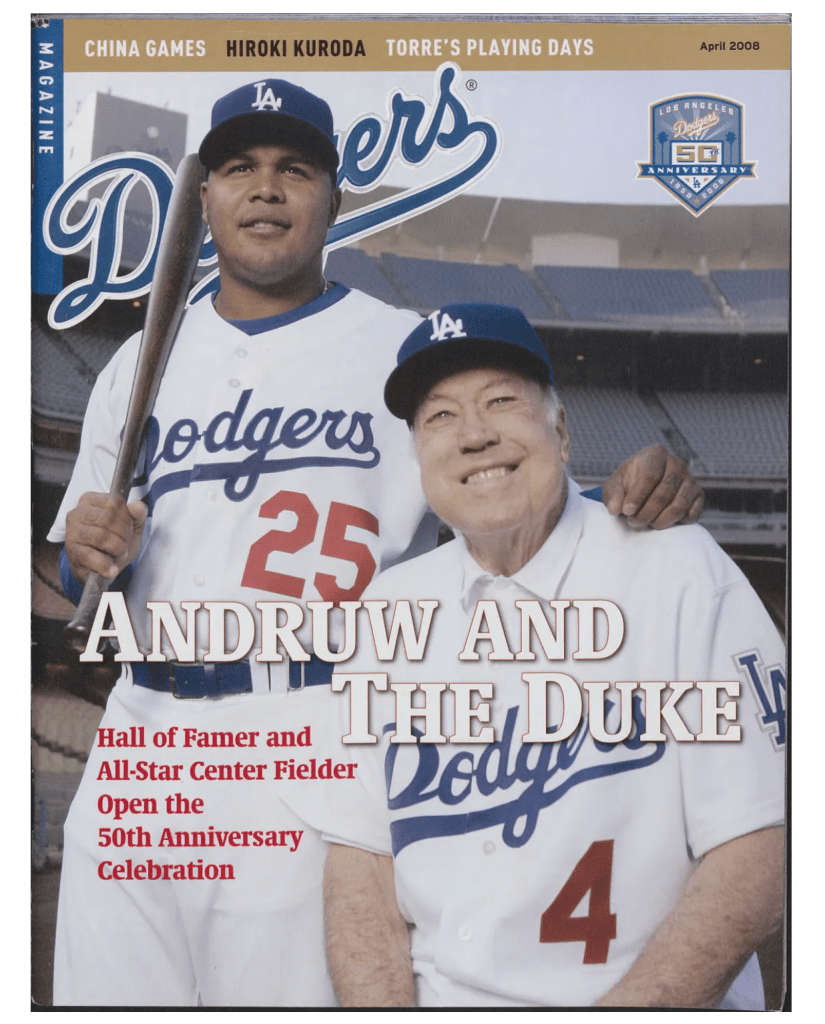
Four players who wore No. 25 during their time with the Los Angeles Dodgers are now in the Baseball Hall of Fame. And none of them are named Tommy John. There’s Rickey Henderson (2003) and Jim Thome (2009), who came on for just one year at the end of their careers. Mike Piazza wore it for his first 21 games as a September callup in 1992 before switching to No. 31 for his Rookie of the Year/first NL All Star season (because veteran third baseman Tim Wallach wanted No. 25).
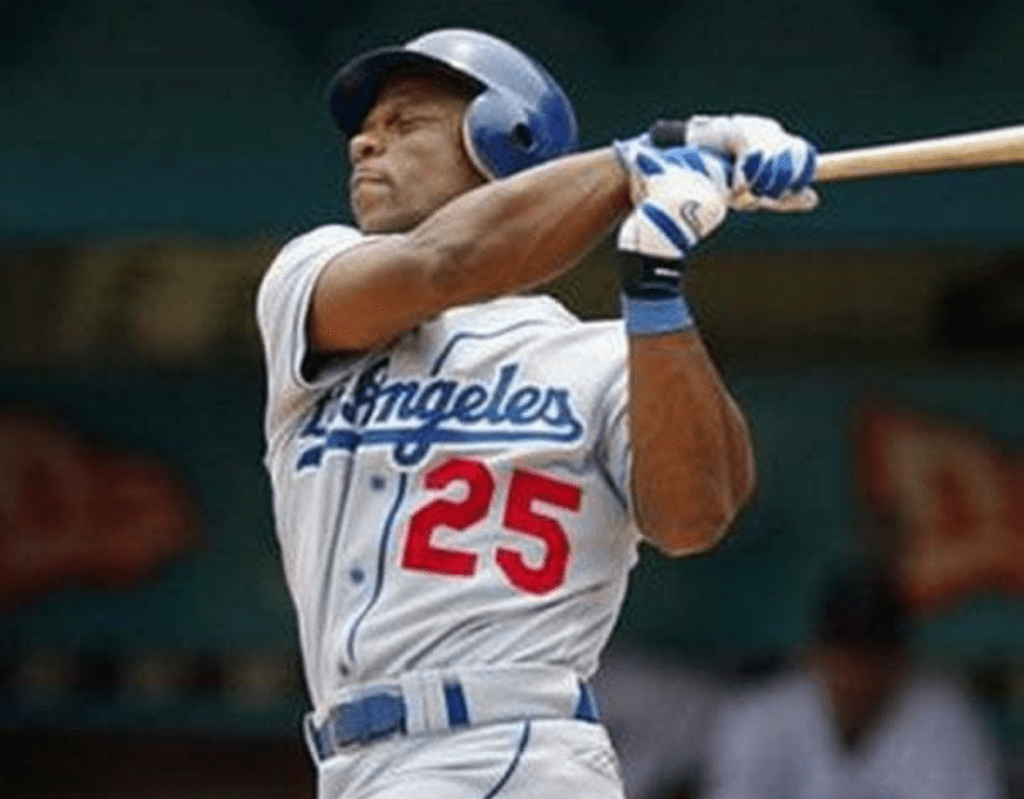
Then there is Jones, whose first 12 seasons were establishing himself as a 10-time Gold Glove winner and five-time All Star in Atlanta. He was second in the 2005 NL MVP voting with 51 homers and 128 RBIs. That upped his value so that in December of 2007, the Dodgers signed the free agent to a two-year, $36.2 million deal. The $18.1 million average annual value was the fifth greatest in baseball at the time. The team had big plans for him. But Jones had notorious poor conditioning and was living off his past when, by May 25, he was on the disabled list for the first time in his MLB career, injuring his knee in batting practice. He tore cartilage. His season was done when he was put on the 60-day DL on Sept. 13. The end result was the Dodgers making a deal to add Manny Ramirez at the trade deadline and promoting Matt Kemp to play center field. Jones hit only .158 in 75 games with three home runs and 14 RBI and had a -1.6 WAR in only 238 plate appearances. His 35 OPS+ tied for worst in Dodger history of the live-ball era (minimum 200 plate appearances). He missed a total of 76 games due to knee surgery as the team won the NL West and went to the NLCS without him. The Dodgers had Kemp, Ramirez, Andre Ethier and Juan Pierre for the 2009 season, leaving Jones on the outside. They reached a buyout agreement in January 2009 and Jones went on to squeeze out just as miserable seasons in Texas, Chicago and New York, plus Japan, as the Dodgers kept paying him through 2014. Maybe the Braves retired his No. 25 in 2023 but he wasn’t happening in L.A. In 2012, was arrest for domestic battery when he attached his wife and threatened to killer her. He pleaded guilty, was fined and given probation. That apparently didn’t matter much any longer as Jones was voted into the Hall in his ninth year of eligibility in 2026. As a footnote: In 1938, future Hall of Fame center fielder Kiki Cuyler wore No. 25 for the Brooklyn Dodgers.
We also have:
Tim Wallach, Los Angeles Dodgers third baseman (1993; also wore No. 29 from 1994 to 1996 with the Dodgers and No. 23 for the California Angels in 1996)
Bobby Bonilla, Los Angeles Dodgers third baseman (1998)
David Freese, Los Angeles Dodgers first baseman (2018 to 2019)
Bobby Bonds, California Angels outfielder (1976 to 1977)
Mitch Kupchak, Los Angeles Lakers forward (wore No. 41 in 1981-82; switched to No. 25 from 1983-84 to 1985-86)
LeRoy Ellis, Los Angeles Lakers forward (1963-64 to 1965-66; switched to No. 14 from 1971-72 to 1972-73)
Jerry Gray, Los Angeles Rams cornerback (1985 to 1991)
Danny Manning, Los Angeles Clippers forward (1988-89, then switched to No. 5 from 1990 to ’94)
Eddie Jones, Los Angeles Lakers forward (1994-95 to 1995-96; also wore No. 6 from 1996-97 to 1998-99).
Pete Trgovich, UCLA basketball guard (1972-73 to 1974-75)
Earl Watson, UCLA basketball guard (1997-98 to 2000-01)
Chris Pronger, Anaheim Ducks defenseman (2006-07 to 2008-09)
Melvin Gordon III, Los Angeles Chargers running back (2019, also wore No. 28 for the Chargers rom 2015 to 2018)
Sony Michel, Los Angeles Rams running back (2021)
Anyone else worth nominating?


1 thought on “No. 25: Tommy John and Dr. Frank Jobe (and Steve Busby)”