

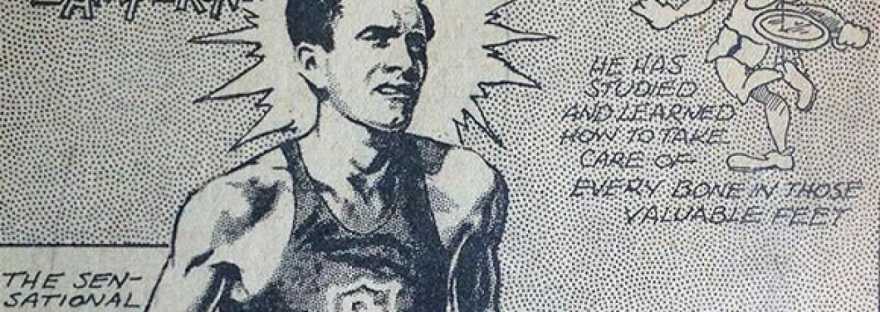
This post is part of a media project called SoCal Sports History 101: The Prime Numbers from 00 to 99 that Uniformly, Uniquely and Unapologetically Reveal The Narrative of Our Region’s Athletic Heritage. Pick a number, and consider the list of athletes attached to it. Who wore it best? Or, what’s the most compelling story linked to it? Any person, place or thing is in play with Southern California connections. Star power, transformational achievement, longevity, notoriety and quirkiness all factor in. Whatever leads to a lively discussion and interpretation.
The most obvious choices for No. 44:

Jerry West: Los Angeles Lakers
Hank Gathers: USC and Loyola Marymount University basketball
Reggie Jackson: California Angels
Darryl Strawberry: Los Angeles Dodgers
Gaston Green: UCLA football
The not-so-obvious choices for No. 44:
Cynthia Cooper: USC women’s basketball
Al Downing: Los Angeles Dodgers
Chris Mills: Fairfax High
Tony Gonzalez: Huntington Beach High
The most interesting story for No. 44:
Louis Zamperini: Torrance High track (1932 to 1935), USC track (1937 to 1940)
Southern California map pinpoints:
Torrance, Compton, Los Angeles, Hollywood

Reference books on the subject:
“Devil at My Heels: A Heroic Olympian’s Astonishing Story of Survival as a Japanese POW in World War II,” by Louis Zamperini and Helen Itris, 1956 (revised in 2003 with David Rensin)
“Unbroken: A World War II Story of Survival, Resilience, and Redemption,” by Laura Hillenbrand, 2010
“Don’t Give Up, Don’t Give In: Lessons from an Extraordinary Life,” by Louis Zamperini with David Rensin, 2014
The zeitgeist of Louis Zamperini zooms in on a hardy, unbroken succession of books, photographs, documents, feature films and oral witness. Much of that started with a leather-bound scrapbook that Zamperini often carried along with him on personal appearances, filled with clippings from the Torrance Herald to the New York Times, simple documented touchstones of his remarkable existence.
His legend is safely secured by city of Torrance, on the campus of USC, and within U.S. government files and links accessible to those searching for an example of someone who represents the definition is of a true, American hero.
While Zamperini was one of many notable sports athletes who served their country, and on a shorter list of veterans who faced extensive war-time adversity, his story never falls short of incredible inspiration.
When Zamperini died in the summer of 2014 at the age of 97, many knew this force of nature had fooled the world once before, and cheated death on several other occasions.
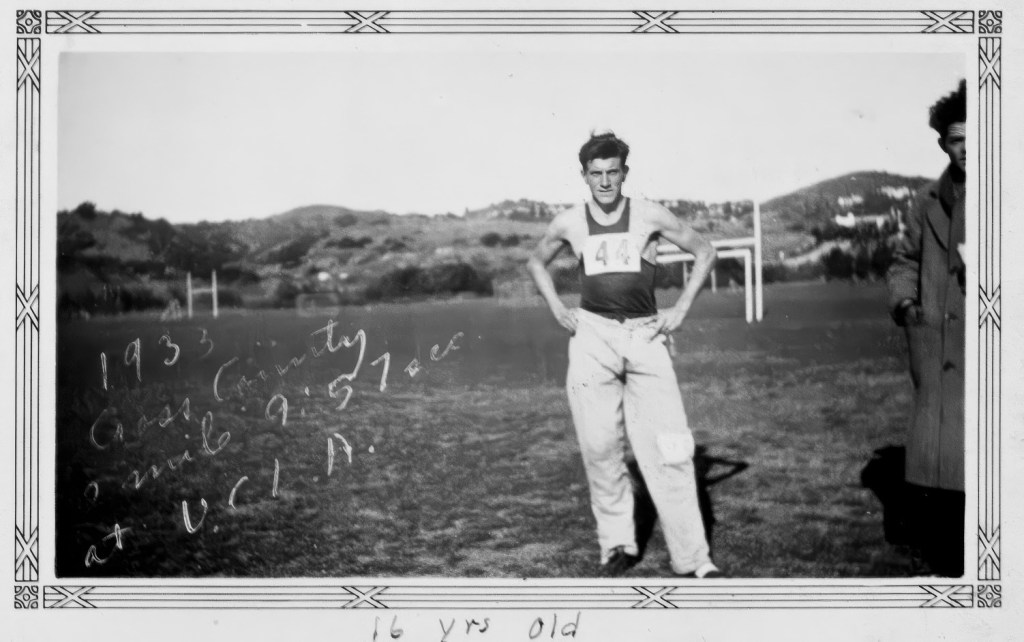
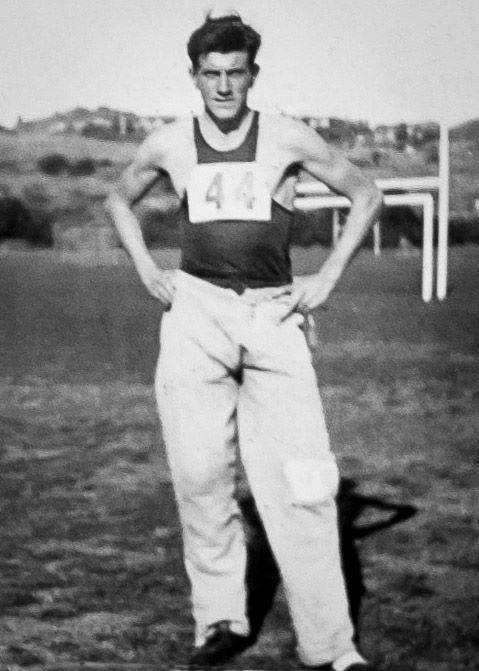
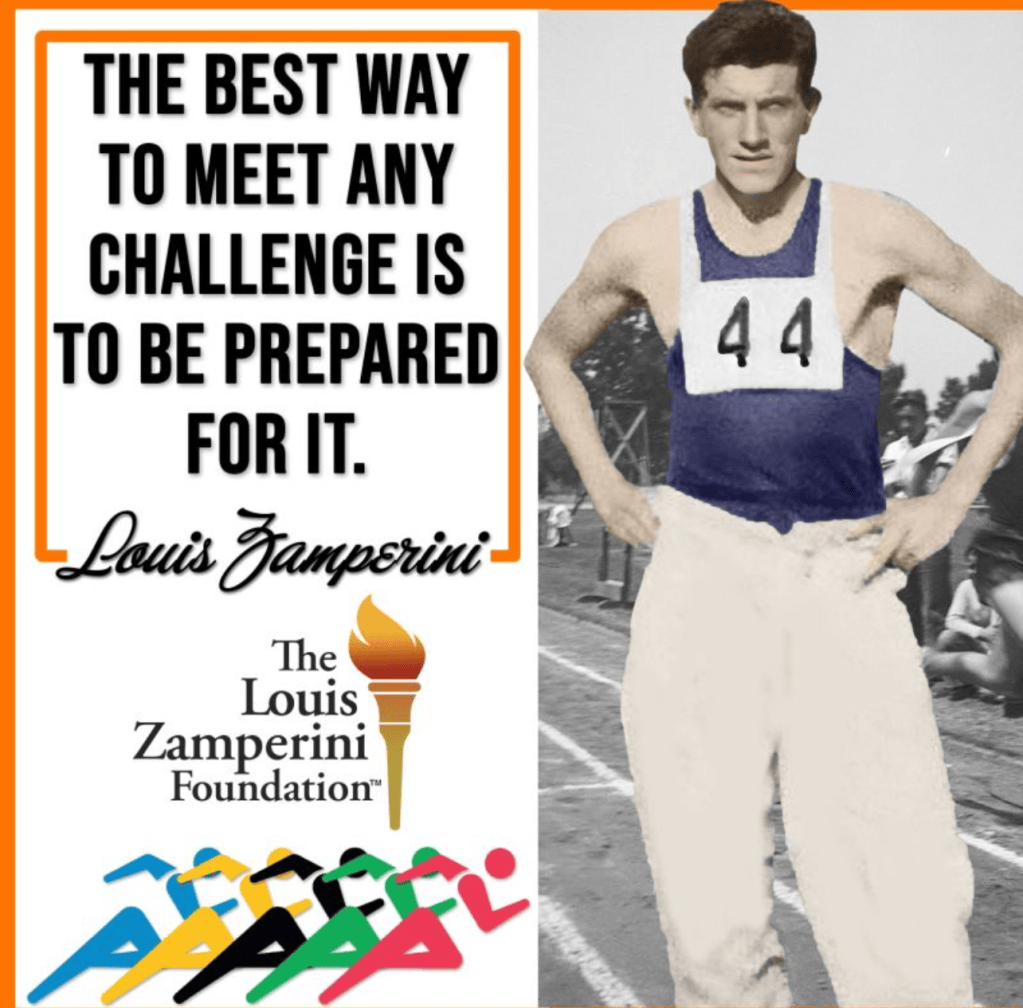
When searching for some official verification, there exists a snapshot of Zamperini, wearing a No. 44 race bib. He is 16 years old, representing Torrance High School.
The Louis Zamperini Foundation, a non-profit based in Tarzana focused on a mission to “inspire young people to face challenges with determination, embrace forgiveness, and cultivate empathy,” was able to provide more background. Luke Zamperini, Louis’ son, went through his father’s digitized collection and pulled out the original photo taken in September of 1933, which included Louie’s handwritten note to verify his age and the fact he had run a two-mile event at UCLA on that day in 9 minutes, 57 seconds. That photo is above.
Then turn to page 18 of Laura Hillenbrand’s best-selling book, “Unbroken.” There is another photo of Zamperini, wearing that same No. 44 pinned to his chest, breaking the finish-line tape. The caption notes he not only won by more than a quarter mile, but his older brother, Pete, is running in from behind to greet him. The Zamperini Foundation also provided the original print below:
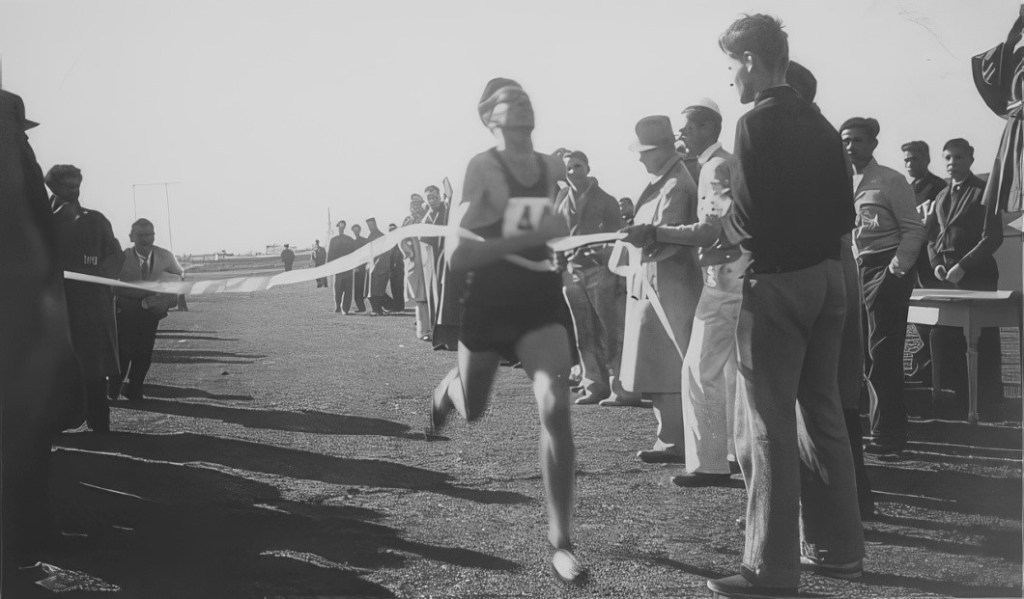
On that day in Westwood, more than 100 competitors from all over the state competed. Zamperini was put into Class C with the youngest runners. He broke the course record, in all divisions that included college runners, and ran it so fast and effortless that he said he had to ask the officials if he mistakenly cut some corners.
“It was the most thrilling race I’ve ever run,” he admitted to Hildebrand.
Zamperini would not lose a race for the next three years. That included his run-up to making the 1936 U.S. Olympic track team.
This moment marks a moment when a self-professed juvenile delinquent became focused on how to accomplish something as a world-class high school runner, built up in the media as candidate to be the first to break the four-minute mile.
Then came a abrupt detour. The Summer Olympics of 1940 and 1944 would be canceled because of World War II. Zamperini, a Army Air bombardier, was shot down over the Pacific, declared dead by his country that didn’t know he was entrapped in a Japanese prison camp and was being made an example because of his noteworthy athletic status.
A return home, PTSD, discovering a faithful path forward that led to forgiveness and redemption …
Zamperini became an author, Hollywood inspiration, motivational speaker. And, despite his resistance of the label, a hero.
His name may be as ubiquitous around Southern California as it may be lost on some recent generations. There are intriguing elements of the Zamperini Experience worthy of review today to appreciate again some nuances of his life and times.
Such as these:
The nickname
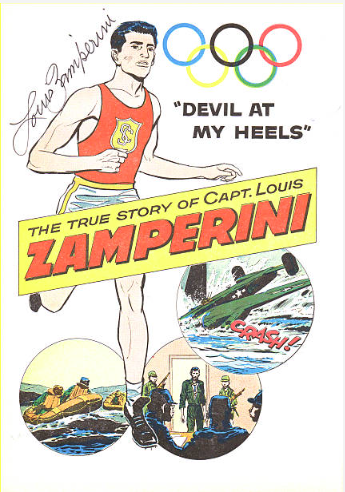
The “Torrance Tornado” is used to introduce chapters early on in both Zamperini’s own account of his life (first penned in 1956 and revived in 2003) called “Devil at My Heels, and in Laura Hillenbrand’s 2010 best-seller “Unbroken.”
His personal best marks on the track have been recorded as 1:53.2 in the 800 meters (1938), 3:52.6 in the 1,500 meters (1939), 4:08.3 in the outdoor mile (NCAA meet, 1938), 4:07.9 in the indoor mile (at Madison Square Garden in NY, 1940) and 14:46.8 in the 5,000 meters (1936). He held the Pacific Coast Conference record in the mile (4:11, in 1939).
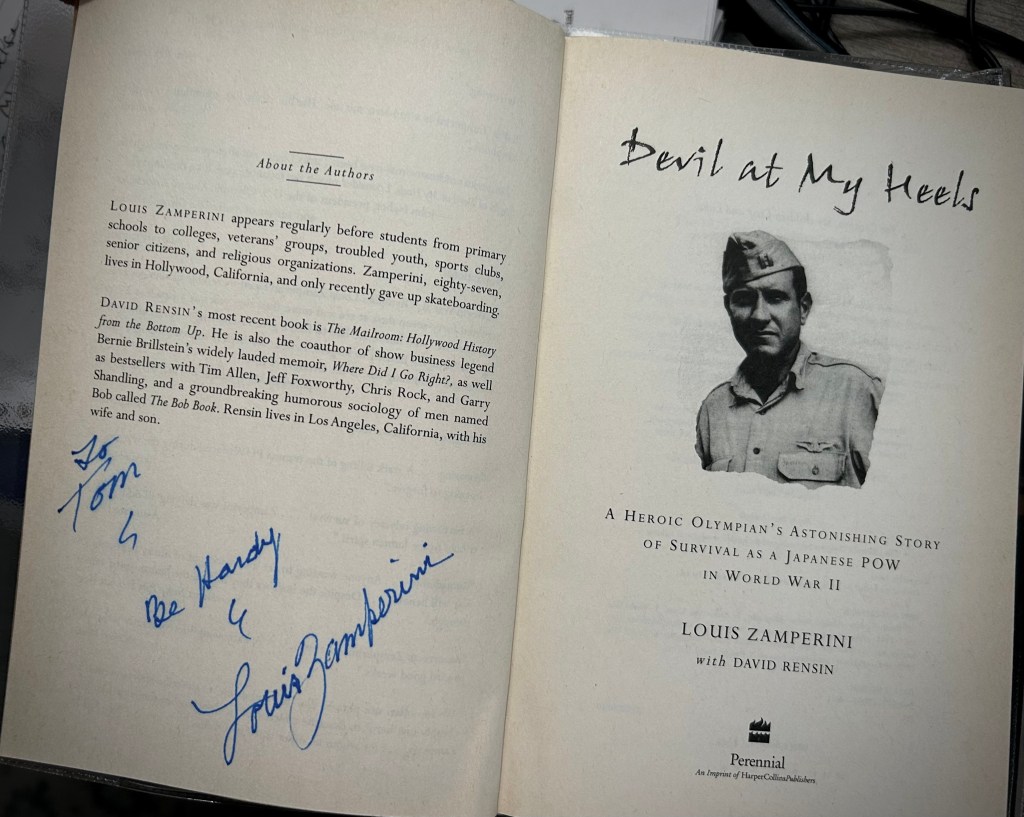
Both books establish how Zamperini, born in New York to Italian immigrants in 1917, moved with his family to Southern California at age 2, suggested by their doctor as a way to breather healthier air. The Gilded Age of New York’s urban ecology took a toll on many, including the Zamperini children. It was helpful that Zamperini’s Uncle Nick already lived in San Pedro.
After the family first settled in Long Beach, it found a 1912 Craftsman three-bedroom bungalow at 2028 Gramercy Street in Torrance, a city founded that same year. Zamperini writes in his book there were “more fields than houses and the barley rose three feet tall.”
But …
“Though I was born in America, I was made to feel like an outsider,” he explained. His family resisted speaking English and stayed true to their Italian roots. It was difficult to assimilate with all the prejudices in the neighborhood.
Louie was somewhat encouraged him to be incorrigible. Enough so that his father taught him the art of boxing to defend himself against taunting bullies who mocked his lack of English.
“An unruly troublemaker,” he called himself. Erratic and defiant. Smoking at age 5 by the railroad tracks. Drinking beer underage in Hermosa Beach during Prohibition. Picking fights, destroying property, stealing food.
At age 3, he jumped on a piece of bamboo and came within “a gnat’s eyelash” of losing his toe, leaving it dangling, until his mother took him to the next door neighbor, a nurse, who stitched it back on. It was the start of a pattern where he overcame all sorts of injuries. At 10, he ran an iron pipe into his hip bone. At 16, he suffered a splintered knee when he was tossed by a bronco in a rodeo. At 17, he fractured his ankle when he was kicked by a horse. By 18 he tore a ligament in his left leg in an automobile accident. At 20 he broke an ankle while skiing.
The opposite of his older brother Pete, a star miler on the high school track team, model student. Who could live in that shadow? “He was my hero,” said Louie.
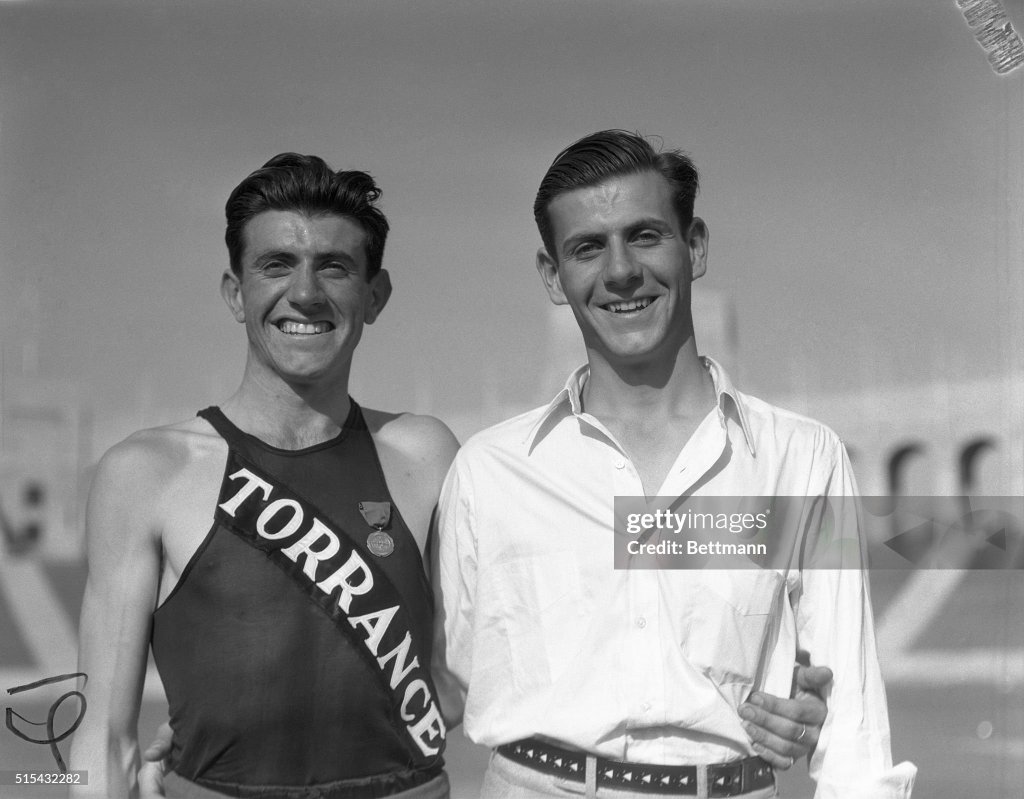
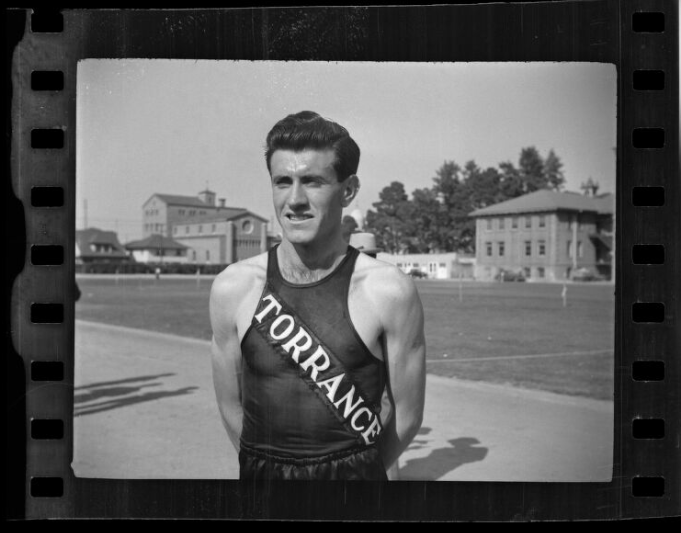
Soon after Louie started ninth grade at Torrance High in February of 1932, the principal tried to expel him for his antics, and the local police department agreed. Pete saved him by promising to channel his brother’s energy into running.
In his first 660-yard school race, he was so out of shape and embarrassed that some girls beat him. A week later, Pete entered Louie in a 660 yard race in a meet against nearby Narbonne High.
“A hundred yards from the tape, two Narbonne runners led,” Louie wrote. “Their third guy was back aways … I didn’t care whether I beat him or not; I was just doing my brother a favor. Then I heard the kids from my school hollering, ‘Come on, Louie!’ … Suddenly I felt a surge of adrenaline and beat Narbonne’s last guy by about a foot. …. Running might be worth it.”
He became motivated enough to train and make the L.A. All-City finals. His daily routine would be to run four miles from his home in Torrance to Redondo Beach, two miles along the beach, then four miles back. He’d even run in the nearby mountains, hunting rabbit and deer that his mom could later cook.
By February of 1933, he had his mom sew him a silk Torrance High track suit so he wouldn’t have to wear the school-issued wool. “My spindly legs still embarrassed me, so I warmed up behind the bleachers,” he wrote. He broke the school record in the mile at 4:58, held by his brother Pete, who by then had gone onto nearby Compton College soon to earn a USC scholarship.
An event at the L.A. Coliseum saw Louie break the state 1,320-yard record for Class B in 3:17. As a high school junior, he was running a 4:28 mile on Torrance’s sandy, oval track.
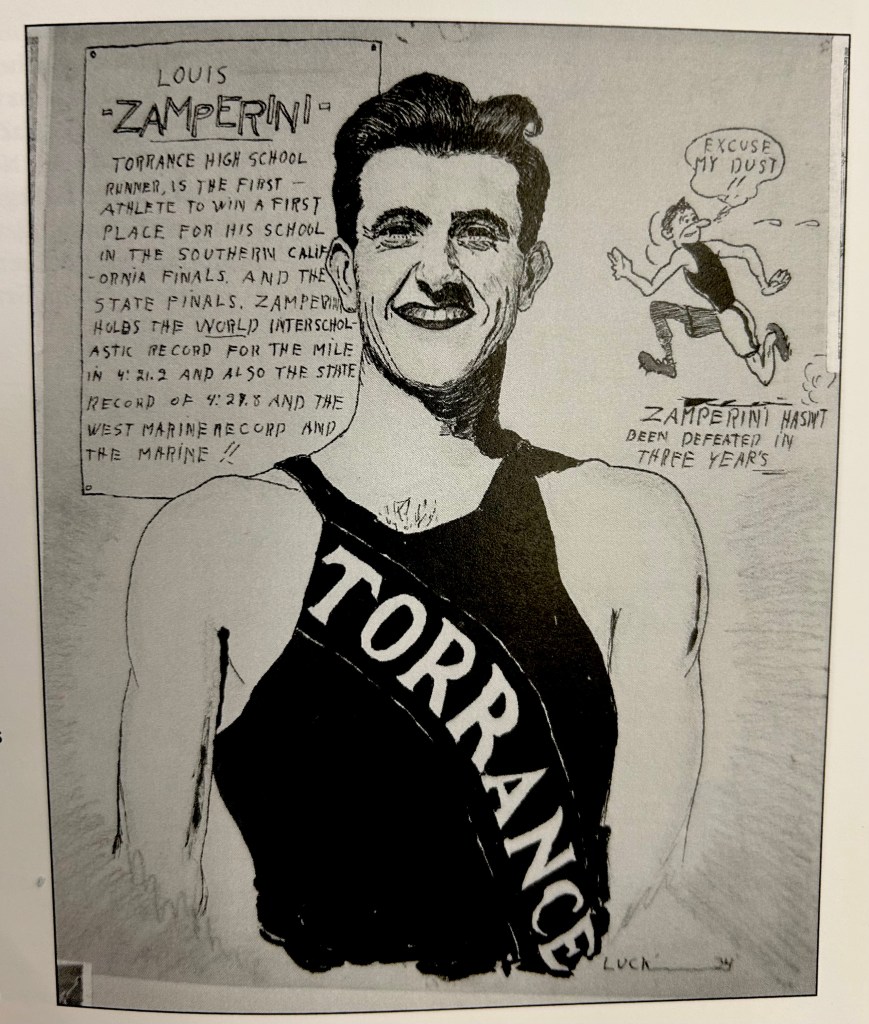
On May 19, 1934, the best milers met at the Coliseum. Pete’s strategy for Louie was to run the first three laps as close to his 1,320-yard time, then pour it on the last lap. At one point, Louie said he felt an opponent clip his heel, and it startled him so much that he took off and finished the last lap in 64 seconds. It broke what Louie was told had been the World’s Interscholastic Mile in 4:21.2, a time that had stood for 18 years going back to World War I.
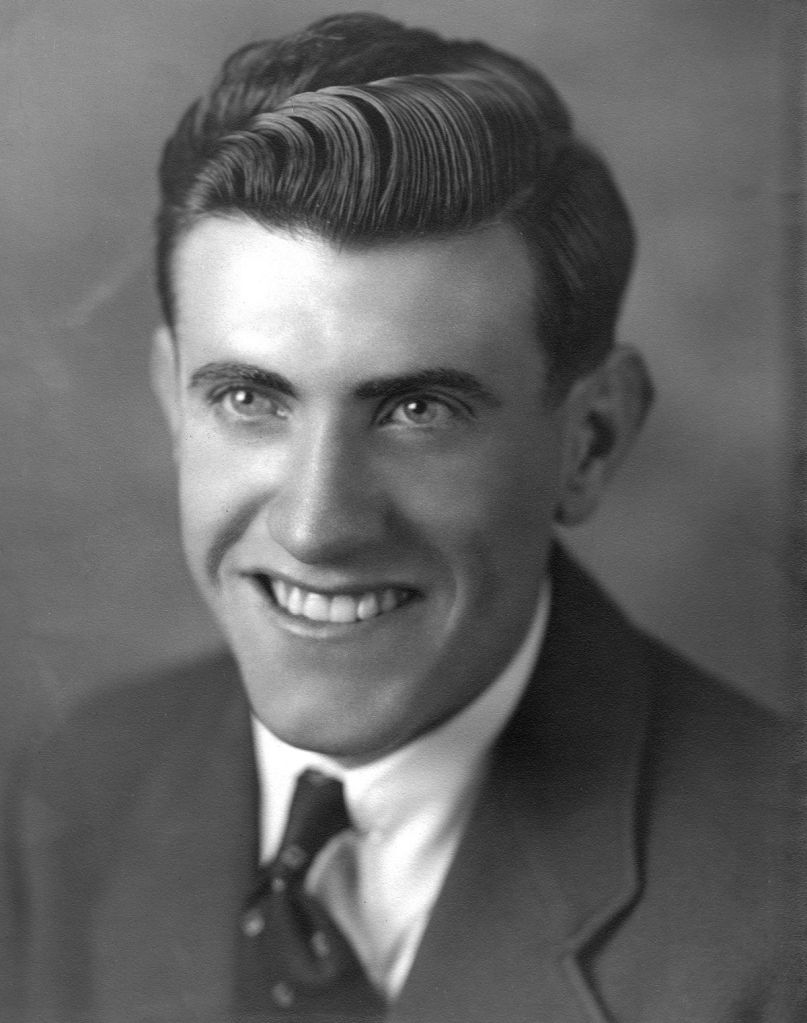
Louie’s new time would hold for another 20 years, until it was passed by Bob Seaman of Reedley, California in 1953, despite some later claims that it had been topped in 1946. He won the California State Meet mile later that year.
The student-body president by the time he was a Torrance High senior, Louie won the Los Angeles City mile at a time when the school was still part of the Los Angeles School District. His graduation in December of 1935 allowed him to focused on making the U.S. Olympic team in whatever event that fit best.
USC and the ’36 Olympics
Figuring out a way to enter the 1936 Olympics planned for Berlin delayed Zamperini’s acceptance of a USC track scholarship. There were no mile races in the Olympics — the 1,500 meters was known instead as the “metric mile” — and the U.S. team was already stacked at that event.
Pete urged Louie to instead work up to the 5,000 meters, a 12-lap race instead of the usual four-laps in the mile. But it would take some adjustments.
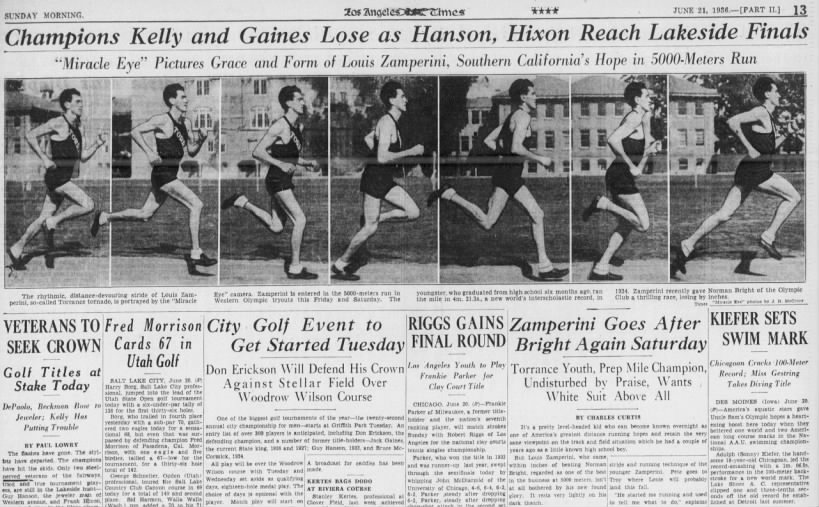
By the time he earned an invitation to the U.S. Olympic trials in New York, Louie was referred to in the Los Angeles Times as “The Torrance Tempest.”
To make the trip by train to the East Coast, thanks to his father working for Southern Pacific Railroad and getting one free round-trip pass to any destination, Torrance merchants from the city of about 2,500 people pulled off a scene from George Bailey in “It’s A Wonderful Life” and gave him a suitcase with “Torrance Tornado” stitched on the side. He quickly covered with masking tape to avoid the wrath of other athletes. (By the way, “It’s A Wonderful Life” didn’t come out until 1946.)
The Torrance Herald, a newspaper Louie once helped brother Pete deliver on his route, was said to be so invested in Zamperini’s success because of the business it drummed up, was said have insured Zamperini’s legs for $50,000.
“Whether Torrance realizes it or not, this recognition of Louis Zamperini, as the leading high school miler in the United States, means a lot to the community,” the Torrance Herald opined in 1935. “It means the city of Torrance will be mentioned in worldwide dispatches every time that Louis goes out for a major track meet. When he won his championship last summer, a Torrance resident on a visit to the old country read about his performance in a daily newspaper of that foreign land. Every other follower of sports in this, and every other country in the world, read about the black-haired, smiling youth from Torrance — a little city that is practically unknown outside of a radius of 100 miles or so, or was until Zamperini put it on the world map of sport.”
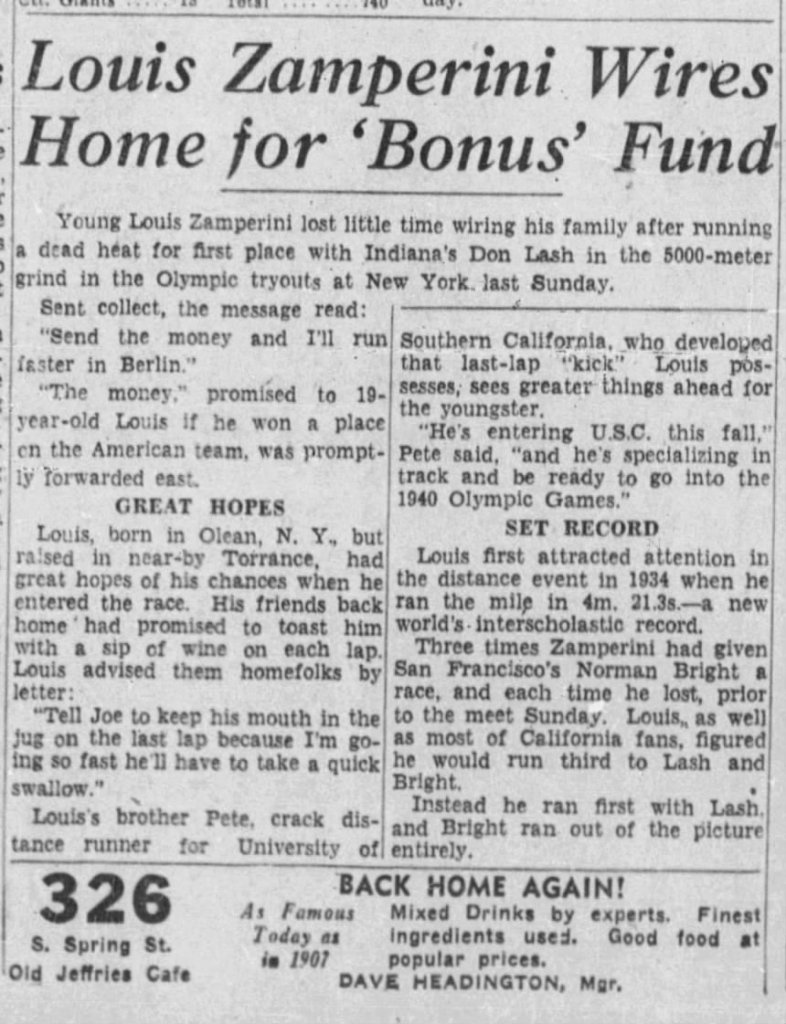
In a finish neither runners could determine the winner, Zamperini admitted he came out of nowhere by all the media projects and finished tied with Don Lash of Indiana University, allowing both to qualify for the Olympic Games along with San Francisco’s Norman Bright.
“The punk kid from California, the high school boy, was overjoyed at having prevailed,” Louie wrote in his book.
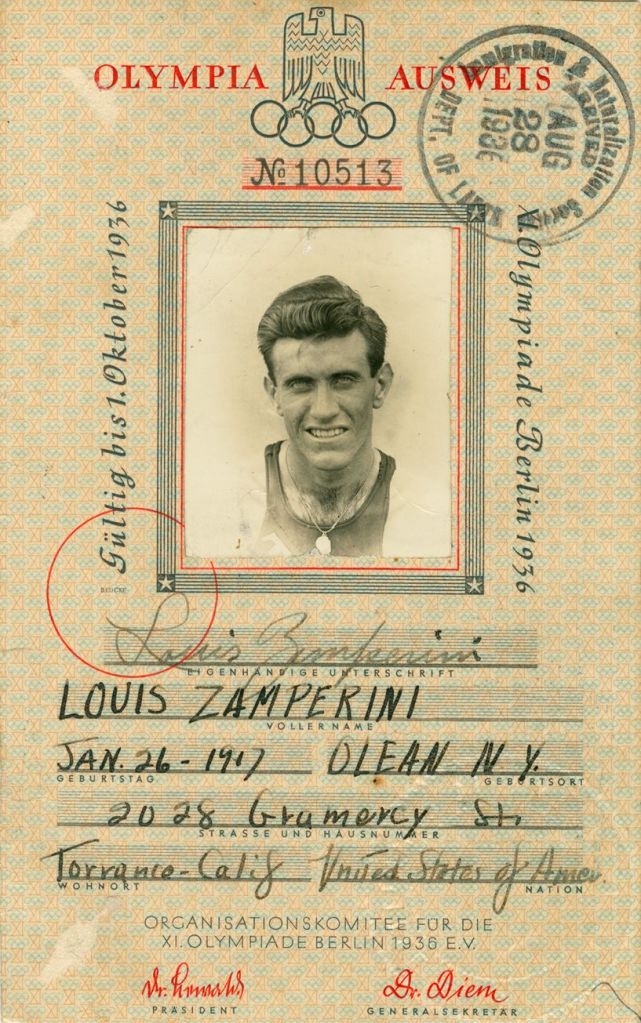
At the Berlin Games, the 18-year-old participating as the youngest in the U.S. delegation wore paper number 751 in the 5,000 meter finals. Zamperini may have had a seventh-place finish and did not medal, it wasn’t without a flourish. He ran a final lap in an astounding 56 seconds to finish in 14:46.8, the best by any American that year by more than 12 seconds. Lash finished 13th.
Zamperini may not have been as famous as U.S. teammate Jesse Owens, but people knew him now. He said he did briefly meet Hitler, who shook his hand and said, “Ah, you’re the boy with the fast finish.”
Zamperini decided to then go out and, after some bar hopping, stole a Nazi flag at the Reich Chancellery where Hitler had just entered. Nazi guards stopped him. He talked his way out of trouble, saying he just wanted a souvenir. The press caught wind of it and reported that he had “stormed Hitler’s palace” and “bullets whistled around his head.”
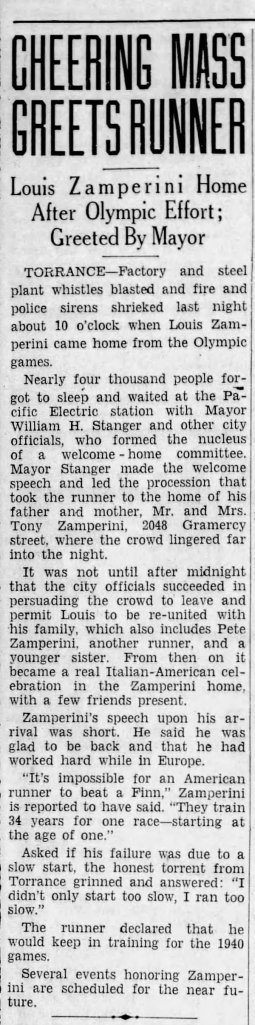
Some 4,000 people back in Torrance cheered him in a parade as Louie was driven around on a flat-bed truck. Then it was back home for a “real Italian-American celebration at the Zamperini home,” as the local newspaper reported.
Already imagining what he might do to stay in shape and qualify for the 1940 Summer Olympics planned then for Tokyo, Louie started his studies at USC and kept racing. He would sneak into the Coliseum and run up and down the stadium aisles until his legs were numb in training.
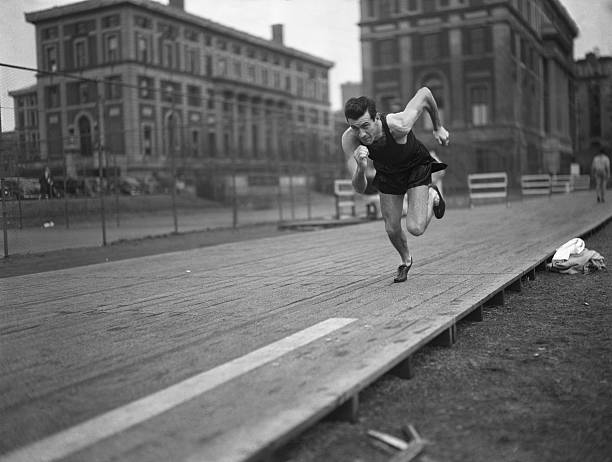
As he narrowed his time in the mile down to 4:13.7, not far off the world record, the media’s focus on if anyone could record a sub-four-minute mark. It wouldn’t come to be until England’s Roger Bannister did it at Oxford University in May of 1954.
The USC suspension
Zamperini’s sub-four-minute goal heading into the NCAA Championships in Minneapolis, set for June of 1938, was in jeopardy.
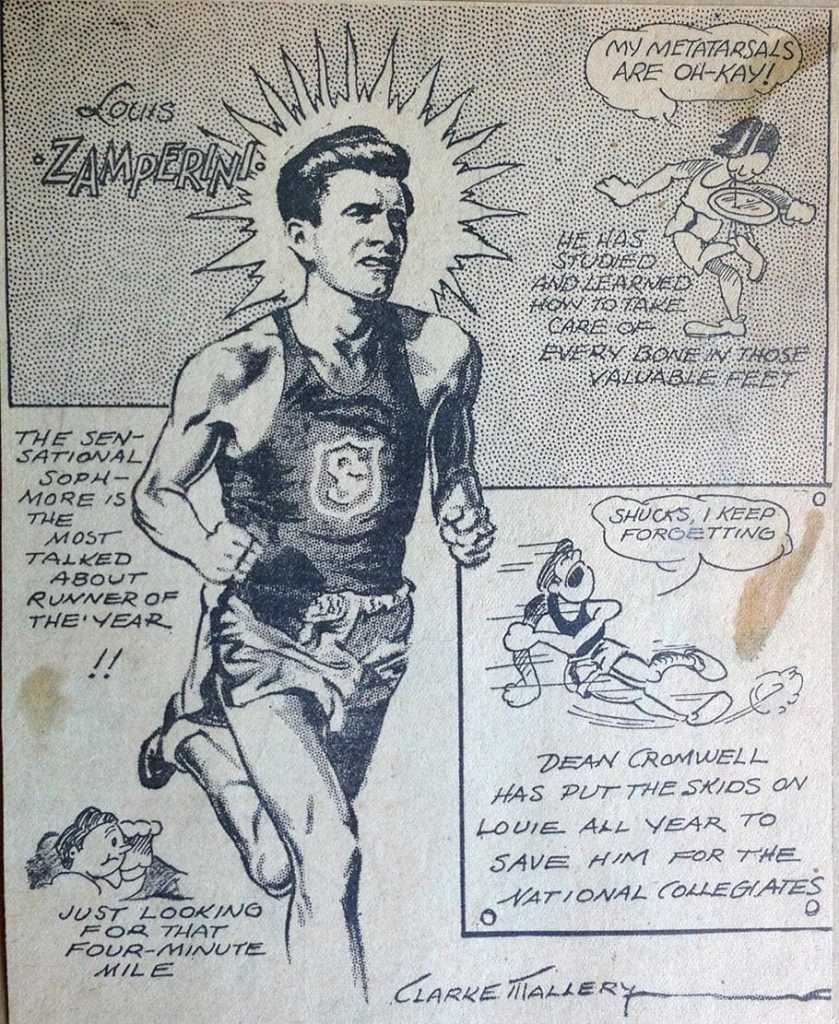
“Zamperini Barred from Coast and NCAA Meet — Only a Sophomore, Louis’ Career Already Botched,” said a headline in the San Diego Sun on May 22, 1938. The Los Angeles Times’ story the same day explained how USC coach Dean Cromwell suspended him “for failure to compete” in the Compton Relay Carnival the previous night, on top of a claim he demanded “excessive expense money” from the organizers. It was said to be $200.
Some 6,000 fans appeared in Compton to watch Zamperini run against Indiana’s Lash in the 1,500 meter rematch, but Zamperini was a no-show. Lash was reported to have received $200-plus for plane fare from Indiana.
Cromwell said Zamperini would not compete in the Pacific Coast Conference meet at Berkeley.
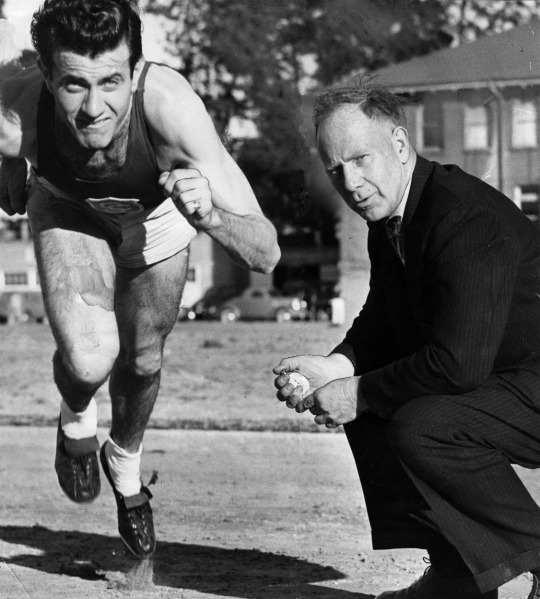
Zamperini released a three-page statement to the media, with the L.A. Times report crediting Zack Farmer, former manager of the L.A. Coliseum and managing director of the 1932 Olympics, for advising him to apologize.
“I realize my stubbornness has caused all this fuss:” Zamperini said. But he called the demand for a payment “a contemptible lie!” Zamperini said his weight was down and he was “saving myself” for the PCC meet. AAU officials said there was no action for suspending his amateur status.
On June 11, Zamperini was reinstated by the school, a week before the NCAA championships.
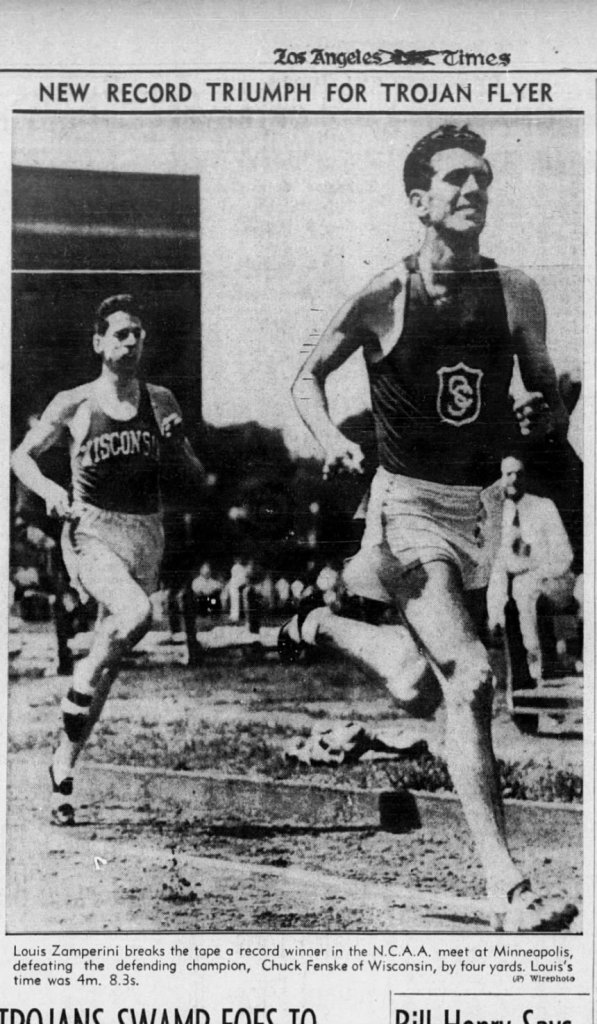
Post-Olympic success, and another mile record
Despite getting boxed in and spiked by rivals, Zamperini pushed through and recorded what was the fastest NCAA mile in history at 4:08.3, fifth-best ever outdoors. It was short of the world mark by 1.9 seconds. It was an NCAA record that stood for 15 years.
During an April, 1939 tri-meet at UCLA, Zamperini won the mile in 4:24.7 as well as the two-mile in 9:12.8, the fastest ever run by a college athlete on the Pacific Coast. In a May, 1939 race, the Los Angeles Times reported on USC’s 81-50 win at Stanford in a head-to-head meet by including how Zamperini, “the best showman on the USC team, allowed (Stanford’s) Marston Girard to stay with him for three and three-quarter laps and then ran away from him in the stretch. The time was 4m, 19.4s, because Louie wanted to make it look like a race.” The Oakland Tribune reported that “Girard faded as if he were being shoved backwards.” Zamperini was also second in the 880-yard run.
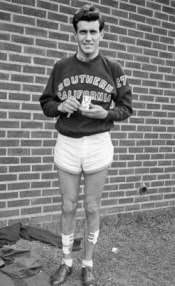
The Coliseum hosted the 1939 NCAA championships and saw Zamperini contribute to USC’s fifth consecutive title by running a 57-second final lap in the mile, going from fifth to first to defeat Wisconsin’s Walter Mehl by five yards in 4:13.6. Stanford’s Girard was fifth.
Competing in more meets at Madison Square Garden and at the Boston Garden, Louie not only kept shaving seconds off his time, but the world wasn’t ready for such headlines. War was eminent.
In April 1940, Louie had been back at USC reading about Hitler’s blitzkrieg across Europe. Finland, which had been preparing now for the 1940 Games after Tokyo relinquished, saw its track stadium collapse under Soviet bombing. The Summer Olympics were canceled.
The news left Louie “unmoored” as Hillenbrand wrote in “Unbroken.” During USC dual meet win over Stanford at the Coliseum, Stanford’s Paul Moore defeated Zamperini in the mile, running 4:11.5, to break the meet record Zamperini set in 1938 of 4:16.0.
War calls
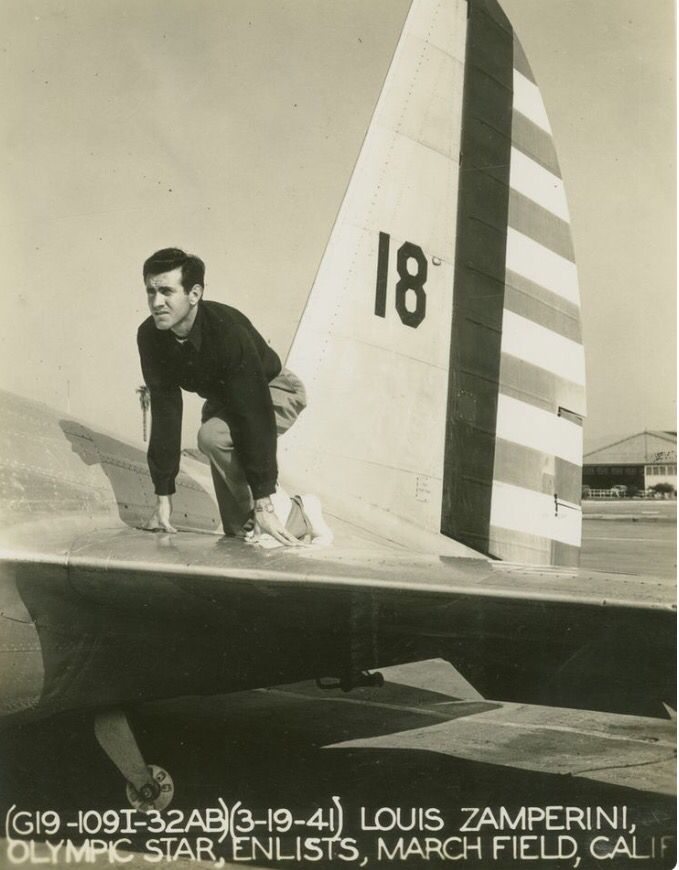
A few credits short of getting his USC degree, Zamperini left the campus and took a job as a welder at Lockheed in Burbank, which punched out aircraft for the Army nearby.
By March of 1941, he signed up to join the Army Air Corps as a flying cadet, but soon bailed out.
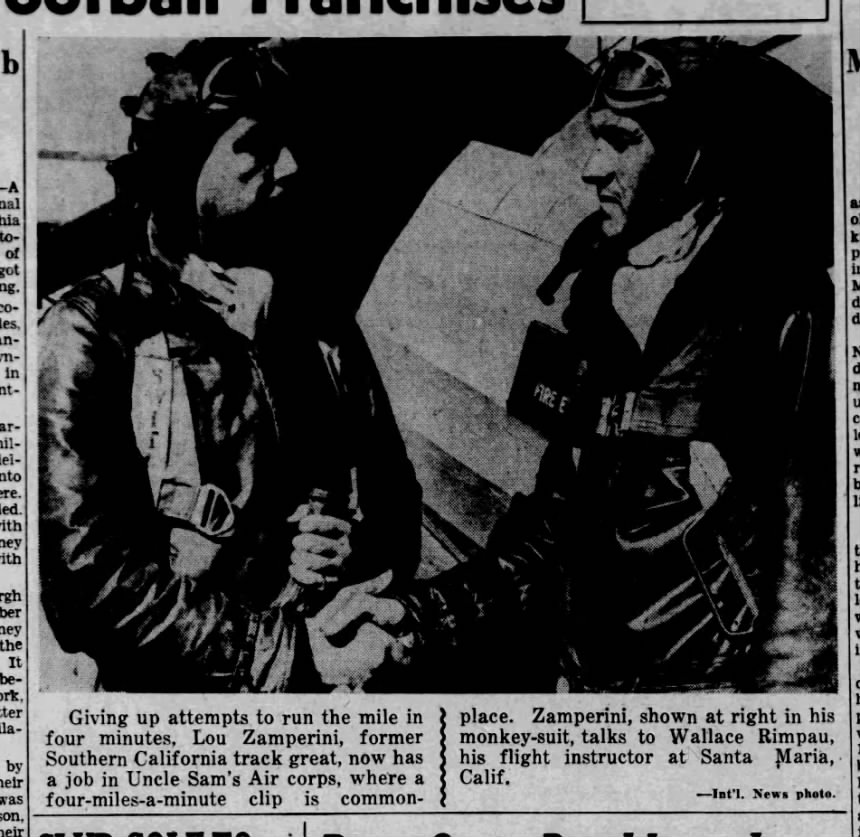
He was dabbling as a movie extra on the set of “They Died With Their Boots On,” starring Errol Flynn as Colonel George Armstrong Custer, shot in Agoura, Calabasas and Chatsworth, when news came that he was drafted in September. He reported to Fort MacArthur and was made into a bombardier.
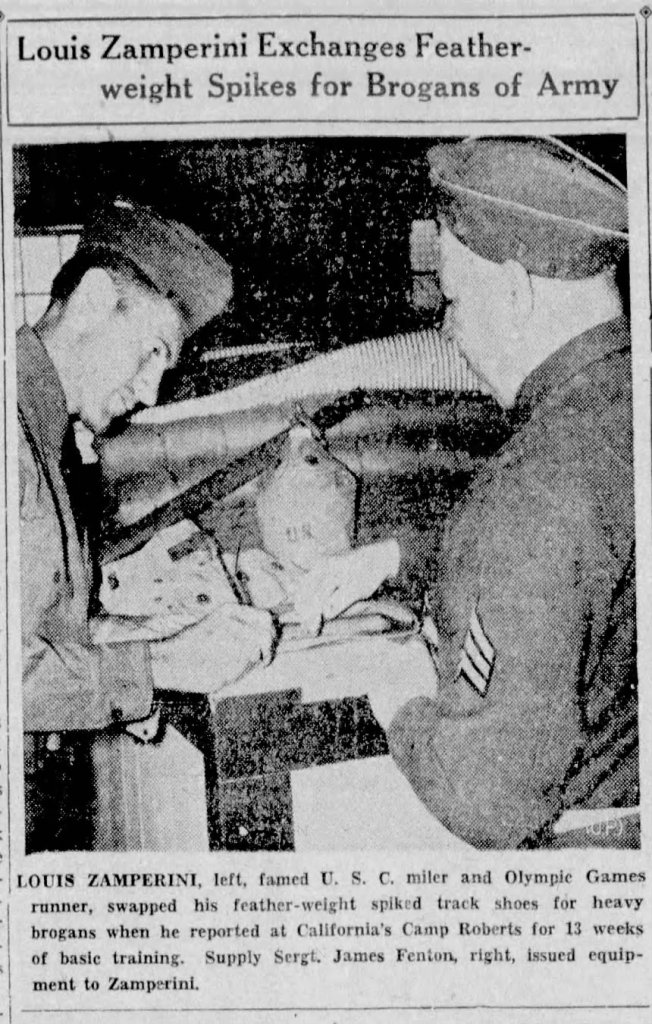
There is little doubt he would have made the U.S. 1940 Olympic team — Zamperini was the 1939 and 1940 NCAA mile champion and place high in the 1938 and 1939 National AAU mile. His times measured up to the best of the day posted by legendary American milers like Glenn Cunningham, Gene Venzke and Archie San Romani.
His days as an athlete would never see another Olympic Game, another track meet. But his Olympic fame would follow him.
“Absolutely, my athletic background saved my life”
Columnist Woody Woodburn, an avid runner himself as he wrote for The Ventura County Star and Daily Breeze of Torrance, caught up with Zamperini, then 83, for a column headlined “The Toughest Miler Ever.” It was featured in the Best American Sports Writing anthology of 2001.
In a discussion of the details of his time as a captain in the U.S. Army Air Forces between 1941 to 1946, earning a Distinguished Flying Cross with the 372nd Bomb Squadron, Zamperini sat in his office at the First Presbyterian Church of Hollywood and surmised that “in ’40 and ’44, I would have been at my running peak. Those would have been my Olympics. I’d have brought home a medal. Or two. … It doesn’t bother me. Not after what I’d gone through.”
An interview with the Associated Press that ran in January of 1943 gave Zamperini an opportunity to talk about how he was part of his first combat flight out of flight training school, part of the Wake Island raid on Christmas Eve, 1942. He awarded a medal for his deeds.
“Nobody was scared,” he said. “I think everyone had an excited jumpy feeling — exactly the same as that one gets before a big race. I’ve been scared more before a race against Cunningham, Venzke and Fenske that I was that night. … As a bombardier, I have all the fun. The Japs were asleep for along while. My plane was one of the last in the formation. We thought we’d get out without having to face gunfire. Then they opened up but none of our planes was hit and got back all right. Only one Jap plane pursued us. I made certain he did not land on his return. I saw him taking off and dropped a 500-pound bomb on the runway. … The raid like that burns up as much energy as a good mile race.”
Then came May 27, 1943.
Zamperini’s B-24 Liberator went down in the Pacific as his group was flying a secret experimental mission south of Hawaii. Eight of the 11 aboard were killed in the crash. Only Zamperini, co-pilot and Second Lt. Russell Phillips, and tail gunner, Sgt. Francis “Mac” McNamara survived. But they seemed to be the only ones aware of that reality.
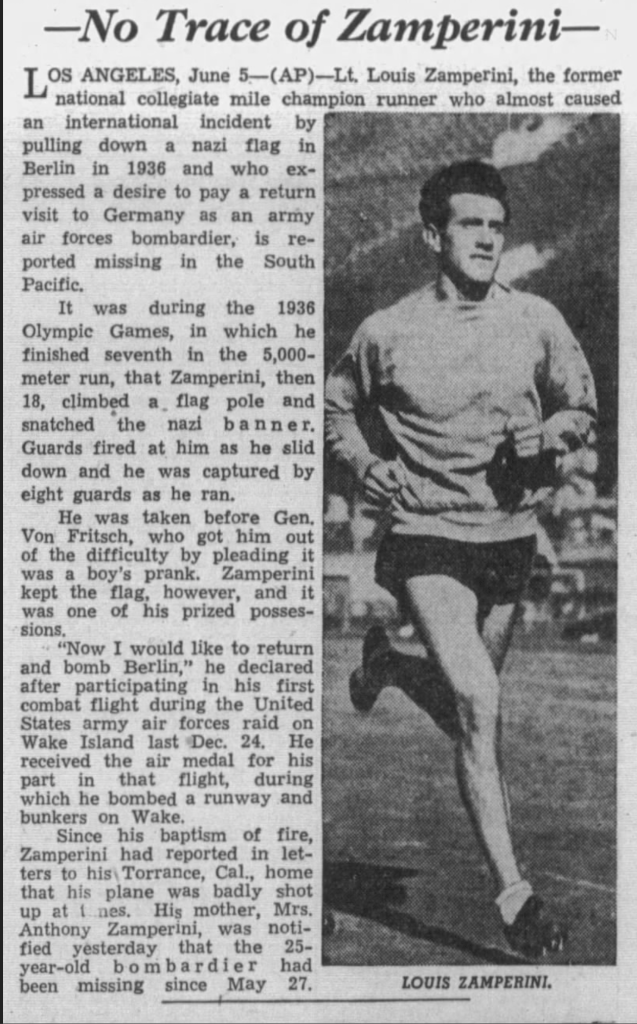
In June of 1943, Anthony and Louise Zamperini received the following message at their Torrance home regarding their son — with a reference to the word “unbroken”:
“In grateful memory of First Lieutenant Louis S. Zamperini, A.S. No. 0-663341, who died in the service of his country in the Central Pacific Area … He stands in the unbroken line of patriots who have dared to die that freedom might live, and grow, and increase its blessings. Freedom lives, and through it, he lives — in a way that humbles the undertakings of most men.”
It was signed, “Franklin D. Roosevelt, President of the United States.”
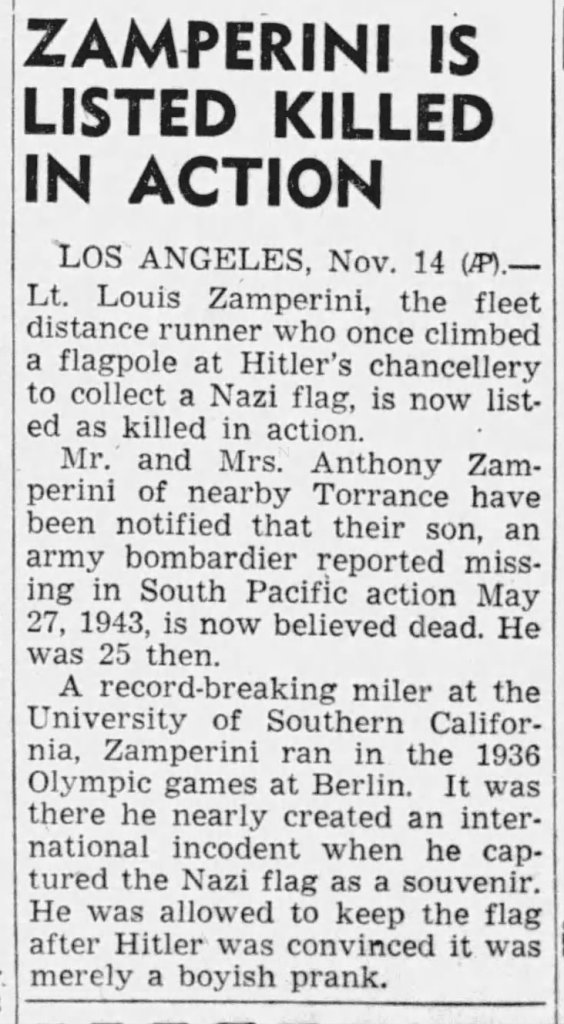
By November of 1944, obituaries appeared in newspapers as carried by the wire services as he was officially declared dead. He was listed among some of the noteworthy former U.S. athletes who died in combat such as USC and Olympic sprinter Charlie Paddock and star Iowa football player Nile Kinnick.
A February, 1945, the Intercollegiate Association of Amateur Athletes of America track meet at Madison Square Garden honored him with what it called the “Zamperini Invitational Mile.” Some newspapers referred to it as the Zamperini “Memorial” mile. Zamperini’s parents refused to allow it to be called a “memorial” anything. They didn’t believe he was dead.
Because, as it turned out, he wasn’t.
After Zamperini and his two crewmen managed to get out of the wreck and climb into a life raft, they floated for 47 days and drifted about 2,000 miles in the Pacific Ocean, battling shark attacks, eating albatrosses and other small fish for survival, trying to stay focused.
“The 5-foot-9-inch Zamperini, who weighed 160 pounds when The Green Hornet crashed, was down to 67 points, and about 37 were his heart,” wrote Woodburn of his situation.
A Japanese fishing boat found them near the Marshall Islands. By that time, McNamara had died. They were arrested, brought to shore, and shuffled from island to island before landing in a POW camp in Japan in September of 1943.
“I thought to myself, ‘Six weeks ago, I was a world-class athlete,” ’ Zamperini told the Associated Press in 2003. “And then, for the first time in my life, I cried.”
For the next 28 months, Zamperini survived beatings, starvation, debilitating illnesses and psychological torture. It designed to break him down and make an example of the famous Olympian-turned-war hero. A newspaper clipping he carried with him of his track celebrity status gave the Japanese incentive to break him down even more.
Marine Corps Maj. Greg ”Pappy” Boyington, who had been held at the same POW camp with Zamperini, wrote in his own 1958 book, ”Baa Baa Black Sheep,” which was later made into a 1976 TV series, that Zamperini kept the men’s minds off their miserable situation by decribing Italian recipes to them.
Zamperini admitted to Woodburn he thought the worst pain he could imagine came when he ran that first 660-yard race as a Torrance High freshman. But it turned out, that experience gave him the strength he could resource for his survival.
“Absolutely, my athletic background saved my life,” Zamperini told Woodburn. “Track and field competition sharpens your skills. I kept thinking about my athletic training when I was competing against the elements, against the enemy, against hunger and thirst.
“In athletics, you learn to find ways to increase your effort. In athletics, you don’t quit — ever. I ‘m certain I wouldn’t have survived I hadn’t been an athlete.”
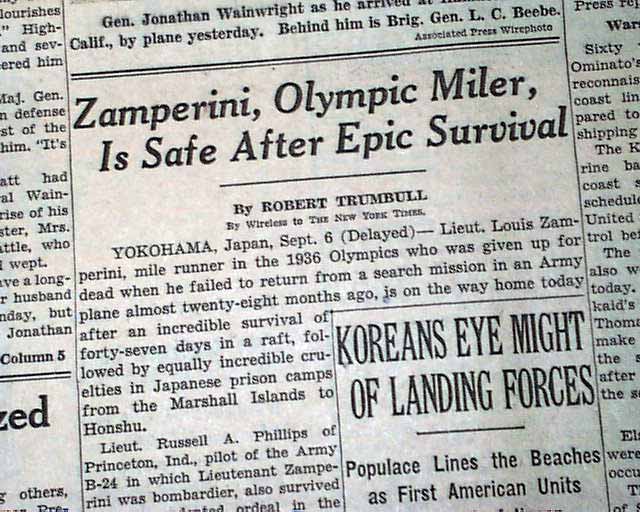
When the war ended and Zamperini was released by his captives in September of 1945 after the Japanese surrender, he met a New York Times reporter. He told him who he was. The reporter didn’t believe him, having read about his death. Zamperini managed to convince him by producing a USC university card, one of the few possessions he had.
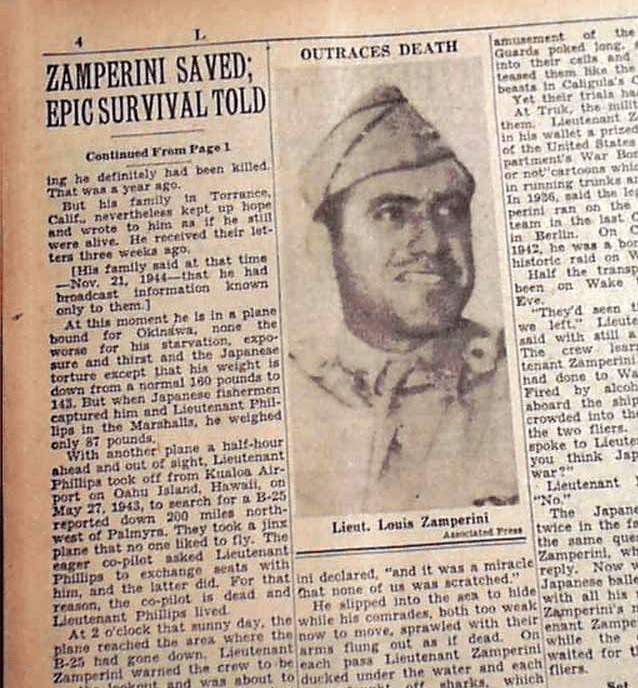
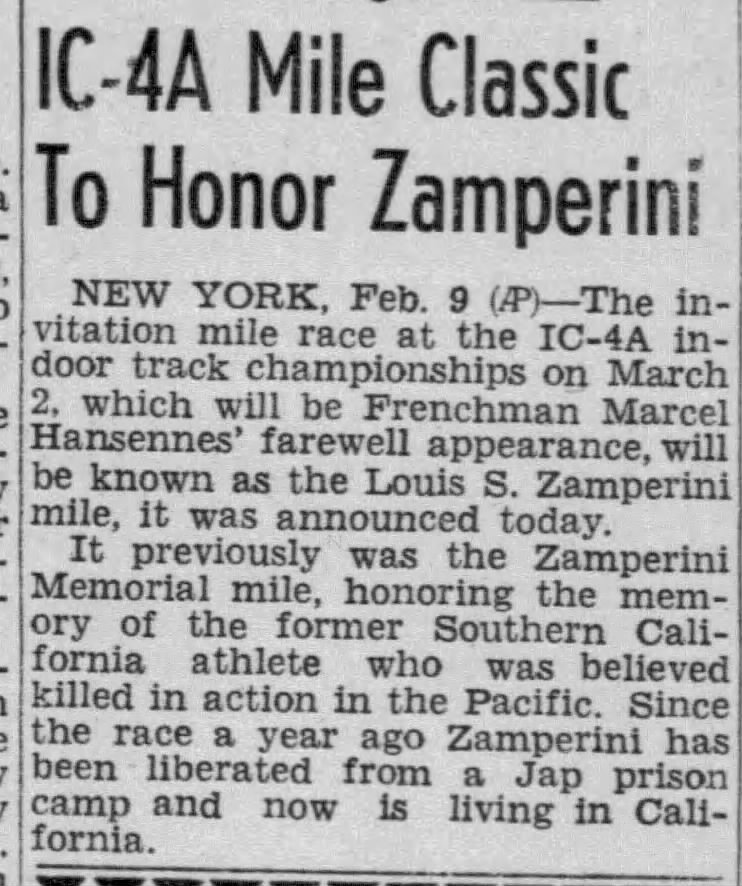
Woodburn wrote that as Zamperini weighed just 80 pounds as the end of the war, he had to try to reconcile what might have been as far as his athletic career.
“He never won the Olympic medal — or two — he once thought he would,” Woodburn wrote. “But he was a mettle winner. He already proved himself to be the toughest miler who ever lived.”
As proof, when Madison Square Garden held its Zamperini “Memorial” Mile run in February of 1946, Zamperini showed up so he could watch it.
The most important memory Zamperini still held onto, as he talked to Woodburn, was the time back decades earlier when he ran that 660-yard event for Torrance against Narbonne.
“That’s the race I remember most fondly, even more than the Olympic race in Berlin, more than the NCAA titles,” he said. “Truthfully. You have to understand, that race changed my life. I was shocked to realize people knew my name. You never forget your first ‘anything,’ and that was my first taste of recognition.”
The journey of redemption
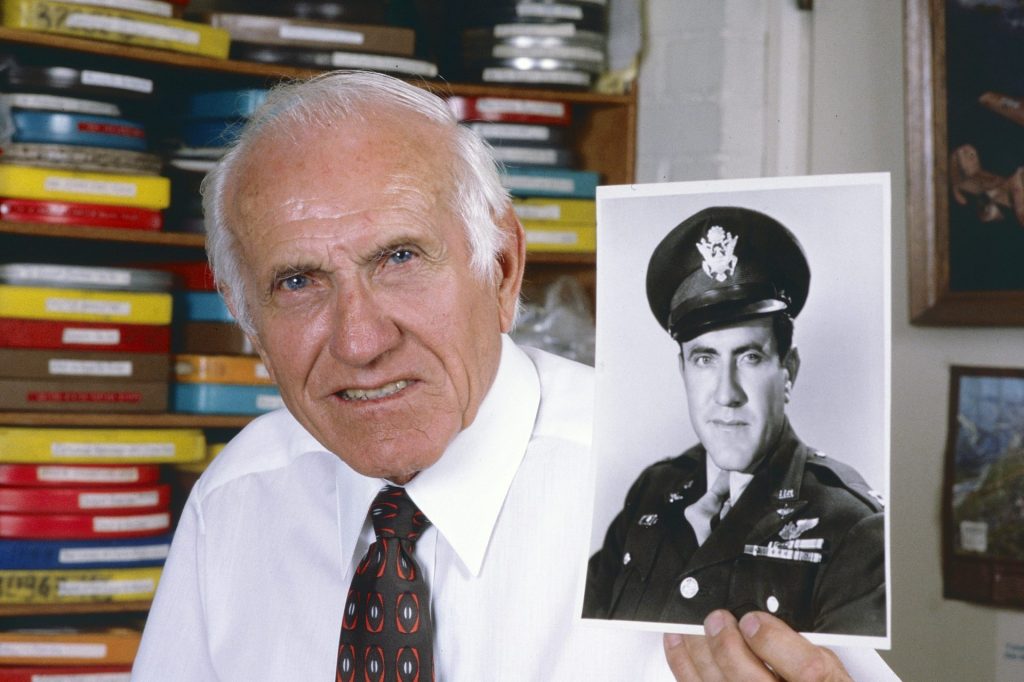
In February of 2011, after Hillenbrand’s “Unbroken” book came out and prior to a release of the film by the same name, USC adjunct journalism professor of sports, media and business Jeff Fellenzer brought Zamperini into his Journalism 380 class.
His students were awestruck by the stories he told.
Zamperini wondered what he had left to possibly make a run at the 1948 Summer Olympics in London. He started working out slowly at L.A. City College track and eventually “I bore down, running for six weeks wearing heavy tennis shoes,” he wrote in his 2014 book, “Don’t Give Up, Don’t Give In.”
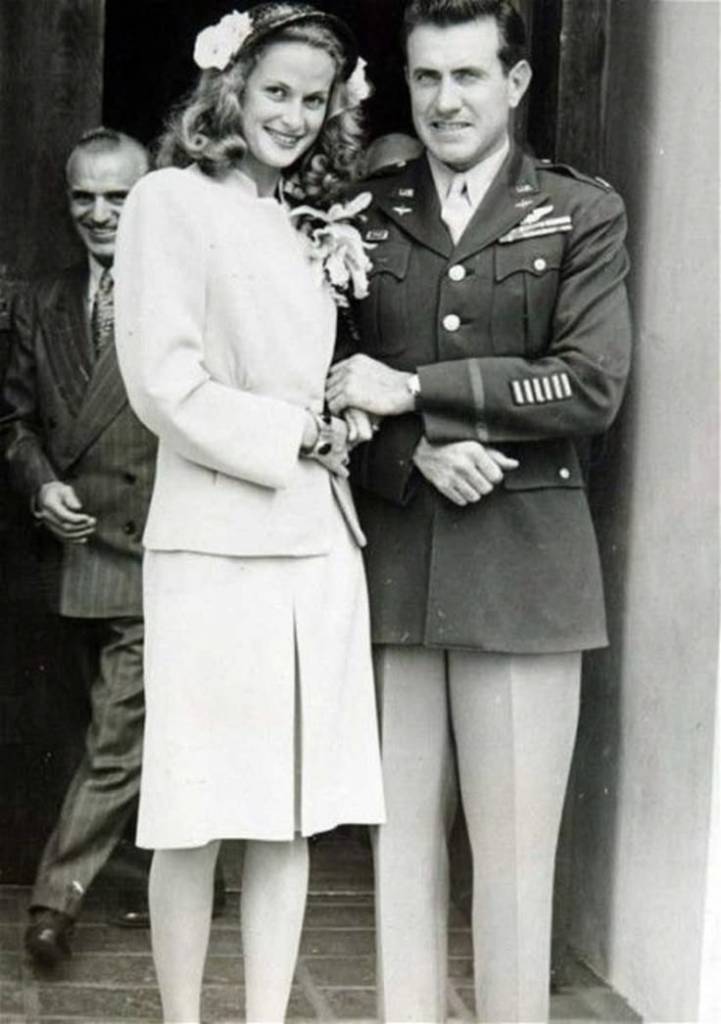
His new bride, Cynthia, called out his times in the mile with a stopwatch as he felt it was time to fully test himself. His first lap was 68 seconds. At the halfway point he was at 2 minutes, 17 seconds.
“That couldn’t be right,” he wrote. “I couldn’t be slowing down. So I pushed harder, and when I did I felt something go wrong in my ankle and searing pain in my calf. These were old injuries. I ignored them. But by the final lap I had nothing left. My trademark kick was gone.”
Zamperini collapsed on the infield grass with a time of 4 minutes, 28 seconds, hardly a competitive time. Sweden’s Gunder Hagg set the world outdoor best of 4:01.4 in 1945 and that hadn’t been touched in three years.
“Cynthia tried to be supportive, even weathered my anger, but she knew better,” Zamperini wrote. “My dream died there and then. I became a victim of the war in the one pursuit that had always mean the most to me: Running. I had quit drinking to train. Now I had no reason to deny myself.”
He spiraled into despair, his life events catching up with him. His years of malnourishment and torture left him despondent, then dependent on alcohol to stave off nightmares and flashbacks.
Zamperini said he was saved from his posttraumatic stress after witnessing a sermon by 30-year-old evangelical preacher Billy Graham during his Los Angeles Crusade of 1949, held in a circus tent that drew 6,000 people at a time. It was erected in a parking lot at the southeast corner of Washington Boulevard and Hill Street that once was the site of the Washington Park baseball field.
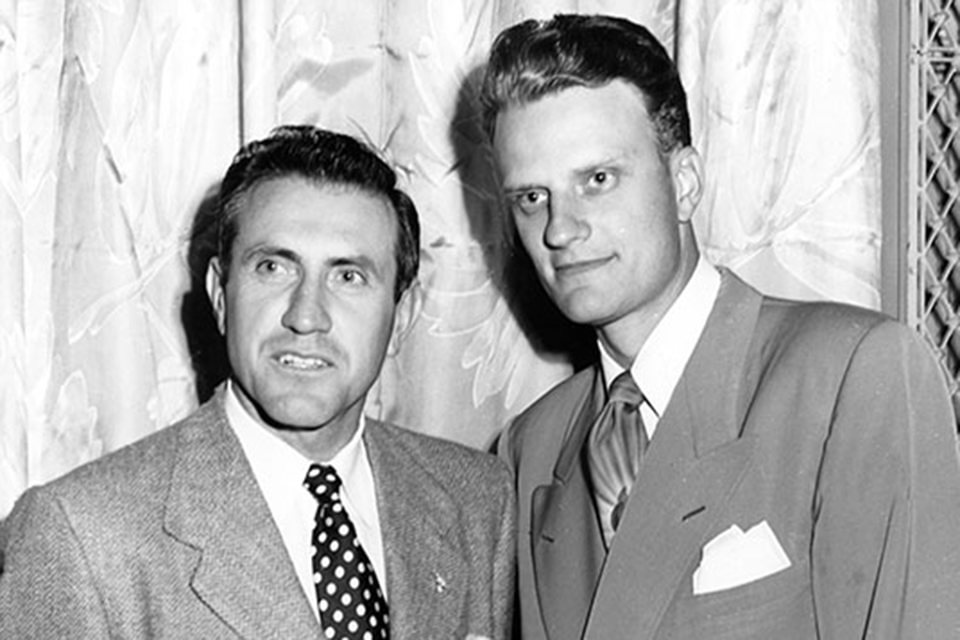
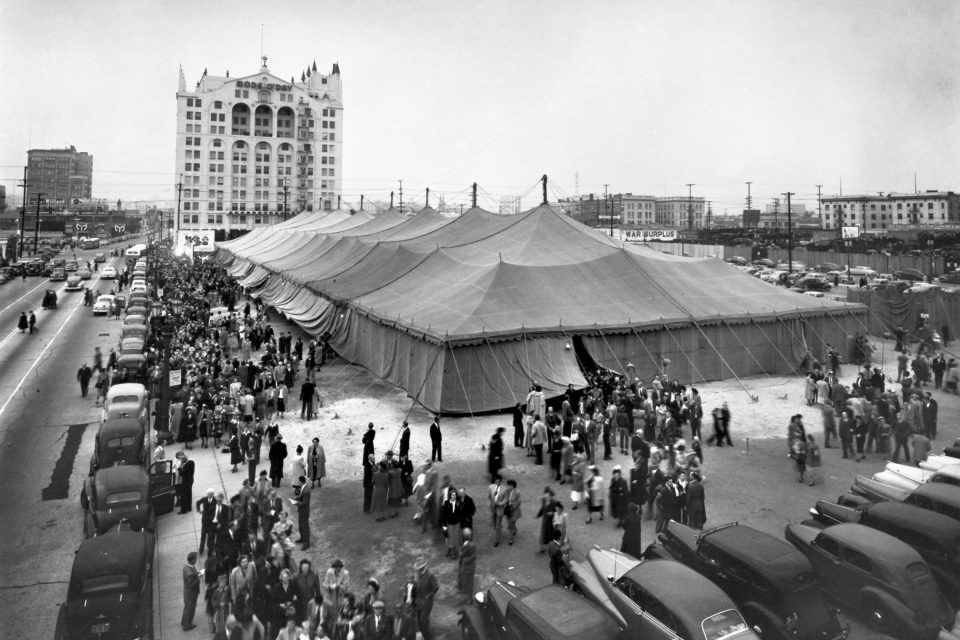
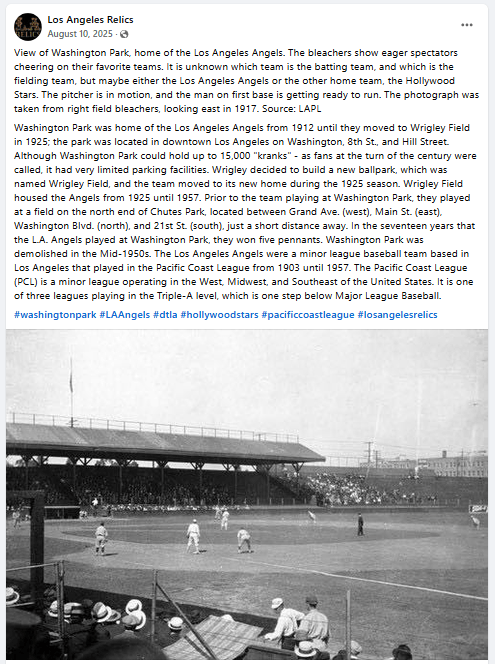
Because of Graham’s Los Angeles crusade, the concept of evangelicalism was introduced as an influential force in American culture, picked up by the media — especially William Randolph Hearst’s Los Angeles Examiner newspaper, whose office building was just up the street. Zamperini’s revelation of redemption made him one of several famously known people attached to the event’s history.
In 1950, Zamperini was compelled to return to Japan for the first time since his liberation to address the Japanese war criminals that were held at Sugamo Prison in Tokyo. While there, he shook hands and embraced many of his old camp guards. But he had one more person he wanted to meet.
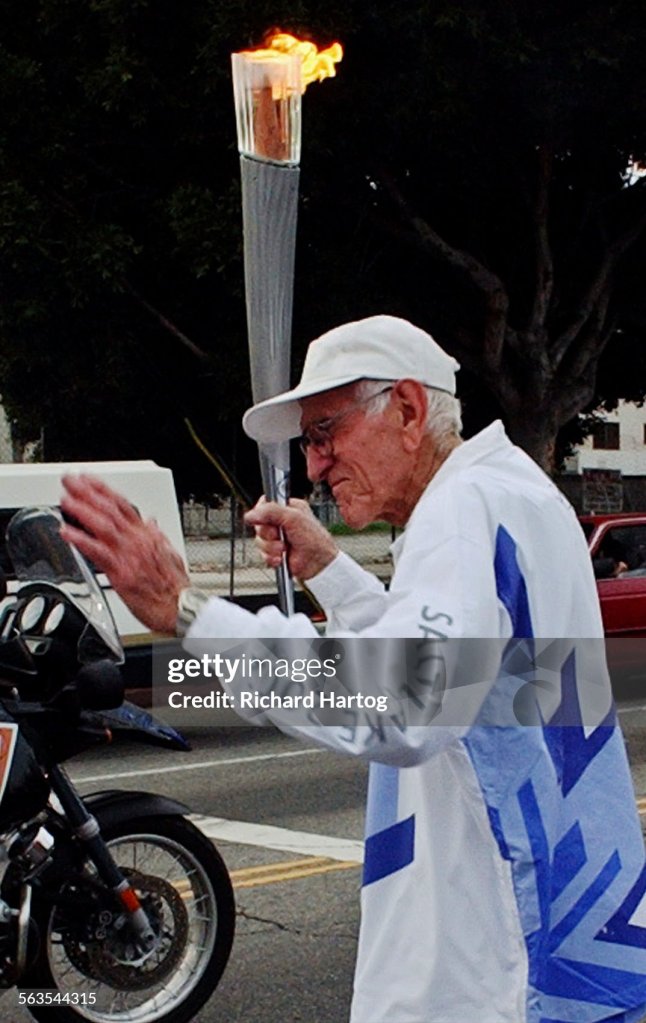
By age 81, Zamperini had been a five-time Olympic torch-bearer, including participating in events leading up to the 1984 Los Angeles Summer Olympics, 50 years after he set the national high school mile mark.
After he walked a leg in the torch relay for the 1988 Winter Olympics in Nagano, Japan, Zamperini expressed an interest in meeting his most brutal wartime tormentor, Mutsuhiro “The Bird” Watanabe. But Watanabe, who escaped prosecution as a war criminal, refused to see him, according to his family. Zamperini could only have the knowledge that he wrote him letter, forgiving him of his actions. Again, the Olympics were a catalyst of his journey of redemption.
Fellenzer, who previously had USC alum Zamperini as a guest in his class in 2007, said this 2011 visit led some students to have tears in their eyes. The presentation included watching a 40-minute video about Zamperini that had been produced by CBS for the 1988 Games before seeing Zamperini walk into the classroom theater stage.
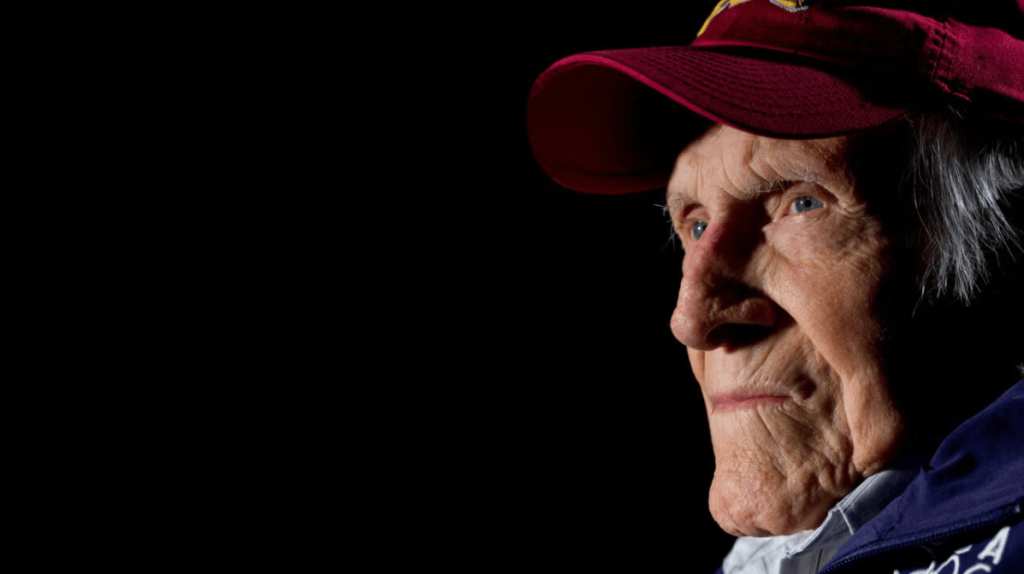
“Spontaneously, the students rose from their seats in unison and began to applaud, the intensity rising as the well-dressed man — 93 years young, wearing his trademark USC cap — walked slowly down the aisle and headed to the stage,” Fellenzer wrote. “For the next hour or so, the students listened intently, asked questions and engaged their new best friend on a variety of topics.”
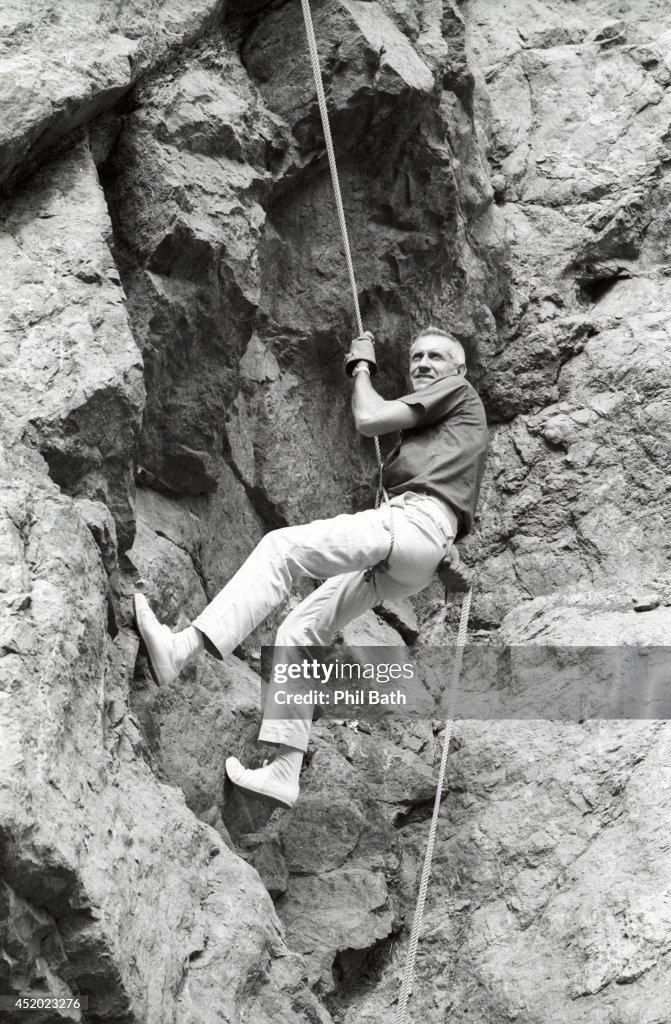
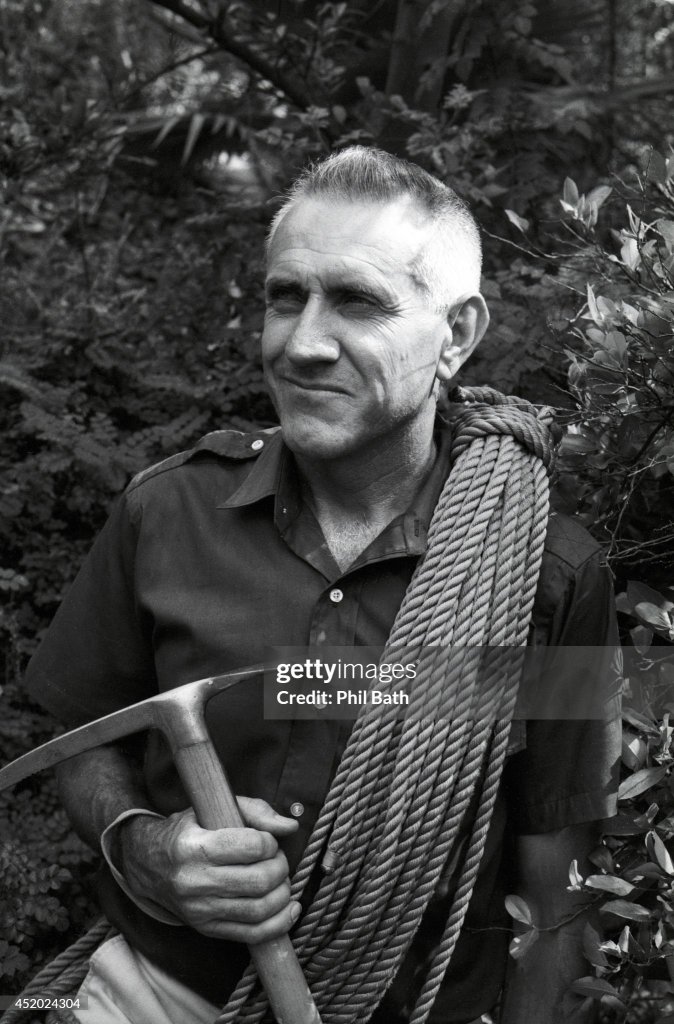
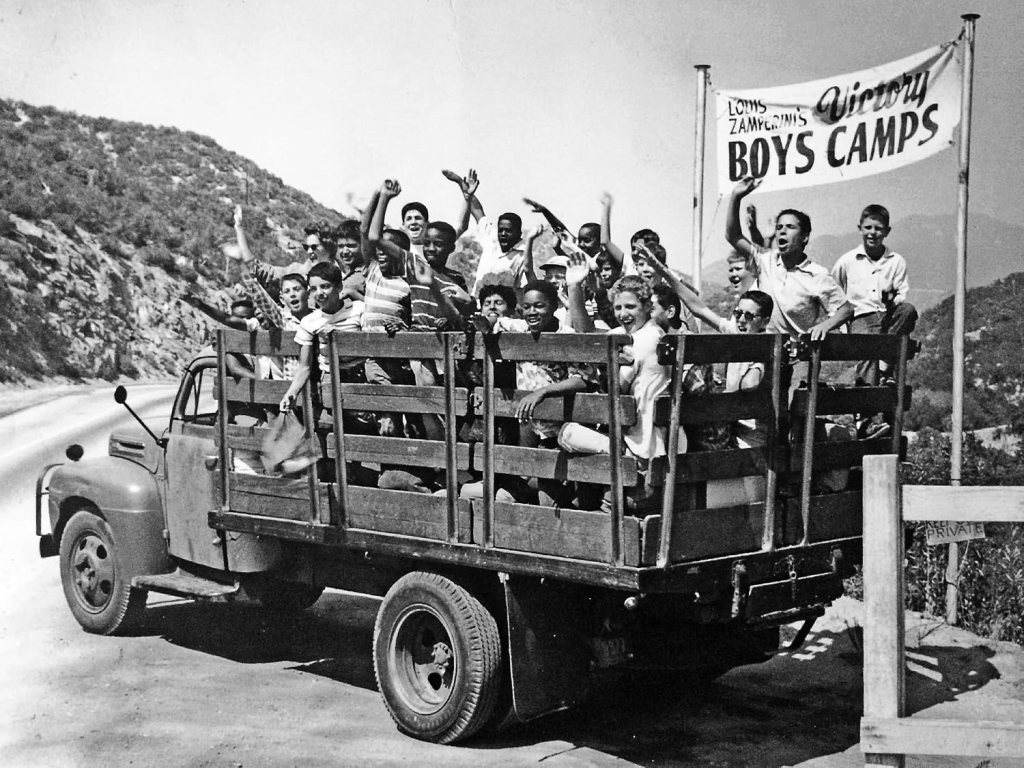
One of the things Zamperini readily discussed was how his conversion to Christianity led him to a nationwide speaking tour and the creation of a “Victory” wilderness camp for troubled youths in the 1950s.
He wanted to connect with young people, showing them the benefits of running, camping and skiing.
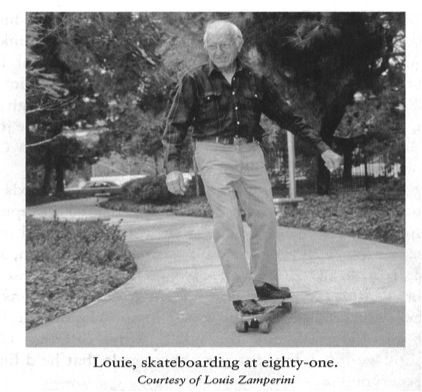
Even as Zamperini worked in commercial real estate and remained physically active into his 90s, he was no stranger to the thrills of mountain climbing to skateboarding.
The Hollywood revival
Before Hillenbrand’s book, several efforts to make Zamperini’s story into a movie had failed. In the 1950s, Tony Curtis wanted to play the lead role. In the late ’90s, Nicolas Cage expressed interest.
The Christmas Day release of the 2014 Universal Pictures drama headed by Angelina Jolie, “Unbroken,” was adapted from Hillenbrand’s book by screenwriters Joel and Ethan Coen, Richard LaGravenese and William Nicholson.
The trailer spends the first half visualizing how Zamperini went from being “a rebel to a champion.” Then, a “champion who became a survivor.” Then, a “survivor who wouldn’t be broken.”
It then apparently ran out of time and focus on his POW time to fully complete the story.
It received Oscar nominations in cinematography and sound editing, but many reviewers, including consensus reviews on RogerEbert.com, argued that the film felt too polished to genuinely convey the visceral agony of Zamperini’s actual suffering. Or, there was too much focus on the torture tactics and not enough of Zamperini’s resolve.
In 2018, “Unbroken: Path to Redemption,” was a Christian-based drama also distributed through Universal, directed by Harold Cronk. It is an often overlooked film that aimed to cover the second part of Zamperini’s journey after World War II.
The legacy
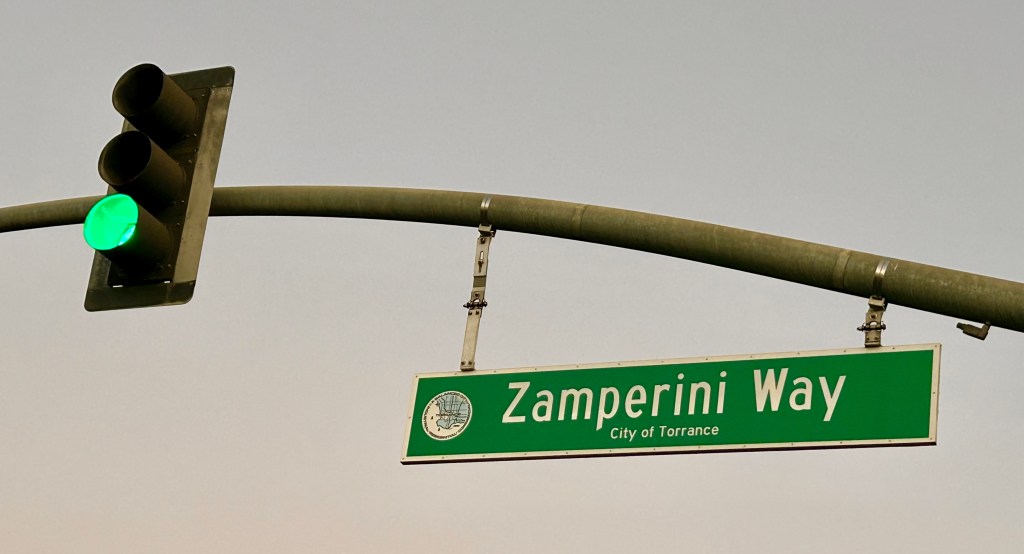
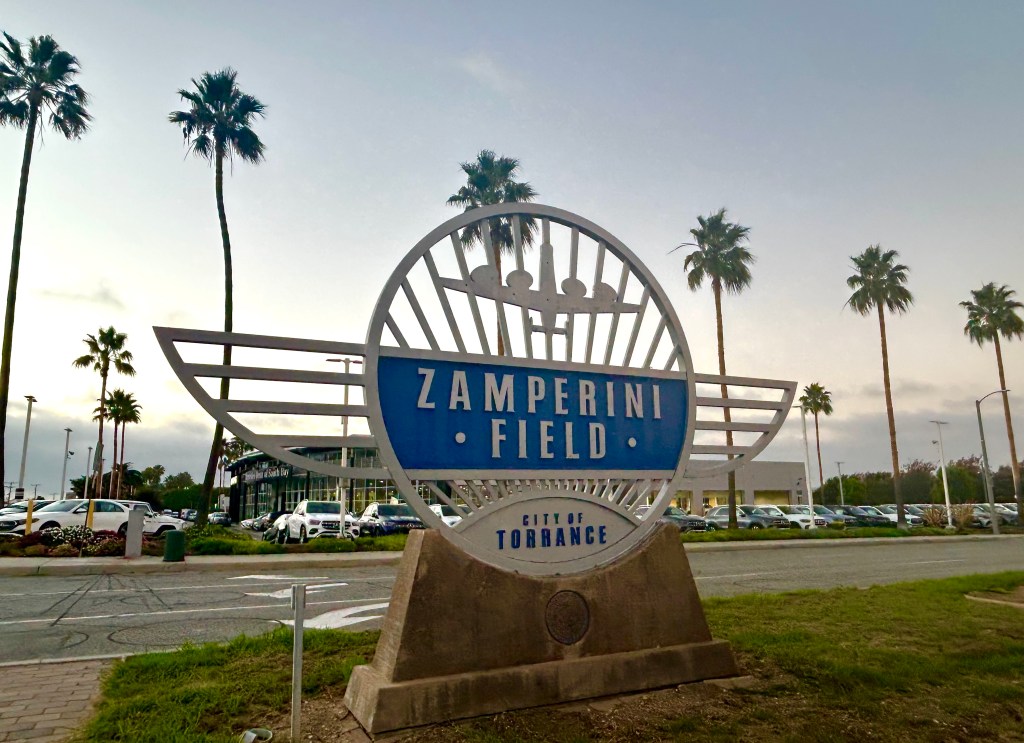
Consider the A-to-Z places to discover how the Zamperini name remains front and center for anyone curious about walking in his footsteps:
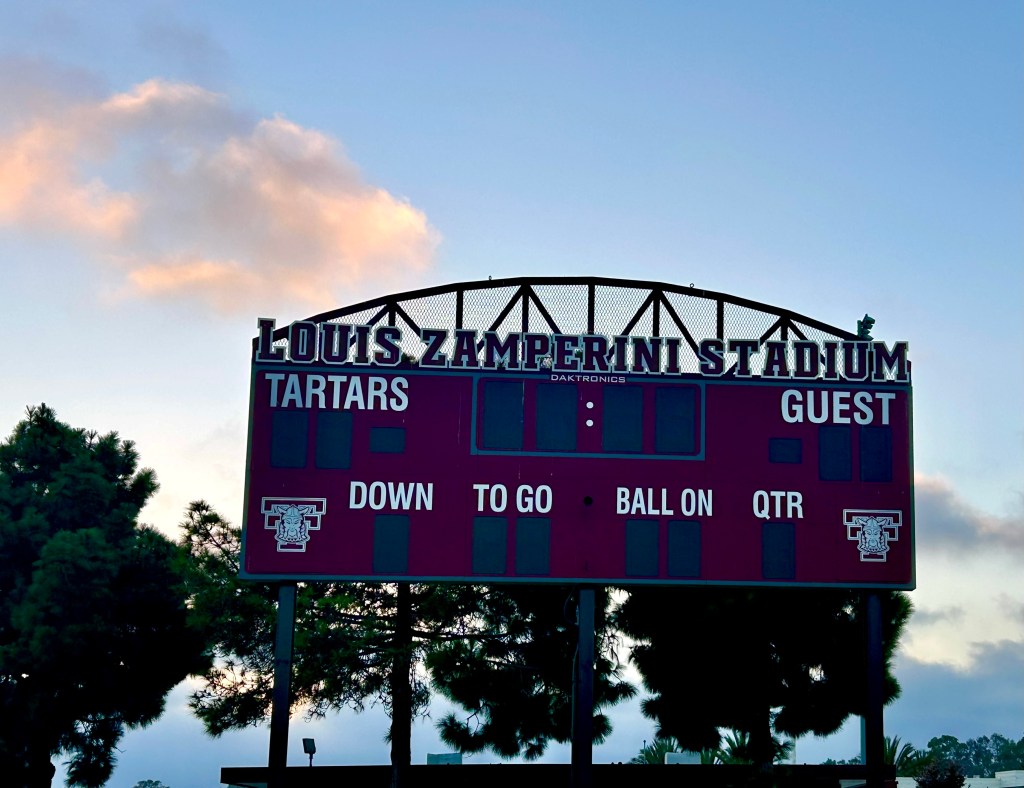
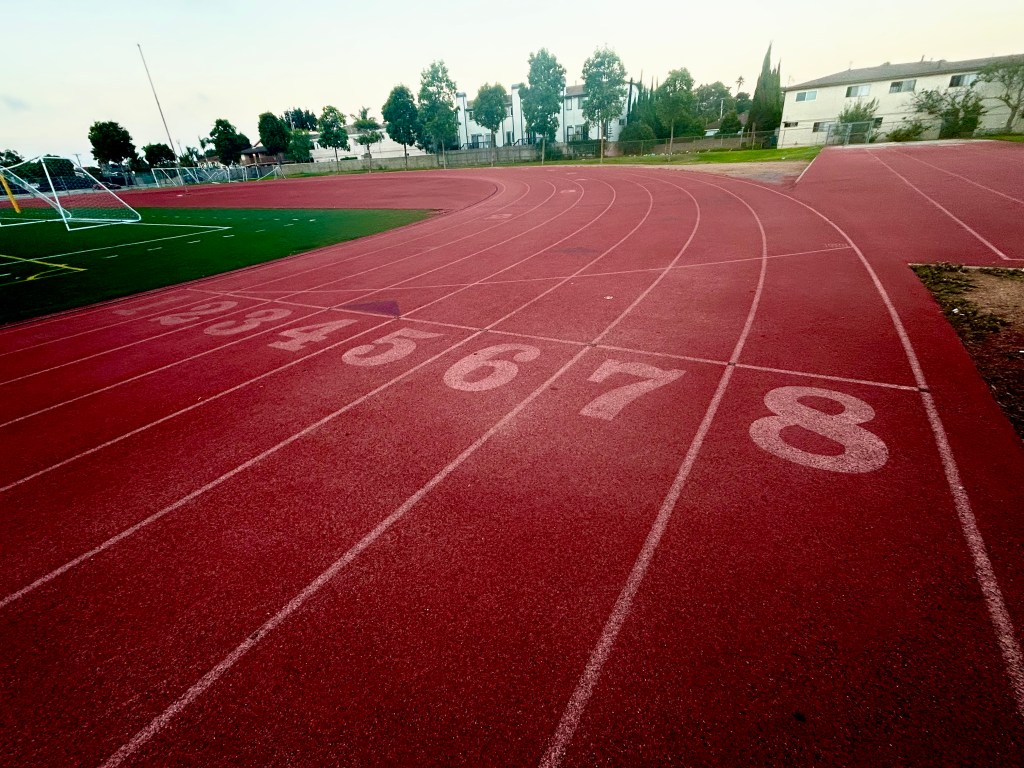
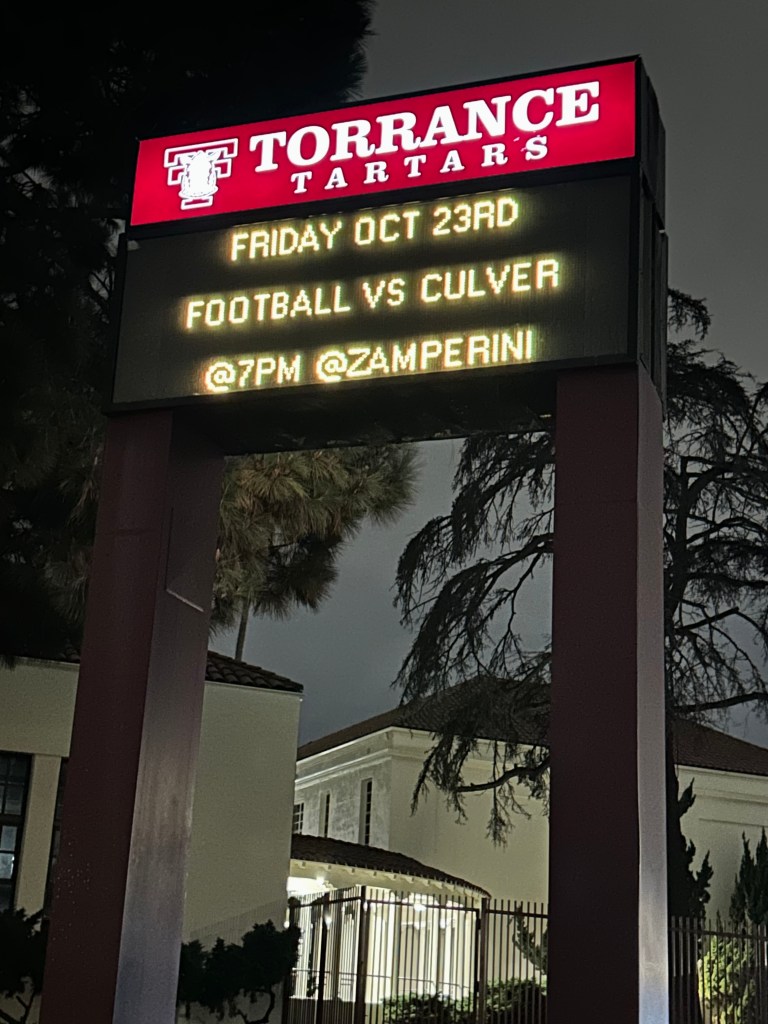
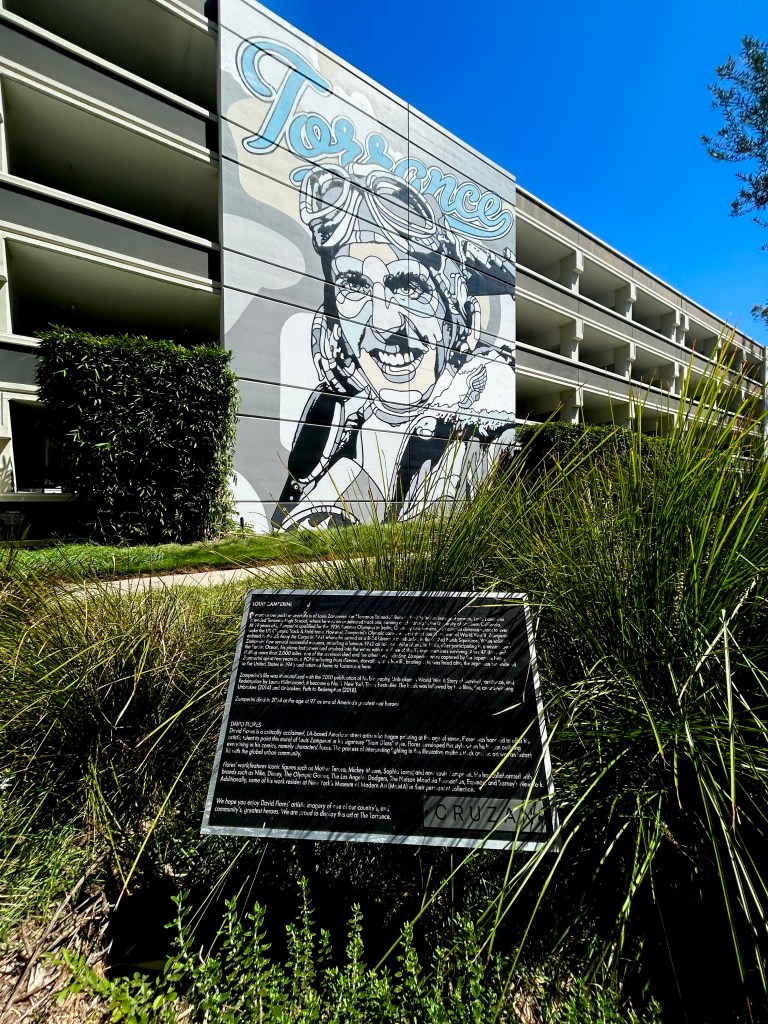
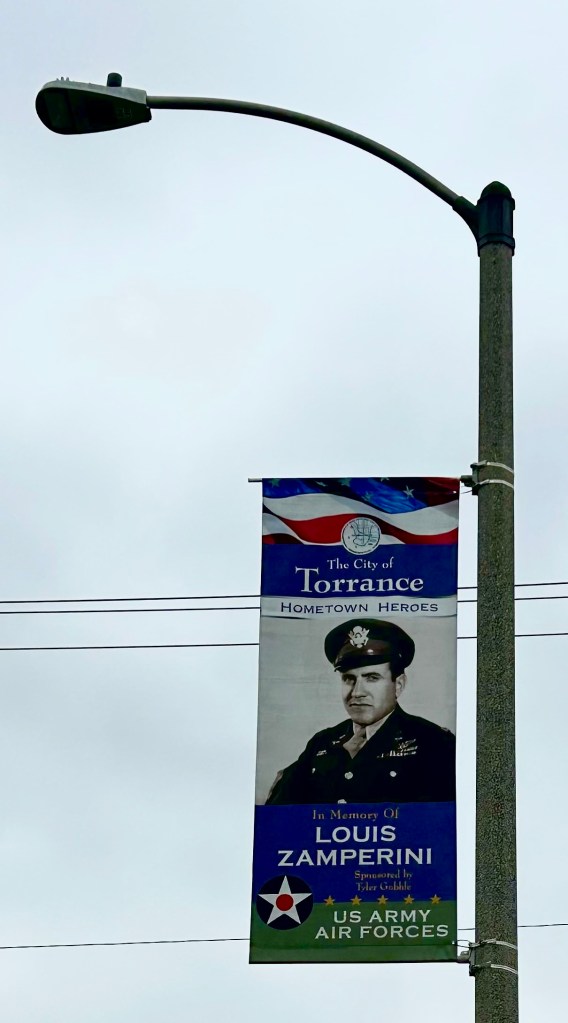
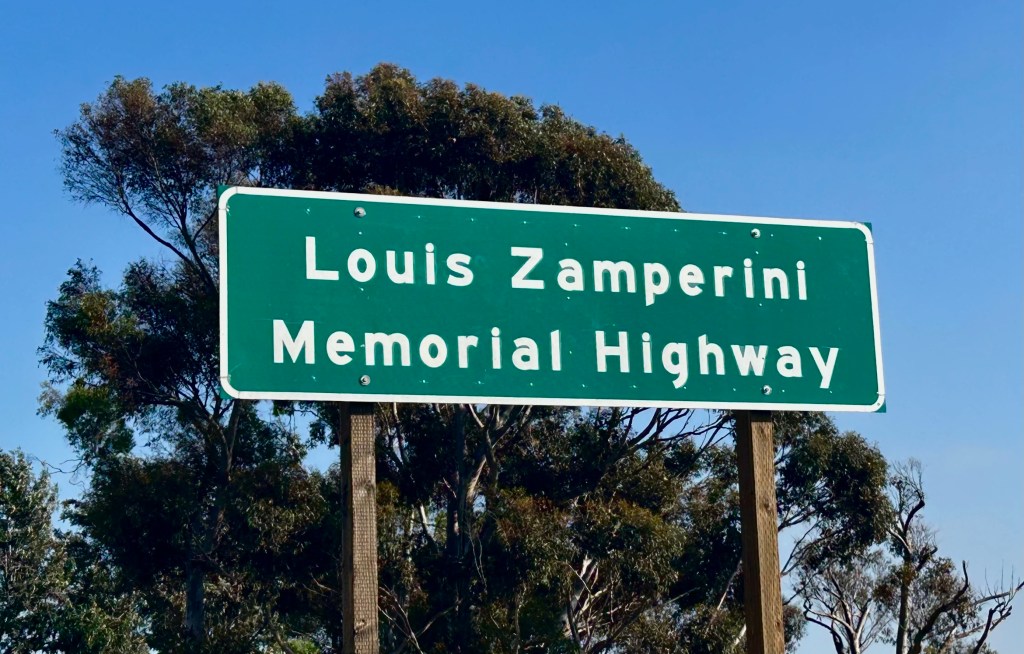
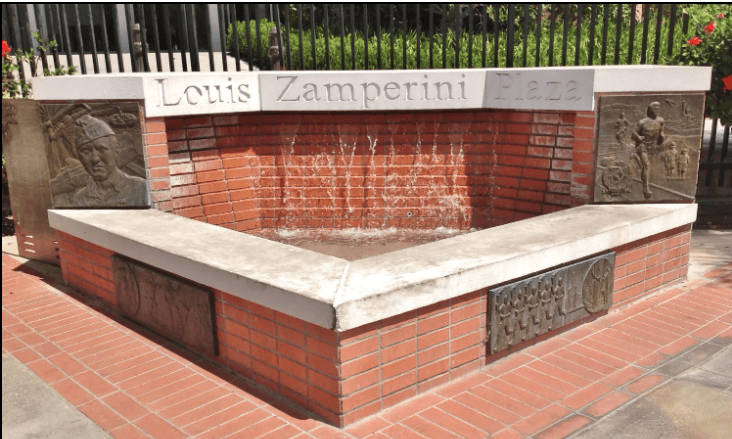
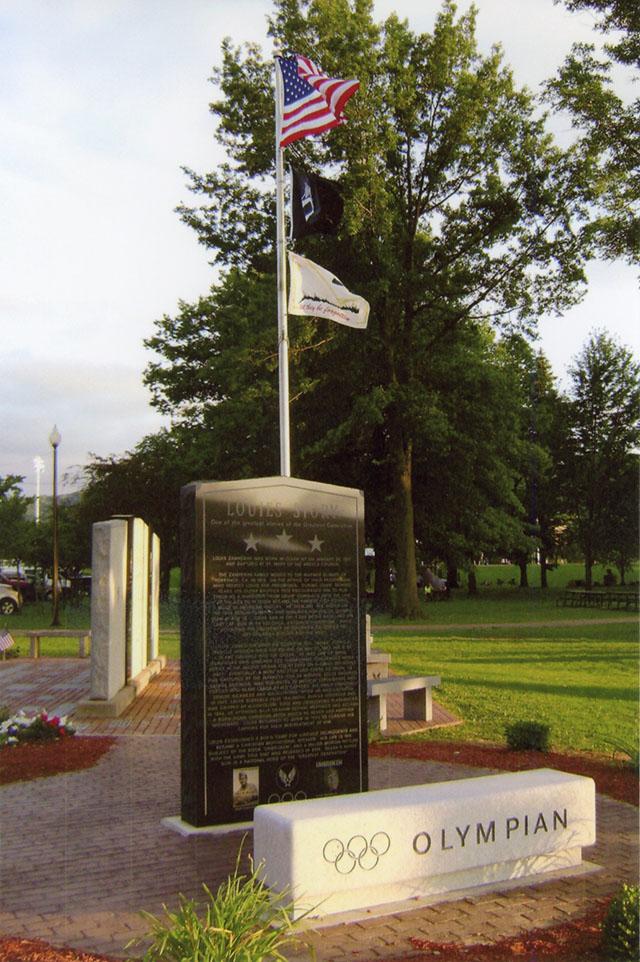
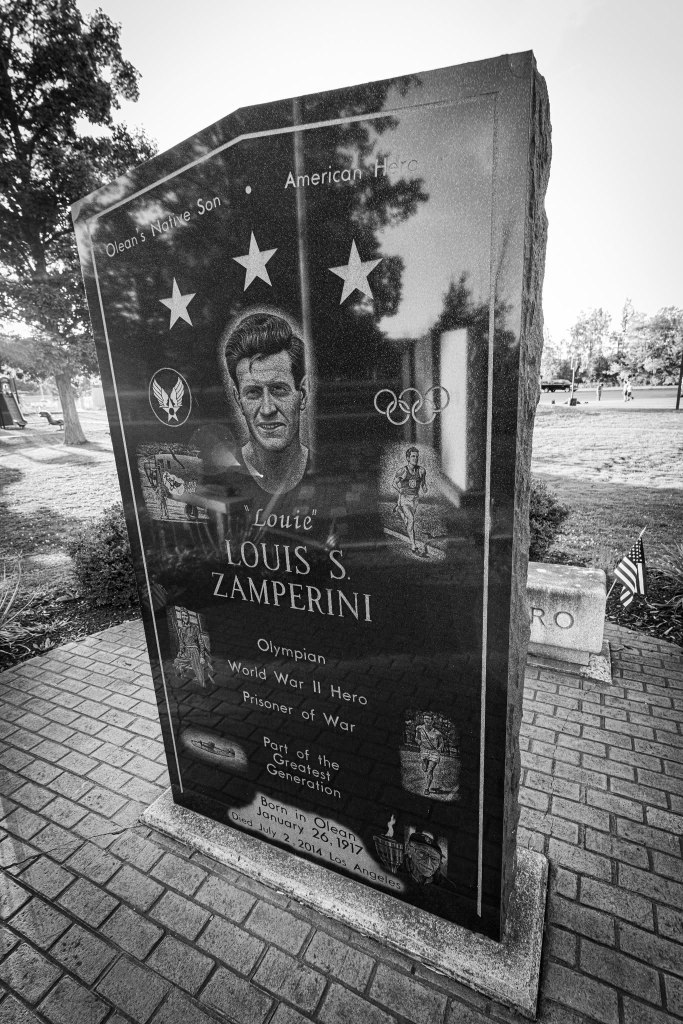
At the Torrance Historical Society in the Old Torrance downtown area, not far from the Zamperini original home on Gramercy Street, a display of memorabilia highlights the best of what it calls its “Lucky Louie” exhibit. Track trophies, Olympic gear, a wartime diary, his Purple Heart and the actual Roosevelt-signed World War II death certificate are included. T
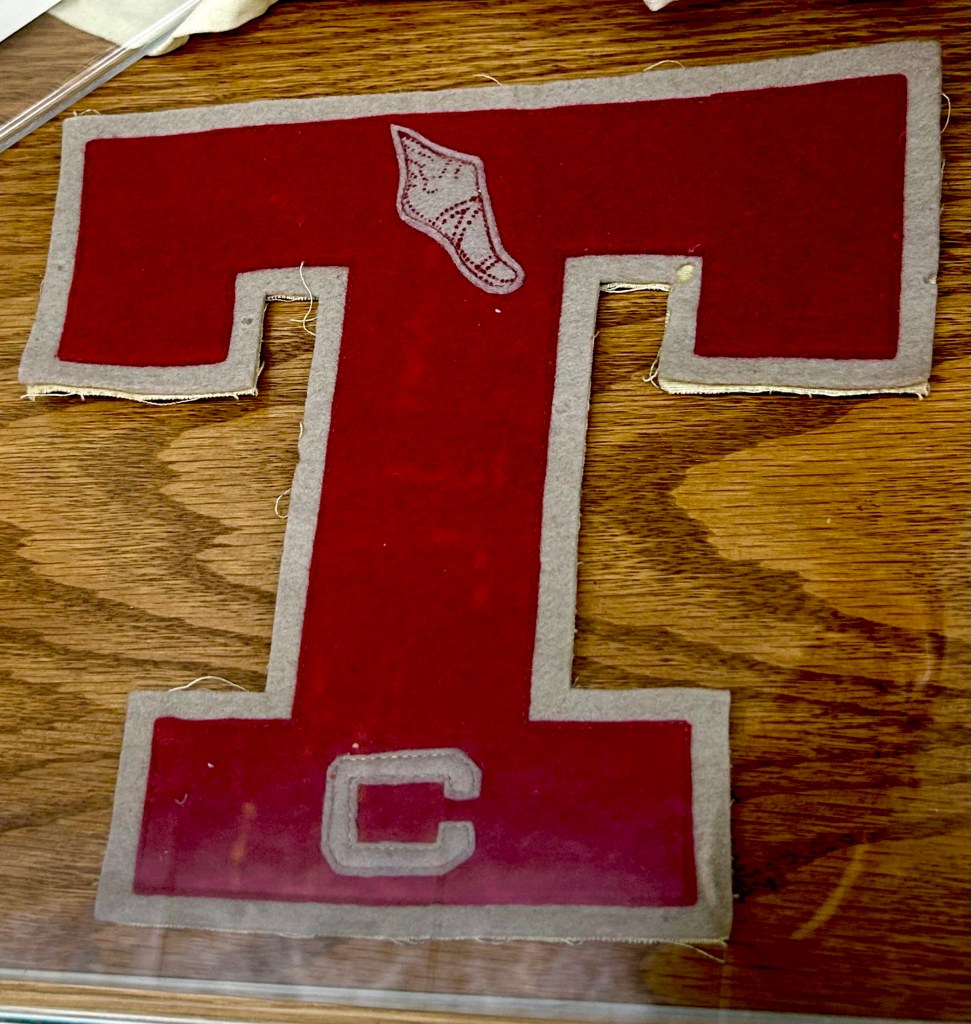
he Amateur Athletic Union proclamation that USC’s Zamperini was its 1940 All-American miler is accounted for. So it the aforementioned suitcase that the city gave to him with his name on it to head back to the Olympic trials.
There’s his Torrance High track letter with the Captain patch. T-shirt replicas of his Torrance High track suit are for sale to support his youth foundation.
Most than 60 pounds of notes are in the archives as well for researchers to delve into.
“No other place in the world has more information and pieces of history tied to Louis than we do,” Historical Society docent Debbie Hays told the Los Angeles Times in 2025.
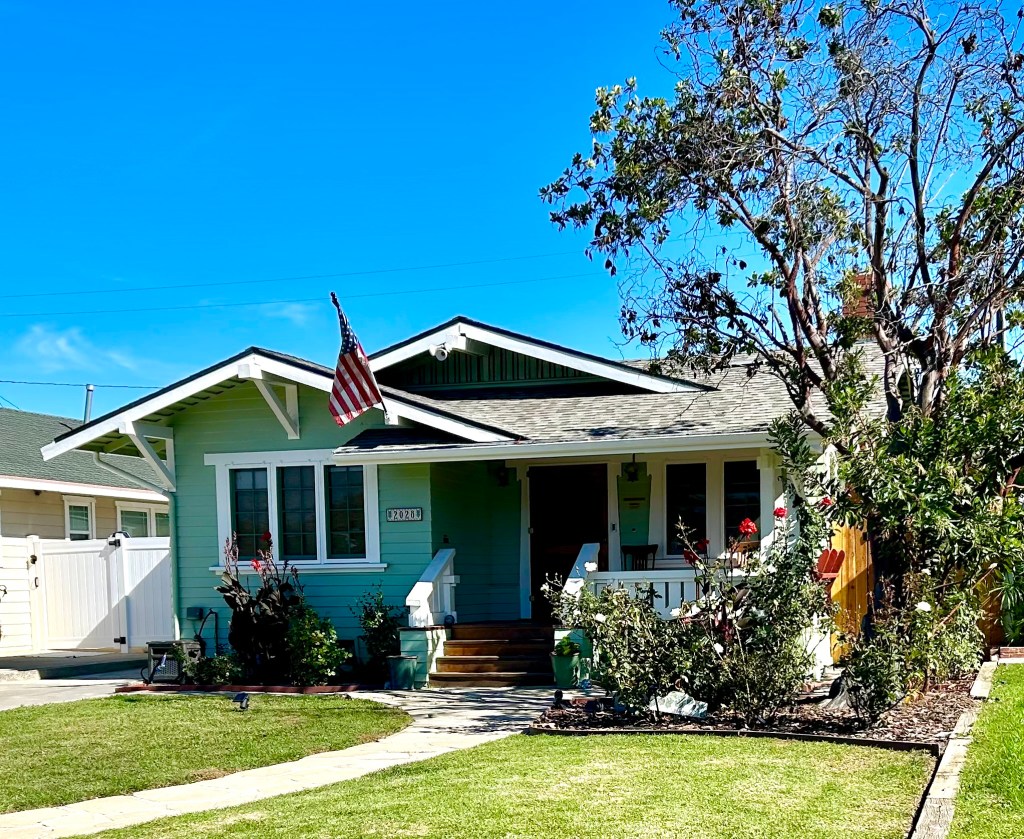
On special occasions, the Save Historic Old Torrance society offers tours of his boyhood home on Gramercy Street. Among the things to see are where a 14-year-old Louie carved his name on a wooden beam at a time when he should have outside been painting the house.
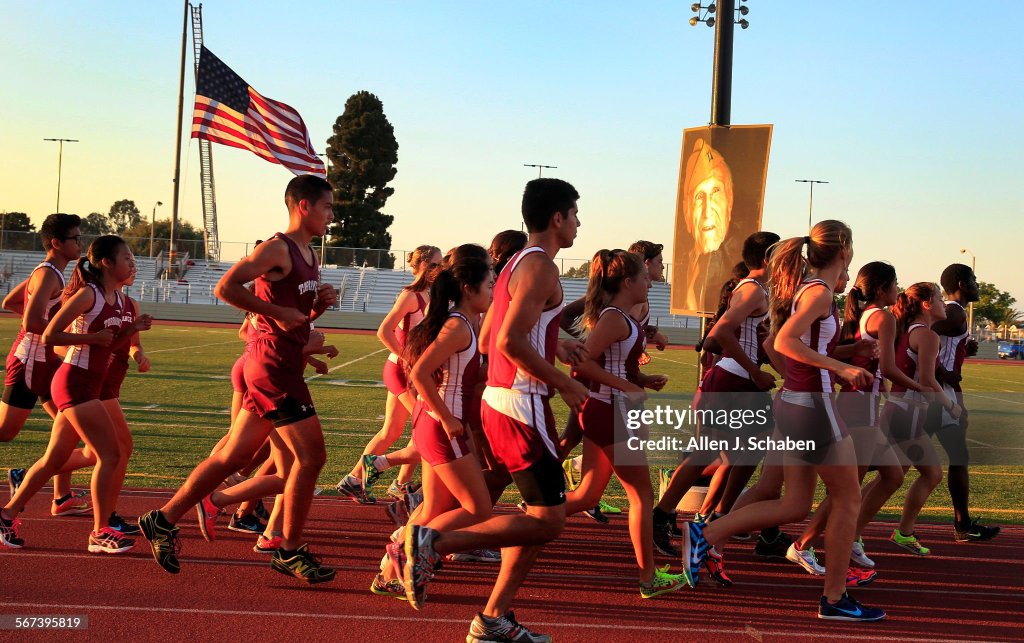
When Zamperini died in 2014, his obituary by USC included a statement by four-time USC Olympic gold medal swimmer John Naber, who had been a close associate in his later years: “Louis was very proud of being a Trojan. He happily wore his USC hat in public and private, and was quick to hug any fellow Trojan. … Louis’ life exemplified USC’s ‘Fight On’ spirit. Amazingly, his impact on other people continued as he grew older. His example inspired thousands to be better people, myself included.”
Hillenbrand referred to Zamperini at the time of his passing as “the grandest, most buoyant, most generous soul I ever knew.”
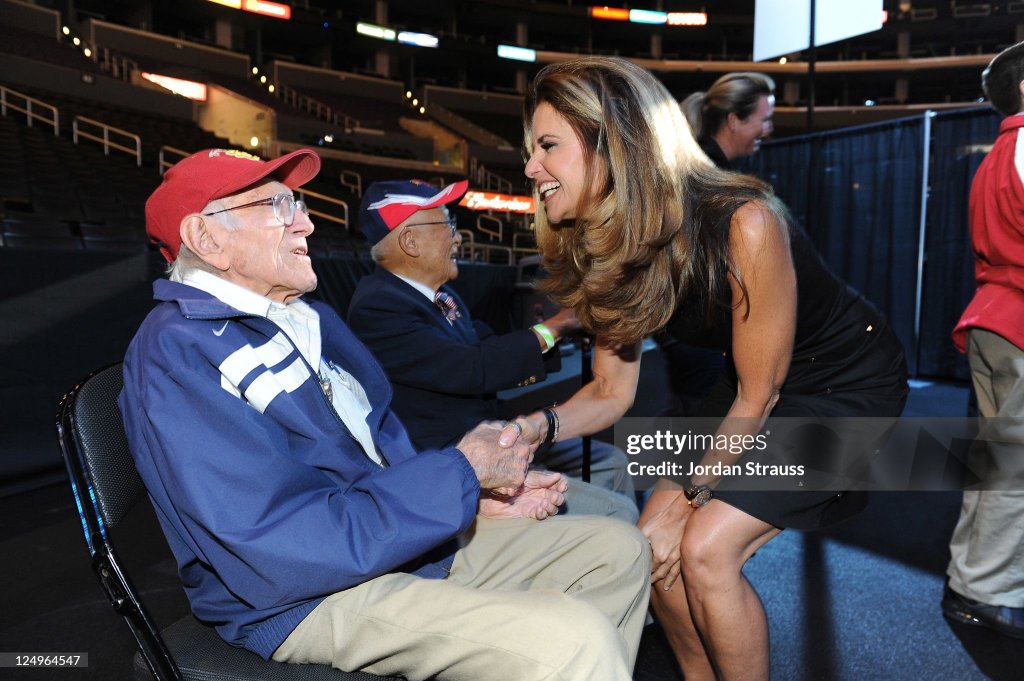
Zamperini’s inclusion in USC’s inaugural Athletic Hall of Fame Class of 1999 noted his time as a three-year letterman and on three NCAA title teams, one of the co-captains of the 1940 Trojan squad. In 2016, he was named to the Pac-12 All-Century Team. A tribute posed by the NCAA noted Zamperini was given the prestigious NCAA Inspiration Award in 2011.
The CBS Morning News aired a piece on Zamperini in 2014 after his passing:
The Louis Zamperini Foundation remains committed to taking his story and offering it as a curriculum for 6-to-12 graders. More than 1,700 educators have requested it, and it has being taught in all 50 states. It continues to grow, reports Drake Morton, the foundation’s director.
Luke Zamperini, Louis’ son, is president and CEO of the non-profit, living in Tarzana with is wife, Lisa, who is Drake’s sister. Louis’ daughter, Cissy, shares the same name as Louie’s wife, Cynthia — they married in 1946 when he returned home from WWII and she died in 2001.
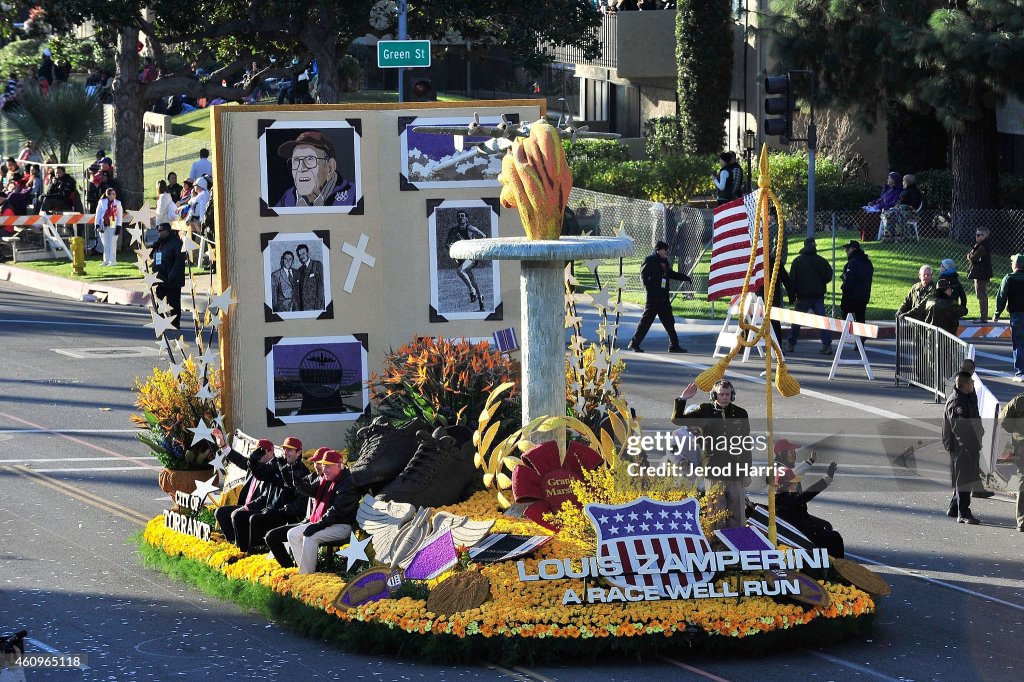
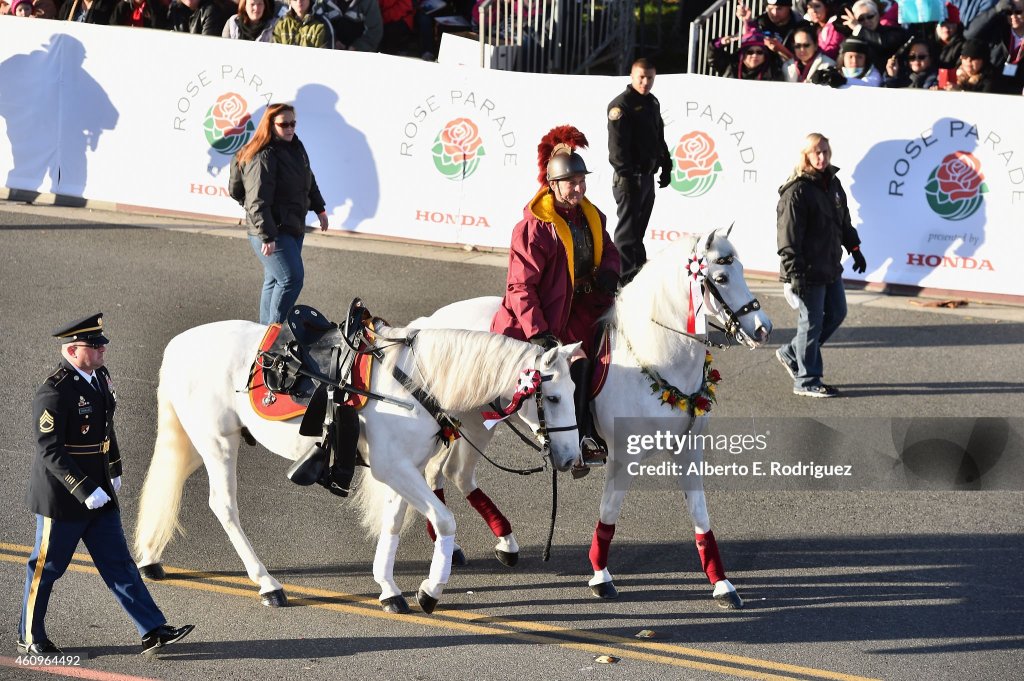
In the last book he wrote, published just days before his death, “Don’t Give Up, Don’t Give In: Lessons from an Extraordinary Life,” Zamperini wrote in the last chapter titled “Remember Me This Way”:
“Who can complain? I accept everything. All things work together for good. … I feel as if I’ve already lived 200 years, but I wouldn’t mind 200 more just so I can keep doing what I’ve been doing: Helping the underog. That’s been my program. That’s been my whole life. I’m a thankful citizen of America who just wants to be remembered for his charitable heart.”
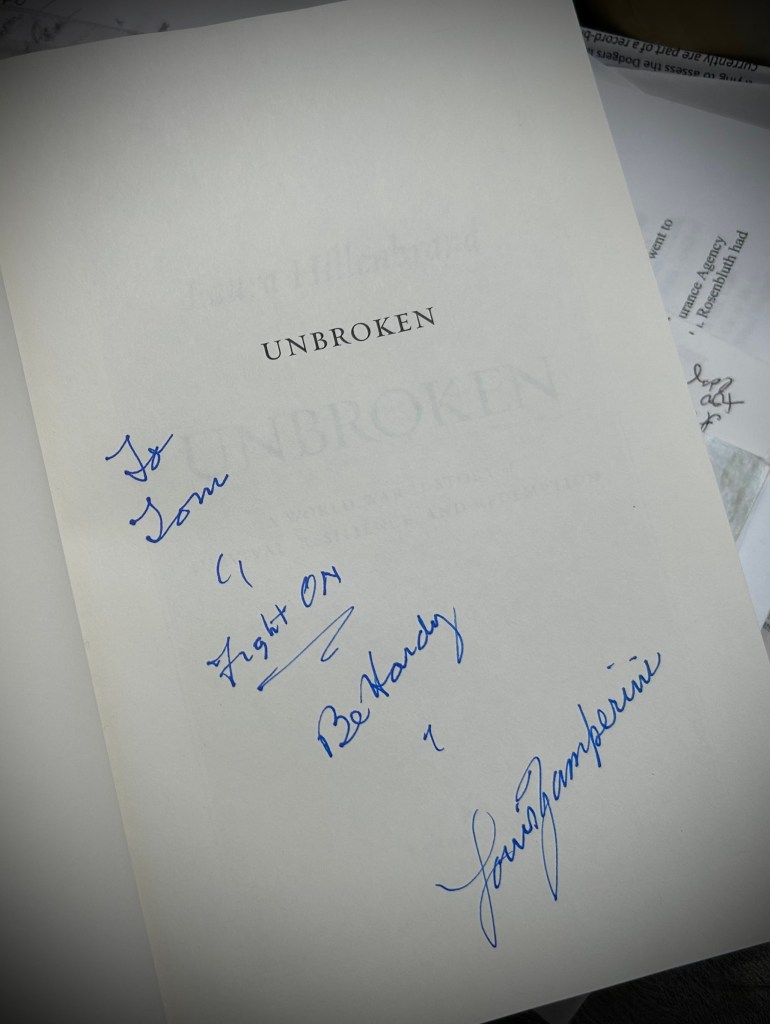
The end of the book includes eulogies delivered by his son, daughter and grandson at his funeral. Grandson Clay said in his own signed copy of “Unbroken,” Louie included a quote by environmentalist John Muir: “Climb the mountains and get their good tidings. Nature’s peace will flow into your as sunshine flows into trees. The winds will blow their own freshness into you, and the storms their energy, while cares will drop away from you like the leaves of Autumn.”
The Zamperini Foundation still uses that image of him in the No. 44 race bib from 1933, colorized, with inspirational messages on its website:
Who else wore No. 44 in SoCal sports history?
Make a case for:

Jerry West, Los Angeles Lakers guard (1960-61 to 1973-74), Los Angeles Lakers coach (1976-77 to 1978-79), Los Angeles Lakers executive (1979 to 2000), Los Angeles Clippers executive (2017 to 2024):
Best remembered: In the 2024 book, “The Basketball 100: The Story of the Greatest Players in NBA History” by the staff of The Athletic, Jerry West comes in at No. 16. If the list had been compiled 20 years earlier, a case could easily have been made for him to challenge for the No. 1, factoring in his entire NBA life.

Emphasizing his three separate inductions into the Basketball Hall of Fame in Springfield, Mass. — as a player in 1980, as a member of the 1960 Olympic gold-medal winning men’s team in 2010, and as a contributor for his years as an executive in 2024 — writer Sam Amick also recites the words from the plaque next to a statue of West outside the Lakers’ DTLA home arena:
“After nearly five decades as a player, coach and team executive, Jerry West is one of the true icons and legends that the game of basketball has ever known. His fearless style of play and emotional ‘wear his heart on his sleeve’ demeanor, made him a beloved figure to Lakers fans. One of the game’s all-time great players, Jerry was known during his playing days in the 1960s and early ’70s as Mr. Clutch for his propensity for hitting huge game-winning shots and his grace under pressure.”
Like this one in Game 3 of the 1970 Finals against the Knicks, as the Lakers were down by two. It only forced a tie game, pushing it into overtime. Where the Lakers lost. Because of course they did.
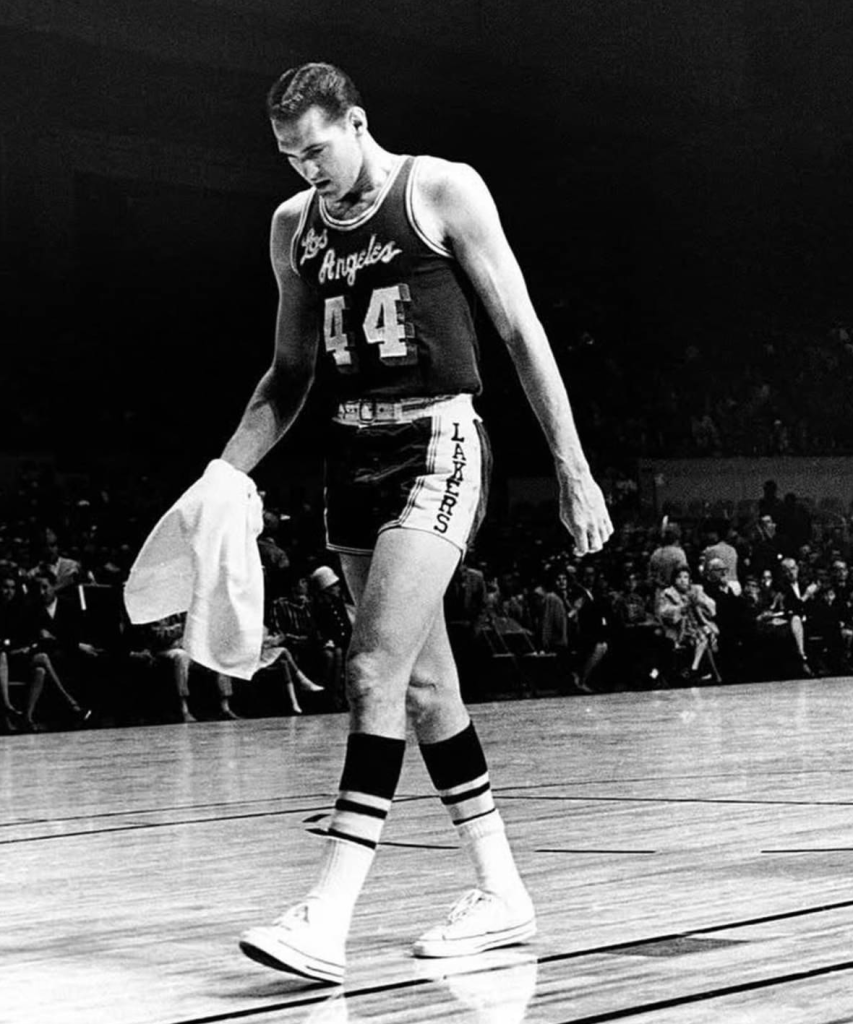
A 2023 feature story on him for The Sports Business Journal pointed out that, while West had the NBA’s seventh-greatest regular-season career scoring average at 27 points per game and the fifth-best playoff scoring average at 29.1 points a game, he could not get past his tortuous failures. Graceful or not.
Like the time he had a 46.3 points per game average in a 1965 Western Conference series against Baltimore, which remains an NBA playoff record, only to see the Lakers lose again to the Boston Celtics in the final.
A reflection of how West made it to the NBA Finals nine times. Six times ended in losses to Boston. Twice ended in losses to New York. His Lakers finally won it all in 1972 when he was a 33-year-old point guard who led the league in regular-season assists at 9.7 a game, two years before retirement.
“It’s almost like Peggy Lee’s song — ‘Is that all there is?’” said West. “That pretty much would apply to the way I felt about my career. … It’s hard for other people to understand how angry, and how sad, it all was. I have people, even today, say, ‘Look what it did for you.’ It didn’t do anything for me. I suppose there are lessons I learned from being second. But I don’t know what they are.”
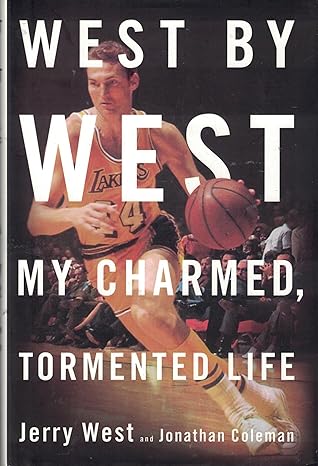
In his 2011 autobiography, “West By West: My Charmed, Tormented Life,” there is more about his unhappy childhood in West Virginia. To balance that, Roland Lazenby’s “Jerry West: The Life and Legend of a Basketball Icon,” which came out a year earlier. The 2026 Netflix documentary, “Jerry West: The Logo,” allows West himself, as well as those in his orbit, to provide what ends up documenting what could have been his eulogy.
Add to the torment that when West died in June of 2024 at age 86, it was somehow first announced to the NBA world by the Los Angeles Clippers. Eventually, the Lakers, where he had been a 12-time All-NBA selection, a 14-time All Star (chosen every single season of his career), the MVP of the 1960 NBA Finals even though his team lost to the Boston Celtics, and architect/contributor to teams that won six NBA titles from Magic Johnson to Shaquille O’Neal and Kobe Bryant, issued a statement.
At the time of his death, West was a consultant to the Clippers, disassociated from his foundational franchise after he felt he couldn’t perform his general manager duties when team owner Jeanne Buss entered a conflict-of-interest romantic partnership with head coach Phil Jackson that seemed to undercut West’s abilities to create.
A two-time NBA Executive of the Year came with one in L.A., but another also in Memphis after he left. In his 20 seasons with the Lakers’ organization after his playing days, they made it to the NBA Finals 10 games.

West will forever be nicknamed “The Logo” as the NBA’s trademarked illustration that came inspired from a 1970 photo of him that appeared in Sport Magazine.
Not well known: No. 44 was retired by the Lakers in 1983 for West. The only other player in franchise history to wear it was a 6-foot-11 center named Chuck Share, at the very end of the 1960 season during the Lakers’ last games spent in Minneapolis.
Hank Gathers: USC basketball forward (1985-86), Loyola Marymount basketball forward (1987-88 to 1989-90)
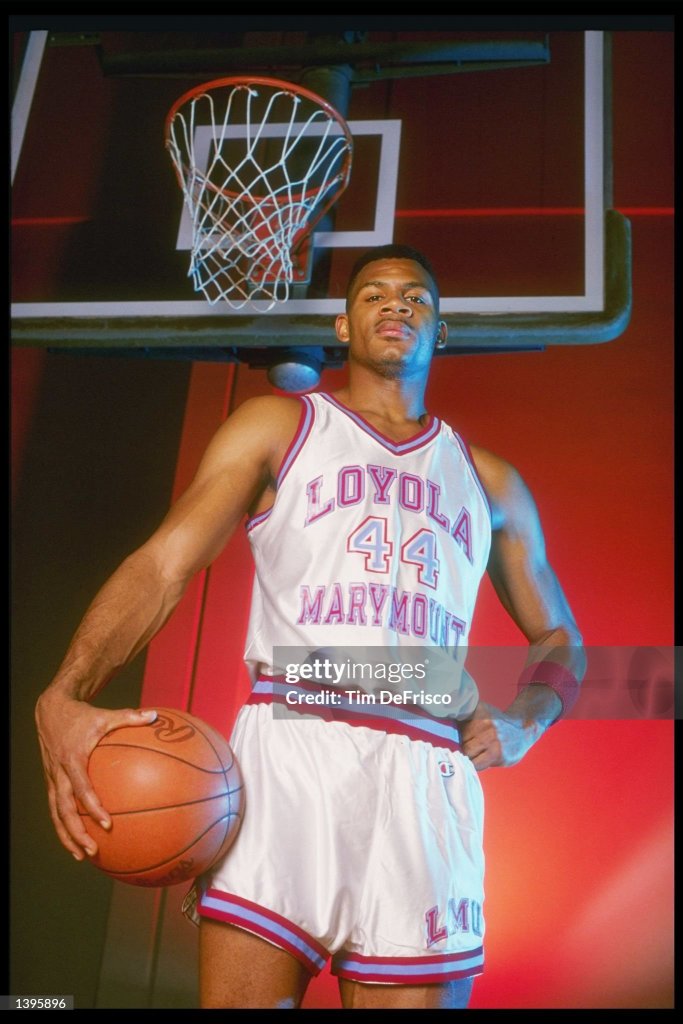
Best remembered: As a junior, Gathers led the NCAA with both a 32.7 points per game average (with 1,015 points) and 13.7 rebounds a game. As a senior, he was sixth-best in the country at 29.0 points a game and led the conference with 10.8 rebounds — which included a game on Feb. 3, 1990 when LMU went to Louisiana State, led by 17-year-old freshman Shaquille O’Neal and beefy 7-foot sophomore Stanley Roberts. Gathers’ first five shots may have been blocked by O’Neal, but he ended up scoring 48 points on 35 shots to go with 13 rebounds. LSU won 148-141 in overtime. “That’s the perfect example of the will and the tenacity and the unstoppable mindset that Hank had, that when I get this ball, nobody can guard me,” said teammate Bo Kimble. “He played with that presence that began his junior year in high school: In the paint, I’m unstoppable; I don’t care who you are. … I played with Hank for 11 years, and there’s no better story about his heart and resilience than the LSU game. He said, ‘You did a great job blocking the first five shots, but good luck trying to stop the next 30.” Gather’s death at the age of 22 during a game at Loyola Marymount in 1990 which ignited a memorable run in the NCAA Tournament is best entwined in a post for the No. 30 post with teammate Bo Kimble and coach Paul Westhead.
Reggie Jackson, California Angels right fielder/DH (1982 to 1986):

Best remembered: In the five seasons that Mr. October vacationed in Southern California at the behest of owner Gene Autry, Jackson made it into just a handful of post-season contests in October. Nothing much to speak of during the Angels’ five-game ALCS loss to Milwaukee in the ’82 (2-for-18, 2 RBIs, 1 HR). Even less in the Angels’ six-game ALCS against Boston in ’86 (5-for-26, 2 RBIs, 0 HRs). Yet he was given almost twice as much money as he made in New York, and guaranteed even more if the Angels passed various attendance thresholds, based on Autry’s desperation to have a World Series title. As an Angel, Jackson made the AL All Star team his first three seasons, tying for the league lead with 39 homers in 1982 (and 101 RBIs) in his first visit to go with a league-high 156 strikeouts. Between the ages of 36 and 40, he attracted people, playing 687 games with the Angels (and striking out 690 times) with a .239 batting average. He hit his 500th career homer in Anaheim off Kansas City’s Bud Black.
His most well-known appearance in an Angels uniform may have been after his MLB retirement, playing himself in the movie “The Naked Gun: From the Files of Police Squad!” in 1988 where he is seemingly hypnotized and got to point a gun at an actress playing Queen Elizabeth watching a game at Dodger Stadium.
Not well remembered: Jackson was given No. 44 off the back of manager Gene Mauch to make his arrival more pleasant. He may have started as No. 9 in Oakland (and No. 31 in his rookie year in Kansas City), but he was No. 44 in New York and brought that as his identity to Anaheim and then, in one final Oakland season.
Gaston Green, UCLA football running back (1984 to 1987), Los Angeles Rams running back (1988 to 1990), Los Angeles Raiders running back (1993):

Best remembered: A 1998 inductee into the UCLA Athletic Hall of Fame ended his career as the school’s all-time leading rusher with 3,731 yards (which held for 25 years until 2012), as well as compiling the most touchdowns (40) and most 100-yard games (20). The team’s offensive MVP in ’86 and ’87 was also the Player of the Game in the 1986 Freedom Bowl in Anaheim after UCLA defeated BYU, 31-10, as he ran for 266 yards, which set an NCAA bowl-game record. He was also the 1985 Fiesta Bowl Offensive Player of the Game in UCLA’s 39-37 win, highlighted by his 72-yard TD run in the second quarter to go with 144 yards rushing on 21 attempts and two TDs. Green returned to UCLA in 2011 to complete his college degree.
Not well remembered: Green, a high school star at Gardena, got to stay in Southern California to start his pro career when the Los Angeles Rams drafted him 14th overall in the first round of 1988, the first running back taken. After wearing No. 30 for his rookie season — fullback Mike Guman had No. 44 for the last season of his career — Green switched to No. 44 for ’89 and ’90 until he was sent to Denver for his last two full NFL seasons (where he had all six of his pro career rushing touchdowns) and came back to Los Angeles with the Raiders but did not make it into a game.
Darryl Strawberry, Los Angeles Dodgers outfielder (1991 to 1993):

Best remembered: The return to Los Angeles for the former Crenshaw High standout sounded good, until it wasn’t.

If manager Tommy Lasorda framed the free-agent signing as if it was as big as when the Los Angeles Kings acquired Wayne Gretzky, considering the former MLB No. 1 draft pick hit 252 home runs over his first eight seasons with the New York Mets, the reality was that a struggle with substance abuse came with him. A five-year, $20.25 million contract was never fully realized. He hit .265 with 28 homers in ’91, which was the fewest long-balls he had hit since 1984, and made his eighth straight All-Star appearance. His running into the wooden fence chasing a fly ball once in right field alarmed the team enough to start padding the walls. He had back issues early in the ’92 season but delayed surgery until September. He hit only five homers in 43 games that season. By ’93, he was arrested for allegedly striking a woman that lived with him. The IRS investigated him for tax evasion. In April of ’94, he went AWOL from the team’s final exhibition game against the Angels, show up admitting his abuse issues, put on the disabled list and the Dodgers reached a contract settlement as they released him in May.
Al Downing, Los Angeles Dodgers pitcher (1971 to 1977):

Best remembered: “Gentleman Al” Downing wore No. 44 when he pitched to No. 44 Henry Aaron in April, 1974 and they became linked forever for Aaron’s 715th home run to break Babe Ruth’s MLB career mark. Downing is also part of a group called the “Black Aces” — a term given to those African-American MLB pitchers by Mudcat Grant who posted a 20-win season, as there are only 15 to do it.
Not well remembered: Downing’s seven seasons in L.A. started with a 20-9 record and 12 complete games with a 2.68 ERA and a career-high 262 1/3 innings after he came over from Milwaukee and into the National League in 1971 for the first time. Downing’s five shutouts also tied Bob Gibson for the NL best. “I ended up with 20,” Downing says in a matter-of-fact-way with The Athletic. “They asked how did you do it? I had good teammates. That’s always the case with a pitcher.” Downing was third in the 1971 NL Cy Young voting behind Ferguson Jenkins and Tom Seaver and 10th in the MVP tabulation. The next season — on May 20, 1972 — Downing pitched the quickest game in Dodger Stadium history. In an hour and a half, he shutout Houston, 3-0.
Downing also said he admired how manager Walter Alston trusted him to start Game 3 of the 1974 World Series even though Downing posted just a 5-6 regular season record in 16 starts. The Dodgers lost the game, 3-2, to Oakland and Catfish Hunter. Not because of Downing, who gave up just one earned run in 3 2/3 innings, facing 20 batters.
Cynthia Cooper, USC women’s basketball (1982 to 1984, 1986):

One of the world’s greatest and most decorated women’s basketball players, Cooper was the 1981 L.A. City Player of the Year at L.A.’s Locke High, averaging 31 points a game and leading her team to the California State 4A championship. She also was on Locke’s track team. She starred as a 5-foot-10 guard for USC’s 1983 and 1984 NCAA Championship teams and as a four-time letter winner she was named an All-Conference first team member in 1986 and made the NCAA All-Tournament team as the Women of Troy made it to the NCAA Final. She averaged 12.9 points, 3.1 assists and 2.1 steals during her career as USC won 114 of 129 games. She currently ranks ninth on USC’s all-time scoring list (1,559 points), eighth in assists (381) and third in steals (256). She circled back to coach the USC women’s team from 2013 through 2017. Cooper-Dyke was inducted into the USC Athletic Hall of Fame in 1999, the Women’s Basketball Hall of Fame in 2009 and the Naismith Basketball Hall of Fame in 2010 (the first WNBA player enshrined). USC retired her No. 44 in 2011. She was the Women’s Sports Foundation’s 1998 Sportswoman of the Year. In 2011, she was voted by fans as one of the Top 15 players in WNBA history.
Garrett Arbelbide, USC football offensive and defensive end (1929 to 1931) and USC baseball (1930 to 1932), Hollywood Stars outfielder (1933):
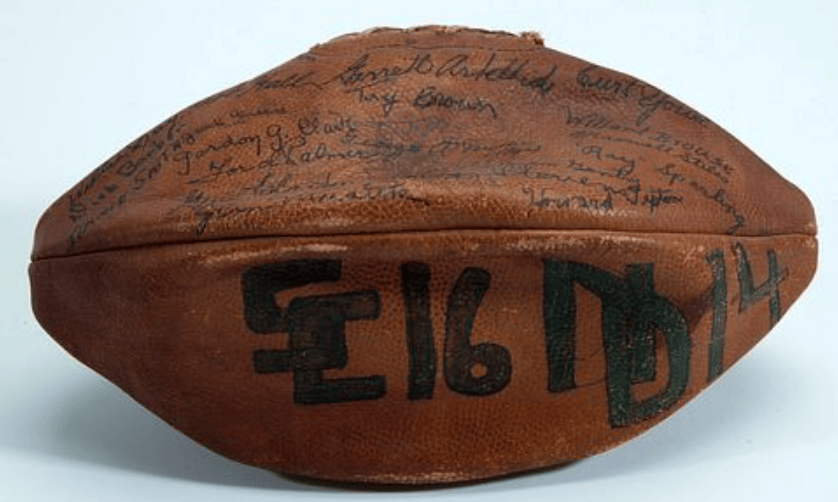
Out of Redland High in San Bernardino, Arbelbide was first-team an All-American as a junior, third-team All-American as a senior, played in two Rose Bowls and was on the USC national title team of ’31 that also was the first to defeat Notre Dame in South Bend, Ind., in a upset win where he made a touchdown-saving tackle. In his second game as a Trojan, Arbelbide caught two touchdown passes and finished the season with eight receptions for 197 yards and four TDs. Even though USC didn’t keep receiving statistics until 1936, no Trojan topped Arbelbide’s yardage until 1942. The next year, Arbelbide caught 12 passes for 288 yards and two touchdowns, drawing All-American votes.
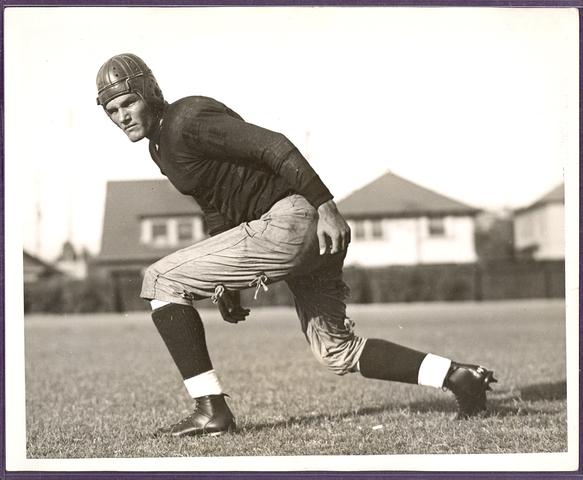
After three years also playing baseball as an outfielder/first baseman at USC, Arbelbide played professionally for the Pacific Coast League’s Hollywood Stars at age 23 in 1933 (25 games: 23-for-77 with two homers and a .299 batting average). La Verne College hired him as its head football coach in 1935, and a year later, he had the same post at the Arizona State Teachers College of Flagstaff (now Northern Arizona University). Serving in the U.S. Army during World War II, he was named head football coach for the 1942 Santa Ana Army Air Base Flyers team. Maybe this piece by the Los Angeles Times’ Bob Oates in 1994 helped push the campaign for Arbelbide to finally be included in the USC Athletic Hall of Fame in 1999.
Scott Matlock, Los Angeles Chargers defensive lineman/fullback (2023 to present):
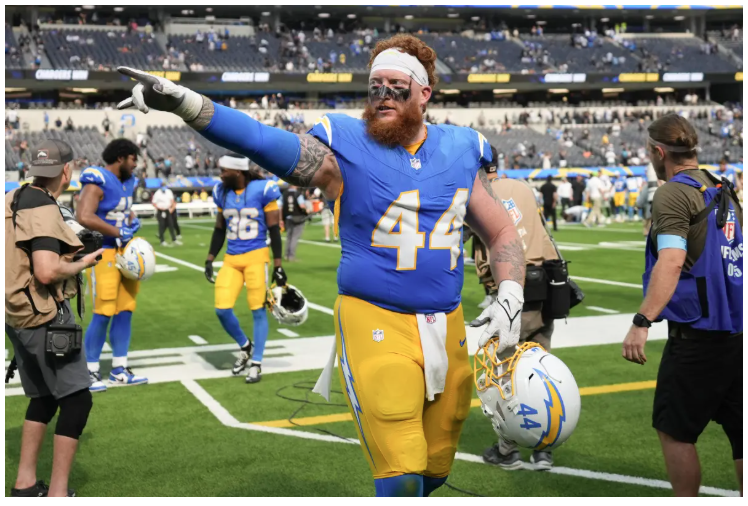
In his first season with the Chargers, Scott Matlock wore No. 99 — soaking it in as primarily a defensive lineman. But when he started taking snaps as a fullback the next season, he changed to No. 44, which is what he also wore in high school in Idaho when he was primarily a tight end, then to Boise State as a defensive lineman. In 2024, Matlock became the NFL’s only two-way player, appearing in 36 percent of the team’s offensive snaps, 19.7 percent on defense and 57.8 percent on special teams. The 6-foot-4, 296-pounder said he switched from No. 99 to No. 44 so he wouldn’t have to report as an eligible receiver 25 times a game.
Chris Mills, Fairfax High basketball (1984-85 to 1987-88):

At 6-feet-7, he became the starting center for each of his three years playing varsity basketball at Fairfax, and was the two-time City 4-A Player of the Year Award, as well as Mr. Basketball for the state of California. El Camino Real coach Mike McNulty once said of him: “He’s one of the three best players ever to come out of Los Angeles—he’s gotta be right there with John Williams and Marques Johnson. Said Taft High of Woodland Hills basketball coach Jim Woodard: “I’ve been watching city basketball for 33 years. Mills is the best I’ve ever seen. He can do it all.” Mills went to Kentucky, was kicked off the team for taking illegal payments, ended up as the Pac-10 Player of the Year at Arizona, and had a 10-year NBA career.
Tony Gonzalez, Huntington Beach High football tight end (1989 to 1993):

Before he was inducted into the Pro Football Hall of Fame as one of the most prolific pass catchers in NFL history from the tight end position, Tony Gonzalez dominated both sides of the ball as a two-sport athlete in Huntington Beach. As a 6-foot-6, 247-pound senior, he caught 62 passes for 945 yards and 13 touchdowns and was a first-team All-American at both tight end and linebacker, where he was the team’s leading tackler. Huntington Beach lost to Los Alamitos in the CIF-SS Division II title game. In basketball, he was the Sunset League MVP, averaging 26 points a game. After his senior year, Gonzalez was named Orange County High School Athlete of the Year, beating out golfer Tiger Woods from Western High in Anaheim, who just won the U.S. Amateur Open. Gonzalez also wore No. 44 at Cal in football (and No. 34 in basketball). As a 17-year NFL pro, Gonzalez doubled up on No. 44 and wore No. 88 for the Kansas City Chiefs and Atlanta Falcons.
Ben Joyce, Los Angeles Angels pitcher (2023 to present):

In recording the final out of his first MLB save, Ben Joyce threw a 104.7 mph fastball past the New York Mets’ J.D. Martinez at Angel Stadium. “He threw it, I laughed — I was like ‘whoa,” said Martinez. It was the fastest pitch thrown by any MLB pitcher that season and the fastest strikeout pitch since pitch tracking began in 2008. The 6-foot-5 Joyce, who once recorded throwing a pitch of 105.5 at the University of Tennessee in 2022, reached 104 mph three more times in 2024 — and went on the disabled list for shoulder surgery in 2025 and came back for 16 games in 2026. He averaged 101 mph with his four-seam fastball, topping out at 104.5 mph
Rich Hill, Los Angeles Dodgers pitcher (2016 to 2019):
The Dodgers were one of a record-14 stops that Hill made in his 21-year career, tying with Edwin Jackson for most MLB uniforms worn. From his debut with the Chicago Cubs at age 25 to a final two starts with the Kansas City Royals at age 45 — and never making an All-Star team in between — Hill had 30 wins for the Dodgers over four seasons, the most of any team he played on. It did not include aa game in Pittsburgh in August of 2017 when Hill took a perfect game into the ninth inning, which became a no-hitter he took into the 10th inning, which became a loss when he gave up a walk-off homer. Of the 10 different numbers Hill wore in his career, he also sported No. 51 for the 2014 Angels for two brief games, failed to get an out and had an ERA of infinity.
Have you heard this story?
Michael Warren, UCLA men’s basketball guard (1965-66 to 1967-68):
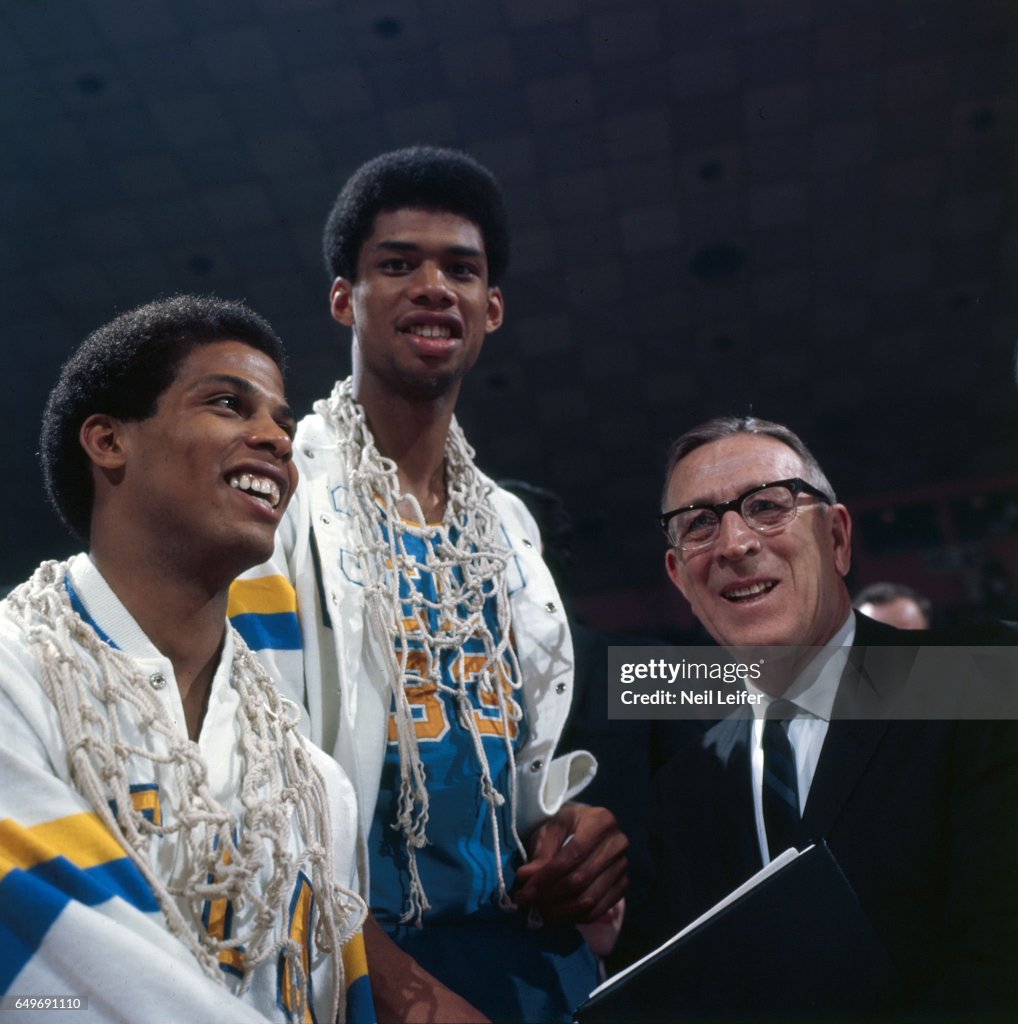
His IMDb.com bio starts: “Smart, talented African-American actor Michael Warren could have followed in the star shoes of Sidney Poitier but Denzel Washington beat him to it.” Warren could have followed in the sneakers of Gail Goodrich and Walt Hazzard as well as a Lakers point guard out of UCLA, but as he told Roy S. Johnson in the New York Times: “‘I was riding a cloud at UCLA Everyone there in the ’60s was. Unfortunately, my plans didn’t coincide with the ones the NBA had. ‘I got tripped up in the first step. ‘At 22, I was a washed-up basketball player.” A two-time All-Indiana high school player came to UCLA to play point guard on two national title teams under coach John Wooden with star teammates Lew Alcindor and Lucious Allen. An All-American his senior year, Warren averaged 16.6 points a game as a sophomore but then 12.7 and 12.1 points a game his junior and senior seasons. He wanted to be taken by the Lakers, but instead landed in Seattle in the 14th round, No. 173 overall, during the 1968 NBA Draft. The closest he came to pro basketball was joining the ABA’s Los Angeles Stars and getting cut in the exhibition season without playing a game. Working in commercials and TV typecast as a basketball player, he caught on with the pilot of NBC’s “Hill Street Blues” and was nominated for Emmys playing officer Bobby Hill from 1981 to 1987. He was inducted into the UCLA Athletics Hall of Fame in 1990, and the Indiana Basketball Hall of Fame in 1992.
Kevin Costner, Cal State Fullerton alum baseball game (2016):
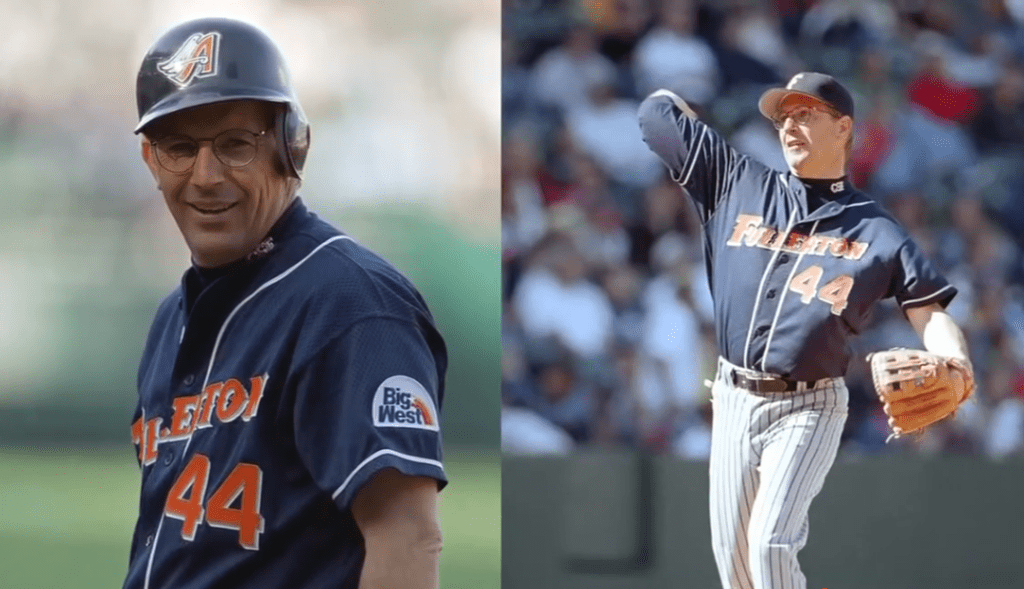
Despite what has circulated in Hollywood, Kevin Costner didn’t play baseball at Cal State Fullerton. But he did at Villa Park High. Born in Lynwood, growing up in Compton, living for a time in Ventura, Costner was a Cal State Fullerton student who graduated in 1978 and, with his high-profile acting success, wanted to help the baseball team. As friends with coach Augie Garrido, Costner was part of a fundraiser/alumni game participant who, in 2016, wore No. 44. In the alum game, he struck out in the top of the second inning against Cal State Fullerton freshman pitcher Colton Eastman.
In 1992, Fullerton gave him a custom jersey with the No. 1 on it. In 1995, Costner went to Omaha, Neb., to see Fullerton play in the College World Series and took part in batting practice (then hopped a private jet to continue editing his movie, Waterworld). In his acting and directing Hollywood career, Costner of course did several films that has baseball as a theme: Bull Durham, Field of Dreams, For Love of the Game, plus The Upside of Anger and Chasing Dreams. He played a baseball player in three of those films and a former pro baseball player in another.
Darrell Evans, Pasadena City College basketball guard (1966 to 1969):

Before he put in 21 seasons as a MLB All Star with Atlanta and San Francisco, Evans was a two sports standout of Muir High in Pasadena and at Pasadena City College. At Muir, Evans was a 13th round pick of the Chicago Cubs, but declined as he hoped to get a scholarship at USC. A right-handed throwing pitcher and left-handed hitting third baseman, Evans threw a no-hitter in March of ’65 — a tribute to his mother and aunt once being professional fast pitch softball players. Evans went to PCC and helped both the baseball team (hitting .423) and basketball team (as its leading scorer) coached by Jerry Tarkanian to state JC championships. Evans received the school’s athlete of the year award in 1967 and was induced into the PCC Hall of Fame. At PCC, he was a second- round pick by the New York Yankees in the 1966 January draft, and again declined. He was the fifth-round pick by Detroit in the ’66 June draft, and again declined. He was a third-round pick of Philadelphia in the ’67 January draft, and declined. He dropped to a seventh-round pick by the Kansas City A’s in the ’67 June draft — and signed. Atlanta then got him in December of ’68 in a Rule 5 draft. In 1973, Evans joined Hank Aaron and Dave Johnson to give the Braves the first trio of teammates in MLB history to each hit 40 home runs or more in the same season.
Alan Foster, Los Angeles Dodgers pitcher (1967 to 1970):

A second-round draft pick by the Dodgers out of Los Altos High in Hacienda Heights, Foster made his MLB debut as a 20-year-old at the end of the ’67 season, as the team was seeking to fill Sandy Koufax’s spot in the rotation. Foster struggled with a 3-9 mark in ’69 — his claim to fame was giving up a home run to Pittsburgh’s Willie Stargell that cleared the right-field pavilion room — he was 10-13 with a 4.26 ERA in 33 starts in ’70. The Dodgers packaged him in a deal to Cleveland for catcher Duke Sims. Foster circled back to Southern California with the Angels in ’71 as part of the Vada Pinson-Alex Johnson deal, but only made it through 12 innings in eight games (wearing No. 32). He finished with St. Louis and San Diego before he was done in ’76. But he will always have the moment when he made the cover of Sports Illustrated in March 1968 touted as one of the top rookies of the upcoming MLB season. That’s Cincinnati’s eventual Hall of Fame catcher Johnny Bench top center (with pitchers Don Pepper of Detroit, Mike Torrez of St. Louis and Cisco Carlos of the Chicago White Sox).
Bob Einstein, Chapman University basketball (1963-64 to 1964-65):


Before he became the comedic stuntman known as “Super Dave” Osborne, Einstein was part of then-named Chapman College and landed on the basketball team. A Los Angeles Times story about the team in December of 1964 noted that Einstein was “a burly 6-4, 220-pound center from Beverly Hills.” The older brother of comedian Albert Brooks (original last name was also Einstein), Bob was the subject of a documentary about his life, The Super Bob Einstein Movie, which came out in 2021, two years after his death at age 76. “There will never be anyone like him,” said commedian Larry David, “as he told us again and again.”
Nannette Diaz Barragán, U.S. House of Representatives (CA-44) (2017 to present):

Since 2017 when the freshman House rep put on a Los Angeles Dodgers’ jersey and sported a red No. 44 to represent her district, then ripped a pinch-hit, RBI-single in her first appearance before 25,000, Barragán continues a baseball legacy of proving her worthiness in the Congressional Baseball Game. Barragán’s 44th District not only covers Carson, Compton, Lynwood, North Long Beach, Rancho Dominguez, San Pedro, South Gate, Walnut Park, Watts, Willowbrook and Wilmington, but also the Compton Youth Baseball Academy, which hosts annual girls baseball tournaments. Barragán’s legislative career continues a progression she made in the sport of baseball. Born in Harbor City as the youngest of 11, Nanette Diaz went to North Torrance High and, which she played softball, she petitioned the administration to be allowed to try out for the baseball team. She made the JV squad. With degrees in political science and public policy at UCLA and a doctorate in law at USC, she launched into a legal career. Getting into politics, she was voted into the Hermosa Beach City Council in 2013, fighting against offshore oil drilling. Two years later, she ran for Congress after Janice Hahn vacated the seat. Barragán, who had decisive victories in re-elections in ’18, ’20, ’22 and ’24, doesn’t hide her love of the Dodger blue, introduced to her by her father. Her official website has fashioned a branding for her that looks like the Dodgers’ logo. For all the times she has played in the Congressional Baseball Game, she sat out the 2026 game at Nationals Park and watched next to Minority Leader Hakeem Jeffries (D-N.Y.)

Malachi Moore, Major League Baseball umpire (2020 to present):

The first professional umpire to graduate from a program created by the Urban Youth Academy in his hometown of Compton to promote baseball among inner-city youngsters, Moore started out working with the program as a part-time groundskeeper making $10 an hour, as he was playing at Compton Junior College as a second baseman. As the 10th Black umpire in MLB history, Moore took No. 44 to honor Kerwin Danley, who retired as baseball’s first Black crew chief, as well as Henry Aaron and President Barack Obama (most notably, the 44th president).
We also have:
Ron Duguay, Los Angeles Kings center (1987-88 to 1988-89)
Rob Niedermayer, Mighty Ducks of Anaheim/Anaheim Ducks center (2002-03 to 2008-09)
Ken Landreaux, Los Angeles Dodgers outfielder (1981 to 1987)
Takashi Saito, Los Angeles Dodgers pitcher (2006 to 2008)
Cliff Robinson, USC men’s basketball (1977-78 to 1978-79)
John Rudomentkin, USC men’s basketball (1959-60 to 1961-62)
Jim Spillane, UCLA men’s basketball (1973-74 to 1976-1977)
Mike Guman, Los Angeles Rams fullback (1980 to 1988)
Anyone else worth nominating?


1 thought on “No. 44: Louis Zamperini”