"Everything comes to him who hustles while he waits." — Tommy Edison
Author: fartheroffthewall
Tom Hoffarth is a sports journalist in Los Angeles, born and raised (reared is the correct phrase, but it just sounds wrong) and specializing in the sports media business. A USC graduate from the School of Journalism (it still exists, somewhat) in 1984, he is also available for service at https://www.linkedin.com/in/tomhoffarth/
This is the latest post for an ongoing media project — SoCal Sports History 101: The Prime Numbers from 00 to 99 that Uniformly, Uniquely and Unapologetically Reveal The Narrative of Our Region’s Athletic Heritage. Pick a number and highlight an athlete — person, place or thing — most obviously connected to it by fame and fortune, someone who isn’t so obvious, and then take a deeper dive into the most interesting story tied to it. It’s a combination of star power, achievement, longevity, notoriety, and, above all, what makes that athlete so Southern California. Quirkiness and notoriety factor in. And it should open itself to more discussion and debate — which is what sports is best at doing.
The most obvious choices for No. 23:
= Kirk Gibson: Los Angeles Dodgers = LeBron James: Los Angeles Lakers = David Beckham: Los Angeles Galaxy = Eric Karros: Los Angeles Dodgers = Dustin Brown: Los Angeles Kings
The not-so obvious choices for No. 23:
= Harold Minor: USC basketball = Diana Taurasi: Don Lugo High School girls basketball = Jackie Joyner: UCLA women’s basketball = Jonathan Franklin: UCLA football = Kenny Washington: UCLA basketball
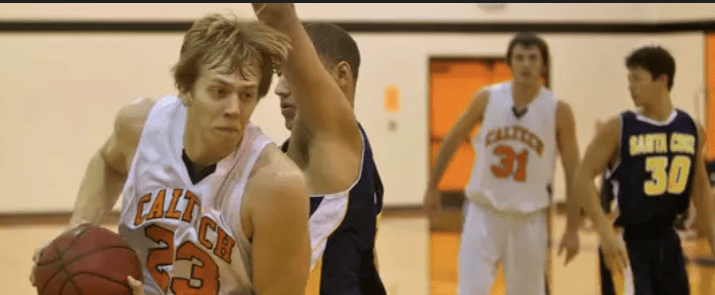
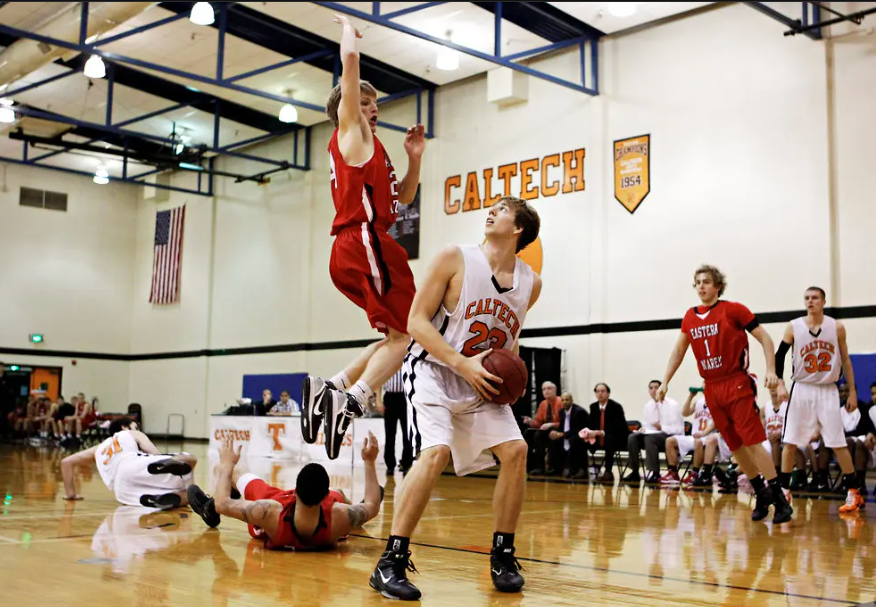
The most interesting story for No. 23: Ryan Elmquist, Caltech basketball guard (2007-08 to 2010-11) Southern California map pinpoints: Pasadena, Whittier, Pomona, LaVerne
Caltech senior Ryan Elmquist looks for a shot during his team’s 87-53 win over Eastern Nazerene, its second in a row during the 2010-11 season (later forfeited). Danny Moloshok/New York Times.
Ryan Elmquist scored 36 on his ACT college entrance exam. That surely impressed his classmates at Woodbury High in Minnesota, just East of the Twin Cities. Especially those who came to understand how that was a perfect score.
It gave Elmquist a ticket to dig out of the Midwest snow, head to Pasadena and enroll in California Institute of Technology — better known as Caltech in “The Big Bang Theory” fandom.
His major was to study computer science. His guilty pleasure was to keep playing basketball.
In Caltech lore, Elmquist, a 6-foot-5 forward, is far better remembered for the time when he scored one not-so-lousy free throw on February 22, 2011. The last of his 23 points, with 3.3 seconds left, accounted for the final margin in a 46-45 victory for the Beavers over visiting Occidental College on their home Braun Athletic Center.
His smarter-than-smart peers were as impressed as the school’s Nobel Laureate-rich professorial staff and researchers. For Elmquist not only had the perfect ending to his senior season in the final game he ever played for the school, it also ended Caltech’s streak of 310 consecutive losses in Southern California Intercollegiate Athletic Conference (SCIAC) competition. That was a streak that began before Elmquist and his teammates were born, in January of 1985.
But who’s counting. Unless you are a campus full of math nerds.
This is the latest post for an ongoing media project — SoCal Sports History 101: The Prime Numbers from 00 to 99 that Uniformly, Uniquely and Unapologetically Reveal The Narrative of Our Region’s Athletic Heritage. Pick a number and highlight an athlete — person, place or thing — most obviously connected to it by fame and fortune, someone who isn’t so obvious, and then take a deeper dive into the most interesting story tied to it. It’s a combination of star power, achievement, longevity, notoriety, and, above all, what makes that athlete so Southern California. Quirkiness and notoriety factor in. And it should open itself to more discussion and debate — which is what sports is best at doing.
The not-so- obvious choices for No. 59:
= Collin Ashton, USC football = Lou Ferrigno Jr., USC football = Mario Celotto, USC football = George Kase, UCLA football = Evan Phillips, Los Angeles Dodgers = Ismail Valdez, Los Angeles Dodgers = Loek Van Mil, Los Angeles Angels
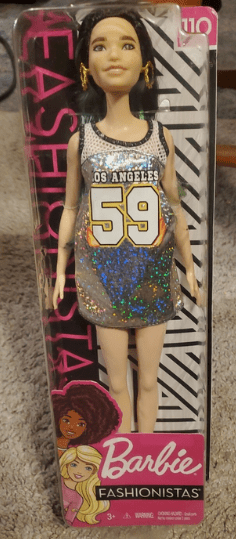
The most interesting story for No. 59: =Barbie, pop culture icon (1959 to present) Southern California map pinpoints: Hawthorne, El Segundo, Los Angeles
Of all the pretty people, impenetrable places and pretend things to chose from, Barbie pushed herself onto the cover of Sports Illustrated in early 2014.
It figures that the iconic figurine and model citizen created by the then-Hawthorne based Mattel toy company wasn’t depicted as an athlete. This wasn’t the SI Sportsperson of the Year issue.
Yet, jockified Barbie could play the part, and this could have passed as fashionable forward thinking here.
Through the years, Barbie has gone beyond a fancy-dressed glamor symbol. She’s been a volleyball player. And a soccer player. And a softball player. Name the sport — we’re even thinking pickleball — and in many display cases, she’s sporting a No. 59 jersey.
That’s a call back to the year she was created, 1959.
Some of those “59” Barbies also tout off her active lifestyle as part of the “Malibu Collection,” along with genital challenged boyfriend, Ken.
But for this purpose, for this SI cover, this Barbie, a certified Southern California 11 ½-inch titan, was on the Swimsuit issue. Wearing her a classic black-and-white one-piece retro swimsuit.
Legendary photographer Water Ioos, Jr., was also in on the photo shoot.
“She’s like the best model I’ve ever worked with,” he said. “She takes directions almost silently.”
Officially, it was an #unapologetic synergistic “cover wrap” to coincide with the American International Toy Fair, as well as celebrate the 50th anniversary of the magazine. Indeed, Mattel paid SI for the privilege of its platform exposure. And a limited edition SI Barbie doll went on sale to cash in on it all.
All in all, this Barbie/SI co-oped exposure became uncomfortable pearl clutching for some concerned about the image-consciousness messaging to young women.
“Mattel has long contended with complaints that Barbie, with her lithesome figure and focus on fashion, is not a positive role model for girls,” a New York Times story noted. “At the same time, Sports Illustrated is no favorite of some critics who believe that the swimsuit issue objectifies women.”
A Mattel spokesman responded in a story for NBC News: “Barbie has always been a lightning rod for controversy and opinions. Posing in SI gives Barbie and her fellow legends an opportunity to own who they are, celebrate what they have accomplished and show the world it is OK to be capable and captivating.”
That story noted Sports Illustrated claims to have more than 17 million women read its Swimsuit issue, more than most major fashion magazines combined, and sales for items the models wear get a significant boost.
“Barbie sort of has been taken hostage,” said a university marketing professor, “(but) despite her haters and naysayers, she’s comfortable with who she is.”
This is the latest post for an ongoing media project — SoCal Sports History 101: The Prime Numbers from 00 to 99 that Uniformly, Uniquely and Unapologetically Reveal The Narrative of Our Region’s Athletic Heritage. Pick a number and highlight an athlete — person, place or thing — most obviously connected to it by fame and fortune, someone who isn’t so obvious, and then take a deeper dive into the most interesting story tied to it. It’s a combination of star power, achievement, longevity, notoriety, and, above all, what makes that athlete so Southern California. Quirkiness and notoriety factor in. And it should open itself to more discussion and debate — which is what sports is best at doing.
The most obvious choices for No. 42:
= James Worthy, Los Angeles Lakers = Ronnie Lott, USC football = Ricky Bell, USC football = Walt Hazzard, UCLA basketball = Don MacLean, UCLA basketball
The not-so-obvious choices for No. 42:
= Connie Hawkins, Los Angeles Lakers = Kevin Love, UCLA basketball = Lucius Allen, UCLA basketball and Los Angeles Lakers = CR Roberts, USC football
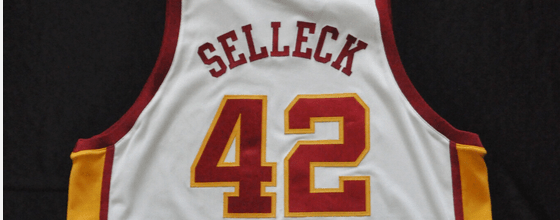
The most interesting story for No. 42: Tom Selleck, USC basketball forward (1965-66 to 1966-67) via Grant High of Van Nuys and L.A. Valley College Southern California map pinpoints: Sherman Oaks, Van Nuys, Los Angeles (Sports Arena), Hollywood
The 42 preamble
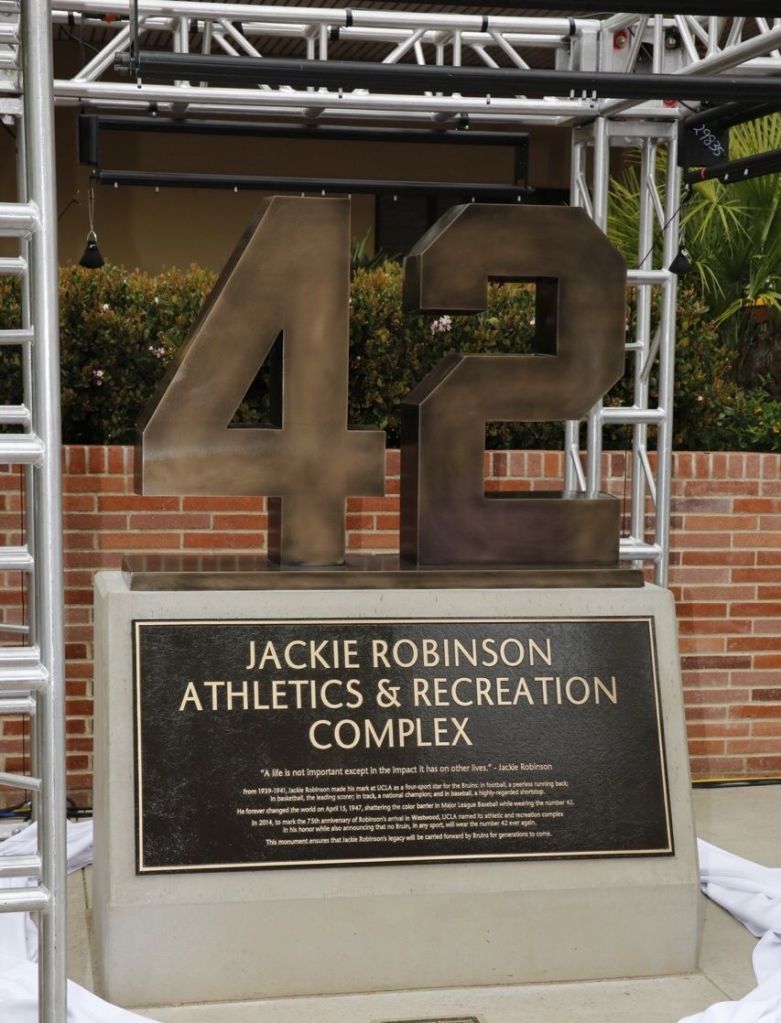
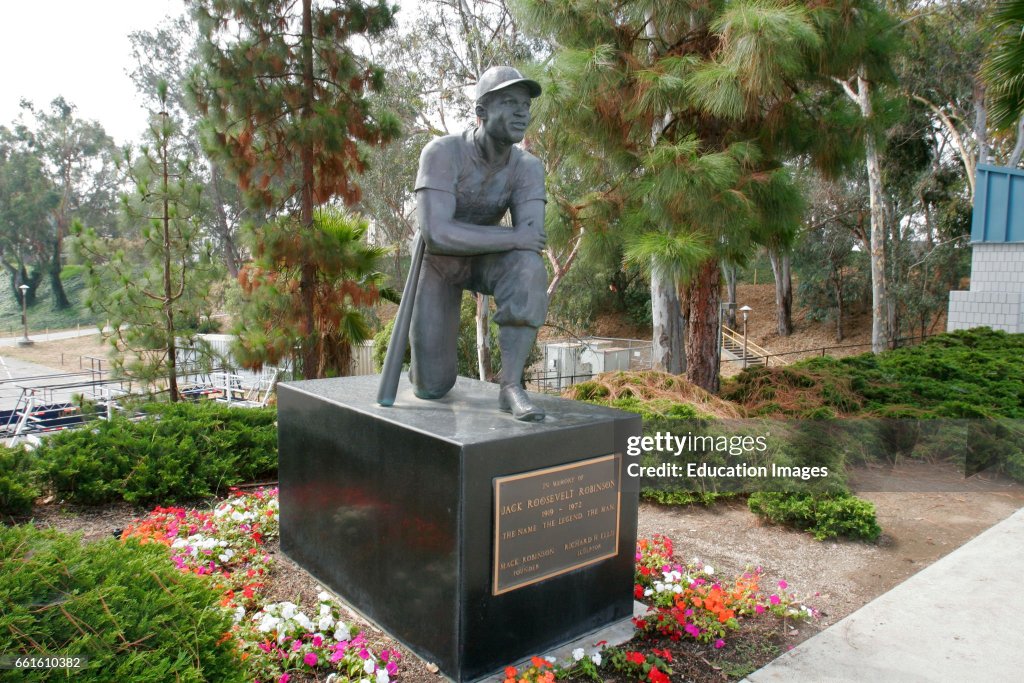
UCLA unveiled a Jackie Robinson monument on campus on March 5, 2016.
In November of 2014, UCLA announced it would retire the No. 42 across all its men’s and women’s sports teams. It was following up what Major League Baseball did 17 years earlier, this time to honor one of its most noteworthy alums, Jack Robinson.
UCLA may have also been nudged by another local university for the concept of this kind of number retirement. In February of ’14, Cal State Northridge’s athletic department retired the No. 58 among all its sports programs to mark the year — 1958 — when the school opened.
Conveniently, the timing for UCLA’s declaration marked the 75th anniversary of Robinson’s arrival as a student-athlete on the campus.
After two years at Pasadena City College, Robinson, out of Muir Technical High, went to Westwood in February of 1939 on an athletic scholarship. He departed in the spring of 1941, a few units short of a degree and with no graduation. The story goes that Robinson needed to make some income to help his family in Pasadena. He would soon go into the military.
But Robinson sure did put a spotlight on the university. He was the first four-sport letterman in UCLA history – football (1939 and 1940), basketball (1940 and 1941), track and field (1940) and even a little baseball (1940).
In 2004, a Jackie Robinson statue was created to sit near Jackie Robinson Stadium just west of the UCLA campus (Getty Images)
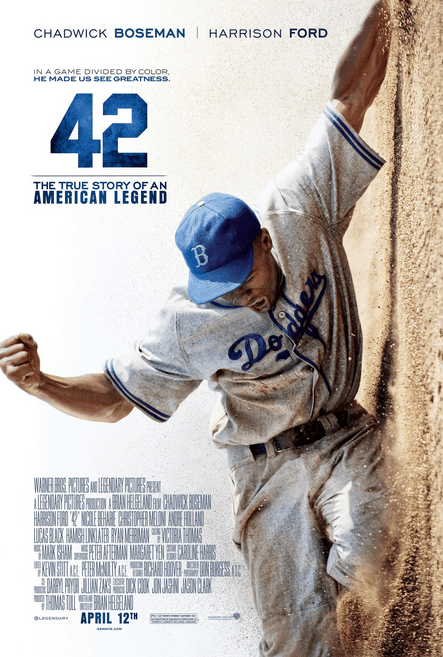
Even more convenient was UCLA announcement’s was just after the success of the 2013 film, “42.”
The late actor Chadwick Bozeman played Robinson on his journey through Pasadena to UCLA, to the Dodgers’ Triple-A Montreal Royals, before it was decided he was equipped to join the Brooklyn Dodgers and wear that number 42.
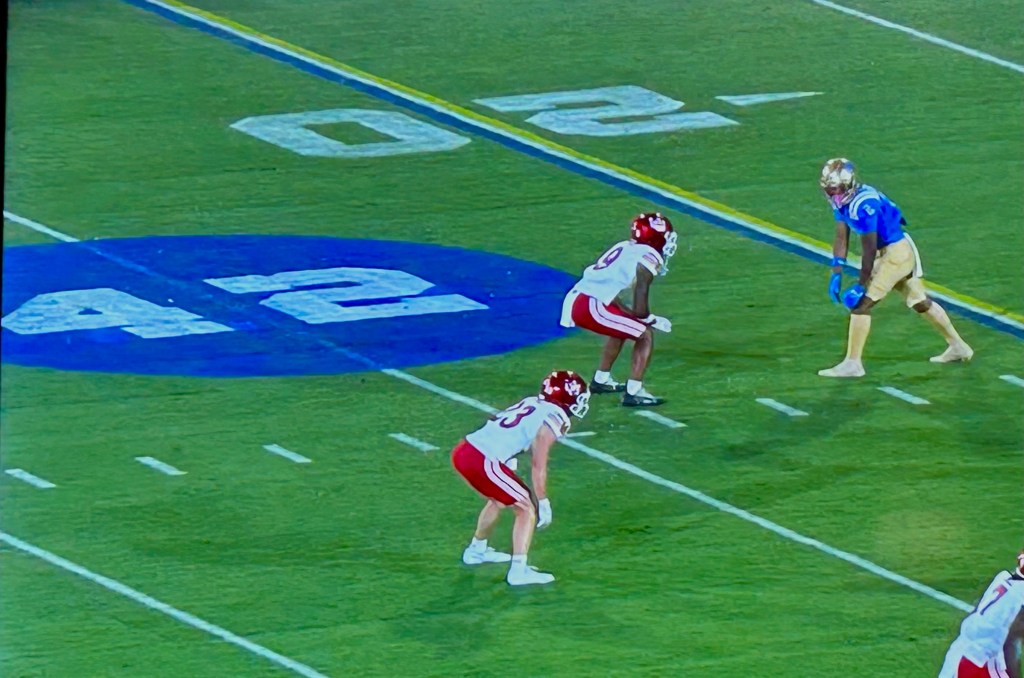
The fact that Robinson never wore No. 42 at UCLA in any sport seems to be beside the point. UCLA’s accounting department acknowledges that as it finds places in almost every athletic platform to make sure a “42” is branded somewhere.
The “42” is painted at each 25 yard line at the Rose Bowl during a UCLA-Utah game in August of 2025. Why not at each 42-yard line?
“Jackie Robinson established a standard of excellence to which people the world over should aspire,” said athletic director Dan Guerrero, a former UCLA baseball player, during the announcement. “We want to ensure that his is a legacy to be upheld and carried forward by Bruins for generations to come. While he wore several numbers at UCLA, Jackie Robinson made the number 42 as iconic as the man himself. For that very reason, no Bruin will be issued the number 42 — in any sport — ever again.”
For UCLA basketball, he was No. 18. For UCLA football, he was famously No. 28. What he wore playing baseball, the Bruin statkeepers still aren’t sure.
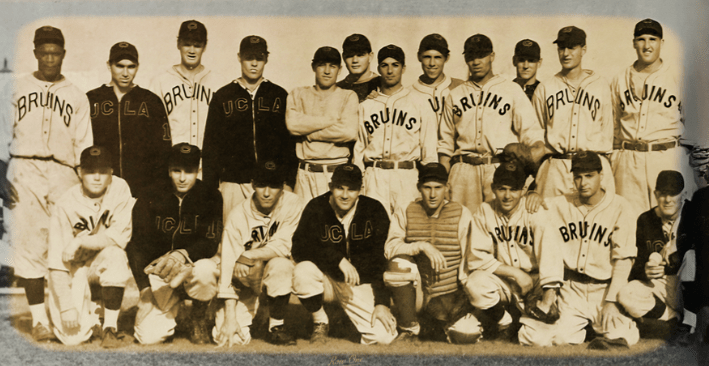
The UCLA Bruins’ 1940 baseball team photo. Jack Robinson is top left.
We had sought out UCLA’s sports information department for more info, but it can’t find any evidence he even wore a baseball number. The Dodgers and the Baseball Hall of Fame’s research department in Cooperstown, N.Y., didn’t produce anything. Neither did a dig through the Amateur Athletic Foundation nor the Pasadena City library archives. Employees at the Jackie Robinson Foundation finally were asked to quiz Rachel Robinson about it. She replied: I don’t know.
For now, it remains an iconic, and ironic, mystery. Which seems pretty twisted in itself.
There also seems to be no magical story behind why Robinson wore 42, other than it’s what the Dodgers gave him to wear.
In Triple-A, Robinson wore No. 10. During his days with the Kansas City Monarchs of the Negro Leagues, various accounts have him wearing Nos. 5, 8 and 23.
Ken Griffey Jr. is probably most responsible for making No. 42 more ubiquitous. When then–MLB Commissioner Bud Selig retired No. 42 for all of baseball on April 15, 1997 — 50 years after Robinson’s MLB debut — Griffey, then with the Seattle Mariners, asked that his uniform number be flipped from 24 to 42 for that day. It was.
By 2004, the league started an annual Jackie Robinson Day. In 2007, Griffey, then with the Cincinnati Reds, asked Selig if he could wear 42 again for the special occasion. Selig got the OK from Rachel Robinson — and the offer was made to any MLB player who wanted to make that number change as well. Then it became a thing.
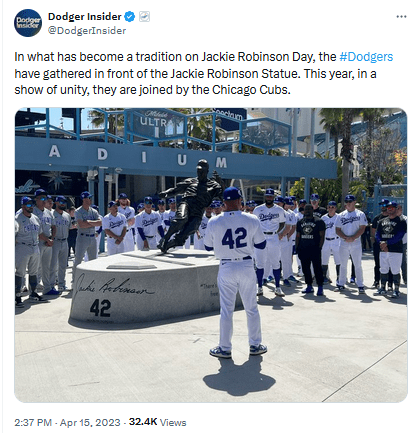
Dodgers manager Dave Roberts, a UCLA graduate, addresses the team at the Dodger Stadium Jackie Robinson statue outside of center field.
We might come up with 42 reasons why Robinson didn’t become our prime focus for No. 42, but the primary reason is that No. 42 is far more acrimonious with Robinson’s Brooklyn Dodgers career. He didn’t come with the team when it moved to Los Angeles. Robinson retired in 1957 before the Dodgers could trade him to the rival Giants.
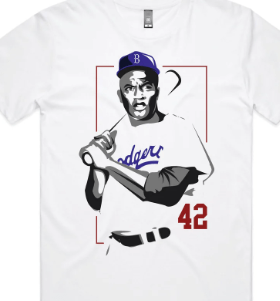
A company named PASADENA CLSC (pronounced Classic), was started in 2019 by graphic designer Dennis Robinson, the grandson of Jack’s brother, Mack, to celebrate his great uncle’s legacy as well as celebrate the community’s history. By some accounts, Robinson would not have been comfortable with this “42” branding opportunity by MLB. Especially as it seems “42” has become a selling point when put on all sorts of hats, clothes, jackets, socks … It’s easily identifiable with a man, a cause and a statement of one’s social justice beliefs. The MLB duly notes that with its own product line.
We consider Robinson’s greatest impact in Southern California sports history when he wore No. 28 playing football.
In 2017, when the Dodgers unveiled a statue honoring Robinson outside of Dodger Stadium, Vin Scully, as the master of ceremonies, told several stories about his relationship with Robinson, going back to Scully’s first year broadcasting Dodgers games in Brooklyn in 1950. Scully punctuated that speech with this “Jackie Robinson Day” celebration on April 15:
“All across the country, in every major-league ballpark, every player will be wearing 42. And what does the 42 means? It doesn’t mean that (the players) are all equal. … but the one thing they share in carrying 42 is the fact that the man who wore it gave them the one thing that no one at the time could have ever done. He gave them equality. And he gave them opportunity. Those were the two things many of those people never had to hold in their hearts when they first began to play. So, yes, 42 is a great number, it means a lot for a great man, but it is a tremendous number when you think of a man who wore it with such dignity, with such pride, and with such great discipline.”
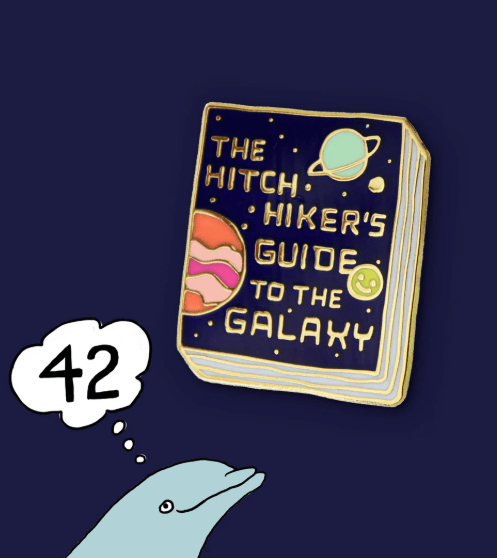
Anyone else able to explain how the number 42 seems to be somehow attached as the “Answer to the Ultimate Question of Life, the Universe, and Everything”?
In Douglas Adams’ late ’70s/early ’80s comedy/science fiction book series, “The Hitchhiker’s Guide to the Galaxy,” No. 42 is the simple answer that comes up after a super computer called “Deep Thought” spends 7 ½ billion years of calculation pondering that the aforementioned question. Or was it a real question. The creators did not actually know what the “Ultimate Question” was, rendering the answer 42 even more confusing.
Adams, when asked, said he simply picked that answer because it was an ordinary, small number.
How so? What does it all mean? Was he a Jack Robinson fan?
Sit with that awhile and see where the universe takes you.
No. 42: Tom Selleck
You never know when a low dose of a early-morning TV chat show might actually clarify some urban Hollywood legend and lead to some legitimate record-keeping.
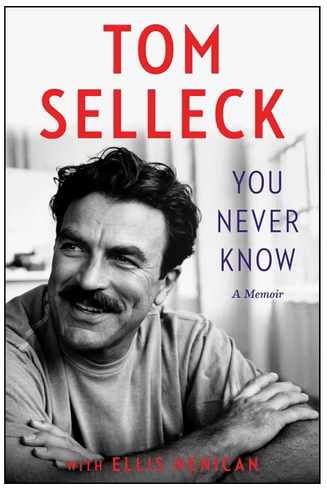
In May of 2024, Tom Selleck climbed up in the high-back chair as a guest on “Live with Kelly and Mark,” taking questions about how he went from a USC basketball player to a Hollywood actor based on his newly released memoir, “You Never Know.” The nattering ABC coffee klatch visit was also a place to get nostalgic for the end of his participation in the long-running CBS series “Blue Bloods.”
“You wanted to be — and I did not realize this — a professional athlete!?” co-host Kelly Rippa piped up as she boosted herself up in her seat.
Selleck shrugged.
“Well, it was kind of a fantasy,” he said sheepishly. “(At first) it was baseball, then I got a little burned out, and by the time I got to ‘SC, I thought it was basketball …”
“You got a scholarship, in fact!” Kelly interjected.
“No,” Selleck answered, almost apologetic. “I was a walk on. Basically my real job was riding the pine at USC … I earned a scholarship my last semester.”
This is the latest post for an ongoing media project — SoCal Sports History 101: The Prime Numbers from 00 to 99 that Uniformly, Uniquely and Unapologetically Reveal The Narrative of Our Region’s Athletic Heritage. Pick a number and highlight an athlete — person, place or thing — most obviously connected to it by fame and fortune, someone who isn’t so obvious, and then take a deeper dive into the most interesting story tied to it. It’s a combination of star power, achievement, longevity, notoriety, and, above all, what makes that athlete so Southern California. Quirkiness and notoriety factor in. And it should open itself to more discussion and debate — which is what sports is best at doing.
The most obvious choices for No. 79:
= Jonathan Ogden, UCLA football = Bob Golic, Los Angeles Raiders = Rob Havenstein, Los Angeles Rams = Jeff Bregel, USC football
The not-so-obvious choices for No. 79:
= Gary Jeter, USC football = Coy Bacon, Los Angeles Rams
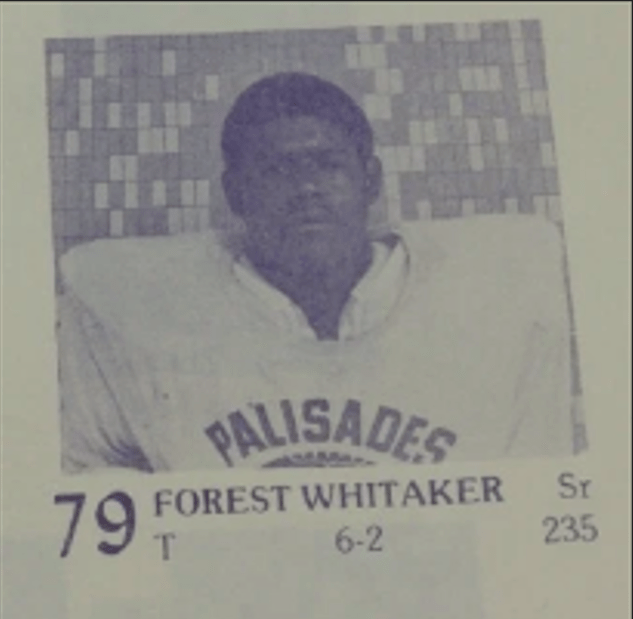
The most interesting story for No. 79: Forest Whitaker, Palisades High football defensive tackle (1976 to 1978) Southern California map pinpoints: Pacific Palisades, Carson, Hollywood
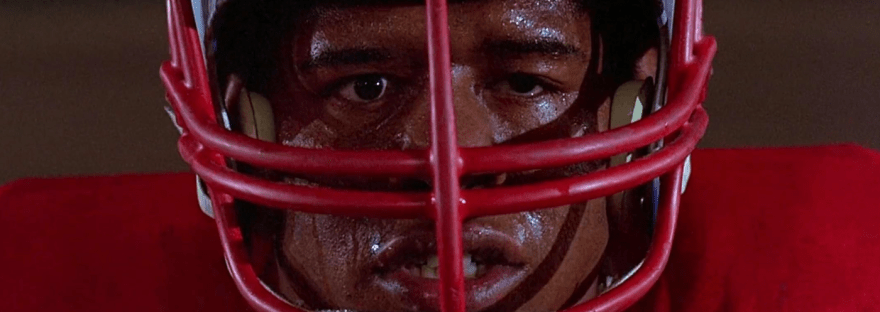
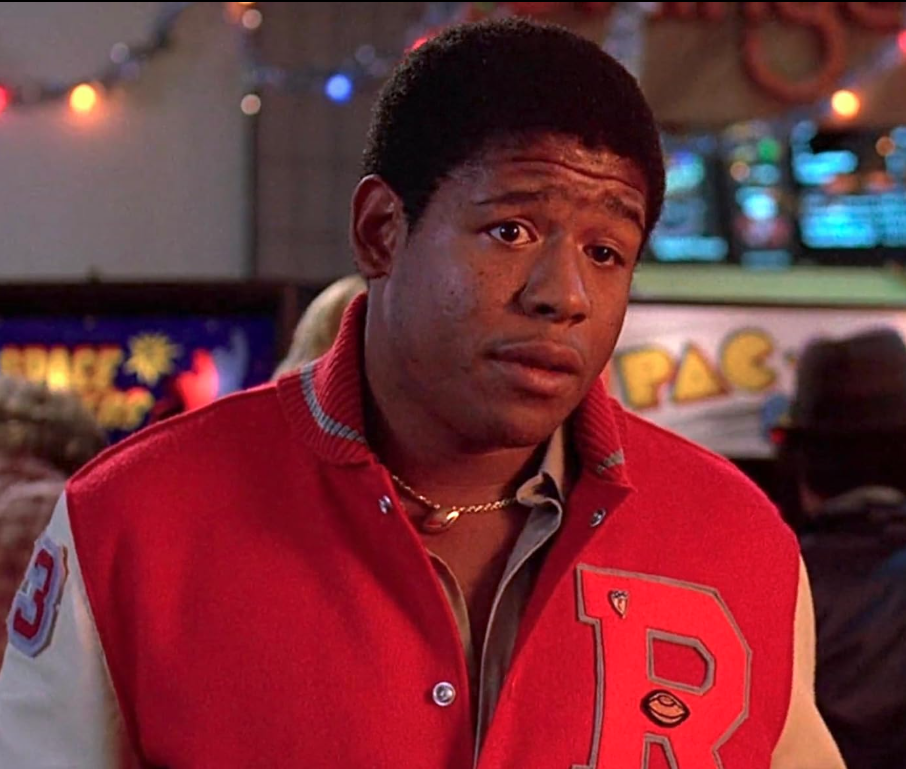
There’s five minutes of mayhem in the iconic 1982 teen flick “Fast Times at Ridgemont High” where Forest Whitaker is allowed to show a full range of acting — and athletic — skills, something he would eventually harness decades later with an Oscar-worthy resume.
As Ridgemont High’s star linebacker Charles Jefferson, wearing No. 33 on his jersey and lettermen’s jacket, Whitaker goes from mild-mannered to maniacal mayhem during a fast-and-furious turn of events.
It wasn’t a real stretch for Whitaker to take on that role.
Just a few years earlier, he was an All-L.A. City defensive tackle at Palisades High, wearing No. 79. He would go off to Cal Poly Pomona on a football scholarship.
Maybe some special effects are used during the movie’s football game scene, allowing Jefferson to launch himself in slow motion over the Lincoln High offensive line and tackle the entire backfield.
One by one, Jefferson knocked out the opposing team to the delight of the Ridgemont student section, many wearing buttons that read “Assassinate Lincoln.”
There were more cinematic knockouts to come for Whitaker.
Forest Steven Whitaker, born on July 15, 1961 in Longview, Texas, moved with his family to Carson at age 4. His mom, Laura, was a special ed teacher and his father, Forest, sold insurance.
Rather than have him attend a school in L.A.’s tougher inner city, Whitaker’s parents figured out a way to have him go to Palisades High in Malibu, which could be an hour-long ride in traffic one way.
Whitaker once said his parents’ decision may have saved his life.
This is the latest post for an ongoing media project — SoCal Sports History 101: The Prime Numbers from 00 to 99 that Uniformly, Uniquely and Unapologetically Reveal The Narrative of Our Region’s Athletic Heritage. Pick a number and highlight an athlete — person, place or thing — most obviously connected to it by fame and fortune, someone who isn’t so obvious, and then take a deeper dive into the most interesting story tied to it. It’s a combination of star power, achievement, longevity, notoriety, and, above all, what makes that athlete so Southern California. Quirkiness factors in. And it should open itself to more discussion and debate — which is what sports is best at doing.
The most obvious choices for No. 95:
= Jamir Miller, UCLA football
The not-so-obvious choices for No. 95: = Roger McQueen, Anaheim Ducks
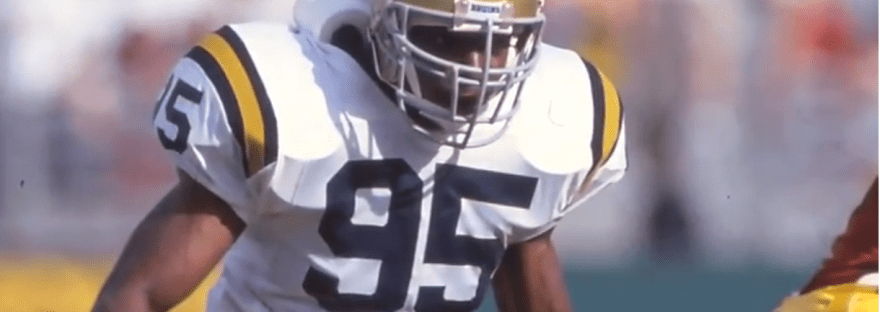
The most interesting story for No. 95: Jamir Miller, UCLA football outside linebacker (1991 to 1993) Southern California map pinpoints: Westwood, Pasadena
Jamir Miller’s jam at UCLA, aside from chasing down quarterbacks, seemed to be a persistent pursuit of parties. That didn’t stop until he was well into a career in pro football.
An All-American linebacker who, in just three seasons with the Bruins would lead the team in sacks each year, rack up a then-school record 23 ½ total, added 35 tackles for a loss, and was a Butkus Award finalist by the time he was done with college football, Miller said he once assessed that by his sophomore year in Westwood, “I embarked on the wild phase of my life that lasted through my second year in the NFL,” according to the Cleveland Plain Dealer in August of 2000.
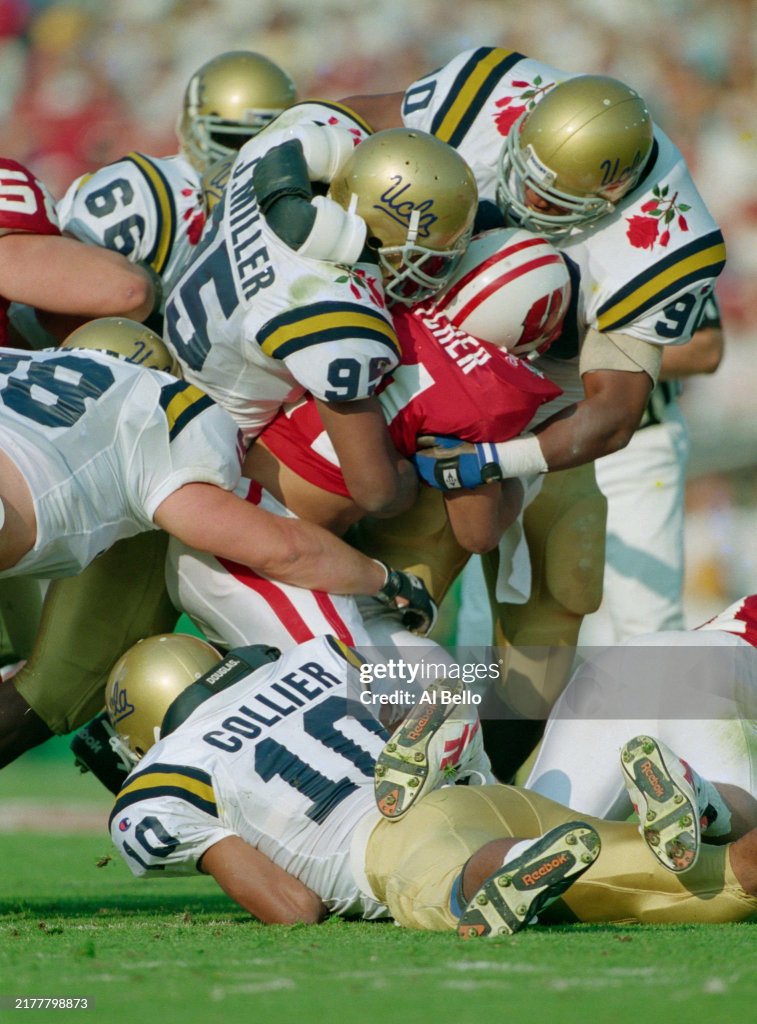
UCLA’s Jamir Miller (95, center) teams up with Shane Jasper (90, right) to wrap up Wisconsin running back Terrell Fletcher (41) in the Rose Bowl on Jan. 1, 1994. (Al Bello/Allsport/Getty Images)
That didn’t include a senior year of college in that time frame.
The 6-foot-5, 252-pounder was arrested twice at UCLA — once for possessing a loaded firearm and once for accepting stolen stereo and computer equipment. He pleaded no contest to both charges, was placed on three years probation and required to perform 100 hours of community service.
Miller also was suspended for the 1993 season opener by head coach Terry Donahue, a person who Miller credits for being most responsible for recruiting him to come to UCLA and tell his mother that her son would be taken care of. UCLA not only lost that first game of the season, 27-25, to Cal, but also the second game, 14-13, at the Rose Bowl against Nebraska, to started 0-2. That would be the last season for Miller at the school.
Miller’s missteps followed a bit of a pattern he developed as a kid growing up with a single mom in the Oakland area, trying to figure out his identity.
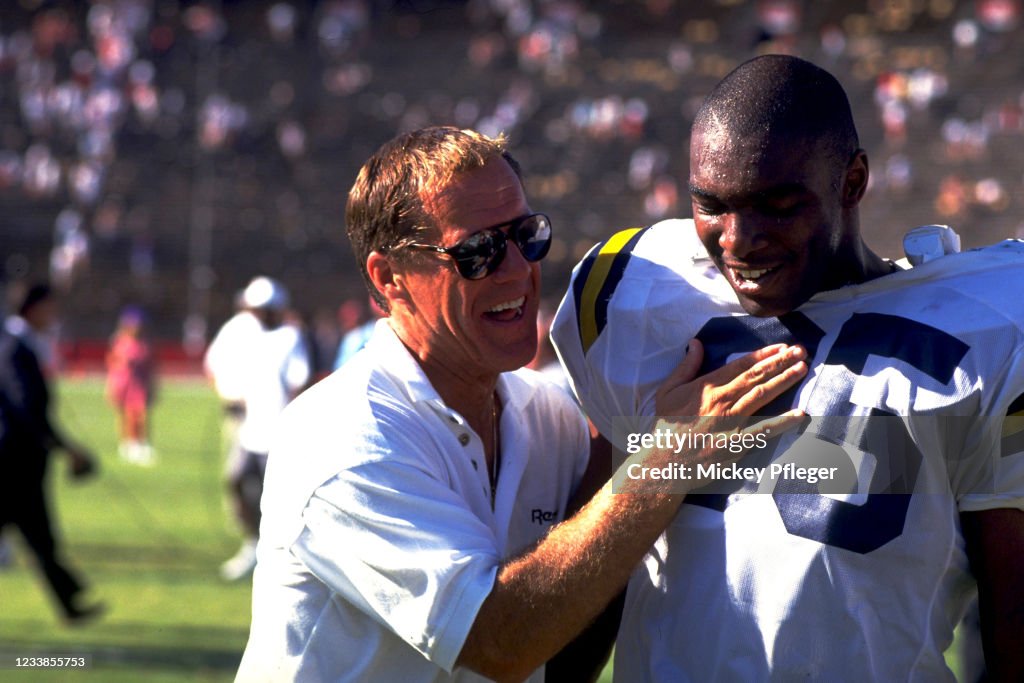
UCLA coach Terry Donahue jokes with linebacker Jamir Miller (95) before a game at Stanford on Sept. 25, 1993. (Mickey Pfleger/Sports Illustrated via Getty Images)
Jamir Malik Miller — his first and middle names mean royal warrior in Swahili — said he didn’t feel much like a warrior growing up.
“When I was younger I didn’t really like my name because it was different and a lot of people couldn’t pronounce it,” Miller told the Los Angeles Times in 1992. “They mess it up and say ‘Jamal’ and I’d go, ‘No, it’s Jamir .’
“I was in the fourth or fifth grade and I’d come home and say, ‘Mom I hate my name because no one can pronounce it.’ She told me not to worry, that I’d understand it when I grew older.
“I wanted to change my name to something like John. I wish my mother had named me something normal. But I decided to stick with it because that’s my identity. And now I’m glad she didn’t name me something normal.”
John Miller was the name of Jamir’s father. A hardened intravenous drug addict, John’s actions forced Jamir’s mother, Rhonda Hardy, to take him as a 3-month old out of their home in Philadelphia and move in with her mother and sisters in the Bay Area.






 Tom Hoffarth's The Drill: More Farther Off the Wall