"Everything comes to him who hustles while he waits." — Tommy Edison
Author: fartheroffthewall
Tom Hoffarth is a sports journalist in Los Angeles, born and raised (reared is the correct phrase, but it just sounds wrong) and specializing in the sports media business. A USC graduate from the School of Journalism (it still exists, somewhat) in 1984, he is also available for service at https://www.linkedin.com/in/tomhoffarth/
The opening act at the massive downtown L.A. arena once known as Staples Center on Oct. 17, 1999: Bruce Springsteen’s Reunion Tour with the E Street Band.
The first of four shows, before any Lakers, Kings or other sporting event at the $400 million palace, inspired L.A. Times music critic Robert Hilburn to write:
“At a time when rock ‘n’ roll’s future is once again being questioned, Bruce Springsteen & the E Street Band showed Sunday at lavish new Staples Center just how glorious the music can still be. … By the end of the concert, Springsteen had done more than simply stir us once again with his music. He showed why he is such a major figure in the history of rock.”
Three months later, the Grammy Awards ceremony, which had danced around various venues in Southern California from the 1960s to the ’90s, quickly gravitated to Staples Center for its 2000 show. It has been the home base pretty much ever since, where Springsteen has often been present as a performer, a nominee (50 times since 1981) or an award recipient (20 of them since 1985).
His 2003 show-ending rendition of the Clash’s “London Calling” – a tribute to the recently departed Joe Strummer — with Elvis Costello, Dave Grohl and Steve Van Zandt remains one of our favorite mashups of talent and music.
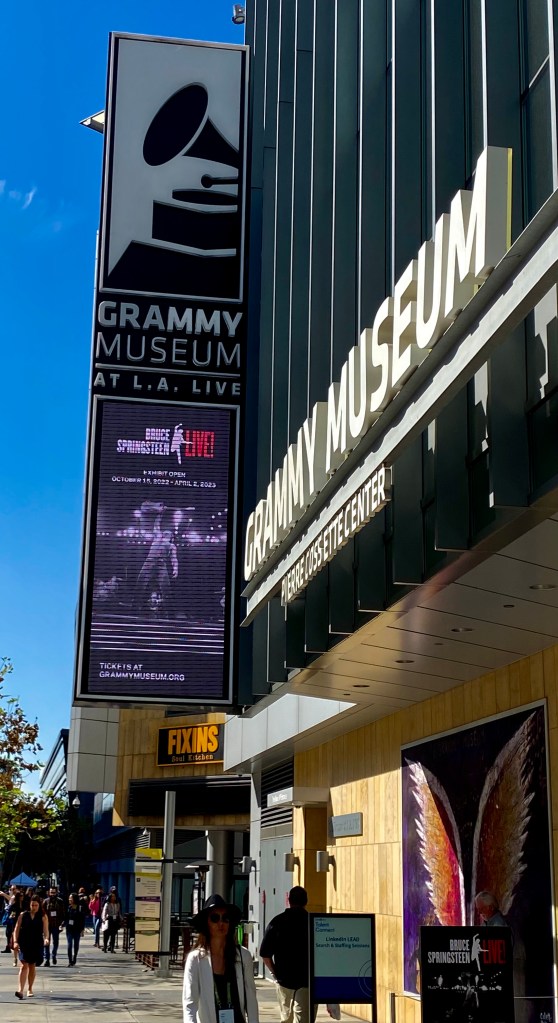
When the Grammy Museum across the street at L.A. Live cleared the second floor for a new exhibit – “Bruce Springsteen Live!” – it seemed like an appropriate as a way to honor New Jersey’s famous son. Dust off some memorabilia and see how it goes.
It actually goes as far as the mind and heart want it to go.
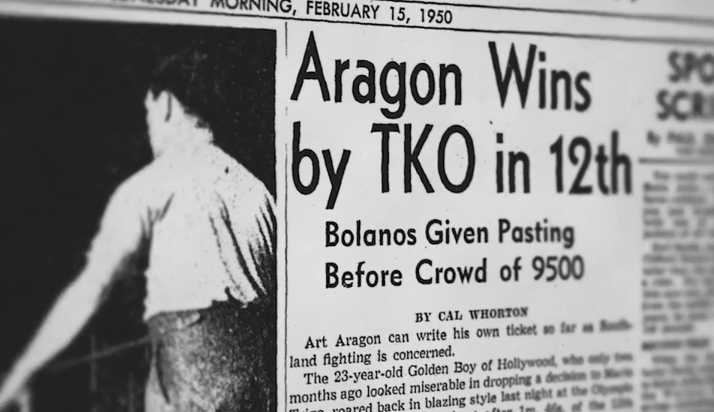
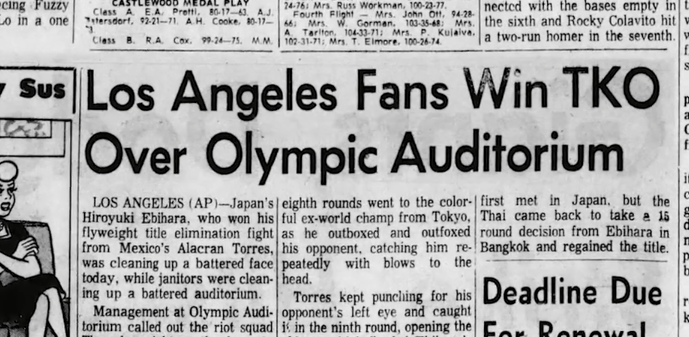
Back in the day, when a boxer had a particularly successful night at The Grand Olympic Auditorium, celebrants in the crowd of some 10,000 tossed coins into the ring.
The opposite could also occur.
When a referee’s decision went against someone – most likely a favorite kid who lived in the neighborhood – watch your head. Chairs could be ripped off their mourning. Cups full of beer went airborne like lobbed grenades.
Orange County adjacent on Saturday night is the next stop, a place for history and nostalgia converging into some humorous hysteria. Fight your way through traffic, wrestle for a parking spot and skate over to the Regal Irvine Spectrum. It’s just a couple of sawbucks at the box office (or these days, online pre-paid codes for your phone) to feel a connection to this landmark.
Be there! See the acclaimed documentary telling the story of L.A. through a historic fight palace, in an immersive theatrical experience. One show only this Saturday at Regal Cinemas Irvine on October 29. Don't wait! Tickets available here: https://t.co/DswOUQoHMd#18thandgrandpic.twitter.com/5OxcQZJSXu
This isn’t a true “Rocky Horror Picture Show”-type of experience, but there is a time warp happening. That’s on purpose. Writer/director/producer Steve DeBro says his 83-minute documentary is meant to whet the appetite — and be seen in a theater rather than your laptop or home TV screen. Communal bonding works on many levels.
Seeing it with viewers who rock to the music, roll with the punches and can recite their shared experiences of this den of dust and dirt, grime and crime figures, Hollywood elite and the common man of the neighborhood just looking to release some energy.
“I tried to make it where you’re carried on a journey that’s almost disorientating, and it should feel like you’re in the Olympic — energetic, fast moving, something that takes you out of yourself,” said DeBro. “That’s why in a theater is the best way you don’t get distracted.”
The screening may be just a one-off event, promoted by boxing matchmaker Roy Englebrecht and his Fight Club OC company, but it doesn’t minimize its journey to this point — and may even confirm the reach it can have beyond its L.A.-based audience. Englebrecht has seen the flick several times and wanted to see if he could generate an audience for it in his neck of the woods.
As some who’ve already seen it live, like Englebrecht, there are repeat customers following these showings.
“The Olympic really had a following from Central California to the Mexican border, and attracted champion boxers like Carols Palomino (born in Mexico and growing up in Westminster),” said DeBro, who could be among the special guests at this O.C. event. “I’m just grateful to them to get the word out and grateful, eager for more to see it, because I think when they see it, the word spreads and spreads.
“We’re thrilled to be able to work with Roy and his team to have the film screened in Orange County. So many great fighters and fans would make the drive from the O.C. to downtown to the fights — this time they won’t have to travel so far to see the action. They’re in for a great night.”
With stops and starts because of COVID infiltration, the doc is back in business and can ramp back up an anticipation we first had when a 2016 piece in the Los Angeles Times gave many of us the promise to revisit a place that has fallen not into disrepair, but more off the radar. That was a year after a Kickstarter campaign launched to get funding for a film that was finally ready for official release in 2021.
The old place can use a new narrative. The one it has now makes it look like it’s doomed to disappear.
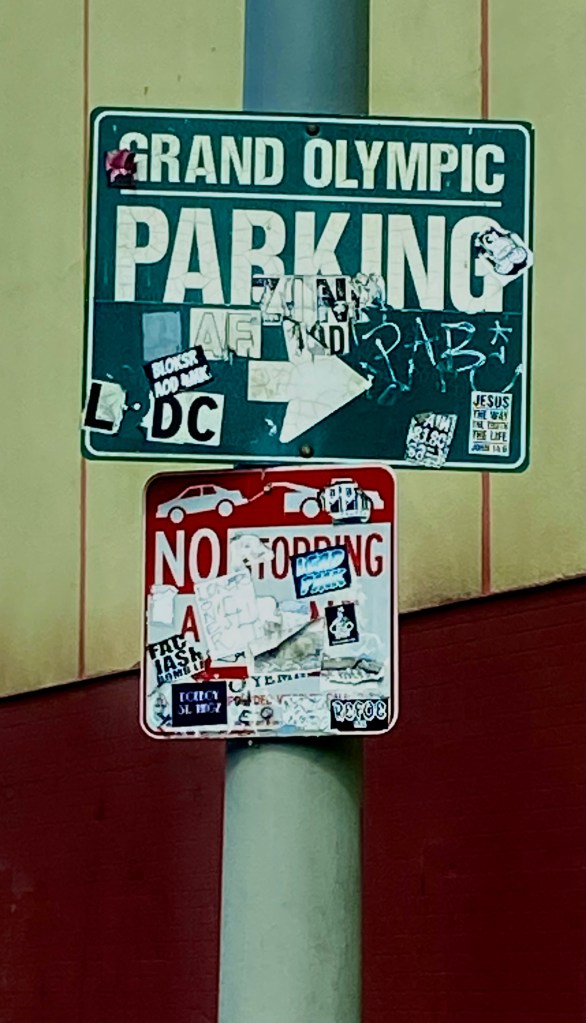
In one of grittiest parts of town, some signs try to show the old Olympic still exists. It really doesn’t. It’s a mirage.
The warehouse-like building that today houses a Korean church on weekends and homeless encampments the rest of the time, looking down at it while whizzing past it off the 10 Freeway likely doesn’t resonate for anyone under 40 years old, lest they attended one of the punk rock events trying to prove that it had an indestructible nature. A few more boxing cards took place during its short revival period of the early 2000s, but eventually, it kind of went into its own coma.
The lighting trellis that once hovered above the smoke-filled boxing and wrestling ring and commanded the Roller Derby matches of the L.A. Thunderbirds is now providing illumination over a church’s altar. That’s where we are at this point. It isn’t designated a state historic or cultural landmark – yet – so there’s a chance it could become a teardown upon the current landlord’s wishes, if he sees the property worth far more than the structure.
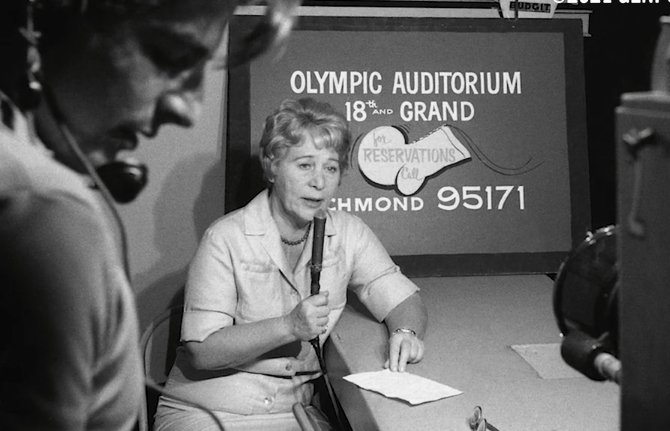
The film can re-energize a revival of what shape up up as a multi-platform, multi-media experience. It uses a home base with a magnificent website, and links to a collection of videos on its YouTube.com channel, all channeling a neat merchandise store. Thanks, and yes, we’ve already got the “RI.9-5171” T-shirt. It was one of two phone numbers we had memorized as a 4-year-old watching Roller Derby at our grandparents house on Manchester and Vermont (the other was their number: PL.1-8096). No area code necessary for those Richmond and Plaza rotary dial prefixes.
There is a strong social media presence on Twitter, Instagram, and and Facebook. If only Aileen Eaton had access to this stuff decades ago when she ran the place from near collapse at its original incarnation to its own house of worship until her passing in the late ’80s and was then inducted into the International Boxing Hall of Fame.
DeBro, the mastermind of this whole adventure through his GenPop Entertainment company, thought he had its first debut in March 2020, a premier set to go at the Cinerama Dome in Hollywood. COVID canceled it, with more than 600 tickets sold and sure to be a sellout, along with a live music event.
In the midst of pandemic recovery, it poked its head out at a drive-in – the closing event at the Slamdance Film Festival in February, 2021, at the City of Industry’s Vineland Drive-in. Last March, it made its indoor screening debut with a three-day run at Laemmle’s across L.A., with special appearances at the theatre’s Royal, Noho and Pasadena Playhouse locations. It has been part of the last March’s San Diego Latino Film Festival and the recent Bushwick Film Festival in Brooklyn, N.Y.
And now, this in the O.C.
In the future: The release of a Blue-Ray, a local TV airing, and the anticipation of an exhibit at La Plaza de Cultura y Artes on Main Street in downtown in L.A. near Union Station, set for the summer of 2023. There is expected to be a book project with this as well featuring the art of photographer Theo Ehret, who recorded 20 years of its history as the staff photographer.
His passing in 2012 — 10 years ago — reminds us that nearly a dozen people interviewed on screen for “18th And Grand” are also gone – Gene LeBell, Don Chargin, Rowdy Roddy Piper and Dick Enberg among them.
The presence of LeBell’s mother, Eaton, is a driving force not just in this documentary, but could have one done on her all to herself. At least this is there to capture what she did and how she did it. Without her, it’s likely there is no Olympic Audition, which almost collapsed under its own bankruptcy a couple years after its 1925 opening, staying around to host boxing and wrestling in the 1932 Summer Olympics in L.A.
It was supposed to be L.A.’s answer to New York’s Madison Square Garden. It instead tells the history of the city perhaps like no other venue still around – like the L.A. Coliseum or Pasadena Rose Bowl, each in their 100th anniversary mode.
In August 1925, the Olympic Auditorium, a state-of-the-art arena built to rival New York’s Madison Square Garden opened. The stars came out, from Jack Dempsey to Rudolph Valentino, a grand event for a city on the come. #18thandgrandpic.twitter.com/d9Hfra0pK6
Our vision of the Olympic, even in its present demoralizing form, is somewhat ethereal as it is surreal. The iconic mosaic of Jack Dempsey above the main entrance wasn’t just painted over, but sandblasted away forever. The place just keeps morphing away like a photograph of Marty McFly’s family in “Back To The Future.”
The Olympic’s history, with Dick Lane’s voice resonating in our heads, takes us back to a place thanks to this doc’s brilliance. It’s non-stop entertainment because of all the music DeBro, a former Atlantic Records exec, invested in its storytelling.
Just realize the Olympic Auditorium exists precariously these days, almost in perpetual purgatory. Perhaps like the Forum in Inglewood, it could get off the mat and make some sort of legitimate, reasonable comeback. Maybe even as a part of the 2028 Olympics back in L.A.?
It also could be bracing to be put it out of its misery like so many other L.A. historic sports venues.
Say it ain’t so, “Classy” Freddie Blassie.
If not now, then catch “18th & Grand” as soon as more opportunities arise. A Saturday meet up among friends in the O.C. is as a good as any place to reconnect. Prepare to cheer, and cheer up, again.
Urine may be discouraged, but if we saw a few coins tossed at the screen afterward, we’d probably smile.
Something to chew on the next time you lazily flip over to Al Michaels bemoaning why he didn’t take an early retirement and is instead stuck trying to quantify a Week 6 Bears-Commanders game on a Thursday night exclusively streaming on Amazon Prime:
Ordering stuff on Amazon isn’t a slippery slope. It’s a slip-n-slide that can confuse us into becoming an existential death spiral.
The sooner one upon another upon another recognizes this mucked-up reality, there is a greater chance we can try to turn this away from the iceberg and survival options don’t have to default to ordering more life preservers from some giant cloud that can be parachuted in for an extra handling fee.
With all the other things in the world we’ve been told to keep an eye on – climate change, the economy, personal freedoms – somehow Amazon.com is not a part of the solution.
Not at all a hyperbolic way.
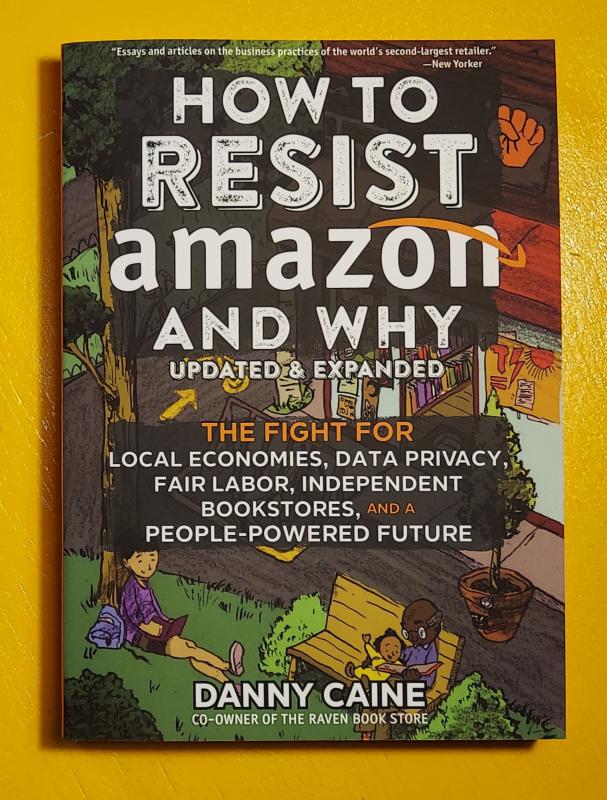
“How to Resist Amazon And Why: The Fight For Local Economies, Data Privacy, Fair Labor, Independent Bookstores and a People-Powered Future” by Danny Caine, the owner of the Raven Book Store in Lawrence, Kansas, is the most instructive take-away we can offer on this tale-of-the-boiling-frog subject.
The first pass was written and published (by Microcosm Publishing of Portland, Ore.) in 2019, well before Amazon got its claws on NFL live product for the 2022 season and beyond.
We find no irony in that Amazon.com offers a first-pass paperback for $3.95 new, $1.46 used. That’s a 20-page version. Ranks #312,137 in books, #316 in business ethics and #99 in retailing industry (books). It has three and a half stars out of 18 ratings.
Considering all there was to consider, the consensus No. 1 event in ’95 had only occurred seven years earlier. Was it too soon?
Enough time has passed for more context, more events taking place, more to consider.
It made as much sense then as it does 27 years later. Which is also our way of saying the list is overdue for a true Hollywood facelift.
These are headline-rich times for sports history in Los Angeles, officially founded as a city on Sept. 16, 1781. The Los Angeles Coliseum marks its 100th season of existence – its first event was USC’s 23-7 college football victory over Pomona on Oct. 6, 1923. The Pasadena Rose Bowl is about to mark the 100th anniversary of its first college football contest. USC’s 14-3 win over Penn State on New Year’s Day ’23 started it all.
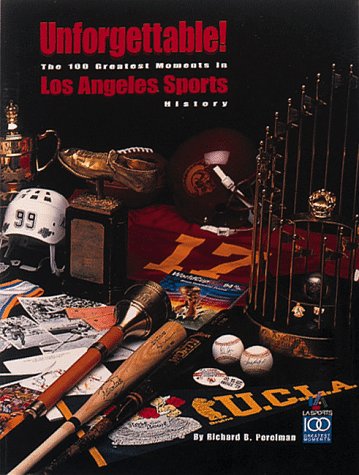
With all due respect to Perelman and his staff, we’re ready for a sequential sequel to quench our thirst.
But first, a refresher on how the Top 10 stood in ’95:
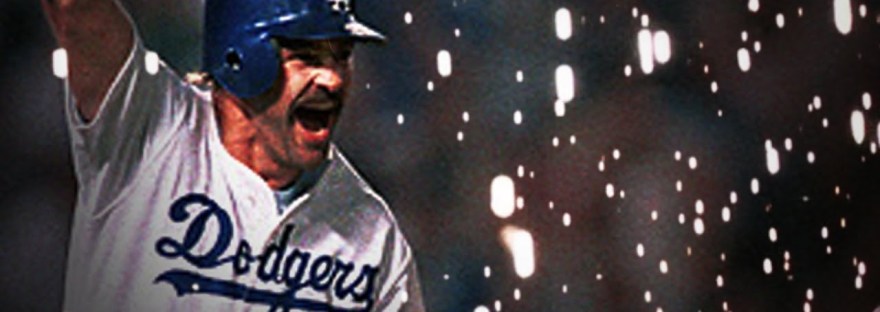
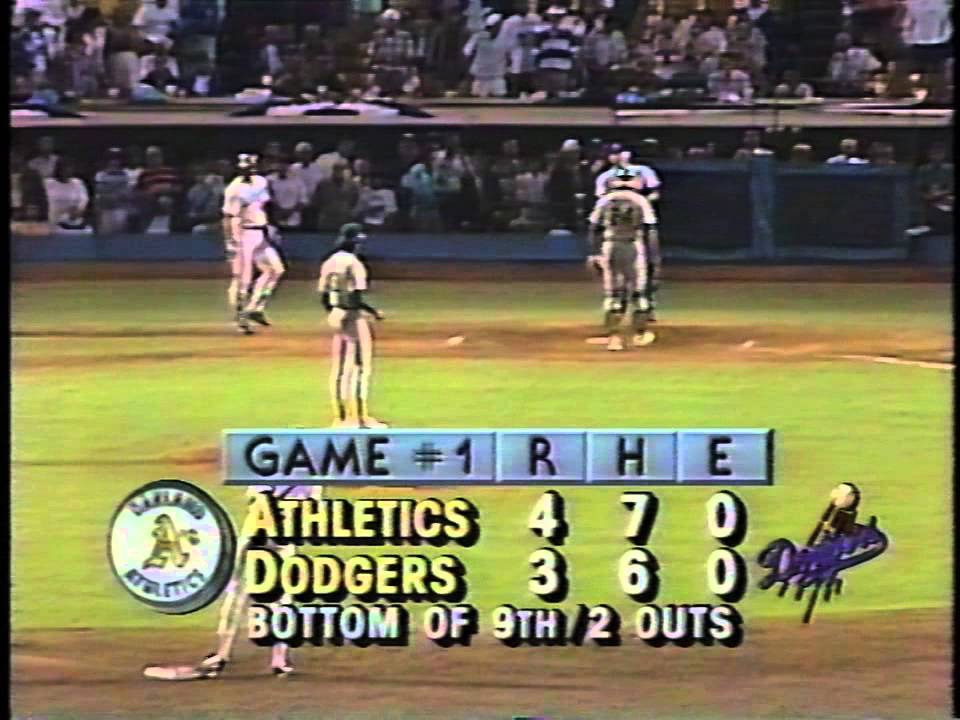
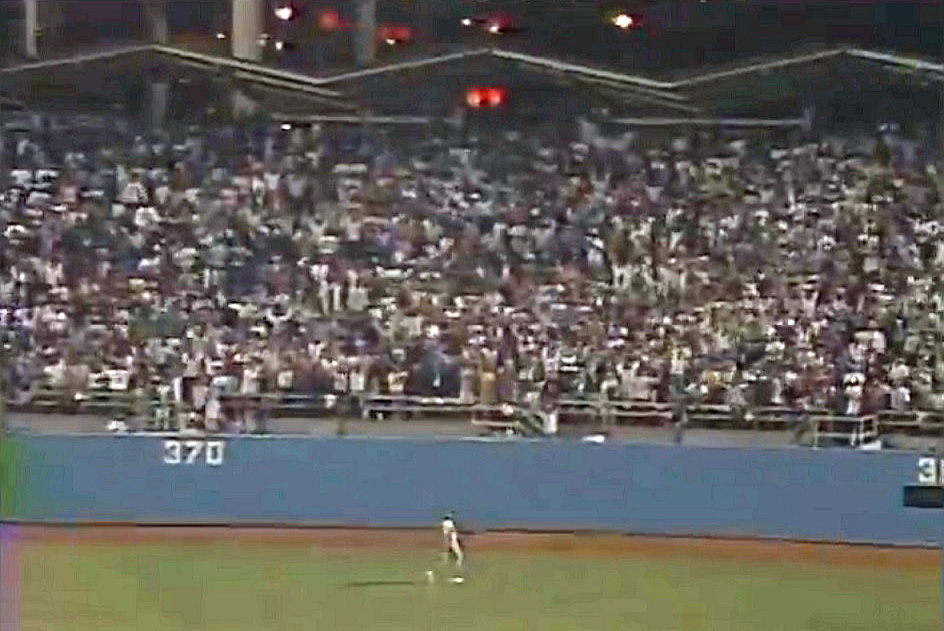
Oct. 15, 1988: “I don’t believe what I just saw!” said CBS radio announcer Jack Buck, likely heard live by no one in L.A. that night (with Vin Scully on the NBC telecast and Don Drysdale on the local radio broadcast). Writes Perelman in his “Unforgettable!” entry: “To this day, there are millions of baseball fans who agree with Jack Buck. They saw it and they still can’t believe it.”
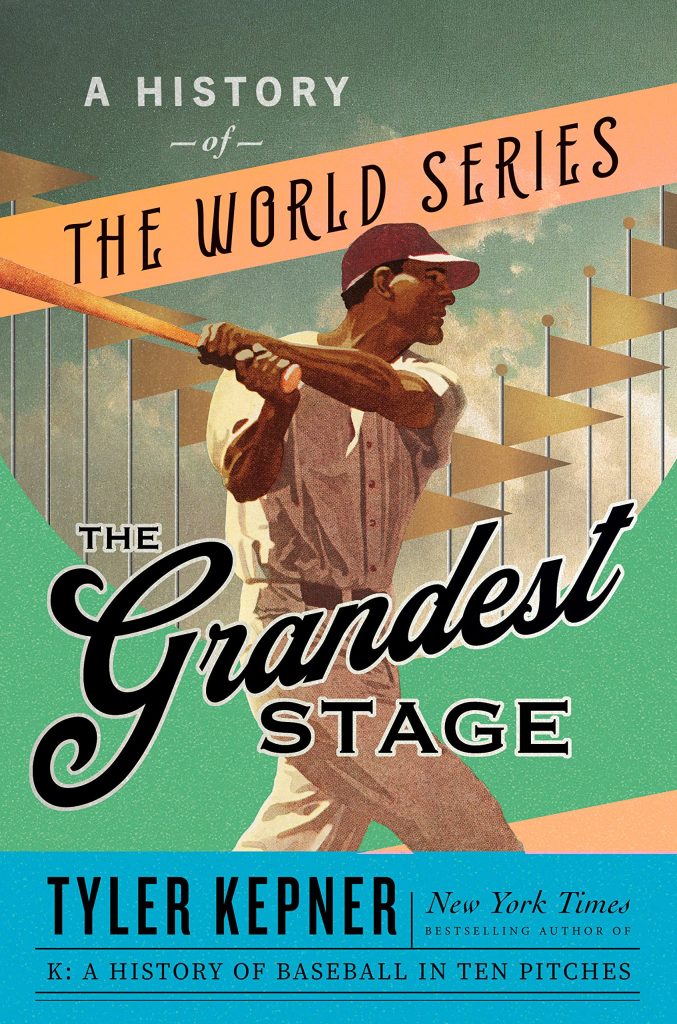
Interesting note No. 1: In the new Tyler Kepner book, “The Grandest Stage: A History of the World Series” (released Oct. 11, Doubleday, $30, 336 pages), the New York Times writer is enlightened enough (as confirmed in a Wall Street Journal review) that this moment only happens because the Dodgers’ Mike Davis (hitting .196) somehow draws a rare two-out walk from Dennis Eckersley to make Gibson’s shot a walk-off.
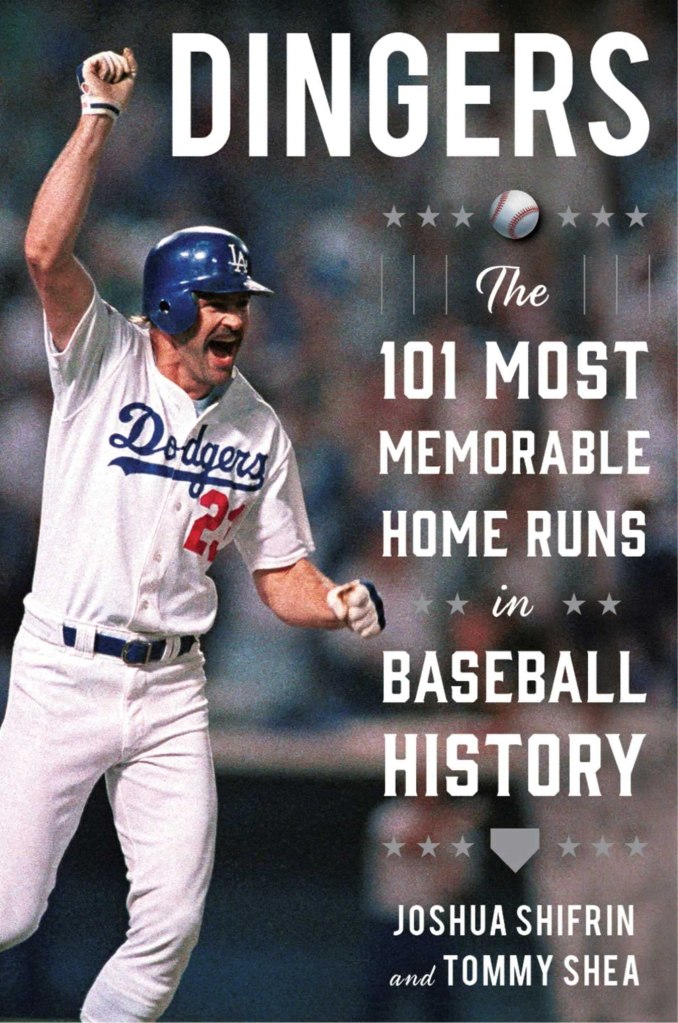
Interesting note No. 2: In the new Joshua Shifrin and Tommy Shea book, “Dingers: The 101 Most Memorable Home Runs in Baseball History” (released in 2016, but updated in May, 2022, Sports Publishing, $19.99, 332 pages), the image of Gibson on the cover is just a ruse. The authors’ top five homers of all time — 1. Bill Mazerowski’s Game 7 walk off for the Pittsburgh Pirates in the 1960 World Series over the Yankees; 2. Bobby Thomson’s “Shot Heard ‘Round The World” for the New York Giants in the playoff over the Brooklyn Dodgers in 1951; 3. Hank Aaron’s 715th homer in 1974 that pushed him past Babe Ruth in the all-time list; 4. Joe Carter’s 1993 walk-off homer to bring the Toronto Blue Jays the World Series in the bottom of the ninth of Game 6 as they were trailing the Philadelphia Phillies; 5. Gibson’s 1988 shot. Why not put Maz on the cover then? Also: The 2022 list Top 5 isn’t different from the 2016 Top 5.
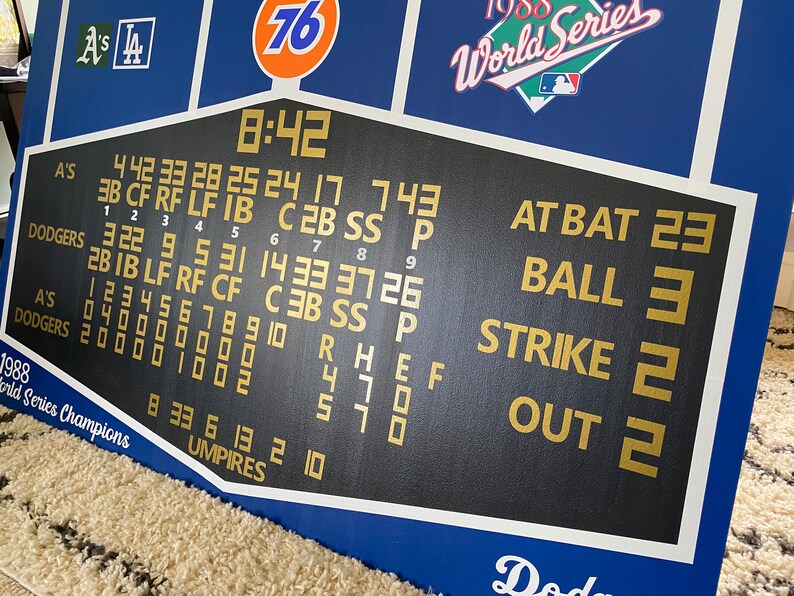
By the way: What time did the Gibson homer occur on Oct. 15, 1988?
This illustration, which we found on Etsy, it has a scoreboard recreation with 8:42 p.m.:
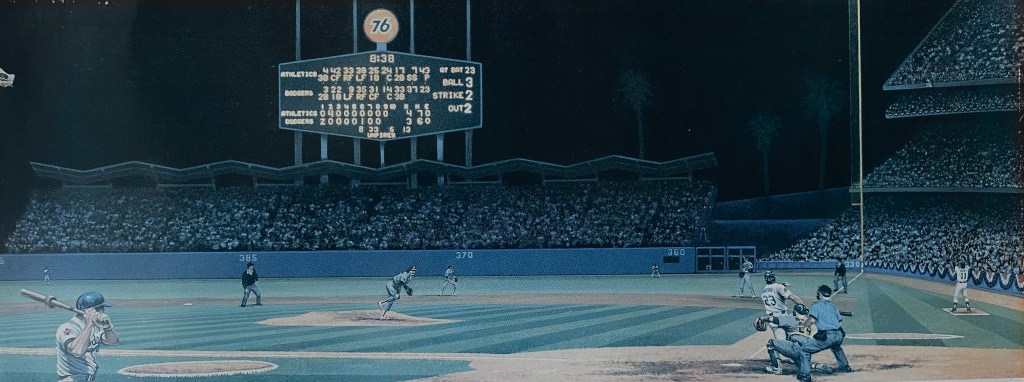
It might just be taking info on this by FineArtAmerica.com and Mark Yench. But zoom in on this lithograph called “Classic Chavez Clout” by Bill Purdom in 1992, which we have on a postcard purchased from the Good Sports Art Gallery, it shows four minutes earlier at 8:38 p.m.:
Both renditions have scoreboard mistakes. Above, it has the Dodgers’ lineup accurately has the No. 8 and No. 9 spots with “37” (Davis) and “23” (Gibson and a position under them blank, because both were pinch hitters. Davis wasn’t in the game at “SS” as the above graphic shows, nor was “26 P” – Alejandro Pena, pitcher – in the game any more at the moment it happened. But one has four umpires listed, and the other has six. The Goff art also has “35 RF” for the Dodgers hitting cleanup (they had no No. 35; it’s No. 5, Mike Marshall) and in the A’s lineup, it’s “38 LF,” a number that belonged to relief pitcher Dave Otto, instead of “28 LF” which was Stan Javier. So … if you’ve got the time for more research …
Like these guys:
Here's an unscoped video of the game on YouTube. If this telecast started at 5:00 PDT, which is what the listings in multiple papers suggest, the moment of contact was 8:38:46.https://t.co/ABHikMVAqg
July 28, 1984 — The 1984 Summer Olympic Games opening ceremony at the Coliseum. More than 92,000 in attendance — including President Reagan, Prince Charles and L.A. mayor Tom Bradley. Plus all those athletes marching in. Eighty four pianos playing “Rhapsody in Blue.” Card stunts. A guy in a jetpack flies to start it. Diana Ross sings to end it. Rafer Johnson lights the torch in between (and the Wikipedia entry notes: The ceremony was also the first time a person of African descent lit the Olympic cauldron). Thank you Peter Ueberroth, who recently had his plaque added to its Ring of Honor. Got six hours to watch the KABC-Channel 7 coverage?
Nov. 30, 1974 — USC 55, Notre Dame 24. The Trojans trailed at halftime, 24-6, and then scored 49 straight points in 17 minutes to defeat the Irish and go onto win the national championship. This will be the first paragraph of Anthony Davis’ obituary someday. (That, or the six-touchdown game he scored as a sophomore against Notre Dame in ’72 — which is No. 32 on this list — leading to a national title — which is No. 50 on the list?)
March 31, 1975— UCLA 92, Kentucky 85. In John Wooden’s final game as a coach, the Bruins win their 10th NCAA title in 12 seasons, at the San Diego Sports Arena. “The Wizard of Westwood” was done after 27 seasons, 766 games and 620 victories at age 65.
Nov. 18, 1967 — No. 4 USC 21, No. 1 UCLA 20. The Coliseum stage before 90,772 provided iconic moments for O.J. Simpson (a 64-yard cut-back TD run) and Gary Beban (16 of 24 passing for 301 yards) in what was to decide the city championship, the conference title, the Rose Bowl representative, the Heisman Trophy and a shot at a national title.
May 16, 1980 — Lakers 123, Philadelphia 107. Rookie Magic Johnson starts at center in the Game 6 NBA Finals win at Philadelphia and scores 42 points to go with 15 rebounds and seven assists in the absence of Kareem Abdul-Jabbar locks up the series MVP award.
Sept. 9, 1965 — Sandy Koufax’s fourth no-hitter. This one is perfect, 1-0, against the Chicago Cubs at Dodger Stadium. Vin Scully’s magical call of the Dodgers’ Cy Young Award winning performance seals the deal in the memory bank. But take a look at that other clip — pretty fantastic.
July 30, 1932 — The 1932 Summer Olympic Games opening ceremony at the Coliseum. In the depths of the depression, a $1 million profit is made as “Los Angeles Becomes the New Star in the Olympic Movement,” says this entry’s headline.
Jan. 22, 1984: L.A. Raiders 38, Washington 9. Your Los Angeles NFL team wins Super Bowl XVIII in Tampa, Fla. Marcus Allen’s 74-yard reverse-field touchdown run at the end of the third quarter gives carpetbagger Al Davis’ team a title, a first Lombardi Trophy in L.A. history. (The NFL does a great job of not letting anyone use its video. You can find a link here, or just watch this bootleg above).
April 18, 1958 — Dodgers 6, San Francisco Giants 5. The Dodgers play the first MLB game in L.A. with 78,672 on hand at the Coliseum, more than anyone who ever saw a big-league baseball game. (Someone named Juan Goglia posted this video on YouTube.com with the description: “My great uncle Isadore “Izzy” Perruccio attended the L.A. Dodger’s first game … The story goes: Izzy gradually snuck onto the field with his camera. Since not too many people, other than reporters, had video cameras back then, he went unsuspected long enough to get this amazing video, until, eventually, he was kindly asked to go back to his seat. You can see Willie Mays approach the camera, Jayne Mansfield, Edward G. Robinson … I hope you enjoy this historic footage.” We did.
The ’95 list was vetted by the L.A. Sports Council members, area sportswriters and sportscasters, plus more than 5,000 members of the Los Angeles Athletic Club. A special veterans committee was also formed to consider events long ago that might be forgotten.
To be considered for this list, Perelman writes that moments “had to have taken place in the greater Los Angeles area (Los Angeles, Orange, Ventura, Riverside and San Bernardino County) or had to involve a person or team from the area.”
Twenty seven years later, here are 27 more things we believe fit those guiderails for consideration, if not into the Top 10, at least the Top 100, as we list them by year:
They each come with interactive maps, which reminds us, in the list of must-have books, we miss not being able to engage in our most enjoyable page-turner — a new, updated Thomas Guide, which used to be No. 1 on the most-useful thing we could get for family members at Christmas time.
We’ve actually been screaming internally for the last couple of weeks to locate a nice place to have a quality moment of silence in this new post-pandemic existence. Our house of worship has been one of those locations, but we yearn to re-explore, look at cities and freeways and supermarkets and other stuff with a new appreciation. Even if it means picking forbidden fruit.
We might want to dive into that same media company’s current list of the 101 “best California experiences.” But when we noticed one of them was the Bob Baker Marionette Theater in Echo Park, we felt another twinge of anxiety. Puppets aren’t our thing. Too many strings attached.
These aren’t “to-do” lists. That’s a whole other activity. This is taking things that exist and, in essence, ranking their value in our own subjective way, then sharing to compare notes and see what others might have on their list.
In that 2020-22 COVID masked-up funk show, we lost control of our world. Our structure and routine was compromised. We got a lot more nutty. We had to re-evaluate.












 Tom Hoffarth's The Drill: More Farther Off the Wall