
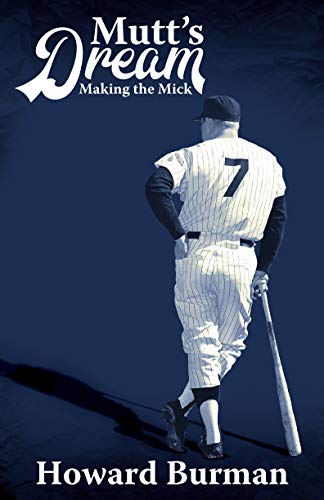
Mutt’s Dream: Making the Mick
The author:
Howard Burman
The publishing info:
Ascend Books
$22.95
320 pages
Released June 16, 2020
The links:
At the publisher’s website
At Amazon.com
At BarnesAndNoble.com
At Powells.com
At Indiebound.org
At the author’s website
The review in 90 feet or less
We had a dream the other night about Mickey Mantle.
It was more a flashback, to a trip that a friend of mine and I took a few years back. We did a start-to-finish, Chicago-to-L.A. trek on what is still left of Route 66. Not quite halfway through, after starting the day in Carthage, Mo., we hit the part of the journey that sliced through Kansas and dipped into Oklahoma. Not far into the Sooner State did we hit a bend and come upon the water tower of Commerce.
It’s the hometown of Mickey Mantle, aka The Commerce Comet.
His high school was just off the main road. A statue of him, right behind Mickey Mantle Baseball Field.
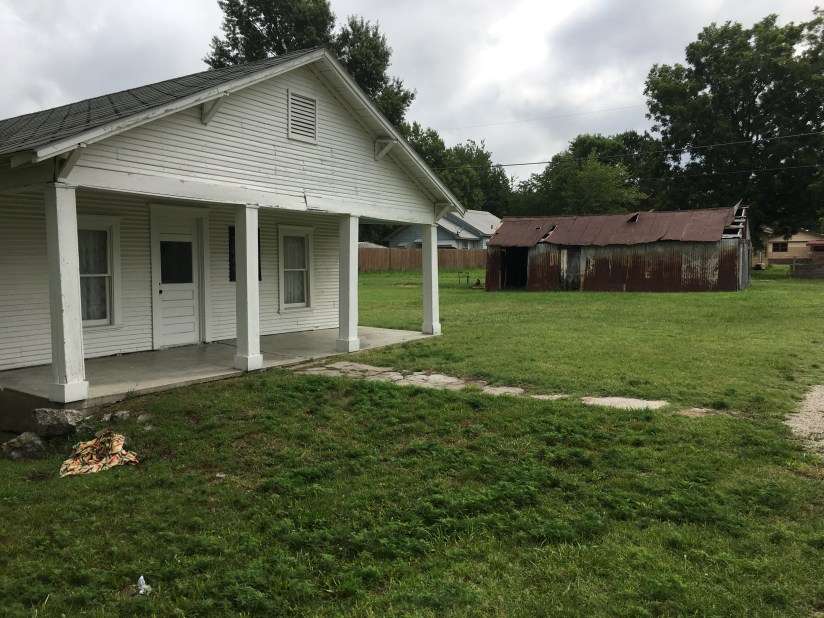
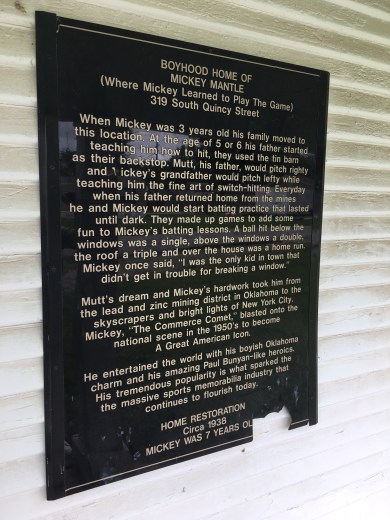
With a Google search, we went just a few blocks away to the home — a sign posted on the front of it looked no worse for wear and confirmed we hit pay dirt in this unexpected discovery.
It also confirmed the story of “Mutt’s dream.”
Across the yard was a tin-covered shed.
Anyone home? Didn’t seem so. A wasp’s nest was formed in one of the window sills.
After paying our respects, it was time to move on. But we felt the need to have a piece of this to take home with us. We found a small branch of a tree on the property. That was enough.
Our own Wonderboy.
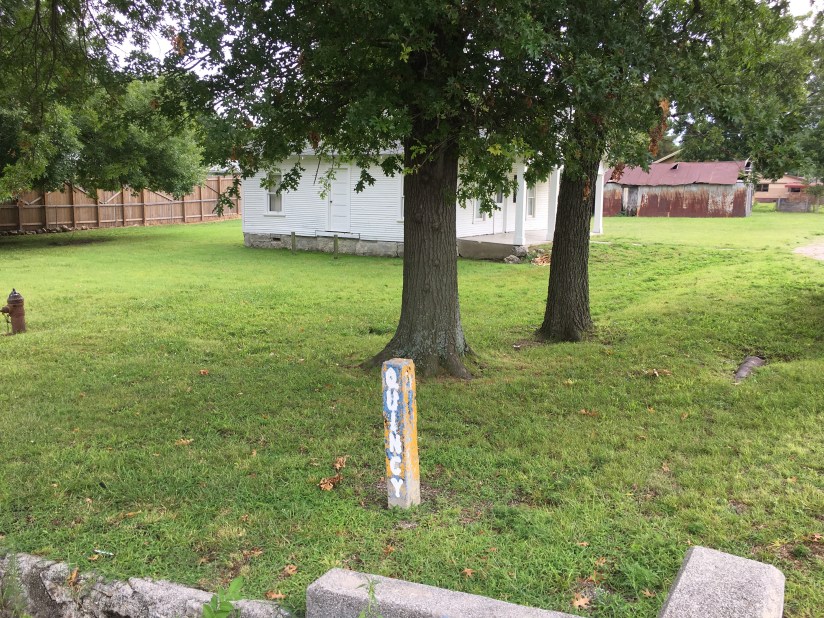
To have been on the property on a quiet summer day allows one to listen to the wind blow, the leaves rustle, the ghosts swirl. It provides something of a surreal context when we now come to an immersion of this book by Howard Burman.
 Burman notes in his acknowledgements that there are “quite a number of books about Mickey. Most concentrate on his Major League Baseball career. Some delve into his public life after he left the game. Not a great deal has been written about the years before he became a professional. There are snippets here and there in various books, including some written (or ghosted) by Mickey himself, including “The Education of A Baseball Player: The Mickey Mantle Story,” as told to Ben Epstein (in 1967, a year before Mantle’s retirement), and “Mickey Mantle: The American Dream Comes to Life,” co-authored by Lewis Early (in 1996, shortly after Mantle’s death at 63). John G. Hall’s “Mickey Mantle Before the Glory” was a valuable resource for this book.”
All those may provide a foundation here for Burman, a Brooklyn native who eventually would get into theater production and chair the department at Cal State University Long Beach. But the sincere beauty of how this book is constructed as a theatrical production feels so real that Burman also has to clarify in here that the dialogue is “word-for-word accurate as recorded” in most parts, and other parts “invented but it is always consistent with the reality of the situation.”
That adds a deeper humanity far richer than simply reproducing facts and newspaper accounts that and gives clarity to more than just a “based on a true story” attempt.
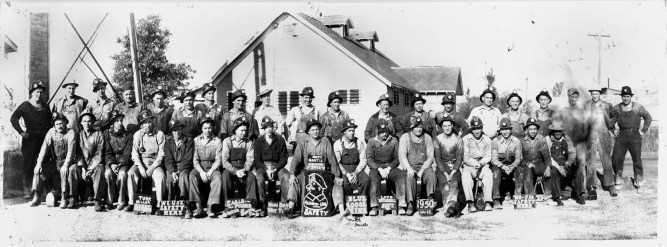
In the first two chapters, Burman establishes the life and struggles of Elven “Mutt” Mantle in the dustbowl of Oklahoma, at the dawn of The Great Depression. A fan of the somewhat nearby St. Louis Cardinals that he can reach through radio broadcasts, Mutt is a bigger fan of Philadelphia Athletics’ hard-nosed catcher Mickey Cochran.
The 18-year-old Mutt is courting Lovell, eight years older than him and the sister of a girl he’d been dating. She’s also divorced and with two kids.
“She is a hellcat; he is invariably polite,” writes Burman. Continue reading “Extra inning baseball book reviews for 2020: If those walls could talk at Mickey Mantle’s home in Commerce, Okla.”

 It’s still odd to us that the stadium, which continues to have its magnetic view of The Gateway Arch along the banks of the Mississippi River, is also just a block or so away from the Old Courthouse where Dred and Harriet Scott’s battle for their freedom from slavery started in the 1840s and became a large part of why we even got to a Civil War.

 Tom Hoffarth's The Drill: More Farther Off the Wall