
Blog

No. 22: Ila Borders

This post is part of a media project called SoCal Sports History 101: The Prime Numbers from 00 to 99 that Uniformly, Uniquely and Unapologetically Reveal The Narrative of Our Region’s Athletic Heritage. Pick a number, and consider the list of athletes attached to it. Who wore it best? Or, what’s the most compelling story linked to it? Any person, place or thing is in play with Southern California connections. Star power, transformational achievement, longevity, notoriety and quirkiness all factor in. Whatever leads to a lively discussion and interpretation.

The most obvious choices for No. 22:

Clayton Kershaw, Los Angeles Dodgers
Elgin Baylor, Los Angeles Lakers
Hugh McElhenny: L.A. Washington High football; Compton College football
Lynn Swann, USC football
Mike Haynes, Los Angeles Raiders

The not-so-obvious choices for No. 22:
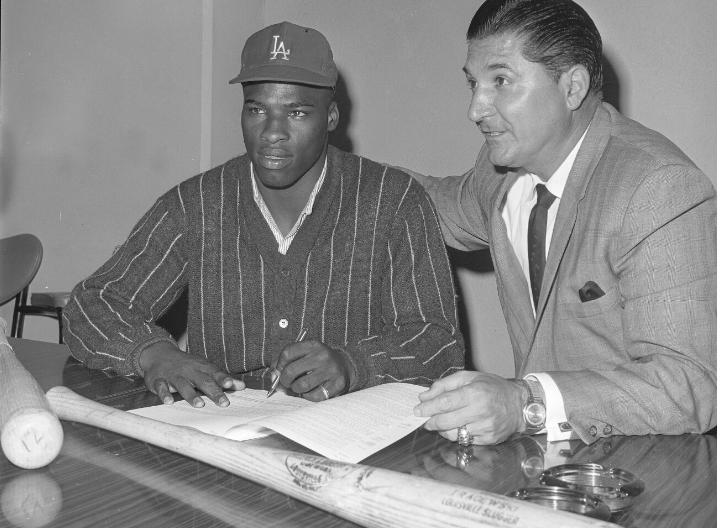
Bo Jackson
, California Angels
Brett Butler, Los Angeles Dodgers
Bill Buckner, Los Angeles Dodgers
Dick Bass, Los Angeles Rams
Raymond Lewis, Verbum Dei High basketball
Raymond Townsend: UCLA basketball

The most interesting story for No. 22:
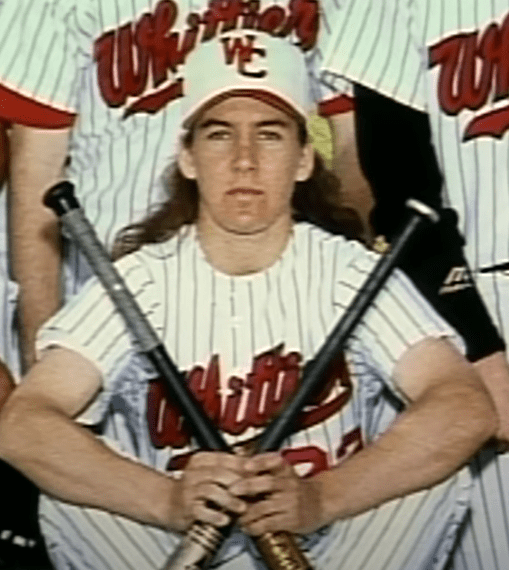
Ila Borders, Whittier Christian High baseball pitcher (1989 to 1993), Southern California College (1994 to 1996), Whittier College (1997)
Southern California map pinpoints:
Downey, La Mirada, La Habra, Bellflower,  Costa Mesa, Whittier, Santa Ana, Long Beach

Reference books on the subject:
“Making My Pitch: A Woman’s Baseball Odyssey,” by Ila Borders, 2017
Post-Cooperstown Post Modernism: The Baseball Reliquary and the Future of Nostalgia,” by Don Malcolm, as published in The National Pastime: Endless Seasons: Baseball in Southern California, 2011


A camera crew from CBS’ “60 Minutes” chased down Ila Borders. She was bordering on a panic attack.

The 23-year-old had become national news of sorts in 1998. She was about to become the first female pitcher to start a game in a men’s professional baseball league, thanks to the Duluth-Superior Dukes of the independent Northern League.

Her instincts were to push back on anything that could distract from her mental preparation. In the prologue of her 2017 book, “Making My Pitch: A Woman’s Baseball Odyssey,” Borders explained why she retreated to the women’s restroom at the ballpark, jumped into a stall and put her feet up so no one could detect she was there.

“I’m an athlete here to win,” she wrote. “Now get the hell out of my face. Would you tell a guy to smile? … I’ve been fighting for this since I was ten years old.”

By the time Mike Wallace sat down with Borders, along with her family, friends, managers and teammates to tell her story, Borders added some background.

“I’ve always had this fierce spirit to do what I want to do,” she said.

It went farther back to the time she wore No. 22 for Whittier Christian High School in La Habra.

Which was right about when the movie “A League Of Their Own” had come out.

At last, there was evidence that women could play pro baseball.

Borders wanted in.

Continue reading “No. 22: Ila Borders”

No. 61: Jake Olson

This post is part of a media project called SoCal Sports History 101: The Prime Numbers from 00 to 99 that Uniformly, Uniquely and Unapologetically Reveal The Narrative of Our Region’s Athletic Heritage. Pick a number, and consider the list of athletes attached to it. Who wore it best? Or, what’s the most compelling story linked to it? Any person, place or thing is in play with Southern California connections. Star power, transformational achievement, longevity, notoriety and quirkiness all factor in. Whatever leads to a lively discussion and interpretation.

The most obvious choices for No. 61:

Chan Ho Park, Los Angeles Dodgers
Rich Saul, Los Angeles Rams

The not-so-obvious choice for No. 61:

Josh Beckett, Los Angeles Dodgers
Bill Fisk, USC football

The most interesting story for No. 61:
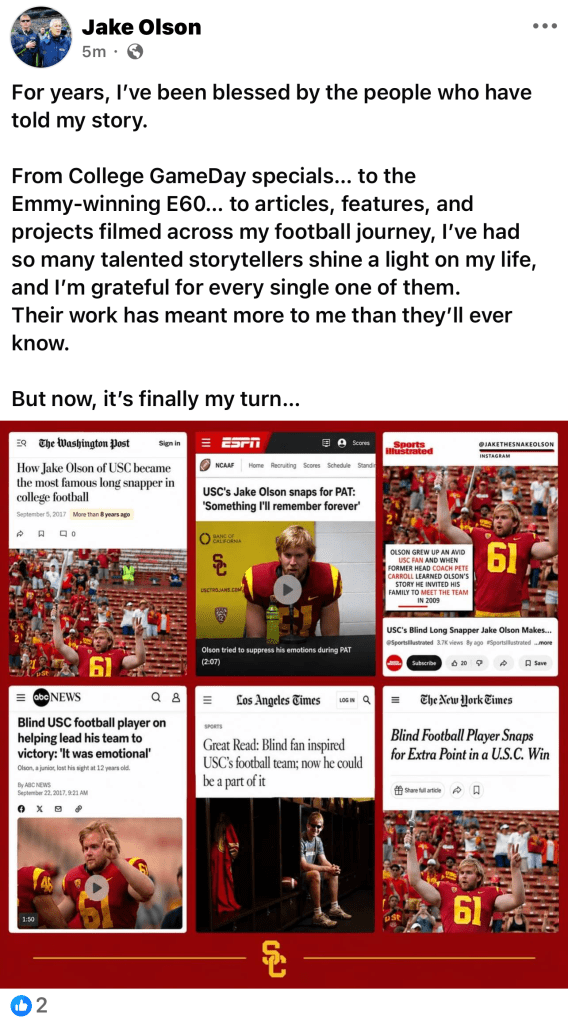
Jake Olson, USC football long snapper (2015 to 2018)
Southern California map pinpoints:
Huntington Beach,  Orange, L.A. Coliseum

Reference books on the subject:
The Faith that Fights On,” by Jake Olsen, 2026
Open Your Eyes: 10 Uncommon Lessons to Discover a Happier Life,” by Jake Olsen, 2014


Long before he ran onto the Los Angeles Coliseum turf with a huge smile on his face for the first time wearing a USC football jersey, given the duty as the point person in executing an extra point, Jake Olson had already made his point.

The Trojans’ 2017 Labor Day weekend season opener against visiting Western Michigan was tied 21-21 after three quarters and the local almns were concerned that things were about to go sideways. Marvell Tell returned an interception 37 yards for a USC touchdown with 3:13 left in the game, so finally, the fourth-ranked Trojans had some breathing room, up 17 points.

Amidst the spectators collective sighs of relief, most didn’t notice that the 20-year-old Olson was taking practice snaps on the sidelines.

The 6-foot-3, 225-pound redshirt sophomore took a deep breath when USC head coach Clay Helton turned to the sideline and yelled his name: “Are you ready? Let’s get this done!”

Olson launched one more football between his legs with a rhythm and rote that had been pure and natural by this point. He put his right hand on the shoulder of teammate Wyatt Schmidt, and the two ran together more than 50 yards across the grass to where the line of scrimmage was at the peristyle end for the touchdown. This would be the game’s punctuation mark.

The referee gave special instructions to both sides, then blew the whistle. Olson made the snap, the ball was placed by Schmidt, and the kick by freshman Chase McGrath was good. USC won 49-31.

“What a pressure player,” Helton said after the game. “Was that not a perfect snap?”

“It turned out to be a beautiful moment,” Olson said.

Former USC head coach Pete Carroll was watching on TV. He called Olson afterward and screamed: “Hey Jakey! I’m so proud of you. I love you.”

If anyone by this point could see all that was special in what had just happened, it was Olson.

Continue reading “No. 61: Jake Olson”

No. 48: Milt Smith

This post is part of a media project called SoCal Sports History 101: The Prime Numbers from 00 to 99 that Uniformly, Uniquely and Unapologetically Reveal The Narrative of Our Region’s Athletic Heritage. Pick a number, and consider the list of athletes attached to it. Who wore it best? Or, what’s the most compelling story linked to it? Any person, place or thing is in play with Southern California connections. Star power, transformational achievement, longevity, notoriety and quirkiness all factor in. Whatever leads to a lively discussion and interpretation.

The most obvious choices for No. 48:

Les Richter, Los Angeles Rams
Ramon Martinez, Los Angeles Dodgers pitcher
Dave Stewart, Los Angeles Dodgers pitcher
Torii Hunter, Anaheim Angels outfielder

The not-so-obvious choices for No. 48:

Lionel Washington, Los Angeles Raiders

The most interesting story for No. 48:
Milt Smith, UCLA football left end (1939 to 1943) via Santa Ana High
Southern California map pinpoints:
Redlands, Santa Ana, Westwood


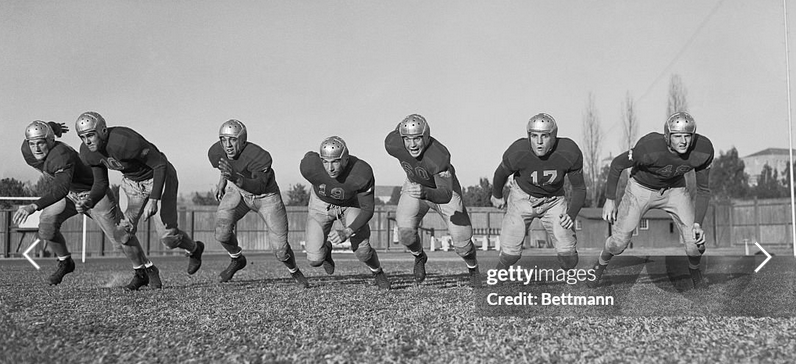
Milt Smith, a 6-foot-3, 190 pound end, far right, is included in photo prior to UCLA’s 1943 New Year’s Day Rose Bowl appearance against Georgia as part of the Bruins’ first string linemen. Also included, from left: Burr Baldwin, Charles Fears, Al Sparlis, Jack Lecoulie, Bill Armstrong and Jack Finlay.

Watch what happens here, and tell us if we’re taking up too much time.

You’ve heard of the 1939 UCLA undefeated football team full of soon-to-be legendary figures?

Milton Bradley “Snuffy” Smith wasn’t one of them.

His name, after all, was Smith.

When the Redlands-born kid from Santa Ana High joined the Bruins roster as a freshman, the offense was already generated by the talents of Jackie Robinson, Kenny Washington and Woody Strode. The Gold Dust Trio.

As Strode moved on after the season to start a film career and try some local semi-pro football, the sophomore Smith was named as his replacement at left end by coach Babe Horrell. But Smith’s season ended with a broken leg in the third quarter of a game in the next-to-last game against Washington — the team’ s only win that season. Smith was still selected second team on the Associated Press and All-Pacific Coast Conference teams.

In 1941, with Bob Waterfield coming in as the new UCLA quarterback, Smith was one of his favorite receivers. He ended up as an honorable mention for the All-PCC team.

Continue reading “No. 48: Milt Smith”

No. 5: Hunter Greene

This post is part of a media project called SoCal Sports History 101: The Prime Numbers from 00 to 99 that Uniformly, Uniquely and Unapologetically Reveal The Narrative of Our Region’s Athletic Heritage. Pick a number, and consider the list of athletes attached to it. Who wore it best? Or, what’s the most compelling story linked to it? Any person, place or thing is in play with Southern California connections. Star power, transformational achievement, longevity, notoriety and quirkiness all factor in. Whatever leads to a lively discussion and interpretation.

The most obvious choices for No. 5:

Reggie Bush: USC football
Albert Pujols: Los Angeles Angels
Robert Horry: Los Angeles Lakers
Freddie Freeman: Los Angeles Dodgers
Kenny Easley: UCLA football
Baron Davis: UCLA basketball, Los Angeles Clippers

The not-so-obvious choices for No. 5:

Brian Downing: California Angels
Dieter Brock: Los Angeles Rams
Misty May Treanor: Long Beach State women’s volleyball
Ali Riley: Angel City FC
Corey Seager: Los Angeles Dodgers
Normar Garciaparra: Los Angeles Dodgers
Jayden Daniels: Cajon High of San Bernardino football quarterback

The most interesting story for No. 5:
Hunter Greene: Notre Dame High of Sherman Oaks baseball (2014 to 2017)
Southern California map pinpoints:
Sherman Oaks, Stevenson Ranch, Compton, Woodland Hills


Hunter Green is swatch No. 19-5511 TCX on the Patone color spectrum. It is described as a cool-tone, earthy, woodland shade that “can evoke feelings of peace and balance, and can also embody growth and new beginnings.”

Hunter Greene — add the “e” on the end of his baseball card with the embedded uniform swatch — wore No. 5 as the Notre Dame High of Sherman Oaks’ pitcher/shortstop/attention grabber when he arrived on the varsity baseball team as a freshman. That was pretty cool unto itself.

Greene’s own inner peace and balance came amidst deciding how to manage being a two-way star. He wasn’t throwing shade. By the time Greene reached the end of his senior season, many saw him as Major League Baseball’s next big deal.

In numerology, No. 5 is said to represent flexibility and resilience. It represents the pentagram. It is supposed to bring luck for those intelligent, adventurous and have good communication skills.

Exhibit A: Hunter Greene.

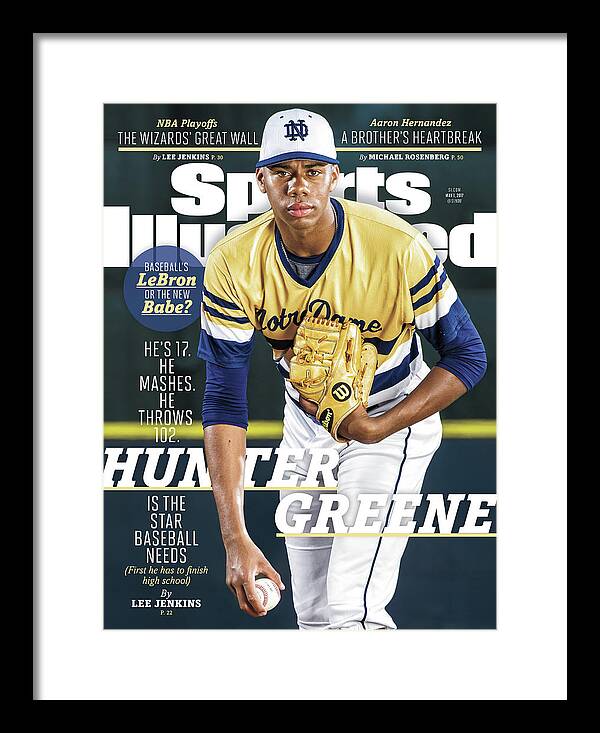
Sports Illustrated still carried cultural relevance and media clout when it presented Hunter Greene to the world on the cover of its April 24, 2017 issue. A few months heading into the Major League Baseball draft, it proclaimed: “Baseball’s LeBron or the new Babe? He’s 17. He mashes. He throws 102. Hunter Greene is the star baseball needs (First he has to finish high school).”

It was suitable for framing. SI had put high school athletes on the cover before — less than a dozen — but Greene was the first California high school athlete honored. Also, the first African-American prep baseball player.

Naturally, he made the June cover of Sports Illustrated for Kids as “Next Up: Meet 17-year-old Hunter Greene, the slugging, flame-throwing, violin-playing painter who is on deck to become baseball’s biggest superstar.”

If anyone could handle that kind of attention, count on Green, who grew up 20 miles north of the Sherman Oaks campus up in Stevenson Ranch near Santa Clarita. A three-time All-CIF player had more than just nice athletic potential upside.

“People are going to look at him expecting things and he’s still just a kid,” his father, Russell Greene said. “He has to rise to that occasion and he will.”

Hunter Greene, in the Los Angeles Daily News, as he was named SoCal Prep Athlete of the Week in April of 2017 after  throwing a three-hitter with seven seven strike outs in a 2-1 complete-game seven-inning win over Harvard Westlake, using just 81 pitches.

Eric Sondheimer of the Los Angeles Times whetted the sports fans’ appetite prior to SI with his own profile of Greene a couple months earlier, just as the 2017 baseball season started. A headline in the paper called him “a teenage star in the making.”

“At 6 feet 4 and 211 pounds, with a still-maturing body and a powerful right arm that could lead to a $9-million signing bonus, Greene … scored 31 on the ACT and is on a first-name basis with many in Major League Baseball’s hierarchy, from the commissioner, Rob Manfred, to Hall of Famers Joe Torre and Tommy Lasorda. This smart, humble, communicative teen could be an ideal role model to perform on baseball’s highest stage.”

He was throwing 100-mph-plus fastballs in the recent winter league games. He was also a fascinating fielding shortstop whose “power is only getting better since his 5-foot-10 freshman days when he batted just .122 on varsity. He has since hit .419 and .390 in the last two seasons. His improvement has been both consistent and dramatic.”

Greene had the green light to do big things.

Continue reading “No. 5: Hunter Greene”

No. 43: Troy Polamalu

This post is part of a media project called SoCal Sports History 101: The Prime Numbers from 00 to 99 that Uniformly, Uniquely and Unapologetically Reveal The Narrative of Our Region’s Athletic Heritage. Pick a number, and consider the list of athletes attached to it. Who wore it best? Or, what’s the most compelling story linked to it? Any person, place or thing is in play with Southern California connections. Star power, transformational achievement, longevity, notoriety and quirkiness all factor in. Whatever leads to a lively discussion and interpretation.

The most obvious choices for No. 43:

Troy Polamalu, USC football
Raul Mondesi, Los Angeles Dodgers
Mychal Thompson, Los Angeles Lakers

The not-so-obvious choices for No. 43:

Ralph Kiner: Alhambra High, Pasadena City College, USC
Megan Grant, UCLA softball
Greg Lee, UCLA basketball
Rick Sutcliffe, Los Angeles Dodgers
Dave Ball, UCLA football
George Brunet, California Angels

The most interesting story for No. 43:
Troy Polamalu, USC football safety (1999 to 2002)
Southern California map pinpoints:
Garden Grove, Santa Ana, L.A. Coliseum

Reference books on the subject:
Polamalu: The Inspirational Story of Pittsburgh Steelers Strong Safety Troy Polamalu,” by Jim Wexel, 2023


From the start, the best chance Troy Polamalu had for survival when he was a kid was to move out of Southern California. His mother agreed. When he was 9 years old, with an incredible amount of self awareness, Troy left Santa Ana and went to live in Oregon. His Uncle Salu Polamalu would be a major influence on him.

Eventually, the next best chance Troy Polamalu had for self fulfillment as an talented athlete driven by passion and street smarts when he was a teenager was was to move back to Southern California. His family agreed. His Uncle Keneti Polamalu, better known during his USC football days as a running back named Kennedy Pola, became a major influence on him after he graduated from high school in Oregon and found a spot on the Trojans’ football roster.

Soon enough, Polamalu stood head and shoulders above his Trojan teammates. Aside from his signature head of hair.

Acrobatic and dynamic, it would be Polamalu’s soulful calmness, integrity and dedication to family and spirituality that made him the latest, greatest link in a line of influential and admired Polynesian/American Samoan players in the region’s storied history history.

Continue reading “No. 43: Troy Polamalu”