
This is the latest post for an ongoing media project — SoCal Sports History 101: The Prime Numbers from 00 to 99 that Uniformly, Uniquely and Unapologetically Reveal The Narrative of Our Region’s Athletic Heritage. Pick a number and highlight an athlete — person, place or thing — most obviously connected to it by fame and fortune, someone who isn’t so obvious, and then take a deeper dive into the most interesting story tied to it. It’s a combination of star power, achievement, longevity, notoriety, and, above all, what makes that athlete so Southern California. Quirkiness and notoriety factor in. And it should open itself to more discussion and debate — which is what sports is best at doing.
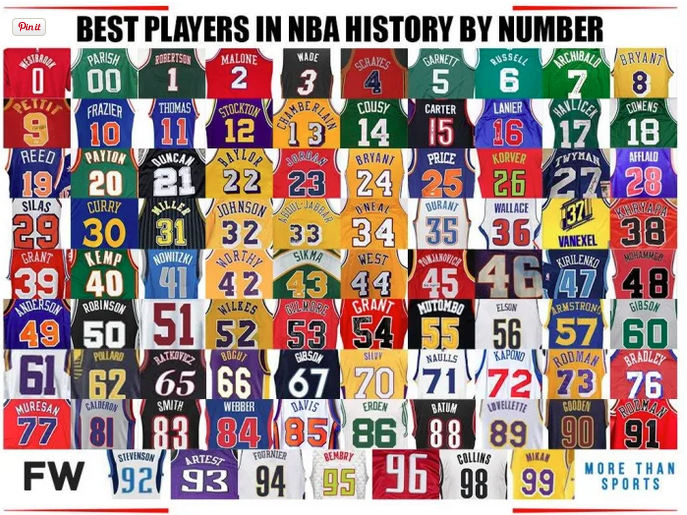
A quirky little exercise 2019 attempts to identify the greatest NBA players who wore each digit from 0 to 00 to 99.
Kobe Bryant has both No. 8 and No. 24. Dennis Rodman has claim to both No. 73 (with the Lakers) and No. 91 (with Chicago) because, let’s face it, who else wore them? And the NBA won’t allow No. 69 to be given to anyone.
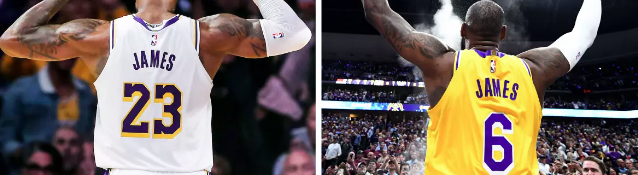
Mostly note that LeBron James received neither No. 6 (it went to Bill Russell) nor No. 23 (it went to Michael Jordan). If only James had picked a more obscure number — like No. 40, the age he reached on Dec. 30, 2024, in the middle of his 22nd NBA season.
Call him King James, LBJ, Chosen One, Bron-Bron, The Little Emperor, The Akron Hammer, L-Train, Benjamin Buckets or Captain LeMerica. The 21-time All Star, 21-time All NBA, four-time regular season MVP, four-time NBA champion (on three different teams), four-time NBA Finals MVP (on three different teams), three-time All-Star Game MVP, four-time scoring champ, six-time All Defensive team, a member of the 75th NBA Anniversary team and — the icing on the cake, the ’23-’24 In-Season Tournament MVP — has some dashing numbers to consider over the breadth and depth of his pro career.
That career, by the way, makes him a professional for a longer period of time than the first 18 years when he wasn’t.
He has been officially listed as a 6-foot-9 and 250-pounds small forward, power forward, point guard, shooting guard and center on his career stats resume.
He is the only NBA player with more than 40,000 regular season points, more than 1,700 games consecutively in which he has scored a point (every game he’s ever played), more than 67,000 minutes logged.
His best scoring performance: 61 in 2014 for Cleveland (which scored 124 in an OT win). His Laker best point-production: 56 in 2022 at age 37.
Most rebounds in a game: 20 in 2024 at age 39 for the Lakers in an epic 2OT win at Golden State.
Most assists in a game: 19 in 2020 at age 35 for the Lakers.
He is the only NBA player with more than 30,000 points, 10,000 rebounds and 10,000 assists in the regular season.
He has played in 292 consecutive playoff games, never without an absence, and his team has won 41 of the 55 series he’s played in.
But really, what do numbers mean when sizing him up?
He’s not even sure.
Consider when James arrived in Los Angeles as a free agent starting with the 2018-19 season, after his second run with his hometown Cleveland Cavaliers, he continued wearing the No. 23 as a Laker.
For the 2019-20 season, James convinced his friend, Anthony Davis, to leave New Orleans and join him with the Lakers – with a promise he would shed No. 23 and give it to Davis, who had those digits since his rookie season in 2013, and even wore in is one year at Kentucky, as a tribute to his favorite player — James.
(The story goes: Davis, who grew up in Chicago, won a Black History Month trivia contest at Perspective Charter High School and with it came a $10 gift card. He used it to buy a book about LeBron James, the Cleveland Cavs player who wore No. 23, and inspired him to do the same. So Davis wasn’t wearing No. 23 for Michael Jordan).
James decided that giving up No. 23 to Davis meant he could slip back into No. 6, which he wore with the Miami Heat from 2011 to 2014 and helped them win a title. But the NBA wasn’t happy with that. Nike had a large supply of No. 23 James jerseys that would have become obsolete to buyers if that switch occurred. They said James and Davis did not give them enough notice before the season, so the league forced James to stick with No. 23. Davis, in response, chose No. 3. The idea stalled.
For the 2022-23 season, James did back shift to No. 6. But Davis stuck with No. 3. To confuse it even more, when Bill Russell died and the NBA honored him with having everyone wear a black circle “6” patch on their jersey, James was wearing No. 6 in two spots on the same jersey.
If that wasn’t waffling enough, James announced for the 2023-24 season, he would go back to No. 23, leaving No. 6 in deference to Russell.
For now.
What do the numbers 23 and/or 6 even mean to him?
When he passed Michael Jordan on the NBA list of most games with 30 or more points, James said he wore No. 23 because of Jordan. That started with James’ high school days at St. Vincent-St. Mary High in Cleveland from 1999-2000 to 2002-03 (although he wore No. 32 as a freshman before changing). The 32 carried over the first seven seasons with the Cleveland Cavaliers. During that stretch (2003-04 to 2009-10), his choices for the U.S. team in the Summer Olympics were No. 9 in 2004 (the 19 year old yielded to Dwayne Wade for No. 6) and then No. 6 in 2008 (James switched numbers with Wade). Joining Wade in Miami, James picked No. 6 again from 2011 to 2014, and also kept No. 6 on Team USA in 2012. Going back to Cleveland in from 2015 to 2018 got him back with No. 23. Then came the flip flopping of 23 and 6 in Los Angeles.
In 2023 he said the No. 6 reflects the birthday of his son Bronny (the 6th of October) as well as the birth month of his son Bryce (born in June). James has also pointed out to those mathematically challenged that two-times-three equals six.
There’s also the case, James said, where another one of his favorite players, Julius Erving, has worn Nos. 32 and 6 in his career in the ABA and then to the NBA.
Why do we now feel so much dumber?
Continue reading “Nos. 6 and No. 23: Why LeBron James will likely never be linked to either number in SoCal sports history”








 Tom Hoffarth's The Drill: More Farther Off the Wall